The Roman Catholic Catechism names the trinity as the central mystery of the Christian faith. The Athanasian Creed binds salvation itself to its confession: *whosoever will be saved, before all things it is necessary that he hold the Catholic Faith — and the Catholic Faith is this, that we worship one God in Trinity, and Trinity in Unity*. The doctrine is therefore not presented as an optional speculation. It is presented as the architecture on which the rest of the Roman system rests.
Yet for a doctrine so central, the question that ought to be answered first is the simplest one. Where did the architecture come from?
There are two possible answers, and only two. Either the apostles received the doctrine from Christ, and the post-apostolic church preserved it in the language available to it — in which case the Hebrew Scriptures and the New Testament will display the doctrine in plain terms. Or the doctrine entered the church from a different source, was given biblical names, and was retroactively read back into the texts that had to be reinterpreted to accommodate it. The question is historical, and history is available. What follows is the audit.
Mystery, Babylon the Great
The book of Revelation contains a portrait of an apostate religious system drawn for the last generation of readers to recognize. She sits on many waters; she is drunk with the blood of the saints; and the name written across her forehead in John’s vision is two words long.
“And upon her forehead was a name written, MYSTERY, BABYLON THE GREAT, THE MOTHER OF HARLOTS AND ABOMINATIONS OF THE EARTH.”
Revelation 17:5, KJV
The first of those words — *mystery* — was the technical Greek term for the initiate cults of the pre-Christian Mediterranean world. The Eleusinian mysteries, the Orphic mysteries, the Mithraic mysteries, and the Isis mysteries were all *mysteria* in the same sense: religions of secret doctrine, accessible only to those who had passed through the appropriate rite of initiation, and never deducible from the public reading of any text. The second word — *Babylon* — is the geographical and theological capital of pre-Mosaic apostasy, the city the prophets used as the type of every religious system arrayed against the worship of the LORD. Two words, both loaded, both ancient, both technical.
When the Roman Catholic Church identifies her own central doctrine, the vocabulary she chooses for it is exact. The *Catechism of the Catholic Church* writes:
“The mystery of the Most Holy Trinity is the central mystery of Christian faith and life. It is the mystery of God in himself. It is therefore the source of all the other mysteries of faith, the light that enlightens them. It is the most fundamental and essential teaching in the hierarchy of the truths of faith.”
Catechism of the Catholic Church, §234
The Catechism uses the word *mystery* four times in five sentences to describe its own central doctrine. The first word on the woman’s forehead is the same word, and it is used in the same sense. The doctrine, on the church’s own account, is something the unaided human mind cannot reach. It must be received from the authority of the hierarchy and held by faith in that authority, not derived from open reading of the Scriptures. That is what *mystery* meant in the original Greek of the initiate cults — doctrine transmitted by hierarchy, not deduced from the public text — and the apostle John has placed it as the first word in the name of the woman.
The triads of antiquity
If the trinity were a genuinely Christian innovation — a doctrine introduced into religious history by the apostles’ teaching — then it would have been new to the world. It was not. The architecture of three-in-one was already the dominant theological pattern of the pre-Christian world, attested in every major civilization that has left a written record.
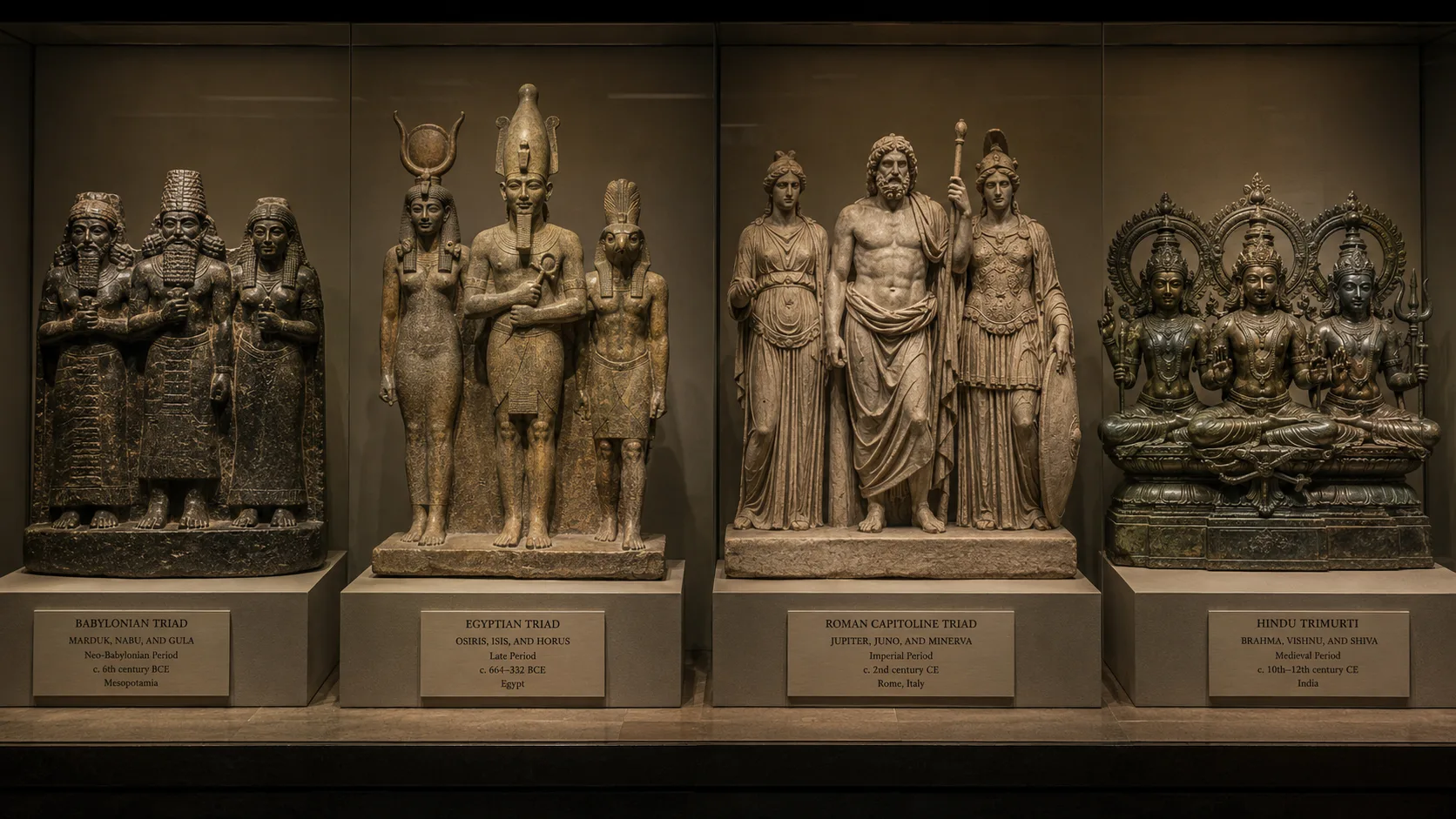
Egyptian religion organized its great gods into triads. The Theban triad — Amun, Mut, and Khonsu — was the central worship of the New Kingdom. The Memphite triad — Ptah, Sekhmet, and Nefertem — anchored the cults of the old capital. The Osirian family — Osiris, Isis, and Horus — was the most widely exported, carried across the Mediterranean by the Hellenistic Isis cult and finally absorbed into the imperial religion of Rome. The pattern was deliberate: a father, a mother, and a son, with the cult of the mother and child eventually overshadowing the cult of the father. The iconography of Isis nursing the infant Horus was already a thousand years old before any Christian artist painted the Madonna and Child.
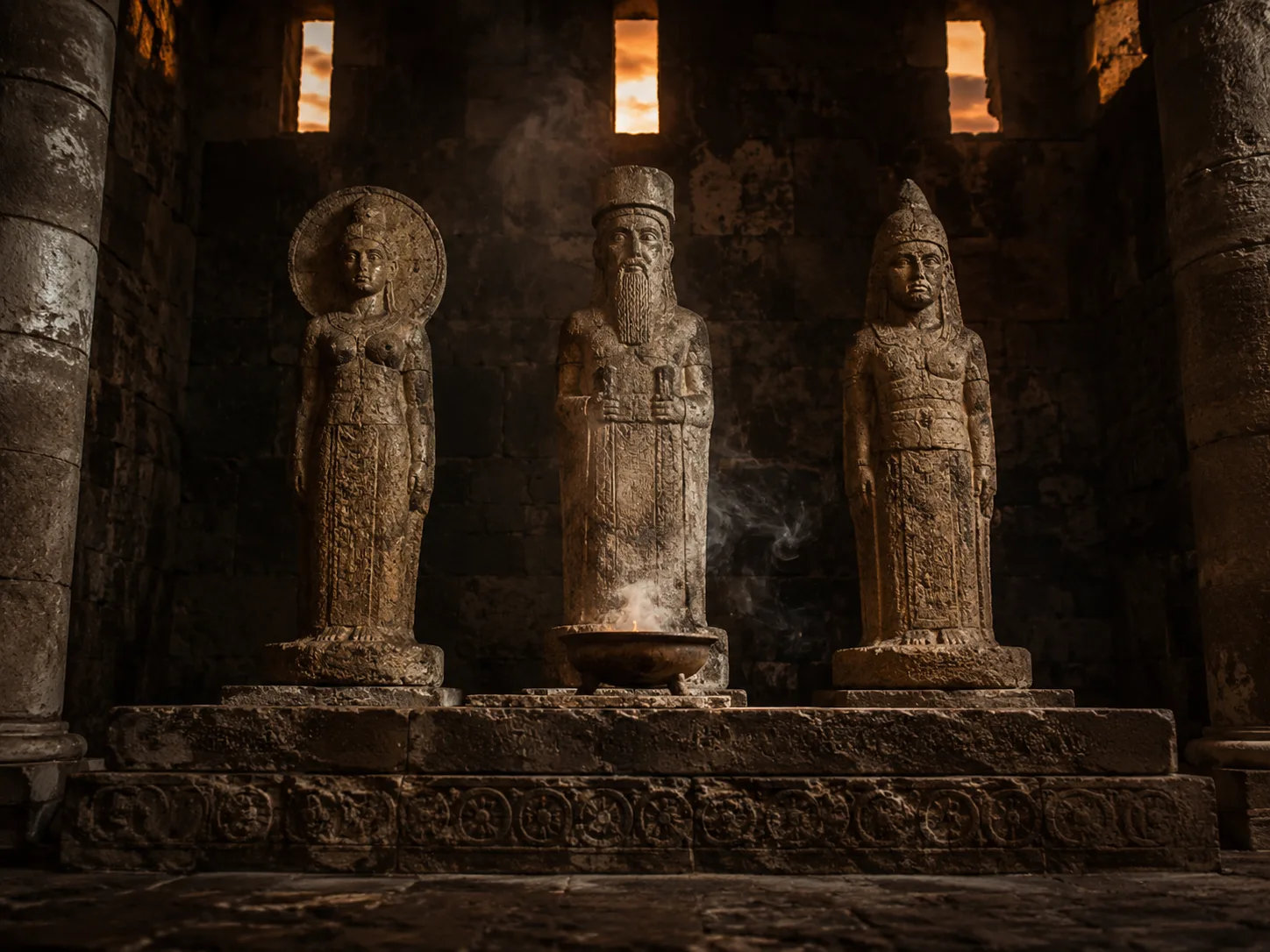
Babylonian religion before Egypt had organized its gods the same way. The supreme Sumerian-Akkadian triad named three regions of creation — Anu, the heavens; Enlil, the air and earth; Ea, the deep waters — and beneath them stood a second triad of heavenly lights: Sin, the moon; Shamash, the sun; and Ishtar, the morning star. The number three was the structural unit of divine relationship in the cult, and the cuneiform tablets that record the Babylonian liturgies have been read and translated for more than a hundred and fifty years.
Hindu religion canonized the same pattern as the *Trimurti* — Brahma the creator, Vishnu the preserver, Shiva the destroyer — three forms of one ultimate divinity. The doctrine is older than the Christian era and survives in the great temples of India to the present day. The vocabulary used to defend the Trimurti — three Persons, one Being, one ultimate substance behind three manifestations — is the same vocabulary the Christian creeds adopted to defend the trinity. The point of agreement is not coincidence. It is shared architecture.
Roman religion before the empire was already triadic. The Capitoline Triad — Jupiter, Juno, and Minerva — sat at the top of the state cult on the Capitoline Hill, in the same city that would later host the great ecumenical councils of the Christian church. Before the Capitoline Triad, the Archaic Triad of Jupiter, Mars, and Quirinus had held the same position in the older Latin religion. Three at the top, with descending pantheons beneath — the same structure observable in Babylon, in Egypt, and in India.
The pattern is therefore not a Christian invention. It is the inherited religious vocabulary of the entire pre-Christian world. When the church’s councils began, in the fourth century, to formulate the relationship of the Father, the Son, and the Spirit in the language of three-in-one substance, they were not introducing a new structure to a world that had never heard of it. They were giving Hebrew names to an architecture the surrounding world had been worshipping under other names for two millennia.
The road to Nicaea
The trinitarian formulation as it is now confessed was not the doctrine of the apostles. The apostolic letters, audited book by book, return a consistent two-fold formula — *one God the Father, and one Lord Jesus Christ* — with the Spirit named as the personal presence of both. The shift to a three-in-one formulation took place over the centuries between the death of the last apostle and the great councils, and the shift is traceable.
The Council of Nicaea was convened by the emperor Constantine in 325 AD to settle a Christological dispute. Its outcome — that the Son was *homoousios*, of one substance, with the Father — established the Greek philosophical vocabulary that would define the later trinitarian formulation. The vocabulary was not Hebrew. *Substance*, *person*, *essence*, *hypostasis* are Greek philosophical categories. The apostles, who wrote in Greek but thought in Hebrew, never used them. The doctrine of three coequal coeternal Persons within a single divine essence was completed at the Council of Constantinople in 381 AD and codified definitively in the Athanasian Creed at some point in the next century or two.
Constantine himself, while presiding over the council that fixed Christian orthodoxy for the next sixteen hundred years, retained the title *Pontifex Maximus* of the Roman state religion until his deathbed. He continued to mint coins inscribed *Sol Invictus Comiti* — the Unconquered Sun, his companion — through the year of the council. He was finally baptized, on his deathbed, by an Arian bishop. He was not a theologian; he was an emperor seeking a unified state cult, and he convened the council that gave him one. The architecture the church received in the fourth century was therefore not received in a vacuum. It was received in the imperial city where the old triadic Roman state cult still operated, by a council convened and presided over by an emperor who was simultaneously the high priest of that cult.
What the convergence shows
The convergence is now visible. The Catholic Church, by her own confession, holds the *mystery* of the trinity as her central doctrine — the same word the Greek text of Revelation 17 inscribes on the forehead of the woman who sits on the seven hills, which are the seven hills of Rome. The architecture of three-in-one was the architecture of every pre-Christian pagan religion. The vocabulary the Christian councils used to formulate the trinity was Greek philosophical vocabulary inherited from the same intellectual world that had produced the Egyptian, Hindu, and Roman triads. The councils were held in the imperial city under the patronage of emperors who simultaneously presided over the old triadic state cult.
The argument is not that three-ness is itself wrong, nor that the Father, the Son, and the Spirit are not the divine beings Scripture names. The argument is that the *specific* architecture of one substance, three coequal coeternal Persons within a single divine being is an architecture the Hebrew Scriptures do not teach and the apostles do not preach. It is an architecture the post-apostolic church inherited from elsewhere, gave the names Father, Son, and Holy Spirit, and then read back into the Scriptures that had to be reinterpreted to accommodate it.
The transparent reading of those Scriptures — the reading recoverable when the architecture is set aside — is the one Christ Himself gave when He named the first commandment of all: the Lord our God is one Lord, the Father; with one Son, Who is His only begotten; and one Spirit, which is the personal presence of both. That reading sustains itself without philosophical reconstruction. The trinitarian reading sustains itself only with the inherited architecture in place.
The triquetra and what it inherited
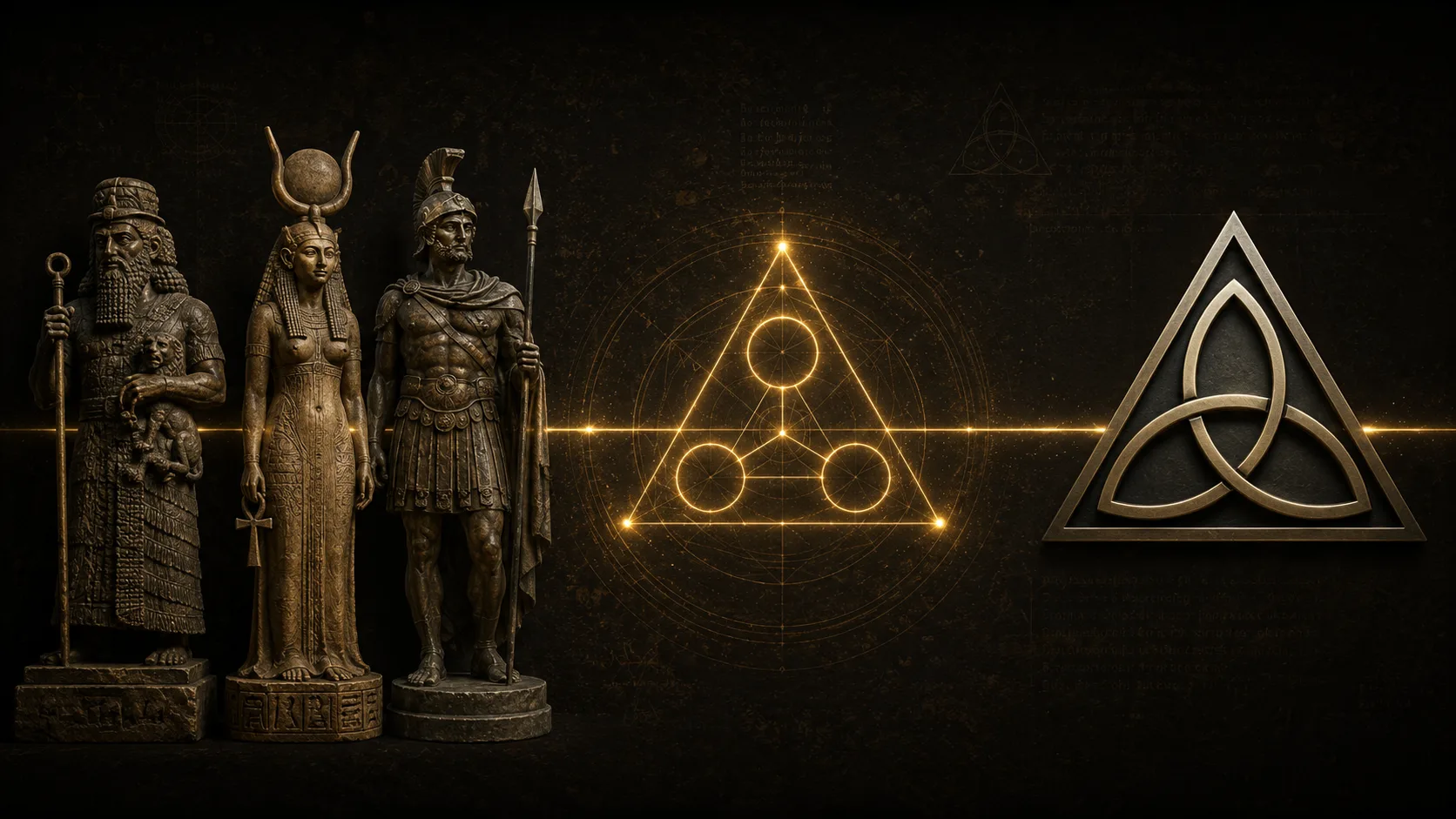
The visual symbol most commonly used to represent the trinity in modern Christian iconography is the *triquetra* — three interlocking arcs forming a continuous figure, often inscribed within a circle. The symbol is pre-Christian. It appears on the Funbo runestones of Sweden, carved by pagan Norsemen before the conversion of Scandinavia. It is found across Celtic stonework in the British Isles, where it predates the arrival of Christian missionaries by centuries. It appears in Hindu temple architecture, in Egyptian decorative motifs, and in Mesopotamian seal impressions. It was a pagan symbol of triadic divinity long before any Christian writer used it.
It was adopted by the post-apostolic church as a trinitarian emblem in the medieval period, retained through the Reformation by liturgical traditions that did not relinquish it, and given a striking modern placement. The cover of the *New King James Version* of the Bible, first published in 1979 and circulated in millions of copies, was embossed with the triquetra. The publisher’s own front matter described the device as an ancient symbol of the trinity. It is also an ancient symbol of pagan triadic divinity, and the fact that it can serve both functions without modification is the visual representation of the doctrinal point this article has been making. The architecture is the same. Only the names have changed.
The geometry beneath the symbol carries the same testimony. The triquetra’s three interlocking arcs rotate around a central equilateral triangle — three sides equal, three angles equal, each angle measuring exactly sixty degrees. Sixty, sixty, sixty. The same digit, written three times, embedded in the geometry of the trinitarian emblem. The number Revelation supplies as the signature of the beast power is the number the symbol itself carries.
The number of a man
The book of Revelation supplies a test for the identity of the beast power. The test is a number, given to readers who have understanding, with the instruction to *count*.
“Here is wisdom. Let him that hath understanding count the number of the beast: for it is the number of a man; and his number is Six hundred threescore and six.”
Revelation 13:18, KJV
The verse names two things at once. The number is *of a man* — that is, assignable to a human title by the gematria conventions of the ancient world, where every letter of the alphabet carried a numerical value and a name could be counted as a sum. And the number is to be *calculated* — the Greek verb is *psephizo*, the technical term for arithmetical reckoning. The reader is told plainly to do the arithmetic on a title.
The title borne by the papacy is *Vicarius Filii Dei* — Vicar of the Son of God. The Latin alphabet inherits numerical values from the Roman numeral system — V is five, I is one, L is fifty, C is a hundred, D is five hundred, M is a thousand — and the letters that are not Roman numerals contribute zero. The title is countable. Counted letter by letter, it yields:
- V (5) + I (1) + C (100) + A (0) + R (0) + I (1) + V (5) + S (0) = 112 [VICARIVS]
- F (0) + I (1) + L (50) + I (1) + I (1) = 53 [FILII]
- D (500) + E (0) + I (1) = 501 [DEI]
- 112 + 53 + 501 = 666
The sum reaches exactly the number Revelation supplies, in the precise title the system claims for itself, with no remainder and no padding. This is what *the number of a man* means in the Apocalypse: a number readers were instructed to calculate from a name, and the name was the head of the system Revelation pictures. The reading is the historic Protestant identification, sustained through the Reformation, the Westminster Confession, and the Baptist and Adventist expositors who followed.
The visual signature and the numerical signature converge on the same value. The equilateral triangle latent in the trinitarian emblem signs the three sixties of its geometry; the Latin title borne by the head of the system that holds the doctrine sums to 666 letter for letter. The two witnesses are independent — one is a shape, the other is a name — and they testify to the same number.
The mark and the day
The same Catholic catechetical tradition that names the trinity as the central doctrine of the church also identifies the day on which that trinity is worshipped. Older Catholic catechisms describe Sunday as *the day dedicated by the apostles to the honor of the Most Holy Trinity*. The connection is the church’s own. The day of worship and the deity worshipped are bound together, and the church is candid about it.
The day in question is not a Christianized Sabbath. *Sunday* is named after the sun in every European language — *dies solis* in Latin, *Sonntag* in German, *zondag* in Dutch — because it was the day of the sun in the Roman state religion before the Christian era. It was observed as the day of the unconquered sun by the same emperor Constantine, who issued the civil legislation of 321 AD that designated it as the public day of rest, and it was re-identified after Nicaea as the day of the church’s three-in-one God. The sun’s day and the triune God’s day are the same day, and the church’s catechisms have never hidden the link.
The connection is not a relic of the patristic era. Rome continues to affirm Sunday as her day in the present. In a 2005 homily preached at the Eucharistic Congress in Bari, Italy, Pope Benedict XVI made the obligation explicit in the language of the fourth-century Abitinian martyrs and applied it to the modern church:
“Sine dominico non possumus — without Sunday, we cannot live.”
Benedict XVI · Homily at Bari, Italy · May 29, 2005
Two years later, in the apostolic exhortation *Sacramentum Caritatis*, the same pope formalised the point: Sunday observance is presented as the indispensable practice of Catholic life, the day on which the church’s worship reaches its fullest expression. Vatican voices have since pressed European governments to legislate Sunday rest, treating the loss of a common Sunday as a threat to Christian civilisation itself. The papacy does not hide what it asks for. It asks for Sunday, and it asks for it now.
On the question of where Sunday actually came from, the church does not pretend it came from the Bible. The most-quoted Catholic admission stands on its own.
“You may read the Bible from Genesis to Revelation, and you will not find a single line authorising the sanctification of Sunday. The Scriptures enforce the religious observance of Saturday, a day which we never sanctify.”
Cardinal James Gibbons · The Faith of Our Fathers · 1876
And the day is named without flinching as the mark of the church’s own authority — the public sign that the church holds the power to alter the divine law itself.
“Sunday is our mark of authority. The Church is above the Bible; and this transference of Sabbath observance is proof of that fact.”
The Catholic Record · September 1, 1923
Three witnesses, separated by eight decades, converge on a single admission. The pope says Sunday is necessary; the cardinal says Sunday is not in the Bible; the parish record says Sunday is the church’s mark of authority. The day and the doctrine arrived together, and they are defended together — by a system whose Catechism names the trinity as her central mystery and whose catechetical tradition names Sunday as the day on which that trinity is honoured.
The Hebrew Scriptures name a different day as the sign of the worship of the LORD. The fourth commandment fixes the seventh day as the memorial of the Creator’s act, signed with the divine name and the divine territory:
“For in six days the LORD made heaven and earth, the sea, and all that in them is, and rested the seventh day: wherefore the LORD blessed the sabbath day, and hallowed it.”
Exodus 20:11, KJV
The book of Revelation, in its final messages to the world, places the worship of the Creator and the keeping of His commandments at the center of the contest of the last days. The contest is not over how many divine Persons there are. It is over which God is worshipped, and which day signs the allegiance. The mark of the apostate system, in Revelation’s vocabulary, is its mark of authority — the public sign by which a worshipper declares his loyalty to Babylon’s God. The seal of the LORD is the corresponding sign by which a worshipper declares his loyalty to the Creator. Both signs are external, both are recognizable, and both are tied to a day of rest dedicated to the deity they represent.
A note on what is being critiqued
The argument of this article is with a doctrinal architecture and the system that holds it. It is not with the millions of sincere believers — Roman Catholic, Protestant, and modern Adventist — who have inherited the trinity without ever examining it from the Scriptures. Every era in church history has contained worshippers Christ called His own; the call of Revelation 18 is addressed to His people who are still inside Babylon when the call goes out. Salvation has never been a denominational membership, and the quarrel here is with teachings, never with neighbours.
Come out of her, my people
The call of Revelation 18 is the final invitation extended to the world before the close of probation. It is addressed to a *my people* who are inside Babylon when the call goes out — not to outsiders, but to the believers whose worship has been quietly shaped by an architecture they did not know they had inherited.
“Come out of her, my people, that ye be not partakers of her sins, and that ye receive not of her plagues.”
Revelation 18:4, KJV
What is to be left behind is not the gospel of Christ. It is the architecture that was added to the gospel after the apostles died — the three-in-one substance, the Greek philosophical vocabulary, the imported triadic emblem, the inherited day of the sun, the *mystery* of a God Who must be received from a hierarchy because He cannot be reached from the Scriptures alone.
What is to be kept is what Christ taught. One God, the Father — the LORD of the Shema, named in every apostolic greeting as the source of grace and peace. One Lord, Jesus Christ — the only begotten Son of the Father, the express image of His Person, in Whom the fullness of the Godhead dwells bodily. One Spirit — the personal life of the Father and the Son, sent into the heart of the believer that the Father and the Son might make their abode with him. The architecture is biblical. The vocabulary is Hebrew. The day is the Sabbath. The God is the God Christ revealed.
Mystery, Babylon has held the central doctrine of her own confession for sixteen hundred years. Her mystery is the architecture that came from her city, and the day of her worship is the day of the sun her emperors named. The remedy is the one Christ named when the scribe asked Him the first commandment of all. *Hear, O Israel.*