
The modern Adventist denomination teaches a triune God — three coequal, coeternal divine Persons within a single Godhead. The historic Adventist faith did not. The pioneers held that there is one God, the Father, and one Lord Jesus Christ, His only begotten Son; that the Holy Spirit is the personal presence of the Father and the Son rather than a third independent Person. Each side claims to read the Bible. Both cannot be right.
There is a test the New Testament itself supplies — and it is the simplest possible one. Every one of the twenty-seven books was opened, addressed, and sent on behalf of someone. The apostles named that someone in their greetings. They named Him again in their closing benedictions. Their salutations are not throat-clearing; they are doctrinal signatures, written in to identify the God in whose name the letter was sent. If the apostles knew a triune God, their greetings will tell us. If they did not, their greetings will tell us that too.
What follows is a book-by-book audit of those greetings. The question is not whether the Spirit exists, nor whether Christ is divine — Scripture settles both elsewhere. The question is narrower and sharper. Across twenty-seven inspired letters and narratives, does any greeting in the New Testament come from a Trinity?
The salutation as authentication
Paul himself names the salutation as a doctrinal signature.
“The salutation of Paul with mine own hand, which is the token in every epistle: so I write.”
2 Thessalonians 3:17, KJV
A greeting carries the writer’s identity and the writer’s theology. It declares who the letter is from and, by extension, the God on whose behalf it is written. The apostles greeted their churches with grace and peace, and they named the source of that grace and peace every time. That source is the heart of the test.
How a person addresses God is how that person understands God. A greeting will not lie; it cannot. It records, without theological filtering, who the writer believed was hearing him and who the writer believed was speaking through him. Across the apostolic letters, those greetings are remarkably uniform — and the uniformity is the evidence.
The four gospels — two human genealogies, two divine, and never three Persons
Matthew opens his gospel with the human genealogy of Christ — the legal line from Abraham through David. The point is to establish, beyond dispute, that Jesus of Nazareth was a true son of man. Mark answers in the opposite key. He gives Christ’s divine pedigree in a single line.
“The beginning of the gospel of Jesus Christ, the Son of God.”
Mark 1:1, KJV
Two beings stand in that opening verse: God, and the Son of God. The relation is named on the first line. Mark does not write “the second Person of the Godhead,” because that category did not exist for him. He writes Father and Son.
Luke prefaces his gospel with a dedication to Theophilus rather than a doxological greeting, and his second volume — the book of Acts — closes the long arc of his narrative on the same two-fold note.
“Preaching the kingdom of God, and teaching those things which concern the Lord Jesus Christ, with all confidence, no man forbidding him.”
Acts 28:31, KJV
Paul’s subject matter, summarised by Luke at the very last verse of the apostolic narrative, is the kingdom of God and the things concerning the Lord Jesus Christ. Two, not three.
John opens his gospel with the most exalted prologue in Scripture, and it has long been pressed into service as a Trinitarian proof-text. The text rewards a careful count.
“In the beginning was the Word, and the Word was with God, and the Word was God. The same was in the beginning with God.”
John 1:1–2, KJV
Two are named. The Word — Christ before His incarnation — and God, by Whom John means the Father. The Word was with God; the Word was God. The verse does not introduce a third. It establishes that the Son shares the Father’s nature, having been brought forth from Him, and that He was already with the Father before any created thing existed. John summarises his entire gospel at its close in exactly the same two-fold key.
“But these are written, that ye might believe that Jesus is the Christ, the Son of God; and that believing ye might have life through his name.”
John 20:31, KJV
The entire purpose of the fourth gospel, by the author’s own statement, is to convince the reader that Jesus is the Son of God — not the second Person of an eternal triune Godhead. The two formulations are not equivalent, and John knew which one he was defending.
Matthew 28:19, read inside Matthew’s own gospel
No examination of New Testament greetings is complete without confronting the verse most often cited to prove the Trinity from the gospels.
“Go ye therefore, and teach all nations, baptizing them in the name of the Father, and of the Son, and of the Holy Ghost.”
Matthew 28:19, KJV
The verse names Father, Son, and Holy Ghost. It does not describe their relation. It does not say the three are one essence, three coequal Persons, or that together they constitute a triune God. It gives a list — and the meaning of the list is settled by what Matthew’s own gospel has already taught about each name.
On the Father, Matthew has been unambiguous from chapter four onward. When the devil offered Christ worship in exchange for the kingdoms of the world, Christ answered with the first commandment.
“Thou shalt worship the Lord thy God, and him only shalt thou serve.”
Matthew 4:10, KJV
The Lord Whom Christ named as the One to be worshipped is the Father. Christ Himself worshipped the Father, prayed to the Father, and identified the Father as His own God. The Father, in Matthew’s gospel, is the one true God of Israel.
On the Son, Matthew is equally clear.
“Thou art the Christ, the Son of the living God. And Jesus answered and said unto him, Blessed art thou, Simon Bar-jona: for flesh and blood hath not revealed it unto thee, but my Father which is in heaven.”
Matthew 16:16–17, KJV
The Father reveals the Son’s identity to Peter, and the identity revealed is precisely this: the Son of the living God. Not co-equal — Son. Not coeternal — the Son of the Living God Who has Him for a Father.
And on the Spirit, Matthew names whose Spirit it is.
“For it is not ye that speak, but the Spirit of your Father which speaketh in you.”
Matthew 10:20, KJV
The Spirit, in Matthew’s vocabulary, is the Spirit of the Father — the personal presence of the one God, going out from Him to teach His servants. By the time the reader reaches the great commission, Matthew has identified the three names exactly: the Father is the living God, the Son is the only begotten of the Father, and the Spirit is the Father’s own Spirit by which He and His Son dwell in the believer. A list of three names is not a doctrine of three Persons; it is what Matthew has been describing all along.
Paul’s standard greeting — repeated thirteen times
Paul wrote thirteen letters in the New Testament canon. Every one of them — Romans through Philemon — opens with substantially the same salutation, and the salutation is identical on the point that matters most.
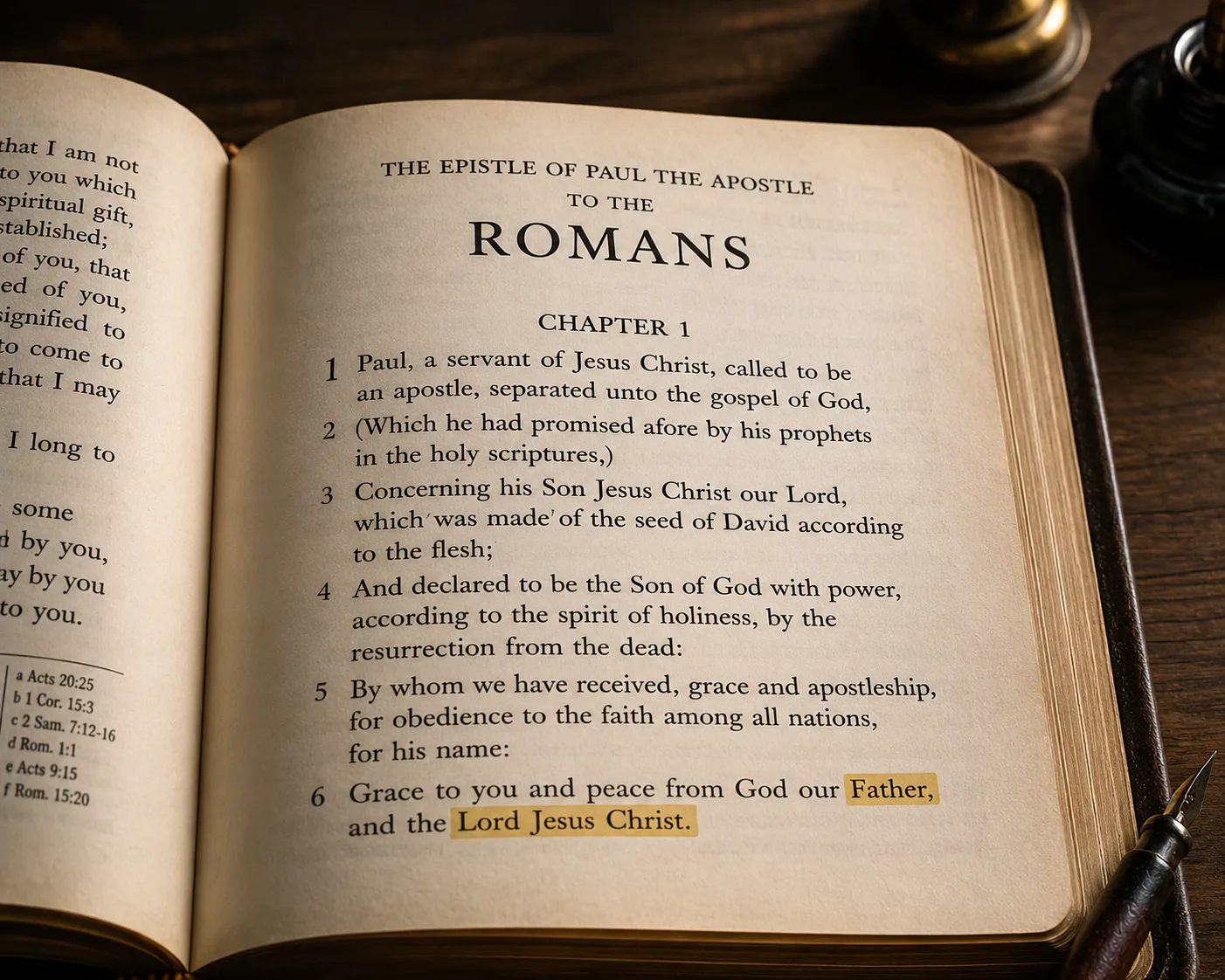
“Grace to you and peace from God our Father, and the Lord Jesus Christ.”
Romans 1:7, KJV
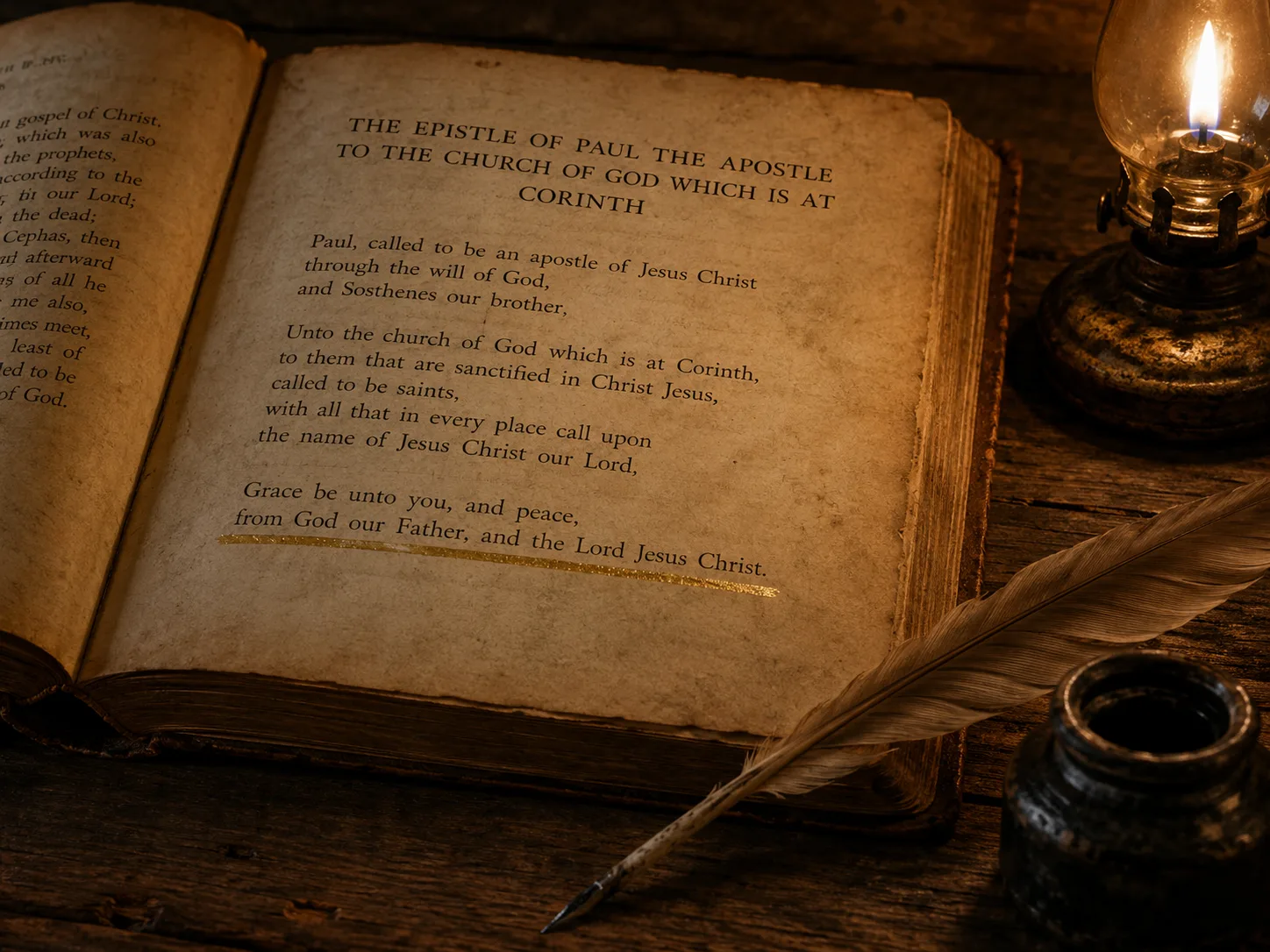
The same words, in the same order, name the same two sources of grace and peace in 1 Corinthians 1:3; 2 Corinthians 1:2; Galatians 1:3; Ephesians 1:2; Philippians 1:2; Colossians 1:2; 1 Thessalonians 1:1; 2 Thessalonians 1:2; 1 Timothy 1:2; 2 Timothy 1:2; Titus 1:4; and Philemon 1:3. The Apostle to the Gentiles, founder of more congregations than any other figure in the first century, never once greeted a church in the name of a Trinity. He named the Father and the Son, and only the Father and the Son.
The pattern is not accidental, and it is not a habit of style. It is doctrine compressed into a salutation. Paul stated the same doctrine explicitly in his first letter to Corinth, in the most formal terms he ever used about the Godhead.
“But to us there is but one God, the Father, of whom are all things, and we in him; and one Lord Jesus Christ, by whom are all things, and we by him.”
1 Corinthians 8:6, KJV
To Paul, the one God is the Father — the source of all things — and the one Lord Jesus Christ is the agent through Whom the Father’s purposes are wrought. The verse is exclusive in its arithmetic. There is one God; there is one Lord; there is no third party in Paul’s formal accounting. The greetings of his thirteen letters are this verse, written in its abbreviated liturgical form, at the head of every page.
2 Corinthians 13:14 — the fellowship of whose Spirit?
One verse at the close of Paul’s second letter to Corinth is the most-quoted Trinitarian proof-text in the New Testament.
“The grace of the Lord Jesus Christ, and the love of God, and the communion of the Holy Ghost, be with you all. Amen.”
2 Corinthians 13:14, KJV
Three names appear. A doctrine of three Persons is then read backwards into them. The verse will not bear that weight, for two reasons that arise from Paul’s own letter.
First, only one of the three is called God. The grace belongs to the Lord Jesus Christ; the love belongs to God — by which Paul means the Father, as he has named Him in chapter one of this same letter (2 Cor 1:3). The communion belongs to the Holy Ghost. The Spirit is not called God in the verse. To force the title onto Him by association is to read the conclusion into the evidence.
Second, Paul has already told the Corinthians, in the very same letter, who the Spirit is.
“Now the Lord is that Spirit: and where the Spirit of the Lord is, there is liberty.”
2 Corinthians 3:17, KJV
The Lord — Christ — is that Spirit. Paul wrote it ten chapters earlier in the same letter, to the same congregation, with no qualification. When at the end of the letter he wishes them the communion of the Holy Ghost, he is not introducing a third divine Person they have not heard of before. He is calling them back into the fellowship of Christ’s own Spirit — the very fellowship the Corinthian church had been forfeiting through faction, immorality, and false teaching.
The benediction makes excellent pastoral sense once it is read in context. The Corinthians had divided into parties; Paul wished for them the Father’s love, the Son’s grace, and the restored fellowship of the Spirit which is the personal presence of Christ in the body. None of that requires — or implies — a Trinity. A reader who arrives at chapter thirteen having read chapters one through twelve cannot mistake what Paul means.
The general epistles continue the pattern
Hebrews does not open with a Pauline-style greeting, but it closes with one of the great benedictions of the New Testament, and the benediction names only Father and Son.
“Now the God of peace, that brought again from the dead our Lord Jesus, that great shepherd of the sheep, through the blood of the everlasting covenant, make you perfect in every good work to do his will, working in you that which is wellpleasing in his sight, through Jesus Christ; to whom be glory for ever and ever. Amen.”
Hebrews 13:20–21, KJV
The God of peace is the Father; He raised Jesus from the dead; He works in the believer through Jesus Christ. Two acting parties, named twice over, with no third. The first chapter of the same letter has already established the same arithmetic: God spoke through prophets, then in these last days by His Son (Heb 1:1–2), and the Son is set above the angels (Heb 1:5–14). Father, Son, angels — that is the cast Hebrews names. There is no fourth category for a third coequal Person.
James, the half-brother of Jesus, opens his letter with a salutation as compact as any in the canon.
“James, a servant of God and of the Lord Jesus Christ, to the twelve tribes which are scattered abroad, greeting.”
James 1:1, KJV
He served two. He greeted on behalf of two. The man who grew up in the same household as Christ, who watched Him through childhood, who became the leader of the Jerusalem church after the resurrection, did not write his letter on behalf of a Trinity. He served God and the Lord Jesus Christ. Later in his letter he made the same point with a wry edge.
“Thou believest that there is one God; thou doest well: the devils also believe, and tremble.”
James 2:19, KJV
James commends his readers for believing that there is one God. The devils, he notes, believe the same — and the devils do not believe a Trinity. They confess one God; they confess Him to have a Son; they tremble. The structure of biblical monotheism is what James and the demons share. The triune formulation is not the biblical monotheism either of them confesses.
Jude — Christ’s half-brother and James’s brother — opens with the same two-fold address.
“Jude, the servant of Jesus Christ, and brother of James, to them that are sanctified by God the Father, and preserved in Jesus Christ, and called.”
Jude 1, KJV
Sanctified by the Father; preserved in Jesus Christ. Two divine actors, no third. The pattern is becoming monotonous in its consistency — and the monotony is the point.
1 Peter 1:2 — only one is called God
Peter opens his first letter with a salutation that names Father, Spirit, and Christ in the same verse, and this is the second great proof-text Trinitarians cite from the catholic epistles.
“Elect according to the foreknowledge of God the Father, through sanctification of the Spirit, unto obedience and sprinkling of the blood of Jesus Christ: Grace unto you, and peace, be multiplied.”
1 Peter 1:2, KJV
Three names appear once again, and once again the count proves nothing on its own. The grammar of the verse names each one carefully and ascribes the divine title to only one of them. The Father is named “God the Father.” The Spirit is named as the medium of sanctification — the means by which God sanctifies. Jesus Christ is named by His proper name and the work of His blood. Of the three, only the Father is called God.
Peter then says the same thing again in the very next verse, and removes any doubt about how he understands the relationship.
“Blessed be the God and Father of our Lord Jesus Christ, which according to his abundant mercy hath begotten us again unto a lively hope by the resurrection of Jesus Christ from the dead.”
1 Peter 1:3, KJV
The Father is identified as the God of Jesus Christ. The Father is not merely Christ’s Father — the verse makes Him Christ’s God. A Trinitarian theology that claims the Son is coequal with the Father cannot easily account for that statement, but Peter has repeated it because it is the truth he believes: there is one God, and that God is the Father of our Lord Jesus Christ. His second letter opens on the same note.
“Grace and peace be multiplied unto you through the knowledge of God and of Jesus our Lord.”
2 Peter 1:2, KJV
Two — and if Peter’s first salutation had been Trinitarian, his second one would have been too. The harmony between his two letters dissolves the supposed proof-text and reveals what Peter actually believed.
John’s letters — fellowship with the Father and with His Son
The apostle who wrote “In the beginning was the Word” addressed his readers, decades later, with the same theology distilled to a single sentence.
“That which we have seen and heard declare we unto you, that ye also may have fellowship with us: and truly our fellowship is with the Father, and with his Son Jesus Christ.”
1 John 1:3, KJV
Two are named as the objects of Christian fellowship. There is no third. Eternal life, in John’s own definition recorded in the seventeenth chapter of his gospel, is to know the only true God and Jesus Christ Whom He has sent (John 17:3). When the apostle who recorded that definition came to write his pastoral letter, he greeted his readers in exactly the same terms.
His second letter is sharper still on the Sonship.
“Grace be with you, mercy, and peace, from God the Father, and from the Lord Jesus Christ, the Son of the Father, in truth and love.”
2 John 1:3, KJV
The Son of the Father — in truth and love. The phrase forecloses the modern reading that Christ’s Sonship is a metaphor or a courtesy title within an eternal Godhead. John says it is true. He says it is real. He says it is the foundation of grace, mercy, and peace. To turn the Sonship into figurative language is to turn John’s greeting into a lie.
Revelation — the throne, the Lamb, and the seven Spirits
Revelation opens with a salutation that contains the only verse in the New Testament that even superficially looks like a Trinitarian greeting.
“John to the seven churches which are in Asia: Grace be unto you, and peace, from him which is, and which was, and which is to come; and from the seven Spirits which are before his throne; and from Jesus Christ, who is the faithful witness, and the first begotten of the dead, and the prince of the kings of the earth.”
Revelation 1:4–5, KJV
Father (named by His eternity), Spirits, and Christ. Three groups — but the count is wrong for a Trinity. The Father is one, the Spirits are seven, and Christ is one. The arithmetic comes to nine, and no theological tradition has ever claimed a nine-fold Godhead. The seven Spirits cannot be a coequal third Person; the number alone forbids it.
Revelation interprets its own symbol. In chapter four the seven Spirits appear as seven lamps of fire before the throne; in chapter five they appear as the seven horns and seven eyes of the Lamb, “sent forth into all the earth.” The Spirit of God, in Revelation’s vocabulary, is presented under the figure of seven because the book is addressing seven churches. Seven Spirits before the throne is the symbolic figure of the one Spirit sent out to the seven congregations — the Father’s personal presence dispatched, through Christ, to His scattered people. It is the same Spirit Paul named when he wished the Corinthians the communion of the Holy Ghost.
Revelation’s closing chapter confirms the count. The book ends with the river of life flowing from one throne, shared between two.
“And he shewed me a pure river of water of life, clear as crystal, proceeding out of the throne of God and of the Lamb.”
Revelation 22:1, KJV
God and the Lamb. Father and Son. The river of the Spirit proceeds out of their shared throne — and the throne is theirs because the Son sits down with the Father in His throne, as the Son Himself promised in the third chapter (Rev 3:21). Two are seated; one Spirit, under the symbol of a river, goes out from them into the earth. The apocalyptic vision and the apostolic greeting tell the same story.
What the silence proves
Twenty-seven books. Every opening greeting examined. Every closing benediction examined. The Trinity never says hello. There is no salutation from a triune God anywhere in the New Testament — not from Paul, not from Peter, not from James, not from John, not from Jude, not from the writer of Hebrews, and not from the risen Christ in His seven messages to the churches in Revelation.
The silence is not an oversight. The apostles knew how to address a divine Person if a divine Person was there to be addressed. They wrote in Greek; they had vocabulary for every concept they needed. They were writing under inspiration of the Spirit they invoked. If a third coequal Person stood beside the Father and the Son in their theology, the natural place to name Him was in the greeting — and that is precisely the one place He never appears.
The conclusion forces itself. The apostolic church did not believe in a Trinity. The faith planted by the apostles in every congregation they founded was a faith in one God, the Father, and one Lord Jesus Christ, His only begotten Son — with the Spirit named as the Father’s own Spirit and the Lord’s own Spirit, by which Father and Son indwell their people. The triune formulation was not the gospel they preached and not the salutation they wrote.
The Trinity entered Christian theology several centuries later, by way of Greek philosophical categories and the dogmatic decrees of post-apostolic councils. It is not a New Testament doctrine. It is an addition to the apostolic deposit, and it changes the apostolic deposit at its centre — for if Christ is not literally the only begotten Son of the Father, the gospel’s logic of inheritance fails, the love of John 3:16 is emptied, and the eternal life that flows to the believer “in His Son” loses the only ground on which it stands.
The grace and peace itself
The apostles repeated their greeting because the greeting was not a formality. It was an offer. Grace and peace from God the Father and the Lord Jesus Christ — the actual blessing, the actual fellowship, the actual indwelling — held out to every reader of every letter, then and now.
The modern Adventist reader who has worked through this audit faces two questions, and they are not in the same order of weight. The first is whether the Bible teaches a Trinity. The audit answers it: it does not. The greetings of the apostles, examined one by one, return a uniform verdict, and the verses that have been pressed into Trinitarian service dissolve into the surrounding context of their own letters when they are read in good faith. That question is settled by evidence.
The second question is whether the grace and peace named in those greetings is now an active reality in the life of the reader. The apostles cared more about the second question than they did about the first, because they expected the first to be obvious. The Father is the only true God; Jesus Christ is His only begotten Son; the Spirit is the presence by which the two dwell in the believer. None of that is hard to see in Scripture. The harder thing — the thing the entire New Testament was written to produce — is the experience.
“And this is life eternal, that they might know thee the only true God, and Jesus Christ, whom thou hast sent.”
John 17:3, KJV
That is the verse Christ Himself prayed on the night before His crucifixion. The only true God is the Father. Jesus Christ is the One He sent. To know the two — not as theological propositions, but as the living source of grace and peace in the believer’s own experience — is eternal life. The apostles greeted their churches with the offer of that knowledge every time they wrote. The greeting still stands.