The second coming of Jesus Christ is not a side teaching of Scripture. It is one of the great pillars of biblical faith. The same Jesus Who ascended into heaven will return in power and glory — not as a hidden influence, not as a secret spiritual awakening, and not merely as a symbol of progress in the world. He will come personally, visibly, audibly, and majestically as King of kings and Lord of lords.
From the Adventist perspective, the second coming is the great climax of the everlasting gospel. It is the moment when Christ delivers His faithful people, ends the reign of sin, raises the righteous dead, translates the living righteous, and begins the final sequence of events that leads to the complete destruction of sin and the creation of a new earth. This hope is not built on speculation, but on the plain promises of Scripture: "I will come again" (John 14:3), "this same Jesus… shall so come in like manner" (Acts 1:11), and "the Lord himself shall descend from heaven" (1 Thessalonians 4:16).
Yet the Bible also teaches that the return of Christ is surrounded by a final conflict. Before Jesus appears, the world will be tested over worship, loyalty, and obedience. The last generation will face deception, religious pressure, and civil enforcement. But God will not leave His people in darkness. Through the prophecies of Daniel and Revelation, He has revealed the outline of last-day events so that His people may watch, pray, and remain faithful.
Central thought — The second coming is the blessed hope of God's people: the visible return of Christ, the resurrection of the righteous, the deliverance of the living faithful, and the doorway to the new earth.
The Manner of Christ's Return
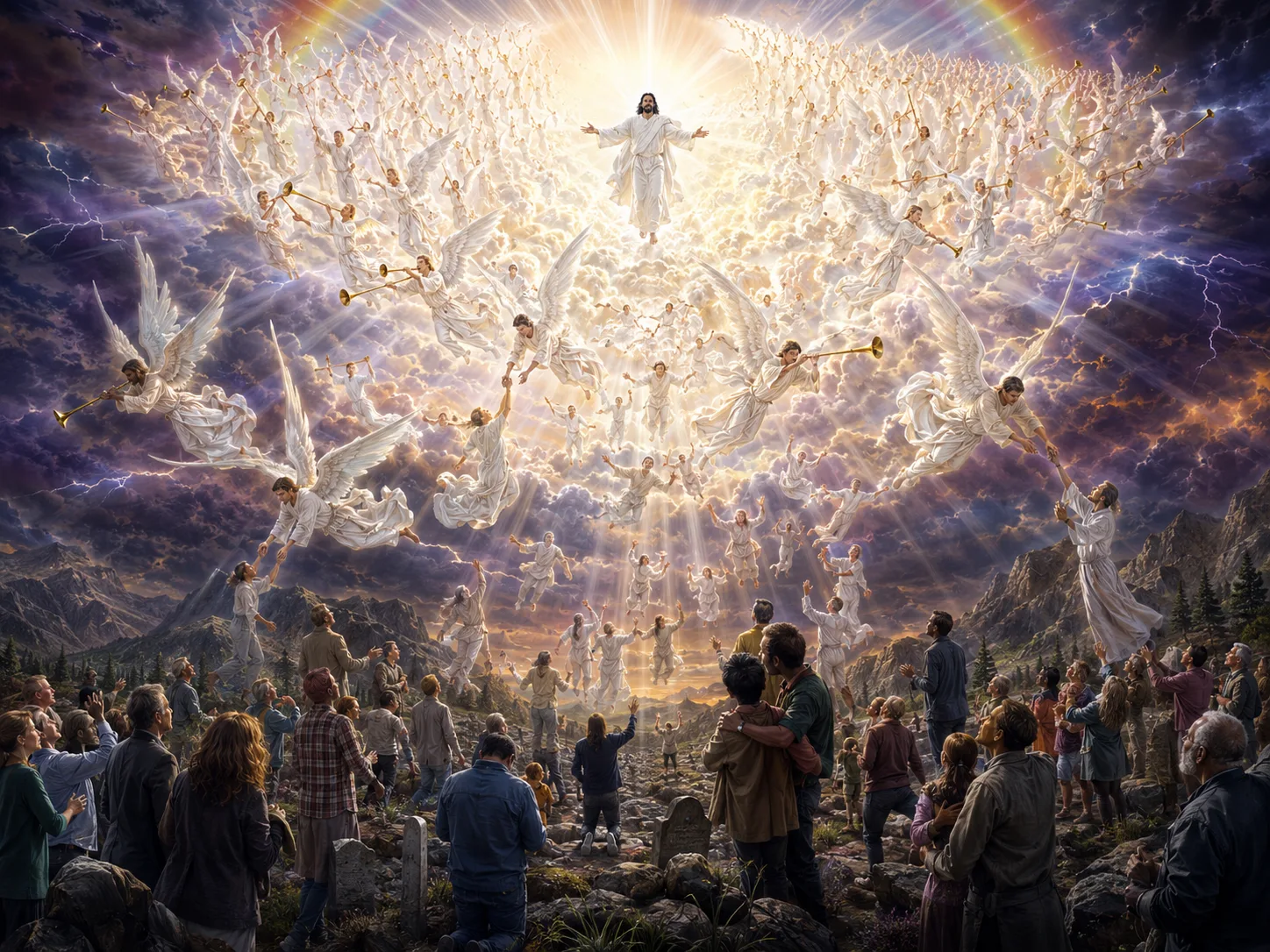
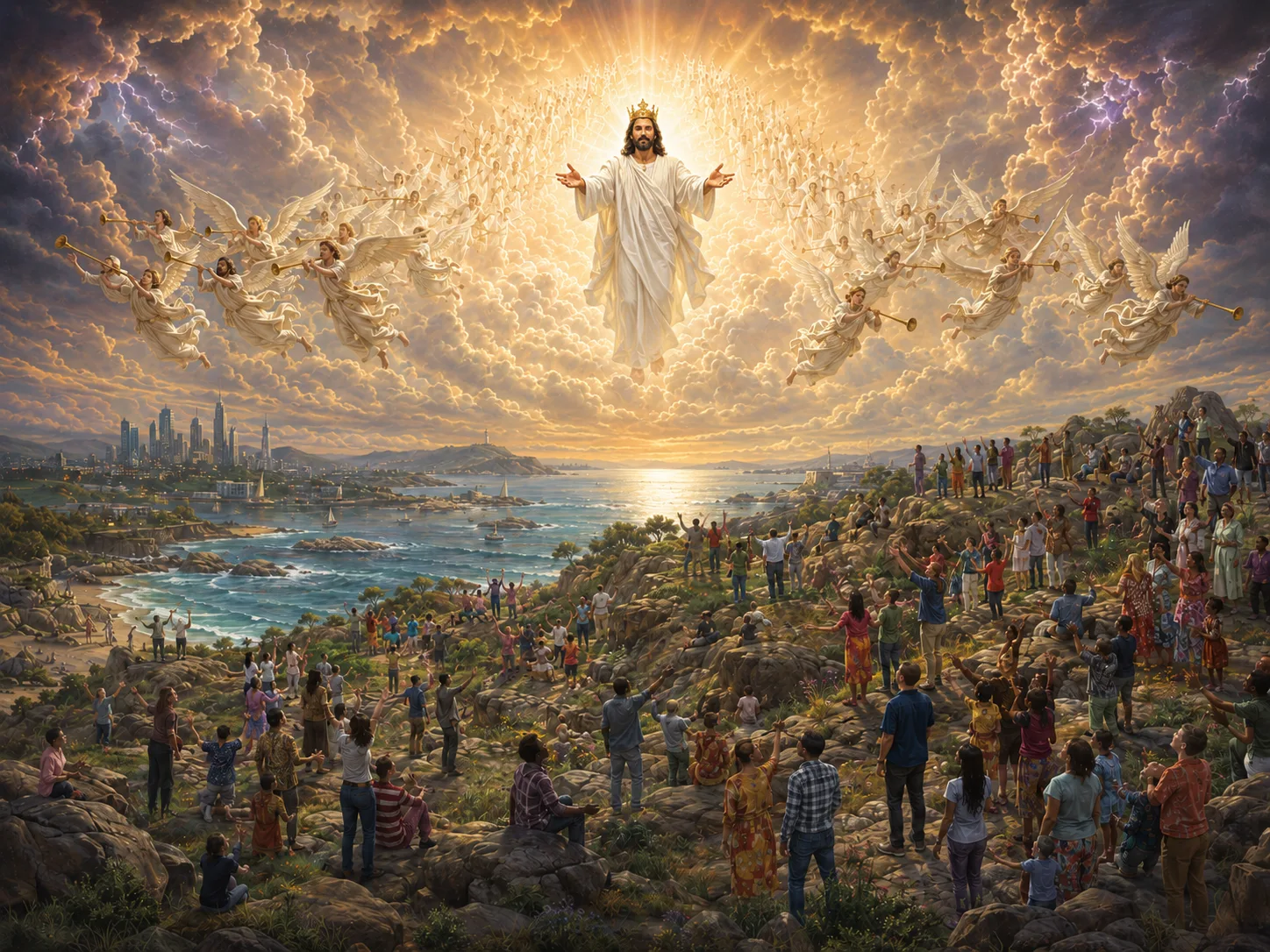
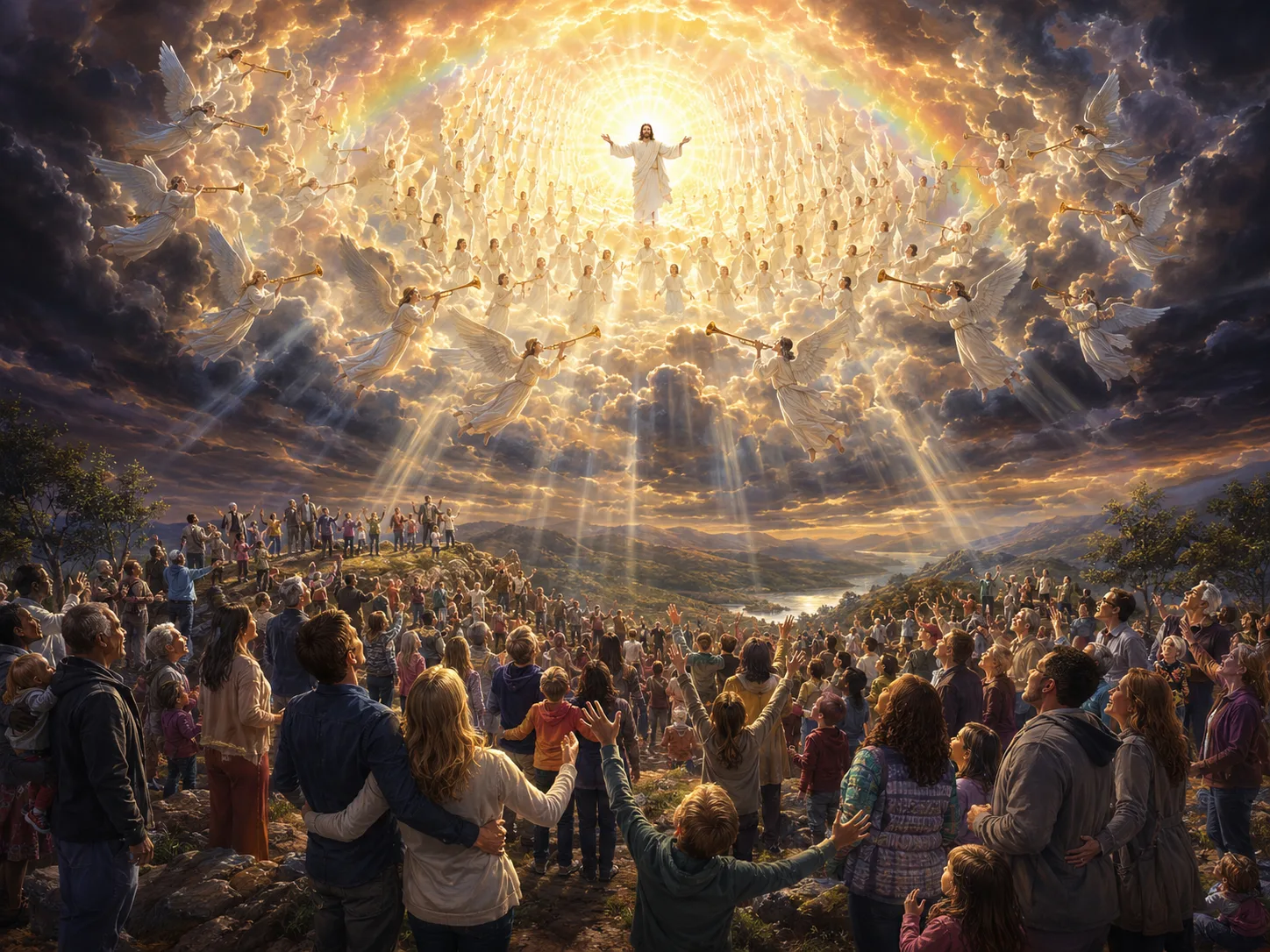
The second coming will not be secret. Christ warned that false teachers would claim He had appeared privately or in hidden places, but He said, "Believe it not" (Matthew 24:26). His coming will be like lightning shining from east to west (Matthew 24:27). Revelation declares, "Behold, he cometh with clouds; and every eye shall see him" (Revelation 1:7). Paul says the Lord will descend with a shout, with the voice of the archangel, and with the trump of God (1 Thessalonians 4:16).
This means the return of Christ will be universal, unmistakable, and world-shaking. The righteous will rejoice, saying, "Lo, this is our God; we have waited for him" (Isaiah 25:9). The unprepared will cry for the rocks and mountains to hide them from the face of Him that sitteth on the throne and from the wrath of the Lamb (Revelation 6:15-17). The same event that brings deliverance to the faithful brings terror to those who have rejected God's truth.
Adventism has historically rejected every theory that turns the second coming into a secret rapture followed by a second chance. Scripture presents the coming of Christ as the decisive appearing of the Lord, the resurrection of the righteous, the destruction of the wicked living, and the gathering of God's people. When Jesus comes, the destinies of humanity have already been settled.
Why Christ's Coming Is Necessary
The world cannot heal itself from sin. Human governments cannot create the kingdom of God. Technology cannot remove death. Moral reform alone cannot cleanse the heart. Scripture teaches that the whole creation groans under the burden of sin, waiting for redemption (Romans 8:22-23). The second coming is necessary because Christ alone can bring the final deliverance His people need.
At His first coming, Jesus came as the Lamb of God to bear the sins of the world. At His second coming, He comes as conquering King to gather the redeemed and execute judgment. His sacrifice was completed at Calvary, but the full results of redemption are not yet visibly complete on earth. The dead in Christ still sleep. The righteous still suffer. The wicked still oppress. The earth still groans. The second coming is the moment when the promise becomes visible: Christ claims those who belong to Him.
The Days and Months Before the Second Coming
The Bible does not give an exact number of days or months between every final event and the appearing of Christ. God has not given His people permission to set a date for the second coming. Jesus said, "Of that day and hour knoweth no man" (Matthew 24:36). But Scripture does reveal the character and order of the final crisis. The last days will be marked by religious deception, moral decline, global unrest, a counterfeit revival, enforcement of false worship, the sealing of God's people, the close of probation, and the seven last plagues.
1. Increasing Deception and Spiritual Confusion
Jesus warned that deception would be one of the great signs of the end: "Take heed that no man deceive you" (Matthew 24:4). Revelation describes three unclean spirits like frogs going forth to the kings of the earth and of the whole world, gathering them to the battle of the great day of God Almighty (Revelation 16:13-14). This indicates a worldwide movement of religious and spiritual deception, accompanied by signs, miracles, and persuasive influence.
From an Adventist understanding, the final conflict will not be fought merely over politics or economics. It will be a crisis of worship. The question will be whether men and women will obey God's commandments and hold the faith of Jesus, or whether they will yield to a religious system that exalts human authority above the Word of God.
2. The Final Message of Warning
Before the end comes, God sends a final message to the world. Revelation 14 presents the three angels' messages: the everlasting gospel, the hour of God's judgment, the call to worship the Creator, the fall of Babylon, and the warning against the beast, his image, and his mark. This message prepares a people who "keep the commandments of God, and the faith of Jesus" (Revelation 14:12).
This final warning is not given in hatred, but in mercy. God exposes Babylon because He has people still within confused systems of worship. Revelation 18 repeats the call: "Come out of her, my people" (Revelation 18:4). The purpose of prophecy is not to make believers proud, harsh, or fearful, but faithful. God's last message calls every honest soul back to Scripture, back to Christ, and back to the worship of the Creator.
3. The Sabbath-Sunday Crisis and the Mark of the Beast
In Adventist prophecy, the final test centers on worship and authority. The Sabbath of the fourth commandment points to God as Creator: "For in six days the LORD made heaven and earth… wherefore the LORD blessed the sabbath day, and hallowed it" (Exodus 20:11). Revelation 14 likewise calls the world to worship Him that made heaven, earth, sea, and fountains of waters. This language points directly back to the creation commandment.
The issue is not merely a day on the calendar. It is whether God's authority or human tradition will govern worship. The mark of the beast is not received simply because a person is currently ignorant of the Sabbath or attends church on Sunday. The final mark comes when the issue is clearly brought before the world and false worship is enforced by law, while God's commandment is knowingly rejected. In that crisis, obedience will reveal allegiance.
Adventists understand the image of the beast to involve a union of religious influence and civil power that pressures conscience. When civil authority is used to enforce a religious institution contrary to God's commandments, the world will be brought to the final test. The faithful will not overcome by political strength, but by the blood of the Lamb, the word of their testimony, and patient obedience to God.
4. The Sealing of God's People
Before the winds of final destruction are fully released, Revelation 7 shows angels holding them back until the servants of God are sealed in their foreheads. This seal represents settled loyalty to God. It is not merely an outward label, but a work of truth in the mind and character. God's people are brought to a place where they would rather suffer than knowingly disobey Him.
The Sabbath is deeply connected with this sealing work because it contains the sign of God's creative authority and sanctifying power. Ezekiel 20:12 says, "I gave them my sabbaths, to be a sign between me and them, that they might know that I am the LORD that sanctify them." In the final conflict, the Sabbath becomes a visible sign of loyalty to the Creator when the world is pressured toward a counterfeit system of worship.
5. The Close of Probation
A solemn truth of Scripture is that probation does not remain open forever. Revelation 22:11 declares, "He that is unjust, let him be unjust still… and he that is righteous, let him be righteous still." Immediately after this, Christ says, "Behold, I come quickly; and my reward is with me" (Revelation 22:12). This shows that before Jesus appears, the decisions of humanity have been fixed.
The close of probation means that Christ's intercessory work for sinners has ended and every case has been decided. The righteous remain righteous, not because they can stand without Christ, but because they have fully surrendered to Him. The wicked remain wicked because they have finally rejected the light God gave them. After this point, no one changes sides. The final plagues fall without mixture of mercy, yet God's sealed people are preserved.
6. The Seven Last Plagues and the Time of Trouble
Revelation 15 and 16 describe the seven last plagues, the final outpouring of God's wrath upon a rebellious world. These plagues fall after probation closes. They are not designed to convert the wicked, for the wicked repeatedly refuse to repent. Instead, they reveal the justice of God's judgment and the hardened character of those who have rejected His truth.
During this time, God's people pass through what Scripture calls a time of trouble. Daniel 12:1 says, "There shall be a time of trouble, such as never was since there was a nation… and at that time thy people shall be delivered, every one that shall be found written in the book." The faithful may appear defenseless, but they are not forsaken. The same God Who preserved Noah, delivered Israel at the Red Sea, and kept Daniel in the lions' den will keep His people through the final crisis.
The Appearing of Christ
At the end of the final crisis, Jesus comes. The heavens depart as a scroll, the earth shakes, and the glory of Christ fills the sky. This is not a regional event. It is not a private revelation. It is the visible arrival of the Son of God with all the holy angels. The redeemed recognize the One for Whom they have waited. The wicked recognize too late the One they have rejected.
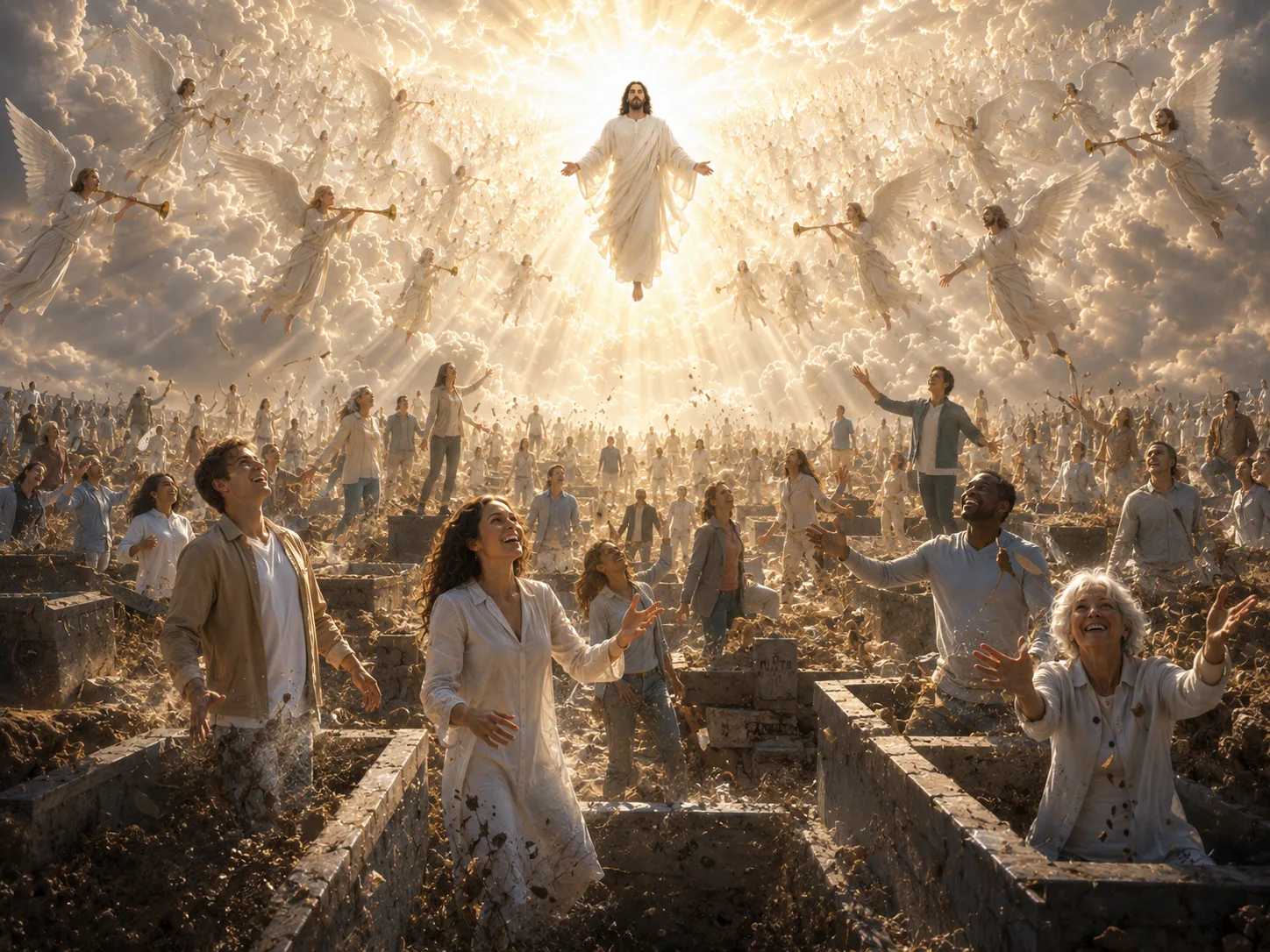
At Christ's appearing, the righteous dead are raised incorruptible. Paul writes, "The dead in Christ shall rise first: then we which are alive and remain shall be caught up together with them in the clouds" (1 Thessalonians 4:16-17). The living righteous are changed in a moment, in the twinkling of an eye (1 Corinthians 15:51-53). Mortal bodies put on immortality. Tears, sickness, age, and death lose their hold on the people of God.
The wicked living are destroyed by the brightness of Christ's coming (2 Thessalonians 2:8). Revelation 19 depicts the defeat of the beast and the kings of the earth. Jeremiah describes the slain of the Lord from one end of the earth to the other (Jeremiah 25:33). This prepares the way for the millennium, during which the earth is left desolate and the redeemed are taken to heaven.
The Millennium: A Thousand Years in Heaven
Revelation 20 teaches that after the second coming there will be a thousand-year period. Adventists understand this millennium to take place in heaven for the redeemed, while the earth remains desolate, broken, and without living human inhabitants. The righteous have been taken to be with Christ. The wicked are dead. Satan is bound, not by a literal chain of metal, but by circumstances. He has no one left to deceive.
During the millennium, the redeemed participate in a work of judgment. Revelation 20:4 says, "Judgment was given unto them." Paul also wrote, "Do ye not know that the saints shall judge the world?… Know ye not that we shall judge angels?" (1 Corinthians 6:2-3). This judgment does not inform God, for He already knows all things. Rather, it allows the redeemed to see the justice, mercy, and transparency of God's decisions.
This is a vital part of the great controversy. God does not ask His people to trust an unexplained judgment forever. He opens the records so that every question can be answered. The redeemed will understand why some are saved and others are lost. They will see that God forced no one, ignored no prayer, overlooked no sincere repentance, and made no mistake. The millennium vindicates the character of God before the universe.
The Earth During the Millennium
While the redeemed are with Christ, the earth is in a condition of desolation. The language of Jeremiah 4:23-27 describes the earth as without form and void, with no man present and the cities broken down by the fierce anger of the Lord. This does not describe the new earth, but the ruined state of the world after the second coming and before final restoration.
Satan and his angels remain on this desolated earth. For thousands of years, Satan has tempted, accused, deceived, and destroyed. During the millennium, he is forced to behold the results of his rebellion. He cannot deceive nations because the righteous are in heaven and the wicked are dead. In this sense he is bound in the bottomless pit, the abyss of a ruined earth.
After the Millennium: The New Jerusalem Descends
At the close of the thousand years, the New Jerusalem descends from heaven to earth. Revelation 21:2 says John saw the holy city, New Jerusalem, coming down from God out of heaven, prepared as a bride adorned for her husband. Christ, the redeemed, and the holy city return to this earth — not to continue the old world, but to bring the final judgment and complete restoration.
At this time, the wicked dead are raised. Revelation 20:5 says, "The rest of the dead lived not again until the thousand years were finished." This is the second resurrection, the resurrection of condemnation. Satan is loosed because he once again has multitudes to deceive. True to his character, he gathers the lost in a final attempt to take the city of God.
This final rebellion shows that the wicked are not lost because they lacked opportunity only, but because they refused the government of God. Even after seeing Christ, the holy city, and the reality of judgment, they still follow Satan. Their character is fully revealed before the universe.
The Final Judgment and the End of Sin
Before the final destruction, every knee bows and every tongue confesses that God is just. The record of history is opened. The cross is seen in its true light. The wicked understand what they have rejected. Satan's accusations are silenced. The whole universe sees that God has been righteous, patient, merciful, and fair.
Then fire comes down from God out of heaven and devours the wicked (Revelation 20:9). This is the lake of fire, the second death. Adventists understand this final punishment as complete destruction, not eternal conscious torment. The wages of sin is death, not everlasting life in misery (Romans 6:23). Malachi says the wicked will be ashes under the soles of the feet of the righteous (Malachi 4:1-3). Sin and sinners are brought to an end.
This final fire also cleanses the earth. The old world, scarred by rebellion, bloodshed, idolatry, sickness, and death, passes away. God does not merely repair the present order. He makes all things new.
The New Earth: God's Eternal Kingdom Restored
After the destruction of sin, God creates a new heaven and a new earth. Revelation 21:3 gives the great promise: "Behold, the tabernacle of God is with men, and he will dwell with them." The redeemed do not spend eternity as disembodied spirits floating in clouds. They inherit a real, restored creation. The earth, once lost through sin, becomes the eternal home of the redeemed.
There will be no more death, sorrow, crying, or pain. The former things will pass away. The curse will be removed. The tree of life will be restored. The servants of God will serve Him, see His face, and reign for ever and ever (Revelation 22:3-5). The great controversy will be finished. Sin will never rise again, because the universe will have seen its full fruit and the perfect justice of God's government.
How This Hope Should Shape Our Lives Now
The doctrine of the second coming is not given merely to satisfy curiosity about future events. It is meant to purify the heart, strengthen faith, and awaken readiness. "Every man that hath this hope in him purifieth himself, even as he is pure" (1 John 3:3). To believe that Jesus is coming soon is to live with eternity in view.
This does not mean living in panic or date-setting. It means daily surrender to Christ. It means studying the Word of God, keeping His commandments through faith, warning others with love, and refusing the deceptions of Babylon. It means valuing truth more than popularity and obedience more than comfort. The final crisis will reveal what has already been forming in the heart.
The great question is not simply, "Can I explain last-day events?" The deeper question is, "Do I know Christ, and am I willing to follow Him wherever His Word leads?" Prophecy is not a substitute for conversion. Knowledge of the timeline cannot save the soul. Only Christ can save. But true faith in Christ will lead us to heed His warnings, receive His truth, and stand with Him when the world stands against Him.
Conclusion: Even So, Come, Lord Jesus
The second coming is the blessed hope of God's people. It is the end of exile, the resurrection of the sleeping saints, the deliverance of the living faithful, the beginning of the millennium, the final exposure of Satan's rebellion, the destruction of sin, and the doorway to the new earth. Every promise of Scripture moves toward this glorious end.
The world may grow darker, but the hope of Christ's return grows brighter. The final crisis will be severe, but it will be short compared with eternity. God's people are not called to fear the future, but to trust the One Who holds the future. Jesus has promised, "Surely I come quickly." The faithful response of every believer should be, "Amen. Even so, come, Lord Jesus" (Revelation 22:20).
At a Glance
- A visible, audible, personal, glorious return. Christ's coming is not secret or symbolic — every eye shall see Him.
- A final worship crisis precedes the appearing. God's commandments, the faith of Jesus, the beast, the image, and the mark.
- Probation closes before Christ appears. After that, the seven last plagues fall and God's sealed people are preserved.
- At the second coming itself. The righteous dead are raised, the living righteous are changed, and the wicked living are destroyed.
- During the millennium. The redeemed are in heaven with Christ while the earth remains desolate and Satan is bound by circumstance.
- After the millennium. The New Jerusalem descends, the wicked are raised, final judgment is executed, sin is destroyed, and God makes the earth new.