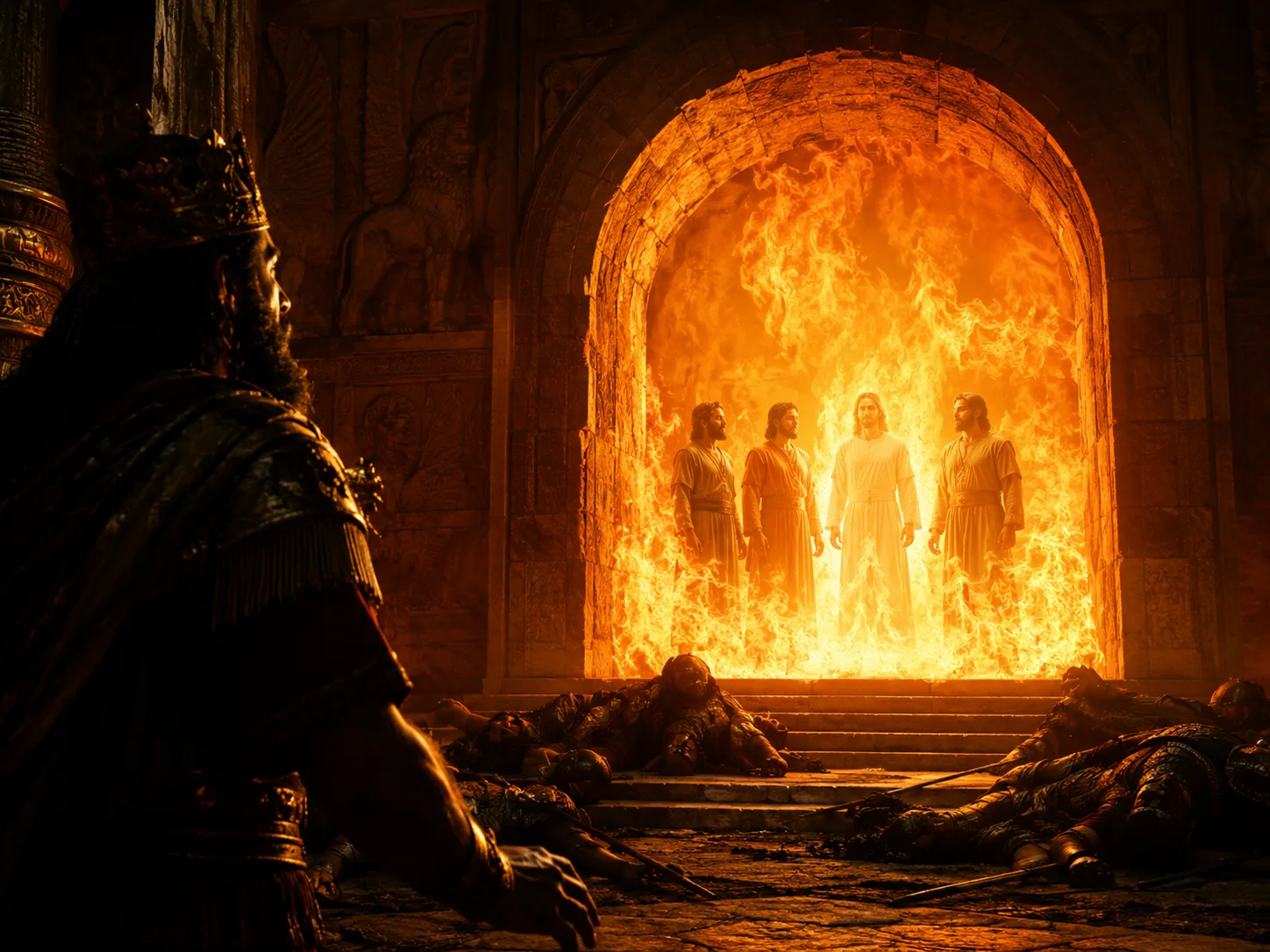
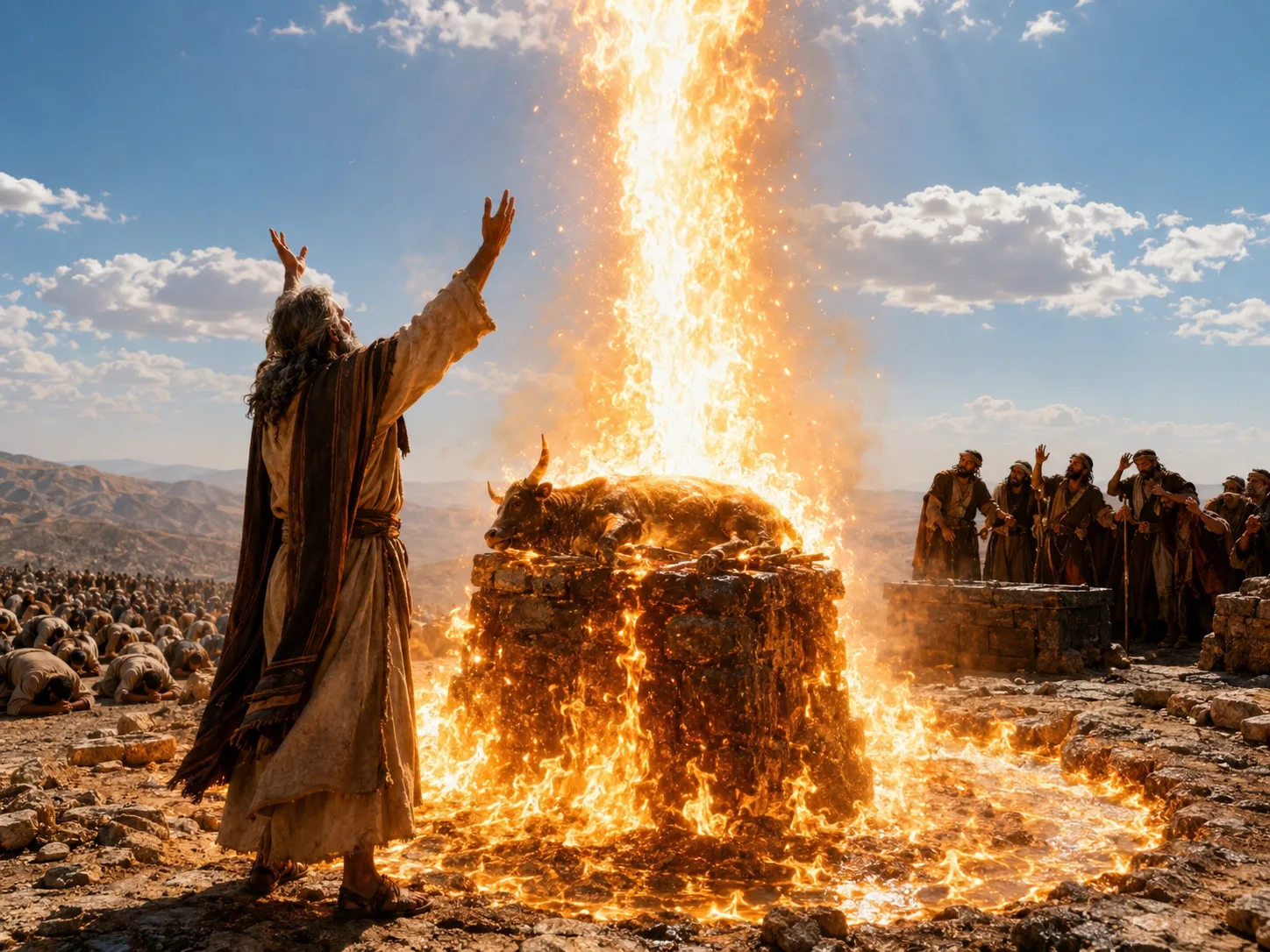

Nebuchadnezzar set up a golden image and commanded the whole world to worship it at a certain time. When three Hebrews refused, he asked the question this study takes as its title: “who is that God that shall deliver you out of my hands?” (Dan 3:15). The question echoes through Scripture and lands again at the close of history. Revelation 14 records another command to worship at a certain time — but this time it comes from heaven, and it points the world to the right God. The two scenes mirror each other deliberately. Read together, they answer the deepest question of the end-time crisis: who is the true God, and how is He identified?
This study takes that question seriously. It is the question on which the gospel turns, on which the Sabbath turns, and on which the mark of the beast turns. It is also the question on which the Seventh-day Adventist movement itself once turned — and from which, in the twentieth century, that movement was systematically turned away. The history matters. The doctrine matters. The pastoral edge matters most.
The image and the question
Daniel 3 opens with Nebuchadnezzar’s image. Sixty cubits high, six cubits broad, gold from head to foot. The previous chapter had shown the king a statue of descending metals — gold, silver, bronze, iron, iron mixed with clay — to teach humanity that the kingdoms of men deteriorate and that only God’s everlasting kingdom will stand. Nebuchadnezzar’s response was to remake the prophecy with the whole statue cast in gold, so that the lesson would be lost in the spectacle.
At the dedication of the image, a herald cried aloud: at the sound of the music, every nation and language was to fall down and worship. Three Hebrews refused. Brought before the king, they answered without negotiating. Then Nebuchadnezzar asked the question:
“Who is that God that shall deliver you out of my hands?”
Daniel 3:15, KJV
The question is not idle. It is the question every command to false worship eventually forces. And the deliverance God then gave — bringing the three out of the furnace untouched, walking with them in the fire — was the answer in advance for every worshipper afterward who would have to give the same answer in the same kind of furnace.
A sign that identifies
When God set apart a people for Himself, He gave them a sign by which the true God could be known from every false god. The sign was the Sabbath.
“Hallow my sabbaths; and they shall be a sign between me and you, that ye may know that I am the LORD your God.”
Ezekiel 20:20, KJV
The Sabbath is not a free-standing rule. It is a sign. It identifies. Specifically, it identifies the One God it points to — and the fourth commandment is exact about which God that is:
“For in six days the LORD made heaven and earth, the sea, and all that in them is, and rested the seventh day: wherefore the LORD blessed the sabbath day, and hallowed it.”
Exodus 20:11, KJV
The Sabbath identifies God as Creator. Among all the gods worshipped in the ancient world — and there were many — only one had made the heavens and the earth. The Sabbath marks Him out. This is why Revelation 14:7 echoes Exodus 20:11 word for word: “worship him that made heaven, and earth, and the sea, and the fountains of waters.” The first angel calls every nation back to the Creator the Sabbath has always pointed to.
A sign loses its meaning when it is detached from what it signifies. A man can keep the day perfectly and miss the God it identifies — exactly as Israel kept the temple sacrifices for centuries without seeing the Messiah they pointed to. The Sabbath, given to identify the true God, can be kept while the worshipper has accepted a substituted God in his mind. That is the situation this study has to address.
The Bible names the true God
The New Testament names the true God plainly.
“And this is life eternal, that they might know thee the only true God, and Jesus Christ, whom thou hast sent.”
John 17:3, KJV
This is Christ’s own definition of eternal life. To know the only true God — and Jesus Christ, the One He has sent. Two distinct identities. The only true God is the One the Son addresses as Father; Jesus Christ is the One the Father has sent. The grammar will not bear another reading.
Paul says the same.
“But to us there is but one God, the Father, of whom are all things, and we in him; and one Lord Jesus Christ, by whom are all things, and we by him.”
1 Corinthians 8:6, KJV
One God: the Father. One Lord: Jesus Christ. The two are not interchangeable; they are named distinctly. The Father is the only true God in the primary sense. The Son is the Lord through Whom the Father acts.
This does not diminish the Son. It identifies Him. The Son is Who He is because He was brought forth from the Father — the only begotten of the Father, before any created thing existed (Prov 8:22–25; John 1:1, 14; Mic 5:2). He shares the Father’s nature by inheritance, possessing divine life by gift (John 5:26), and is the express image of the Father’s person (Heb 1:3). The companion study,
“The Divinity and Sonship of Christ,” develops that case at length. For the purposes of this article it is enough to note the structure: the Father is the only true God in the primary sense (the source); the Son is fully divine by inheritance from the Father (the only begotten); the Holy Spirit is the personal presence and mind of God Himself extending into the believer (1 Cor 2:11; John 14:18; 2 Cor 3:17). The Bible names two persons in the Godhead, not three — and the “Spirit of God” is, in Scripture, the Spirit that is of God, the Spirit of the Father and of the Son, never a third co-equal person.
The historical Adventist witness
This was the position of the Seventh-day Adventist movement from its founding until the mid-twentieth century. It was not a fringe view recovered by later zealots; it was the formal teaching of the body. The 1872 and 1889
Fundamental Principles of Seventh-day Adventists — drafted by Uriah Smith and published with James White’s approval — stated the position openly. The first principle named “one God, a personal, spiritual Being, the creator of all things, omnipotent, omniscient, and eternal.” The second principle named “the Lord Jesus Christ, the Son of the Eternal Father, the one by whom God created all things, and by whom they do consist.” The Father, and the Son. Not three persons of one substance. Not a metaphorical Father and a metaphorical Son. The historical pioneer position was a real Father and a really begotten Son.
James White, Joseph Bates, J. N. Andrews, Uriah Smith, J. N. Loughborough, R. F. Cottrell, E. J. Waggoner, A. T. Jones — and Ellen G. White herself — all wrote in defense of this position at various points. Ellen White wrote of Christ:
God so loved the world, that he gave his only begotten Son — not a son by creation, as were the angels, nor a son by adoption, as is the forgiving sinner, but a son begotten in the express image of the Father’s person, and in all the brightness of his majesty and glory, one equal with God in authority, dignity, and divine perfection. In him dwelt all the fullness of the Godhead bodily.
In another place she wrote of the Father “tearing from his bosom him who was made in the express image of his person, and sending him down to earth to reveal how greatly he loved mankind.” The language is exact. Christ is a Son begotten — brought forth from the Father’s own person, made in the Father’s express image, sharing the Father’s nature. He is not a son by creation. He is not a son by adoption. He is not a son by metaphor.
1888 — when the Sabbath was joined to the Son’s righteousness
In 1888, at the General Conference session in Minneapolis, two younger ministers — E. J. Waggoner and A. T. Jones — preached a message on the righteousness of Christ. The message was simple: salvation comes by faith in the perfect obedience of Jesus Christ, not by the believer’s own keeping of the law.
The message was controversial. A large portion of the SDA leadership rejected it. Ellen White stood with Waggoner and Jones and spent the rest of her ministry pressing the church to receive what had been preached at Minneapolis. She called it “the third angel’s message in verity.”
The connection to the Sabbath is the heart of this article. The Sabbath is the sign that we rest from our own works in the finished work of God’s Creator. By faith in the righteousness of Christ — the Son’s perfect obedience credited to the believer — we cease from our own works exactly as God ceased from His on the seventh day of creation. The Sabbath day is the weekly enactment of righteousness by faith. Reject the righteousness, and the day loses what it was given to teach.
Waggoner wrote, in plain words:
The true keeping of God’s Sabbath, therefore, instead of being an attempt to get righteousness by works, is the acceptance of righteousness by faith. The third angel’s message is righteousness by faith, for the Sabbath is righteousness by faith.
When the 1888 message was rejected, the Sabbath did not disappear from the corporate Adventist calendar. The day remained. What lost ground was the inner significance — the connection to the Son whose righteousness the day was given to memorialize. The pattern then matched the Jewish pattern of the first century: the day kept, the substance unseen. And as the inner connection to the Son weakened, the doctrine of who the Son and the Father actually are could be quietly revised without the loss being noticed.
The pivot of the twentieth century
The transition of the corporate Seventh-day Adventist Church from its founding doctrine of God to the Trinitarian doctrine it now holds is a matter of public record. The dates and the documents are not disputed.
- 1872 and 1889 — The Fundamental Principles are published. They are non-Trinitarian, name the Father as the one God, and name the Son as His begotten.
- 1915 — Ellen White dies. The non-Trinitarian witness loses its most authoritative living voice within the denomination.
- 1931 — The Yearbook prints, for the first time, a Fundamental Beliefs statement with explicitly Trinitarian wording. The statement was drafted by F. M. Wilcox without a vote of the General Conference in session.
- 1946 — The Yearbook statement is endorsed by the General Conference session.
- 1955–1956 — SDA leaders — chief among them LeRoy Edwin Froom — meet repeatedly with the evangelical scholars Walter Martin and Donald Grey Barnhouse, working toward a doctrinal statement that will position Seventh-day Adventism inside mainstream evangelical Protestantism on the Trinity, the nature of Christ’s atonement, eternal punishment, and the role of Ellen White’s writings.
- 1957 — The book Seventh-day Adventists Answer Questions on Doctrine (commonly “QOD”) is published as the public outcome of those conferences. It is the formal Trinitarian alignment. Walter Martin subsequently certifies SDA as an evangelical church rather than a “cult.”
- 1971 — LeRoy Froom publishes Movement of Destiny, his book-length account of the doctrinal change. He describes the shift candidly, names the pioneers as non-Trinitarian, and treats the transition as a maturing of the movement.
- 1980 — At the General Conference session in Dallas, the Seventh-day Adventist Church formally adopts 27 Fundamental Beliefs. Belief #2, “The Trinity,” reads in part: “There is one God: Father, Son, and Holy Spirit, a unity of three coeternal Persons.” The 1872 Fundamental Principles is no longer in any official catechism.
These dates establish the substance. The corporate body now teaches a doctrine of God which the pioneers — including Ellen White — did not teach. The historical transition is documented; what is in dispute is whether the new position is the gospel position.
LeRoy Froom
LeRoy Edwin Froom (1890–1974) was the most consequential single figure in this transition. He edited Ministry magazine (the SDA pastors’ journal) for twenty-two years, served as the principal Adventist representative in the Martin–Barnhouse conferences, was the lead author of Questions on Doctrine, and wrote Movement of Destiny as the public history of the change. The reason he matters to this article is not personal. It is documentary. Without him the doctrinal shift would have looked very different. His own words establish that the shift was deliberate, sustained over decades, and aimed at aligning Seventh-day Adventism with mainstream Protestant Trinitarian orthodoxy.
In Movement of Destiny, Froom describes the pioneers’ Godhead position frankly. He concedes that the founders held a non-Trinitarian view, that the doctrine of the Trinity as held by historic Christendom was not part of early Adventist teaching, and that the shift to the modern Adventist Trinitarian formula was the result of editorial and theological work carried out by named individuals over the first half of the twentieth century. He saw the shift as progress. He did not hide his role in it.
The reader is invited to read Movement of Destiny directly. It is in print and the relevant chapters are accessible. The doctrinal history this article describes is not assembled from hostile speculation about the corporate church; it is summarised from a book the corporate church’s own most important twentieth-century theologian wrote.
The Jesuit question
A separate claim circulates among non-Trinitarian Adventists: that Froom was Jesuit-trained, or even a Jesuit himself. The claim is made with some frequency. Its evidence, as commonly presented, is circumstantial — that he worked toward doctrinal alignment with Rome on the Trinity, that his Prophetic Faith of Our Fathers relied on Catholic-friendly sources, that the softening of Adventist distinctives in Questions on Doctrine mirrored mid-century Catholic-influenced evangelical sensibilities. None of these is the kind of evidence that would establish a man’s formal religious affiliation.
This study will not assert that Froom was a Jesuit. The documentary record does not establish it, and an article that depends on an unproven personal accusation will not persuade a careful reader to reconsider the doctrinal substance. The question gets asked and is left honestly open here.
What the documentary record does establish — and what is enough — is that Froom led the largest doctrinal change in Seventh-day Adventist history, and that the change moved the church toward the central doctrine of the very religious system the pioneers had labored to distinguish their movement from. Whether the move came from sincere theological conviction, from the pressure of mid-century evangelical respectability, or from any other source is a secondary question. The result is in the Yearbook. The substance is what matters.
And the substance is what the rest of this article addresses.
Daniel 3 and Revelation 14
Return now to the central parallel.
In Daniel 3, a worldwide command is issued — “people, nations, and languages” — to fall down and worship the golden image at a certain time. The time is the signal. The day is the trigger. Whoever refuses to worship at that time is to be cast into the furnace.
In Revelation 14, an angel flies in the midst of heaven with the everlasting gospel, calling “every nation, and kindred, and tongue, and people” to worship — for the hour of His judgment is come. The time again is named. The day again is the signal. And the command is exact: “worship him that made heaven, and earth, and the sea, and the fountains of waters” (Rev 14:7) — quoting the fourth commandment.
The two scenes mirror each other so precisely that the parallel is unmistakable. Same audience: every nation, tongue, people. Same structure: a command to worship at a designated time. Same consequence for refusal: in Daniel 3, the furnace; in Revelation 13:15, death. Same theological core: the question of who is being worshipped.
In Daniel 3 the time of the music was a sign that the worship was of the golden image. In Revelation 14 the time of the judgment hour is the sign that the worship is of the Creator. In both cases the time names the God. Where the worshipper falls down is what he has chosen.
The day and the doctrine behind it
The Sabbath is the time God designated to be a sign of His own worship as Creator. Sunday is a time Rome openly claims as the sign of her authority over the law.
Sunday is our mark of authority. The Church is above the Bible; and this transference of Sabbath observance is proof of that fact.
(The Catholic Record, 1923.) The day is the visible sign of which God the worshipper has chosen.
But Rome also names the foundational doctrine from which Sunday derives. Receive the doctrine and the day follows; receive the day and the doctrine is what is honoured. The Catechism of the Catholic Church is explicit on which doctrine sits at the centre of the system:
The mystery of the Most Holy Trinity is the central mystery of Christian faith and life. It is the mystery of God in himself. It is therefore the source of all the other mysteries of faith, the light that enlightens them. It is the most fundamental and essential teaching in the hierarchy of the truths of faith.
(Catechism of the Catholic Church, §234.) So the doctrine grounds the day, and the day is the visible sign of the doctrine. To receive Rome’s day is to receive — at the level of structure — Rome’s God.
The mark of the beast, then, is not merely the day. Revelation 13:17 names three categories of allegiance: “the mark, or the name of the beast, or the number of his name.” Three angles on one allegiance. The Trinity is the name of blasphemy on the beast’s heads (Rev 13:1); Sunday is the visible mark of allegiance to that god; and Vicarius Filii Dei, the Pope’s title, totals 666 in Roman numerals. The day, the doctrine, the title. Three identifiers for the same chosen God.
Forehead and hand
The mark is given “in their right hand, or in their foreheads” (Rev 13:16). The locations are not arbitrary. The forehead is the seat of conscious thought. The hand is the seat of practiced action. A person may accept the substituted God in mind without yet performing the substituted worship in practice. A person may also keep the correct day in practice while having already accepted the substituted God in mind.
This is the situation Adventism’s history has produced. A community that keeps the seventh day in the hand and has, by official statement since 1980, accepted the Trinitarian doctrine in the forehead. The day is correct. The God the day was given to identify has been quietly replaced.
The sealing of Revelation 7 mirrors the same two locations in reverse. The seal of God is “in their foreheads” (Rev 7:3) — the mind settled in the right God. The 144,000 stand on Mount Zion with “his Father’s name written in their foreheads” (Rev 14:1). Not the Trinitarian formula. The Father’s name. The identity of the only true God, inscribed in the conscious worship of His people.
Ellen White’s warning
Ellen White wrote, around 1903, of a future when leaders within Adventism would seek to “reorganize” the church on principles different from those that had built it:
The enemy of souls has sought to bring in the supposition that a great reformation was to take place among Seventh-day Adventists, and that this reformation would consist in giving up the doctrines which stand as the pillars of our faith, and engaging in a process of reorganization. Were this reformation to take place, what would result? The principles of truth that God in His wisdom has given to the remnant church, would be discarded. Our religion would be changed. The fundamental principles that have sustained the work for the last fifty years would be accounted as error.
(Selected Messages, Book 1, pp. 204–205.) The “fifty years” were the years from approximately 1853 to 1903 — the decades during which the 1872 and 1889 Fundamental Principles were drafted, defended, and lived by. Those are the principles the warning names. Their non-Trinitarian content is what would be accounted error.
She continued, in the same passage:
The Sabbath, of course, would be lightly regarded, as also the God who created it. Nothing would be allowed to stand in the way of the new movement. The leaders would teach that virtue is better than vice, but God being removed, they would place their dependence on human power, which, without God, is worthless. Their foundation would be built on the sand, and storm and tempest would sweep away the structure.
Read in light of what has actually transpired in the corporate movement, the warning lands with weight. The day is technically still kept. The God Who created it — the only true God of John 17:3 and 1 Corinthians 8:6 — has been, in official statement, replaced by a Trinitarian formula not present in the pioneer faith. The day is the hand; the doctrine is the forehead. Both belong to the question Nebuchadnezzar asked.
The question Nebuchadnezzar asked
A reader may be tempted to treat this study as a polemic. It is not. It is a question — Nebuchadnezzar’s question — addressed to the conscience of every Christian who has ever opened the Bible.
“Who is that God that shall deliver you out of my hands?”
Daniel 3:15, KJV
The Bible answers without ambiguity. The Father is the only true God (John 17:3). The Son is His only begotten, brought forth from the Father before any created thing (John 1:1; Prov 8:22–25; Mic 5:2), sharing the Father’s nature by inheritance (Heb 1:3), possessing divine life by gift (John 5:26). The Holy Spirit is the personal presence and mind of the Father and the Son extending into the believer (1 Cor 2:11; John 14:18; 2 Cor 3:17). A real Father. A really begotten Son. The Spirit that is the very life of both, given to be in His people.
Eternal life is in this Son.
“He that hath the Son hath life; and he that hath not the Son of God hath not life.”
1 John 5:12, KJV
Eternal life is not in a doctrinal formula. It is not in a denominational membership. It is in the actual Son of the actual Father — the only true God Whom Christ alone can reveal. This is the gospel. It is also what the Sabbath was given to identify. It is what Daniel 3 dramatised in pre-figure. It is what Revelation 14’s three angels carry to every nation at the end. The whole structure of biblical religion is built on the right answer to Nebuchadnezzar’s question.
The answer is the Father. And His only begotten Son.
Scripture summary
The biblical passages on which this study rests:
- Daniel 3:1–25 — The image, the command to worship at a certain time, the question Nebuchadnezzar asked, the deliverance of the three Hebrews.
- Exodus 20:8–11 — The fourth commandment. The Sabbath identifies God as Creator.
- Ezekiel 20:12, 20 — The Sabbath as a sign “that ye may know that I am the LORD your God.”
- John 17:3 — Eternal life is to know the only true God — the Father — and Jesus Christ Whom He sent.
- 1 Corinthians 8:6 — One God, the Father; one Lord, Jesus Christ.
- Proverbs 8:22–25 — The Wisdom of God — Christ pre-incarnate — speaking of being brought forth from the Father before any creature.
- John 1:1, 14 — The Word in the beginning with God; the Word made flesh, the only begotten of the Father.
- Micah 5:2 — The Son Whose goings forth have been from of old, from everlasting.
- Hebrews 1:3 — The Son as the brightness of the Father’s glory and the express image of His person.
- John 5:26 — As the Father has life in Himself, so He has given to the Son to have life in Himself.
- Revelation 13:16–18 — The mark, the name, and the number of the beast — three identifiers of one allegiance.
- Revelation 14:6–12 — The three angels’ messages, the call to worship the Creator, the warning against the mark.
- Revelation 14:1 — The 144,000 with the Father’s name written in their foreheads — the inverse of the mark.
- 1 John 5:11–12 — God has given to us eternal life, and this life is in His Son.
Sources and further reading
On the doctrinal history summarised in sections 4–8:
- Fundamental Principles of Seventh-day Adventists (1872, 1889) — Drafted by Uriah Smith; published with James White’s approval. Reproduced widely; the 1872 edition is the simpler statement.
- LeRoy E. Froom, Movement of Destiny (Review and Herald, 1971) — Froom’s own account of the doctrinal transition. The relevant chapters openly describe the non-Trinitarian position of the pioneers and the editorial work by which the modern Trinitarian formula was put in its place.
- Seventh-day Adventists Answer Questions on Doctrine (Review and Herald, 1957) — The book published out of the 1955–56 conferences with Walter Martin and Donald Grey Barnhouse; the formal Trinitarian alignment.
- 27 (later 28) Fundamental Beliefs — Adopted 1980, Dallas. Belief #2, “The Trinity.” The replacement of the 1872/1889 Fundamental Principles in the corporate Adventist catechism.
- Ellen G. White, Selected Messages, Book 1, pp. 204–205 — The “new movement” / “reorganization” warning passage cited in section 12.
- Ellen G. White, Signs of the Times, May 30, 1895 — The “a son begotten in the express image of the Father’s person” passage cited in section 4.
- E. J. Waggoner, The Glad Tidings (Pacific Press, 1900) — The clearest summary of the 1888 message’s connection between the Sabbath and the righteousness of Christ.
A companion study on this site develops the divinity of the Son specifically: “The Divinity and Sonship of Christ,” under /doctrine/divinity-of-christ. The argument here and the argument there are two halves of one biblical doctrine — the Father, and the Son the Father has given.