In brief
David and Solomon are not legendary. The archaeology has been arriving since 1868.
For most of the twentieth century, a school of biblical studies known as minimalism argued that the United Monarchy of Israel under David and Solomon was a theological fiction composed centuries after the fact — that there had been no King David, no Solomonic kingdom, no tenth-century-BC capital at Jerusalem, no organised Israelite state larger than a tribal chiefdom. The difficulty for this position is that the archaeological record refuses to cooperate with it. Between 1868 and the present, six independent lines of evidence have surfaced, each of which on its own substantially corroborates the biblical record of the United Monarchy, and which together render the minimalist hypothesis indefensible.
This article catalogues those six: the Tel Dan Stele’s ninth-century Aramaic reference to the “House of David,” the Mesha Stele’s second independent reference to the same dynasty in the same century, Eilat Mazar’s excavation of a massive tenth-century public building on the summit of the City of David, Yosef Garfinkel’s fortified tenth-century Judahite city at Khirbet Qeiyafa, Yigael Yadin’s identical six-chambered city gates at Hazor, Megiddo, and Gezer matching 1 Kings 9:15, and the Pharaoh Shoshenq I’s Karnak inscription recording his invasion of Israel and Judah in the fifth year of Solomon’s son Rehoboam, exactly as recorded in 1 Kings 14:25.
1. The minimalist challenge and what would settle it
The minimalist position in modern biblical archaeology, most prominently advanced by scholars such as Philip Davies and Thomas Thompson in the 1980s and 1990s and partially followed by Israel Finkelstein, holds that the figures of David and Solomon are theological constructions inserted into the biblical narrative by Persian-period or even Hellenistic-period editors. On this reading, the tenth century BC in Judah was a backwater of subsistence farmers; Jerusalem was a small village rather than a royal capital; and the United Monarchy under David and Solomon, which the Hebrew Bible places at approximately 1010–930 BC, simply did not exist as described.
What would falsify the minimalist position is straightforward. Any of the following would suffice: an extra-biblical inscription mentioning the dynasty by name, in or near the period the Bible places it; a tenth-century monumental building in the Judaean highlands of a scale incompatible with a tribal chiefdom; a tenth-century fortified Judahite city demonstrating organised state-level construction; or a corroborating Egyptian, Assyrian, or Moabite reference synchronising biblical events with externally-dated historical chronology. Each of the four would be significant. All four exist. The sections that follow set them out.
2. The Tel Dan Stele — “House of David” in stone
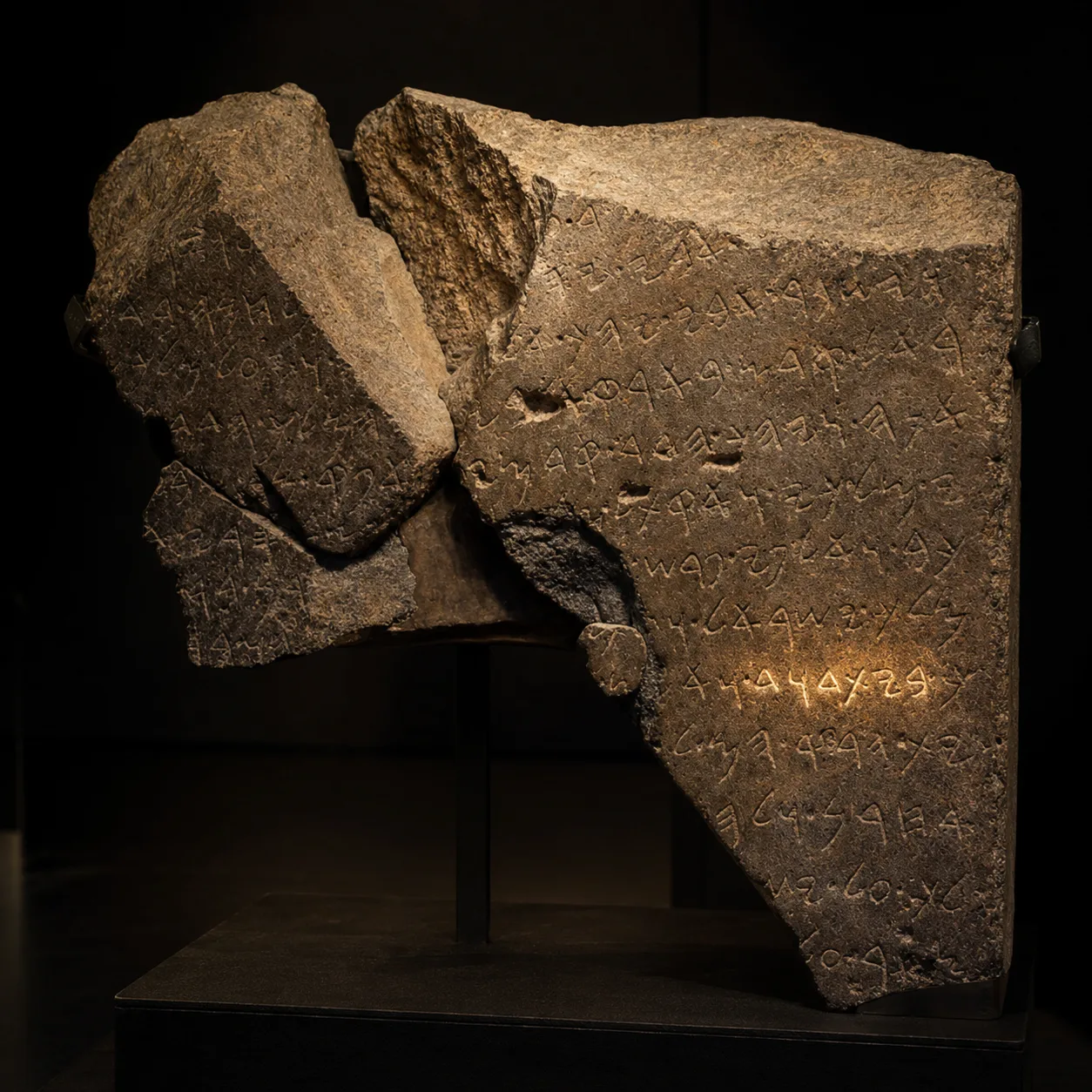
On the afternoon of 21 July 1993, Gila Cook, a surveyor working with the archaeological team of Avraham Biran at Tel Dan in the upper Galilee, noticed a flat basalt stone that had been reused as part of a Late-Iron-Age wall. The stone was inscribed. Two further fragments were recovered in June 1994. Together, the three fragments make up part of a triumphal monumental inscription, written in Old Aramaic, composed in the late ninth century BC by a king of Aram-Damascus — almost certainly Hazael, who is known from contemporary Assyrian sources and who appears by name in 2 Kings 8–13.
In the inscription, the Aramaean king boasts of killing two named royal figures: Jehoram, son of Ahab, king of Israel, and Ahaziah, son of [Jehoram], king of the House of David. The Aramaic phrase appears as BYTDWD — bēyt-dāwid, “the House of David.” This is not, in 9th-century Near Eastern usage, a metaphor; it is a standard dynastic-house formula, parallel to the Aramaic bēyt-omri, “the House of Omri,” which Assyrian inscriptions use to refer to the kingdom of Israel itself.
The implications are difficult to evade. An Aramaean king, writing in his own language for his own political purposes a hundred and fifty years after David’s death, names the kingdom of Judah by reference to its founding dynasty. He does not call it “Judah”; he calls it “the House of David,” using the same convention by which his contemporaries called Israel “the House of Omri.” David, on this inscription, was a real historical figure whose name the nations around Israel used to identify the kingdom he founded — in the same way they used Omri’s name to identify the northern kingdom. The minimalist account of David as a Persian-period invention cannot accommodate the Tel Dan Stele. The minimalist response, when the Stele was published, was largely to attempt to reread the inscription — proposals that the phrase bytdwd referred to a place-name, a temple, or an unknown deity — none of which have gained traction in the field.
3. The Mesha Stele — a second independent witness
In August 1868, the Anglican missionary Frederick Augustus Klein was led by a Bedouin guide to the ruins of ancient Dibon in modern Jordan, where he photographed an upright basalt stele inscribed in an early Moabite script. The stele was smashed by Bedouin tribesmen the following year in a dispute over its acquisition, but the French Orientalist Charles Clermont-Ganneau had taken a paper squeeze (impression) of the inscription before its destruction and was subsequently able to reconstruct the bulk of the text from the recovered fragments. The reassembled stele is held today in the Louvre.
The inscription is the longest Moabite text ever recovered and is a first-person memorial inscription by Mesha, king of Moab, dated to approximately 840 BC. Mesha records his rebellion against Israelite domination and names his oppressor by both personal name and dynastic-house formula: Omri, king of Israel… the House of Omri. The Omri reference is itself significant: Omri is a biblical figure, named in 1 Kings 16, recorded by Assyrian sources, and now attested by Moabite sources as well. The minimalists accept the Mesha Stele’s Omri reference without difficulty.
The more remarkable feature of the inscription, in line 31, is what the French epigrapher André Lemaire argued in a 1994 Biblical Archaeology Review article: that a damaged section of the stele preserves a second independent reference to the “House of David” (Moabite BT[D]WD), parallel in form and function to the inscription’s reference to the House of Omri. Lemaire’s reading was contested when first proposed but has gained substantial support over the intervening thirty years. In 2022, a new high-resolution digital analysis by Lemaire and Jean-Philippe Delorme, using photogrammetric reconstruction of the original squeeze, appears to have confirmed the reading. The Mesha Stele thus stands as an independent ninth-century witness to the dynasty — on a stone monument unconnected to Tel Dan, in a different language, written by a different king, from a kingdom hostile to Israel and Judah alike.
4. Eilat Mazar’s Large Stone Structure — a palace on the summit of Zion
In 2 Samuel 5:7–11, the biblical text records that after David captured the Jebusite stronghold of Zion, Hiram king of Tyre sent him cedar wood, carpenters, and stonemasons, and built him a palace on the captured summit. The summit of the City of David is a narrow rocky spur rising above the Gihon Spring on the eastern slope of Jerusalem. For decades the question of whether the biblical palace actually existed on this site, or had ever existed at all, was open. Beginning in February 2005, the late Israeli archaeologist Eilat Mazar — building on her own published hypothesis that the palace, if it existed, would be found at the northernmost end of the spur — began excavating.
She found it. Beneath Byzantine and Second-Temple-period debris, Mazar uncovered the foundations of an enormous public building: massive ashlar walls between two and two and a half metres thick, executed in finely-dressed stone of a type imported from Phoenicia, with decorative proto-Aeolic capitals consistent with elite royal construction. The structure rests upon and was supported by the so-called Stepped Stone Structure, a massive Iron-Age stone retaining wall covering the north-eastern slope of the spur and visible to visitors of the City of David today.
Mazar dated the building, on the basis of stratified pottery in the foundation fills and beneath the floors, to the tenth century BC — the very century the Bible places David. Subsequent excavation seasons uncovered, within the building, two bullae (clay seal impressions) bearing the names of court officials known from the book of Jeremiah: Jehucal son of Shelemiah (Jeremiah 37:3, 38:1) and Gedaliah son of Pashur (Jeremiah 38:1). The bullae confirm that the building remained in royal administrative use for centuries after its construction.
The structural interpretation has been challenged by some Israeli archaeologists, who have argued for a slightly later dating, or for treating the foundation walls as belonging to multiple separate structures rather than to one building. The substantive points are not in dispute: the building exists; it is enormous; it dates broadly to the early Iron II period; it sits exactly where 2 Samuel 5 places David’s palace; and its decorative scheme matches the kind of Phoenician royal construction the biblical text says Hiram of Tyre provided. Whether or not the building can be called “David’s palace” with technical archaeological precision, the minimalist claim that tenth-century Jerusalem was a village rather than a capital cannot survive the existence of the building. Villages do not build proto-Aeolic-capital ashlar structures of the size Mazar uncovered.
5. Khirbet Qeiyafa — a fortified Judahite city in David’s lifetime
Twenty miles south-west of Jerusalem, in the Elah Valley through which the brook ran where David is said to have slain Goliath, sits the fortified ruin known as Khirbet Qeiyafa. Beginning in 2007, Yosef Garfinkel of the Hebrew University and Saar Ganor of the Israel Antiquities Authority conducted seven seasons of excavation at the site. What they uncovered is the single piece of evidence most fatal to the minimalist position.
Khirbet Qeiyafa is a six-acre fortified city, surrounded by a casemate city wall built of unworked megalithic boulders weighing up to eight tons apiece. Within the walls, a planned residential quarter follows the casemate on a unified architectural scheme, with the houses sharing the city wall as their rear room — a layout known as the Judahite casemate plan and unique to the Judahite cultural sphere. The site has two monumental gates — unusual; most fortified cities of the period have one — which corresponds to the biblical place-name Sha’arayim (literally “two gates”), named in 1 Samuel 17:52 as the place of the Philistine flight after Goliath’s death.
Radiocarbon dating of burned olive pits recovered from the destruction layer of the city, performed at the Oxford Radiocarbon Accelerator Unit, dates the site to approximately 1050–970 BC: the lifetime of David. The faunal remains tell their own story: thousands of identifiable animal bones, but no pig — consistent with kosher dietary observance, the signature of an Israelite or Judahite population, and sharply distinct from contemporary Philistine sites, which preserve pig bones in substantial proportion. No idols or cult statues have been recovered, again consistent with the biblical prohibition of graven images and again sharply distinct from contemporary Philistine sites.
On Garfinkel’s reading — defended in his 2018 monograph Debating Khirbet Qeiyafa — the site is a tenth-century-BC Judahite border fortress built and administered from a centralised Judahite state. The construction effort required to raise the megalithic walls (an estimated 200,000 tonnes of stone moved by hand) is incompatible with a tribal chiefdom. It requires the organised labour resources of a state. And the state in question is, by every cultural indicator the site preserves — the casemate plan, the absence of pig, the absence of idols — specifically Judahite. A Judahite state with state-level construction capacity existed in the lifetime of David. That is what the site demonstrates.
6. The Solomonic gates at Hazor, Megiddo, and Gezer
1 Kings 9:15 records, with unusual administrative specificity, that the “levy which king Solomon raised” was used to build “the house of the LORD, and his own house, and Millo, and the wall of Jerusalem, and Hazor, and Megiddo, and Gezer.” Three of those cities — Hazor in the upper Galilee, Megiddo in the Jezreel Valley, and Gezer near the Coastal Plain — are major archaeological sites that have been intensively excavated in the modern period. Between 1957 and 1970, the Israeli soldier-archaeologist Yigael Yadin directed excavations at all three sites in succession.
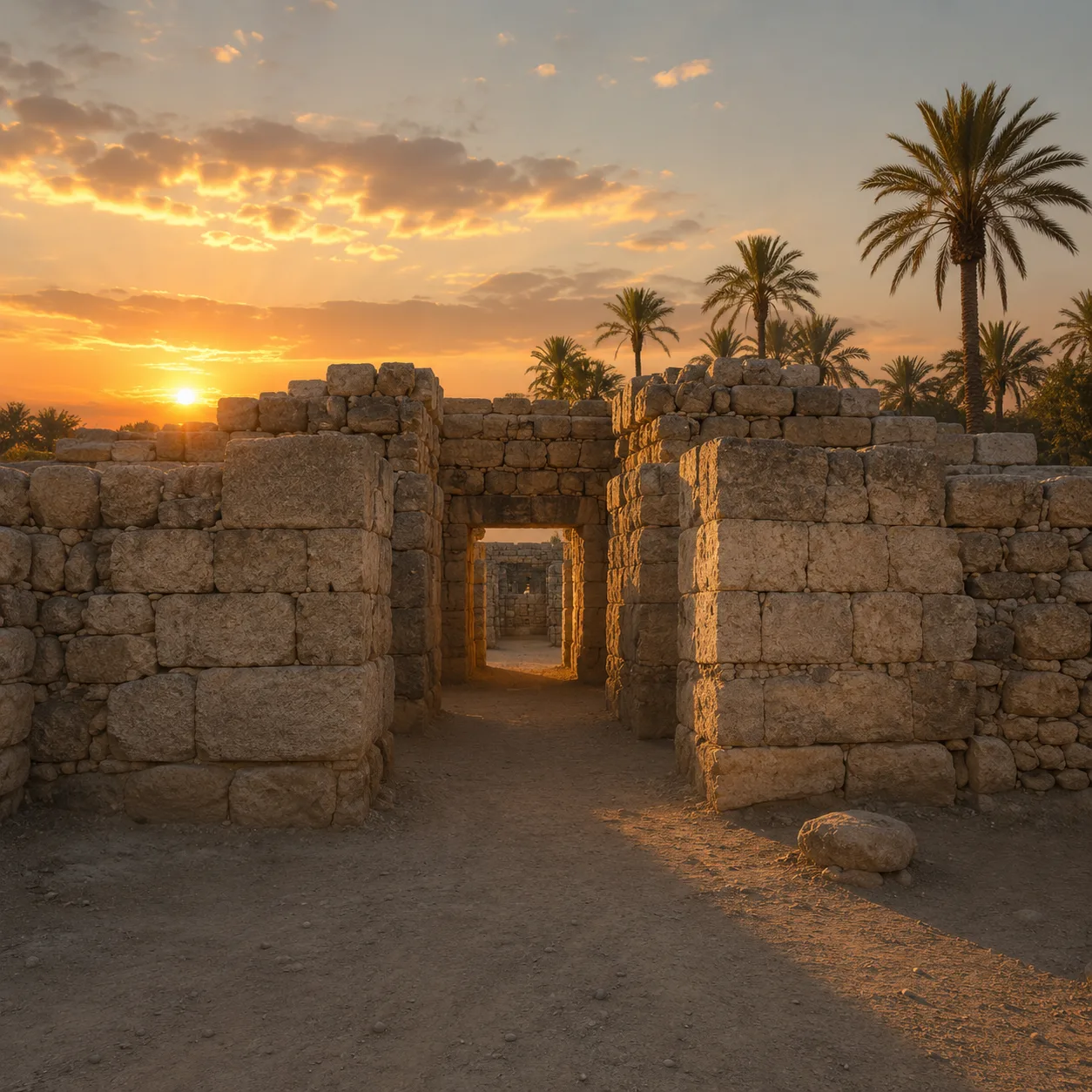
What Yadin found is one of the more remarkable coincidences in biblical archaeology — if it can be called a coincidence at all. At each of the three cities, in the Iron-Age IIA stratum, a six-chambered city gate had been built: three rooms on each side of an entryway, flanked by twin towers, of monumental dressed stone construction. The dimensions of the three gates are virtually identical: an inner width of 4.2 metres at all three sites, wall thickness of 1.6 metres at all three sites, with proportional consistency throughout. Yadin proposed the obvious inference: the three gates were built from a single architectural template by a single building programme — the same programme, mentioned in 1 Kings 9:15, by which Solomon fortified the three named cities.
Yadin’s dating has been contested. Israel Finkelstein in the late 1990s and early 2000s proposed, on the basis of pottery typology, that the gates date approximately a century later, to the time of the Omride dynasty. The dispute has been adjudicated, in part, by radiocarbon dating of organic samples recovered from beneath the gate foundations. Recent carbon-14 work at Gezer, published in 2023, has redated the Gezer gate to the early tenth century BC, consistent with Yadin’s original Solomonic attribution and inconsistent with Finkelstein’s lower chronology. Independent carbon-14 studies at Megiddo have produced results in the same range. The minimalist redating, on the present evidence, does not stand. The gates are what Yadin said they were: a single monumental construction programme commissioned by a tenth-century Judahite king with the administrative capacity to build at three major Israelite cities simultaneously.
7. Shoshenq I’s Karnak inscription — confirming Shishak’s invasion
Of all the synchronisms between the biblical record and external Egyptian history, the cleanest is the campaign of the pharaoh Shoshenq I — the founder of the Egyptian Twenty-Second Dynasty, whose name in Hebrew renders as Shishak (Shishaq, שִישַק) and who is named explicitly in 1 Kings 14:25–26 and 2 Chronicles 12:1–12. The biblical text records that “in the fifth year of king Rehoboam” — that is, approximately 925 BC by Egyptian dating — Shishak came up against Jerusalem and stripped the Temple and the royal house of their treasures.
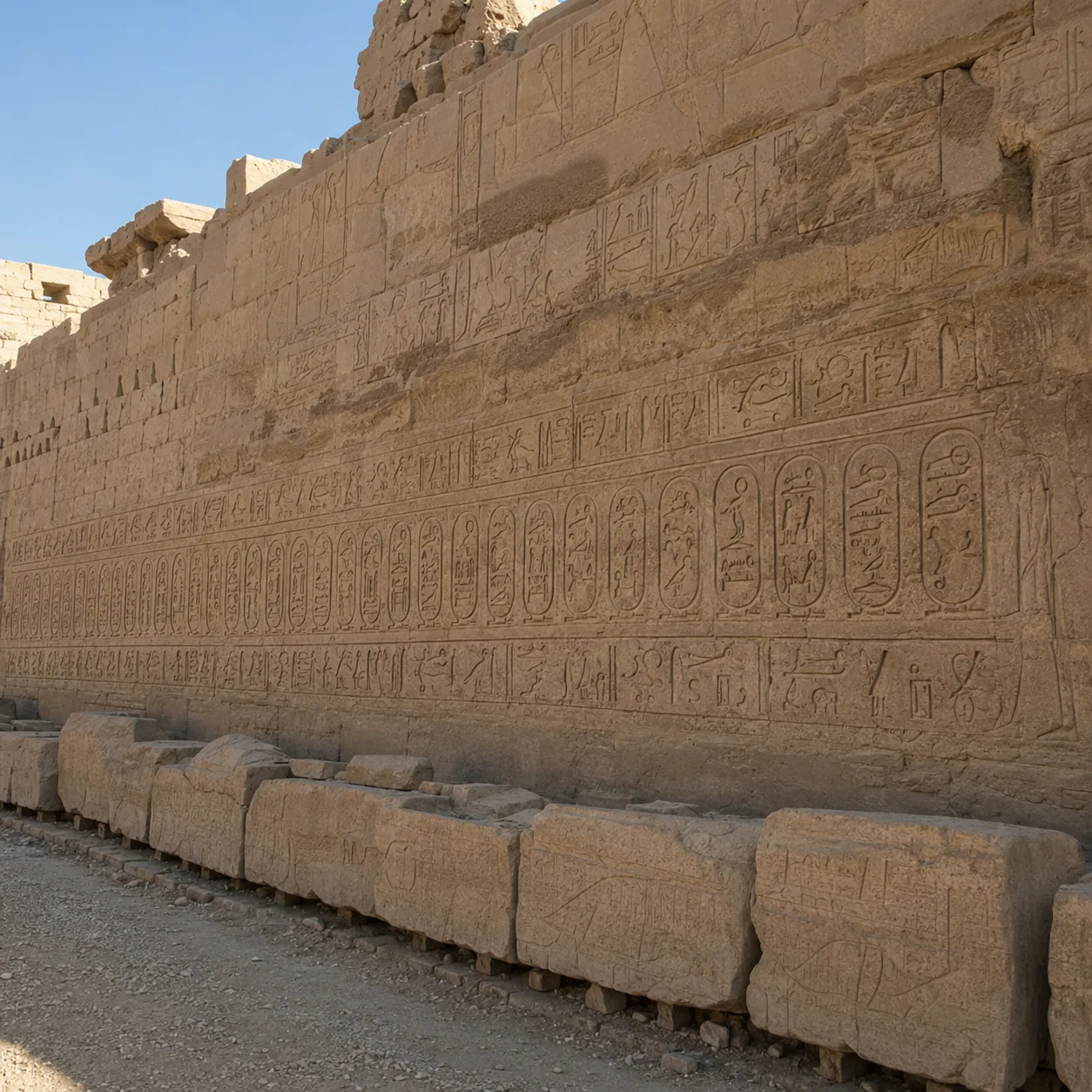
On the southern wall of the Bubastite Portal at the temple of Amun at Karnak, in Upper Egypt, Shoshenq I had carved a triumphal relief commemorating his own version of the same campaign. The relief depicts the pharaoh smiting his enemies before the god Amun, and behind the divine figure are arranged the names of more than one hundred and fifty conquered Levantine cities, each inscribed in a fortified oval cartouche representing a captured settlement. The list is the standard ancient-Egyptian topographical catalogue of a military campaign. Of the legible place-names, more than forty have been securely identified with cities known from the biblical record: Gibeon, Beth-horon, Aijalon, Megiddo, Taanach, Shunem, Beth-shean, Mahanaim, and dozens of others. The campaign route plotted from the surviving cities passes precisely through the Jezreel Valley and the central hill country — the heart of both Israel and Judah.
A separate fragment of a Shoshenq I victory stela was recovered at Megiddo itself, bearing the pharaoh’s cartouche — physical confirmation that he reached and took the city, exactly as the Karnak list indicates. Egyptian and biblical chronology converge on the year: 925 BC by independent astronomical synchronism from Egypt; the fifth year of Rehoboam by Israelite king-list chronology. The two sources, written independently in two languages for completely different audiences, describe the same campaign.
The Shoshenq inscription does not name Jerusalem in the surviving portion of the city list — though parts of the inscription are damaged, and various scholars have argued that the missing or eroded sections could have contained the Jerusalem reference. Even if it does not, the omission would be consistent with the biblical record: 2 Chronicles 12:7–8 records that Rehoboam paid Shishak off by surrendering the temple treasures, and that the LORD spared Jerusalem from outright destruction. A pharaoh who took tribute and withdrew without destroying the city would not normally list Jerusalem among his sacked cities. The synchronism between the biblical text and the Karnak relief stands on its own.
8. The cumulative case
The minimalist position required, at a minimum, that no ancient Near Eastern source outside the Hebrew Bible mention David, that no tenth-century Judaean state-level construction be uncovered, and that no synchronism between the biblical text and contemporary Egyptian, Aramaean, or Moabite history be securely established. By 1994, two independent dynastic-house references — one Aramaean and one Moabite — had surfaced. By 2007, tenth-century monumental construction had been excavated on the very summit of the City of David. By 2008, a fortified Judahite border city dating to David’s lifetime had been confirmed by carbon-14 at Khirbet Qeiyafa. By 2023, the Solomonic-gates dating at Gezer had been independently confirmed by carbon-14. And the Shoshenq synchronism at Karnak has stood as solid externally-dated history since the inscription was first read in the nineteenth century.
The minimalist hypothesis can survive the loss of one of these. It cannot survive the loss of all six. The cumulative case is closed: David was a real king of a real dynasty named for him in his own century; Solomon was his son and successor with the administrative capacity to build identically-planned royal cities across the northern kingdom; the United Monarchy existed; and the Egyptian pharaoh who plundered the Temple in the fifth year of Solomon’s son left a record of the plunder carved into the wall of his own temple, still legible today. The biblical record of 1 Samuel through 2 Chronicles, on these specific archaeological questions, is corroborated where it intersects the external record at every point on which the external record can speak.
Scripture testimony
The following passages anchor the archaeological discussion above. They are the biblical claims that the external record either confirms or contradicts:
- 2 Samuel 5:7
- Nevertheless David took the strong hold of Zion: the same is the city of David.
- 2 Samuel 5:11
- And Hiram king of Tyre sent messengers to David, and cedar trees, and carpenters, and masons: and they built David an house.
- 1 Kings 9:15
- And this is the reason of the levy which king Solomon raised; for to build the house of the LORD, and his own house, and Millo, and the wall of Jerusalem, and Hazor, and Megiddo, and Gezer.
- 1 Kings 14:25–26
- And it came to pass in the fifth year of king Rehoboam, that Shishak king of Egypt came up against Jerusalem: and he took away the treasures of the house of the LORD, and the treasures of the king's house; he even took away all: and he took away all the shields of gold which Solomon had made.
- 1 Samuel 17:52
- And the men of Israel and of Judah arose, and shouted, and pursued the Philistines, until thou come to the valley, and to the gates of Ekron. And the wounded of the Philistines fell down by the way to Shaaraim, even unto Gath, and Ekron.
Sources
- Avraham Biran and Joseph Naveh, “An Aramaic Stele Fragment from Tel Dan,” Israel Exploration Journal 43 (1993): 81–98; and Biran and Naveh, “The Tel Dan Inscription: A New Fragment,” Israel Exploration Journal 45 (1995): 1–18 — the original publications of the Tel Dan Stele.
- André Lemaire, “House of David: Restored in Moabite Inscription,” Biblical Archaeology Review 20:3 (May/June 1994): 30–37 — the original proposal of the Mesha Stele’s “House of David” reading; and André Lemaire and Jean-Philippe Delorme, “Mesha’s Stele and the House of David,” Biblical Archaeology Review 48:1 (2022) — the 2022 digital-photogrammetric confirmation.
- Eilat Mazar, “Did I Find King David’s Palace?” Biblical Archaeology Review 32:1 (January/February 2006); and Mazar, Preliminary Report on the City of David Excavations 2005 at the Visitors Center Area (Shoham, 2007).
- Yosef Garfinkel, Saar Ganor, and Michael G. Hasel, Debating Khirbet Qeiyafa: A Fortified City in Judah from the Time of King David (Jerusalem: Israel Exploration Society, 2018) — the full publication of the Qeiyafa excavation with detailed responses to minimalist counter-arguments.
- Yigael Yadin, “Solomon’s City Wall and Gate at Gezer,” Israel Exploration Journal 8 (1958): 80–86; and Yadin, Hazor: The Rediscovery of a Great Citadel of the Bible (Random House, 1975).
- Steven M. Ortiz et al., “Tel Gezer Excavations: New Carbon-14 Dating Evidence for the Tenth-Century BC Fortifications,” Bulletin of the American Schools of Oriental Research (2023) — the recent carbon-14 redating of the Gezer gate in support of the Yadin/Solomonic chronology.
- Kenneth A. Kitchen, The Third Intermediate Period in Egypt (1100–650 BC), third edition (Aris & Phillips, 1996) — the standard reference work on Shoshenq I and the Karnak campaign list, including the full transcription of the Bubastite Portal place-names.
- James K. Hoffmeier and Dennis R. Magary (eds.), Do Historical Matters Matter to Faith? A Critical Appraisal of Modern and Postmodern Approaches to Scripture (Crossway, 2012) — representative responses by mainstream conservative biblical scholarship to the minimalist programme, including chapters on the United Monarchy archaeology.