
Among the dietary teachings of the Bible, none is more widely dismissed in modern Christendom than the distinction between clean and unclean foods. The standard modern reading takes the clean/unclean categories of Leviticus 11 and Deuteronomy 14 as Jewish ceremonial law, abolished at the cross, and rendered irrelevant for the Christian under the new covenant. On that reading, Peter's vision in Acts 10 abolishes the food restrictions, Mark 7 declares all foods clean, Romans 14 leaves the matter to individual conscience, and 1 Timothy 4 sanctifies any creature received with thanksgiving. The matter is treated as closed.
Scripture itself does not treat the matter as closed. The clean/unclean distinction is older than Sinai by centuries — Noah carried the categories onto the ark four hundred years before Moses was born. The criteria of Leviticus 11 line up with categories of animal biology a four-thousand-year-old text could not have anticipated by guesswork. The four New Testament passages the modern reader assumes abolish the laws say something different when read in their own contexts. And the prophet Isaiah, looking forward to the day of the Lord, names swine-eating as one of the practices the judgment of God will consume. This article walks the whole subject in depth — the categories, the biology behind them, the New Testament texts, and the eschatological frame in which the question still stands.
Clean and Unclean Before Sinai
The first appearance of the distinction in Scripture is not in Leviticus. It is in Genesis 7, when God instructs Noah to load the ark:
"Of every clean beast thou shalt take to thee by sevens, the male and his female: and of beasts that are not clean by two, the male and his female. Of fowls also of the air by sevens, the male and the female; to keep seed alive upon the face of all the earth."
Genesis 7:2-3, KJV
The categories were already in operation. Noah knew which animals were clean and which were unclean. Four hundred years before Sinai, and at least seven centuries before the books of Moses were written, the distinction belonged to the human family as such — to all the children of Adam, not to any one tribe within them. After the flood, when Noah built the first post-deluge altar, he offered sacrifice "of every clean beast, and of every clean fowl" (Genesis 8:20). The unclean were not sacrificed because the unclean could not be set on the altar of God. The whole structure of the distinction predates the Mosaic law by centuries.
The cross-cultural witness confirms it. The Hindu Code of Manu, the legal-religious compendium of the pre-Christian Indian subcontinent, forbade the eating of carnivorous birds and of animals lacking the cloven hoof — the very criteria of Leviticus 11. The ancient Iranian dietary code restricted fish to those bearing both fins and scales. The peoples of the South Pacific inherited a prohibition on the eating of eel. Islamic law forbids pork and prescribes a method of slaughter very similar to the Jewish. The Navajo of North America, the Yakuts of northern Turkey, and the Sami of Scandinavia all hold ancestral prohibitions on swine flesh. These are not Jewish customs; they are scattered fragments of a pre-flood human inheritance, dispersed through the line of Noah's sons, and preserved in the religious memory of nations that have long since forgotten where the prohibition came from.
The distinction is not a Jewish law. It is a creation-grounded human inheritance, preserved across language families, and codified for Israel as a fragment of an older universal truth.
The Categories of Leviticus 11
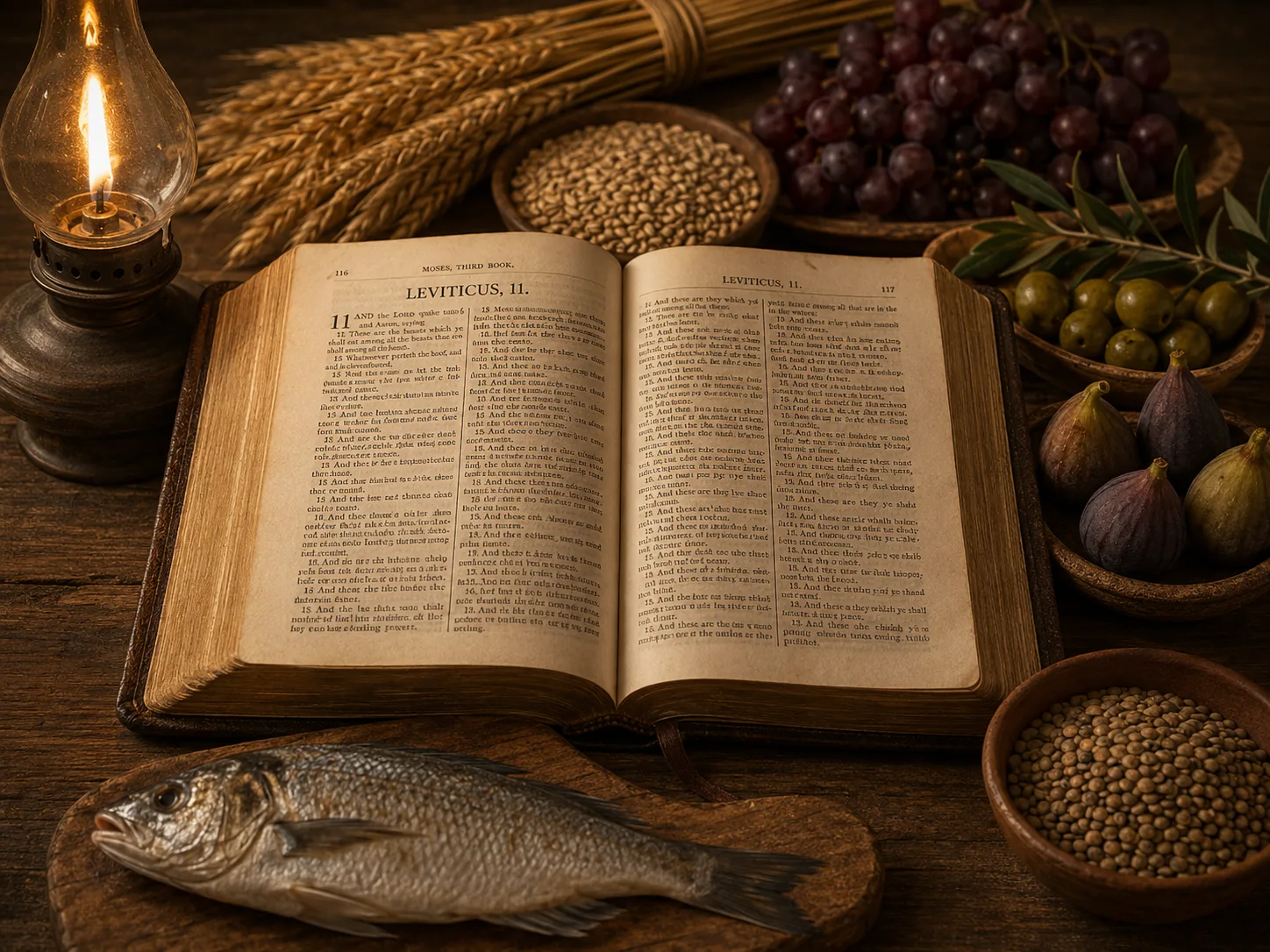
When the Mosaic law was given at Sinai, the distinction was set out in full. Leviticus 11 and Deuteronomy 14 give the criteria in four classes: land animals, water creatures, birds, and creeping things.
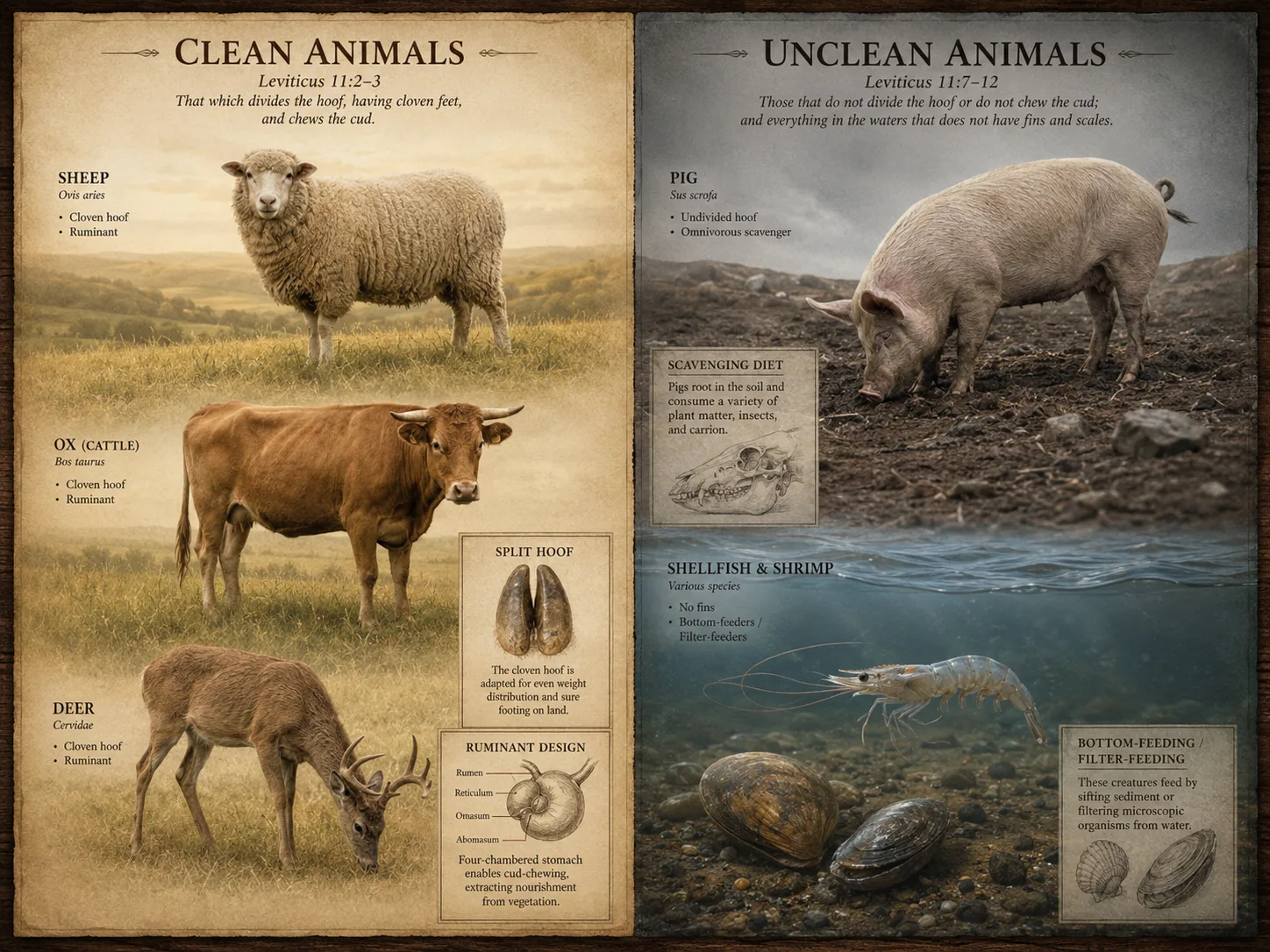
- Land animals. Whatsoever parteth the hoof, and is clovenfooted, and cheweth the cud, among the beasts — that ye shall eat (Leviticus 11:3). The two criteria are conjoined: both the cloven hoof and the chewing of the cud are required. The camel chews the cud but does not part the hoof; unclean. The coney and the hare chew the cud but do not part the hoof; unclean. The swine parts the hoof but does not chew the cud; unclean (Leviticus 11:4-7).
- Water creatures. Whatsoever hath fins and scales in the waters, in the seas, and in the rivers, them shall ye eat. And all that have not fins and scales in the seas, and in the rivers… they shall be an abomination unto you (Leviticus 11:9-12). Again the criteria are conjoined: both fins and scales are required. Catfish, eel, lamprey, and the smooth-skinned fishes are unclean. Sharks and rays are unclean. Shellfish, shrimp, lobster, crab, oyster, mussel, clam — all unclean. Squid, octopus, calamari — unclean.
- Birds. Leviticus 11:13-19 lists twenty unclean birds by name. They are the raptors and the scavengers — the eagle, the ossifrage, the ospray, the vulture, the kite, the raven, the owl, the night hawk, the hawk, the cormorant, the pelican, the stork, the heron, the lapwing, the bat. By contrast, the foraging birds — the chicken, the dove, the pigeon, the quail, the turkey, the goose, the duck — are not named in the unclean list and were eaten by the Israelites without restriction.
- Creeping things and insects. Most creeping things are unclean (Leviticus 11:29-31, 41-43). The exception is the locust family — "yet these may ye eat of every flying creeping thing that goeth upon all four, which have legs above their feet, to leap withal upon the earth; even these of them ye may eat; the locust after his kind, and the bald locust after his kind, and the beetle after his kind, and the grasshopper after his kind" (Leviticus 11:21-22). John the Baptist ate locusts (Matthew 3:4) — a permitted insect.
The criteria are exact and uncompromising. The Bible does not say a creature is unclean simply because it is unfamiliar or unattractive. Each category is determined by a precise anatomical or behavioural feature that has, under modern scientific analysis, turned out to track real biological differences in toxin load, digestive physiology, and nutritional safety. The remainder of this article walks those features class by class.
The Cloven Hoof and the Cud: Anatomy of the Clean Land Animal
The two criteria for clean land animals — cloven hoof and chewing the cud — pick out, in modern zoological terminology, the ruminants of the order Artiodactyla. Cattle, sheep, goats, deer, gazelles, antelope, bison, and the various wild bovids of the African savannah and the European forest all qualify. These animals share a distinctive anatomy: a four-chambered stomach (rumen, reticulum, omasum, abomasum) in which bacterial fermentation breaks down plant cellulose into digestible nutrients.
The process is elegant. The animal eats large quantities of vegetation — grasses, leaves, stems — which it could not digest on its own. The plant material enters the rumen, a large fermentation chamber populated by cellulose-digesting bacteria. The bacteria break down the cellulose, producing short-chain fatty acids that the animal can absorb, and they synthesise the B-vitamins and several essential amino acids that the plant material itself lacks. The animal regurgitates partially-fermented food (the "cud"), re-chews it to mechanically increase the bacterial access, and swallows it again. The food then passes from the rumen through the reticulum, omasum, and abomasum (the "true" stomach) to the intestine, where the digested nutrients — including the digested bodies of the fermentation bacteria themselves — are absorbed.
Two consequences follow. First, the ruminant occupies the lowest trophic level of the animal kingdom — it feeds directly on plants. It is at the very bottom of the food chain. The biological-magnification effect that concentrates environmental toxins in higher trophic levels is at its absolute minimum in the ruminant. Second, the fermentation product passes through the intestine only once, in the proper direction, with the fermentation bacteria themselves digested as part of the nutrient delivery. Waste products pass out the other end and are eliminated. There is no recirculation of waste through the digestive tract.
A creature with this anatomy is, on every modern metric of food safety, an unusually clean source of animal protein. Its tissues are low in environmental toxins, low in concentrated pollutants, low in the secondary metabolites that accumulate at higher trophic levels. The biblical criterion — cloven hoof and chewing the cud — identifies this category with high precision, four thousand years before the trophic-level analysis it tracks was scientifically articulated.
The Camel Problem: Why the Ruminant Anatomy Is Not Enough
The camel chews the cud. It has a rumen-like fermentation chamber (technically three-chambered rather than four, but functionally analogous). On the chewing-cud criterion alone, it should be clean. But the Bible names it unclean: "the camel, because he cheweth the cud, but divideth not the hoof; he is unclean unto you" (Leviticus 11:4). The camel has a broad, soft, paw-like foot, not a cloven hoof. Why does that detail matter?
The camel's anatomy reflects an adaptation to a desert environment — an environment that, on the biblical timeline, came into existence after the curse of Genesis 3 and the disruption of the pre-flood world. The camel's adaptations to that environment include the ability to tolerate substantial body-temperature increases without sweating, the ability to retain water in extreme conditions, and the ability to recycle urea (the waste-product of protein metabolism) back into its rumen, where the bacteria can re-incorporate it into amino acids. These adaptations are remarkable engineering. They also produce a meaningfully higher toxin load in the tissues of the animal. Where a cow excretes urea promptly and continuously through the kidneys, the camel retains it, recycles it, and runs higher tissue concentrations of the products of protein metabolism. The result is meat that, while perfectly suitable for the camel's own metabolism, carries a substantially higher load of nitrogenous waste than the meat of the cloven-hoofed ruminants.
The cloven-hoof criterion, in other words, is not a foot-design preference. It is a marker, in the Bible's economy, for the un-adapted, pre-fall ruminant — the animal whose physiology has not had to be modified to cope with the conditions of the post-fall world. The cloven hoof and the chewing of the cud, conjoined, identify the original mammalian herbivore. Animals that have been adapted to desert, scavenging, or carnivorous regimes — even when they retain some of the ruminant anatomy — fall outside the original category. The biblical criterion is exactly tuned to the distinction.
The Coprophages: Why the Hare, the Coney, and the Horse Are Unclean
A different set of unclean animals shares a different anatomical feature. The hare, the coney (rock hyrax in modern zoology), and the horse all "chew the cud" in a loose sense — they re-process plant material in their digestive tracts — but the fermentation in these animals happens at the wrong end of the intestine.
In ruminants, the fermentation chamber (the rumen) sits at the beginning of the digestive tract, before the small intestine. In the hare, the coney, and the horse, the fermentation chamber (the caecum) sits at the END of the small intestine, just before the colon. This is a meaningful difference. In the ruminant, the bacterial-derived nutrients are absorbed by the small intestine on the way out — efficient, single-pass nutrition. In the caecal fermenter, the nutrients produced by the fermentation are deposited at the END of the absorptive tract, downstream of the absorption. The only way to harvest those nutrients is to re-ingest the caecal contents from the other end.
And that is exactly what these animals do. The rabbit produces two distinct kinds of fecal pellets. The familiar hard pellets are the final waste, discarded. But the rabbit also produces a soft, mucus-coated cecotrope — the contents of the caecum, expelled separately, and consumed directly from the anus by the rabbit itself. This is the "chewing of the cud" of Leviticus 11:6 — the re-ingestion of pre-digested food. The hare, the coney, and the horse all engage in this practice; the technical name is coprophagy. It is not aberrant behaviour for these animals; it is the normal mechanism by which they extract bacterial nutrition from the caecal fermentation.
Coprophagy has a cost. Where the ruminant's digestive products pass through the absorptive small intestine in the proper direction, the caecal fermenter's products have already traversed the small intestine before being expelled and re-eaten. The cecotrope therefore carries with it secondary bile salts, accumulated metabolic waste, and other secondary products of intestinal passage that the ruminant's system does not. Some of these compounds are carcinogenic on long-term exposure. The Bible's distinction lines up exactly with this: ruminants, whose fermentation happens before the intestine, are clean; caecal fermenters, whose fermentation happens after, are unclean.
The Pig: Scavenger, Carrier, Allergen, Carcinogen
The most famous of the unclean animals is the pig. The pig parts the hoof but does not chew the cud — failing the conjoined criterion — and Scripture singles it out repeatedly as the type of the unclean (Leviticus 11:7-8; Isaiah 65:4; 66:17; Matthew 8:30-32; 2 Peter 2:22). The biological reasons run several layers deep.
- The pig is an omnivorous scavenger. Where the clean ruminant eats plant material at the bottom of the trophic ladder, the pig eats anything available — carrion, refuse, animal remains, plant matter, parasites, fungi, even feces. Biological magnification — the concentration of environmental toxins at higher trophic levels — operates strongly in the pig. Heavy metals, persistent organic pollutants, dioxins, and a wide range of secondary toxins accumulate at multiples of their environmental concentrations in pig tissues. The dioxin contamination scandal in Belgian pork in 1999 is the most public modern example; the underlying biology is permanent.
- The pig is a parasite reservoir. The pig hosts Trichinella spiralis (trichinosis), Taenia solium (the pork tapeworm, capable of producing fatal neurocysticercosis in humans), Ascaris suum (pig roundworm), and a wide range of other parasites that cross to human hosts through under-cooked or improperly handled pork. Modern industrial farming has reduced the incidence of some of these in commercial pork, but the species barrier remains thin and the parasitic load in wild and semi-wild pig populations remains high.
- The pig is a viral incubator. Pig physiology is close enough to human physiology that pig tissues serve as a mixing chamber for influenza viruses crossing the species barrier between birds and humans. The H1N1 "swine flu" of 1918 and 2009, the various avian-influenza outbreaks of the early twenty-first century, and the well-documented role of porcine hosts in influenza recombination all turn on this. Pig heart valves and pig pancreatic insulin have been used in medical procedures for decades, and the medical literature now documents porcine endogenous retroviruses (PERVs) as a class of pathogens that can theoretically be transmitted from porcine tissue to human recipients. The species-bridge function of the pig is no incidental fact; it is a built-in feature of pig physiology.
- Pig allergens and carcinogens. The flesh of pigs in the family Suidae carries a distinctive allergen profile, designated in the medical literature as the "pork-cat syndrome" and related cross-reactivities. The International Agency for Research on Cancer (WHO) classified processed meats — pre-eminently bacon, ham, and pork sausage — as Group 1 carcinogens in 2015, the same classification given to tobacco and asbestos. Red meat in general was classified as Group 2A (probably carcinogenic); processed pork in particular sits in the higher category.
No amount of cooking eliminates these factors. Cooking destroys most bacteria and many parasites. Cooking does not destroy the heavy-metal load, the dioxin load, the persistent organic pollutants, the secondary metabolites, the carcinogenic compounds, or the species-bridge potential of the porcine genome. The Bible's designation of the pig as unclean is not an arbitrary tribal taboo. It is a precisely-targeted health rule that modern food science has, over the past century, independently caught up with.
The Phytotoxic Index: An Experimental Confirmation
The most striking modern test of the biblical distinction is an experiment in plant toxicology. The procedure is straightforward: muscle extracts of various animal species are added to the growth medium of seedling plants (commonly Lupinus albus or similar legumes), and the resulting impairment of plant growth is measured. The percentage of normal growth achieved in the presence of the extract is called the phytotoxic index. An index of 100% means no impairment; an index of 60% means the plant grew at sixty percent of its normal rate when exposed to the extract.
The pattern is unmistakable. Muscle extracts from animals the Bible names clean — sheep, ox, goat, deer, calf — produce phytotoxic indices in the 82-94% range. The plants grow nearly normally. Muscle extracts from animals the Bible names unclean — dog, black bear, white rat, grizzly bear, pig, cat, groundhog, opossum, silver fox, hare, guinea pig — produce phytotoxic indices in the 62% range and below. The plants are substantially impaired in their growth.
The same pattern holds for fish. Bass, herring, pike, salmon, cod — all bearing fins and scales — produce relatively high phytotoxic indices. Sharks, porcupine fish, puffers, moonfish, catfish, eels — none bearing both fins and scales — produce substantially lower indices. The pattern holds for birds. Pigeon, duck, quail, coot, swan, goose, turkey — all foraging birds — produce high indices. Sparrow hawk, owl, crow, hawk — all raptors or scavengers — produce indices in the 60s.
The implication is direct. Tissues of the animals the Bible names unclean carry chemical compounds that demonstrably impair the growth of plants. Whatever those compounds are — secondary metabolites of high-trophic-level feeding, accumulated environmental toxins, carcinogenic by-products, hormone analogues — they are biologically active substances that interfere with cell division and developmental signalling. When the same tissues enter the human digestive tract, the same biologically-active compounds enter human metabolism. The biblical criterion is not arbitrary; it tracks a measurable physiological signal.
Fish: Fins and Scales
The biblical criterion for clean water creatures is conjoined: fins and scales (Leviticus 11:9-12). Both are required. The criterion picks out, in modern terminology, the bony fish of the class Osteichthyes in their normal scaled form. Several biological features make this category distinctive.
First, the bony fish with scales has an efficient osmoregulatory system. In a marine environment, where the surrounding water is saltier than the fish's tissues, the fish drinks seawater, processes it through specialised salt glands in the gills, and excretes the salt — keeping its internal salinity stable. In a freshwater environment, where the surrounding water is less salty than the tissues, the fish actively absorbs salt through the gills and produces large volumes of dilute urine. Either way, the salt and water balance is maintained without accumulation of toxic concentrations of either.
Second, the scaled fish is, at some life stage, herbivorous or near-herbivorous. Many bony fish are plankton-feeders as larvae, even when they shift to a more predatory diet as adults. This keeps the trophic-level concentration of toxins manageable. Third, the scaled fish has efficient detoxifying enzyme systems (cytochrome P450 and related) that handle metabolic and dietary toxins more cleanly than the simpler systems of cartilaginous or jawless fish.
The unscaled water creatures — sharks, rays, eels, catfish, lampreys, and the various smooth-skinned fish — are unclean by the biblical criterion, and the biology of each lines up. Sharks and rays solve their osmoregulation problem by retaining urea in their tissues at concentrations that would be toxic to other vertebrates; their tissue urea levels are the highest in the animal kingdom. The dried fins of a shark, processed for "shark fin soup," consist substantially of crystallised urea. Catfish and eels are scavengers, feeding at the bottom of rivers and lakes on detritus and decomposing organic matter; their tissues concentrate a wide range of environmental toxins. Lampreys are parasites. The criterion of fins-and-scales identifies, with high precision, the marine and freshwater organisms whose tissues are safest for human consumption.
A striking modern echo of the biblical criterion appears in military survival training. The standard U.S. Army survival manual — long published as FM 21-76 and continued in its successor FM 3-05.70 — and the parallel U.S. Navy and U.S. Air Force SERE (Survival, Evasion, Resistance, and Escape) curricula teach personnel stranded at sea to preferentially eat fish bearing both fins and scales. Scaleless fish, sharks, rays, jellyfish, and the colourful reef predators are flagged as carrying the higher toxin loads — tissue urea concentration in sharks and rays, ciguatera and scombroid in the reef and pelagic carnivores, heavy-metal bioaccumulation in the scavenging bottom-feeders — and are to be avoided whenever alternatives can be caught. The rule of thumb taught to U.S. military aviators, sailors, and special-operations personnel for use in open-water survival is the same rule Leviticus 11 set out three and a half millennia earlier. The convergence is not accidental. Both texts are responding to the same underlying biology, and both arrive at the same line.
Shellfish: The Filter-Feeders
A specific case within the water-creature category is the shellfish — shrimp, prawn, lobster, crab, crayfish, oyster, mussel, clam, scallop. None of these has scales. All are unclean by the biblical criterion. The biological reason is precise: the shellfish, collectively, are the filter-feeders and scavengers of the water column and the sea floor.
A single oyster filters roughly fifty gallons of seawater per day, concentrating in its tissues whatever is suspended in the water. A clam bed is, ecologically, the kidney of an estuary — a tissue designed to extract and accumulate the suspended biological and chemical material the water carries. When that water carries dinoflagellate blooms (the "red tide"), the shellfish accumulates the dinoflagellate toxins to lethal concentrations; deaths from paralytic shellfish poisoning are a permanent feature of the coastal medical record. When the water carries heavy metals, the shellfish accumulates the metals. When the water carries fecal coliforms, the shellfish accumulates the bacteria. The shellfish is doing exactly what the ecology designed it to do — purify the water column by trapping the suspended load in its tissues. The Bible's designation of the shellfish as unclean is precisely the designation of a creature whose biological role is to be the filter, not the food.
The crustaceans — shrimp, lobster, crab — are not filter-feeders in the strict sense, but they are scavengers of the sea floor, feeding on decomposing matter, dead fish, and the refuse of the marine ecosystem. Their tissues accumulate the same range of secondary toxins by the same mechanism of trophic concentration. The "luxury" status of shrimp and lobster in modern Western cuisine is no biological recommendation; the prices reflect market dynamics, not toxin profiles.
Birds: Foraging vs. Raptor and Scavenger
Leviticus 11:13-19 lists the unclean birds by species rather than by criterion, but every species named falls into one of two functional categories: raptors (the eagle, the ospray, the kite, the hawk, the owl, the night hawk, the gier eagle) or scavengers (the vulture, the raven, the cormorant, the pelican, the stork, the heron, the lapwing, the bat — the bat being grouped with the birds despite its mammalian biology). The unifying biological feature is that all these creatures feed at high trophic levels — on other animals, on fish, on carrion, on the residual products of decomposition. The biological-magnification effect is at its maximum in this category.
The clean birds — never explicitly listed in Leviticus 11 but identifiable by the negative — are the foraging birds: chickens, turkeys, geese, ducks, quail, doves, pigeons, partridge, and similar grain-and-insect feeders. The clean birds occupy a low trophic level. They have a crop (the avian analogue of a rumen) at the top of the digestive tract, in which seeds are softened and partially fermented before passing to the gizzard for mechanical breakdown. Their tissues carry low loads of accumulated environmental toxin.
One modern caveat must be noted within the biblical framework. The clean status of the foraging birds presupposes their natural diet. Industrial poultry-feeding practices, in which chickens are fed carcass-meal, fish-meal, or other animal-derived protein, functionally turn the chicken into an omnivore — and the same biological-magnification effect that makes the pig unclean begins to operate. The bird whose anatomy was given by the Creator as that of a grain-eating forager loses its anatomical cleanness when it is fed against its design. The biblical principle — that the cleanness of a creature is tied to its design and its place in the trophic structure — has implications for the modern food system that go beyond the simple category lists of Leviticus 11.
Creeping Things and Insects
The Bible explicitly permits one class of insects: the locust and grasshopper family. "These ye may eat… the locust after his kind, and the bald locust after his kind, and the beetle after his kind, and the grasshopper after his kind" (Leviticus 11:21-22). The criterion is "legs above their feet, to leap withal upon the earth" — the long jumping legs of the Orthoptera. John the Baptist ate locusts (Matthew 3:4); they were a permitted protein source in the wilderness.
Locusts and grasshoppers are strict herbivores. They feed on grasses, leaves, and stems — the same lowest-trophic-level plant material the ruminant feeds on. Their tissues carry the same low toxin load. By contrast, the unclean creeping things — most insects, lizards, snakes, mice, weasels, ferrets, chameleons, snails, moles (Leviticus 11:29-30) — are either carnivores, scavengers, or coprophages. The praying mantis is a carnivore; the dung beetle is a coprophage. The criterion of jumping legs picks out the strict-herbivore Orthoptera with high precision and excludes the carnivorous and scavenging Coleoptera and other insect orders.
Fat and Blood
Alongside the species categories, the Mosaic dietary law forbids the consumption of fat and of blood — "a perpetual statute for your generations throughout all your dwellings, that ye eat neither fat nor blood" (Leviticus 3:17). Both prohibitions have direct biological warrant.
The fat tissue of an animal is its long-term storage site for fat-soluble toxins. Persistent organic pollutants, organochlorine pesticides, dioxins, polychlorinated biphenyls, heavy-metal organometallic compounds, hormone analogues — all preferentially accumulate in adipose tissue. The fat is also the most concentrated source of dietary cholesterol and saturated fatty acids, the implication of both in cardiovascular disease being one of the most extensively documented findings in modern medicine. The biblical prohibition on fat consumption tracks the modern medical consensus precisely.
The blood is the medium through which the body transports both nutrients and metabolic waste. At any given moment, the blood carries the waste products bound for the kidneys for excretion. To consume blood is to ingest, undigested, the very compounds the donor animal's body was attempting to remove. The biblical prohibition on blood predates Moses — Genesis 9:4, to Noah after the flood, instructs: "flesh with the life thereof, which is the blood thereof, shall ye not eat." The Apostolic Council of Acts 15 reaffirmed the prohibition for Gentile Christians:
"That ye abstain from meats offered to idols, and from blood, and from things strangled, and from fornication: from which if ye keep yourselves, ye shall do well."
Acts 15:29, KJV
The reaffirmation in Acts is significant. The Jerusalem Council, deliberately setting minimum requirements for Gentile believers who had never been under the Mosaic law, retained the prohibition on blood (and on things strangled — animals killed without their blood being drained). The early Church did not regard the blood prohibition as part of the abolished ceremonial system. It regarded it as a continuing moral health law binding on Gentile believers as well as on Jewish.
Misreading One: Mark 7 and "Purging All Meats"
The first New Testament passage commonly cited as abolishing the food laws is Mark 7. The chapter records a dispute between Christ and the Pharisees, and the conclusion is read by some modern translations to declare all foods clean. The text, in context, says something quite different.
The dispute opens at verse 1 with a specific accusation. The Pharisees see Christ's disciples eating bread "with defiled, that is to say, with unwashen hands" (Mark 7:2). Verses 3-4 explain the issue: "the Pharisees, and all the Jews, except they wash their hands oft, eat not, holding the tradition of the elders. And when they come from the market, except they wash, they eat not. And many other things there be, which they have received to hold, as the washing of cups, and pots, brasen vessels, and of tables." The dispute is entirely about a Pharisaic ceremonial hand-washing tradition — not about Levitical food categories. No clean or unclean food is mentioned anywhere in the passage.
Christ's response is to expose the tradition as a human addition to the law of God (Mark 7:6-13). He then turns to the multitude and gives the principle: "There is nothing from without a man, that entering into him can defile him: but the things which come out of him, those are they that defile the man" (Mark 7:15). The disciples ask him to explain. He explains in verses 18-19:
"Do ye not perceive, that whatsoever thing from without entereth into the man, it cannot defile him; because it entereth not into his heart, but into the belly, and goeth out into the draught, purging all meats?"
Mark 7:18-19, KJV
The KJV translation is faithful to the Greek. The participle καθαρίζων (katharizōn) — "purging" — modifies the digestive process itself: the food enters the belly, passes through the digestive tract, and is eliminated, with the digestive system purging the food in the technical sense of separating nutrients from waste. The verse describes the digestive system's normal sanitation function. It does not describe a divine declaration of cleanness.
Several modern translations (NIV, ESV, NRSV) insert a parenthetical clause — "(thus he declared all foods clean)" or similar — into verse 19. The clause is not in the Greek. It is a translator's interpretation, inserted to align the verse with a particular theological reading. The Greek text describes only the digestive process. The parallel account in Matthew 15, recording the same incident, concludes simply: "but to eat with unwashen hands defileth not a man" (Matthew 15:20). Matthew has no clean-foods declaration. The supposed declaration is the work of modern translators, not the work of Christ.
The decisive evidence that Christ did not abolish the food categories in Mark 7 comes from Peter himself. Some eight to ten years after the resurrection, Peter in Acts 10 will respond to the vision of the sheet with: "Not so, Lord; for I have never eaten any thing that is common or unclean" (Acts 10:14). If Christ had abolished the food laws during His earthly ministry, Peter — the apostle to whom He had spoken, who had been present at every recorded teaching — would have known. Peter's response in Acts 10 settles the matter. The food categories were not abolished in Mark 7.
Misreading Two: Acts 10 and Peter's Vision
The second New Testament passage commonly read as abolishing the food laws is the vision Peter receives at Joppa in Acts 10. The story is famous; the standard reading is that the vision opens the door to unclean foods. The story's own narrative refuses that reading.
Peter, while waiting for his midday meal, falls into a trance. He sees a great sheet let down from heaven, "wherein were all manner of fourfooted beasts of the earth, and wild beasts, and creeping things, and fowls of the air" (Acts 10:12). A voice instructs him: "Rise, Peter; kill, and eat." Peter refuses: "Not so, Lord; for I have never eaten any thing that is common or unclean" (Acts 10:14). The vision is repeated three times. Peter never eats. The sheet is taken back up to heaven, and Peter is left puzzling over its meaning.
Peter's own interpretation of the vision is given in the same chapter, when he reaches the house of the Gentile centurion Cornelius:
"Ye know how that it is an unlawful thing for a man that is a Jew to keep company, or come unto one of another nation; but God hath shewed me that I should not call any man common or unclean."
Acts 10:28, KJV
The vision is explicitly about people, not food. Peter is not commanded to eat anything from the sheet; he is commanded to go to a Gentile household and preach the gospel. The Holy Spirit falls on the Gentile hearers exactly as it had fallen on the Jewish disciples at Pentecost (Acts 10:44-47), and the gospel is opened to "every nation" (Acts 10:35). The vision's subject is the equality of Gentile and Jew in the gospel — a major theological pivot in the book of Acts and in the Pauline epistles. The vision's subject is not the abolition of Leviticus 11.
Two further details confirm the reading. First, Peter himself, recounting the vision to the Jerusalem church in Acts 11:5-9, repeats his original refusal — "Not so, Lord: for nothing common or unclean hath at any time entered into my mouth" — and presents the vision as a divine instruction to take the gospel to Gentiles, not as an instruction to change his diet. Second, when the early church reaches the question of what to require of Gentile converts in Acts 15, the apostolic council does not abolish the food laws; it reaffirms specifically the prohibitions on blood and on things strangled, which are part of the same legislative complex (Acts 15:20, 29). If Peter's vision had abolished the food laws, the Jerusalem Council a few years later would not have re-imposed two of them on Gentile believers.
Misreading Three: Romans 14 and the Esteeming of Days
The third New Testament passage read as abolishing the food categories is Romans 14:1-6. The chapter is widely quoted as "we have liberty to eat anything"; the chapter's own text says nothing of the sort.
The setup is verse 1: "Him that is weak in the faith receive ye, but not to doubtful disputations." Paul is addressing a specific dispute within the Roman church. Verse 2 names the dispute: "one believeth that he may eat all things: another, who is weak, eateth herbs." Verse 5 names a parallel dispute: "one man esteemeth one day above another: another esteemeth every day alike. Let every man be fully persuaded in his own mind." Verse 6 ties the two together: "He that regardeth the day, regardeth it unto the Lord… he that eateth, eateth to the Lord, for he giveth God thanks; and he that eateth not, to the Lord he eateth not, and giveth God thanks."
The dispute is over fasting, not over Levitical categories. The Pharisees boasted of fasting twice a week (Luke 18:12); some Jewish Christians had continued the practice, some had abandoned it; some Gentile Christians, anxious about idol-meat in the Roman markets, had adopted strict vegetarianism on certain days as a precaution. The "weak in the faith" who eat only herbs are not vegetarians in the modern sense; they are believers who are abstaining from meat for fear that any meat in the Roman markets has been offered to a pagan idol. Paul addresses the same concern in detail in 1 Corinthians 8 and 10. The "esteeming of days" is the Pharisaic fast-day calendar, not the weekly Sabbath — the Sabbath is never mentioned in Romans, and Paul himself was a regular Sabbath-keeper in his preaching ministry (Acts 13:14, 42-44; 16:13; 17:2; 18:4).
The phrase "eateth all things" in Romans 14:2 cannot be expanded to mean "everything in the animal kingdom" without producing absurdities (cannibalism, the eating of skunks, the consumption of bats). The phrase is bounded by the dispute Paul is addressing: among the foods that were in dispute in the Roman church — clean meats potentially offered to idols, vs. herbs eaten as a safer alternative — Paul tells the congregation not to judge one another. The chapter never touches the Levitical distinction between clean and unclean species.
1 Corinthians 10:25-29 makes Paul's actual position on idol-meat explicit. The Christian may go to the market and buy meat without asking whether it has been offered to an idol; the meat is just meat. But if the host at a meal volunteers the information that the meat was sacrificial, the Christian should decline — not because the meat is intrinsically defiled, but for the sake of the host's conscience. The whole framework of Romans 14 and 1 Corinthians 8-10 is built around the idol-meat question and the fast-day dispute, not around Leviticus 11.
Misreading Four: 1 Timothy 4 and "Every Creature of God"
The fourth New Testament passage cited as abolishing the food laws is 1 Timothy 4:3-5. The standard reading takes verse 4 — "every creature of God is good, and nothing to be refused" — as a divine license for the eating of any creature. The passage in full says the opposite.
"Now the Spirit speaketh expressly, that in the latter times some shall depart from the faith, giving heed to seducing spirits, and doctrines of devils; speaking lies in hypocrisy; having their conscience seared with a hot iron; forbidding to marry, and commanding to abstain from meats, which God hath created to be received with thanksgiving of them which believe and know the truth. For every creature of God is good, and nothing to be refused, if it be received with thanksgiving: for it is sanctified by the word of God and prayer."
1 Timothy 4:1-5, KJV
The passage opens with a prophecy. In the latter times, Paul writes, false teachers will arise who will forbid two things: marriage, and certain meats. The reference is to the ascetic-gnostic stream of late-antique Christianity, which condemned marriage as defiling and meat-eating as carnal — the doctrine that produced the celibate priesthood, monastic vegetarianism, and the systematic devaluation of created life that culminated in medieval Catholic asceticism. Paul is warning Timothy against that whole stream of false teaching.
The defence against the false teaching is the principle of verses 4-5: every creature of God is good and is to be received with thanksgiving — but the qualification is decisive. The creatures God has set apart for food are sanctified by the word of God and prayer. The "word of God" includes Leviticus 11 and Deuteronomy 14, which set apart the clean creatures for food. Paul's point is not that any creature is sanctified by mere prayer over it; his point is that the creatures the word of God has named clean are not to be refused by ascetic doctrine. To invert the verse and turn it into a license for the eating of swine and shellfish is to reverse Paul's argument exactly. The verse limits permitted food to what the word of God sanctifies; it does not extend it to what the word of God names abomination.
The principle of 1 Timothy 4:5 is that food is sanctified by the word of God AND prayer. Praying over a creature the word of God names unclean does not sanctify it. The word of God is the prior requirement.
Colossians 2 and the Feast-Day Sabbaths
A fifth passage sometimes cited in passing is Colossians 2:16: "Let no man therefore judge you in meat, or in drink, or in respect of an holyday, or of the new moon, or of the sabbath days." Read in context, the verse refers to the ceremonial feast-sabbaths of Leviticus 23 — the annual sabbaths attached to Passover, Pentecost, Trumpets, Atonement, Tabernacles — and the associated "meat and drink offerings" of the sacrificial system (Leviticus 23:13, 18, 37). These ceremonial elements pointed forward to Christ's sacrificial work and were fulfilled at the cross. The weekly Sabbath of the fourth commandment, established at creation, is a different category — and the Levitical health laws on clean and unclean animals are a different category still. Colossians 2:16 addresses the ceremonial system. It does not address Leviticus 11.
Isaiah 66 and the End-Time Judgment on Swine-Eating
The eschatological evidence is decisive. The prophet Isaiah, in his closing chapter, describes the day of the Lord's final judgment:
"For, behold, the LORD will come with fire, and with his chariots like a whirlwind, to render his anger with fury, and his rebuke with flames of fire. For by fire and by his sword will the LORD plead with all flesh: and the slain of the LORD shall be many. They that sanctify themselves, and purify themselves in the gardens behind one tree in the midst, eating swine's flesh, and the abomination, and the mouse, shall be consumed together, saith the LORD."
Isaiah 66:15-17, KJV
The judgment falls on those who, in the very day of the Lord's coming, eat "swine's flesh, and the abomination, and the mouse." Isaiah 65 records the same combination: "a people that provoketh me to anger continually to my face… which eat swine's flesh, and broth of abominable things is in their vessels" (Isaiah 65:3-4). The end-time text is unmistakable. The eating of swine is named, in the closing prophecy of Isaiah, among the practices the judgment of the second coming will sweep away.
If the food laws had been abolished at the cross, Isaiah 66 would make no sense. The prophet, writing eight centuries before Christ, is describing the second coming and the closing crisis of human history. He names swine-eating in the same breath as idolatry and the cult of the dead, and he places all of them under the same fire of judgment. The eschatological frame settles the question. The food categories stand, in their original force, all the way to the day of the Lord.
The Body as the Temple of the Holy Spirit
The pioneer-Adventist reading places the food laws inside the broader framework of Paul's temple theology. The body of the believer is the temple of the Holy Spirit (1 Corinthians 6:19), bought with a price (1 Corinthians 6:20), to be glorified to God in body and in spirit. The cleanness or uncleanness of what enters the temple is therefore not a matter of arbitrary preference. It is a matter of the housekeeping of the body in which the indwelling Spirit dwells.
The pattern is set in Daniel 1. Daniel and his three companions, exiled to the court of Nebuchadnezzar, refuse to defile themselves with the king's meat and the king's wine. The Babylonian court diet included extensive unclean meats; Daniel's purpose was that he and his friends "would not defile himself with the portion of the king's meat, nor with the wine which he drank" (Daniel 1:8). After ten days on a vegetable-and-water diet, "their countenances appeared fairer and fatter in flesh than all the children which did eat the portion of the king's meat" (Daniel 1:15). After three years, the king found them "ten times better" than all the magicians and astrologers of his realm (Daniel 1:20). The dietary fidelity produced bodily health, mental clarity, and prophetic insight. The whole book of Daniel, the most extended prophetic-vision book of the Old Testament, opens with a test of food.
The Adventist health message is the continuation of that pattern. The food laws are not abolished because the body is not abolished. The believer who has been redeemed in the body is called to glorify God in the body, and the diet that supports a glorifying body is the diet the Creator named clean.
Diet as a Public Confession of the Creator
A final feature of the clean/unclean distinction is its function as a public confession. Other commandments of the moral law can be kept invisibly, or by people who do not acknowledge the God Who gave them. An atheist can refrain from murder. A Buddhist can refrain from adultery. A Muslim can honour his parents. None of these obediences specifically confesses the God of creation.
The Sabbath and the clean-foods distinction are different. To keep the seventh-day Sabbath as a memorial of creation is to specifically confess the God Who made heaven and earth in six days. To eat what the Creator named clean and to refuse what He named unclean is to specifically confess the same God's authority over the body. The two go together. A believer who keeps the Sabbath and eats clean has, in his weekly cycle and in his daily diet, two public confessions of the Creator's lordship that no other religious practice on earth makes in the same direct way. The connection is not accidental. Genesis 1:29 (the original diet) and Genesis 2:1-3 (the original Sabbath) both belong to the same creation account, both predate the fall, and both stand as the original gifts of the Creator to the human family.
Practical Counsel
The pioneer-Adventist counsel on the clean/unclean distinction is plain and uncomplicated.
- Eat what the word of God names clean. The categories of Leviticus 11 and Deuteronomy 14 are not obscure. Cloven-hoofed, cud-chewing ruminants. Bony fish with both fins and scales. Foraging birds (chickens, turkeys, doves, geese, ducks, quail) that have not been fed against their natural diet. The locust-family insects in the cultures where insect protein is a normal food. The categories are wide enough to provide ample nutritional variety in every climate and culture.
- Avoid what the word of God names unclean. No pork in any form (bacon, ham, sausage, salami, pepperoni, lard, gelatin from porcine sources). No shellfish, shrimp, lobster, crab, oyster, mussel, clam, scallop, squid, octopus. No catfish, eel, shark, ray. No carnivorous or scavenging birds. No bats. No reptiles. No amphibians. No coprophagic mammals — rabbit, hare, horse.
- Avoid fat and blood. Trim the visible fat from clean meat before cooking. Drain the blood from any animal slaughtered for food (the kosher method, retained by the Apostolic Council of Acts 15, is biblically sound on this point). Avoid commercial products in which blood is an ingredient — black pudding, blood sausage, certain Asian and European cured products.
- Read labels. Modern industrial food production hides unclean ingredients in unexpected places. Lard appears in many commercial baked goods, fried foods, and confections. Gelatin in many candies, marshmallows, capsules, and dairy products is porcine in origin unless explicitly labelled "kosher" or "halal" or "bovine." Surimi (imitation crab) is itself an unclean-fish product. Reading labels is a routine discipline for the believer who takes the food laws seriously.
- Do not impose the laws on those who do not yet know them. The clean/unclean distinction is a private discipline of the believer's body before God, not a flag to wave at strangers. Daniel kept the laws quietly at the court of Nebuchadnezzar. Paul ate clean among Gentile hosts without making the diet the subject of conversation (1 Corinthians 10:27). The believer who eats clean does so because his body is the temple of the Holy Spirit, not because he wishes to convict the conscience of his neighbour.
What the New Testament Believer Inherits
The New Testament Christian inherits the clean/unclean distinction as the New Testament inherits the rest of the moral law. The ceremonial sacrifices ended at the cross; the moral law did not. The health laws on food, given for the long-term flourishing of the human body God made, are not ceremonial. They have no shadowy reference to a coming Messiah; they have no sacrificial element. They are practical creation-grounded rules of bodily care, given to the human family at the time of Noah and codified for Israel at Sinai, and they continue in force in the body of the believer who has been bought with the blood of Christ and indwelt by the Holy Spirit.
The categories were given for the same reason every other moral law was given — for the good of the people they bind. The biology, as the last two centuries of biochemistry, toxicology, and parasitology have shown, confirms the categories at every point. The eschatology, as Isaiah 66 settles, retains the categories all the way to the day of the Lord. And the spiritual frame, as Paul's temple theology shows, places the categories squarely inside the broader life of the believer whose body has been claimed for God.
The believer who walks in the light God has given on this subject is not under a burden. He is in fellowship with the Creator over the most ordinary daily act of human life — the taking of food. Three times a day, the discipline of clean eating is a confession of who made the body and who made the food and who is feeding the temple. The discipline is small. The fellowship is real. The day God set apart at the close of creation is paired with the diet God set apart at the opening of creation, and together they are the two oldest gifts of the Creator to the human family.
Scripture Index
- Genesis 7:2-3; Genesis 8:20. The clean/unclean distinction before Sinai — Noah brought clean by sevens and unclean by twos onto the ark; only the clean were sacrificed on the post-flood altar.
- Genesis 9:3-4. Meat permitted after the flood; the prohibition on consuming blood given to Noah, four hundred years before Moses.
- Leviticus 11; Deuteronomy 14:3-21. The full Mosaic catalogue of clean and unclean — land animals (cloven hoof + chewing cud), water (fins + scales), birds (foragers vs. raptors and scavengers), creeping things (locust family permitted, others unclean).
- Leviticus 3:17; 7:23-27; 17:10-14. The perpetual prohibition on the consumption of fat and blood — biological waste products that the modern medical literature has independently flagged as health hazards.
- Matthew 3:4. John the Baptist ate locusts and wild honey — a permitted insect under Leviticus 11:21-22.
- Mark 7:1-23; Matthew 15:1-20. The hand-washing dispute. Christ rejects Pharisaic ceremonial tradition; the parallel in Matthew 15:20 closes with "to eat with unwashen hands defileth not a man" and makes no clean-foods declaration. Mark 7:19's "purging all meats" describes the digestive system, not a divine repeal.
- Acts 10:9-16, 28; Acts 11:1-18. Peter's vision at Joppa. The vision is explicitly about Gentiles (Acts 10:28). Peter never eats from the sheet. Eight to ten years after the resurrection he is still saying "I have never eaten any thing that is common or unclean."
- Acts 15:20, 29; 21:25. The Apostolic Council's reaffirmation of the prohibitions on blood and on things strangled for Gentile believers — the food laws are not abolished, even for non-Jewish Christians.
- Romans 14:1-6. The Roman dispute over fast-days and idol-meat — not over Levitical clean/unclean categories. The Sabbath is not mentioned anywhere in Romans.
- 1 Corinthians 8:1-13; 10:23-33. The detailed Pauline treatment of meat sacrificed to idols — the actual subject of Romans 14, expanded in 1 Corinthians.
- 1 Timothy 4:1-5. Paul's warning against the ascetic-gnostic doctrines that would forbid marriage and forbid clean meats. Verse 5's "sanctified by the word of God and prayer" qualifies, not abolishes, the dietary distinction — the word of God names what is sanctified.
- 1 Corinthians 3:16-17; 6:19-20. The body of the believer as the temple of the Holy Spirit — the spiritual frame in which the food laws are not arbitrary preference but housekeeping of the dwelling God has claimed.
- Daniel 1:8-20. Daniel and his three companions refusing the unclean meats of the Babylonian court — bodily and mental superiority after ten days of clean diet, and a wisdom ten times that of the magicians after three years.
- Isaiah 65:3-4; Isaiah 66:15-17. The end-time judgment on those who eat swine's flesh, and the abomination, and the mouse — the eschatological proof that the food laws stand to the day of the Lord.
- Genesis 1:29; Genesis 2:1-3. The original creation diet and the original creation Sabbath — the two oldest gifts of the Creator to the human family, both predating the fall, both still given to the believer who confesses the God Who made the body and the food.