Moses ended his last sermon on the same note he had repeated through forty years in the wilderness — remember, and forget not. The promised land was in view; the older generation was almost gone; the prophet wanted the covenant burned into the memory of the people who would cross the Jordan after him. Of all the things Israel was warned to remember, one stood at the head of the list, and the consequence of forgetting it was written in plain covenantal language.
“And it shall be, if thou do at all forget the LORD thy God, and walk after other gods, and serve them, and worship them, I testify against you this day that ye shall surely perish.”
Deuteronomy 8:19, KJV
The threat is not loss of memory in the abstract. It is the specific loss that opens the gate to every other apostasy — forgetting who the one God is, and walking after other gods in His place. Moses structured the covenant so that the identity of God was the foundation; obedience, worship, and the moral law itself hang on getting that first question right. When the answer is lost, the gods that replace it do not always announce themselves as foreign. Sometimes they are introduced inside the old terminology, by teachers who still use the name of the LORD while meaning by it something the prophets did not.
The question this article asks is whether the modern church has remembered the answer Christ Himself gave when He was asked the same question by a teacher of the law.
The first commandment of all
In the closing days of His ministry, after the temple cleansing and the great confrontations of the last week, Christ was approached by a scribe with the deepest test a Jewish teacher could administer. A scribe was a copyist of the Scriptures, a man who knew the law by hand because he had written it out by hand. He asked the one question whose answer would settle whether the rabbi he was testing knew the foundation of his own Bible.
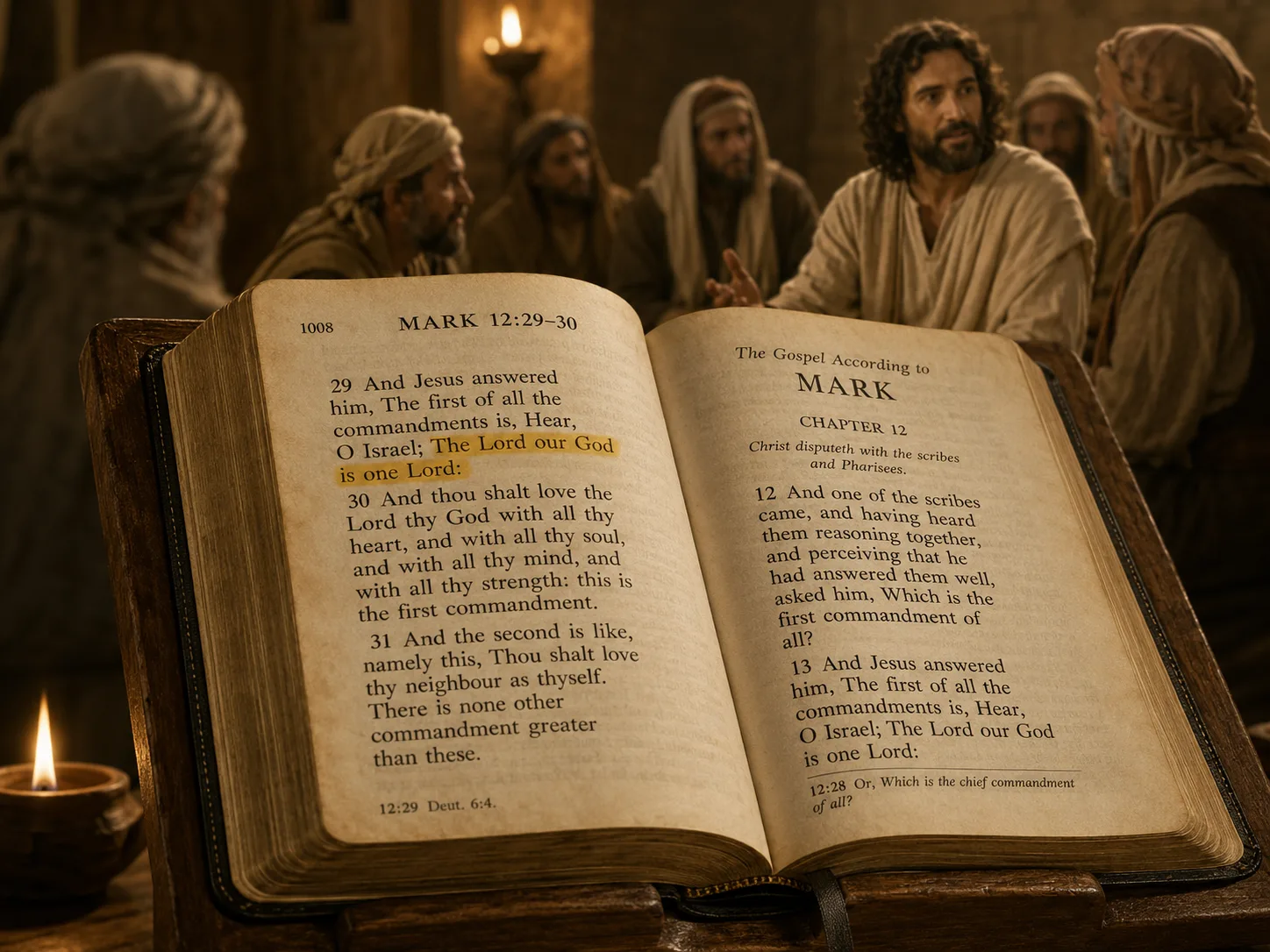
“Which is the first commandment of all? And Jesus answered him, The first of all the commandments is, Hear, O Israel; The Lord our God is one Lord: And thou shalt love the Lord thy God with all thy heart, and with all thy soul, and with all thy mind, and with all thy strength: this is the first commandment.”
Mark 12:28–30, KJV
Out of every text in Moses and the prophets, Christ chose Deuteronomy 6:4 — the Shema, the ancient confession recited at every synagogue gathering in Israel. He did not begin His answer with a command. He began it with a declaration of identity. *Hear, O Israel; the Lord our God is one Lord.* The command to love follows from the identity; without the identity there is nothing to love.
The scribe heard the answer and gave it back in his own words.
“Well, Master, thou hast said the truth: for there is one God; and there is none other but he.”
Mark 12:32, KJV
There is no triune subtext in the scribe’s reply, and Christ did not supply one. He commended the man — *thou art not far from the kingdom of God* — and the foundation of the law stood where the scribe and the rabbi had agreed it stood: the singular monotheism of the Hebrew Scriptures, addressed to the singular God of Israel.
The one God Christ names
If the first commandment turns on the identity of the one God, the next question is who that one God is. Christ answers it directly, in language that does not require interpretation.
“It is my Father that honoureth me; of whom ye say, that he is your God.”
John 8:54, KJV
The Jews of Christ’s day worshiped one God, and Christ identifies that one God — without hedge, without footnote — as His Father. The God of the scribes is the Father; the God of the Shema is the Father; the God of Israel is the Father. When the disciples asked Him how to pray, He directed their worship to the same Person.
“After this manner therefore pray ye: Our Father which art in heaven, Hallowed be thy name.”
Matthew 6:9, KJV
And when He Himself prayed, in moments where His own theology was on display before His disciples, He prayed to the same Person.
“I thank thee, O Father, Lord of heaven and earth, because thou hast hid these things from the wise and prudent, and hast revealed them unto babes.”
Matthew 11:25, KJV
The Father is the Lord of heaven and earth. He is the God of the worshipping Jew, the God of the praying Christian, the God of the Hebrew Scriptures, and the God Christ Himself worshiped. To the woman at the well, Christ gave the further specification that closes any remaining gap.
“But the hour cometh, and now is, when the true worshippers shall worship the Father in spirit and in truth: for the Father seeketh such to worship him.”
John 4:23, KJV
The true worshippers worship the Father. Not a triune committee in which the Father is one Person of three; the Father, named singularly, as the object of all worship that Christ recognized as true.
The apostles do not contradict their Lord
The apostolic letters do not introduce a refinement that corrects Christ’s teaching by promoting the Father into a triune mystery. They repeat what Christ said, in language that is sharper because it had to answer Greek philosophical pressure that the gospels had not yet faced. Paul writes to the Corinthians, in a passage explicitly contrasting the gods of the pagans with the God of the gospel:
“But to us there is but one God, the Father, of whom are all things, and we in him; and one Lord Jesus Christ, by whom are all things, and we by him.”
1 Corinthians 8:6, KJV
The apostle does not list three; he lists two. One God, the Father — of whom are all things. One Lord, Jesus Christ — by whom are all things. The structure is the same structure Christ used when He defined eternal life: the only true God, and the One He sent. To Timothy, Paul wrote it shorter, with the same architecture.
“For there is one God, and one mediator between God and men, the man Christ Jesus.”
1 Timothy 2:5, KJV
Between the one God and us, there is one mediator — and a mediator is not the one God He mediates to. The category of mediator requires distinction. Paul gave the same distinction in different language to the Corinthians earlier in the same letter.
“But I would have you know, that the head of every man is Christ; and the head of the woman is the man; and the head of Christ is God.”
1 Corinthians 11:3, KJV
The head of Christ is God — meaning the Father. The relation between the Father and the Son is the relation of head and head-of, not the symmetrical relation of two Persons within a triune committee. James says the same thing in five words.
“Thou believest that there is one God; thou doest well: the devils also believe, and tremble.”
James 2:19, KJV
Bare monotheism is not yet faith — even demons confess it — but it is at minimum the truth a believer must hold before any further article of faith can mean anything. James assumes his reader confesses one God in the same sense the Shema confesses one God, and that one God is the Father his brother Christ taught him to pray to. Paul closes the matter in Ephesians.
“One God and Father of all, who is above all, and through all, and in you all.”
Ephesians 4:6, KJV
The one God is the Father. Not a triune God in which the Father is one third; the Father, called the one God of all, named in the same line as His title of Father. The apostles wrote the same God Christ revealed.
The plural-of-majesty objection
The most common Hebrew-language objection raised against this monotheism is the plural form of *Elohim*. Genesis 1:26 — *Let us make man in our image* — is pressed into trinitarian service on the strength of grammatical plurality alone. The Bible answers its own grammar.
“And the LORD said unto Moses, See, I have made thee a god to Pharaoh: and Aaron thy brother shall be thy prophet.”
Exodus 7:1, KJV
The word translated *god* in that verse is the same plural Elohim. Moses, a single individual standing in a single body, is called Elohim to Pharaoh. If grammatical plurality required plurality of persons, then Moses would have to be three persons in one Moses, and the category collapses. What the verse shows instead is that Elohim, in Hebrew, denotes greatness rather than multiplicity — the plural of majesty, applied to a singular subject when that subject is to be honored.
Plurality of persons in the Godhead therefore cannot be established from Hebrew grammar. It must be established from explicit doctrinal statement, and the explicit doctrinal statements — Christ’s, the apostles’, and the prophets’ — run the other direction. The plural counsel of Genesis 1:26 is explained in the New Testament by the same Scripture that wrote it: the Father spoke, and through the Son the worlds were made. The plural pronoun records a real conversation between two real beings — Father and Son — not a tripartite voice from a single divine committee.
Who, then, is Christ?
If the Father alone is the one God of Israel, the question Christ Himself put to His disciples becomes the next question for every reader of the gospels.
“Whom say ye that I am? And Simon Peter answered and said, Thou art the Christ, the Son of the living God.”
Matthew 16:15–16, KJV
On Peter’s confession Christ founded the church. The hinge was not theological abstraction; it was identity. Jesus is the Son of God — and the Father had stated the same identity twice, with an audible voice from heaven, at the Jordan and on the mount of transfiguration. The voice did not specify that the Son was a coequal Person within a triune Godhead. It specified that Jesus is His Son.
“And lo a voice from heaven, saying, This is my beloved Son, in whom I am well pleased.”
Matthew 3:17, KJV
The voice from heaven is among the rarest events in the New Testament. The Father, Who could have entrusted the announcement to an angel or a prophet, spoke it Himself, and spoke it twice. What He chose to say on the few occasions He spoke at all was that Jesus is His Son. That fact is what He marked as load-bearing.
The opposition recognized it as load-bearing too. The very first temptation in the wilderness, the first sentence Satan addressed to Christ after forty days of fasting, was *if thou be the Son of God*. He repeated the question; he was answered the same way both times. At the cross, the chief priests mocked Him with the same line — *if he be the Son of God, let him now come down from the cross*. The Sonship was the point Satan would not let alone, and the point on which Christ would not yield.
It was therefore the charge for which He was condemned to die.
“I adjure thee by the living God, that thou tell us whether thou be the Christ, the Son of God. Jesus saith unto him, Thou hast said… Then the high priest rent his clothes, saying, He hath spoken blasphemy.”
Matthew 26:63–65, KJV
Christ went to the cross rather than retract the claim that He was the Son of God. The same claim was the foundation of Paul’s first sermon — the very first sermon the future apostle preached after his conversion, recorded in the book of Acts in a single line:
“And straightway he preached Christ in the synagogues, that he is the Son of God.”
Acts 9:20, KJV
Of every doctrine Paul could have opened with, he opened with that one. The foundation laid in Damascus is the foundation of every letter he later wrote.
Only begotten — what Scripture means by “Son”
Sonship in Scripture is not a single category. Angels are called sons of God by creation (Job 1:6). Believers are called sons of God by adoption (Romans 8:15). Adam was a son of God by direct creation (Luke 3:38). Christ stands in none of these categories. The qualifier the Spirit inspired John to use is *only begotten*, and the Greek term carries the technical sense of *born of*.
“For God so loved the world, that he gave his only begotten Son, that whosoever believeth in him should not perish, but have everlasting life.”
John 3:16, KJV
“And the Word was made flesh, and dwelt among us, (and we beheld his glory, the glory as of the only begotten of the Father,) full of grace and truth.”
John 1:14, KJV
If Christ is begotten, the question that has to be asked next is when. Scripture answers it in two places. The first is Micah’s prophecy of the Messiah’s birthplace, which corrects in advance the assumption that Bethlehem was His beginning.
“But thou, Bethlehem Ephratah, though thou be little among the thousands of Judah, yet out of thee shall he come forth unto me that is to be ruler in Israel; whose goings forth have been from of old, from everlasting.”
Micah 5:2, KJV
The Hebrew word translated *goings forth* carries the sense of origin or family descent. The verse points the reader backward — past Bethlehem, past the prophets, past the patriarchs, into the days of eternity. Bethlehem was His birth into humanity. His birth as the Son of God was earlier, and earlier than any other event Scripture records.
The second passage is Solomon’s, in the book of Proverbs, where the apostolic letters identify Christ as the wisdom of God speaking in the first person (1 Corinthians 1:24, 1:30).
“The LORD possessed me in the beginning of his way, before his works of old. I was set up from everlasting, from the beginning, or ever the earth was. When there were no depths, I was brought forth; when there were no fountains abounding with water. Before the mountains were settled, before the hills was I brought forth.”
Proverbs 8:22–25, KJV
Twice in that passage Solomon uses the verb *brought forth*. The Hebrew term carries the generative sense of being born. The event is dated relative to creation: before the depths, before the fountains, before the mountains, before the foundations of the earth. Christ was therefore begotten of the Father before anything was created, and creation itself was the next event in the divine record.
“And to make all men see what is the fellowship of the mystery, which from the beginning of the world hath been hid in God, who created all things by Jesus Christ.”
Ephesians 3:9, KJV
“For by him were all things created, that are in heaven, and that are in earth, visible and invisible… all things were created by him, and for him: and he is before all things, and by him all things consist.”
Colossians 1:16–17, KJV
Two things follow from these texts and cannot follow from any others. First, Christ was not created, because all things were created by Him. Second, He existed before all things, and the form in which He existed is named — He was the only begotten Son of the Father, brought forth before time. The Father then created the heavens and the earth through Him, and all things were made *for* Him: a son’s inheritance, prepared in advance by the Father Whose nature He shared.
The Old Testament knew Him
It is sometimes argued that the Sonship is a New Testament construction laid over a Hebrew text that does not know it. The Hebrew text knows otherwise.
“For unto us a child is born, unto us a son is given: and the government shall be upon his shoulder: and his name shall be called Wonderful, Counsellor, The mighty God, The everlasting Father, The Prince of Peace.”
Isaiah 9:6, KJV
Isaiah declares the Son given for our salvation. Solomon poses the rhetorical question — *what is his name, and what is his son’s name, if thou canst tell?* (Proverbs 30:4) — because the answer is supposed to be common knowledge in Israel. A pagan king, watching three Hebrews refuse to bow in the furnace, sees a fourth figure walking with them in the flame and identifies Him by relationship.
“Lo, I see four men loose, walking in the midst of the fire, and they have no hurt; and the form of the fourth is like the Son of God.”
Daniel 3:25, KJV
Nebuchadnezzar knew what the three captives had been preaching to him: the God of the Hebrews has a Son, and that Son is the Saviour to come. The pagan king understood it because the Hebrew missionaries had taught it to him. The Old Testament knows the Son of God, and names Him, and prophesies Him, and shows Him walking with His people through fire.
What inheritance brings
Sonship is not an honorary title in Scripture. It is a relation that carries inheritance, and the inheritance is named in the opening chapter of Hebrews.
“Who being the brightness of his glory, and the express image of his person, and upholding all things by the word of his power… being made so much better than the angels, as he hath by inheritance obtained a more excellent name than they.”
Hebrews 1:3–4, KJV
Christ inherited a *more excellent name*. *Name* in the Hebrew idiom is more than identification. It carries authority — Christ came in His Father’s name (John 5:43). It carries character — when the Lord proclaimed His name to Moses on the mount, He recited a list of attributes (Exodus 34:6–7). And it carries nature, because the name of a son is the name of the family, and the name of the family is the family’s inheritance. What Christ inherited from His Father, by right of Sonship, was the Father’s authority, the Father’s character, and the Father’s own divine nature.
“For as the Father hath life in himself; so hath he given to the Son to have life in himself.”
John 5:26, KJV
The Father has life in Himself — the uncreated, self-existent life of God. By the gift of begetting, the Son has the same life in Himself. The same divine life that streams unceasingly from the Father streams equally and underivedly through the Son, because the Son shares the Father’s nature by inheritance.
“For in him dwelleth all the fulness of the Godhead bodily.”
Colossians 2:9, KJV
“Who, being in the form of God, thought it not robbery to be equal with God.”
Philippians 2:6, KJV
The fullness of the Godhead dwells in Christ bodily — because the Father pleased to grant the Son the same divine fullness that was His own. To be equal with God was not robbery, the apostle writes, because the equality was the Son’s by inheritance and not by usurpation. The pattern is the pattern God ordained in human generation: a son inherits the parent’s nature. Christ, born of God, inherits the divine nature.
The implication has to be drawn carefully — because the popular Trinitarian framing has confused it. The equality of Christ with God is grounded *in* His Sonship, not in spite of it. Take away the begetting, and there is no inheritance; take away the inheritance, and there is no equality; take away the equality, and there is no Saviour. Every link in the chain depends on the previous one. To deny that Christ is the begotten Son of God is therefore not to elevate Him to a higher position; it is to dissolve the only basis Scripture gives for His divinity.
“That all men should honour the Son, even as they honour the Father. He that honoureth not the Son honoureth not the Father which hath sent him.”
John 5:23, KJV
The verse rules out both possible errors at once. The Son is not less than the Father in honor — He is honored *as* the Father is honored. And the honor given the Son is not separable from the honor given the Father — to dishonor the one is to dishonor the other. There is no trinitarian arithmetic in either direction; there is a relation of inheritance, and a unity of honor that flows from it.
The Spirit by which they indwell
What remains, if the Father is the one God and the Son the only begotten of the Father, is the question of the Spirit. The popular doctrine names the Spirit a third coequal Person — a divine individual standing alongside the Father and the Son, with His own will and worship. Scripture names the Spirit as something else: the very life and presence of the Father and the Son, by which they indwell their people.
The Bible defines its own terms. The clearest definition comes through the apostle Paul, who quotes Isaiah in a verse where the apostle’s substitution is itself the commentary. Isaiah writes:
“Who hath directed the Spirit of the LORD, or being his counsellor hath taught him?”
Isaiah 40:13, KJV
Paul, quoting that verse in Romans, renders it as follows.
“For who hath known the mind of the Lord? or who hath been his counsellor?”
Romans 11:34, KJV
The Spirit of the LORD in Isaiah becomes the mind of the Lord in Paul. The substitution is the apostle’s, and the apostle is inspired. The Spirit of God is the mind of God — the inward life and consciousness of God, not an independent Person standing alongside Him. The apostle states the analogy directly a chapter later in his earlier letter:
“For what man knoweth the things of a man, save the spirit of man which is in him? even so the things of God knoweth no man, but the Spirit of God.”
1 Corinthians 2:11, KJV
The comparative word *even so* is decisive. The spirit of a man is in the man; only the spirit of a man knows the things of a man, because the spirit of a man is the man’s own inward life. In exactly the same way — the apostle is unambiguous about the comparison — the Spirit of God knows the things of God because the Spirit of God is God’s own inward life. The spirit of Nebuchadnezzar that was troubled in the second chapter of Daniel was not a separate Person inside the king; it was the king’s own mind. The Spirit of God is no further removed from God than that.
And the Spirit is shared between the Father and the Son. Paul names it both ways in a single passage and treats the two names as interchangeable:
“But ye are not in the flesh, but in the Spirit, if so be that the Spirit of God dwell in you. Now if any man have not the Spirit of Christ, he is none of his. And if Christ be in you, the body is dead because of sin; but the Spirit is life because of righteousness.”
Romans 8:9–10, KJV
The Spirit of God and the Spirit of Christ are one Spirit, possessed by the Father and by the Son. And the indwelling of that Spirit is, in the apostle’s next sentence, the indwelling of Christ Himself — *if Christ be in you*. The Spirit is not a third Person standing between Christ and the believer; the Spirit is Christ’s own personal presence, reaching the believer by His own life. The same identification is made directly elsewhere.
“Now the Lord is that Spirit: and where the Spirit of the Lord is, there is liberty.”
2 Corinthians 3:17, KJV
The Lord *is* that Spirit. And Christ Himself, in the upper room discourse where He promised the Comforter, explained the promise in language no trinitarian metaphysics is required to interpret.
“I will not leave you comfortless: I will come to you.”
John 14:18, KJV
The Greek word translated *another Comforter* a few verses earlier is *allos*, which can mean another of the same kind. Christ was His disciples’ first Comforter while He walked with them; He promised them the same Comforter — Himself — would be with them after His ascension, by another mode. Not by a new third Person, but by His own Spirit. The promise was kept at Pentecost; Paul calls it the Spirit of His Son, sent into the heart of the believer (Galatians 4:6), crying *Abba, Father*.
The Spirit is therefore neither absent from Scripture nor an independent third object of worship. It is the divine life that belongs to the Father, is possessed by the Son by inheritance, and is given to the believer that he may know the two. There is one God, the Father; one Lord, Jesus Christ; one Spirit — the personal presence of both — by which Father and Son make their abode with those who love them.
A note on what is being critiqued
The argument of this article is with a doctrinal architecture, not with the millions of sincere believers — Roman Catholic, Protestant, and modern Adventist — who have inherited the triune formulation without ever examining it from the Scriptures. Every Christian tradition has contained worshippers Christ called His own. The call of Christ at the close of the gospels was not to a sect but to a confession — that the Father is the only true God, that He sent His Son, and that the Spirit is the personal life of both. The quarrel here is with the architecture that obscures that confession, never with the believers it has obscured it from.
The foundation that was forgotten
On the night before His crucifixion, Christ defined eternal life in the prayer He prayed to the Father. The definition is not propositional knowledge of a triune mystery. It is a relational knowing of two — the only true God, and the One He sent.
“And this is life eternal, that they might know thee the only true God, and Jesus Christ, whom thou hast sent.”
John 17:3, KJV
The Spirit is the means by which the knowing happens; it is not a third object of the knowing. To know the Father is to know the only true God. To know the Son is to know the only begotten of the Father, the One in Whom the fullness of the Godhead dwells. To receive the Spirit is to receive the personal presence of both into the believing heart. That is the gospel the apostles preached and the salutations of every New Testament letter pronounced — grace and peace from God the Father and the Lord Jesus Christ.
What was at stake in Deuteronomy 8 — what Moses warned the people never to forget — was the singular identity of God. What is at stake in the modern triune formulation is the same thing. The Father has been folded into a committee in which He is one of three. The Son’s begotten relation to the Father has been recast as metaphor or office. The Spirit has been promoted from the inward life of God to an independent divine Person. Each move replaces the biblical identity with a theological construction, and the construction is then taught as orthodoxy while the identity Christ taught is steadily forgotten.
The remedy is the forgotten first commandment. To hear the Shema as Christ Himself quoted it. To identify the one God as the Father Whom Christ worshiped. To honor the Son as the only begotten in Whom dwells the fullness of the Godhead bodily. To receive the Spirit as the very life of both. That is the faith Israel was warned never to forget, the faith Christ confessed before Pilate, the faith the apostles preached, and the faith on which the gospel still rests.
“Hear, O Israel: The LORD our God is one LORD.”
Deuteronomy 6:4, KJV