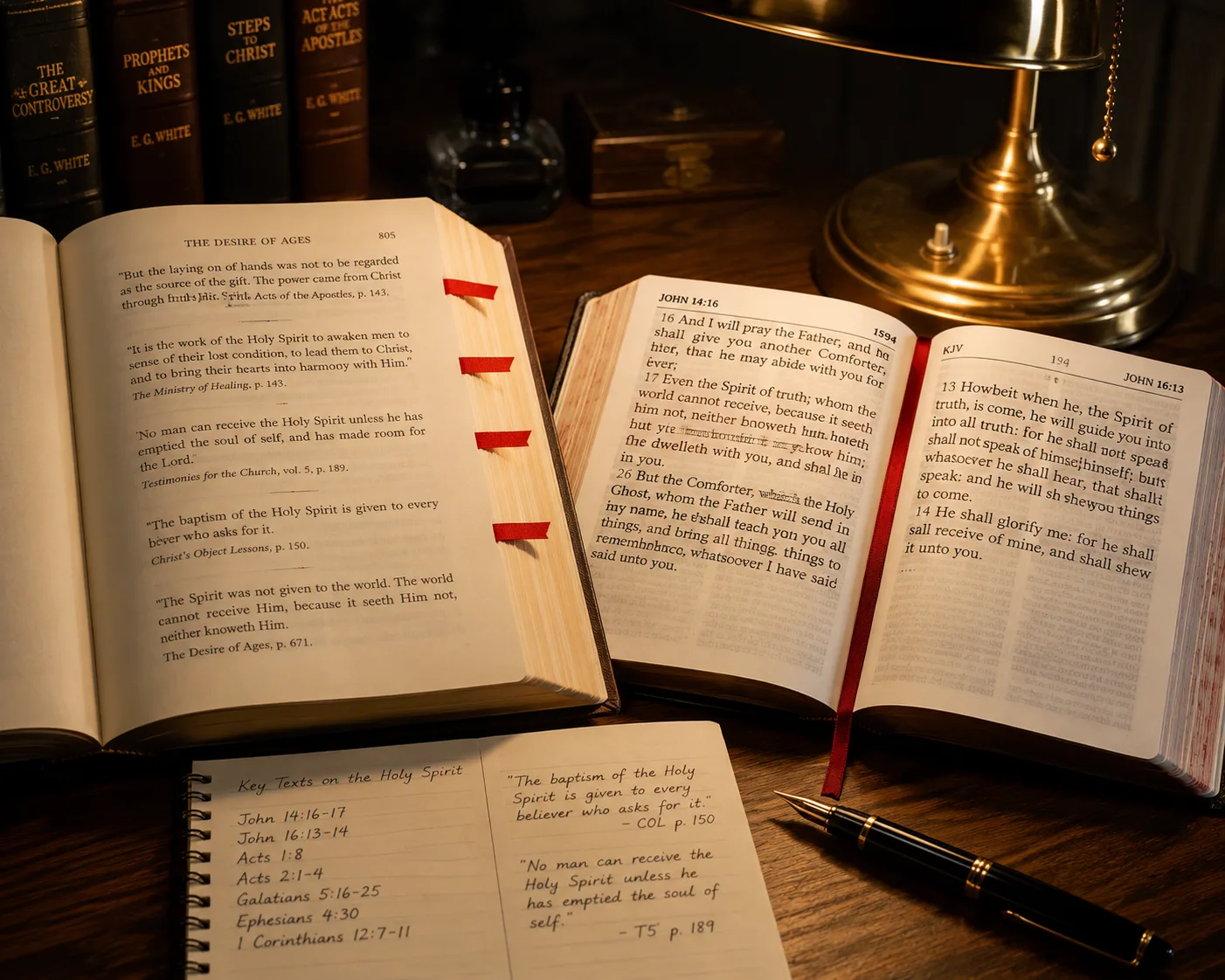

One of the most consequential changes in modern Adventist teaching concerns the identity of the Holy Spirit. Where the Adventist pioneers — and Ellen White herself — described the Spirit as the personal presence of Christ extended throughout creation, the modern denomination now teaches that the Holy Spirit is a third coequal divine Person within a triune Godhead. The two positions are not equivalent. They cannot both be the historic Adventist faith.
This study draws on Ellen White’s own published words to show what she actually taught about the Holy Spirit. The pattern across her writings — from early letters in the 1890s to the Conflict of the Ages volumes — is consistent and unambiguous: the Spirit she described is the Spirit of Christ, the Comforter Who is Christ Himself, the divine influence and power by which the Father and the Son draw near to their people. She does not describe a third independent Person.
The order in which her statements are presented here follows the line of the argument; the quotations themselves are her own.
The Comforter is Christ Himself
Modern Christian tradition reads John 14 as introducing the third Person of a triune God who would arrive after Christ’s departure to take His place. Ellen White read it differently. To her, the Comforter promised in the upper room is Christ Himself, returning to His disciples in spiritual form.
“Christ is to be known by the blessed name of Comforter. ‘The Comforter,’ said Christ to His disciples, ‘which is the Holy Ghost, whom the Father will send in My name, He shall teach you all things, and bring all things to your remembrance, whatsoever I have said unto you’ [John 14:26 quoted].”
Ellen G. White · Manuscript 7, January 26, 1902
She returns to this identification again and again, with a directness that resists the modern reading.
“The Saviour is our Comforter. This I have proved Him to be.”
Ellen G. White · Manuscript Releases 8, p. 49.3
“Let them study the seventeenth of John, and learn how to pray and how to live the prayer of CHRIST. HE is THE Comforter. He will abide in their hearts, making their joy full.”
Ellen G. White · Review and Herald, January 27, 1903
“As by faith we look to Jesus, our faith pierces the shadow, and we adore God for His wondrous love in giving JESUS THE COMFORTER.”
Ellen G. White · Manuscript Releases 19, p. 297.3
The Spirit of Truth, in the same passage of John, is identified directly with Christ as well — not as a separate counsellor sent in His stead.
“JESUS comes to you as the SPIRIT of TRUTH; study the mind of the Spirit, consult your Lord, follow His way.”
Ellen G. White · Manuscript Releases 2, p. 337.1
“To the guidance of this Comforter all who believe in CHRIST may implicitly trust. HE is the Spirit of truth, but this truth the world can neither discern nor receive.”
Ellen G. White · Manuscript Releases 12, p. 260.1
“We cannot be with Christ in person, as were His first disciples, but HE has sent HIS Holy Spirit to guide us into all truth, and through this power we too can bear witness for the Saviour [John 16:13 quoted].”
Ellen G. White · Manuscript 30, June 18, 1900
Christ breathed His own Spirit upon the disciples
Ellen White’s commentary on John 20 reinforces the same point. When the resurrected Christ stood before His disciples and breathed upon them, the Spirit He gave was His own.
“And when He had said this, He [Christ] breathed on them, and saith unto them, Receive ye the Holy Ghost: Whosesoever sins ye remit, they are remitted unto them; and whosesoever sins ye retain, they are retained. The Holy Spirit was not yet fully manifested; for Christ had not yet been glorified. The more abundant impartation of the Spirit did not take place till after Christ’s ascension. Not until this was received could the disciples fulfill the commission to preach the gospel to the world. But the Spirit was now given for a special purpose. Before the disciples could fulfill their official duties in connection with the church, CHRIST breathed HIS Spirit upon them.”
Ellen G. White · Desire of Ages, p. 805
“JESUS is waiting to breathe upon all his disciples, and give them the inspiration of HIS sanctifying SPIRIT, and transfuse the vital influence from HIMSELF to his people.”
Ellen G. White · Signs of the Times, October 3, 1892
She frames the gift of the Spirit not as the introduction of a separate divine Person, but as Christ extending His own life into His people.
“JESUS is seeking to impress upon them the thought that in giving HIS Holy SPIRIT He is giving to them the glory which the Father has given him, that He and his people may be one in God.”
Ellen G. White · Signs of the Times, October 3, 1892
“When the HOLY SPIRIT was poured out upon the early church, ‘The whole multitude of them that believed were of one heart and of one soul.’ The SPIRIT of CHRIST made them one. This is the fruit of abiding in Christ.”
Ellen G. White · General Conference Daily Bulletin, February 6, 1893
The Holy Spirit is the Spirit of Christ
Stripped of theological scaffolding, Ellen White’s identification of the Holy Spirit is plain. The Spirit promised, sent, and poured out is the Spirit of Christ. There is no third independent Personality intervening between the Father and the believer.
“The HOLY SPIRIT is the SPIRIT of CHRIST, which is sent to all men to give them sufficiency.”
Ellen G. White · Manuscript Releases 14, p. 84
“We want the HOLY SPIRIT, which is JESUS CHRIST.”
Ellen G. White · Letter 66, April 10, 1894
“but it is the leaven of the SPIRIT of JESUS CHRIST, which is sent down from heaven, called the HOLY GHOST.”
Ellen G. White · Manuscript 36, 1891
The pioneers spoke in exactly the same vocabulary. Uriah Smith and E. J. Waggoner — two of the most theologically careful voices of the early Adventist movement — wrote on the same subject in the same years and arrived at the same conclusion.
“The Holy Spirit is the Spirit of God; it is also the Spirit of Christ. It is that divine, mysterious emanation through which they carry forward their great and infinite work.”
Uriah Smith · General Conference Bulletin, March 18, 1891, pp. 146–147
“Here we find that the Holy Spirit is both the Spirit of God and the Spirit of Christ.”
E. J. Waggoner · Christ and His Righteousness, p. 23, 1890
The Father gave His Spirit to His Son
If the Spirit is Christ’s Spirit, where did Christ receive it? Ellen White is direct on this too: from the Father, without measure.
“The Father GAVE HIS SPIRIT without measure to HIS SON, and we also may partake of its fulness.”
Ellen G. White · Review and Herald, November 5, 1908
“ALL THINGS Christ received from God, but He took to give.”
Ellen G. White · Desire of Ages, p. 21
This is the order of the gospel as the pioneers received it. The Father is the source. The Son receives all things — including the fullness of the Spirit — from the Father, and dispenses them to His people. The Spirit poured out upon the church is therefore the Father’s Spirit, given to His Son, and given by His Son to those who believe.
“In giving us HIS Spirit, God gives us HIMSELF, making Himself a fountain of divine influences, to give health and life to the world.”
Ellen G. White · Testimonies, vol. 7, p. 273, 1902
The Spirit is divine influence and power, not a separate Person
Modern trinitarian theology presses Adventists to read every reference to the Spirit as a reference to a third coequal Person. The pioneers actively resisted that reading. Uriah Smith stated the case as plainly as it can be put.
“The terms ‘Holy Ghost’ are a harsh and repulsive translation. It should be ‘Holy Spirit’ (hagion pneuma) in every instance. This Spirit is the Spirit of God, and the Spirit of Christ; the Spirit being the same whether it is spoken of as pertaining to God or Christ. But respecting this Spirit, the Bible uses expressions which cannot be harmonized with the idea that it is a person like the Father and the Son. Rather it is shown to be a divine influence from them both, the medium which represents their presence and by which they have knowledge and power through all the universe, when not personally present.”
Uriah Smith · Review and Herald, October 28, 1890
Ellen White’s own language matches the pioneer’s exactly. The Spirit is presence; the Spirit is power; the Spirit is divine influence — never an additional Person beside the Father and the Son.
“The divine Spirit that the world’s Redeemer promised to send, is the presence and power of God.”
Ellen G. White · Signs of the Times, November 23, 1891
“Christ has given HIS Spirit as a divine POWER.”
Ellen G. White · Review and Herald, November 19, 1908
Two in individuality, one in Spirit
Ellen White preserves a careful symmetry: the Father and the Son are two distinct Beings, but their unity is real and undivided — and that unity is expressed by the Spirit they share.
“They were two, yet little short of being identical; two in individuality, yet ONE IN SPIRIT, and heart, and character.”
Ellen G. White · Youth Instructor, December 16, 1897
“They have one God and one Saviour; and one Spirit — the Spirit of Christ — is to bring unity into their ranks.”
Ellen G. White · Testimonies, vol. 9, p. 189.3
When the believer receives the Spirit, then, the Father and the Son together come to dwell within. There is no third Person introduced; the Spirit is the medium of their presence.
“BY the SPIRIT the FATHER and the SON will come and make their abode with you.”
Ellen G. White · The Bible Echo, January 15, 1893
Christ omnipresent through His Spirit
Ellen White’s most extended statement on the subject anchors everything that has come before. After the ascension, Christ remained personally absent from this world; but His Spirit, given to the church, IS Christ Himself — divested of human limitation, present everywhere His people are.
“Cumbered with humanity, CHRIST could not be in every place personally; therefore it was altogether for their advantage that He should leave them, go to His father, and send the Holy Spirit to be His successor on earth. The Holy Spirit is [Christ] HIMSELF, divested of the personality of humanity, and independent thereof. HE would represent Himself as present in all places by HIS Holy Spirit, as the Omnipresent.”
Ellen G. White · Letter 119, February 18, 1895
She returns to the same picture in shorter form across multiple years.
“This refers to the omnipresence of the Spirit of Christ, called the Comforter.”
Ellen G. White · Manuscript Releases 14, p. 179.2
“CHRIST has left HIS Holy Spirit to be HIS representative in the world, to give celestial aid to every hungering, thirsting soul.”
Ellen G. White · Letter 84, October 22, 1895
“The Holy Spirit is the SPIRIT of CHRIST; it is HIS representative. Here is the divine agency that carries conviction to hearts. When the power of His Spirit is revealed through the servants of God, we behold divinity flashing through humanity.”
Ellen G. White · Manuscript Releases 13, p. 313.3, 1895
“CHRIST came to our world, but the world could not endure His purity. He has gone to His Father, but HE has sent HIS Holy Spirit to represent HIM in the world till he shall come again.”
Ellen G. White · Manuscript 1, January 11, 1897
“The promise of the Holy Spirit is not limited to any age or to any race. CHRIST declared that the divine influence of HIS SPIRIT was to be with His followers unto the end. From the Day of Pentecost to the present time, the Comforter has been sent to all who have yielded themselves fully to the Lord and to His service.”
Ellen G. White · Acts of the Apostles, p. 49.2
What this means for the modern Adventist position
The modern denomination’s adoption of a trinitarian formulation introduces a Person into the Godhead whom Ellen White never described. Across thousands of pages of letters, sermons, manuscripts, and books, her testimony on the Holy Spirit is consistent with what the pioneers received from scripture: there is one God, the Father; there is one Lord Jesus Christ, His begotten Son; and the Holy Spirit is the very presence of the Father and the Son extended into their people. The Spirit is Christ’s representative because the Spirit is, in the deepest sense, Christ Himself — present where Christ in His glorified humanity cannot be.
To affirm a triune Godhead is to affirm something Ellen White did not write. To affirm what she did write is to stand with the pioneers, and to receive the gospel they preached: a real Father, a real Son, and the indwelling Spirit by whom both come to make their abode in the believer.