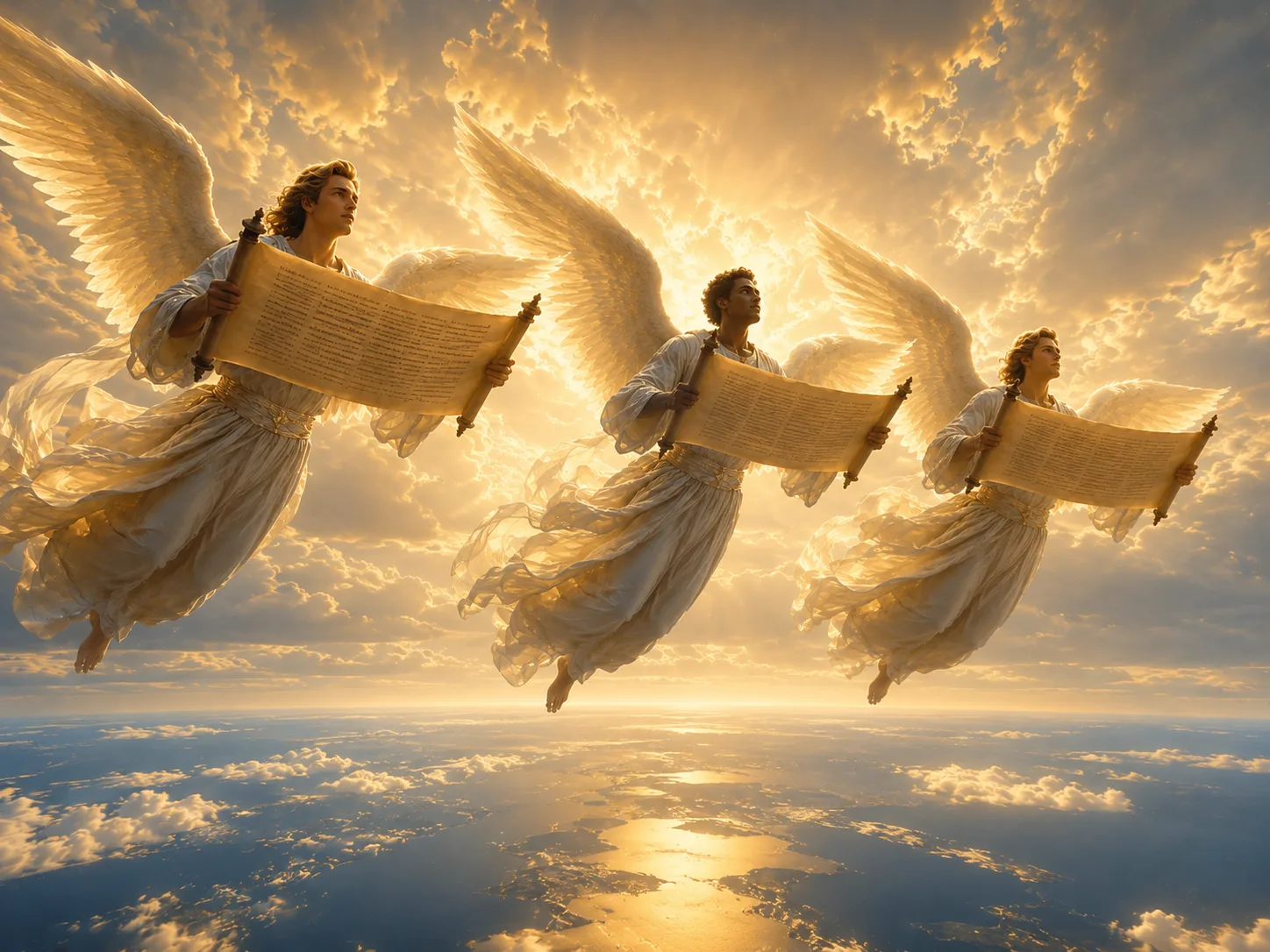
Revelation 14:6-12 is heaven's last word to a planet on the eve of its judgment. Three angels are seen flying in the midst of heaven, each carrying a definite message that goes to "every nation, and kindred, and tongue, and people" — a message that brings the world to the brink of a final choice over worship. Immediately afterward John sees the Son of man come on the cloud, sickle in hand, to reap the harvest of the earth (Revelation 14:14-16). Whatever else the three angels' messages are, they are the gospel sermon preached at the close of human probation, and the warning given before the King returns.
This article walks the three messages in order, locates each in the prophetic history through which it has been preached, identifies Babylon by name, defines the mark of the beast from Scripture, and exposes the seal of God in its place. It is written for a generation called to give the message, not merely to study it.
The Three Messages, Read Together
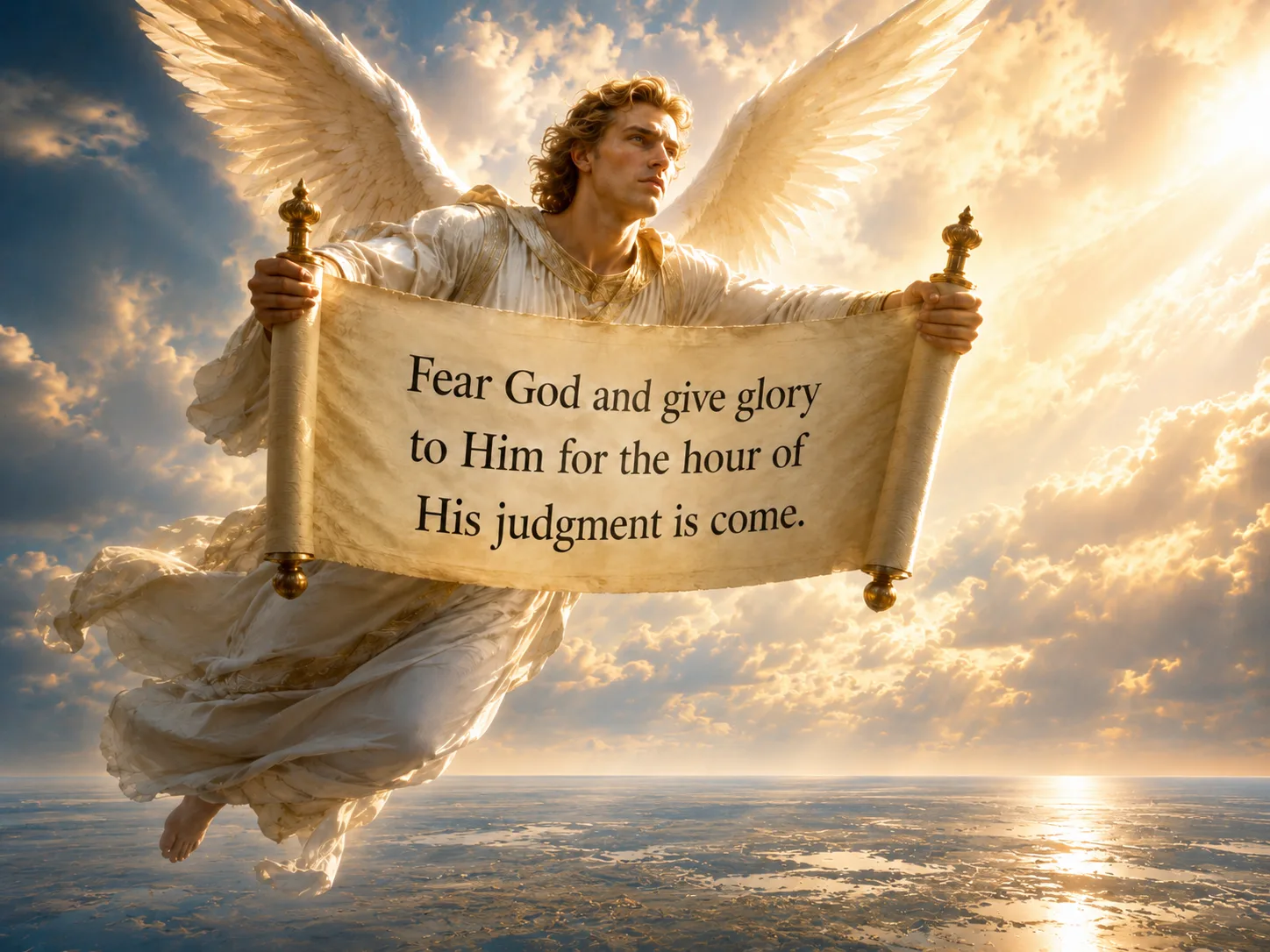
"And I saw another angel fly in the midst of heaven, having the everlasting gospel to preach unto them that dwell on the earth, and to every nation, and kindred, and tongue, and people, saying with a loud voice, Fear God, and give glory to him; for the hour of his judgment is come: and worship him that made heaven, and the earth, and the sea, and the fountains of waters. And there followed another angel, saying, Babylon is fallen, is fallen, that great city, because she made all nations drink of the wine of the wrath of her fornication. And the third angel followed them, saying with a loud voice, If any man worship the beast and his image, and receive his mark in his forehead, or in his hand, the same shall drink of the wine of the wrath of God."
Revelation 14:6-10, KJV
The three angels do not deliver three competing themes. They deliver one threefold message — the everlasting gospel — applied to a particular moment in history. The first angel announces the hour of judgment and calls the world back to the worship of the Creator. The second announces the fall of Babylon, the religious-political confusion into which the world's churches have gone. The third warns, with the strongest threat in all Scripture, against the mark of the beast — the badge of the apostate worship Babylon enforces. The gospel runs through all three. The crisis runs through all three. The choice the three messages call for is a single choice: the Creator's worship, or the beast's.
Where the Angels Stand in Time
Revelation 14 belongs to the prophetic chain that runs from Daniel 2 through Revelation 22. That chain ends with Christ's return and the new earth; the three angels stand at the very last station before the line terminates. Revelation 14 itself confirms it: immediately after the angels finish their proclamation (v.12), John sees the harvest of the earth — the Son of man coming on the cloud (v.14-16). The angels' work is the work that precedes the second coming. There is no further gospel message after the third angel, only the harvest.
They are not therefore optional or peripheral. Revelation does not describe them as a side stream of prophetic curiosity; it describes them as the gospel itself, in its present-truth form, going to every nation, kindred, tongue, and people. Jesus said: "And this gospel of the kingdom shall be preached in all the world for a witness unto all nations; and then shall the end come" (Matthew 24:14). Revelation 14 is the same promise in prophetic form. The three angels' messages are the everlasting gospel for the final generation.
The Messages in History: 1831-1844 and Onward
The first angel's message began to be preached in the United States, Britain, and across the world in the years 1831-1844, in the great religious awakening known to history as the Advent movement. The central note of that movement was the announcement: "the hour of his judgment is come." It rested on the prophetic time of Daniel 8:14 — "Unto two thousand and three hundred days; then shall the sanctuary be cleansed" — which, by the day-for-a-year principle (Numbers 14:34; Ezekiel 4:6) and reckoning from the decree of Daniel 9:25, terminated in 1844. William Miller in America, and a parallel awakening across Europe, preached the imminent return of Christ. Tens of thousands looked.
The expected date came; Christ did not appear. The Adventist movement entered the period it has ever since called the Great Disappointment. But the prophecy of Daniel 8:14 had not failed. Its meaning had been misread. What 1844 brought was not the cleansing of the earth by fire (which they had expected), but the beginning of the cleansing of the heavenly sanctuary — the entry of Christ as High Priest into the most holy place to begin the work of investigative judgment (Daniel 7:9-10; Hebrews 9:23-24). The hour of his judgment had indeed come, but it was the judgment that begins at the house of God (1 Peter 4:17), preparing the way for Christ's eventual return.
The second angel's message — "Babylon is fallen" — was preached in the summer of 1844 as the popular Protestant churches rejected the call of the first angel. When the visible Protestant world refused light, it joined the apostasy already named in Revelation 17 and 18, and the cry "come out of her" went forth. The third angel's message, with its warning against the worship of the beast and his mark, came into focus in the years immediately following 1844, as the post-disappointment company discovered the sanctuary truth, the seventh-day Sabbath of Exodus 20:8-11, and the final-conflict shape of the prophecy. From that point onward the three angels' messages have been preached together as one connected proclamation.
The first angel announced the judgment hour. The second announced Babylon's fall. The third has been warning, since the Disappointment, against the worship Babylon enforces. The three together form the gospel of the closing crisis.
The First Angel: Worship the Creator
Revelation 14:7 carries the first angel's words: "Fear God, and give glory to him; for the hour of his judgment is come: and worship him that made heaven, and earth, and the sea, and the fountains of waters." The verse divides into four clauses. Each carries weight.
- Fear God. To fear God in Scripture is to reverence Him, to take His word seriously, to depart from evil (Proverbs 16:6). The first angel calls a casual Christendom back to a sober regard for the One Whose word is the rule of life.
- Give glory to him. To give glory is to acknowledge God as the source of life, salvation, truth, and authority. In an age of self-exaltation, the call is to refuse the glory of men and to render it to God alone.
- The hour of his judgment is come. This is the date-line of the first angel: 1844 and onward — the open court of heaven, where every life is brought into review before the second coming. It declares that history is not aimless; it is moving toward a verdict.
- Worship him that made heaven, and earth, and the sea, and the fountains of waters. The angel's closing clause is a near-verbatim citation of the fourth commandment: "For in six days the LORD made heaven and earth, the sea, and all that in them is" (Exodus 20:11). The first angel does not merely call the world to worship in a general sense. He calls the world to worship the Creator — and the sign of that worship is the Sabbath the Creator gave.
The first angel is therefore a call back to the Sabbath. Every other day on the calendar is in some way the creation of man — Sunday by a fourth-century imperial decree, the rest by mere convention. Only the seventh day is bound to a Maker Whose mark it bears. The angel's very words are the words of the commandment.
The God of the First Angel's Call
Because the first angel's message is a worship message, the identity of the One to be worshiped is decisive. Revelation 14:7 identifies Him as the Creator. Scripture identifies that Creator as the Father, through His only begotten Son. Christ said in His high-priestly prayer: "And this is life eternal, that they might know thee the only true God, and Jesus Christ, whom thou hast sent" (John 17:3). Paul names the same two: "But to us there is but one God, the Father, of whom are all things… and one Lord Jesus Christ, by whom are all things, and we by him" (1 Corinthians 8:6).
The first angel is therefore not a call to worship a triune committee of three co-equal divine persons sharing one substance — a doctrine the apostolic church did not hold and the Bible nowhere describes. It is a call to worship the one true God, the Father, through His only begotten Son, by the Spirit who is the personal presence of both in the believer (Romans 8:9-10). On any other framework the first angel's call cannot be answered, because the One to Whom it points has been replaced. The companion study on the identity of the true God walks this thread in detail; the angel's call presupposes its conclusion.
The Second Angel: Babylon Identified
The second angel's message — "Babylon is fallen, is fallen, that great city, because she made all nations drink of the wine of the wrath of her fornication" (Revelation 14:8) — refuses to be reduced to a vague symbol of confusion. Babylon in Revelation is a specific religious-political system. Revelation 17 portrays her as a woman seated upon a scarlet beast, arrayed in purple and scarlet, holding a golden cup full of abominations, drunken with the blood of the saints and of the martyrs of Jesus (Revelation 17:3-6). She is the mother of harlots, and her daughters — apostate religious bodies that share her doctrines — are named with her.
Read against history, the woman is the papal system of the Roman Church. She united religious authority with civil power; she persecuted the saints across the long centuries between Justinian and the French Revolution; she sat enthroned in the city that has ruled over the kings of the earth (Revelation 17:18). Her daughters are the apostate Protestant bodies that, having broken from her in the Reformation, have nevertheless returned to her on the foundational issues — the immortal soul, Sunday observance in place of the Sabbath, the Trinity, the eternal torment of the wicked, the supremacy of tradition over the plain reading of Scripture. The wine of her fornication is the false doctrine by which she has made the nations drunk.
The second angel does not declare Babylon's fall in indignation; he declares it in mercy. Many of God's honest people are still inside the confused systems — Catholic, Protestant, and otherwise. Revelation 18 expands the second angel's message into the loud cry of the last days: "And I heard another voice from heaven, saying, Come out of her, my people, that ye be not partakers of her sins, and that ye receive not of her plagues" (Revelation 18:4). The fall is announced; the call is to leave. That is the mercy of the second angel.
The Third Angel: the Mark of the Beast
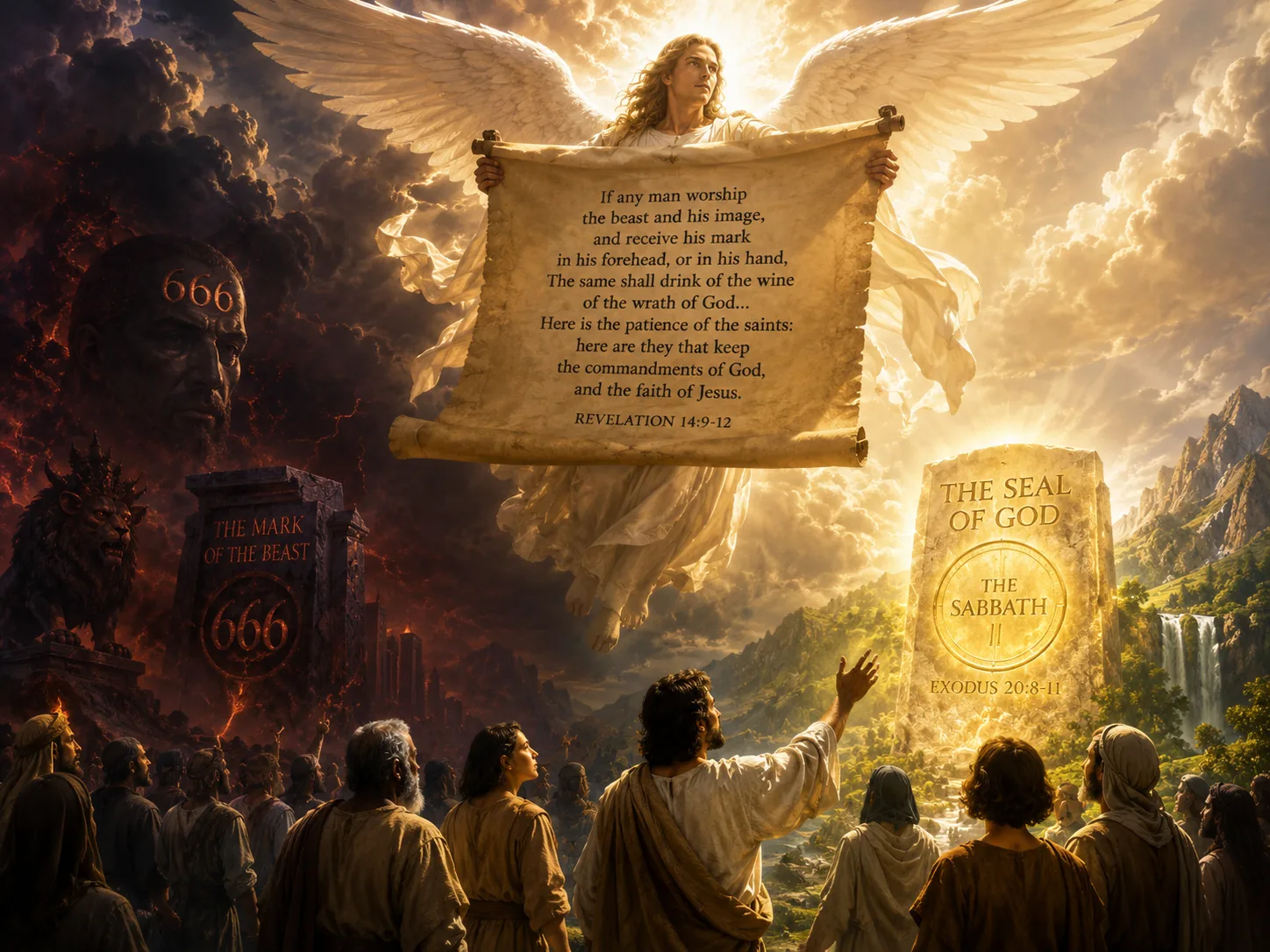
The third angel's warning is the most severe in all Scripture: "If any man worship the beast and his image, and receive his mark in his forehead, or in his hand, the same shall drink of the wine of the wrath of God" (Revelation 14:9-10). The threat fits the issue. The worship of the beast is the climax of human apostasy; the mark of the beast is the badge by which that apostasy is publicly received.
Revelation 13 identifies the beast as the same papal power Revelation 17 portrays as the woman — a religious-political system that received its seat, power, and great authority from the dragon (Revelation 13:2), exercised dominion over the saints for the 1260 prophetic days (Revelation 13:5; Daniel 7:25), suffered a deadly wound (the captivity of Pius VI in 1798), and is seen recovering toward a deadly-wound-healed dominance in the closing crisis (Revelation 13:3). The image of the beast is a religious-political combination that copies the original — the apostate Protestantism of the closing days, in alliance with civil power, enforcing the doctrines of the papal mother.
What is the mark of the beast itself? It is the badge of the beast's authority — the public, enforced acknowledgment of the papal claim. The papacy has declared in its own writings that its authority to change times and laws is most clearly proved by its having transferred the day of worship from the Sabbath of the Lord (the seventh day) to Sunday (the first day) without any biblical command. To worship on the day the beast has appointed, in defiance of the day the Creator gave, is to acknowledge the beast's authority above God's law. When that worship is enforced by civil power — when Sunday is legislated and the Sabbath-keeping conscience is criminalised — the mark is being received. The third angel's warning falls precisely there.
The mark of the beast is therefore not a microchip, a barcode, or any future technology. It is the worship of the beast — the formal allegiance to a substitute day of worship, pressed upon the conscience under penalty of the state. When the world reaches that crisis, the third angel's warning will have been preached for generations, and every conscience will have been informed.
The Seal of God: the Sabbath
Set over against the mark of the beast in Revelation is the seal of God. Revelation 7:1-3 shows four angels holding the four winds of the earth — symbolic of impending destruction — until the servants of God are sealed in their foreheads. Revelation 14:1 shows the same sealed company standing with the Lamb on Mount Zion with the Father's name written in their foreheads. The seal is the badge of the Father's authority on His people, as the mark is the badge of the beast's authority on its worshipers.
What is the seal? In the language of the law a seal carries three marks: the name of the lawgiver, his title, and his domain. In the Decalogue only one commandment bears all three: the fourth. "Remember the sabbath day, to keep it holy… for in six days the LORD" (the name) "thy God" (the title) "made heaven and earth" (the domain) (Exodus 20:8, 11). The Sabbath is the seal of God's law. To keep it is to acknowledge His authority as Creator over against any rival claim. To refuse the substituted Sunday under pressure of civil law is to receive the seal of God when the worship-test breaks upon the world.
This is why the Sabbath/Sunday question is not a private religious preference. It is the open contest between the authority of the Creator and the authority of the apostate church. The third angel's warning is the warning before that final test breaks; the seal of God is the protection of those who, when the test breaks, stand with the Creator.
The Loud Cry of Revelation 18
Revelation 18 begins where Revelation 14 reaches its threefold proclamation, but with intensified power: "And after these things I saw another angel come down from heaven, having great power; and the earth was lightened with his glory. And he cried mightily with a strong voice, saying, Babylon the great is fallen, is fallen" (Revelation 18:1-2). This angel is the swelling final cry of the third angel — the same message preached now with the full outpouring of the Spirit, the latter rain, the earth itself lightened with the glory of God.
The loud cry is what calls God's honest people out of Babylon in the closing hours. Many will hear the message for the first time and obey. Many who have long been in the confused systems will see clearly for the first time and come out. The result is a final harvest before probation closes: "And I heard another voice from heaven, saying, Come out of her, my people, that ye be not partakers of her sins, and that ye receive not of her plagues" (Revelation 18:4). The loud cry is the gospel of Revelation 14 brought to its climax — the everlasting gospel preached with power, to every nation, kindred, tongue, and people.
The People the Three Angels Produce
Revelation does not leave us guessing about the kind of people the three angels' messages produce. Verse 12 names them: "Here is the patience of the saints: here are they that keep the commandments of God, and the faith of Jesus."
- They have patience. They endure under pressure, hold to the truth when costs rise, and wait for their Lord (Revelation 13:10; Hebrews 10:36-37).
- They are saints. They are set apart for God, by the redeeming blood of Jesus Christ and the sanctifying work of the Spirit (1 Corinthians 6:11; 1 Peter 1:2).
- They keep the commandments of God. All ten — including the fourth, the Sabbath of the Lord. Their obedience is not legalism but the fruit of regenerated love (Romans 13:10; 1 John 5:3).
- They have the faith of Jesus. Christ's own faith, lived in them. They trust the Father as He trusted Him; they obey as He obeyed; they hold fast as He held fast even unto death.
These four marks are not optional add-ons. They are the visible result of the three angels' messages having gone into a soul. Where the gospel of Revelation 14 takes hold, this is the kind of life that comes out the other side.
Elijah on Mount Carmel — and the Same Choice at the End
The three angels' messages carry the spirit of Elijah. On Mount Carmel, in a moment of national apostasy, Elijah called Israel to a single decision: "How long halt ye between two opinions? if the LORD be God, follow him: but if Baal, then follow him" (1 Kings 18:21). The issue was worship — the true God or the false. The test was visible. The fire from heaven gave the verdict. Israel answered, "The LORD, he is the God; the LORD, he is the God" (v.39).
Malachi 4:5 promises that this same Elijah-message would come before the great and dreadful day of the Lord. The three angels' messages are that message — the final call to choose between the worship of the Creator and the worship of the beast, between the seal of God and the mark of the beast, between Christ and apostate Christendom's substituted authority. The choice is exactly what Elijah's was. It admits no middle ground. It cannot be indefinitely delayed.
Good News in a Solemn Warning
The three angels' messages contain the strongest warning in the Bible. They also contain the everlasting gospel. The two are not in tension; they are the same message in its two faces. God warns because He saves. He exposes deception so that no one need be trapped by it. He announces judgment so that every soul can flee to the Refuge before it is too late. He identifies false worship so His people can return to true worship.
At the centre of the everlasting gospel stands the cross of Christ. The first angel's call to worship the Creator presupposes the Creator Who, in the person of His Son, came down to be the Lamb slain. The second angel's call out of Babylon presupposes the Saviour Who waits with open arms beyond her walls. The third angel's warning against the mark presupposes the same Christ, Whose righteousness covers the saints who stand against the beast. The four marks of Revelation 14:12 — patience, sainthood, commandment-keeping, faith of Jesus — are produced by the indwelling of Christ Himself in the believer, not by any human striving. The gospel is the message. The warning is the gospel applied to the precise hour in which we live.
The Final Message Is a Worship Message
The three angels' messages are not, finally, about beasts and Babylon and prophetic timelines, though those details are unavoidable. They are about worship. The first angel commands the worship of the Creator. The second announces the fall of the religious system that has substituted false worship. The third warns of the worship the beast enforces. The seal of God is the badge of true worship. The mark of the beast is the badge of false. Every soul on earth will eventually carry one or the other.
At the centre of true worship stands the truth Christ Himself called life eternal: "that they might know thee the only true God, and Jesus Christ, whom thou hast sent" (John 17:3). The Father is the only true God. Jesus Christ is His only begotten Son, the divine Son through Whom we come, the appointed Mediator, the Saviour Whose righteousness covers the worshiper. The Holy Spirit is the personal presence and power of both, written into the heart of the believer. This is the God to Whom the first angel calls the world. This is the God the saints of Revelation 14:12 worship and obey.
The message is therefore plain: fear God, give glory to Him, worship the Creator, come out of Babylon's confused worship, refuse the mark of the beast's false worship, keep the commandments of God — including the Sabbath that bears His name — and hold fast the faith of Jesus. When the three angels have finished their proclamation, the Son of man comes on the cloud, and the saints who have received the message rise to meet Him. Until then, the messages stand. The gospel is preached. The warning is given. The choice is open.
Scripture Index
- Revelation 14:6-12. The three messages in order — the everlasting gospel, the fall of Babylon, the warning against the beast and his mark, and the patient saints who keep God's commandments.
- Revelation 14:14-16. The harvest of the earth that follows the three messages — Christ the Son of man on the cloud, sickle in hand.
- Revelation 18:1-4. The loud cry — Babylon's fall preached again with great power, and the call "come out of her, my people."
- Revelation 13:1-18. The beast, his image, and his mark identified — the religious-political system the third angel warns against.
- Revelation 17:1-18. Babylon the woman on the beast, the mother of harlots and her daughters, the city that reigneth over the kings of the earth.
- Revelation 7:1-3; 14:1. The seal of God in the foreheads of the saints — the Father's name written on those who stand with the Lamb on Mount Zion.
- Exodus 20:8-11. The fourth commandment — the Sabbath bears the Lawgiver's name, title, and domain, and is therefore the seal of God's law.
- Daniel 8:14. The 2300 days — the prophetic time on which the first angel's "hour of his judgment is come" rests, terminating in 1844.
- Matthew 24:14. Christ's own promise that the gospel of the kingdom will be preached to all nations before the end comes.
- John 17:3; 1 Corinthians 8:6. The one true God is the Father; Jesus Christ is His only begotten Son — the God to whom the first angel calls the world.
- 1 Kings 18:21; Malachi 4:5. The Elijah pattern — between the LORD and the false god, the world is called to choose, before the great and dreadful day.