

But when ye pray, use not vain repetitions, as the heathen do: for they think that they shall be heard for their much speaking.
The first time a Christian hears about affirmations — repeating a single sentence to yourself a hundred times until it sinks in — that verse is the wall they hit. Isn’t this the very thing Jesus warned against? It’s a fair question, and it deserves a real answer. The answer turns on a distinction almost nobody stops to make.
Two acts that look alike
The objection assumes affirmations and vain repetitions are the same activity because they share one surface feature: repetition. But repetition is only the form. The substance is what you are doing with it — and these are two different acts pointed in two opposite directions.
A vain repetition is aimed at God. It is prayer — a person talking to a deity, trying to be heard. An affirmation is aimed at yourself. It is self-suggestion — a person talking to his own subconscious, trying to install an idea. One is communication with a Person outside you. The other is maintenance on the mind inside you. They are no more the same thing because both use words than crying and singing are the same thing because both use the voice.
What Jesus actually condemned
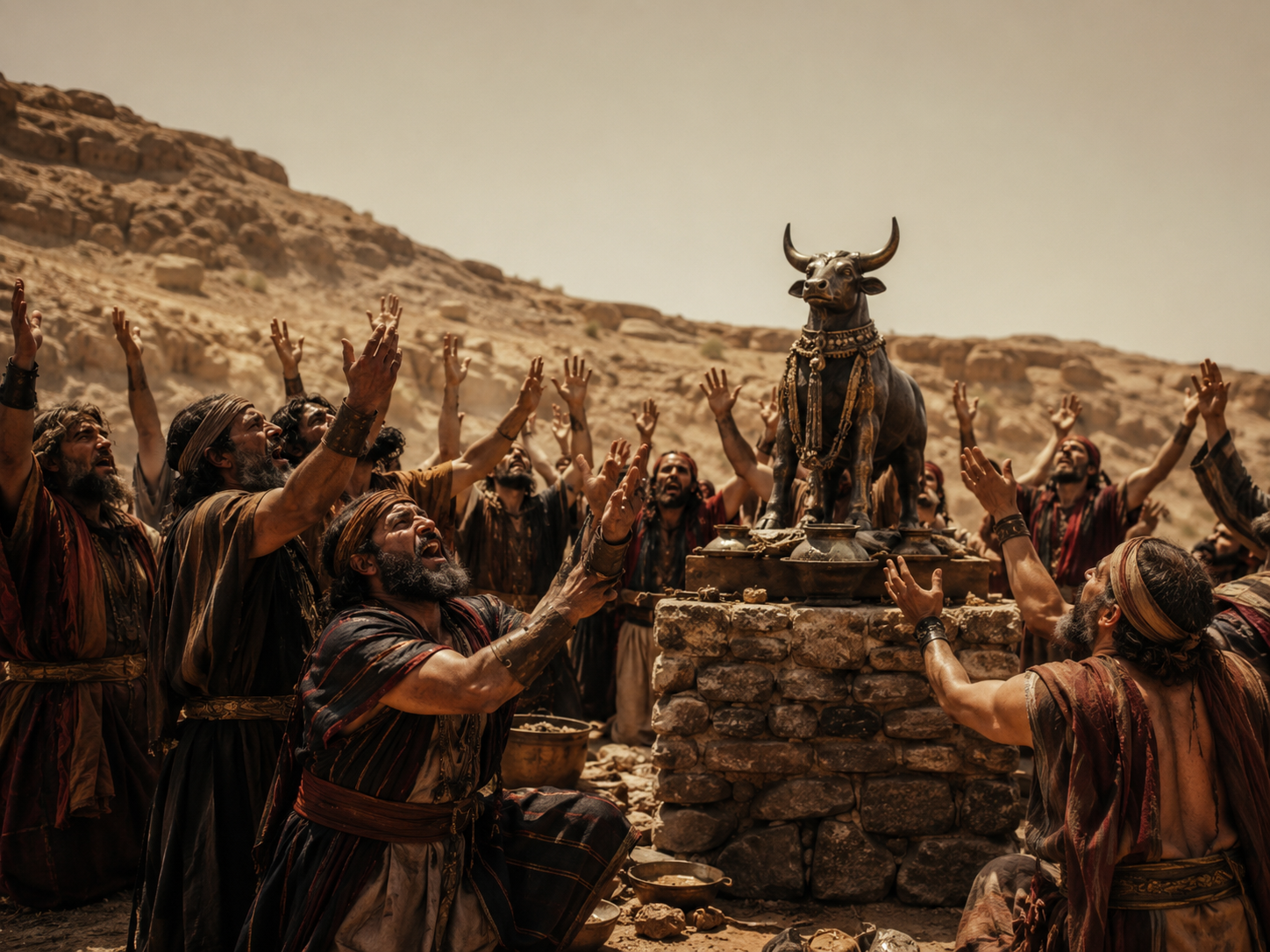
Read His words again, because He was precise. The phrase translated “vain repetitions” is the Greek battalogeō — to babble, to stammer the same syllables over and over, the way the prophets of Baal “called on the name of Baal from morning even until noon, saying, O Baal, hear us” (1 Kings 18:26). The sin is not the repeating. It is the theory behind the repeating — “they think that they shall be heard for their much speaking.” The pagan believed the words themselves, piled high enough, would force the god’s hand. That is mechanical, manipulative prayer aimed at a deity who has to be worn down. That is what He condemned.
And we know repetition itself was never the target, because Christ did it Himself. In Gethsemane He “prayed the third time, saying the same words” (Matthew 26:44). David repeats “for his mercy endureth for ever” twenty-six times in a single psalm (Psalm 136). If repeating a sentence were the sin, Scripture would be the first offender. It is not the repetition. It is treating God like a machine you can operate by volume.
An affirmation is not aimed at God at all. You are not trying to be heard by Him. You are not trying to be heard by anyone. You are doing something to your own mind — the thing the world has been doing to it, without your permission, your whole life.
You are already run by repetition
Here is the part people miss. You are already the product of repetition. Every belief you hold about yourself right now — what you are capable of, what you are worth, what is possible for someone “like you” — was installed the same way. Not by a decision. By saturation. Years of it.
A child does not choose to believe “money is hard to come by.” He hears it three hundred times before he is ten, in the tone of voice his parents use at the kitchen table, and it sinks past the thinking mind into the part of him that runs automatically. Nobody argued the point with him. The world simply repeated itself until the idea became furniture.
That deep layer — call it the subconscious, the heart, the paradigm — does not reason. It accepts. It takes whatever is repeated to it, with feeling or without, true or false, and makes it the default you operate from for the rest of your life, unless something interrupts it. “As he thinketh in his heart, so is he” (Proverbs 23:7). The heart was thinking long before you started paying attention to what you were feeding it.
So the real question is not whether you will let repetition shape you. That ship sailed in childhood. Repetition is shaping you every day, whether you direct it or not. The only question is whether you are going to take the wheel.
How a new idea reaches the deep layer
That is all an affirmation is: taking the wheel. Bob Proctor spent fifty years teaching one idea — that the paradigm, the bundle of subconscious programs, controls the results, and the paradigm is changed by repetition, not by understanding. Joseph Murphy built his whole work on the same observation: the subconscious accepts what the conscious mind impresses on it through repetition. Maxwell Maltz, a surgeon, noticed his patients’ self-image did not change when he changed their face — it changed only when they rehearsed a new picture of themselves until it took.
Left to the world, that rehearsal takes years, because the world is slow and scattered and not on your side. An idea drifts toward the deep layer at the speed of accidental repetition. But you can do on purpose, in a focused window, what the world does by accident over a decade. You can take one chosen sentence and repeat it deliberately, daily, until the deep layer files it as true — and collapse a process that would have taken years into weeks or months. That is not mysticism. It is the same mechanism that installed everything else in you, run on purpose instead of by default.
Saturation, not intensity
Here is where most affirmation advice goes wrong. The manifestation crowd tells you to feel it — summon white-hot emotion, visualize with desperate intensity, want it badly enough to bend reality to your will. Drop all of that. You do not need the emotion, and the strain works against you. The deep layer is most open when the body is calm and unforced — the drowsy minutes after waking, the first stretch of a long walk, the quiet before sleep. What it responds to is not intensity. It is saturation — volume, the same plain sentence, repeated calmly, often, over a long enough stretch of time.
This is why the most effective method is almost boring: robotic repetition. A short phrase on a loop. No drama. You are not casting a spell; you are laying brick. The prophets at Carmel had intensity to spare — they cut themselves and screamed for half a day. It bought them nothing, because intensity was never the mechanism. Quiet, consistent saturation is.
What to load — and one line not to cross
Which makes the one thing that actually matters obvious: what you choose to saturate. The tool is neutral. It will drive a lie into you as efficiently as the truth — that is exactly how the lies got in. So you fill it deliberately, and you fill it with what is true. “Whatsoever things are true… think on these things” (Philippians 4:8) is not a devotional nicety; it is a manufacturing instruction. Paul says a person is transformed “by the renewing of your mind” (Romans 12:2). The mechanism is built in. We are simply told what to load.
One line not to cross. The world’s version of this eventually tells you that you are the source — that your own mind is god, that reality is the obedient servant of your own divinity. That is a lie, and it is the oldest one: “ye shall be as gods” (Genesis 3:5). You are not the source. You are a creature, made in the image of a Creator, given real, delegated power to shape the small kingdom of your own life — your habits, your work, your character, the way you respond to what comes. That is an enormous, God-given power. It is not godhood, and you do not need to claim godhood to use it. Keep the power; leave the lie.
The protocol
- Pick three to five over-encompassing affirmations. Not twenty narrow ones. A few short, total statements that cover the territory — money, competence, communication, character.
- Keep them short and present-tense. The deep layer takes simple, declarative input. Long, ornate affirmations have their place, but for daily saturation, short wins.
- Repeat them robotically, in a calm state. Not with summoned emotion. In the soft windows — waking, walking, before sleep.
- Use a track if it helps. A short phrase looped over quiet music does the saturation for you while the body stays relaxed.
- Give it ninety days, minimum. This is the part everyone skips. The old programs took years; the new one needs a real run before it becomes the default. Two weeks proves nothing.
- Mind your casual speech the other twenty-three hours. Fifteen minutes of chosen input cannot outvote twelve hours of “I’m broke” and “I’m exhausted.” Repetition wins — and all-day speech wins on sheer volume unless you shut it down.
How I do this
My own foundation is Bible reading and ongoing prayer — not a scheduled session but constant contact, a conversation with God kept open through the day. That is the relationship, and it stays separate from the mind-work. I do not confuse the two: one is communion with my Father, the other is conditioning my own mind.
For the mind-work, I run three to five over-encompassing affirmations — plain, in my own voice: I make a million dollars a month. I am a highly effective professional. I communicate with clarity and confidence. I am highly skilled in everything that I do. I record them myself — a phrase or two looped over reverb, delay, and soft music built to relax the body rather than hype it up — and I run a track two or three times a day, fifteen to thirty minutes: in the first quiet minutes after waking, in the first stretch of a long walk, and before sleep. Calm, not intense. Saturation, not summoning. And I guard the rest of the day’s speech so it does not undo the work.
That is the whole thing. Reading and prayer for the relationship; robotic affirmation for the programming; speech discipline to protect it.
The choice in front of you
So no — affirmations are not vain repetitions. Vain repetition is babbling at God as though many words could move Him. Affirmation is taking the same mechanism that built every belief you already carry and pointing it, on purpose, at the truth. One is a person trying to manipulate a deity. The other is a person doing his own mind the way it was always going to be done — by repetition — and finally choosing what gets repeated.
You were never going to escape being shaped by what you hear over and over. Nobody does. The only decision in front of you is whether the voice doing the repeating is the world’s, by accident — or yours, on purpose, loaded with what is true. Pick the sentence. Run it. Give it the ninety days.
Sources
On the mechanism of the subconscious and repetition:
- Bob Proctor, You Were Born Rich — paradigms and the subconscious.
- Joseph Murphy, The Power of Your Subconscious Mind (1963).
- Maxwell Maltz, Psycho-Cybernetics — the self-image.
- Napoleon Hill, Think and Grow Rich — autosuggestion.
- Neville Goddard — the assumption (the technique, set apart from the metaphysics).
- James Allen, As a Man Thinketh (1903).
Scripture (KJV): Matthew 6:7; Matthew 26:44; 1 Kings 18:26; Psalm 136; Proverbs 23:7; Philippians 4:8; Romans 12:2; Genesis 3:5.
Companion pieces: Umbrella Affirmations (which affirmations to actually use, and how) and The Law of Assumption (the mechanism, and where Neville went wrong).