

For as he thinketh in his heart, so is he.
I want to begin by conceding something that many Christians are too nervous to concede, because they think the concession is the danger. It is not. Neville Goddard was right about the machine. The settled assumption a man carries in the deep layer of himself — what Scripture calls the heart — really does shape the life that comes out of him. He did not invent that truth; he borrowed it from the Book he spent his career dismantling. The tragedy of Neville is not that he found a working mechanism. It is what he traded to keep it.
The mechanism is real
Let us not flinch from it. A man is not, in the end, what his conscious mind agrees with on a Tuesday. He is what the settled layer beneath it assumes to be true. “For as he thinketh in his heart, so is he” (Proverbs 23:7) — and the thinking Solomon names is not the running commentary of the head but the fixed conviction of the heart, the place a man’s real expectations and reflexes live. Change what that layer assumes, and you change the man; leave it untouched, and no amount of new information will move him. That is why Scripture does not say, be transformed by the gathering of more facts, but “be ye transformed by the renewing of your mind” (Romans 12:2).
The Bible treats this as a law as dependable as seedtime and harvest. “Keep thy heart with all diligence; for out of it are the issues of life” (Proverbs 4:23) — guard the deep layer, because everything downstream flows from it. “Death and life are in the power of the tongue” (Proverbs 18:21). And most striking of all, from the lips of Christ Himself: “whosoever… shall not doubt in his heart, but shall believe that those things which he saith shall come to pass; he shall have whatsoever he saith” (Mark 11:23). The assumption held without wavering in the heart tends to reproduce itself in the life. We have written about this at length elsewhere — that you become what you say, that the governing program of a life is a paradigm that can be deliberately rewritten, and that affirmation is a biblical mechanism, not a pagan one. So when Neville said the assumption you accept as true hardens into fact, he was not lying about the mechanism. He was reading the dial correctly.
Here is the one word that changes everything, and it is the word Neville could not bring himself to keep: the power is delegated. Man is a sub-creator, made in the image of a Creator, handed a real but borrowed authority to shape his inner world and, through it, his outer one. The faucet is genuinely in your hand. But the water is not yours, and the plumbing is not yours, and the moment you forget that, the gift becomes a snare. Neville forgot it. He took the delegated faucet and declared himself the reservoir.
The trade he made
To keep the mechanism and be rid of the God who lent it, Neville had to pay in three coins. He paid with the Bible’s people, dissolving Abraham and Moses and David and Jesus into moods of your own mind. He paid with the Bible’s history, declaring the whole record a psychological drama that never touched the ground of the real world. And he paid with the throne, seating the human imagination in the place of God. None of the three was necessary to operate the mechanism. Each of them was necessary only to operate it without a Master. That is the whole error, and it is worth taking one coin at a time.
Error one — the Bible dissolved into allegory
Neville’s method was to read every name in Scripture as a state of consciousness and every event as an inner experience. David is not a king; he is the awakened imagination. The crucifixion is not a death on a Roman cross outside Jerusalem; it is your consciousness being nailed to a new assumption. Israel’s journey out of Egypt is not a nation crossing a real sea; it is your escape from limiting belief. On this reading the Bible contains no history at all — only a coded manual for the manipulation of your own states, with the “characters” as costumes the psyche wears.
This is the ancient error of allegorizing, and the church has met it before. When you turn a real person into a pure symbol, you are free to make him mean anything you like — which is to say, he no longer means anything at all; he means you. The method is seductive precisely because it flatters the reader: every page becomes a mirror. But a mirror cannot rebuke you, cannot command you, cannot save you. A God who is only a metaphor for your own mind can make no demand you did not first invent. That is not a small theological quirk. It is the entire point of the system: to keep the Bible’s power language while removing the Bible’s living Author.
Error two — a history he could not answer
Here is the fact that changes how we should read Neville altogether, and it is a fact of timing. Neville taught and wrote from the 1930s to the early 1970s. He formed his conviction that the Bible was pure allegory in the last era when an educated man could still say such a thing and sound informed. That era had a name in the academy — biblical minimalism: the confident assumption that the patriarchs were legend, that David was a folk hero with no more reality than King Arthur, that the Scriptures were late, fictional, and historically empty. In Neville’s lifetime the shovel had not yet spoken. He was arguing into a silence.
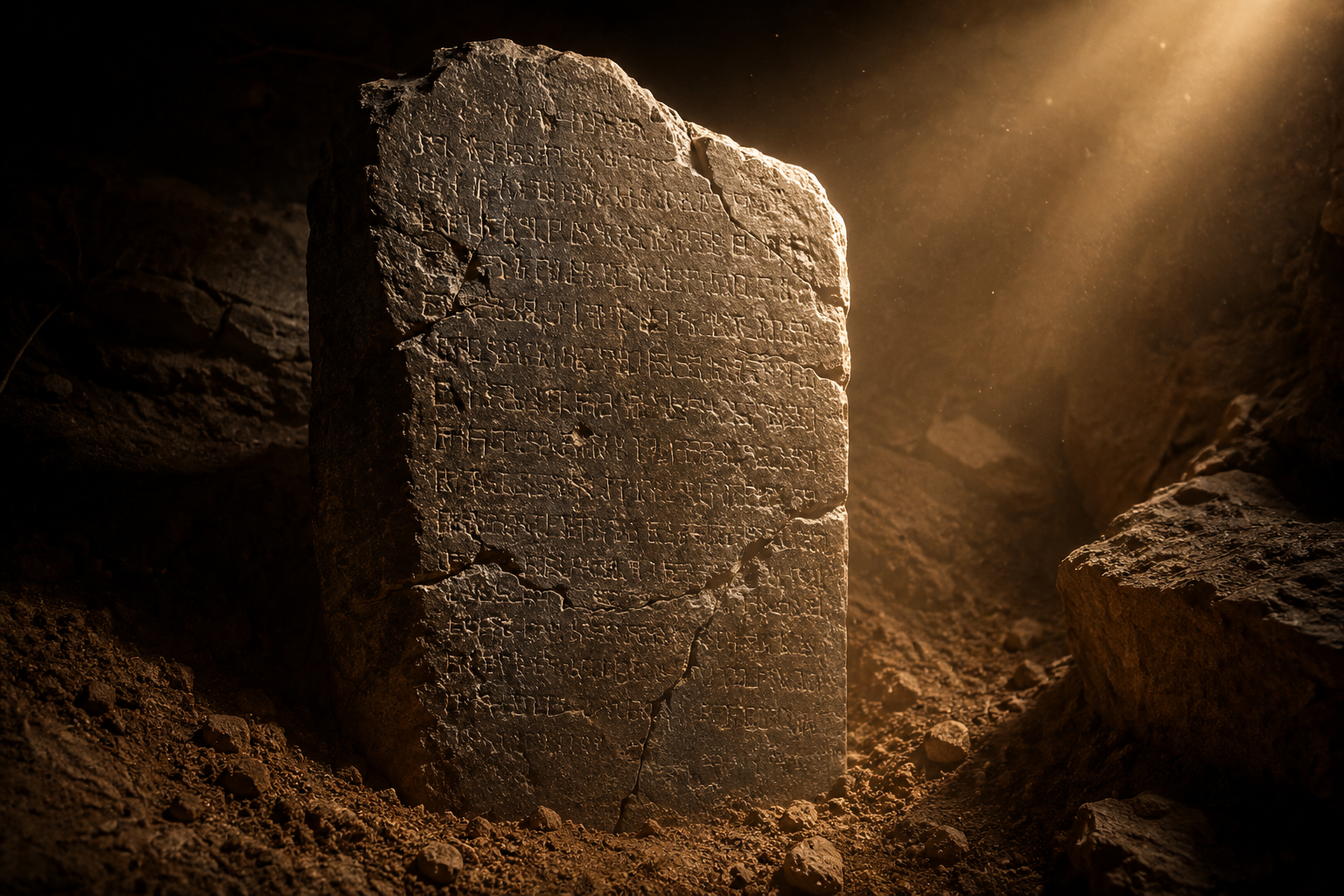
That silence is over. The single most important thing to understand about Neville’s skepticism is that it belongs to a world that no longer exists — a world before the discoveries, before the museum cases, before the search bar. He could allegorize David because, in his day, no stone had yet named him. Ours has. Consider only a handful of what the ground has surrendered since:
- The Tel Dan Stele (1993). A shattered victory monument in Aramaic, carved by an enemy of Israel, boasting of war against the “House of David.” The first hard, extra-biblical witness to David as the founder of a real dynasty — not a state of consciousness, but a king whose line his enemies feared enough to name in stone. See The House of David.
- The Pilate Stone (1961). A limestone block at Caesarea bearing the name Pontius Pilatus, Prefect of Judea — the governor of the Gospels, confirmed in his own title, in his own province, in his own hand. The trial of Jesus is set in a real administration. See Discoveries from the Era of Christ.
- Hezekiah’s seal and the Siloam tunnel. A clay bulla reading “Belonging to Hezekiah… king of Judah” (published 2015), and the water tunnel he cut through solid rock beneath Jerusalem — the very work recorded in 2 Kings 20:20. The king on the page is the king in the earth. See Sennacherib and Hezekiah.
- The Dead Sea Scrolls. Copies of Scripture a thousand years older than anything known before, found in the caves of Qumran — and, when set beside the later text, all but identical. In 2025 a study pairing radiocarbon dating with a trained AI handwriting model pushed several scrolls even earlier than scholars had dared to date them. The Book Neville dismissed as fluid myth turns out to have been copied with a precision that shames the doubt. See The Dead Sea Scrolls.
Notice what this does to the allegory. You cannot turn a man into a mood once his signet ring is in your hand. The moment David, Hezekiah, and Pilate step out of the ground as real men in real reigns, Neville’s reading collapses — not because a theologian refuted it, but because the archaeologist did. He was not a wicked genius who saw the evidence and defied it. He was a man arguing in the dark, in the last hour before the lights came on. We have no such excuse. The evidence he lacked is on the phone in your pocket.
Error three — the imagination on the throne
The first two errors are grave. The third is fatal. Neville did not merely say that your imagination is powerful. He said your imagination is God. “I AM,” the covenant name God gives Himself at the burning bush, Neville reassigned to human consciousness: the “I am” you feel within is, he taught, the only God there is. There is no Creator on a throne; there is only awareness, wearing your face, dreaming your world into being.
We have heard this sentence before. It was first spoken in a garden, by a voice that promised, “ye shall be as gods” (Genesis 3:5). It was repeated by a fallen morning star who said in his heart, “I will be like the most High” (Isaiah 14:14). The oldest lie in the world is not God does not exist. It is you are Him. Neville simply gave that lie a method and a following. And here is why it is fatal and not merely mistaken: a self that is its own god has no Savior, needs no Savior, will accept no Savior. If you are the source, then the cross was a costume, sin was a low vibration, and the Son that God gave was only a symbol of your own awakening. The one door out of death is quietly bricked over — not with a denial, but with a flattery.
The power without the lie
Now we can say plainly what this article is for. You do not have to choose between the power of the renewed mind and the God who gave it. That was Neville’s false choice, forced on him by a skepticism the evidence has since dismantled. Keep the mechanism. Refuse the lie. The Bible had the law of the mind long before New Thought borrowed it and filed off the serial number — and in Scripture the law runs on faith, not on self-deification.
Read the hinge verse again with fresh eyes: “Now faith is the substance of things hoped for, the evidence of things not seen” (Hebrews 11:1). That is the law of assumption — stated by the apostle, centuries before Neville, and stated better. To assume a thing so settledly that it becomes the evidence you live from is exactly what faith does. The difference is not the mechanism; the difference is whose report you are believing and whose power fulfils it. Neville’s assumer believes in himself and commands his own imagination. The believer believes God and lays hold of a promise. One rests on a creature; the other rests on the Creator — and only one of them can bear weight when the creature fails.
So the practice survives, purified. Guard the gate of the mind — “casting down imaginations… and bringing into captivity every thought to the obedience of Christ” (2 Corinthians 10:5). Choose your inputs on purpose, because a mind left ungoverned is not neutral — it is being programmed all day by the world, the advertisement, the fear, the crowd. Better to program it yourself, with truth: “whatsoever things are true… think on these things” (Philippians 4:8); “thou shalt meditate therein day and night” (Joshua 1:8). Fill the deep layer with God’s own word, by repetition, until it becomes your reflex. For the fuller toolkit — the paradigm, the affirmation, the guarded self-image — see The Self-Image and Is Self-Development Bad?
Beholding is becoming
Set two verses side by side and you have the whole law of the mind, told in the Bible’s own words. The first names the faculty: “For as he thinketh in his heart, so is he” (Proverbs 23:7) — the settled inward thought sets the man. The second names the process: “But we all, with open face beholding as in a glass the glory of the Lord, are changed into the same image from glory to glory” (2 Corinthians 3:18) — the settled inward gaze remakes him. Thinking and beholding: two names for the single transforming chamber of the inner life. What you keep before the eye of the mind, you become.
And notice — this is the part almost everyone misses — that the beholding Paul describes is not ordinary eyesight. No one in this life looks upon the glory of the Lord with the physical eye; Paul says we behold it “as in a glass,” in a mirror, in the imagination lit by faith. The gaze that changes us is an inner gaze. Which means the thing we most need to see: what you behold in the mind transforms you exactly as much as — and often more than — what you behold with the eye. Nor are the two ever really apart. To look at a thing with the eye is already to carry its image inward; sight itself ends in the mind, as a picture held in thought. There is no seeing that does not become an inner seeing. So the imagination is no toy and no lie. It is a real organ of transformation — the very chamber where beholding does its work.
That is precisely why the object of the gaze is everything, and why Neville’s error was fatal rather than clever. He was right that the inner image remakes you. He was catastrophically wrong about what to set before it. Fill the inner eye with yourself-as-god, and you are changed into that image — a small, anxious idol, tending a private world it cannot really command. Fill it with the glory of the Lord — His character, His promises, His Son — and you are “changed into the same image from glory to glory.” The mechanism is neutral; the direction is not. Behold the creature, and you shrink to the creature. Behold the Creator, and you are enlarged into a son. Neville aimed the mightiest faculty God ever gave a man straight at the mirror. Scripture aims it at the Lord.
Where the lie leaves you
It matters where a road ends, not only how it feels at the trailhead. The law-of-assumption teaching, taken with Neville’s theology intact, is not a harmless productivity hack. It is a slow catechism in self-worship. It trains a person to look inward for a god, to treat other people as projections of his own consciousness, and to meet real suffering — his own and his neighbor’s — with the cold counsel that they simply assumed the wrong story. And at the end of it stands a soul alone with its own imagination, having been talked out of the one Father who was really there and the one Savior He really gave.
That is the danger we owe it to people to name. Not the power of the mind — that is God’s good gift, and we will not surrender it to the people who abused it. The danger is the substitution: a creature persuaded to sit in the Creator’s chair, a mind full of technique and empty of God. To such a soul the whole point of the good news is unintelligible, because you cannot receive a gift you have been taught you never needed. This is why we write these things — the same reason we would write a letter to a friend in the New Age: not to win an argument, but to leave the door to the real God standing open.
Keep the power; refuse the lie
Neville Goddard read one dial correctly and misnamed everything around it. The assumption of the heart really does shape the life — Solomon said so, and Christ said so, long before he did. But the imagination is not God; it is God’s instrument, lent to a creature made in His image. The Bible is not a code for your moods; it is history, and the ground keeps saying so. And the mind’s great power is not a throne to be seized but a gift to be surrendered — poured back, full of His word, into His hands.
So keep the mechanism. Renew the mind, guard the heart, assume the promise, behold the glory — and do it all as a son of the living God, not as a lonely god of a private world. Neville had the faucet and lost the reservoir. You may have both. The One True God is real, He is not your imagination, and the Savior He gave is not a symbol of your awakening but a Person who came, in real history, to bring you home.
Sources
On the teaching examined: Neville Goddard, Feeling Is the Secret (1944), The Power of Awareness (1952), and Awakened Imagination (1954) — cited as the subject under examination, not as authority. On the mechanism of the renewed mind, treated biblically, see the Christian Self-Development library: Changing Your Paradigm, Affirmations and Vain Repetitions, You Become What You Say, and The Self-Image. On the historical record: The House of David, Discoveries from the Era of Christ, Sennacherib and Hezekiah, and The Dead Sea Scrolls. Scripture quoted from the King James Version.