In brief
The first century is the most thoroughly excavated stretch in the Bible.
For most of the nineteenth and twentieth centuries, a significant strand of New Testament scholarship argued that the Gospels and the Acts of the Apostles were late theological compositions written long after the events they purport to describe, by authors with no first-hand knowledge of the places, persons, or institutional details they record. On this reading, the New Testament was a theological document dressed up in pseudo-historical costume. The trouble with the position has been that the archaeological record has, for the past hundred and fifty years, kept producing material confirmation of precisely those places, persons, and institutional details — at a density and specificity which a late, distant, and uninformed author could not have produced by guess. This article surveys ten of the most significant of those confirmations.
The discoveries catalogued below were made between 1845 and 2018, in controlled excavations at sites across Israel, Greece, and the wider Roman Mediterranean. They include the only contemporary inscription naming Pontius Pilate, the ossuary of the high priest Caiaphas who tried Jesus, the actual Pool of Siloam where the man born blind was healed, the actual Pool of Bethesda whose five porticoes John records, the earliest synagogue in Galilee at the hometown of Mary Magdalene, a first-century fishing boat of exactly the kind used by Jesus’ disciples, the only archaeological evidence of Roman crucifixion ever recovered, the inscription of Erastus the treasurer of Corinth named in Romans 16, and a stone inscription confirming the unusual Greek civic title politarchs used by Luke in Acts 17 — a title for which scholars long argued no parallel existed outside the New Testament. The pattern is unambiguous. The New Testament describes a real first-century world, and the archaeology keeps producing the receipts.
1. The Pilate Stone — the only contemporary inscription of Pontius Pilate
Before 1961, the existence of Pontius Pilate as a historical figure rested on four written sources: the four Gospels, the Acts of the Apostles, the Jewish historian Josephus, the Alexandrian philosopher Philo, and a brief reference by the Roman historian Tacitus. There was no physical artefact bearing Pilate’s name. This gave a certain school of skeptical scholarship the opportunity to argue that Pilate was a New Testament invention; that no Roman official by that name had ever governed Judaea; that the Gospels were therefore historically unreliable on the most basic question of who tried Jesus.
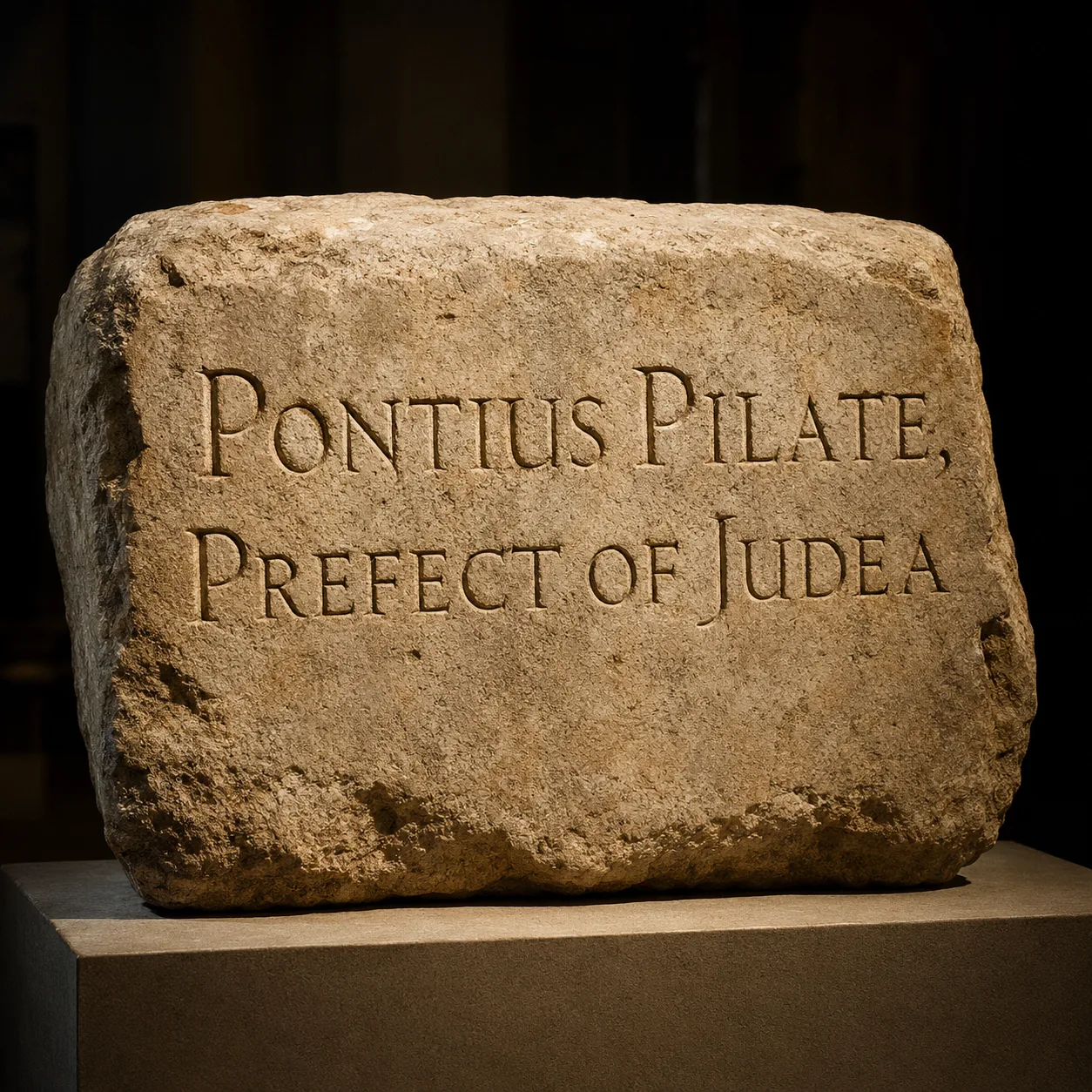
In June 1961, an Italian archaeological team led by Antonio Frova was excavating the Herodian theatre at Caesarea Maritima — the coastal Roman administrative capital of Judaea, twenty-three centuries old and overlaid by Crusader, Byzantine, and Roman strata. During the excavation, the Italian archaeologist Maria Teresa Fortuna Canivet recovered a damaged limestone block which had been reused as a step in a later staircase. The block bore the partial remains of a four-line Latin inscription. With the missing portions reconstructed, the inscription reads:
[DIS AUGUSTI]S TIBERIÉUM
[...PONTI]US PILATUS
[...PRAEF]ECTUS IUDA[EA]E
[...FECIT D]E[DICAVIT]
“To the divine Augusti, [this] Tiberieum, [Ponti]us Pilatus, [Pref]ect of Juda[ea], [has dedi]cated.”
Three facts about the inscription are worth noting. First: it is the only contemporary inscription bearing Pilate’s name in the world. Every other reference to him is in later literary sources. The Pilate Stone is the man’s own dedication of a temple building (the Tiberieum) to the deified Emperor Tiberius and his family, carved in stone during his own governorship at his own administrative capital. Second: the inscription gives Pilate’s title as prefect of Judaea (praefectus), not procurator. This matters: Roman administrators of Judaea were called praefecti until AD 41, after which the title was changed to procurator. The biblical text and Josephus, writing later, sometimes use the later title loosely, but the Caesarea inscription preserves the actual title Pilate held during his own tenure — consistent with the historical reality the Gospels imply. Third: the physical location of the find — Caesarea Maritima rather than Jerusalem — confirms what the New Testament and Josephus both indicate, that the Roman prefect’s actual administrative base was at Caesarea rather than the Jewish capital. The Pilate Stone is now on permanent display at the Israel Museum in Jerusalem.
2. The Pilate Ring — a copper seal from Herodium
A second possible Pilate artefact emerged from the archaeological record in 2018, though the actual object had been in storage since 1969. During the 1968–69 excavation season at Herodium — the desert palace and burial complex built by Herod the Great south of Bethlehem — the Israeli archaeologist Gideon Foerster recovered a small copper-alloy sealing ring from a Second-Temple-period context. The ring was indistinct, corroded, and went into the storage shelves of the Hebrew University without much notice. Fifty years later, advances in photographic imaging allowed a thorough cleaning and re-examination of the artefact. When the corrosion was lifted, the ring was found to bear, in Greek letters, the inscription ΠΙΛΑΤΟ (PILATO) flanking the image of a wine vessel. The find was published in November 2018 in the journal Israel Exploration Journal.
The ring’s identification with Pilate himself remains contested. The ring is of poor copper-alloy workmanship, not the sort of object one would expect a wealthy Roman prefect to wear; one scholarly view is that the ring belonged to a freedman, a relative, or a junior official of Pilate’s administration, used to seal correspondence on the prefect’s behalf. Either way, the find places the name Pilatus in a Second-Temple-period archaeological context at Herodium, ten miles from Jerusalem — consistent with the biblical record and independent of the Caesarea inscription.
3. The Caiaphas Ossuary — the high priest who tried Jesus
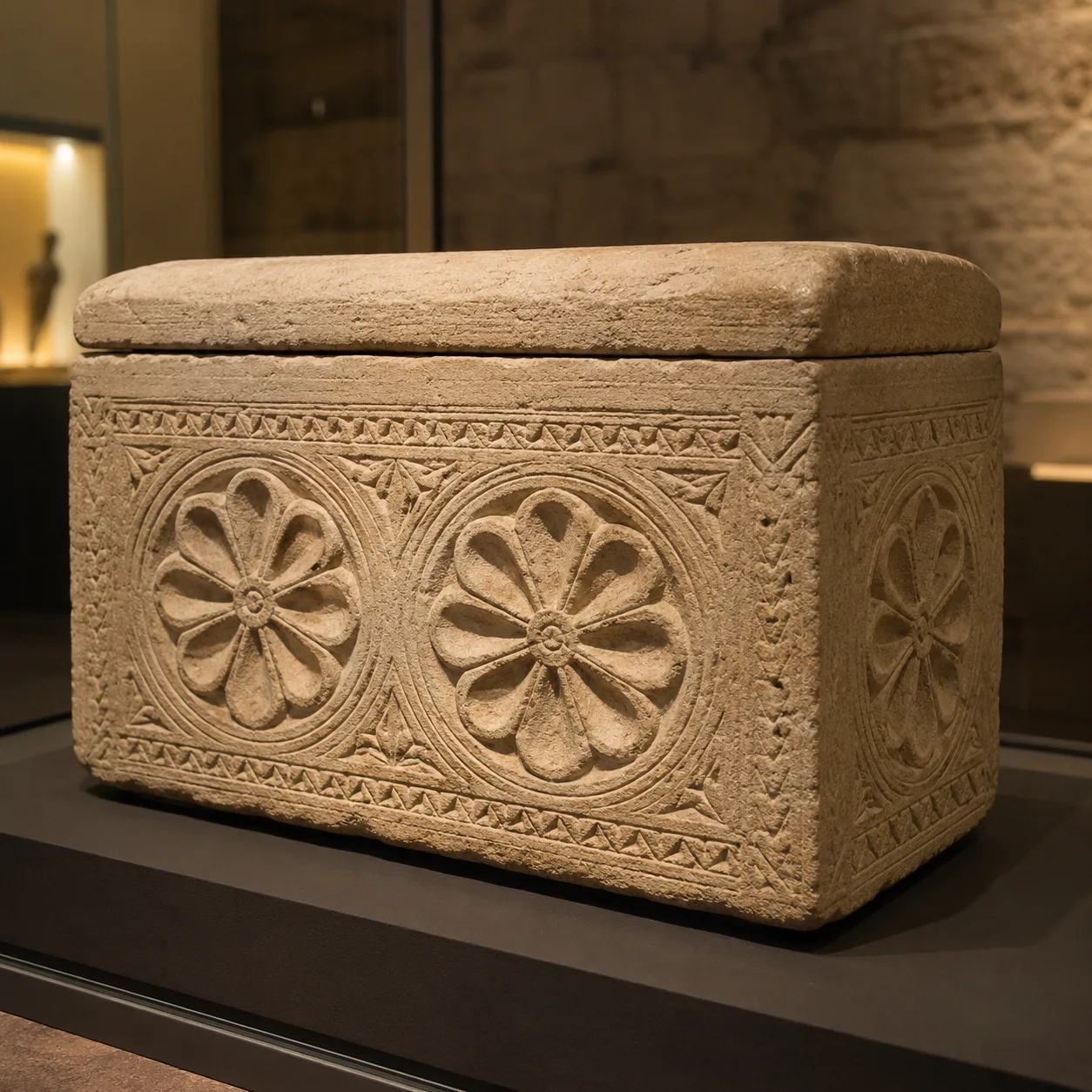
In November 1990, workers extending a water park in the Peace Forest south of Jerusalem accidentally collapsed the roof of an underground first-century burial chamber. The Israel Antiquities Authority was summoned. Within the chamber were twelve limestone ossuaries — bone boxes of the kind in standard use for elite Jewish secondary burial during the Second Temple period. Two of the twelve bore the name of the same family. The most ornate of them — carved with delicate floral rosettes and the most elaborate decoration of any ossuary in the chamber — bore an Aramaic inscription on its side, twice repeated: Yehosef bar Qayafa, “Joseph, son of Caiaphas.”
Inside the ossuary were the disarticulated bones of six individuals: two infants, a child of three or four, a young teenage boy, an adult woman, and an adult man of approximately sixty years. The age and gender of the principal occupant — together with the family name on the ossuary, the wealth implied by the decoration, the prominent burial site outside Jerusalem, and the chronological window for the chamber’s use (the first century AD) — align precisely with what is known of the high priest named in the Gospels.
The Caiaphas of Matthew 26:3, John 18:13, and Acts 4:6 is identified in Josephus (Antiquities 18.2.2 §35; 18.4.3 §95) by both his personal name and his patronymic: Joseph who is called Caiaphas. Josephus records that he served as high priest in Jerusalem from approximately 18 to 36 or 37 AD — the precise period of Jesus’ public ministry and trial. The man whose ossuary was recovered in 1990 was named on the box as Joseph son of Caiaphas, was approximately sixty years old at death, was buried in elite Jerusalem fashion within the right chronological window, and was a member of the priestly aristocracy by the decoration of his ossuary. The identification with the biblical figure is, in the judgment of most scholars who have examined the find, secure. The honest reader will note that this is the actual bone box of the actual man who, by the biblical record, presided over the trial of Jesus Christ — on view today at the Israel Museum, with the inscription clearly legible.
4. The Pool of Bethesda — the five porticoes confirmed
In John 5:2, the apostle records a healing performed by Jesus at a Jerusalem pool whose architectural description is unusually precise: “Now there is at Jerusalem by the sheep market a pool, which is called in the Hebrew tongue Bethesda, having five porches.” A pool with five porticoes is geometrically odd — the standard Roman pool had four sides — and for most of the nineteenth century the detail was cited as evidence that John was a late symbolic author inventing architectural features for theological effect. The number five, on the skeptical reading, was a numerological gesture toward the five books of Moses; the pool itself was assumed not to exist.
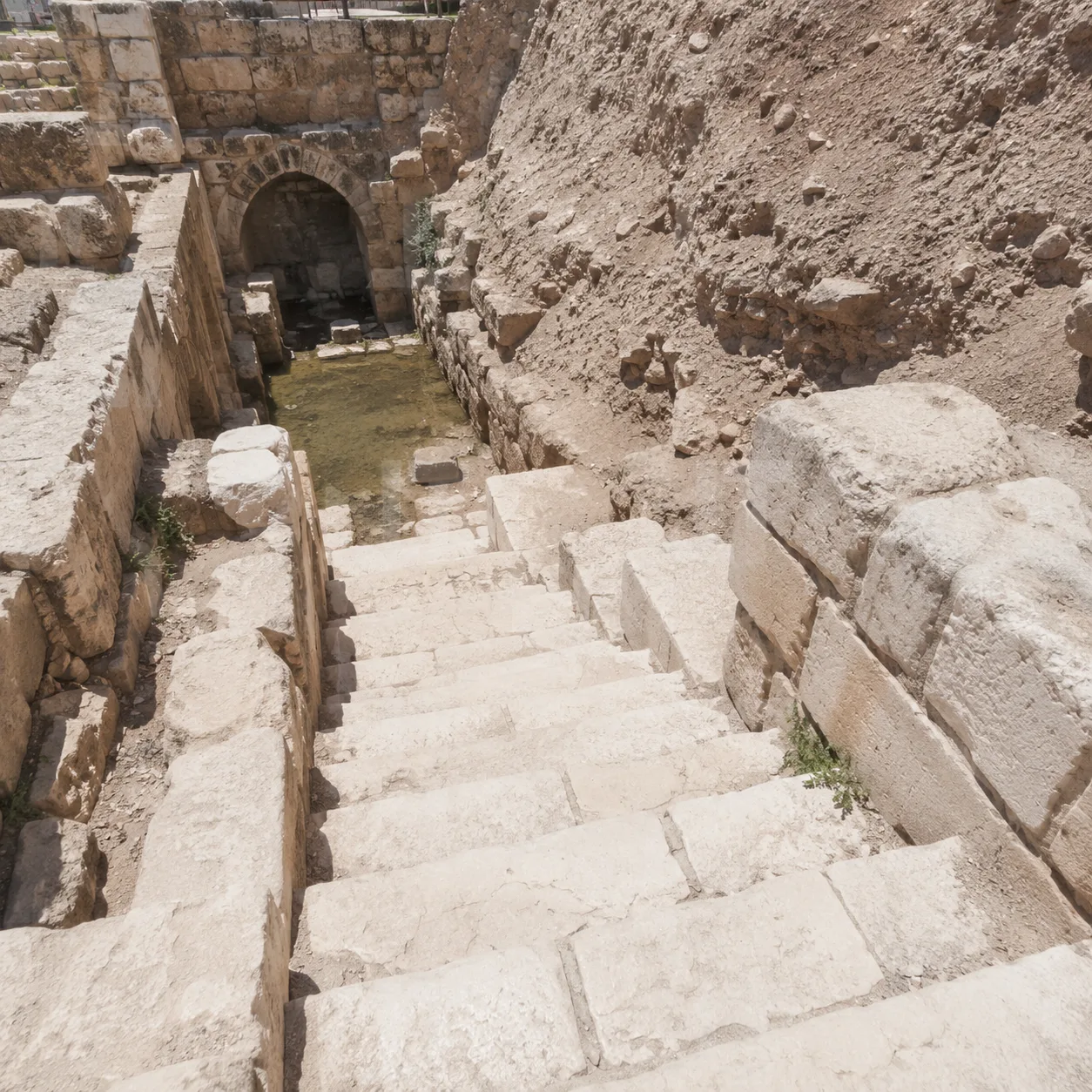
Beginning in 1888 and continuing through the mid-twentieth century, excavations conducted in the courtyard of the Church of Saint Anne near the Lions’ Gate of Jerusalem progressively uncovered a large twin first-century pool: two adjoining rectangular basins separated by a central partition. Around the outer edges of the twin pool ran four colonnaded porticoes, one on each side. Across the central partition ran a fifth portico. Five porticoes, exactly as John records them — a four-sided pool, but with a fifth covered walkway across the dividing wall down its middle.
The architecture is now beyond dispute. Visitors to the Church of Saint Anne in the Muslim Quarter today walk directly down into the excavated remains of the pool, and can stand in the central courtyard between the two basins where the fifth portico ran. John’s description, on which an entire school of late-dating skeptical scholarship had partly rested its case, has been confirmed in stone. The detail is so architecturally specific, and so impossible to reverse-engineer by guess, that the Cambridge New Testament scholar Urban C. von Wahlde has argued the architectural accuracy of John 5:2 independently establishes that the Fourth Gospel was composed by an author with first-hand knowledge of pre-AD 70 Jerusalem — that is, before the Roman destruction of the city, which is the date the traditional view of Johannine authorship requires.
5. The Pool of Siloam — where the blind man washed
In John 9, Jesus heals a man born blind by anointing his eyes with clay and instructing him to go and wash in the Pool of Siloam. For most of Christian history, pilgrims venerated a small Byzantine pool at the southern end of the City of David as the site of the miracle. Twentieth-century scholars suspected, on the basis of the Siloam Inscription and the run of Hezekiah’s Tunnel (see the companion article on Sennacherib and Hezekiah), that the actual first-century Pool of Siloam had to be larger and probably stood elsewhere, but the location had been lost.
In the autumn of 2004, workers laying a new sewer line for the modern Arab village of Silwan, immediately south of the Temple Mount, struck stone steps. Excavation by the Israeli archaeologist Eli Shukron of the Israel Antiquities Authority uncovered what the steps belonged to: a monumental stepped trapezoidal pool, approximately fifty metres on a side, with broad stone steps descending into the water on at least three sides. Stratified coinage from the foundation deposits dated the pool firmly to the Second Temple period. It was the actual first-century Pool of Siloam — large enough to accommodate hundreds of pilgrims, designed for the ritual purification of Jewish worshippers ascending to the Temple, fed by the same Gihon Spring waters that Hezekiah’s Tunnel had carried into the city seven hundred years earlier.
The site is now an active archaeological dig and is partially open to visitors as part of the Pilgrimage Road excavation. Subsequent seasons have begun uncovering the Roman-period processional way that ran from the Pool of Siloam up to the Temple Mount — the actual road on which first-century pilgrims walked to the Temple. The Pool of Siloam at which the man born blind washed his eyes is no longer a vague pilgrimage tradition; it is an excavated stone monument open to inspection. The Byzantine-era pool venerated for centuries by Christian pilgrims turned out to be a much later, smaller successor built over a different spring.
6. The Magdala Synagogue — the earliest in Galilee
For decades, the question of where exactly Jesus preached during His Galilean ministry was constrained by an embarrassing archaeological absence: although the Gospels repeatedly record Him teaching in the synagogues of Galilee (Matthew 4:23, Mark 1:39, Luke 4:15), no first-century Galilean synagogue had been excavated. The synagogues recovered in Galilean excavations — including the well-known synagogue at Capernaum — all dated to the third or fourth century AD, with no surviving structures from the lifetime of Jesus.
In 2009, an Israel Antiquities Authority test excavation was conducted on a plot at Magdala — the small fishing village on the western shore of the Sea of Galilee that gave its name to Mary Magdalene — in advance of a planned guesthouse construction. Less than a foot beneath the surface, the team uncovered an unrecognised first-century synagogue, dating by ceramics and coinage to between 50 BC and 100 AD. It is the earliest synagogue recovered anywhere in Galilee.
The synagogue has been the largest single Galilean archaeological event of the past century. Its main hall is approximately twelve metres on a side, with stone benches along the walls for the congregation. The walls preserve their original brightly-coloured frescoes — the only first-century synagogue frescoes ever recovered. The floors are mosaic. In the centre of the main hall stood a carved limestone reading table, intact, now known as the Magdala Stone, depicting on its panels a seven-branched menorah flanked by amphorae and what appears to be an architectural representation of the Temple in Jerusalem — carved by an artist who, on the early dating, must have personally seen the Second Temple before its destruction in AD 70. The menorah depiction is among the earliest in existence, predating the famous relief on the Arch of Titus in Rome by a generation.
Jesus’ ministry took Him repeatedly through the villages of the western Sea of Galilee shore, of which Magdala was the largest and the only one with a market large enough to support a fishing-export industry. The synagogue at Magdala is the one Galilean synagogue, of the very period of His ministry, in which the Gospels would place Him. The probability that He taught in this very room is, on any reading of the evidence, substantial.
7. The Sea of Galilee Boat — a fisherman’s vessel of the period
The northern Sea of Galilee experienced a severe drought in 1985 and into 1986, dropping the lake level by several metres and exposing stretches of mudflat that had been underwater for two thousand years. In January 1986, two brothers from Kibbutz Ginosar on the north-western shore, Moshe and Yuval Lufan — both amateur archaeologists with the village’s archaeology club — were walking the exposed shoreline when they spotted oval shapes in the lake mud. They recognised them as the protruding ends of ancient hull timbers and reported the find to the Israel Antiquities Authority. The excavation that followed, racing against the return of the lake water, recovered an intact 2,000-year-old wooden fishing boat.
The boat is twenty-seven feet long and seven and a half feet wide. Construction details — mortise-and-tenon joints, the use of multiple wood types in repair, the size and shape of the hull — date it firmly to the late Hellenistic to early Roman period. Radiocarbon dating of the recovered timbers gave a calibrated range of 40 BC plus or minus 80 years, and stratified pottery and a ceramic oil lamp recovered with the boat confirmed the first-century date. The boat is large enough to carry between twelve and fifteen men. It is the precise size and construction of the kind of vessel the Gospels repeatedly describe Jesus and His disciples using on the Sea of Galilee.
No direct connection between this particular boat and any specific biblical narrative can be claimed. The boat is a type-specimen, not a relic. But it is the actual, excavated, physical example of the kind of vessel in which, according to Matthew 8, Jesus slept during the storm; from which, according to Luke 5, Peter cast his nets and pulled in the miraculous catch; into which, according to John 21, the risen Christ instructed the disciples to cast their net on the right side. After twelve years of submerged conservation in a wax bath, the boat is on permanent display at the Yigal Allon Galilee Boat Museum at Kibbutz Ginosar — the physical artefact of the kind of vessel that carried the founding events of the Christian gospel across the Sea of Galilee.
8. Yehohanan ben Hagkol — the only physical evidence of Roman crucifixion
Despite the well-documented Roman use of crucifixion as a method of execution — the historian Josephus records Romans crucifying as many as five hundred Jews per day during the siege of Jerusalem in AD 70 — no archaeological evidence of an actual crucifixion victim was recovered for nearly two thousand years after the practice ended. The wooden crosses rotted; the bodies were buried; the iron nails were almost always extracted and reused for their economic value. The complete absence of physical evidence had become a small puzzle in classical archaeology.
In 1968, during construction work in the Giv’at ha-Mivtar neighbourhood of north Jerusalem, workers uncovered a Second-Temple-period family tomb. Among the ossuaries within the tomb was one inscribed in Aramaic with the name Yehohanan ben Hagkol — “John, son of Hagkol.” The bones inside the ossuary belonged to a man of approximately twenty-five years. Upon examination by the Israeli anthropologist Nicu Haas of the Hebrew University Medical School, one of the bones produced a finding without archaeological precedent: the right heel bone of Yehohanan still had an iron Roman nail driven through it. The nail, eleven and a half centimetres long, had been bent at the point where it protruded out the side of the foot — bent on impact with a knot in the wood — and had to be left in place when his body was taken down for burial, because the bent point made the nail impossible to extract without destroying the heel.
Yehohanan’s heel bone is, to this day, the only archaeologically recovered physical evidence of Roman crucifixion anywhere in the world. The find establishes beyond any doubt that the Romans did, in fact, crucify Jews in first-century Jerusalem, using iron nails through the heel of the kind the Gospels describe. The detail of the bent nail, in particular, accidentally answers a skeptical question that had circulated in some Christian history circles: how, if Jesus’ nails were removed at the deposition from the cross (as John 20:25 implies in Thomas’s reference to the nail-marks rather than the nails themselves), could there be any physical evidence of crucifixion in the archaeological record? The answer is that ordinarily the nails were recovered. Yehohanan’s nail survived only because it had bent on impact and could not be removed without breaking the body. The find is on display today at the Israel Museum.
9. The Erastus Inscription — the treasurer of Corinth
In Romans 16:23, in the closing greetings of his letter to the church at Rome, the apostle Paul names a Corinthian friend who is sending his own greetings along with Paul’s: “Erastus the chamberlain of the city saluteth you, and Quartus a brother.” The Greek term Paul uses for Erastus’s civic office is oikonomos tēs poleos — the city treasurer. The letter to the Romans is conventionally dated to AD 57, written from Corinth.
In 1929, during American School of Classical Studies excavations of the Roman forum at ancient Corinth, the archaeologist T. L. Shear uncovered a Latin inscription carved into a limestone paving stone near the first-century theatre. The inscription reads, in translation:
ERASTVS PRO AEDILITATE S(VA) P(ECVNIA) STRAVIT
“Erastus, in return for his aedileship, laid [this pavement] at his own expense.”
The aedile was, in the Roman civic system, the magistrate responsible for the city’s public buildings, markets, and finances — precisely the office Paul names by its Greek equivalent oikonomos. The dating of the inscription is mid-first century AD by epigraphic style, which places Erastus’s aedileship in the exact decade of Paul’s residence in Corinth. The name Erastus is not common enough in the Corinthian epigraphic record to support coincidental identification. The pavement is still in place at the site, in its original location north-east of the theatre, and can be inspected today by visitors to the Corinth archaeological park. Paul’s greeting from the friend named in Romans 16:23 is matched, on the ground, by that friend’s own civic dedication.
10. The Politarchs of Thessalonica — vindicating Luke
In Acts 17:6–8, Luke records that the Thessalonian Jews, enraged by Paul’s preaching, seized his host Jason and dragged him before “the rulers of the city.” The Greek word Luke uses for these civic magistrates is politarchs (politarchas) — literally “rulers of the city.” For most of the nineteenth century, the word was unattested in any source other than Acts. No Greek inscription, no Roman administrative record, no Hellenistic literary text used politarch as a civic title. The German rationalist scholar Friedrich Christian Baur, founder of the Tübingen school of New Testament criticism, cited the term’s absence from external sources as evidence that the author of Acts was a late, distant, ignorant fabricator who had invented a civic title that never existed.
Beginning in the late nineteenth century, archaeological work in northern Greece progressively recovered a series of stone inscriptions from Thessalonica and surrounding Macedonian cities bearing the exact term politarch as an actual local civic title. The most famous is the Vardar Gate Inscription, a Roman-period public arch from the city wall of Thessalonica itself, bearing six lines of Greek that begin: “In the time of the politarchs Sosipater son of Cleopatra, Lucius Pontius Secundus, Aulus Avius Sabinus, Demetrius son of Faustus...” — followed by a list of Thessalonian magistrates serving under the title Luke had used. The inscription was removed from the gate in 1876 and is now in the British Museum.
Subsequent finds have increased the total count of attested politarch inscriptions to more than thirty, from sites across Macedonia and adjacent regions, dated to the period of Paul’s ministry. Luke’s use of the term was not an invention. It was the precise, local, Macedonian civic vocabulary an author who had personally accompanied Paul to Thessalonica would know. The skeptical argument has reversed: the term is now considered evidence of Luke’s first-hand knowledge of the cities he records, not of his distance from them. The same pattern recurs across the book of Acts. Luke gets local civic titles right at city after city — proconsul for Achaia (Acts 18:12), asiarchs for Ephesus (Acts 19:31), the chief man of the island for Malta (Acts 28:7) — in every case with technical accuracy confirmed by later epigraphic finds.
11. The cumulative case
Ten discoveries from a single period. The Roman governor named in the trial of Jesus, attested by his own dedicatory inscription. The high priest who presided over the trial, attested by his own ossuary. The pool with the unusual five-portico architecture John records, excavated as described. The pool of Siloam at which the blind man washed, monumentally recovered in 2004. The synagogue at Mary Magdalene’s home town, the only first-century Galilean synagogue ever found, in the exact area Jesus’ ministry repeatedly traversed. The kind of fishing boat Jesus and His disciples used, lifted intact from the mud of the Sea of Galilee. The only archaeologically recovered crucifixion victim in the world, confirming the physical details of the practice the Gospels describe. The civic dedication of the friend Paul greeted at the end of Romans, still in place in the Corinthian forum. The local civic title Luke used for Thessalonian magistrates, recovered on more than thirty stone inscriptions throughout Macedonia.
The cumulative effect is the inverse of the late-and-distant-author hypothesis. The New Testament documents are written by authors with detailed first-hand knowledge of the specific places, persons, buildings, civic offices, architectural features, and material culture of the first-century Roman East. Where the documents can be archaeologically checked, they check out. The honest reader is invited to consider what bearing this density of external corroboration has on the cases where the archaeology cannot speak — the resurrection of Jesus, the conversion of Paul, the miracles recorded in the Gospels and Acts. The documents which describe those events are the same documents which, on the archaeologically checkable details, are confirmed at a density few other ancient sources can match.
Scripture testimony
The biblical passages most directly anchored to the discoveries surveyed above:
- Luke 3:1
- Now in the fifteenth year of the reign of Tiberius Caesar, Pontius Pilate being governor of Judaea, and Herod being tetrarch of Galilee, and his brother Philip tetrarch of Ituraea and of the region of Trachonitis, and Lysanias the tetrarch of Abilene…
- John 5:2
- Now there is at Jerusalem by the sheep market a pool, which is called in the Hebrew tongue Bethesda, having five porches.
- John 9:7
- And said unto him, Go, wash in the pool of Siloam (which is by interpretation, Sent). He went his way therefore, and washed, and came seeing.
- Matthew 26:3–4
- Then assembled together the chief priests, and the scribes, and the elders of the people, unto the palace of the high priest, who was called Caiaphas, and consulted that they might take Jesus by subtilty, and kill him.
- Acts 17:6
- And when they found them not, they drew Jason and certain brethren unto the rulers of the city, crying, These that have turned the world upside down are come hither also…
Sources
- Antonio Frova, “L’iscrizione di Ponzio Pilato a Cesarea,” Istituto Lombardo, Rendiconti 95 (1961): 419–434 — original publication of the Pilate Stone.
- Shua Amorai-Stark et al., “An Inscribed Copper-Alloy Finger Ring from Herodium,” Israel Exploration Journal 68:2 (2018): 208–220 — the Pilate Ring publication.
- Zvi Greenhut, “The Caiaphas Tomb in North Talpiyot, Jerusalem,” Atiqot 21 (1992): 63–71; and Ronny Reich, “Caiaphas Name Inscribed on Bone Boxes,” Biblical Archaeology Review 18:5 (Sept/Oct 1992).
- Urban C. von Wahlde, “The Puzzling Pool of Bethesda,” Biblical Archaeology Review 37:5 (Sept/Oct 2011); and von Wahlde, “The Pre-70 ce Dating of the Gospel of John,” New Testament Studies 71 (2025).
- Hershel Shanks, “The Siloam Pool: Where Jesus Cured the Blind Man,” Biblical Archaeology Review 31:5 (Sept/Oct 2005) — the original announcement of the 2004 Pool of Siloam discovery by Eli Shukron.
- Mordechai Aviam, “The Decorated Stone from the Synagogue at Migdal,” Novum Testamentum 55:3 (2013); and Aviam, People, Land, Economy, and Belief in First-Century Galilee and Its Origins (Eisenbrauns, 2013).
- Shelley Wachsmann, The Sea of Galilee Boat: An Extraordinary 2000 Year Old Discovery (Plenum, 1995) — standard reference on the 1986 boat.
- Vassilios Tzaferis, “Crucifixion — The Archaeological Evidence,” Biblical Archaeology Review 11:1 (Jan/Feb 1985) — on the Yehohanan ben Hagkol heel bone find.
- Henry J. Cadbury, “Erastus of Corinth,” Journal of Biblical Literature 50 (1931): 42–58 — the foundational identification of the Erastus inscription with the Pauline figure.
- Edwin A. Judge, “The Decrees of Caesar at Thessalonica,” Reformed Theological Review 30 (1971); and the catalogue of politarch inscriptions in Charles Edson’s Inscriptiones Graecae X.2.1 (Berlin, 1972).