In brief
The Assyrian invasion of 701 BC is the best-attested event in the Hebrew Bible.
Of all the synchronisms between the Old Testament and external history, none is cleaner than the Assyrian invasion of Judah in 701 BC. The biblical account is unusually detailed: 2 Kings 18–19, 2 Chronicles 32, and Isaiah 36–37 all give parallel narratives of Sennacherib’s campaign, Hezekiah’s defensive preparations, the siege rhetoric of the Rabshakeh, the destruction of forty-six Judean cities, the encirclement of Jerusalem, the divine intervention that broke the siege, and Sennacherib’s death years later at the hands of his own sons. By rare archaeological fortune, the matching Assyrian account survives in equally rich detail: the king’s own annals carved in cuneiform on three hexagonal clay prisms, an extensive set of stone-relief wall panels depicting his siege of Lachish, his palace tribute records, and his own assassination confirmed by the Babylonian Chronicle.
Where the two accounts can be compared they corroborate one another almost beat-for-beat. They diverge in the way one would expect a victor’s and a survivor’s account to diverge — the boasting is asymmetric, the interpretive frame is different, the miraculous element is preserved only in the biblical version — but every checkable detail of the political, military, and architectural narrative is independently attested. Add to this the physical survival of Hezekiah’s water tunnel beneath the City of David, his defensive wall in the Jewish Quarter, his personal seal impression recovered from the Ophel, and a probable seal impression of the prophet Isaiah recovered ten feet away — and the result is one of the most thoroughly documented stretches of pre-Christian history we possess.
1. The campaign of 701 BC
In the late eighth century BC, the Neo-Assyrian Empire was the dominant military power in the ancient Near East, stretching from the Persian Gulf to the Mediterranean and from the Taurus Mountains in the north to the borders of Egypt in the south. In 722 BC, the Assyrian king Sargon II had completed his conquest of the northern kingdom of Israel and deported its population. Twenty years later, his son Sennacherib (reigned 705–681 BC) turned south against the kingdom of Judah, where the godly king Hezekiah (reigned roughly 715–687 BC) had refused to continue paying tribute.
The Assyrian campaign of 701 BC was the third campaign of Sennacherib’s reign. The biblical narrative records what happened from the Judean side. The Assyrian army moved down the Mediterranean coast, took the Phoenician cities, and turned inland into Judah. The Judean fortified city of Lachish, the second city of the kingdom, fell after a brutal siege. Forty-six other walled Judean cities and towns fell with it. Hezekiah, encircled in Jerusalem, sent tribute to Sennacherib at Lachish — gold, silver, and the gold-plating stripped from the doors of the Temple itself. Sennacherib accepted the tribute but continued the campaign, dispatching his general the Rabshakeh to demand Jerusalem’s surrender. Hezekiah prayed, the prophet Isaiah delivered the LORD’s promise of deliverance, and overnight the besieging army was struck down by divine intervention. Sennacherib withdrew to Nineveh and never returned. Years later he was assassinated by two of his own sons.
2. Sennacherib’s Prism — the Assyrian account
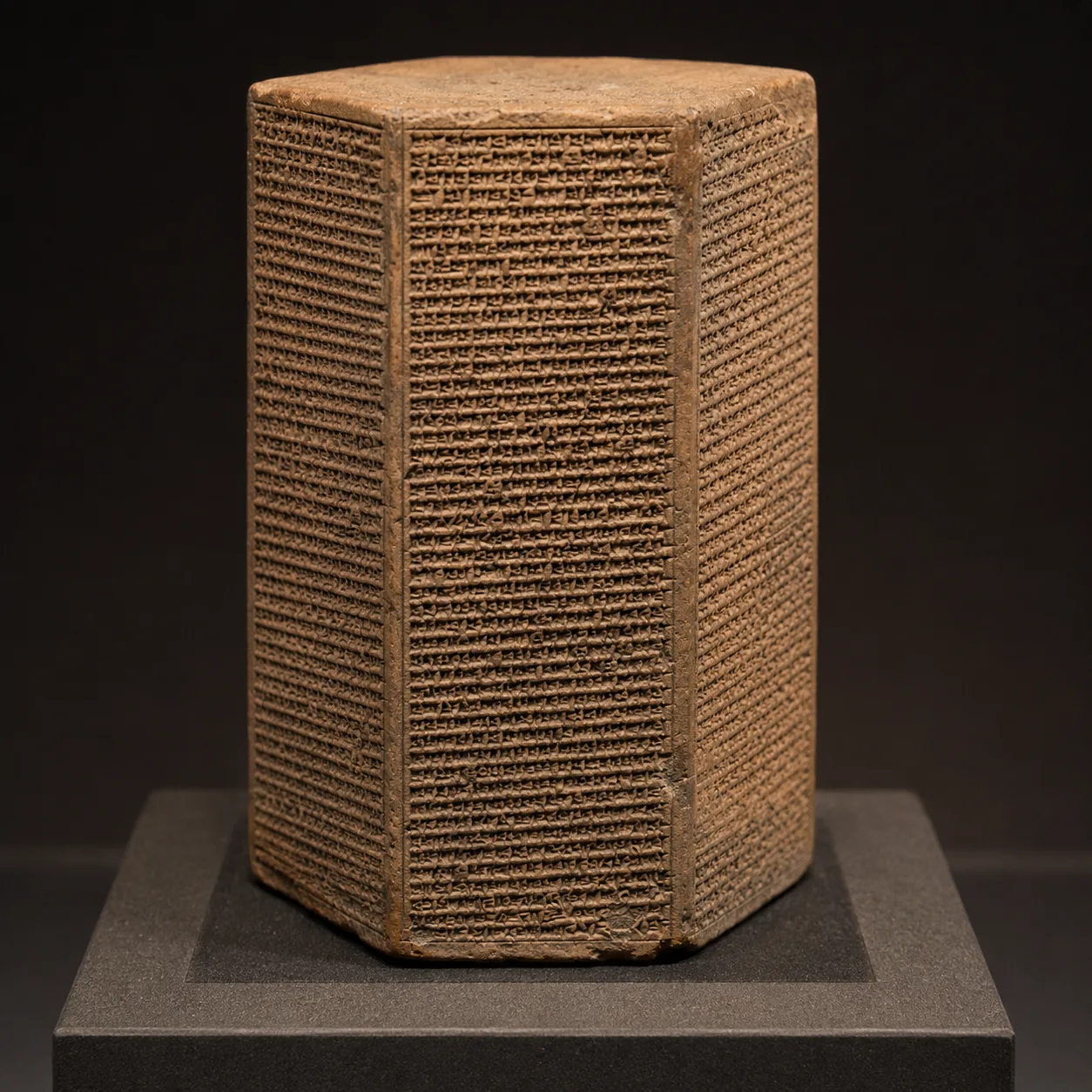
Sennacherib’s own version of the campaign survives in three near-identical copies of an Akkadian cuneiform inscription — the Sennacherib Annals — carved on hexagonal red baked-clay prisms approximately thirty-eight centimetres tall. The best-preserved copy, known as the Taylor Prism, was recovered from the ruins of Nineveh by Colonel Robert Taylor in 1830 and purchased by the British Museum in 1855, where it remains. A second copy, the Oriental Institute Prism, is in the Institute for the Study of Ancient Cultures at the University of Chicago; a third, the Jerusalem Prism, in the Israel Museum.
The relevant section of the prism describes the Judean campaign. The Assyrian text says, in part:
As for Hezekiah the Judahite, who did not submit to my yoke: forty-six of his strong walled cities, as well as the small towns in their area which were without number… I besieged and took… He himself, like a caged bird, I shut up in Jerusalem, his royal city. I put watchposts strictly around him, and turned back to his disaster any who went out of his city gate.
Three features of the prism deserve careful attention. First: the inscription corroborates the biblical narrative at every checkable detail. Sennacherib campaigned against Hezekiah. He took forty-six fortified Judean cities. He besieged Jerusalem. The numbers match. The geography matches. The political situation matches. Sennacherib received tribute from Hezekiah — the prism even lists the specific items, in quantities that align closely with 2 Kings 18:14–16.
Second: what the inscription does not claim is decisive. Sennacherib boasts of taking forty-six fortified cities. He boasts of confining Hezekiah “like a caged bird” in Jerusalem. He does not, anywhere on the prism, claim to have taken Jerusalem itself. This is an extraordinary omission. Assyrian royal inscriptions are not modest; their entire purpose is to glorify the king’s conquests. When an Assyrian king took a capital city, he said so — in detail, with the plunder enumerated and the population deportations recorded. Sennacherib’s silence on Jerusalem is the silence of a man who did not take the city. The biblical account, which records that the angel of the LORD smote the Assyrian camp overnight, supplies precisely the explanation the prism declines to give.
Third: the metaphor itself is telling. To “shut up like a caged bird” was Assyrian idiom for an operational success that was something less than a capture. Sennacherib could legitimately boast that he had isolated Jerusalem; he could not legitimately boast that he had taken it. The honest reader will note that this is exactly how a defeated besieger writes when he has to preserve his prestige at home.
3. The Lachish Reliefs — what Assyria did to the cities it took
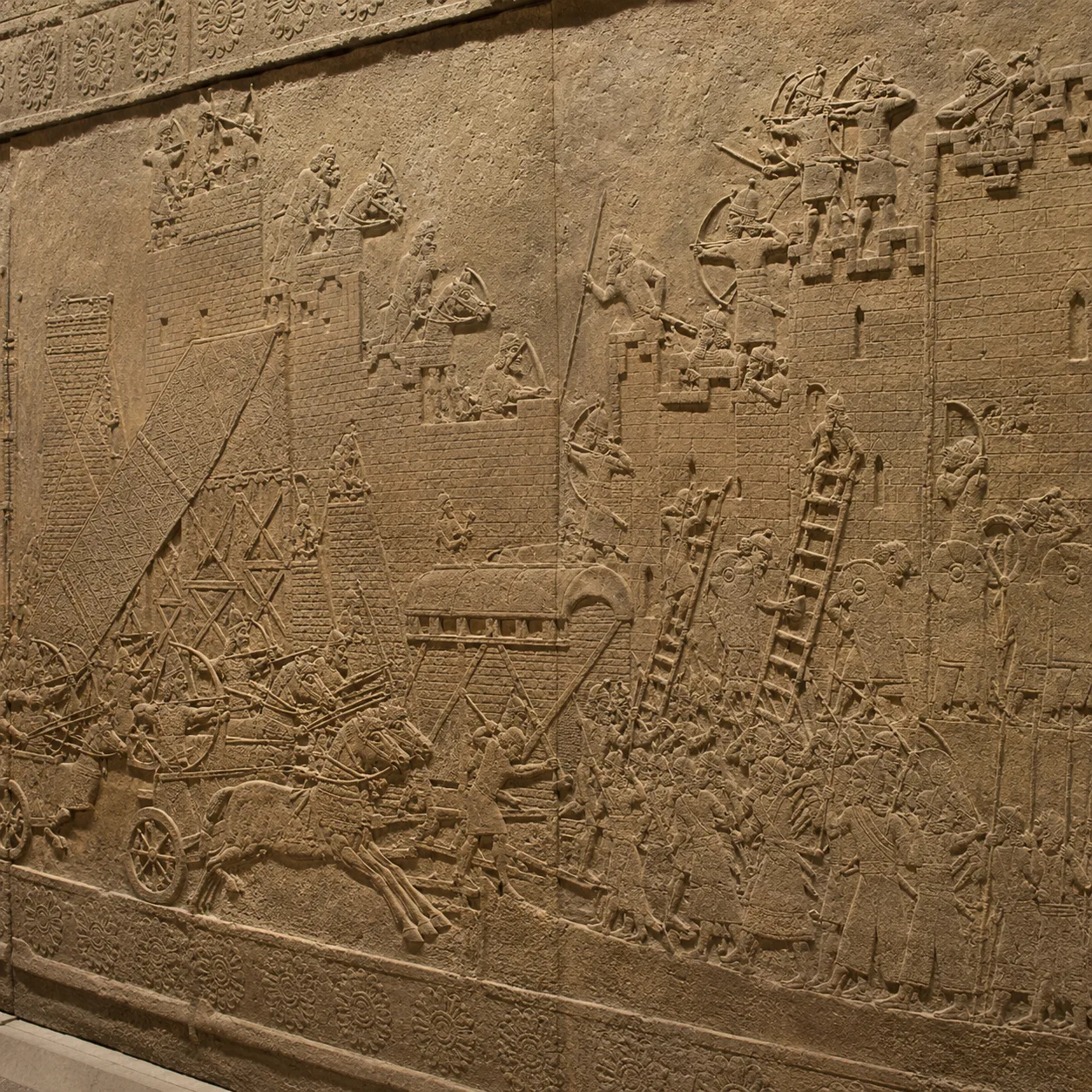
While Sennacherib’s prism summarises the campaign in words, the southwest palace at Nineveh recorded the siege of Lachish in pictures. In 1845–1847, the twenty-eight-year-old English archaeologist Austen Henry Layard excavated a large palace room at Kuyunjik (ancient Nineveh) whose four walls were lined, from floor to ceiling, with a continuous stone-relief frieze depicting a single military operation: the Assyrian siege and capture of Lachish. The reliefs — over twelve metres wide and more than five metres tall — were transported to the British Museum, where they remain on display in their original arrangement.
The frieze reads from left to right as a single visual narrative. The Assyrian army assembles outside the walled city; siege engines roll up earthen ramps toward the gates; Judean defenders rain stones and arrows from the battlements; Assyrian troops scale the walls. The next scene shows the aftermath: Judean prisoners flee the burning city in a procession of refugees, their families and possessions accompanying them; some are impaled outside the city walls; others are deported in lines under armed guard. Sennacherib himself sits enthroned on a hillside outside the city, reviewing the conquest. The Akkadian inscription above the throne reads: “Sennacherib, king of the world, king of Assyria, sat upon a throne, and the booty of Lachish passed before him.”
The reliefs are corroborative on two levels. On the basic historical level, they confirm the biblical record at 2 Kings 18:13–14 and 2 Chronicles 32:9 that Sennacherib’s army took Lachish in 701 BC. On a deeper level, they show what was at stake for Jerusalem. The fate of the captured Lachishites — deportation, mutilation, the city burned to the ground — is the fate Hezekiah and his people would have suffered had Sennacherib taken Jerusalem as well. The biblical claim of divine deliverance is not the claim of a city that suffered a manageable hardship. It is the claim of a city that escaped what the reliefs themselves depict in graphic detail.
4. Hezekiah’s Tunnel and the Siloam Inscription
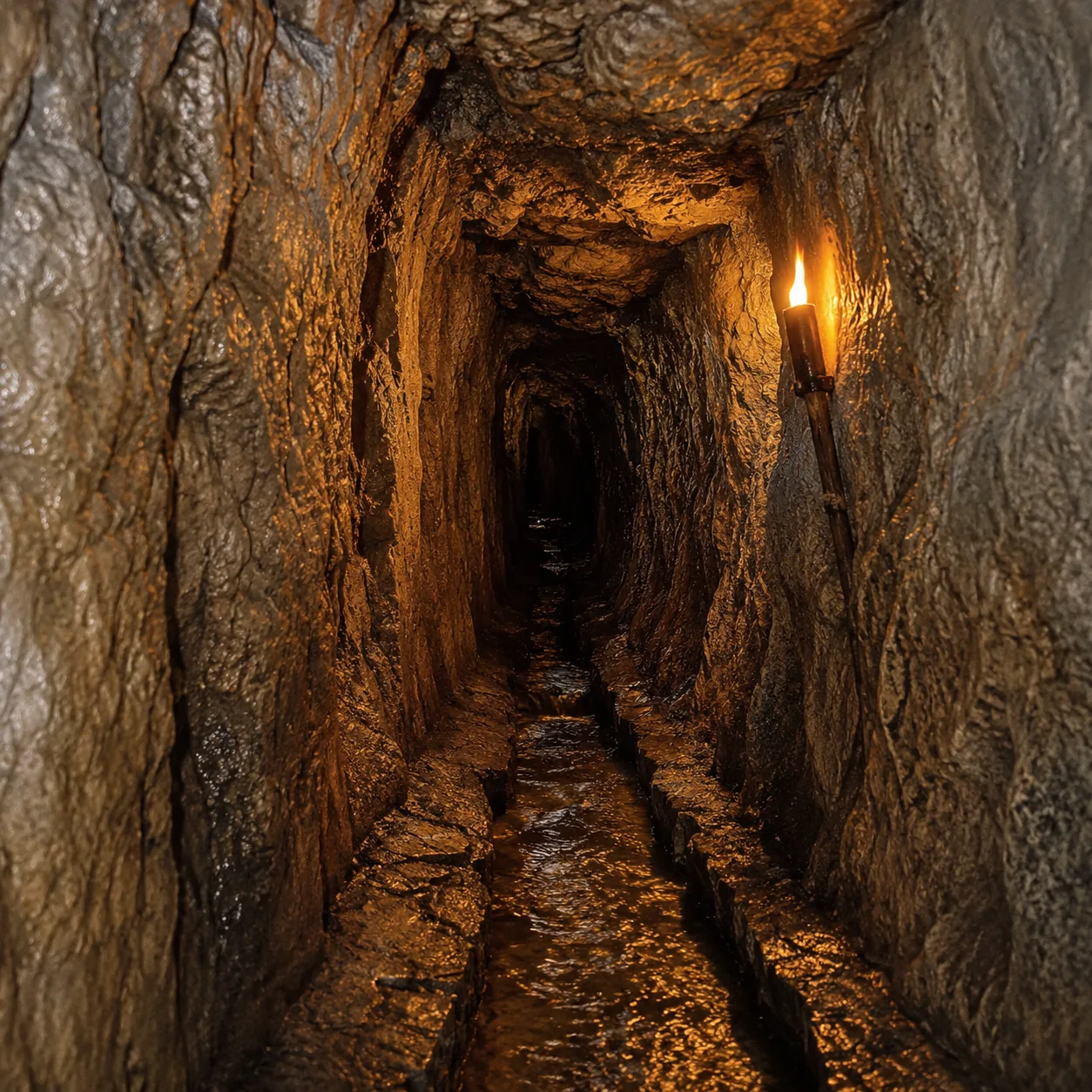
Of all the physical artefacts surviving from the period of the Hezekiah–Sennacherib confrontation, the single most accessible to modern visitors is Hezekiah’s preparation for the siege itself. The ancient city of Jerusalem, built on a narrow rocky spur descending southward from the Temple Mount, had a single natural water source: the Gihon Spring, which emerged from a cave at the base of the eastern slope, outside the city wall. The Bible records that Hezekiah — anticipating Sennacherib’s advance — performed two engineering operations on the spring: he stopped its visible outflow outside the city, denying water to a besieging army, and he tunnelled a new channel underneath the city itself, bringing the water into a pool inside the walls (2 Kings 20:20; 2 Chronicles 32:30).
Both works survive and can be visited. Hezekiah’s Tunnel runs for approximately seventeen hundred and fifty feet through solid bedrock under the City of David, from the Gihon Spring to a reservoir at the southern end of the ridge known as the Pool of Siloam. It is the same tunnel through which the man born blind washed his eyes in John 9:7. It is still water-filled today, and visitors walk the entire length of it in knee-deep spring water that emerges as cold and pure as it did in 700 BC.
In 1880, an Arab boy named Jacob Eliyahu, a pupil at the nearby Conrad Schick mission school, was wading the tunnel with a friend when he slipped on a rock and landed face-down in the water. As he raised his head he noticed, six metres from the Pool of Siloam end of the tunnel, an inscription chiselled into the wall. The Siloam Inscription, as it became known, is the longest pre-exilic Hebrew text ever recovered. It is written in classical Paleo-Hebrew, dates on the script to the late eighth century BC (i.e. to Hezekiah’s reign exactly), and describes the moment, two thousand seven hundred years before, when the two crews tunnelling toward each other from opposite ends finally broke through:
… this is the story of the boring through. While [the diggers raised] their picks each toward his fellow, and while there were yet three cubits to be bored through, the voice of one called to the other, for there was a crack in the rock on the right and on the left. And on the day of the boring through the diggers struck, each to meet the other, pick against pick. And the waters flowed from the spring to the pool, a thousand and two hundred cubits. And the height of the rock above the heads of the diggers was a hundred cubits.
The inscribed length of twelve hundred cubits corresponds, at the ancient royal cubit of roughly eighteen inches, to almost exactly the modern measured length of seventeen hundred and fifty feet. The archaeology, the inscription, and the biblical text are in perfect agreement — not merely that Hezekiah tunnelled a water conduit, but that it ran a precisely recorded distance, that two crews worked simultaneously from opposite ends, and that they met somewhere in the middle. The inscription itself can be visited today at the Istanbul Archaeology Museum, where it has been held since being chiselled from the tunnel wall under Ottoman rule in 1891.
5. The Broad Wall — Hezekiah’s fortifications
In 1970, during the post-1967 rebuilding of the Jewish Quarter of the Old City of Jerusalem, the Israeli archaeologist Nahman Avigad uncovered, in the foundations beneath a modern apartment block, a wall. Not an ordinary wall: a massive defensive wall, seven metres thick at the base, constructed of roughly-dressed limestone blocks, running for a hundred and twenty-five metres along an east-west line in what is now the Jewish Quarter. Stratified pottery in the foundation trench dated the wall to the late eighth century BC — Hezekiah’s reign.
The wall’s position is significant. It runs along the western hill of Jerusalem, not the original City of David ridge. This places it well outside the original Davidic city walls, demonstrating that by Hezekiah’s reign the population of Jerusalem had outgrown the original City of David and expanded westward to occupy the much larger western hill. Hezekiah, in preparation for the Assyrian invasion, had thrown a defensive wall around the expanded city.
The biblical record describes this exact operation. In Isaiah 22:9–11, the prophet reproaches the Jerusalemites for trusting in their physical defences rather than in the LORD: “Ye have seen also the breaches of the city of David, that they are many: and ye gathered together the waters of the lower pool. And ye have numbered the houses of Jerusalem, and the houses have ye broken down to fortify the wall.” The Broad Wall confirms each element of the description. There are visible breaches in the older city of David walls. Buildings were demolished to provide stone for the new fortifications — Avigad’s excavations identified the foundations of Iron-Age domestic buildings cut by the wall itself, exactly as Isaiah 22:10 describes. The wall, today preserved as an outdoor archaeological exhibit, can be visited and walked along in the Jewish Quarter.
6. The bulla of King Hezekiah
Ancient documents in the kingdom of Judah were ordinarily written on papyrus scrolls. The scrolls themselves do not survive in the Levantine climate — papyrus rots in damp soil — but the small clay seals (Hebrew bullae, singular bulla) used to close and authenticate the scrolls are essentially imperishable. When a sealed scroll was burned in antiquity, the surrounding clay was fired into a hard ceramic. When the scroll then rotted, the bulla survived, preserving the impression of the seal that had been pressed into it while the clay was still soft. Thousands of such bullae have been recovered from Jerusalem excavations in the past fifty years.
Between 2009 and 2010, the same Eilat Mazar team that excavated the Large Stone Structure on the summit of the City of David (see the companion article on the House of David) conducted excavations at a site immediately south of the Temple Mount known as the Ophel. In a carefully-sifted refuse dump from the late eighth century BC, the team recovered thirty-four bullae, clay figurines, ceramic vessels, and other ordinary royal-household debris. Among the thirty-four bullae was one which, when cleaned and read, bore an inscription in Paleo-Hebrew script flanking a two-winged sun disc flanked by twin ankh symbols. The inscription reads:
Belonging to Hezekiah, [son of] Ahaz, king of Judah.
Mazar’s 2015 publication of the find established that, as she carefully noted, “although seal impressions bearing King Hezekiah’s name have been known from the antiquities market since the mid-1990s — including some with the winged scarab and others with the winged sun — this is the first time a seal impression of a Judean king has ever come to light in a scientific archaeological excavation.” The provenance is therefore unimpeachable: the bulla was recovered in a controlled excavation, in a securely dated stratum, in a context (the Ophel refuse) consistent with royal household waste from the late eighth century BC. The Hezekiah of 2 Kings 18–20 sealed a scroll with this very seal twenty-seven hundred years ago, and the impression of that seal can now be seen on display in the Israel Museum.
7. The bulla of the prophet Isaiah
In the same Ophel excavation, approximately three metres (ten feet) from where the Hezekiah bulla was recovered, Mazar’s team uncovered a second seal impression. It is broken along the bottom edge, with part of the lower inscription missing or damaged. The surviving portion reads, in Paleo-Hebrew script:
Belonging to Yesha’yah[u] … nvy…
The personal name Yesha’yahu (in standard English transliteration, Isaiah) is unambiguous: the same name borne by the prophet of Isaiah 1–66. The three Hebrew letters after the name — nun-vav-yod, the consonants of the Hebrew word navi (prophet) — survive, but the bottom of the seal is broken at exactly the point where the determinative final letter aleph would confirm the reading ha-navi (“the prophet”). Eilat Mazar’s 2018 publication of the find proposed that the bulla originally read Belonging to Isaiah the prophet, recovered in immediate proximity to the seal of the very king whom the biblical text places in close advisory contact with the prophet.
The reading is, on Mazar’s own caveat, not certain. The damaged section could theoretically have read differently — the letters following nvy could have spelled a place-name or a different word. But the alternative readings are forced; the natural reading of nvy immediately after a personal name is the title prophet; and the recovery of the bulla ten feet from a confirmed seal of King Hezekiah is exactly what the biblical account would predict — Hezekiah and Isaiah are repeatedly recorded as being in personal consultation during the 701 BC crisis (2 Kings 19:1–7, 19:20–34, 20:1–11). The Bible places these two men in the same room. The archaeology placed their seals ten feet apart in the same ancient refuse dump.
8. Sennacherib’s death — 681 BC, by his own sons
The biblical narrative of the 701 BC crisis closes with a twenty-year flash-forward (2 Kings 19:36–37; Isaiah 37:37–38) describing Sennacherib’s eventual death. The text records that Sennacherib withdrew to Nineveh after the failed siege, lived for some years, and was then assassinated by two of his own sons — named in the Hebrew text as Adrammelech and Sharezer — while worshipping in the temple of his god Nisroch. The assassins fled to the land of Ararat (Armenia). A third son, Esarhaddon, succeeded him.
The external corroboration is independent and unimpeachable. The Babylonian Chronicle — an Akkadian historical record kept by Babylonian scribes contemporary with the events — records that Sennacherib was killed by his own son on 20 October 681 BC. Later Assyrian sources confirm and expand the account. The conspirators are named: the elder son Arda-Mulissu (whose name renders into Hebrew as Adrammelech by a normal phonetic transliteration) and his brother Nabu-shar-usur (which renders as Sharezer by the same conventions). The motive, as the Assyrian sources record it, was succession: the elder Arda-Mulissu had been demoted from heir-apparent by Sennacherib in 684 BC in favour of the younger son Esarhaddon, and after repeated appeals had been refused, Arda-Mulissu and his brother resorted to the assassination of their father. The coup did not, however, succeed: Esarhaddon raised an army, marched on Nineveh, and installed himself as king as Sennacherib had intended — precisely as 2 Kings 19:37 records.
Every name in the biblical account is independently attested. Every date, every kinship relation, every political event, every geographic detail is independently confirmed by Assyrian and Babylonian records written without knowledge of the Hebrew text. The Hebrew historian recording 2 Kings 19:37 in the seventh century BC did not have access to the Babylonian Chronicle or the later Assyrian succession texts. The convergence of the accounts is not the product of copying; it is the product of two independent records of the same events.
9. The cumulative case
Few periods in pre-Christian history are this thoroughly documented from independent sources. The biblical narrative of the Assyrian crisis of 701 BC is corroborated by:
- Three independent copies of Sennacherib’s own annals, in cuneiform, naming Hezekiah by name and confirming the campaign in detail — while conspicuously failing to claim Jerusalem.
- A complete pictorial frieze of the siege of Lachish, carved in stone on the walls of Sennacherib’s palace at Nineveh and recovered in 1845.
- The water tunnel itself, walkable today, exactly matching the biblical description in length, route, and engineering method, with a contemporaneous Hebrew inscription describing the tunnel’s construction.
- The Broad Wall, a tangible defensive fortification matching every detail of Isaiah 22:9–11, including the houses demolished for its construction.
- The personal seal of King Hezekiah, recovered in controlled excavation in 2009–2010 with the king’s name and patronymic in Paleo-Hebrew.
- A probable personal seal of the prophet Isaiah, recovered three metres from the Hezekiah seal in the same archaeological context.
- The Babylonian Chronicle’s record of Sennacherib’s assassination by his sons in 681 BC, matching 2 Kings 19:37 in every detail of name, manner, date, and dynastic succession.
The honest historian, given seven independent corroborating sources for a single biblical narrative, would treat the narrative as historically reliable in every other detail the sources cannot independently check. The miraculous deliverance recorded in 2 Kings 19:35 — the single element of the story for which no Assyrian or Babylonian source can speak — is the only element on which a verdict can be debated. The honest reader is invited to consider how to weigh that one un-corroborated element against the entire corroborated frame around it. The same source which the external record confirms at every other point is the source which claims that 185,000 men of the Assyrian camp died in a single night.
Scripture testimony
The biblical narrative is preserved in three parallel accounts — 2 Kings 18–20, 2 Chronicles 32, and Isaiah 36–39 — which agree with one another at every point. The anchor passages cited above:
- 2 Kings 18:13
- Now in the fourteenth year of king Hezekiah did Sennacherib king of Assyria come up against all the fenced cities of Judah, and took them.
- 2 Kings 19:35–37
- And it came to pass that night, that the angel of the LORD went out, and smote in the camp of the Assyrians an hundred fourscore and five thousand: and when they arose early in the morning, behold, they were all dead corpses. So Sennacherib king of Assyria departed, and went and returned, and dwelt at Nineveh. And it came to pass, as he was worshipping in the house of Nisroch his god, that Adrammelech and Sharezer his sons smote him with the sword: and they escaped into the land of Armenia. And Esarhaddon his son reigned in his stead.
- 2 Kings 20:20
- And the rest of the acts of Hezekiah, and all his might, and how he made a pool, and a conduit, and brought water into the city, are they not written in the book of the chronicles of the kings of Judah?
- Isaiah 22:9–11
- Ye have seen also the breaches of the city of David, that they are many: and ye gathered together the waters of the lower pool. And ye have numbered the houses of Jerusalem, and the houses have ye broken down to fortify the wall. Ye made also a ditch between the two walls for the water of the old pool.
- 2 Chronicles 32:30
- This same Hezekiah also stopped the upper watercourse of Gihon, and brought it straight down to the west side of the city of David. And Hezekiah prospered in all his works.
Sources
- Daniel David Luckenbill, The Annals of Sennacherib, Oriental Institute Publications 2 (University of Chicago Press, 1924) — the standard scholarly edition of the Sennacherib Prism in transliteration and English translation.
- Mordechai Cogan, “Sennacherib’s Siege of Jerusalem,” in Context of Scripture vol. 2, ed. William W. Hallo (Brill, 2003) — modern translation with full notes on the biblical synchronisms.
- David Ussishkin, The Conquest of Lachish by Sennacherib (Institute of Archaeology, Tel Aviv University, 1982) — the standard reference on the Lachish reliefs combined with the archaeological excavation of the site itself.
- Austen Henry Layard, Nineveh and Its Remains (John Murray, 1849) — the original publication of the discovery of the Lachish reliefs and the southwest palace.
- Frank Moore Cross, “Notes on a New Reading of the Siloam Inscription,” Bulletin of the American Schools of Oriental Research 224 (1976) — the standard modern reading of the inscription with notes on the late-eighth-century Hebrew script.
- Nahman Avigad, Discovering Jerusalem: Recent Archaeological Excavations in the Upper City (Thomas Nelson, 1983) — Avigad’s own publication of the Broad Wall and the Jewish Quarter excavations.
- Eilat Mazar, “The Discovery of the Hezekiah Bulla,” Eretz-Israel 32 (2016) and Biblical Archaeology Review 41:1 (January/February 2015); and Mazar, “Is This the Prophet Isaiah’s Signature?” Biblical Archaeology Review 44:2 (March/April/May/June 2018).
- A. Kirk Grayson, Assyrian and Babylonian Chronicles (Locust Valley, NY: J. J. Augustin, 1975) — standard edition of the Babylonian Chronicle including the record of Sennacherib’s assassination.