
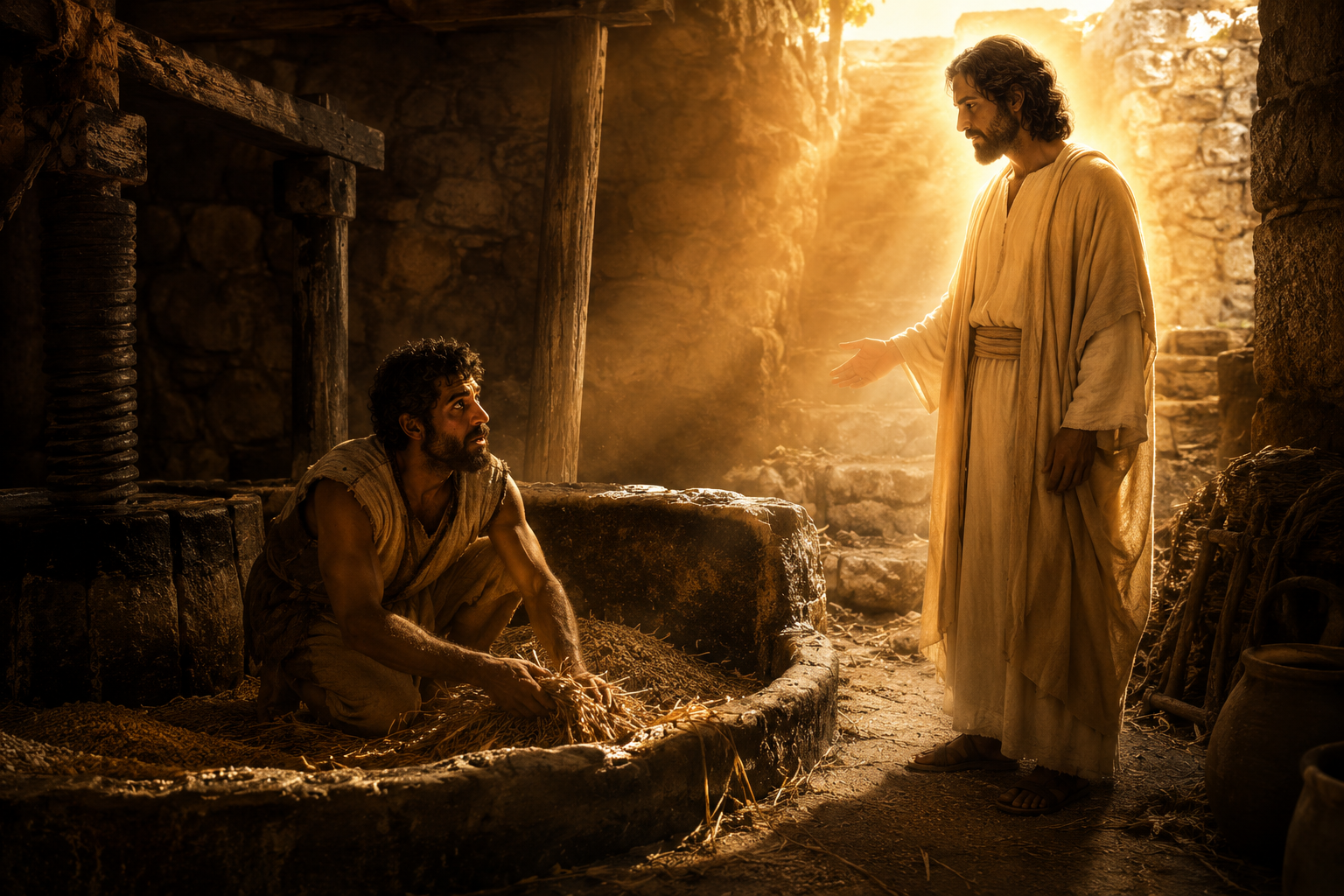

And there came an angel of the LORD, and sat under an oak which was in Ophrah, that pertained unto Joash the Abiezrite: and his son Gideon threshed wheat by the winepress, to hide it from the Midianites. And the angel of the LORD appeared unto him, and said unto him, The LORD is with thee, thou mighty man of valour.
Look at where Gideon is standing when Heaven calls him a mighty man of valour. He is hiding. He is threshing wheat down in a winepress so the Midianites will not see it, beaten down, afraid, the furthest thing from a warrior. And the angel does not say you could become a mighty man of valour. He says thou art one — past, present, settled — long before a single act of Gideon’s justified the name. The picture was hung before the man grew into it. That order is the whole subject of this piece.
The picture you hold of yourself
In the nineteen-fifties a plastic surgeon named Maxwell Maltz noticed something that should have made no sense. He would correct a patient’s face — fix the scar, straighten the nose, undo the thing they had hated in the mirror their whole life — and a real share of them would walk out of his office still feeling ugly. The face was changed. The feeling was not. He had operated on the wrong layer.
What he found, and built a whole work around, is that every person carries an inner picture of the kind of person he is — competent or hopeless, likable or invisible, the sort who finishes or the sort who quits. Maltz called it the self-image. And it is not a vague mood. It is the master setting. You behave, almost without thinking, like the kind of person you privately believe you are. Change the face and leave the picture untouched and nothing moves. Change the picture and the behavior follows it like a shadow. The scalpel was never going to reach the part that mattered.
Maltz put the principle in one sentence that has never let me go: you cannot consistently outperform your own self-image. You can spike above it for a day, on adrenaline or a deadline. You cannot live above it. Whatever the picture says you are, that is the level your life keeps drifting back to.
A governor, not a cheerleader
Here is the part that surprises people. The self-image is not on your side. It is not a cheerleader rooting for the best version of you. It is a governor — a thermostat — and a thermostat does not want the room warm or cold. It wants the room at the number it is set to. Set it to sixty-eight and it will fight a heat wave and a cold snap with equal effort, because its only job is to pull the room back to the set point.
So it corrects you in both directions. Watch what happens to people who jump suddenly above their set point. Lottery winners — a startling share of them — are broke again within a few years, because a million dollars in the account of a man whose inner picture says “I am someone who scrapes by” is a thermostat reading too high, and the system spends until the number matches. The crash dieter loses the thirty pounds and regains them, because the weight came off but the picture of “a heavy person” did not. The man who finally gets the promotion he does not feel he deserves finds some quiet way to sabotage it, because the title sits above the set point and the governor pulls him back down to where he “belongs.”
None of this is bad luck. It is a setting doing exactly what a setting does. As long as the inner number stays the same, the outer life keeps snapping back to it. Which means there is no point fighting the results one at a time. You have to reach the dial.
How the picture got set
So where did the number come from? Almost nobody chose it. It was set early, by repetition, before the critical mind was awake enough to push back. A small child has no filter at the door of his own heart. He cannot yet weigh a claim, test it, throw it out. Whatever is said about him, often enough and in a tone he trusts, goes straight in and becomes part of the furniture.
He is told he is clumsy — and he starts moving like a clumsy child, which earns him more of the word, which deepens the picture, which guides the next stumble. He is the shy one, the one who is bad at math, the difficult one, the one who never finishes anything. None of these began as facts. They began as offhand remarks, and the child took dictation, and the picture became self-confirming — generating the very behavior that seems to prove it true. By the time he is grown the label feels like a discovered fact about himself rather than a sentence somebody once spoke over a tired afternoon. “As he thinketh in his heart, so is he” (Proverbs 23:7). The heart was being taught its lines long before he started listening.
Why willpower loses every time
Now we can see why so many sincere attempts at change collapse. Willpower is a conscious tool — it lives in the thin, bright, top layer of the mind, the part you steer on purpose. The self-image lives underneath it, in the deep layer that runs automatically. And when the thin layer tries to force a behavior the deep layer’s picture does not match, the picture wins. Not because you are weak. Because you are outnumbered. The set point has hours in the day; willpower has minutes.
This is why the man who white-knuckles a new habit onto an old self-image snaps back the moment his attention drops. He has been shoveling against the thermostat. The behavior was always going to lose to the picture, because the behavior is downstream of the picture. Change the image, though, and the same behavior that took agony to force now feels like simply acting in character. You are no longer fighting yourself. You have changed who “yourself” is. Identity comes before behavior. Always. Get the identity right and the behavior stops being a battle and starts being natural.
How to reset it — two tools
The picture can be re-hung. It was installed by repetition, and it can be re-installed by repetition, run on purpose this time. There are two tools, and they work the same deep layer from two angles.
Tool one is imagination. Maltz’s great discovery was that the deep layer does not draw a clean line between an experience that actually happened and one rehearsed vividly enough in the mind. To that layer, a clear, repeated mental picture is logged as evidence — as something you have done, proof of the kind of person you are. This is why athletes rehearse the race in their heads before they run it: the nervous system files the rehearsal as practice. You do the same with the self. A few quiet minutes a day, seeing yourself plainly as the man you intend to be — handling the meeting well, keeping your word, steady under pressure — and the deep layer begins to stack that picture as proof. Not fantasy for its own sake. Deliberate evidence, fed to the layer that decides who you are.
Tool two is the word. The picture also takes dictation from what you say about yourself, over and over, the same way it took dictation from what was said over you as a child. This is the spoken side of the reset, and because the affirmation method has its own piece, I will not lay the whole protocol out again here — the mechanism of repetition and the daily protocol are covered in full there. What matters in this piece is one place that spoken side touches the self-image more directly than any other.
And before we go there, the one line never to cross. This power to re-author your own picture is real and large, but it is delegated. You are a creature made in the image of a Creator, handed genuine authority over the small kingdom of your own life — your habits, your character, who you are becoming. That is a sub-creator’s power, not a god’s. The world’s version of this teaching eventually whispers that your mind is the source, that you are your own divinity. It is the oldest lie there is — “ye shall be as gods” (Genesis 3:5) — and you do not need it. Keep the delegated power; refuse the counterfeit godhood. You are renaming yourself under the One Who made you, not in His place.
The two most important words you speak
The two most important words in your vocabulary are I am. Whatever you put after them goes almost straight past the filter and into the self-image, because I am is not a wish or a plan — it is a declaration of present identity, and the deep layer files identity statements where it keeps the picture. “I am disorganized.” “I am terrible with money.” “I’m just not a people person.” Said fifty times a week in passing, those are not descriptions. They are instructions. You are hand-feeding the governor its set point.
Which is why an identity-level statement beats a goal-level wish every time. “I will try to be more confident” lives in the thin top layer and keeps the trait at arm’s length, something out ahead of you that you are reaching for and have not got. “I am a confident, capable man” speaks to the deep layer in the only grammar it stores identity in — present tense, settled, already true. One is a hope about the future. The other is a fact being filed.
And this is exactly how God works with people. Watch the pattern. He renames a man not for who he is, but for who he is becoming, and He speaks the new name as a present fact long before the evidence catches up. He calls Abram Abraham — “a father of many nations have I made thee” (Genesis 17:5) — while the man is still old and childless, the new identity declared in the past tense over an empty cradle. He calls unstable, impulsive Simon by the name Peter, the rock, years before the man becomes one. And He sends an angel to call Gideon a mighty man of valour while Gideon is still cowering in the winepress. In every case the new name comes first and the new man grows up into it. Heaven hangs the picture, and the life rises to meet it.
The protocol
- Name the picture you are running now. Write down what you actually believe about yourself in the areas that matter — money, work, relationships, character. Drag the old set point into the light where you can see the number.
- Write the new picture in present-tense “I am” statements. A handful of short, total declarations of the man you intend to be. Not “I will try.” I am.
- Rehearse it daily in imagination. A few calm minutes seeing yourself plainly as that man, handling real situations well. Let the deep layer log the evidence.
- Stop voicing the old picture. Cut the offhand “I’m hopeless at this” lines. You cannot feed the new image fifteen minutes a day while narrating the old one the other twenty-three hours.
- Act from the new picture when you can. Not constant heroics — just the occasional small choice the new man would make. Each one is another piece of evidence the deep layer files.
- Give it ninety days. The old picture took years to set. The new one needs a real run before it becomes the default you operate from without thinking. Two weeks proves nothing.
How I do this
I keep the spoken reset and the relationship with God separate in my own practice — Bible reading and ongoing prayer are communion with my Father, not a technique I run on myself — and you can read how I handle the daily affirmation work in the piece on affirmations. Here I will only say what I do specifically about the picture.
The deepest layer of my self-image is not one I assigned and not one I earned. It is the one Scripture assigns. When I rehearse who I am, the foundation under every other statement is this: “Therefore if any man be in Christ, he is a new creature: old things are passed away; behold, all things are become new” (2 Corinthians 5:17). That is not a hope about the future or a label I talked myself into. It is a present fact declared over me by the One with the authority to name. Every “I am” I build sits on top of that one. I am building a picture, yes — but I am building it on the name He already gave me, not inventing a self out of nothing.
So my order is fixed. The new creature in Christ is the bedrock identity. On that I lay the working picture — confident, capable, skilled, faithful in the small kingdom He put me over. I rehearse it, I speak it in the present tense, I guard my casual speech so I do not un-say it, and I give it the time it takes. The relationship is the ground. The picture is the building.
Back to the winepress
So go back and stand next to Gideon one more time. He is still in the winepress when the word comes. Nothing about the scene has changed — the threat is real, the fear is real, the man is small. The only thing that has changed is the picture, and the picture has changed first, spoken over him before he could have argued himself into it: thou mighty man of valour. The valour came later. The name came first, and the man grew up into the name.
That is the order, and it is the order Heaven has always worked in. Abram before there was a son. Peter before there was a rock. The new creature declared over you in Christ before a single “old thing” has finished passing away. You do not behave your way into a new identity. You receive the identity, hang the picture, and let the life rise to meet it. Name the man God says you are. Then go become him.
Sources
On the self-image and the mechanism that sets it:
- Maxwell Maltz, Psycho-Cybernetics (1960) — the self-image as the master setting, and imagination as the tool that resets it.
Companion pieces in this library: Changing Your Paradigm, You Become What You Say, Affirmations and Vain Repetitions, and The First Hour.
Scripture (KJV): Judges 6:11-12; Proverbs 23:7; Genesis 3:5; Genesis 17:5; 2 Corinthians 5:17.