In brief
The Hebrew Bible was transmitted across a thousand years without substantive change.
For over a thousand years, the oldest complete Hebrew manuscript of the Old Testament available to scholars was the Aleppo Codex, copied in approximately 930 AD, and the Leningrad Codex, copied in 1008 AD — the two flagship manuscripts of the rabbinic Masoretic tradition. A persistent skeptical question hovered over both: could a text transmitted by hand across the centuries between its composition and its earliest surviving copy really be relied upon to preserve the original words? Critics argued that scribal alteration, theological adjustment, and accumulated error must have progressively corrupted the text. Without an older manuscript witness, there was no way to test the claim.
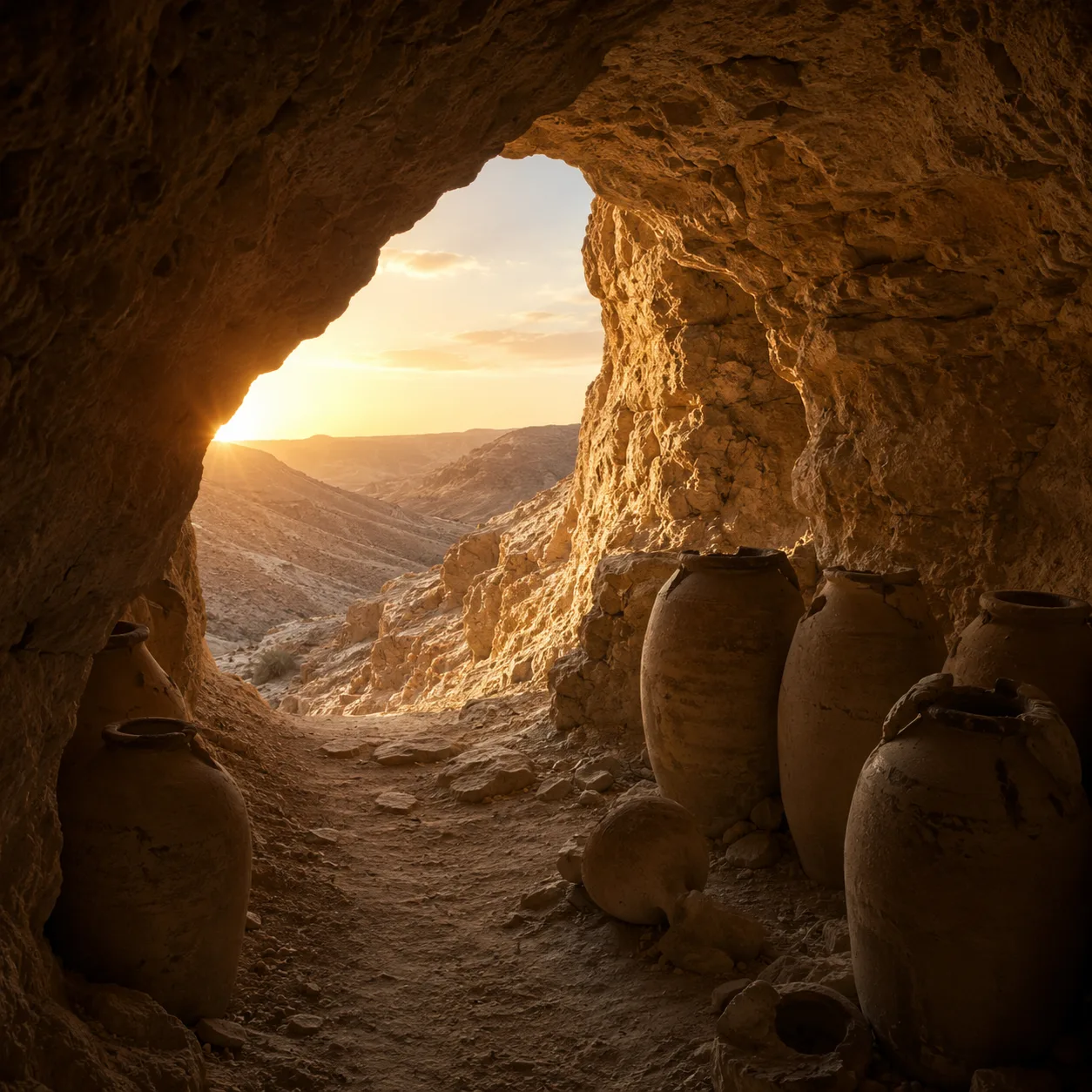
Then, in 1947, a Bedouin shepherd boy chasing a stray goat threw a rock into a cave on the limestone cliffs above the north-western shore of the Dead Sea. He heard pottery break. The clay jars he found inside that cave, and in ten other caves discovered over the following nine years, contained over nine hundred ancient manuscripts — the surviving library of a Jewish community destroyed by the Romans in 68 AD. Among the manuscripts was a complete copy of the entire book of Isaiah, carbon-dated to approximately 125 BC: a Hebrew biblical text a thousand years older than any previously known manuscript. When the Qumran Isaiah was compared, word-for-word, with the Masoretic Isaiah, the agreement was over 95 percent — the remaining 5 percent consisting almost entirely of spelling variants and obvious scribal slips, with not a single doctrine of the book altered by a single variant. The text had been transmitted across a thousand years without substantive change. This article walks through what was found, what it confirmed, and what it implies.
1. The 1947 discovery
In late 1946 or early 1947 — the exact date is uncertain from the surviving oral testimony — a fifteen-year-old Bedouin shepherd named Muhammad edh-Dhib Hassan (“Muhammad the Wolf”) of the Ta’amireh tribe was searching for a stray goat among the limestone cliffs above the north-western shore of the Dead Sea, in the desert wilderness south-east of Jerusalem. He threw a rock into a small cave entrance in one of the cliffs and heard, instead of the impact of stone on stone, the unmistakable sound of breaking pottery. Returning the following day with his cousin Jum’a Muhammad, he squeezed into the cave and recovered the first of what would eventually be called the Dead Sea Scrolls.
Inside the cave were a series of cylindrical clay jars, their lids sealed with pitch. Inside the jars were leather scrolls wrapped in linen, preserved by the combination of the desert’s extreme dryness and the airtight pottery storage for nearly two thousand years. Muhammad and his cousin recovered seven scrolls from that first cave — including the complete copy of Isaiah which would become the find’s most famous artefact. Unaware of what they had, the cousins sold the scrolls to a Bethlehem antiquities dealer for a small sum.
The scrolls passed through several hands before being recognised by Eleazar Sukenik of the Hebrew University as ancient Hebrew biblical manuscripts of unprecedented age. The political turbulence surrounding the 1947 partition of Palestine and the 1948 Arab-Israeli War complicated their immediate study, but news of the find reached the wider scholarly world. By 1956, after almost a decade of searches by Bedouin and archaeological teams alike, scrolls and scroll fragments had been recovered from a total of eleven caves in the Qumran area. The combined haul, after laborious reconstruction by international teams of palaeographers, totalled approximately 981 distinct manuscripts, reconstructed from over twenty-five thousand individual fragments — the surviving library of an entire Jewish religious community.
2. The scope of the find
The 981 manuscripts fall into three broad categories. Approximately thirty per cent are biblical manuscripts: copies, in Hebrew and a small number in Aramaic and Greek, of the books of what Christians call the Old Testament. Approximately another thirty per cent are non-biblical Jewish religious texts that were ultimately not received into the canon — the so-called apocryphal and pseudepigraphal works, including books like Tobit, Sirach, Jubilees, and 1 Enoch. The remaining forty per cent are sectarian documents composed by the community at Qumran itself: rules of communal life, liturgical hymns, biblical commentaries, eschatological visions, and the documentation of the community’s religious self-understanding.
The manuscripts span a chronological window from approximately the third century BC to 68 AD, when the Roman Tenth Legion under the future emperor Vespasian destroyed the Qumran settlement during the First Jewish Revolt. The community had hidden their library in the surrounding caves in the weeks before the Roman attack, evidently intending to recover it once the crisis had passed. The crisis never passed. The community was annihilated; the library remained where they had hidden it for the next nineteen centuries.
The combined corpus is the single largest body of Second-Temple-period Jewish religious literature ever recovered, and the single most important manuscript find in the history of biblical scholarship. Every subsequent edition of the Hebrew Bible has had to be revised in light of the Qumran evidence; every subsequent reconstruction of pre-Christian Judaism has had to be tested against the sectarian documents.
3. The Great Isaiah Scroll — a thousand-year manuscript test
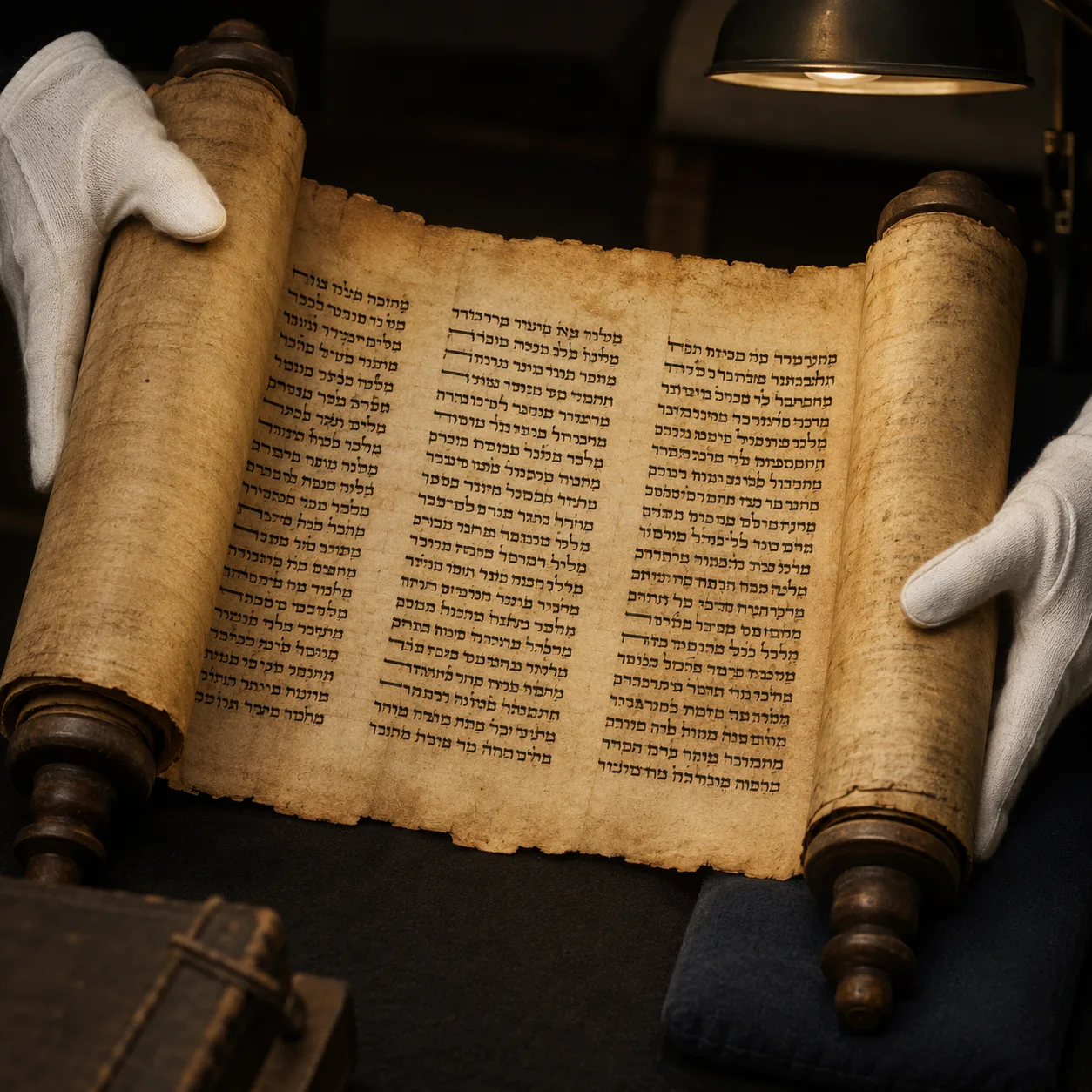
The single most significant of the Qumran manuscripts is the one Muhammad edh-Dhib carried out of Cave 1 in 1947: the Great Isaiah Scroll, catalogued by scholars as 1QIsaa. The scroll is a complete Hebrew text of the entire book of Isaiah, all sixty-six chapters, written on seventeen sheets of leather sewn together into a continuous roll twenty-four feet long. It is, by carbon-14 dating of the leather and by palaeographic analysis of the script, dated to approximately 125 BC — that is, between eight hundred and a thousand years older than any previously known complete Hebrew manuscript of Isaiah.
When the scroll was unrolled in 1948 and transcribed for comparison with the standard Masoretic text of Isaiah, the result was the central evidential event in the modern history of biblical textual criticism. Scholars who expected to find a markedly different text — a text from which the medieval Masoretes had supposedly diverged substantially over the intervening centuries — found instead a text that was, in the judgement of Gleason Archer in his classical survey, “word for word identical with our standard Hebrew Bible in more than 95 percent of the text.” The Millar Burrows transcription identified approximately 2,600 variants between 1QIsaa and the Masoretic Isaiah. Of those variants:
- The vast majority are differences in spelling conventions (Hebrew has both “defective” and “plene” spelling systems, the latter containing more vowel-marking letters; the Qumran scroll uses the more vowel-rich convention).
- A second large category are obvious scribal slips — transposed letters, omitted words, and duplicated lines — clearly recognisable as mechanical copying errors rather than intentional changes.
- A third category are deliberate scribal updates to clarify archaic Hebrew constructions for the first-century-BC reader, while preserving the meaning of the underlying text.
- Not a single variant alters a doctrine, a prophecy, a numerical detail of significance, or any theological claim of the book. The Isaiah of 1QIsaa and the Isaiah of the Aleppo Codex are recognisably the same text.
The implication for the integrity of the Hebrew Bible is decisive. A text transmitted by hand across a thousand years and preserved with this degree of fidelity has not been corrupted in any substantive sense. The Masoretic text we have today — the underlying Hebrew of every major modern Old Testament translation — is substantively the same text the Jews of Jesus’ day read. The skeptical hypothesis that the Hebrew Bible has been progressively corrupted by post-Christian Jewish or Christian alteration cannot survive the Qumran evidence. Whatever else may be debated about the Bible, the question of textual integrity has been answered.
The Great Isaiah Scroll itself is housed today in the Shrine of the Book, a custom-built temperature- and humidity-controlled gallery at the Israel Museum in Jerusalem. The full text has been digitised and is freely searchable online through the Israel Antiquities Authority’s Leon Levy Dead Sea Scrolls Digital Library; any reader can examine the Hebrew text character-by-character against the Masoretic.
4. The canon — every Old Testament book except Esther
Among the biblical manuscripts recovered from the eleven caves, every single book of the Hebrew Old Testament is attested at least in fragmentary form — with one exception: the book of Esther. There are twenty-one copies of Deuteronomy. Thirty-six copies of the Psalms. Twenty-two copies of Isaiah. Eighteen of Exodus. Seventeen of Genesis. There are copies of every other book, even the briefer minor prophets, in numbers consistent with their relative importance in Second-Temple-period Jewish religious life. There is no Esther.
The absence of Esther has been the subject of substantial scholarly speculation. Four explanations have been offered. First, simple statistical accident: only a fraction of any ancient library survives, and the survival rate is non-uniform; the absence of a single book from one library is not a particularly strong inference about its canonical status. Second, the Qumran community’s solar calendar was incompatible with the lunar-calendar dating of the feast of Purim which Esther establishes; the community may have rejected the book for liturgical reasons. Third, Esther is the only book of the Hebrew Bible that does not contain the name of God — a possible scruple for a highly observant community. Fourth, the book’s sympathetic portrayal of the Persian king Ahasuerus and Esther’s marriage to him may have conflicted with the community’s strict separatist ethos.
Whatever the reason for the Qumran omission, the broader point is that thirty-eight of the thirty-nine books of the Protestant Old Testament were already in circulation, treated as Scripture, and being copied, commented upon, and venerated in the second and first centuries BC. The canon of the Hebrew Bible was not a late post-Christian construction; it was already substantially closed by the time of Christ. The Christian tradition’s claim that Jesus and the apostles cited a recognisable Hebrew Scripture is confirmed by the Qumran evidence: the Scripture they cited was already in circulation, in essentially the form we have it today, two centuries before Christ.
5. The Qumran community — who were they?
The forty per cent of the Qumran manuscripts that are sectarian documents allow us to reconstruct, in considerable detail, the religious community that produced and preserved the library. They lived at the nearby site of Khirbet Qumran — a settlement of approximately two hundred people excavated in the 1950s by the French archaeologist Roland de Vaux. They followed a strict communal rule (preserved in the Community Rule, 1QS), held property in common, observed daily ritual bathing in the site’s elaborate ritual immersion pools, kept a modified Levitical priestly calendar, and looked for the imminent arrival of two messianic figures — a priestly Messiah of Aaron and a kingly Messiah of Israel.
The dominant scholarly identification of the Qumran community is with the Essenes — one of the three principal Jewish religious parties of the Second-Temple period (alongside the Pharisees and Sadducees), described in detail by the Jewish historian Josephus, by Philo of Alexandria, and by the Roman historian Pliny the Elder. Pliny’s description in his Natural History (5.17.4) places an Essene community on the western shore of the Dead Sea between Jericho and Engedi — the exact location of Qumran. The Essene identification is not unanimous in modern scholarship, and minority alternative theories have been proposed (the community as a splinter group of priests rejected from the Jerusalem Temple, or as a sect unidentified by any external ancient source). What is not in dispute is the community’s essential character: a priestly, separatist, eschatologically-focussed Jewish community of the late Second-Temple period, hostile to the Hasmonean and Herodian establishments in Jerusalem, copying Scripture and waiting for the Messiah.
6. The Qumran messianic expectation
One of the most theologically significant consequences of the Qumran finds is what they reveal about pre-Christian Jewish expectation of the coming Messiah. Critical scholarship in the late nineteenth and early twentieth centuries had argued that the New Testament’s identification of Jesus as the Messiah depended on Christian re-readings of the Old Testament — that the pre-Christian Jewish community had not, in fact, been expecting a messianic figure of the kind the Gospels portray. The Qumran sectarian texts have made this position increasingly difficult to maintain.
The Qumran Habakkuk Pesher (1QpHab), a verse-by-verse commentary on the prophet Habakkuk, applies the prophet’s words to a figure called the Teacher of Righteousness — the community’s founding leader — using a hermeneutical method recognisably parallel to the New Testament’s Christological readings of the Old Testament. The manuscript known as 4Q521 (sometimes called the Messianic Apocalypse) lists the works the coming Messiah will perform: He will heal the wounded, raise the dead, and preach good news to the poor — the exact catalogue of messianic works Jesus cites in His answer to John the Baptist’s disciples in Matthew 11:4–5 and Luke 7:22. The manuscript 11Q13 (the Melchizedek Scroll) develops a complex theology of the heavenly priestly figure Melchizedek as an eschatological deliverer — remarkably parallel to the development of the same theme in Hebrews 7.
The pre-Christian dating of these manuscripts — all of them composed and copied before the birth of Jesus — is decisive. The messianic expectation Jesus claimed to fulfil was not invented by His followers after His death. It was the expectation already operative in Second-Temple-period Judaism, recorded in manuscripts sealed in clay jars at Qumran before the New Testament existed. The Gospels are responding to that expectation, not creating it.
7. What the scrolls do not contain
Two further observations on the absences in the Qumran library are worth recording. First, there are no New Testament documents among the Qumran manuscripts. (A single fragment, 7Q5, has occasionally been argued to preserve a passage of Mark 6, but the identification is contested and even on its advocates’ own framing remains speculative.) This is unsurprising: the Qumran community was destroyed in 68 AD, before most of the New Testament was composed, and was a Jewish sectarian group entirely outside the early Christian movement. The Qumran library is a snapshot of Jewish religious life immediately before and during the apostolic period, not a witness to Christianity itself.
Second, the Qumran texts do not contain the kind of late-developing rabbinic Judaism that emerged in the Mishnah (c. 200 AD) and Talmud (c. 400–500 AD). What we see at Qumran is the pre-rabbinic religious matrix from which both early Christianity and rabbinic Judaism would subsequently diverge. The Scrolls have therefore allowed scholarship to map, with new precision, what Second-Temple-period Jewish belief actually looked like — against which the New Testament can be read in its proper historical context, and against which both first-century Christianity and second-century rabbinic Judaism can be seen as parallel developments from a common Jewish source.
8. The cumulative case
The Qumran library, more than any other single archaeological find of the modern era, has settled a family of questions that occupied biblical scholarship for two hundred years.
- Question: Has the Hebrew Bible been substantively corrupted in transmission across the centuries? Answer: No. The Great Isaiah Scroll demonstrates better than 95 per cent word-for-word fidelity across a thousand-year gap, with no doctrinal alteration.
- Question: Was the Old Testament canon a late post-Christian invention? Answer: No. Thirty-eight of thirty-nine Protestant Old Testament books are attested at Qumran, all copied in the centuries before Christ.
- Question: Was the Jewish messianic expectation the Gospels appeal to a post-Christian Christian reading of the Old Testament? Answer: No. The Qumran sectarian texts document a pre-Christian messianic expectation that already included healing the wounded, raising the dead, and preaching good news to the poor — precisely the catalogue Jesus claimed to fulfil.
- Question: Did pre-Christian Judaism include the apocalyptic and eschatological vocabulary of the Gospels and Acts? Answer: Yes. The community at Qumran was intensely apocalyptic, expecting the imminent intervention of God in history, the arrival of two Messiahs, the purging judgement, and the eschatological battle — recognisably the same conceptual world the New Testament documents inhabit.
The honest reader may consider what the cumulative effect of these answers is. The biblical text we have today is the biblical text Jesus and the apostles cited. The expectation Jesus claimed to fulfil is the expectation already documented in Second-Temple-period Jewish literature. The Old Testament canon the Christian church inherited was already in place before Christ was born. Every major skeptical reconstruction of the relationship between the Hebrew Bible, Second-Temple Judaism, and early Christianity that operated by assuming late corruption, late canonisation, or late invention has had to be revised or abandoned in light of the Qumran evidence. The text we have, on the evidence of the manuscripts a shepherd boy stumbled into in 1947, is the text God preserved.
Scripture testimony
The biblical doctrine of the preservation of the Scriptures is itself an explicit claim of the text. The passages which bear most directly on the question:
- Isaiah 40:8
- The grass withereth, the flower fadeth: but the word of our God shall stand for ever.
- Psalm 12:6–7
- The words of the LORD are pure words: as silver tried in a furnace of earth, purified seven times. Thou shalt keep them, O LORD, thou shalt preserve them from this generation for ever.
- Matthew 5:18
- For verily I say unto you, Till heaven and earth pass, one jot or one tittle shall in no wise pass from the law, till all be fulfilled.
- 2 Timothy 3:16
- All scripture is given by inspiration of God, and is profitable for doctrine, for reproof, for correction, for instruction in righteousness.
- 1 Peter 1:24–25
- For all flesh is as grass, and all the glory of man as the flower of grass. The grass withereth, and the flower thereof falleth away: but the word of the Lord endureth for ever.
Sources
- Millar Burrows (ed.), The Dead Sea Scrolls of St. Mark’s Monastery, Volume 1: The Isaiah Manuscript and the Habakkuk Commentary (American Schools of Oriental Research, 1950) — the original publication and transcription of the Great Isaiah Scroll.
- Emanuel Tov, Textual Criticism of the Hebrew Bible, fourth edition (Fortress Press, 2022) — the standard reference on Hebrew biblical textual criticism, including comprehensive treatment of the Qumran evidence and its bearing on the Masoretic text.
- Frank Moore Cross, The Ancient Library of Qumran, third edition (Sheffield Academic Press, 1995) — classical survey of the manuscripts and the community.
- Geza Vermes, The Complete Dead Sea Scrolls in English, revised seventh edition (Penguin Classics, 2011) — standard English translation of the non-biblical sectarian documents.
- Lawrence H. Schiffman, Reclaiming the Dead Sea Scrolls (Jewish Publication Society, 1994) — on the Jewish religious context of the community and its relationship to Pharisaic, Sadducean, and emergent rabbinic Judaism.
- James C. VanderKam and Peter Flint, The Meaning of the Dead Sea Scrolls (HarperOne, 2002) — comprehensive introduction with full treatment of the canon implications and the messianic expectation texts.
- Gleason L. Archer, A Survey of Old Testament Introduction, revised edition (Moody, 1994) — classical conservative treatment of the manuscript-transmission question and the Qumran evidence.
- The Leon Levy Dead Sea Scrolls Digital Library, Israel Antiquities Authority (deadseascrolls.org.il) — freely accessible high-resolution photographic archive of every Qumran manuscript fragment, including searchable transcription of 1QIsaa.