In brief
The Exodus did happen. The mainstream is looking in the wrong century.
For the past half-century, the mainstream Egyptological consensus has been that the Exodus is fiction. There is, the argument runs, no Egyptian record of the plagues, no trace of two million slaves leaving the Delta, no archaeological footprint of a forty-year wilderness wandering, no Sinai we can identify with confidence. This article argues that the consensus is the consequence of a chronological error: the standard model assumes a thirteenth-century BC date for the Exodus and looks for the evidence in the wrong stratum. When the chronology is corrected per 1 Kings 6:1 to roughly 1446 BC, and the dig sites are re-examined in the right period, the evidence is not absent. It is substantial, multi-sourced, and harder to dismiss than the consensus admits.
What follows is a survey of the evidence: the chronology question itself; the identification of the specific pharaohs of the Exodus drama within the Eighteenth Dynasty (Thutmose I, Hatshepsut, and Thutmose III) once the chronology is corrected; the Ipuwer Papyrus’s Egyptian eyewitness account of nationwide calamity; the Austrian excavations at Tell el-Dab’a (ancient Avaris) revealing a buried Semitic city in the eastern Delta exactly where Goshen should be; the smashed statue of an Asiatic governor found in that city; the Brooklyn Papyrus’s list of Egyptian household slaves bearing Hebrew names; the Soleb temple inscription’s earliest extra-biblical use of the divine name YHWH; the archaeological record at Jericho where the walls of the city did, in fact, fall outward and burn; and the question of where Mount Sinai actually stands.
1. The chronology question — looking in the wrong century
The single most important fact in any honest discussion of the archaeology of the Exodus is this: the question when the Exodus occurred is not settled by archaeology. It is settled — for those who hold Scripture as authoritative — by the plain testimony of 1 Kings 6:1.
And it came to pass in the four hundred and eightieth year after the children of Israel were come out of the land of Egypt, in the fourth year of Solomon’s reign over Israel… that he began to build the house of the LORD.
Solomon’s fourth year is securely dated to 966 BC by Assyrian and Babylonian synchronisms — a date virtually no chronologist disputes. Four hundred and eighty years before that is 1446 BC, the fifteenth century. That is the Exodus date the Bible establishes for itself. It places Moses in the reign of Amenhotep II, the Israelite entry into Canaan around 1406 BC, the conquest of Jericho around 1400 BC, and the United Monarchy in its proper Late-Bronze-to-Iron-Age context.
The mainstream Egyptological consensus, however, assumes a thirteenth-century date for the Exodus — typically around 1250 BC, in the reign of Rameses II. The reasoning is straightforward: Exodus 1:11 names the city of Raamses as one of the store cities built by the Israelite slaves, and the pharaoh Rameses II reigned in the mid-thirteenth century. So, the argument runs, the Exodus must have happened then. When archaeologists then dig in thirteenth-century strata and find no trace of a mass departure, the conclusion is drawn that the Exodus did not happen at all.
The problem with the argument is that it assumes a thirteenth-century pharaoh on the basis of a single toponym (a place-name) which is plainly an editorial update — the same way a modern Bible editor updates Salem to Jerusalem or Padan-aram to Mesopotamia. The city of Pi-Rameses is attested under that name only in the thirteenth century, but it was built on top of the older Hyksos capital at Avaris (Tell el-Dab’a), and Avaris was inhabited by a Semitic population for centuries before Rameses II was born. When Exodus 1:11 says the Israelites built Raamses, it is naming the city by the name the editor’s audience would recognise — not by the name it bore at the time of the Israelite slavery.
This editorial updating of place-names is uncontroversial elsewhere in Scripture. Genesis 14:14 records Abraham pursuing kings as far as the city of Dan — a city not named Dan until the period of the Judges, centuries after Abraham’s death. Nobody concludes from this that Abraham did not exist. The naming convention is the same in Exodus 1:11. The archaeology of the Exodus must be sought in the fifteenth century, not the thirteenth, because that is when the Exodus happened. The evidence that follows is what is found when the chronology is corrected.
2. The pharaohs of the Exodus — the Thutmoside dynasty
The corrected fifteenth-century chronology lands the Exodus on the year 1446 BC. The corresponding Egyptian dynasty, on the conventional Egyptian regnal chronology used in every standard textbook, is the Eighteenth Dynasty at the height of its imperial expansion. The dynastic identification is not in dispute. What the mainstream consensus has rarely been willing to do is to name the specific pharaohs — because once the names are attached, the biblical narrative acquires a precision the consensus has no way of dismissing. The identifications below follow the reading argued by Walter Veith in his Genesis Conflict lecture series, and they fall out of the chronology as a matter of arithmetic.
The princess who drew Moses out — Hatshepsut
Moses was born approximately eighty years before the Exodus, in the year 1526 BC. The pharaoh reigning at that date was Thutmose I (c. 1506–1493 BC). His daughter, born of the Great Royal Wife Queen Ahmose, was Hatshepsut. She is the only recorded daughter of a pharaoh whose age, rank, and circumstance match the description in Exodus 2:5–10: a royal princess of Egypt of marriageable age, with the standing and authority to adopt a Hebrew infant out of the Nile and raise him as her own son in the royal court. Hatshepsut would later marry her half-brother Thutmose II and would bear him no surviving son — a fact independently attested in the Egyptian record. An heirless princess who had taken in an adopted Hebrew boy would have been positioning him for the succession in default of a biological alternative. That is precisely the position the Hebrew text places Moses in.
The pharaoh from whom Moses fled — the rising Thutmose III
Moses fled Egypt at the age of forty (Acts 7:23) in the year 1486 BC, after killing an Egyptian and finding that Pharaoh sought his life (Exodus 2:11–15). On the conventional Egyptian chronology, 1486 BC fell during the co-regency of Hatshepsut and her young nephew Thutmose III (c. 1479–1425 BC). Hatshepsut, who had raised Moses, is unlikely to have been the figure seeking his life. Thutmose III, the biological heir whose ascent to sole rule was being obstructed by Hatshepsut’s elevation of an adopted Hebrew rival, fits the role exactly. The Exodus narrative names the threat that drove Moses into Midian; the Eighteenth Dynasty supplies a figure with the precise motive.
The pharaoh of the Exodus — Thutmose III
Moses returned to Egypt forty years after his flight, at the age of eighty (Exodus 7:7), in the year 1446 BC. Hatshepsut had died in approximately 1458 BC, and Thutmose III had reigned as sole pharaoh in the twelve years since. He is the pharaoh of the burning-bush commission. He is the pharaoh who said, “Who is the LORD, that I should obey his voice to let Israel go?” (Exodus 5:2). He is the pharaoh under whom the ten plagues fell. He is the pharaoh whose chariots pursued Israel to the sea.
Two features of the historical Thutmose III deserve note in this context. First, in the immediate aftermath of Hatshepsut’s death, Thutmose III commissioned the systematic defacement of her monuments throughout Egypt — one of the most thoroughgoing attempts in ancient history to erase a predecessor from the historical record. Her cartouches were chiselled out of inscriptions, her images were hammered off temple walls, her statues were smashed and buried. The motive for the campaign has been debated by Egyptologists for more than a century. The Veith identification of Hatshepsut as the princess who raised Moses offers a coherent explanation that no rival proposal has matched: she had elevated the foreign-born rival who would later return to humiliate Egypt itself. The damnatio memoriae was not arbitrary. It was a settling of accounts.
Second, the question of Pharaoh’s death at the Red Sea must be addressed honestly. Exodus 14:28 records that the returning waters covered “all the host of Pharaoh that came into the sea after them; there remained not so much as one of them.” The verse describes the destruction of the pursuing army. The position of Pharaoh’s own person is, in the Hebrew text, indeterminate. Some interpreters hold that he led the pursuit and perished; others hold that he commanded from the shore. The mummy of Thutmose III, recovered from the Deir el-Bahri royal cache in 1881 and now in the Egyptian Museum in Cairo, indicates that he died of natural causes at advanced age and was buried in his tomb in the Valley of the Kings. The mummy is not an objection to the identification; it is consistent with the reading that Pharaoh stood on the shore and watched his army perish.
A note on the Amenhotep II alternative
An alternative scholarly identification, advanced by Bryant Wood of the Associates for Biblical Research, places the Exodus instead in the reign of Thutmose III’s son and successor Amenhotep II (c. 1427–1401 BC), on the basis of an Egyptological dating adjustment that pulls the standard chronology approximately twenty years earlier. The two identifications agree on the Eighteenth Dynasty and on the general historical setting; they differ on the individual pharaoh and on whether a chronological adjustment is required to make the identification fit. The present article follows the Veith identification of Thutmose III for the simple reason that it requires no adjustment to the conventional Egyptian chronology — the biblical date of 1446 BC lands within the conventional dates of Thutmose III’s sole reign as a matter of arithmetic. The reader interested in Wood’s alternative is referred to his published work in the sources below.
3. The Ipuwer Papyrus — an Egyptian eyewitness to the plagues
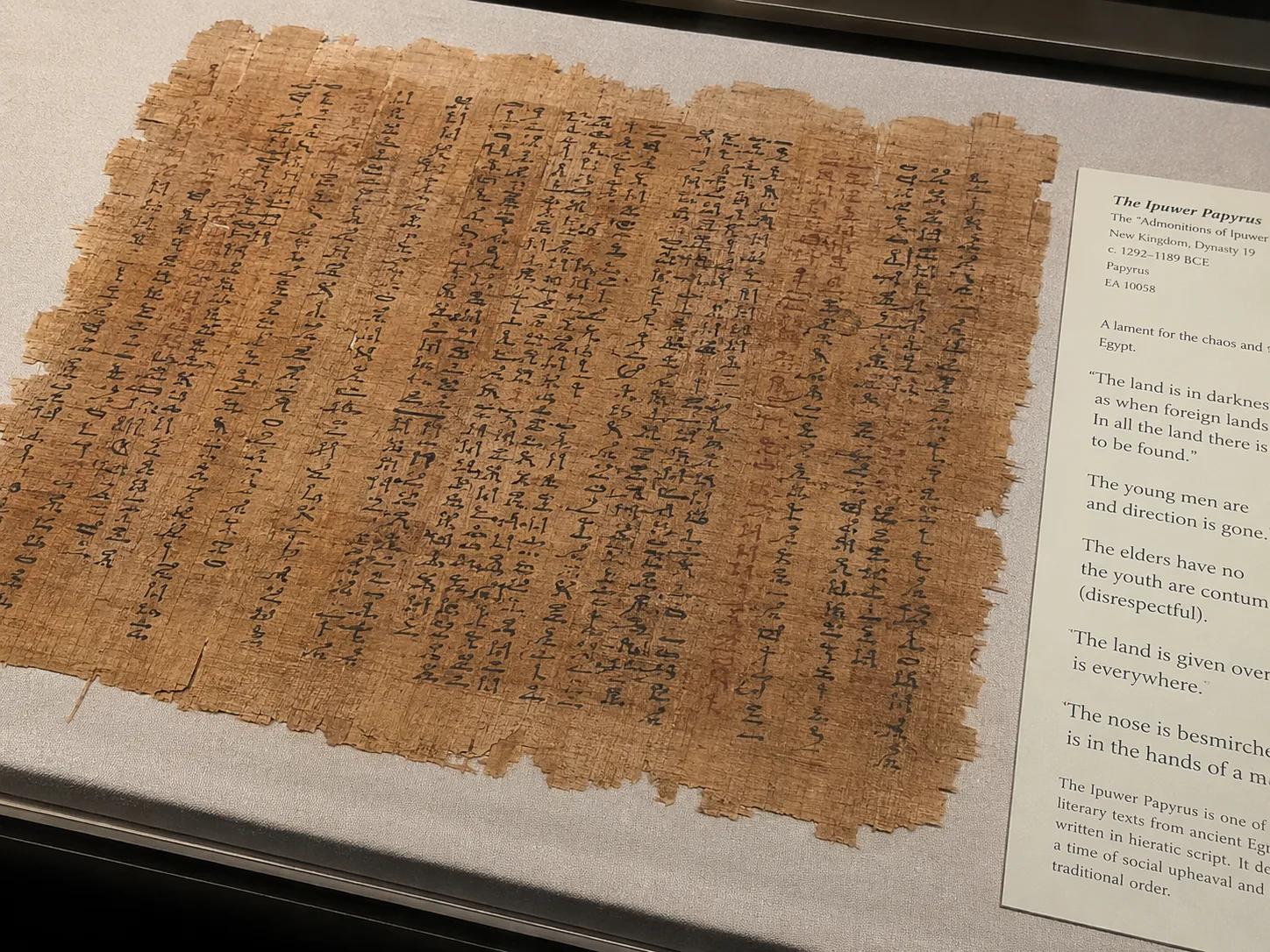
Held today in the Rijksmuseum van Oudheden in Leiden, Netherlands, and catalogued as Papyrus Leiden I 344 recto, the document known as the Admonitions of Ipuwer is an Egyptian poetic lament written in hieratic script and composed during the late Twelfth or early Thirteenth Dynasty of Egypt (between roughly 1991 and 1650 BC by the conventional chronology). The papyrus is broken at the beginning and the end, but its surviving sixteen sections record, in the first person, the testimony of an Egyptian scribe named Ipuwer describing a nationwide catastrophe that has overwhelmed his country.
The parallels with the plagues of Exodus 7–12 are striking enough that for over a century — since Egyptologist Sir Alan Gardiner’s 1909 translation — Jewish and Christian scholars have proposed Ipuwer as a possible Egyptian eyewitness account of the events described in the Hebrew Bible. The catalogue below sets the parallels side by side from the surviving text:
| Plague described in Exodus | Bible (KJV) | Ipuwer Papyrus |
|---|---|---|
| The Nile turned to blood | Exodus 7:20–21 — "all the waters that were in the river were turned to blood… and the river stank" | Ipuwer 2:5–6, 2:10 — "the river is blood… men shrink from tasting; human beings thirst after water" |
| Crops and livestock destroyed | Exodus 9:25 — "the hail smote… every herb of the field, and brake every tree of the field" | Ipuwer 6:1 — "no fruit nor herbs are found"; 5:5 — "all animals, their hearts weep; cattle moan" |
| Fire from heaven | Exodus 9:23–24 — "the LORD sent thunder and hail, and the fire ran along upon the ground" | Ipuwer 2:10 — "gates, columns, and walls are consumed by fire" |
| Darkness covering the land | Exodus 10:22 — "there was a thick darkness in all the land of Egypt three days" | Ipuwer 9:11 — "the land is without light" |
| Death of the firstborn | Exodus 12:29 — "the LORD smote all the firstborn in the land of Egypt"; v. 30 — "there was a great cry" | Ipuwer 2:13, 4:3, 6:12 — "he who places his brother in the ground is everywhere"; "the children of princes are dashed against walls"; "men have been hurled into the millstones" |
| The departure of the slaves | Exodus 12:35–36 — "they spoiled the Egyptians"; the people left in haste with their dough unleavened | Ipuwer 3:2 — "gold and lapis lazuli are hung about the necks of female slaves"; 7:1 — "the slaves are leaving" |
The standard mainstream-Egyptological response to these parallels is that the Admonitions of Ipuwer belongs to a known Egyptian genre of pessimistic literature — a formal lament about social inversion in which the countryside is in ruins, the river is dry, the dead are unmourned, slaves rule the rich, and so on — and that the parallels are coincidental. There is a kernel of truth to the genre observation. There were other lament texts in ancient Egypt. The honest reader, however, will note that no other lament text contains the river-turned-to-blood line, the fire-from-heaven line, the death of the children of princes, and the departure of the slaves with the gold and lapis lazuli of their former masters — all in a single composition, all matching Exodus beat by beat.
The mainstream further objects that Ipuwer dates earlier than the conventional Exodus date. That is true on the thirteenth-century chronology. On the biblical fifteenth-century chronology, Ipuwer fits comfortably in the era immediately following the plagues, when the memory was raw enough for a court scribe to compose a national lament about what had befallen Egypt. The chronology problem with Ipuwer is, in other words, the chronology problem with the Exodus generally: corrected, the difficulty dissolves.
4. Avaris — the buried Semitic city in Goshen
Since 1966, an Austrian archaeological mission directed by Professor Manfred Bietak of the University of Vienna has conducted continuous excavations at Tell el-Dab’a in the north-eastern Nile Delta, the site of ancient Avaris. The work is mainstream, peer-reviewed, and uncontroversial in its methodology. What it has revealed is what should make any honest reader pause.
Bietak’s team has documented, layer by stratigraphic layer, that Avaris was — for centuries before its thirteenth-century rebuilding by Rameses II as Pi-Rameses — the largest Semitic city in Egypt. The material culture is unmistakably Canaanite, not Egyptian: the pottery shapes match the Levantine repertoire rather than the local Nile-valley forms, the burial practices follow Canaanite norms (sheep and donkey burials, weapons interred with the dead, residential burials), the architecture follows a long-room Syrian house plan, and the personal names recovered on inscribed scarabs are West Semitic.
The location of Avaris is itself the first piece of evidence. Genesis 47:6 records Pharaoh placing the family of Jacob in “the best of the land… in the land of Goshen.” Goshen is consistently identified, in every reading of the biblical text I am aware of, with the eastern Nile Delta. That is precisely where Avaris sits. The largest Semitic settlement in second-millennium-BC Egypt was located in the very region Scripture names as the dwelling-place of the Israelites.
Two further details from the Avaris excavations are worth recording. First, Bietak documented in one stratum a series of shallow mass graves — bodies thrown in without ceremony, in apparent haste, all at the same archaeological horizon. Such graves are inconsistent with the ordinary mortuary practice of the Semitic population at the site (which followed Canaanite norms) and inconsistent with Egyptian practice (which emphasised the elaborate preparation of the dead). Something happened, in a single moment, that produced a large number of bodies requiring rapid disposal. The biblical narrative offers a candidate explanation in Exodus 12:29–30: a great cry in the land because there was not a house where there was not one dead.
Second, Bietak documented that the entire Semitic settlement at Avaris was abruptly and largely abandoned at a particular stratigraphic horizon — its houses left intact, its material possessions left behind, the population simply gone. Cities are not normally abandoned in this way. A captive population leaving en masse — taking what they could carry, leaving what they could not — would produce precisely the archaeological signature found at the site.
5. The statue of an Asiatic governor — Joseph in Avaris?
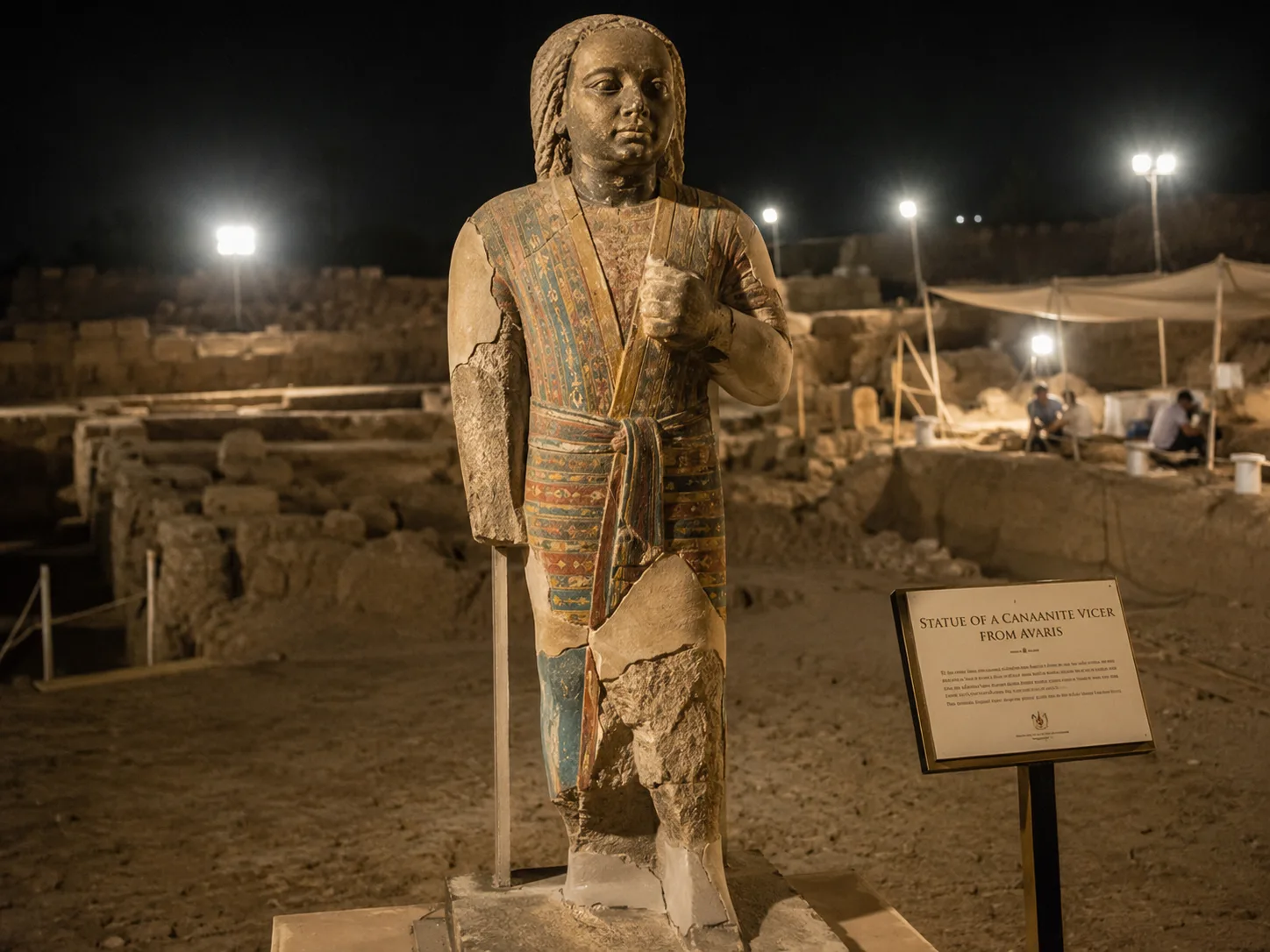
Between 1986 and 1988, in a tomb at Tell el-Dab’a located within the grounds of an Egyptian palace complex, Bietak’s team excavated the smashed remains of a seated stone statue approximately one and a half times life-size. The reconstructed statue depicts an Asiatic man — not an Egyptian. The features identify him unambiguously: yellow skin (the Egyptian artistic convention for portraying Asiatics), a mushroom-shaped hairstyle painted red (the same convention used for Canaanite elites on Egyptian tomb paintings), and a multi-coloured striped robe across the shoulders and back. In his hand he holds a throwstick — the Egyptian hieroglyphic determinative for a foreigner.
Two further details define the find. First, the statue is the only one of its kind ever recovered from second-millennium Egypt: the depiction of a non-royal Asiatic at over life-size, in the regalia of an Egyptian governor, buried in his own pyramid-style tomb within a palace complex, has no archaeological parallel. Second, the statue had been deliberately and violently smashed — the face hammered off, the body broken in pieces — and the tomb itself had been emptied at some point after the statue’s destruction. The bones of the man it commemorated were not present when the tomb was excavated.
The English Egyptologist David Rohl, working from Bietak’s own published evidence, has argued that this is the tomb of Joseph. The identifying details — the multi-coloured robe (Genesis 37:3, the “coat of many colours”), the Asiatic features of a Canaanite, the seat of authority in the eastern Delta, the governor’s regalia (Genesis 41:42–43) — line up beat-for-beat with what the Hebrew text records. The smashing of the statue and the emptying of the tomb correspond to what one would expect of a population that, generations later, fell out of favour with a new Egyptian dynasty — the “new king over Egypt, which knew not Joseph” of Exodus 1:8 — and to the biblical record in Exodus 13:19 that Moses, on the night of departure, took the bones of Joseph with him, in fulfilment of an oath Joseph had extracted from his descendants centuries earlier (Genesis 50:25).
Rohl’s identification is, on the mainstream consensus, speculative. The article does not press it further than the evidence warrants. The minimum that any honest observer must concede is this: at exactly the time and place the Bible says Joseph governed Egypt, in precisely the region the Bible says he settled his family, an extraordinary tomb of an Asiatic governor was built, decorated with the visual markers the Bible records, then violently destroyed and emptied of its occupant.
6. The Brooklyn Papyrus — Hebrew names on an Egyptian slave list
Acquired by the Brooklyn Museum in 1935 and catalogued as Papyrus Brooklyn 35.1446, this seven-foot Egyptian hieratic document records the legal household roster of a Theban noblewoman named Senebtisi during the late Twelfth and early Thirteenth Dynasty (c. 1809–1743 BC by conventional chronology). On the recto, the papyrus lists ninety-five servants belonging to her household. On the verso, an updated register adds further names from a later period.
The text is in Egyptian; the names of the servants are not. Of the ninety-five, approximately thirty bear personal names identified by linguists as belonging to the Northwest Semitic language family — the family to which Hebrew, Aramaic, Phoenician, and the other Canaanite dialects belong. Several of those names are unmistakably Hebrew. Among them, one in particular has caught the attention of every commentator who has examined the text: the name Shiphrah — identical to the name of one of the two Hebrew midwives commanded by Pharaoh to kill the male infants of the Israelites in Exodus 1:15.
The mainstream-archaeological response is that the presence of Semitic personal names in an Egyptian slave roster proves only that there were Semitic-speaking slaves in Egypt — not that they were specifically Israelites. That objection has a kernel of truth: a name in itself is not a proof of national identity. But the Brooklyn Papyrus is not a single piece of evidence; it is one element in a cumulative case. A Hebrew-speaking servant population in Egypt, attested in an Egyptian legal document, dated to the very period the Bible places the Israelites in Egyptian bondage, with at least one name identical to a name the Bible specifically records from that period — this is precisely the kind of external corroboration the mainstream consensus claims does not exist.
7. The Soleb inscription — the earliest writing of the divine name
In 1957–1963, the Italian archaeologist Michela Schiff Giorgini conducted excavations at Soleb, a temple complex in modern-day Sudan founded during the reign of Pharaoh Amenhotep III (approximately 1390–1352 BC). Among the inscriptions recovered from the temple was a toponym list — a series of place-names of conquered peoples — carved into the columns of the hypostyle hall. One of the entries on the list, in Egyptian hieroglyphs, reads: tā šāsw Y-h-w-ā — “the land of the Shasu of Y-h-w-h.”
This is significant for two reasons. First, the inscription is dated to approximately 1400 BC, in the lifetime of Moses by the biblical chronology and within a generation of the Exodus. Second, the name YHWH — the tetragrammaton, the personal name of the God of Israel, first revealed to Moses at the burning bush in Exodus 3:14–15 — appears here as the name of a god worshipped by a nomadic people called the Shasu. The Shasu are attested elsewhere in Egyptian records as a Semitic semi-nomadic population living in the regions east of Egypt, including the Sinai Peninsula and northern Arabia: precisely the region in which Israel wandered for forty years.
The Soleb inscription is the earliest known extra-biblical attestation of the divine name YHWH. The mainstream Egyptological response acknowledges the attestation but argues that “the Shasu of YHWH” describes a people-group worshipping a god by that name, not the Israelites specifically. That is a reasonable distinction to draw at the linguistic level. The honest observer will nevertheless note that, at the exact period the Bible describes Israel wandering in the desert between Sinai and Canaan, an Egyptian pharaoh recorded the name of his nomadic neighbours’ god — and the name he recorded was the name the Bible says Moses had just learned at the burning bush.
8. Jericho — the walls that fell outward
No site in biblical archaeology has produced a sharper controversy than the city of Jericho — or, more precisely, the question of when the city was destroyed and by whom. The mound of Tell es-Sultan in the modern West Bank has been excavated four times: by Charles Warren in 1868, by Ernst Sellin and Carl Watzinger from 1907–1909, by John Garstang from 1930–1936, and by Dame Kathleen Kenyon from 1952–1958. Each of the four expeditions has produced different conclusions.
Garstang’s dating of the city’s final destruction to approximately 1400 BC — precisely the date of the biblical conquest under Joshua — was overturned in the 1950s by Kenyon, whose more careful stratigraphic work redated the destruction to roughly 1550 BC, a century and a half too early to match the Israelite conquest on any chronology. Kenyon’s dating dominated the field for the next three decades, and the conclusion drawn in mainstream textbooks was that the biblical conquest narrative is unhistorical because there was no city standing at Jericho when Joshua and his people are said to have arrived.
In 1990, the American archaeologist Bryant G. Wood of the Associates for Biblical Research published a peer-reviewed reanalysis of Kenyon’s own excavation notes and the pottery recovered from the relevant stratum. Wood’s reanalysis — published in the academic journal Biblical Archaeology Review — demonstrated that Kenyon had based her redating on the absence of a particular class of imported pottery (Cypriot bichrome ware) which she did not expect to find in a poor agricultural settlement. The locally-made pottery actually recovered from the destruction layer is consistent with a Late Bronze I date (c. 1400 BC), matching Garstang’s original dating and the biblical chronology.
Wood’s reanalysis has remained controversial in the mainstream field. But four features of the destruction layer at Jericho are independent of the dating dispute and are matters of physical archaeological record on which no excavator disagrees:
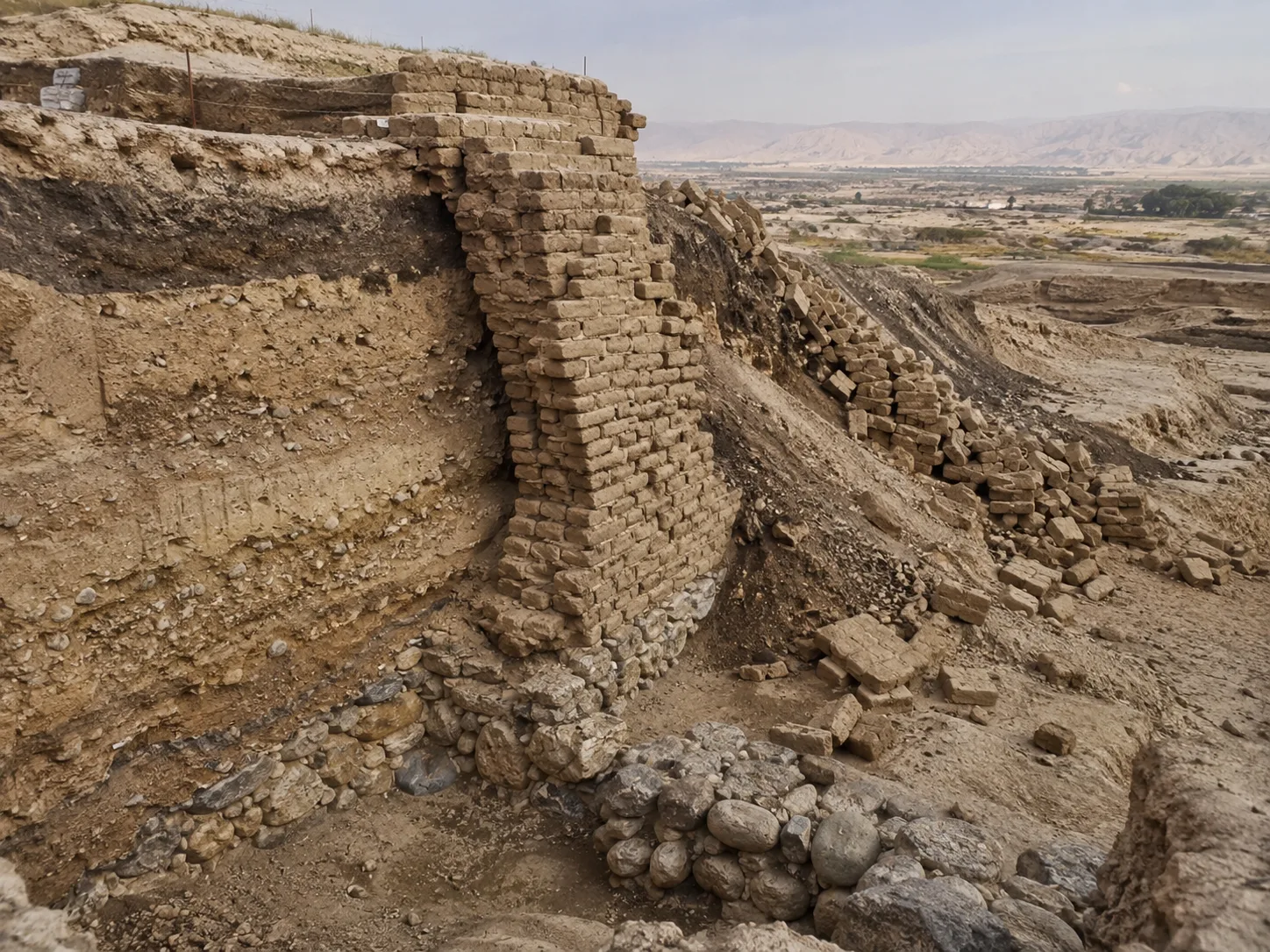
- The walls fell outward, not inward. The mudbrick parapets of the city collapsed away from the tell, forming a ramp of fallen brickwork at the foot of the revetment wall — producing exactly the situation described in Joshua 6:20, “the wall fell down flat, so that the people went up into the city, every man straight before him.” In an ordinary military siege the walls of a captured city collapse inward, under the impact of battering rams and the weight of attackers. At Jericho they fell outward, as if pushed from inside, or shaken loose from beneath.
- The city was burned in a single conflagration. The destruction layer is a thick band of carbonised material — ash, charred wood, burned mudbrick — consistent with the city being put to the torch from end to end in a single event, as Joshua 6:24 describes: “they burnt the city with fire, and all that was therein.”
- The grain stores were full and burned in place. Kenyon herself documented large jars of charred grain inside the destroyed city. This is archaeologically remarkable. Captured cities are normally plundered of their food stores; grain was the most valuable movable wealth a Bronze Age army could acquire. At Jericho the grain was burned untouched — consistent with the divine command of Joshua 6:17–19 that nothing in Jericho was to be taken as plunder.
- The siege was short, not long. The volume of grain remaining in the storage jars is inconsistent with a prolonged siege, in which the defenders would have consumed their reserves. The grain had been harvested very recently before the city fell. That detail aligns with Joshua 3:15’s note that the Jordan was at flood stage when Israel crossed — the spring grain harvest — and with the narrative of a seven-day march, not a multi-month investment.
Whatever one makes of the dispute over the absolute date of the destruction, the manner of the destruction is not in dispute. The city collapsed outward, burned in a single event, and was found with its grain stores intact and burned in place. The archaeology, in the matters that can be physically observed at the site, reads as a word-for-word confirmation of the narrative in Joshua 6.
9. Mount Sinai — where the law was given
The traditional identification of Mount Sinai with Jebel Musa in the southern Sinai Peninsula was established in the fourth century AD by Christian pilgrims, and codified in 530 AD by the Emperor Justinian’s construction of Saint Catherine’s Monastery at its foot. The identification rests on Byzantine pilgrim tradition, not on biblical or archaeological evidence: the Pentateuch never specifies the mountain’s exact location, and no archaeological remains at Jebel Musa pre-date the fourth century.
Of more substantive interest is what the New Testament itself records about the location. In Galatians 4:25, the apostle Paul, writing in the first century AD, states plainly:
For this Agar is mount Sinai in Arabia, and answereth to Jerusalem which now is, and is in bondage with her children.
Paul places Mount Sinai in Arabia. This is a geographically meaningful statement: in the first century, “Arabia” referred to the territory east of the Gulf of Aqaba — the region of modern-day north-western Saudi Arabia, not the Sinai Peninsula. The Sinai Peninsula was Egyptian territory in the first century. If Paul had meant the traditional Jebel Musa, he would not have written that Sinai was in Arabia.
Paul’s placement points toward a mountain in north-western Saudi Arabia — specifically, the range around Jebel al-Lawz (and its adjacent peak Jebel Maqla) in the Midian region. This identification has a respectable scholarly pedigree independent of the more controversial popular claims associated with the site. The nineteenth-century English traveller and biblical geographer Charles Tilstone Beke argued in 1873 that the true Mount Sinai had to be in Arabia on the basis of Paul’s testimony and on the volcanic descriptions of the mountain in Exodus 19:18. More recently, the bestselling author Joel Richardson and the national-security researcher Ryan Mauro have conducted independent on-site investigations of Jebel al-Lawz and Jebel Maqla, documenting features at the site — a blackened summit, an enormous split rock matching the biblical description of the rock at Horeb, the remains of a substantial Bronze Age altar at the foot of the mountain, twelve standing-stone pillars, and a large cleared area suitable for a national encampment — that are consistent with the narrative in Exodus 19–34.
Two distinctions must be drawn carefully here. First, much of the popular material in support of the Jebel al-Lawz identification originated in the 1980s and 1990s with the American amateur explorer Ron Wyatt, who claimed to have located the site along with a remarkable array of other biblical artefacts (including the Ark of the Covenant, the literal blood of Christ, and the site of the Crucifixion). Wyatt’s claims have been repeatedly and credibly criticised across the conservative Christian and academic spectrum. The author of this article does not endorse Wyatt’s broader corpus and does not lean on it. The Jebel al-Lawz case made by Beke, Richardson, Mauro, and the work of independent scholars such as Allen Kerkeslager stands on independent evidence.
Second, the case is admittedly not yet settled. The Saudi government has historically restricted access to the Jebel al-Lawz site, and rigorous independent excavation has not been possible. What can be said with confidence is what Paul said in Galatians 4:25: Mount Sinai is in Arabia. Where exactly in Arabia is a question awaiting further work. The traditional Egyptian Sinai, on present evidence, is not the right location.
10. The Red Sea crossing — the Gulf of Aqaba
If Mount Sinai stands in Arabia, then the Israelites had to cross water to reach it. The traditional identification of the “Red Sea” (Hebrew yam suph, “sea of reeds”) places the crossing at the marshes north of the Gulf of Suez. This identification is geographically problematic in several respects: the Hebrew text describes Pharaoh and his army drowning in deep water (Exodus 14:28, 15:5, 15:10), the wind blew the waters back to form a wall on either hand (Exodus 14:22), and the Israelites’ route from Goshen to a mountain in Arabia would not pass through the northern Suez marshes.
The candidate location consistent both with the biblical text and with a Sinai in Arabia is Nuweiba Beach on the Egyptian side of the Gulf of Aqaba — a broad alluvial fan emptying onto the Gulf, with a submerged underwater land bridge across to the Saudi coast. The bathymetry of the Gulf of Aqaba at this point produces a relatively shallow ridge between two deep basins, geologically anomalous and suggestive of the kind of dry passage the biblical narrative describes.
Underwater video footage from divers at Nuweiba Beach has circulated for several decades depicting coral-encrusted objects on the seabed at the ridge crossing, identified by some observers as the remains of chariot wheels and military equipment. The author of this article will note that the bulk of this material was originally promoted by Ron Wyatt, and that the identifications — whether of coral formations or of genuine artefacts beneath the encrustation — are disputed and have not been subject to rigorous independent archaeological recovery. The Egyptian and Saudi governments have not permitted such recovery to date.
The author offers no claim about specific identifications of underwater chariot wheels. What can be said with confidence is this: Galatians 4:25 requires Mount Sinai to be in Arabia; the Israelites’ route from Goshen to Arabia required a crossing of the Gulf of Aqaba; the Gulf of Aqaba contains, at exactly the location a crossing would naturally have occurred, a submerged land bridge of anomalous bathymetry; and the underwater survey work that would either confirm or refute the identification of chariot debris has been refused by the controlling national authorities. The reader is left to weigh that combination of facts on his own.
11. The cumulative case
No single one of the nine pieces of evidence catalogued above is, in isolation, a conclusive proof of the Exodus. Each carries some legitimate scholarly counter-argument. The Thutmoside dynastic identification depends on the conventional Egyptian regnal chronology. The Ipuwer Papyrus belongs to a known lament genre. The Avaris Semitic population could in principle have been any of several Canaanite groups. The Avaris statue is not labelled. The Brooklyn Papyrus contains Semitic but not specifically Israelite names. The Soleb inscription names a people, not a nation. The Jericho destruction date is contested. The Sinai location requires further excavation. The Nuweiba crossing site remains archaeologically unrecovered.
Considered cumulatively, however, the pattern is difficult to dismiss. We have a corrected biblical chronology that lands the Exodus precisely within the sole reign of Thutmose III, with Hatshepsut available as the princess of Exodus 2 and the dynastic dynamic of an heirless queen elevating an adopted Hebrew rival accounting for the savagery with which Thutmose III later erased her from the record. We have an Egyptian eyewitness account of nationwide calamity beat-for-beat matching the plagues. We have, in the eastern Delta exactly where Goshen should be, a buried Semitic city of the right period containing the smashed tomb of an Asiatic governor in the regalia described in Genesis 41, mass graves consistent with a sudden mortality event, and a population that abruptly abandoned the city. We have an Egyptian household papyrus of the right period containing the name of one of the two Hebrew midwives named in Exodus 1. We have the earliest extra-biblical attestation of the divine name YHWH, in an Egyptian toponym list of nomadic peoples east of Egypt, dated to the very period the Bible places Israel between Sinai and Canaan. We have a Late Bronze Age city in the right location whose walls fell outward and whose grain stores were burned in place untouched, exactly as the conquest narrative requires. We have a New Testament identification of Mount Sinai as “in Arabia” and a topographically suitable mountain in north-western Saudi Arabia. And we have a crossing point on the Gulf of Aqaba at exactly the location the route requires.
The mainstream verdict that there is no archaeological evidence for the Exodus rests, on the present author’s reading, on three errors: looking in the wrong century (the thirteenth instead of the fifteenth), looking at the wrong mountain (the traditional Sinai instead of an Arabian one), and treating each piece of available evidence as an isolated case to be debunked rather than as an element in a cumulative pattern. Corrected in those three respects, the archaeology produces what the Hebrew Scriptures have always claimed: that the God of Abraham, Isaac, and Jacob did, in the fifteenth century BC, deliver a captive nation out of the land of Egypt, did appear to them on a mountain in Arabia, did walk them through a wilderness for forty years, and did bring them across the Jordan into the land He had promised to their fathers.
Scripture testimony
The following passages bear most directly on the archaeological questions discussed above. They are the anchor points from which the chronology and geography of the Exodus must be reconstructed:
- 1 Kings 6:1
- And it came to pass in the four hundred and eightieth year after the children of Israel were come out of the land of Egypt, in the fourth year of Solomon's reign over Israel, in the month Zif, which is the second month, that he began to build the house of the LORD.
- Exodus 12:40–41
- Now the sojourning of the children of Israel, who dwelt in Egypt, was four hundred and thirty years. And it came to pass at the end of the four hundred and thirty years, even the selfsame day it came to pass, that all the hosts of the LORD went out from the land of Egypt.
- Galatians 4:25
- For this Agar is mount Sinai in Arabia, and answereth to Jerusalem which now is, and is in bondage with her children.
- Joshua 6:20
- So the people shouted when the priests blew with the trumpets: and it came to pass, when the people heard the sound of the trumpet, and the people shouted with a great shout, that the wall fell down flat, so that the people went up into the city, every man straight before him, and they took the city.
Sources
- Manfred Bietak, Avaris, the Capital of the Hyksos: Recent Excavations at Tell el-Dab’a, British Museum Press, 1996; and subsequent published excavation reports through the present.
- Sir Alan H. Gardiner, The Admonitions of an Egyptian Sage from a Hieratic Papyrus in Leiden (Pap. Leiden 344 recto), J. C. Hinrichs, 1909 — the foundational translation of the Ipuwer Papyrus.
- David M. Rohl, A Test of Time: The Bible — From Myth to History, Century, 1995, and Exodus: Myth or History?, Thinking Man Media, 2015.
- Walter J. Veith, “The Search for Truth” and related lectures in the Genesis Conflict series (Amazing Discoveries, various editions) — the primary source for the Thutmoside dynastic identification of the pharaohs of the Exodus argued in section 2 of the present article.
- Bryant G. Wood, “The Rise and Fall of the 13th-Century Exodus-Conquest Theory,” Journal of the Evangelical Theological Society 48:3, 2005, pp. 475–489 — the principal scholarly statement of the alternative Amenhotep II identification.
- Joyce Tyldesley, Hatchepsut: The Female Pharaoh, Penguin, 1996 — standard mainstream biography covering her reign, her heirless marriage to Thutmose II, and the systematic damnatio memoriae of her monuments by Thutmose III.
- Bryant G. Wood, “Did the Israelites Conquer Jericho? A New Look at the Archaeological Evidence,” Biblical Archaeology Review 16:2, 1990.
- Tim Mahoney, Patterns of Evidence: The Exodus (2014), The Moses Controversy (2019), and The Red Sea Miracle Parts I & II (2020) — documentary series synthesising the chronology question and the archaeological evidence for general audiences.
- Titus Kennedy, “The Land of the SAsw (Nomads) of yhwA at Soleb,” published in Excavations and the Bible 2019 — on the Soleb temple inscription.
- James K. Hoffmeier, Israel in Egypt (Oxford 1996) and Ancient Israel in Sinai (Oxford 2005) — representative of the mainstream scholarly case, against which several of the arguments above are framed.
- Joel Richardson, Mount Sinai in Arabia: The True Mount Sinai Revealed, WND Books, 2018; and the independent on-site investigative work of Ryan Mauro at Jebel al-Lawz.