
In brief
The doctrine of the Trinity did not arrive in Christianity through the front door. It crept in gradually, across the fourth century, through a sequence of imperial edicts, contested councils, and conciliar formulae written under the political authority of the emperor of Rome — finally reaching its modern triadic shape at the Council of Constantinople in AD 381, three hundred and fifty years after the apostolic generation. The arc is documentary throughout. It can be traced step by step through the conciliar records, the surviving letters of the principal disputants, the imperial edicts of Constantine and his successors, the testimony of the pre-Nicene patristic writers who held a different confession, and the standing witness of Christian bodies (Celtic, Gothic, Waldensian, Armenian, the great Church of the East) who never accepted the new formulary at all. This article walks the arc on the documentary record and commends the willing reader to weigh the apostolic alternative on its own ground.
What this article sets out
- the apostolic confession Christ Himself taught (Jn 17:3; 1 Cor 8:6) and the pre-Nicene patristic consensus that followed it;
- the Alexandrian controversy of the early fourth century and what was actually at stake between Alexander and Arius;
- the Council of Nicaea (AD 325) — Eusebius of Caesarea’s pre-controversy creed, the Athanasian party’s manufactured rejection of it, and the imperial insertion of the homoousios formula under penalty of banishment;
- the post-Nicaean reversal — Arius’s recall, Constantine’s baptism by an Arian bishop, Athanasius banished five times, and the Council of Rimini (AD 359–60) at which Arianism became the official imperial orthodoxy;
- the re-establishment of the Trinity under Theodosius (AD 380) and the Council of Constantinople (AD 381) at which the Holy Spirit was first formally added as a third hypostasis;
- the bodies of Christians who never accepted the formulary (Celtic, Gothic, Waldensian, Armenian, and the great Church of the East), and Rome’s own modern admission that the Trinity is a Church-formulated doctrine without precise authority in the Gospels;
- the pioneer-Adventist recovery of the apostolic begotten-Son framework — from James White’s 1846 protest to D. W. Hull (1859), J. N. Loughborough (1861), Joseph Bates (1868), J. N. Andrews (1869), R. F. Cottrell (1869, later endorsed by A. L. White as representative of the pioneer position), Ellen G. White’s own published statements, J. H. Waggoner (1884), E. J. Waggoner (1890), and J. S. Washburn (1939);
- the twentieth-century institutional migration of the corporate Seventh-day Adventist denomination from the pioneer non-Trinitarian confession (1889 Year Book) through the formal insertion of the Trinity (1931 Year Book) to the modern Catholic-Trinitarian formulation (1981 Year Book), tracked in parallel by the hymnal record (1909 and 1941 non-Trinitarian, 1985 reverted), and acknowledged on the public record by Andrews University’s George Knight in his 1993 Ministry Magazine admission.
The apostolic confession
Before the controversy, before the council, before the creed, the apostolic Scripture itself sets out the identification of God. The reading is neither metaphysical nor speculative; it is given in Christ’s own voice and reiterated by the apostolic confession. The willing reader is invited to weigh both passages on their own plain terms:
And this is life eternal, that they might know thee the only true God, and Jesus Christ, whom thou hast sent.
But to us there is but one God, the Father, of whom are all things, and we in him; and one Lord Jesus Christ, by whom are all things, and we by him.
Two persons are named with precision. The Father is identified as the only true God by Christ Himself; Christ is identified as the Father’s only-begotten Son, sent into the world. The apostolic confession does not produce a formula in which the two are reduced to a single metaphysical substance, nor does it produce a third hypostasis to make the arrangement triadic. The Holy Spirit, in the apostolic record, is uniformly the Spirit of God or the Spirit of Christ — a divine presence and power proceeding from the Father through the Son (Rom 8:9; Phil 1:19; 1 Pet 1:11), not a third independent personal centre of the Godhead.
TAHBRI’s editorial position holds with the apostolic confession in its specifically apostolic form. The institute affirms readily the full divinity of the Lord Jesus Christ on Christ’s own self- disclosed divine titles — the first and the last (Rev 1:17), the Alpha and Omega (Rev 1:8; 22:13), the I AM (Jn 8:58), the Almighty (Rev 1:8), the Word by Whom all things were made (Jn 1:3; Heb 1:2). The divinity of Christ is not at issue between the apostolic confession and the later Nicene formulary; what is at issue is whether the apostolic naming (Father, Son) is reducible to a single metaphysical substance whose three hypostases are co-equal and co-eternal — a claim the apostolic Scripture does not state and which the Father’s own unique title at John 17:3 actively resists.
The Alexandrian controversy
The controversy that would eventually produce the Nicene formulary began in the city of Alexandria in the early part of the fourth century. The historian A. T. Jones summarised the documentary record in his The Two Republics (Battle Creek: Review and Herald, 1891), drawing on Stanley’s History of the Eastern Church and Gibbon’s Decline and Fall as the primary modern collations of the conciliar record. The narrative is unflattering to all sides:
A certain Alexander was bishop of Alexandria. Arius was a presbyter in charge of a parish church in the same city. Alexander attempted to explain ‘the unity of the Holy Trinity.’ Arius dissented from the views set forth by Alexander. A sort of synod of the presbyters of the city was called, and the question was discussed. Both sides claimed the victory, and the controversy spread. Then Alexander convened a council of a hundred bishops, by the majority of which the views of Alexander were endorsed. Upon this, Arius was commanded to abandon his own opinions, and adopt Alexander’s. Arius refused, and Alexander excommunicated him and all who held with him in opinion, of whom there were a considerable number of bishops and other clergy, and many of the people.
The dispute was therefore not, at its origin, a fringe-against-mainstream affair. A substantial body of bishops, clergy, and laity throughout the Alexandrian diocese held the position Alexander attempted to suppress, and the dispute spread rapidly across the eastern empire as letters and counter- letters circulated between the partisans on both sides.
What was actually disputed
On the documentary record the dispute turned on a single Greek letter. The word that expressed Alexander’s position was homoousion (“of the same substance”); the word that expressed Arius’s position was homoiousion (“of like substance”). The difference is one letter — an additional iota in the Alexandrian word — and the council’s subsequent chairman, on the documentary record of the assembly itself, was unable to articulate what the difference actually meant.
Nevertheless, those who would think in terms of homoiosian or ‘similar,’ instead of homoousian, or ‘identical,’ were promptly labeled as heretics and Arians by the clergy. Yet when the emperor, Constantine, in full assembly of the Council of Nicaea, asked Hosius, the presiding bishop, what the difference was between the two terms, Hosius replied that they were both alike. At this all but a few bishops broke out into laughter and teased the chairman with heresy.
Even Athanasius, who succeeded Alexander as bishop of Alexandria and would become the principal patron of the homoousios formula through the rest of the fourth century, candidly confessed on the documentary record that the substance under dispute was beyond his comprehension. Gibbon preserves the admission:
Athanasius himself has candidly confessed that whenever he forced his understanding to meditate upon the divinity of the Logos, his toilsome and unavailing efforts recoiled on themselves; that the more he thought, the less he comprehended; and the more he wrote, the less capable was he of expressing his thoughts.
The historical record of the principal disputants’ actual positions deserves careful reading. Alexander’s stated view, on his own surviving words, was that “the Son is immutable and unchangeable, all- sufficient and perfect, like the Father, differing only in this one respect, that the Father is unbegotten,” and that “the Son proceeded from the Father, for He is the reflection of the glory of the Father, and the figure of His substance.” Alexander himself appealed to Christ’s own statement “My Father is greater than I” (Jn 14:28) in defence of the begotten-Son framework. His own formulation acknowledged a real Father-Son distinction with the Father as unbegotten and the Son as proceeding from Him — language essentially indistinguishable from the apostolic confession at this point in his own statement.
Arius’s stated view, on his own surviving words, was an explicit affirmation of Christ’s pre- existence and full divinity, paired with the affirmation that the Father has no beginning and that the Son’s personal existence began with the Father’s begetting of Him:
We say and believe, and have taught, and do teach, that the Son is not unbegotten, nor in any way unbegotten, even in part; and that He does not derive His subsistence from any matter; but that by His own will and counsel He has subsisted before time, and before ages, as perfect God, and only begotten and unchangeable, and that He existed not before He was begotten, or created, or purposed, or established. For He was not unbegotten. We are persecuted because we say that the Son had a beginning, but that God was without beginning. This is really the cause of our persecution.
Two clarifications on Arius’s position belong on the documentary record. First, Arius affirmed Christ as perfect God and only-begotten. The common later characterisation of Arius as denying the divinity of Christ is a polemical caricature; the historical record of his own words preserves the divinity affirmation. Second, Arius’s use of the word created alongside begotten reflects fourth-century Greek vocabulary in which the two terms had overlap; later non-Trinitarian historians (Limborch, Wilkinson) have noted that it is doubtful Arius personally meant that Christ was a creature in the sense of the angels and the rest of the created order. What he affirmed was the Father’s priority and the Son’s real begetting before all ages — which is the apostolic confession of Jn 17:3, Heb 1:2–5, Prov 8:22–31, and Ps 2:7 in its specifically historical-pre-existence form.
Per the editorial line of the institute, TAHBRI does not reject the historical Arius’s actual position on the later Nicene party’s terms. TAHBRI receives the begotten-Son framework Arius articulated as substantially identical to the apostolic confession Christ Himself taught at Jn 17:3. The label “Arian”, as a polemical shorthand for denial of Christ’s divinity, is a fourth-century invention of the Nicene party which the willing reader is invited to set aside in favour of reading the historical record on its own ground.
The Council of Nicaea (AD 325)
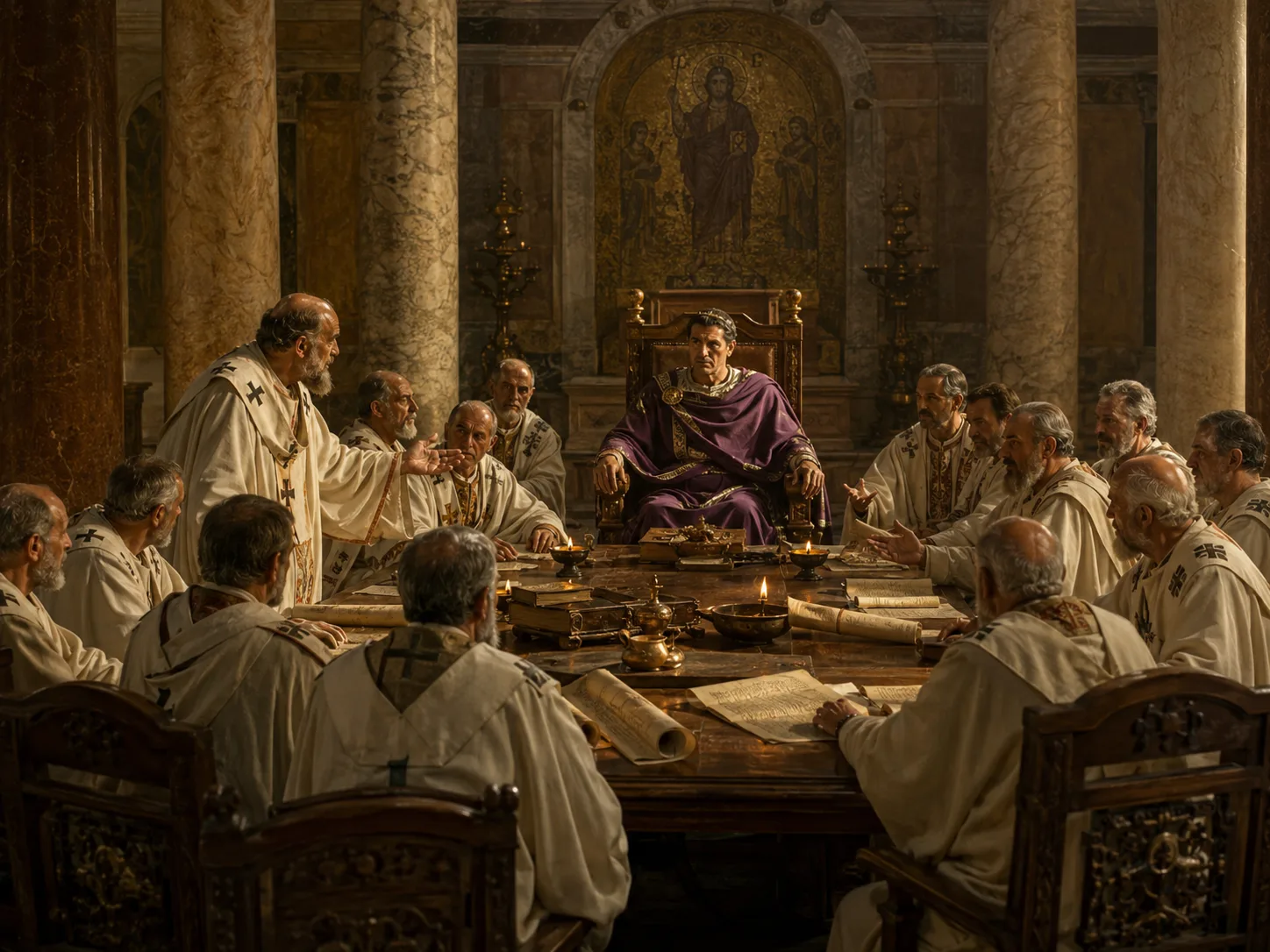
When Constantine’s attempts to reconcile the parties by personal correspondence failed (the letters deepened rather than abated the dispute), the emperor convened a general council in May–July AD 325 in the Bithynian city of Nicaea. The council was attended by approximately 318 bishops with an additional uncounted body of deacons, presbyters, acolytes, and attendants. The proceedings were not minuted in the modern parliamentary sense and the surviving record is partial; what can be reconstructed comes from the letters of attendees (preserved chiefly in Isaac Boyle, A Historical View of the Council of Nice with a Translation of Documents), from Stanley’s collation, and from the conciliar edicts.
Three parties were present in the assembly: those who held with Alexander, those who held with Arius, and a larger middle body of bishops who held neither extreme and who came to the council hoping to serve as mediators. Arius himself, not being a bishop, held no official seat but attended at Constantine’s express command and was repeatedly called upon to express his views. The deacon Athanasius, who would succeed Alexander and become the principal champion of the Alexandrian position, attended in his bishop’s retinue and played a substantial role in the discussion despite his lack of an official place.
The Alexandrian party determined early in the proceedings, on the documentary record, that they could rely on the majority of the council and that they would therefore formulate the test creed in such terms that the Arian party could not honestly sign. A first draft of a creed was presented by the Arian party and signed by eighteen of their bishops; the Alexandrian party tore it to pieces unread, expelling Arius from the assembly. The conciliar dispute had therefore reached, within days of opening, a state in which the majority party would only accept a formula designed to exclude the minority position by construction.
Eusebius’s pre-controversy creed
The most consequential moment of the council, on the documentary record, came when Eusebius of Caesarea — historian, biographer of Constantine, and one of the principal mediators between the parties — presented a baptismal creed that he had personally learned in childhood, accepted at his own baptism, and taught throughout his career as presbyter and bishop. The creed had been in continuous use in the Caesarean diocese long before the controversy had erupted. It read:
I believe in one God, the Father Almighty, maker of all things both visible and invisible, and in one Lord Jesus Christ, the Word of God, God of God, Light of Light, Life of Life, the only-begotten Son, the First-born of every creature, begotten of the Father before all worlds, by whom also all things were made. Who for our salvation was made flesh, and lived amongst men, and suffered, and rose again on the third day, and ascended to the Father, and shall come in glory to judge the quick and the dead. And we believe in one Holy Ghost. Believing each of them to be and to have existed: the Father, only the Father; and the Son, only the Son; and the Holy Ghost, only the Holy Ghost.
Two documentary features of this creed deserve careful weighing. First, on its presentation to the council, the Arian party publicly signified its willingness to subscribe to the creed in full. The pre-controversy baptismal confession of the eastern churches was therefore, on the assembled record of the council itself, substantially identical with the position the Arian party held. The dispute was not between the apostolic baptismal confession of the pre-controversy church and the Arian position; it was between Alexander’s new formulation and both the older apostolic confession and the Arian articulation of it. Second, this creed identifies the Father, the Son, and the Holy Ghost as distinct beings (the Father, only the Father; and the Son, only the Son; and the Holy Ghost, only the Holy Ghost), without the metaphysical reduction to a single substance that the Alexandrian party would shortly insist upon.
Eusebius’s own broader theology, set out in his Ecclesiastical History (composed before the controversy reached Caesarea), preserves the begotten-Son framework with unusual precision:
For as no one hath known the Father, but the Son, so no one on the other hand, can know the Son fully, but the Father alone, by whom He was begotten… that living Word which in the beginning was with the Father, before all creation and any production visible or invisible, the first and only offspring of God, the prince and leader of the spiritual and immortal host of heaven… the second cause of the universe next to the Father, the true and only Son of the Father.
A second figure named Eusebius — bishop of Nicomedia, a different man from Eusebius of Caesarea — was the leading episcopal voice of the Arian party at the council. His own statement preserved in a letter to a fellow bishop captures the pre-Nicene understanding with similar precision:
We have never heard, my Lord, of two beings unbegotten, nor of one divided into two; nor have we learnt or believed that He could suffer any thing corporeal, but that there is one unbegotten, and another truly from Him…
The phrase one unbegotten, and another truly from Him is the apostolic confession in compact form. One Father (without beginning); one Son (truly from the Father, in real personal generation before all ages). Until the Alexandrian controversy of the early fourth century, this was the substantially uniform confession of the eastern churches.
The Nicene formulary
The Alexandrian party, observing that the Arian party had signed Eusebius’s pre-controversy creed, recognised that the creed as it stood would not accomplish the exclusion they sought. They searched the documentary record for a word the Arian party had specifically rejected, that they could then insert into the creed as a test. They found it in a letter previously written by Eusebius of Nicomedia, in which he had stated that to assert the Son to be uncreated would be to say He was of one substance (homoousion) with the Father, and that the word was evidently absurd. The Alexandrian party tore Eusebius’s letter to pieces in the assembly and committed themselves to adopting the very word he had said was absurd.
Constantine, who held the political power to make the council’s decisions binding through imperial edict, was persuaded by Hosius (the council’s chairman) and his associates to support the insertion of homoousios into Eusebius’s creed. The emperor accordingly proposed the creed with the added word, and the Alexandrian party, now backed by imperial sanction, required additional phrases of similar import. The final Nicene Creed of AD 325, as first issued, read:
We believe in one God, the Father Almighty, Maker of all things both visible and invisible. And in one Lord Jesus Christ, the Son of God, begotten of the Father, only begotten, that is to say, of the substance of the Father, God of God, Light of Light, very God of very God, begotten, not made, being of one substance with the Father, by whom all things were made… And in the Holy Ghost. But those that say, ‘There was when He was not,’ and ‘Before He was begotten He was not,’ and that He came into existence from what was not, or who profess that the Son of God is of a different person or ‘substance,’ or that He is created, or changeable, or variable, are anathematised by the Catholic Church.
Two documentary observations on the AD 325 text bear weighing. First, the creed’s treatment of the Holy Ghost is a single bare clause: And in the Holy Ghost. No third hypostasis is yet asserted; no co-equal personality is yet defined; no procession from the Father (or from the Father and the Son) is yet formulated. The triadic Trinity in its later form is not in the original Nicene Creed. The original creed addresses only the Father-Son relation. Second, the anathemas attached to the creed specifically condemn the apostolic historical-pre-existence framework (“There was when He was not”, “Before He was begotten He was not”) — the very framework the pre-Nicene patristic witness affirms (cf. Justin Martyr, Tertullian, Origen, Novatian below).
The Nicene Creed as it is recited in the modern Roman and Anglican liturgies is not the AD 325 text. Two textual alterations bear specific record. The original “begotten of the Father, only begotten, that is to say, of the substance of the Father” was replaced, in the post-Constantinopolitan recension, with “eternally begotten of the Father… of one Being with the Father.” The shift from begotten (with the implication of a real generation in eternity past) to eternally begotten (with the later Catholic gloss of “one ceaseless action” continuing without beginning or end) is a substantive theological move covered by a textual revision. The Knights of Columbus catechetical material defines the modern Catholic understanding plainly:
The Christian belief is that the Christ of history is the Son of God, eternally begotten by one ceaseless action from the Father…
The willing reader is invited to weigh the position carefully. One ceaseless action is a metaphysical formula whose actual content is opaque even on its own terms; it is not a translation of an apostolic Greek term, nor is it derived from any plain biblical statement. The original Nicene word begotten preserved a real historical generation; the modern eternally begotten collapses the generation into a timeless ceaseless process that means, in practice, that the Son was never begotten in any sense the apostolic Scripture would recognise. The textual revision is not documentary in the sense of bringing forward additional manuscripts; it is a theological retro-fitting of the formula to accommodate a position the original creed did not state.
Imperial coercion
Of the bishops present at the council, seventeen refused to subscribe to the new creed. Constantine imposed banishment as the penalty for non-signature. Twelve of the seventeen subscribed under coercion; five refused outright, including Eusebius of Nicomedia (who initially signed the creed but refused to subscribe to the anathemas, and was banished shortly afterward), Theognis of Nicaea, Theonas of Marmarica, and Secundus of Ptolemais. Eusebius of Caesarea took an entire day to deliberate before signing; in his deliberation he consulted Constantine personally, and the emperor explained to him that homoousios was to be understood in a sense compatible with homoiousion — that is, that the insertion involved no material unity of the persons such as Eusebius feared could be deduced from it (Stanley, Eastern Church, Lecture iii, par. 34). On that imperial reassurance, Eusebius signed.
The treatment of Arius was harsher still. Constantine published an edict naming Arius as the chief propagator of the condemned doctrines, ordering him to be denominated “Porphyrian” (after the pagan philosopher Porphyry, whose anti-Christian works the empire had also proscribed), and decreeing capital punishment for any subject of the empire found concealing a treatise by Arius and not consigning it to the flames:
If any treatise composed by Arius should be discovered, let it be consigned to the flames, in order that not only his depraved doctrine may be suppressed, but also that no memorial of him may be by any means left. This therefore I decree, that if any one shall be detected in concealing a book compiled by Arius, and shall not instantly bring it forward and burn it, the penalty for this offence shall be death; for immediately after conviction the criminal shall suffer capital punishment.
Arius’s principal work, the Thalia (a collection of doctrinal songs which had circulated widely among the laity), was publicly burned, and the example was so thoroughly followed across the empire that the work became, within a generation, almost entirely lost. The bulk of what is now known about the historical Arius’s positions survives only through the writings of his opponents, which is the documentary equivalent of reading a defendant’s case through the prosecutor’s files. The willing reader is invited to weigh how thoroughly the imperial apparatus was committed to ensuring that the minority position would not survive in its own voice.
After Nicaea — Arianism wins
The Nicene formulary did not, in the decades following its enactment, produce the doctrinal settlement Constantine had hoped for. On the documentary record the immediate aftermath was a swing in the imperial court back toward the pre-Nicene position, with the remarkable consequence that within a generation the imperially endorsed doctrine of the empire was no longer the Nicene formula but the older begotten-Son framework — under the same emperor who had personally imposed the homoousios formula at the council.
In AD 327 Constantine’s sister Constantia, who had long held with the pre-Nicene party and who had an Arian presbyter as her spiritual advisor, was dying. She convinced her brother on her deathbed that Arius had been unjustly condemned. Constantine shortly afterward recalled Arius from banishment, received from him a fresh confession of faith which the emperor found satisfactory, and reinstated him. The two leading Arian bishops, Eusebius of Nicomedia and Theognis of Nicaea, were likewise restored to their sees, displacing the bishops who had been installed in their absence (Milman, History of Christianity, book iii, chap. iv, par. 21).
Athanasius, who had succeeded Alexander as bishop of Alexandria in AD 328, was banished five times across the next four decades under successive emperors and synods. The famous polemical tag Athanasius contra mundum (“Athanasius against the world”) preserves, in compact form, the documentary fact that for substantial portions of the fourth century the imperial and conciliar machinery of the empire was running against the Nicene formula rather than in support of it.
Constantine’s own deathbed in AD 337 is itself a documentary marker. The emperor who had imposed homoousios at Nicaea was received into the church not by a Nicene bishop but by an Arian one — Eusebius of Nicomedia, the same man whose earlier letter had been torn to pieces at the council and who had been banished within months of signing the original creed. The Encyclopedia Britannica, on the article Constantine, observed that, “tested by character indeed, he stands among the lowest of all those to whom the epithet ‘Great’ has in ancient or modern times been applied.”
Across the next two generations the conciliar and imperial machinery oscillated. Constantine’s three sons divided the empire and the religion between them: Constantine II (north Italy / Gaul) and Constans (the western provinces) held the Nicene position; Constantius (the East) held the pre-Nicene begotten-Son framework. Civil wars and assassinations consolidated the empire under Constantius by AD 353, and the new sole emperor, holding the pre-Nicene position, called a series of councils to repair the doctrinal situation according to his own conviction. The Council of Sirmium (AD 357) and the twin Councils of Rimini and Seleucia (AD 359–60) produced conciliar formulations rejecting the Nicene homoousios and substantially restoring the pre-Nicene begotten-Son framework.
This order was executed with the utmost rigor in all the provinces of the empire, and very few were found who did not sign with their hands what they condemned in their hearts. Many who till then had been thought invincible, were overcome… Thus were all the sees throughout the empire filled with Arians, insomuch that in the whole East not an orthodox bishop was left, and in the West but one; namely, Gregory, bishop of Elvira in Andalusia.
The documentary record is therefore striking. By AD 360, thirty-five years after the Council of Nicaea, the entire conciliar and episcopal apparatus of the empire — eastern and (with one Spanish exception) western — was officially aligned against the Nicene formulary and for a return to the pre-Nicene begotten-Son framework. The Nicene party had been reduced, in the imperial-conciliar order, to a single occupied see and a network of exiled bishops. The willing reader is asked to weigh, on the documentary record, how a formula whose status as ancient ecumenical orthodoxy is now treated as a given of Christian history was, for substantial portions of the century immediately following its enactment, the minority position rejected by the imperial conciliar machinery itself.
Theodosius, the edict of AD 380, and the Council of Constantinople (AD 381)
The reversal that finally established the Trinity in its formal triadic configuration came under the emperor Theodosius I, a Spanish military officer elevated to the eastern throne in AD 379. Within months of his baptism by the Catholic bishop of Thessalonica in early AD 380, Theodosius issued the edict Cunctos Populos (28 February 380), the first imperial edict in the documentary record to use the word Trinity in its specifically formal theological sense:
It is our pleasure that the nations which are governed by our clemency and moderation, should steadfastly adhere to the religion which was taught by St. Peter to the Romans, which faithful tradition has preserved, and which is now professed by the pontiff Damasus, and by Peter, bishop of Alexandria, a man of apostolic holiness. According to the discipline of the apostles, and the doctrine of the gospel, let us believe the sole deity of the Father, the Son, and the Holy Ghost: under an equal majesty, and a pious Trinity. We authorize the followers of this doctrine to assume the title of Catholic Christians; and as we judge that all others are extravagant madmen, we brand them with the infamous name of ‘heretics,’ and declare that their conventicles shall no longer usurp the respectable appellation of churches. Besides the condemnation of divine justice, they must expect to suffer the severe penalties which our authority, guided by heavenly wisdom, shall think proper to inflict upon them.
The willing reader records the documentary feature: the imperial edict of February 380 is the first known formal use of the term Trinity in either the imperial or the conciliar literature. The doctrine is therefore not, on the documentary record, an apostolic confession from the second-Temple Jewish monotheism the Lord Jesus inherited and proclaimed (cf. Mk 12:29: “Hear, O Israel; The Lord our God is one Lord”); it is a fourth- century theological development whose first formal appearance in any official document is in an imperial edict issued under the political authority of a Spanish military officer who had been baptised some weeks previously.
To consolidate the edict in the conciliar order, Theodosius convened the Council of Constantinople in May AD 381. The council was attended by 186 bishops (150 of the new Catholic party; 36 of the Macedonian party, who held the begotten-Son framework specifically with respect to the Father-Son relation but disputed the personhood of the Holy Spirit). The 150 Catholic bishops, the Macedonians having walked out, framed the creed that now stands as the substantive content of the modern Nicene Creed recited in the Roman and Anglican liturgies:
We believe in one God, the Father Almighty, Creator of heaven and earth, and of all things visible and invisible. And in one Lord Jesus Christ, the only- begotten Son of God, begotten of the Father before all times [ages], Light from Light, very God from very God, begotten, not created, of the same substance with the Father… And we believe in the Holy Ghost, the Lord and Life-giver, who proceedeth from the Father; who with the Father and the Son together is worshipped and glorified; who spake by the prophets.
Three documentary features of the Constantinople formula bear weighing. First, the creed still retains the AD 325 language that the Son was begotten of the Father before all times — the phrase the modern Latin recension would later alter to eternally begotten. Second, the Holy Spirit is for the first time elevated in the conciliar record to the status of an independent hypostasis worshipped and glorified together with the Father and the Son. The triadic Trinity in its modern form is not present in the AD 325 creed; it appears in the AD 381 creed for the first time on the documentary record. Third, the Macedonian bishops who walked out of the council (36 of the original 186 attendees, more than 19% of the assembly) were not a fringe party. They held the pre-Nicene majority position on the Holy Spirit as divine influence rather than as a third hypostasis; their walking out is the documentary marker of the formal departure of the begotten-Son tradition from the Catholic conciliar order on this specific point.
After 381 — the Athanasian Creed, the Filioque, and the schism of 1054
The Council of Constantinople of AD 381 was not the end of the doctrine’s development. Across the next seven centuries the Trinitarian formula was progressively elaborated, sharpened, and disputed in ways that would eventually divide the Roman and Eastern churches from each other on the strength of a single Latin word. Three documentary moments in that long arc deserve specific recording here, as each preserves on the public record how the metaphysical formula continued to evolve long after the apostolic generation had passed.
The Athanasian Creed (Quicunque Vult) — not by Athanasius
The most aggressively Trinitarian of the historic creeds — the one routinely cited in catechetical literature as the definitive statement of orthodox Trinitarian confession — is the so-called Athanasian Creed, known by its opening Latin words Quicunque vult (“Whosoever will…”). The creed opens with the uncompromising statement that “whosoever will be saved, before all things it is necessary that he hold the Catholic faith,” and proceeds to define that faith as the worship of one God in Trinity and Trinity in Unity, with each of the three Persons being uncreated, infinite, eternal, almighty, and co-equal. It is the most thoroughgoing and confrontational statement of the developed Trinitarian formula in the historic creedal literature.
The creed has been attributed traditionally to Athanasius of Alexandria, the principal Nicene champion of the fourth century. The attribution is historically untenable. The Dutch humanist scholar Gerhard Voss demonstrated on linguistic and theological grounds in 1642 that the document could not have been written by Athanasius, and modern scholarship has confirmed his verdict without serious dissent. The creed is composed in Latin (not Greek, the language of Athanasius); it uses theological vocabulary — particularly the formula on the procession of the Holy Spirit including the Latin Filioque (see below) — that did not exist in the fourth century; and the earliest manuscripts and citations all come from the Latin West of the fifth and sixth centuries, several generations after Athanasius’s death in AD 373.
The first certain documentary attestation of the creed is in the sermons of Caesarius of Arles in southern Gaul, who died in AD 542; on the theological resemblances to the work of Vincent of Lérins (d. c. 445), the most plausible scholarly window for the creed’s composition is between approximately AD 434 and 540, in southern Gaul, by an anonymous Latin author. The willing reader is asked to weigh the documentary feature: the most aggressively Trinitarian of the historic creeds, the one most often cited as the definitive Christian confession, was written more than a century after its supposed author had died, in a language he did not write in, and incorporates formulae that did not yet exist in his lifetime. The attribution to Athanasius is a medieval ecclesiastical convention, not an apostolic credential.
The Filioque — one Latin word splits Christendom
The original Constantinople creed of AD 381 had declared that the Holy Spirit “proceedeth from the Father” — a formula deliberately framed in the language of Jn 15:26 (where Christ Himself says the Spirit proceedeth from the Father). In the late sixth century the Spanish Latin Church, holding the Third Council of Toledo in AD 589, inserted into the creed an additional Latin word: Filioque (“and from the Son”). The Spanish motivation, on the historical record, was political and anti-Arian: the Visigothic kingdom of Spain had recently converted from the begotten-Son framework to the Nicene-Constantinopolitan position, and the Spanish bishops wished to assert the Son’s full equality with the Father in such a way that left no remaining room for the older Arian formulation. The double procession of the Spirit — from the Father and from the Son — was the formula they introduced for that purpose.
Toledo was a local Spanish council with no ecumenical authority, and the addition created little immediate disturbance. Across the next two centuries the Filioque spread through the Latin liturgical books in Spain, Gaul, and northern Italy. In AD 809 the Frankish emperor Charlemagne formally adopted the addition for the imperial liturgy of his empire and demanded that the Roman papacy ratify it. Pope Leo III, on the documentary record, agreed with the theological substance but refused to alter what he regarded as an ecumenical creed, and ordered the original Greek text inscribed on two silver tablets and displayed at the entrance of St. Peter’s in Rome as a deliberate conservative gesture. By the early eleventh century, however, papal opposition had been worn down; the Filioque entered the Roman liturgical recension and became the standard Latin formulation of the creed.
The eastern churches, who had never accepted the insertion and whose theology had developed differently on the procession of the Spirit, regarded the Latin alteration as both theologically erroneous and procedurally improper — a unilateral amendment to an ecumenical creed by one half of Christendom without consulting the other. On 16 July 1054, in the cathedral of Hagia Sophia in Constantinople, the Roman cardinal Humbert of Silva Candida placed on the altar a bull of excommunication against the Patriarch of Constantinople, Michael Cerularius. The patriarch responded with a reciprocal excommunication of Humbert. The exchange — remembered as the Great Schism of 1054 — formalised the institutional division of the one historic Catholic Church into the Roman Catholic West and the Eastern Orthodox East. The mutual excommunications were not formally lifted until 1965, more than nine hundred years later.
The willing reader is asked to weigh the documentary feature soberly. The doctrine of the Trinity, which had been imposed at Nicaea in AD 325 specifically to unify Christendom against the begotten- Son framework, had by AD 1054 split Christendom into two halves on the strength of a single Latin word added to the metaphysical formula. The unity Rome had attempted to enforce by Constantine’s imperial authority had collapsed under the weight of its own internal contradictions. Neither half retained the apostolic confession of Jn 17:3 in its plain form; both had built their identities on competing elaborations of the post-apostolic formula. The doctrine had, in plain terms, become the engine of division it had been imposed to prevent.
Trent (1545–63) and Vatican I (1869–70)
On the Roman Catholic side, the Trinitarian doctrine was reaffirmed at the Council of Trent (1545–63) as part of the broader Counter- Reformation against the Protestant recovery of Scripture-supreme authority. Trent did not amend the Trinitarian formula itself but inscribed it into the binding Tridentine catechism (the Catechism of the Council of Trent, also known as the Roman Catechism, published 1566) as fundamental and unrevisable Catholic dogma. Vatican I (1869–70) further sharpened the doctrinal architecture by declaring papal infallibility ex cathedra on matters of faith and morals — a declaration which had the institutional effect of placing every subsequent Roman doctrinal definition, including the elaborated Trinity, beyond the reach of textual or historical criticism within the Roman communion. The modern Catechism of the Catholic Church (1992; second edition 1997) reproduces the doctrine as the central mystery of the Catholic faith under the inheritance of these conciliar definitions.
The faithful remnant outside the imperial settlement
The Council of Constantinople established the Nicene- Constantinopolitan Trinity as the official Catholic orthodoxy of the Roman Empire from AD 381 onward. It did not, however, establish that doctrine as the confession of every body of Christians on earth. On the documentary record, multiple substantial bodies of Christian believers outside the immediate imperial ecclesiastical settlement retained the pre-Nicene begotten-Son framework for centuries afterward. The historian Benjamin G. Wilkinson, in his Truth Triumphant (1944), assembled the documentary record:
No wonder that the Celtic, the Gothic, the Waldensian, the Armenian Churches, and the great Church of the East, as well as other bodies, differed profoundly from the papacy in its metaphysical conceptions of the Trinity and consequently in the importance of the Ten Commandments.
The bodies Wilkinson names span an enormous geographical and chronological range. The Celtic Church (Ireland, Scotland, Cornwall, Brittany) maintained an independent ecclesiastical tradition from the fourth century through the Synod of Whitby (AD 664) and in some regions long afterward; its founding figures (Patrick, Columba, Aidan) preserved the pre-Nicene begotten-Son framework in their confessions of faith. The Gothic Church (Ulfilas, the translator of the Gothic Bible, fourth century) carried the begotten-Son framework into the broader Germanic peoples; the various Gothic kingdoms of the early medieval West (Visigoths in Spain and southern France, Ostrogoths in Italy, Vandals in North Africa, Lombards in northern Italy) held that framework as their official confession for centuries, in many cases at deliberate variance with the post- Constantinian Roman settlement.
The Waldensian Christians — the alpine valleys body that the Reformation later identified as a continuous witness running back through the medieval centuries to the apostolic age — maintained the begotten-Son framework throughout their long history. The Armenian Church, the great Church of the East (the so-called “Nestorian” communion that carried Christianity into Persia, central Asia, India, and as far as Tang-dynasty China), and substantial bodies within the Coptic and Ethiopian traditions held variant Christological positions that consistently retained the begotten-Son framework against the imperial-Roman formulary.
It is doubtful if many believed Christ to be a created being. Generally, those evangelical bodies who opposed the papacy and who were branded as Arians confessed both the divinity of Christ and that He was begotten, not created, by the Father. They recoiled from other extreme deductions and speculations concerning the Godhead.
Wilkinson’s observation deserves careful weighing. The polemical label “Arian” has, since the late fourth century, been applied almost indiscriminately by the imperial-Catholic party to any body that maintained the pre-Nicene begotten- Son framework, regardless of whether that body actually held the historical Arius’s specific formulations. The willing reader who has been taught to associate non-Trinitarianism with a denial of Christ’s divinity will recognise, on the documentary record, that the equation is the imperial party’s polemical construction and not the actual position of the bodies the label was applied to. The Celtic, Gothic, Waldensian, Armenian, and Eastern bodies all confessed the divinity of Christ; what they denied was the post-apostolic metaphysical formula by which the imperial party reduced the Father and the Son to a single substance.
The pre-Nicene patristic witness
The pre-Nicene patristic writers — those Christian authors writing between approximately AD 100 and AD 300, before the Alexandrian controversy and the Council of Nicaea — uniformly preserve the begotten- Son framework. A representative sampling, drawn from their own surviving works, is set out below for the willing reader to weigh.
The Scripture has declared that this Offspring was begotten by the Father before all things created; and that which is begotten is numerically distinct from that which begets, any one will admit.
The three days [of creation] which were before the luminaries are types of the Trinity (Greek trias): of God, and His Word, and His Wisdom.
Theophilus of Antioch, writing in his apology To Autolycus around AD 181, is the earliest extant Christian writer to use the Greek word trias (translated trinity) in a theological connection. The willing reader who is told that the doctrine of the Trinity is therefore attested as early as the second century is asked to read Theophilus’s actual usage with care. His triad is not Father, Son, and Holy Spirit as three co-equal persons of a single substance — which is the post-Nicene formula. His triad is God, His Word, and His Wisdom, drawn as a typological reading of the first three days of creation in Genesis 1 before the heavenly luminaries were created on the fourth day. The vocabulary is continuous with the Hellenistic-Jewish category of divine attributes (Nous, Logos, Sophia — mind, word, wisdom) familiar to a Greek-philosophical reader such as Autolycus; the doctrine is not the fourth-century triadic formulation. Theophilus’s attestation belongs in the documentary record of the word’s pre-Nicene usage, not in the documentary record of the doctrine’s pre-Nicene formulation. The two are not the same.
The Church… has received from the apostles and from their disciples the faith in one God, Father Almighty, the creator of heaven and earth and sea and all that is in them; and in one Jesus Christ, the Son of God.
We do indeed believe that there is only one God, but we believe that under this dispensation, or, as we say, oikonomia, there is also a Son of this one only God, his Word, who proceeded from him and through whom all things were made and without whom nothing was made.
I shall not indeed speak of two Gods, but of one; of two Persons however, and of a third economy — the grace of the Holy Spirit. For the Father indeed is One, but there are two Persons, because there is also the Son; and then there is the third, the Holy Spirit. The Father decrees, the Word executes, and the Son is manifested, through whom the Father is believed on.
Hippolytus of Rome (c. AD 170–235), writing against the modalist heretic Noetus of Smyrna, preserves an important documentary feature on the pre-Nicene record. Noetus had taught that Christ was the Father Himself, with no real distinction between the persons — an ancestor of what would later be called Modalism or Sabellianism. Hippolytus opposes the modalist conflation by insisting on a real personal distinction between the Father and the Son. Two features of his formulation are worth recording. First, the Father is identified as One in a way the Son and Spirit are not (the Father indeed is One, but there are two Persons); the ordering is asymmetric, with the Father as primary and the Son as derivative. Second, the third item in Hippolytus’s formula is not yet a third person co-equal with the first two; it is named as a third economy (Greek oikonomia, the arrangement or administration), specifically the grace of the Holy Spirit. The pre- Nicene patristic witness against modalism therefore preserved a real Father-Son distinction without producing the fourth-century triadic Trinity. The willing reader who has been taught that the Trinity is the universal apostolic confession from the earliest centuries is invited to weigh Hippolytus’s actual formulation on its own terms.
That there is one God who created and arranged all things, and who, when nothing existed, called all things into existence… Secondly, that Jesus Christ himself, who came, was born of the Father before all creatures; and after he had ministered to the Father in the creation of all things, for through him all things were made.
God the Father, founder and creator of all things, who alone knows no beginning, who is invisible, immeasurable, immortal, and eternal, is one God… From him… the Word was born, his Son… Assuredly, he [the Son] is God, proceeding from God, causing, as Son, a second person after the Father, but not taking away from the Father the fact that God is one.
We believe in one God, the Father almighty, maker of all things, both visible and invisible; and in one Lord Jesus Christ, the Son of God, begotten of God the Father, only-begotten, that is, of the substance of the Father; God of God, light of light, true God of true God; begotten, not made…
There is no other God, nor has there been heretofore, nor will there be hereafter, except God the Father unbegotten, without beginning, from whom is all beginning, upholding all things, as we say, and his Son Jesus Christ…
Two features of the pre-Nicene patristic witness deserve specific recording. First, the uniformity of the begotten-Son framework across the patristic record is unmistakable. From Justin Martyr in the mid-second century through Irenaeus, Tertullian, Origen, Novatian, and on to Epiphanius and the missionary Patrick of Ireland, the apostolic formula is preserved with substantial unanimity: one God the Father (without beginning, unbegotten), and one Lord Jesus Christ the Son (truly begotten of the Father before all ages, fully divine in the Father’s divinity which He shares as His begotten Son). Second, the patristic record neither produces the homoousios formula in advance of Nicaea nor produces a triadic Trinity in advance of AD 381. The formula and the doctrine are, on the documentary record, post-apostolic theological developments — not pre-existing apostolic confessions inherited from the first generation.
Rome’s own admission
The most consequential confirmation of the institute’s reading of the documentary record comes from the Roman Catholic Church’s own catechetical and apologetic literature. Rome openly acknowledges that the Trinity is a Church-formulated doctrine rather than an apostolic confession derived directly from Scripture:
The mystery of the Trinity is the central doctrine of the Catholic Faith. Upon it are based all the other teachings of the Church… The Church studied this mystery with great care and, after four centuries of clarification, decided to state the doctrine in this way: in the unity of the Godhead there are three Persons — the Father, the Son, and the Holy Spirit.
Our opponents [Protestants] sometimes claim that no belief should be held dogmatically which is not explicitly stated in Scripture (ignoring that it is only on the authority of the Church we recognize certain Gospels and not others as true). But the Protestant churches have themselves accepted such dogmas as the Trinity for which there is no such precise authority in the Gospels…
The Catholic admission deserves the willing reader’s careful attention. The central doctrine of the Catholic Faith… after four centuries of clarification. The doctrine is acknowledged, by its principal modern proponent, as a doctrine the Church arrived at across four centuries of development — that is, by AD 400 to 500 the formula now treated as ancient creedal orthodoxy had reached its substantive modern shape. The Life Magazine confession is even more explicit: the doctrine is held on the authority of the Church, not on precise scriptural authority. The willing reader who has received the doctrine on the basis of its supposed apostolic origin is invited to weigh Rome’s own statement that this is not, in fact, the basis on which the doctrine stands.
A further documentary observation on the broader intellectual genealogy of the doctrine deserves recording. The French Nouveau Dictionnaire Universel (Paris, 1865–70), in its article on trinitarian doctrine, identifies the philosophical-religious background openly:
The Platonic trinity, itself merely a rearrangement of older trinities dating back to earlier peoples, appears to be the rational philosophic trinity of attributes that gave birth to the three hypostases or divine persons taught by the Christian churches… This Greek philosopher’s [Plato’s, fourth century BC] conception of the divine trinity can be found in all the ancient [pagan] religions.
The willing reader is invited to weigh the intellectual genealogy on the documentary record. The triadic configuration of divinity is present in pre- Christian pagan religious systems (Babylonian, Egyptian, Hindu, Greek), is given its specifically Platonic philosophical form in the fourth century BC, is woven into the Hermetic-Pythagorean tradition that travelled through Hellenistic philosophy into the early Christian centuries (this is the intellectual matrix our short-course on the Cosmological Deception walks at length), and emerges formally in the Catholic Christian dogma in the fourth and fifth centuries AD. The doctrine’s intellectual ancestry is therefore traceable; it is not an apostolic inheritance.
The pioneer-Adventist recovery
The recovery of the pre-Nicene begotten-Son framework in the mid-nineteenth century came through the pioneer generation of the Sabbatarian Adventist movement — the small body of post- Millerite believers in New England and the upper Midwest who, between roughly 1844 and the formal organisation of the Seventh-day Adventist Church in 1863, recovered a sequence of biblical doctrines (the seventh-day Sabbath, the heavenly sanctuary ministry of Christ, the state of the dead, the conditional immortality of the soul, the second coming as a literal personal return) which the medieval and post-Reformation churches had largely abandoned. The pioneers’ recovery of the apostolic confession of the Father as the only true God and the Lord Jesus Christ as His only-begotten Son was held in this same recovery context. The institute carries the same editorial line; the pioneer-era documentary record is therefore part of the foundational charter of TAHBRI’s present position.
James White (1821–1881) — the earliest pioneer protest
James White, the principal editor of the early Sabbatarian Adventist movement and co-founder (with Ellen G. White and Joseph Bates) of what would become the Seventh-day Adventist Church, addressed the Trinity question in print earlier than any other named pioneer. Writing in the Millerite paper The Day Star in 1846 — before the Sabbatarian movement had even formally organised — he identified the inherited Trinitarian creed plainly:
The way spiritualizers have disposed of or denied the only Lord God and our Lord Jesus Christ is first using the old unscriptural Trinitarian creed, viz., that Jesus Christ is the eternal God, though they have not one passage to support it, while we have plain scripture testimony in abundance that he is the Son of the eternal God.
Thirty-one years later, in the consolidated Review and Herald of the established denomination, he was still naming the same error:
The inexplicable Trinity that makes the Godhead three in one and one in three, is bad enough; but that ultra Unitarianism that makes Christ inferior to the Father is worse. Did God say to an inferior, ‘Let us make man in our image’?
James White’s formulation is worth careful weighing because it preserves, in compact form, the balanced TAHBRI position. The institute does not accept the Catholic Trinitarian formula (“three in one and one in three”); neither does it accept the Socinian or modern unitarian formula that reduces Christ to a creature inferior to the Father. The apostolic begotten-Son framework holds both errors at bay simultaneously — Christ is fully divine because He is the only-begotten of the Father, sharing His Father’s divine nature by birth, while the Father retains the unique title of the only true God (Jn 17:3) as Christ Himself confessed. James White held this position in print from 1846 onward and never receded from it; in the same 1854 R&H article TAHBRI cites in the closing section below, he placed the Trinitarian formula on the same level as Sunday observance and the immortality of the soul as inherited Catholic errors the closing-hour church would be called to set aside.
D. W. Hull (1859) — the Bible doctrine of the divinity of Christ
D. W. Hull’s two-part series in the Review and Herald of 10 and 17 November 1859, titled The Bible Doctrine of the Divinity of Christ, is the most sustained pioneer exegetical treatment of the Father-Son relation in print before the Civil War. Hull’s opening sentences are characteristic of the pioneer’s sober tone:
The doctrine which we propose to examine, was established by the Council of Nice, A. D. 325, and ever since that period, persons not believing this peculiar tenet, have been denounced by popes and priests, as dangerous heretics… As we can trace this doctrine no farther back than the origin of the ‘Man of Sin,’ and as we find this dogma at that time established rather by force than otherwise, we claim the right to investigate the matter, and ascertain the bearing of Scripture on this subject.
Hull anticipated the standard objection (“Do you believe in the divinity of Christ?”) and answered with the same balance James White had set out: “Most unquestionably we do; but we don’t believe, as the M. E. church Discipline teaches, that Christ is the very and eternal God; and, at the same time, very man.” His exegesis worked through Isa 9:6, Jn 1:1, Phil 2:5–11, and the full sequence of New Testament passages where the Father and the Son are addressed as distinct beings, concluding the second instalment of the series with four propositions which TAHBRI receives substantially unchanged:
We have found positive testimony to show 1. That God is a personal being. 2. That Jesus Christ was his Son. 3. That he and his Father were distinct persons having one common interest, and 4. That Jesus Christ died soul and body and rose again.
The fourth point in Hull’s summary is load-bearing for the broader pioneer Adventist framework, and is the same exegetical point J. H. Waggoner would develop at length in 1884 (see below) and which the institute holds today. If the Catholic Trinitarian formula is true and the divine Son was consubstantial with an immortal Father, then only the human nature of Christ died on the cross; in which case the atonement is a human sacrifice and the divine Son took no part in our redemption. Hull worked the dilemma through with patience over the course of two issues and concluded that the documentary record of Scripture cannot accommodate that reading. The begotten-Son framework escapes the dilemma; the Catholic formula does not.
J. N. Loughborough (1832–1924) — three reasons against the Trinity
John Norton Loughborough, one of the longest-living of the pioneer generation and the historian whose The Great Second Advent Movement Ellen G. White publicly endorsed as a load-bearing record of the early work, addressed the Trinity question in the Review and Herald of 5 November 1861 in answer to a reader’s question from Toledo, Ohio. His answer set out the three reasons that have remained, on the documentary record, the standard pioneer formulation of the rejection:
QUESTION 1. What serious objection is there to the doctrine of the Trinity? ANSWER. There are many objections which we might urge, but on account of our limited space we shall reduce them to the three following: 1. It is contrary to common sense. 2. It is contrary to scripture. 3. Its origin is Pagan and fabulous.
Loughborough’s elaboration of each of the three points is preserved at length in the same R&H article and is worth weighing carefully. On common sense, his observation was that “it is not very consonant with common sense to talk of three being one, and one being three… if Father, Son, and Holy Ghost are each God, it would be three Gods; for three times one is not one, but three.” On Scripture, he observed that the seventeenth chapter of John alone refutes the doctrine (“Over forty times in that one chapter Christ speaks of his Father as a person distinct from himself”), and that the principal Trinitarian proof-text (1 Jn 5:7) is an interpolation absent from one hundred and twelve of the one hundred and thirteen Greek manuscripts Adam Clarke had collated in his day. On origins, Loughborough cited Milman’s edition of Gibbon and Mosheim’s church history to show that the formal Trinitarian formula “was commenced about 325 A. D., and was not completed till 681. … It was adopted in Spain in 589, in England in 596, in Africa in 534” — the same multi-century conciliar arc the body of this article has walked from the Roman documentary side.
Loughborough’s framing of the doctrine as reducing Scripture to absurdity is among the sharpest rhetorical formulations in the pioneer record:
To believe that doctrine, when reading the scripture we must believe that God sent himself into the world, died to reconcile the world to himself, raised himself from the dead, ascended to himself in heaven, pleads before himself in heaven to reconcile the world to himself, and is the only mediator between man and himself.
Joseph Bates (1792–1872) — co-founder of Sabbatarian Adventism
Joseph Bates, the retired sea captain who in 1845 carried the Sabbath truth from a small body of observant believers in New Hampshire to James and Ellen White and so set in motion the formation of the Sabbatarian Adventist movement, addressed the Trinity question explicitly in his published autobiography (Battle Creek: Steam Press, 1868):
Respecting the trinity, I concluded that it was an impossibility for me to believe that the Lord Jesus Christ, the Son of the Father, was also the Almighty God, the Father, one and the same being. I said to my father, ‘If you can convince me that we are one in this sense, that you are my father, and I your son; and also that I am your father, and you my son, then I can believe in the trinity.’
Bates’s reasoning is held on the apostolic ground of personal distinction. The Father and the Son are named distinctly throughout the New Testament; they are not interchangeable; they hold asymmetric relations of begetting and being-begotten which cannot be reduced to a single self-identity without dissolving the relations themselves. The willing reader is invited to weigh the pioneer observation: the metaphysical formula by which the Father and the Son are made to be a single being is not a deepening of the apostolic confession but a dissolution of the very distinction Scripture consistently maintains.
J. N. Andrews (1829–1883) — first Adventist missionary
John Nevins Andrews, the most exegetically rigorous of the pioneer generation and the first ordained Seventh-day Adventist missionary sent to Europe, addressed the question in the Review and Herald for 7 September 1869 in the course of an exegetical study of Hebrews 7:3 (Melchizedek, without father, without mother, without descent, having neither beginning of days, nor end of life). The passage required Andrews to consider which beings in Scripture are properly described as without beginning. His conclusion is on the documentary record:
As the Son of God, [Christ] would be excluded [from the Melchizedek description], for he had God for his Father, and did, at some point in the eternity of the past, have beginning of days. So that if we use Paul’s language in an absolute sense, it would be impossible to find but one being in the universe, and that is God the Father, who is without father, or mother, or descent, or beginning of days, or end of life.
Andrews’s reading preserves the apostolic distinction with precision. The Father is the only being in the universe Who is uniquely without beginning of days. The Lord Jesus Christ, as the begotten Son, has at some point in the eternity of the past, in a real personal generation by the Father, His beginning of days. The framework is the pre-Nicene begotten-Son framework Justin, Tertullian, Origen, Novatian, and the eastern patristic witness had preserved; Andrews recovered it from the apostolic Scripture in nineteenth-century New England without recourse to the patristic record at all. The recovery was on the apostolic ground.
R. F. Cottrell (1869) — the pioneer position, later endorsed by A. L. White
Roswell F. Cottrell, a long-serving Review and Herald contributor of the founding generation, set out the pioneer position on the Trinity in his Review article of 1 June 1869 — a piece subsequently selected by Arthur L. White, Ellen White’s grandson and the principal twentieth-century custodian of her literary estate, as the article that “sets forth well the attitude of the pioneers and believers on the question of the trinity.” The selection by A. L. White is itself a documentary feature of the institutional record: the denomination’s own twentieth-century guardian of the Spirit-of-Prophecy literary inheritance identified Cottrell’s 1869 position as the authentic pioneer stance.
My reasons for not adopting and defending it [the Trinity], are: 1. Its name is unscriptural — the Trinity, or the triune God, is unknown to the Bible; and I have entertained the idea that doctrines which require words coined in the human mind to express them, are coined doctrines. 2. I have never felt called upon to adopt and explain that which is contrary to all the sense and reason that God has given me. All my attempts at an explanation of such a subject would make it no clearer to my friends.
Cottrell’s positive confession in the same article is worth recording at length, because it captures with unusual clarity the balanced TAHBRI framework:
But if I am asked what I think of Jesus Christ, my reply is, I believe all that the Scriptures say of him. If the testimony represents him as being in glory with the Father before the world was, I believe it. If it is said that he was in the beginning with God, that he was God, that all things were made by him and for him, and that without him was not anything made that was made, I believe it. If the Scriptures say he is the Son of God, I believe it. If it is declared that the Father sent his Son into the world, I believe he had a Son to send. If the testimony says he is the beginning of the creation of God, I believe it. If he is said to be the brightness of the Father’s glory, and the express image of his person, I believe it. And when Jesus says, I and my Father are one, I believe it; and when he says, My Father is greater than I, I believe that too; it is the word of the Son of God, and besides this it is perfectly reasonable and seemingly self-evident.
Cottrell’s closing observation on worshipping the Son is, on the documentary record, the most precise pioneer statement of why Christ’s full divinity is in no tension with the apostolic confession at Jn 17:3:
It is the Father’s will that all men should honor the Son, even as they honor the Father. We cannot break the commandment and dishonor God by obeying him. The Father says of the Son, Let all the angels of God worship him. Should angels refuse to worship the Son, they would rebel against the Father. Children inherit the name of their father. The Son of God hath by inheritance obtained a more excellent name than the angels. That name is the name of his Father.
Ellen G. White (1827–1915) — the prophetic voice on the Godhead
Ellen G. White, who with her husband James and Joseph Bates is generally identified as the principal co-founder of the Sabbatarian Adventist movement and whose published writings the institute receives as standing in the continuing prophetic gift, never published a polemic against the Trinitarian formula in the manner of her husband or of Bates, Hull, Loughborough, Cottrell, or the Waggoners. Her contribution to the pioneer record on this question comes through positive statements on the Father, the Son, and the Holy Spirit, scattered across the devotional and theological writings of her published ministry. Read together, they preserve the apostolic begotten-Son framework with notable clarity.
The most direct statement is in the Signs of the Times of 30 May 1895 — a paragraph published while she was in Australia and which appeared without editorial revision through her lifetime:
A complete offering has been made; for ‘God so loved the world, that he gave his only- begotten Son,’ — not a son by creation, as were the angels, nor a son by adoption, as is the forgiven sinner, but a Son begotten in the express image of the Father’s person, and in all the brightness of his majesty and glory, one equal with God in authority, dignity, and divine perfection. In him dwelt all the fullness of the Godhead bodily.
The threefold negation deserves careful weighing. Christ is not a son by creation (excluding the creature-Christology later associated with the Watchtower and certain post-Reformation rationalist schools); He is not a son by adoption (excluding the modern adoptionist readings that reduce Christ’s Sonship to a Spirit-anointed status given at His baptism or resurrection); He is a Son begotten in the express image of the Father’s person — the apostolic begotten-Son framework in compact form, identical to the pre-Nicene patristic witness and to the position the historical Arius affirmed before being caricatured by the Nicene party. The remainder of the paragraph affirms Christ’s full divinity (one equal with God in authority, dignity, and divine perfection) without producing a metaphysical formula of co-equal consubstantial persons.
The companion statement in the Youth’s Instructor of 20 December 1900 confirms the same framework with explicit reference to Christ’s pre-existence in the express image of the Father:
Before Christ came in the likeness of men, he existed in the express image of his Father.
On the Holy Spirit specifically, the 1891 letter to Brother Chapman (preserved at Manuscript Releases, vol. 14, pp. 175–80) is the clearest single statement in her extant correspondence. Writing in response to Chapman’s speculation that the Holy Spirit was the angel Gabriel, she counselled silence and identified the Spirit, not as a third divine hypostasis, but as the Comforter promised in Jn 14:16–17:
It is not essential for you to know and be able to define just what the Holy Spirit is. Christ tells us that the Holy Spirit is the Comforter, and the Comforter is the Holy Ghost… This refers to the omnipresence of the Spirit of Christ, called the Comforter… There are many mysteries which I do not seek to understand or to explain; they are too high for me, and too high for you. On some of these points, silence is golden.
The pastoral counsel (it is not essential for you to know and be able to define just what the Holy Spirit is) is the same posture of holy reticence the apostolic Scripture observes on the nature of the Spirit; the identification of the Comforter as the omnipresence of the Spirit of Christ carries the apostolic framework in compact form (Rom 8:9; Phil 1:19; 1 Pet 1:11). It is incompatible with the later post-Nicene formula that the Holy Spirit is a third hypostasis worshipped and glorified together with the Father and the Son.
A further documentary observation is worth recording. In the testimonies of her own work that survive from the pioneer period, Ellen White never corrected James White, Bates, Hull, Loughborough, Cottrell, Andrews, the Waggoners, or any other named pioneer for their rejection of the Trinitarian formula. She corrected fanaticism on the Godhead in other directions repeatedly — the pantheistic theories of J. H. Kellogg in The Living Temple (1903), the spiritualistic theories of Ballenger on the sanctuary (1905), the speculative theories on the impersonality of God which she rebuked at Testimonies for the Church vol. 8, pp. 292–93 — but she did not rebuke the standing pioneer position that the Father is the only true God and the Lord Jesus Christ is His only- begotten Son. On the documentary record her positive contribution to the question is continuous with the published pioneer formulation; her negative contribution (the absence of correction) is itself weighty.
J. H. Waggoner (1820–1889) — the doctrine and the atonement
Joseph Harvey Waggoner, the Wisconsin printer turned Adventist minister and the principal Pacific Press editor of the pioneer era, produced in his book The Atonement: An Examination of a Remedial System in the Light of Nature and Revelation (first serialised 1863, published as a book 1868, final book edition 1884) the most extended pioneer theological treatment of the relation between the Trinitarian doctrine and the doctrine of the atonement. Waggoner’s argument was that the two are systematically incompatible — that the Catholic Trinitarian formula, by reducing the Father and the Son to a single substance, makes the atonement metaphysically impossible:
The Scriptures abundantly teach the pre-existence of Christ and his divinity; but they are entirely silent in regard to a trinity… The doctrine of a trinity degrades the Atonement, resting it solely on a human offering as a basis. As a trinitarian, the Son cannot have died as the divine Son of God, for the divine Son cannot properly die. The trinitarian conception of the Son’s eternal coequality with the Father makes his death meaningless or his deity unreal. In either case the Atonement is destroyed.
Waggoner’s argument deserves careful weighing on its substance. The Catholic formula holds that the Son is co-equal, co-eternal, and consubstantial with the Father. But the apostolic Scripture teaches that the Son died for our sins (Rom 5:8, 1 Cor 15:3, Heb 2:9 explicitly tasted death for every man). The two claims are in tension: a being who is consubstantial with an immortal God either cannot die (in which case the Son’s death is not really the death of the divine Son), or his death dissolves his consubstantiality with the immortal Father. The apostolic begotten-Son framework escapes the dilemma by holding that the Father, Who alone has immortality in Himself (1 Tim 6:16), begot a Son Who shares the Father’s divine nature by generation but Whose distinct personal existence can therefore be laid down for the redemption of the fallen race in a way the modal-identity Trinitarian framework cannot accommodate. The willing reader is invited to weigh Waggoner’s argument on its own terms: the Trinitarian formula is not merely a metaphysical curiosity; it has immediate soteriological consequences for the doctrine of the cross.
E. J. Waggoner (1855–1916) — Christ and His Righteousness
Ellet Joseph Waggoner, son of J. H. Waggoner and co-presenter (with A. T. Jones) of the righteousness-by-faith message at the 1888 General Conference in Minneapolis — the message Ellen G. White publicly endorsed as “the third angel’s message in verity” and the message which set the editorial trajectory the institute carries today — published in 1890 the most exegetically sustained pioneer treatment of the divinity of Christ within the begotten-Son framework. The book is Christ and His Righteousness (Oakland: Pacific Press, 1890), which devotes its second chapter to the doctrine of the Lord’s person. Waggoner’s formulation has been load-bearing for the historic Adventist position ever since:
And since He is the only-begotten son of God, He is of the very substance and nature of God, and possesses by birth all the attributes of God; for the Father was pleased that His Son should be the express image of His person, the brightness of His glory, and filled with all the fullness of the Godhead… It is not given to men to know when or how the Son was begotten; but we know that He was the Divine Word, not simply before He came to this earth to die, but even before the world was created. Just before His crucifixion, He prayed, ‘And now, O Father, glorify Thou Me with Thine own self, with the glory which I had with Thee before the world was’ (John 17:5).
He is better than the angels, because He is uncreated, begotten Son, the Creator… He is the only-begotten Son of God, and therefore the Son of God in a sense in which no other being ever was or ever can be.
Waggoner’s formulation captures the apostolic framework with unusual precision and balance. The Lord Jesus Christ is fully divine — He has by His Father’s begetting all the attributes of God, including the divine name, the divine character, the divine creative power, the divine glory which He shared with the Father before the world was. He is uncreated — He is the Creator, not the creature, of the world (Jn 1:3; Col 1:16; Heb 1:2). He is begotten, in a real personal generation by the Father which Scripture presents as historical (Prov 8:22–31, Heb 1:5 citing Ps 2:7, Heb 5:5) and which Waggoner carefully holds as a matter of holy reticence (it is not given to men to know when or how the Son was begotten). The framework affirms everything Scripture explicitly affirms about the Lord Jesus Christ; it refuses only the post- apostolic metaphysical elaboration which Scripture does not affirm and which dissolves both the Father-Son personal distinction and the integrity of the atonement.
J. S. Washburn (1939) — the last pioneer voice
The principal pioneer-era statement of the rejection of the Trinitarian formula on the eve of the twentieth-century institutional shift came from Judson Sylvanus Washburn, a long-serving Adventist minister whose ministry overlapped both the pioneer generation and the founding period of the 1931 General Conference Yearbook redefinition (see below). Washburn’s 1939 letter on the doctrine circulated widely in the field of his day; a conference president of the period found it sufficiently load-bearing to distribute it to thirty-two of his ministers. The opening sentence remains, on the documentary record, the sharpest pioneer-era statement of the rejection:
The doctrine of the Trinity is a cruel heathen monstrosity, removing Jesus from his true position of Divine Savior and Mediator. It is true we can not measure or define divinity. It is beyond our finite understanding, yet on this subject of the personality of God the Bible is very simple and plain. The Father, the Ancient of Days, is from eternity. Jesus was begotten of the Father.
Satan has taken some heathen conception of a three- headed monstrosity, and with deliberate intention to cast contempt upon divinity, has woven it into Romanism as our glorious God, an impossible, absurd invention. This monstrous doctrine transplanted from heathenism into the Roman Papal Church is seeking to intrude its evil presence into the teachings of the Third Angel’s Message… If, however, we leap over all these minor, secondary doctrines and accept and teach the very central root, doctrine of Romanism, the Trinity, and teach that the son of God did not die, even though our words seem to be spiritual, is this anything else or anything less than apostasy, and the very Omega of apostasy?
Washburn’s identification of the Trinitarian formula as the very Omega of apostasy deliberately invokes Ellen G. White’s 1904 warning to her son W. C. White and Daniells concerning the impending Alpha and Omega of deadly heresies the closing-hour church would be called to confront (Selected Messages, vol. 1, pp. 194–200). Whether Washburn was right to apply the Omega warning specifically to the Trinitarian drift is a question the willing reader is invited to weigh on the documentary record; the institute does not adjudicate the prophetic-identification question one way or the other in this article. What is on the documentary record is that Washburn, writing in 1939, identified the Trinity-formula institutionalisation as the proximate threat to the Third Angel’s Message in the corporate denominational life of his day, and named the rejection of the formula as a continuing apostolic responsibility for the closing- hour movement.
The institutional shift — the SDA Fundamental Beliefs of 1889, 1931, and 1981
The shift from the pioneer non-Trinitarian confession to the corporate Trinitarian declaration is itself a documentary record preserved in three successive editions of the denomination’s official Year Book — in the institutional language of corporate Adventism, the Fundamental Beliefs of 1889, 1931, and 1981. The three documents together preserve, on the public record, the historical fact of the corporate theological migration.
The 1889 Year Book opened its statement of Adventist belief with the following:
I. That there is one God, a personal, spiritual being, the creator of all things, omnipotent, omniscient, and eternal; infinite in wisdom, holiness, justice, goodness, truth, and mercy; unchangeable, and everywhere present by his representative, the Holy Spirit. Ps. 139:7. II. That there is one Lord Jesus Christ, the Son of the Eternal Father, the one by whom he created all things, and by whom they do consist; that he took on him the nature of the seed of Abraham for the redemption of our fallen race…
The 1889 statement is, on the documentary record, a straightforward pioneer-Adventist non-Trinitarian confession. The one God is identified as a single personal being (with no triadic formula); the Lord Jesus Christ is identified as the Son of the Eternal Father (preserving the begotten-Son framework); the Holy Spirit is identified as the Father’s representative (preserving the pre-Nicene apostolic understanding of the Spirit as the divine influence of the Father rather than a third hypostasis).
The 1931 Year Book is the institutional point of departure from the pioneer position. On the documentary record this is the first time the word Trinity appears in a denominational statement of fundamental belief:
That the Godhead, or Trinity, consists of the Eternal Father, a personal, spiritual Being, omnipotent, omnipresent, omniscient, infinite in wisdom and love; the Lord Jesus Christ, the Son of the Eternal Father, through whom all things were created and through whom the salvation of the redeemed hosts will be accomplished; the Holy Spirit, the third person of the Godhead, the great regenerating power in the work of redemption. Matt. 28:19.
Two textual features of the 1931 redefinition bear weighing. First, the term Trinity appears for the first time on the corporate denominational record, and is offered as an alternative designation for the term Godhead (“the Godhead, or Trinity”). The two terms are not synonymous in pioneer usage; the pioneers used Godhead in the apostolic (1 Cor 8:6) sense of divinity, not in the post-Nicene sense of a triadic formula. The 1931 redefinition trades on the pioneer’s vocabulary to introduce the post-pioneer doctrine. Second, the Holy Spirit is for the first time identified as the third person of the Godhead, a formula incompatible with the 1891 Chapman letter from Ellen G. White and with the uniform pioneer record set out above.
The 1981 Year Book consolidated the shift in its modern form, replacing the brief 1931 statement with the full triadic Catholic-Trinitarian formulation now standard in the Fundamental Beliefs:
2. The Trinity: There is one God: Father, Son, and Holy Spirit, a unity of three co-eternal Persons. God is immortal, all-powerful, all-knowing, above all, and ever present. He is infinite and beyond human comprehension, yet known through His self-revelation. He is forever worthy of worship, adoration, and service by the whole creation. (Deut. 6:4; Matt. 28:19; 2 Cor. 13:14; Eph. 4:4–6…)
The 1981 formulation is the modern Catholic Trinitarian doctrine in its post-Constantinopolitan shape — one God in three co-eternal Persons, worshipped and adored together. It is the formula this article has walked from its Nicene-Constantinopolitan origin and from the pre-Nicene patristic, Celtic, Gothic, Waldensian, Armenian, and Eastern witness against it. The willing reader is asked to weigh, on the documentary record, that the institutional Seventh-day Adventist denomination’s arrival at this formula in 1980–81 was a deliberate theological migration from the 1889 pioneer confession; the two are not continuous, and the denomination’s own historian-theologian George Knight would shortly acknowledge as much in print (see below).
The hymnal record — Holy, Holy, Holy in 1909/1941 and in 1985
The institutional migration is preserved with particular clarity in the corporate worship literature of the denomination. Reginald Heber’s 1826 hymn Holy, Holy, Holy — the most widely sung Trinitarian hymn in the English-speaking Protestant world — originally closed its first stanza with the explicitly Trinitarian line “God in three persons, blessed Trinity!” In the official Seventh-day Adventist hymnal Christ in Song (1909) and again in the official 1941 Church Hymnal, the line was deliberately altered to remove the Trinitarian formula. The 1909 and 1941 Adventist text reads: “God over all who rules eternity!”
The non-Trinitarian alteration was no editorial oversight; it was the published worship language of the corporate denomination across thirty-two years of continuous use, spanning the lifetime of most of the surviving pioneer generation. In the 1985 official Seventh-day Adventist Hymnal, the line was quietly restored to Heber’s original “God in three persons, blessed Trinity!” The restoration aligns the corporate worship language with the 1980–81 institutional adoption of the Trinitarian formula. The willing reader is invited to weigh the documentary feature: the same denominational institution which in 1909 and 1941 had taken pains to remove the Trinitarian formula from its principal congregational hymn restored it in 1985 once the corporate theological migration had been formally completed. The hymnbook, on the documentary record, tracked the migration faithfully.
George Knight (1993) — the institutional admission
The clearest institutional admission of the magnitude of the migration came from one of the denomination’s own most prominent historian- theologians. George Knight, then a senior Andrews University seminary professor and author of the principal Adventist history textbooks in use at the time, observed candidly in the denomination’s flagship ministerial journal:
Most of the founders of Seventh-day Adventism would not be able to join the church today if they had to subscribe to the denomination’s Fundamental Beliefs. More specifically, most would not be able to agree to belief number 2, which deals with the doctrine of the Trinity…
Knight’s admission is, on the institutional record, the simplest possible statement of the situation. The denomination’s own twentieth-century institutional historian, writing in the principal denominational journal, acknowledged that the founders — James and Ellen White, Bates, Andrews, Hull, Loughborough, Cottrell, the Waggoners, Smith, Cornell, Haskell, Amadon, Wilcox, Prescott, Jones, and the rest of the pioneer generation — would not be able to subscribe to the modern denomination’s Fundamental Belief number 2. The continuity between the pioneer Adventist gospel and the modern institutional confession on this specific point has been broken. The institute receives Knight’s admission as definitive on the historical question and aligns its own editorial line with the pioneer confession.
The pioneer-Adventist recovery is therefore the documentary foundation of the institute’s present editorial position. From James White to Bates to Hull to Loughborough to Andrews to Cottrell to Ellen G. White to the elder and the younger Waggoner to Washburn, the pioneer generation uniformly held the apostolic confession of John 17:3 and the begotten-Son framework as the heart of the Adventist gospel. The subsequent twentieth-century drift of the institutional Seventh-day Adventist denomination toward the Catholic Trinitarian formulary — preserved in the 1931 Year Book insertion, the 1980 General Conference Dallas declaration adopting the Trinitarian language of fundamental belief number two, the 1981 Year Book codification, and the 1985 hymnal restoration of Heber’s original Trinitarian line — is a departure from the pioneer position the institute does not follow. TAHBRI carries the pioneer-Adventist editorial line on this question as on every other where the pioneer recovery and the post-pioneer drift have diverged.
What the willing reader is invited to weigh
The documentary record this article has set out is, in its broad outlines, undisputed even by the most orthodox modern Catholic and Protestant church historians. The arc from the apostolic confession through the Alexandrian controversy, the Council of Nicaea, the post-Nicaean reversal, the Theodosian re-establishment, the Council of Constantinople, and the continued witness of bodies outside the imperial settlement is the actual history of the doctrine. The dispute is not over the historical record; it is over how the willing reader weighs the record.
The institute commends the apostolic confession of John 17:3 and 1 Corinthians 8:6 to the willing reader as the substance of the question. The Lord Jesus Himself, in His high-priestly prayer, identified the Father as the only true God and Himself as the One Whom He sent. The apostle Paul, on the same apostolic ground, identified one God the Father and one Lord Jesus Christ. The full divinity of the Lord Jesus Christ is held by the institute on Christ’s own self-disclosed divine titles — Alpha and Omega, first and last, I AM, Almighty, the Word by Whom all things were made — and is not at issue between the apostolic confession and the post-apostolic Nicene formula. What is at issue is whether the apostolic naming (Father, Son) is reducible to a single metaphysical substance, and whether the Holy Spirit is properly named as a third independent hypostasis. The apostolic Scripture does not state either reduction; the post-apostolic conciliar literature does. The willing reader is invited to weigh which authority is finally to be received.
The pioneer Adventist witness on the question, in the mid-nineteenth-century recovery of the begotten-Son framework, set out the issue plainly. James White, writing in the Review and Herald in 1854, identified the doctrine among the inherited Catholic errors that the closing-hour church was called to set aside:
As fundamental errors, we might class with this counterfeit sabbath other errors which Protestants have brought away from the Catholic church, such as sprinkling for baptism, the trinity, the consciousness of the dead and eternal life in misery. The mass who have held these fundamental errors, have doubtless done it ignorantly; but can it be supposed that the church of Christ will carry along with her these errors till the judgment scenes burst upon the world? We think not.
The pioneer position is therefore not a sectarian modern Adventist invention. It is the recovery of the pre-Nicene apostolic confession on the documentary record set out above — a recovery the pioneers of the mid-nineteenth century made, on the same Scripture-supreme principle that drove the Reformation, and applied it to the one doctrinal point at which the Reformation itself had not been completed. The willing reader who has received the Reformation principle of sola Scriptura is invited to weigh whether the principle, consistently applied, would conclude at any other formulation than the apostolic confession of the Father as the only true God and the Lord Jesus Christ as His only- begotten Son.
A note on charity
The institute does not press the question of the Trinity formulary as a fellowship test against individual believers — Catholic, Orthodox, Protestant, or otherwise — who have received the doctrine in good conscience and on the teaching of communions they have trusted. Many of the most faithful Christians of the past sixteen centuries have confessed the Nicene formula in good faith without ever having engaged the documentary record this article walks. The institute’s identification is of the institutional process by which the formula came to be defined, and of the apostolic alternative the willing reader is invited to receive on its own ground. The apostolic gospel of the Father’s only- begotten Son crucified, risen, ministering as High Priest, and returning bodily for His people is the substance of salvation; the metaphysical formulation of the Father-Son-Spirit relations is not. The institute commends the willing reader to weigh the documentary record, to pray over the apostolic Scriptures, and to follow the conviction of conscience at the pace the Holy Spirit works it in the heart.
Foundational text
“And this is life eternal, that they might know thee the only true God, and Jesus Christ, whom thou hast sent.”
— John 17:3 (Christ in His own voice, in His high-priestly prayer)