

Start on common ground
Jehovah’s Witnesses are among the most earnest Bible readers you will ever meet at your door. They give their Saturdays to it, and many of them know their verses better than most churchgoers. A Seventh-day Adventist has an unusual opening with them: on several questions where Witnesses expect an argument, we already agree. That common ground is not a trick. It is a door — and through it we can talk about the one question where we stand far apart.
We agree
- There is no immortal soul: “the soul that sinneth, it shall die” (Ezekiel 18:4).
- There is no eternally burning hell; the wicked are destroyed (Malachi 4:1).
- The trinity is not a Bible teaching. The Father is the one true God (John 17:3).
- Jesus is Michael, the great Prince (Daniel 12:1) — though not a created angel.
- God has a name, and it should be loved and honored (Exodus 3:15).
- “To day shalt thou be with me in paradise” — the comma belongs after “to day” in sense (Luke 23:43).
We differ
- Jesus is the begotten Son, not a creature (John 1:3, 14).
- Jesus is to be worshipped and called upon (Hebrews 1:6; Acts 7:59).
- Jesus rose in the same body, now glorified (Luke 24:39).
- His return is visible, not an invisible presence since 1914 (Revelation 1:7).
- Heaven’s hope and the New Earth belong to all the redeemed together (Revelation 5:9-10; 7:9).
- The Bible, not an organization, is the rule of faith; the seventh-day Sabbath stands (Isaiah 8:20; Exodus 20:8-11).
The one question
Jesus asked His disciples, “But whom say ye that I am?” (Matthew 16:15). That is still the question. Witness publications answer it this way:
He is called “the firstborn of all creation,” for he was God’s first creation. … This means that Jesus is the only one directly created by God.
Scripture’s answer is different. The Son was not made; He was begotten — “the only begotten of the Father” (John 1:14) — brought forth from the Father before all things, sharing His nature as a son shares his father’s, and by Him “all things were made” (John 1:3). Almost every other difference on this sheet grows out of that one. The objections below are what a Witness will actually say, answered briefly with the texts to open — often in their own Bible.
Find an answer fast
Part I · Who Jesus is
Who Jesus is · Objection 1
“Jesus was God’s first creation — the only one directly created by God.”
“All things were made by him; and without him was not any thing made that was made” (John 1:3). If He made everything that was made, He is not one of the things made. Scripture never calls the Son “created”; it calls Him the “only begotten” and says “I was brought forth” (Proverbs 8:24). Lucifer was “created” (Ezekiel 28:15) — but “unto which of the angels said he at any time, Thou art my Son, this day have I begotten thee?” (Hebrews 1:5). A son is not a product; he comes out of his father and shares his nature. Heresies sheet, C1 →
Refs · John 1:3, 14 · Heb 1:5 · Prov 8:24-25 · Ezek 28:15
Who Jesus is · Objection 2
“John 1:1 says ‘the Word was a god’.”
Ask the simple question: how many true gods are there? Scripture knows the one true God and false gods — “Is there a God beside me? yea, there is no God; I know not any” (Isaiah 44:8). A second, lesser, created “god” whom angels serve fits neither category. John means the Word was God in nature, of the same divine kind as the Father He was with — as a son is the same kind as his father.
The NWT’s own study note offers “the Word was divine,” and its note on Hebrews 1:8 grants that “The Greek text allows for the rendering found in many translations: ‘Your throne, O God, is forever.’” That is the Father speaking to the Son (Hebrews 1:8). Heresies sheet, C5 →
Refs · John 1:1, 18 · Heb 1:8 · Isa 44:8 · NWT study note
Who Jesus is · Objection 3
“Colossians 1:16 says ‘all other things were created’ by Him — so He is one of the created things.”
The word “other” is not in the Greek. The 1984 NWT put it in brackets; the 2013 edition prints it as plain text four times. Its own study note says why:
A literal rendering of the Greek text would be “all things.” However, such a rendering could give the impression that Jesus was not created but was the Creator himself.
That is exactly the impression Paul gives: “For by him were all things created … all things were created by him, and for him: And he is before all things” (Colossians 1:16-17). Ask kindly: should a translation remove an impression the inspired text gives?
Refs · Col 1:16-17 · John 1:3 · NWT 2013 study note
Who Jesus is · Objection 4
“He is ‘the firstborn of all creation’ and ‘the beginning of the creation by God’.”
Firstborn is birth language, and in Scripture it is also rank: “I will make him my firstborn, higher than the kings of the earth” (Psalm 89:27). Paul explains it in the next verses — He is before all things, and all things were made by Him. In Revelation 3:14, archē means beginning as source and head, the same word as “the beginning, the firstborn from the dead” (Colossians 1:18). And Proverbs 8 says it in birth language: “I was brought forth” (vv. 24-25) — the NWT’s own footnote reads “Or ‘brought forth as with labor pains.’” Born, not made. Heresies sheet, C2–C4 →
Refs · Col 1:15, 18 · Ps 89:27 · Rev 3:14 · Prov 8:22-25
Who Jesus is · Objection 5
“John 8:58 should read ‘before Abraham came into existence, I have been’.”
Even on their rendering the point stands: Jesus claimed to exist before Abraham. But the Jews heard more than a claim to be old; they “took … up stones to cast at him” (v. 59). Men are not stoned for saying they are older than Abraham. Jesus spoke as the One whose “goings forth have been from of old, from everlasting” (Micah 5:2) — the Son who carries His Father’s name, the same Son who spoke from the bush (Exodus 3:14). From the Days of Eternity →
Refs · John 8:56-59 · Exod 3:14 · Micah 5:2
Who Jesus is · Objection 6
“Jesus is Michael the archangel, so He is an angel.”
Here we agree on the identity and differ on the nature. Jesus is Michael — jw.org says Michael is “evidently a name given to Jesus” — and Adventists have taught the same from the beginning. But archangel means chief of the angels, their Prince and Commander, not one of their number. Hebrews 1 sets the Son above the angels and says they all worship Him. They worship their Prince. Michael the Archangel →
Refs · Dan 10:21; 12:1 · Jude 9 · 1 Thess 4:16 · Rev 12:7 · Heb 1:4-6
Who Jesus is · Objection 7
“Isaiah 9:6 calls Him ‘Mighty God’, not ‘Almighty God’ — a lesser god.”
The very next chapter uses the same title of the Father: “The remnant shall return, even the remnant of Jacob, unto the mighty God” (Isaiah 10:21) — the same Hebrew, El gibbor. If “Mighty God” is a title of Jehovah in 10:21, it is not a title for a creature in 9:6. Scripture does not have two kinds of true God; it has a Father and His Son, who shares His Father’s nature.
Refs · Isa 9:6 · Isa 10:21 · Rev 1:8; 22:12-13
Who Jesus is · Objection 8
“The Word can’t be ‘with God’ and be God at the same time.”
We agree the Word is a distinct Person from the Father — He was with Him. That is why the trinity fails. But a son can be with his father and still be of his father’s nature. The Son is “the express image of his person” (Hebrews 1:3), the “only begotten Son, which is in the bosom of the Father” (John 1:18). Two Beings, one divine nature, Father and Son — not two Gods of different rank, and not one God in three persons.
Refs · John 1:1-2, 18 · John 10:30 · Heb 1:3
Part II · Worship & prayer
Worship & prayer · Objection 1
“Hebrews 1:6 means the angels ‘do obeisance’ to Him, not worship Him.”
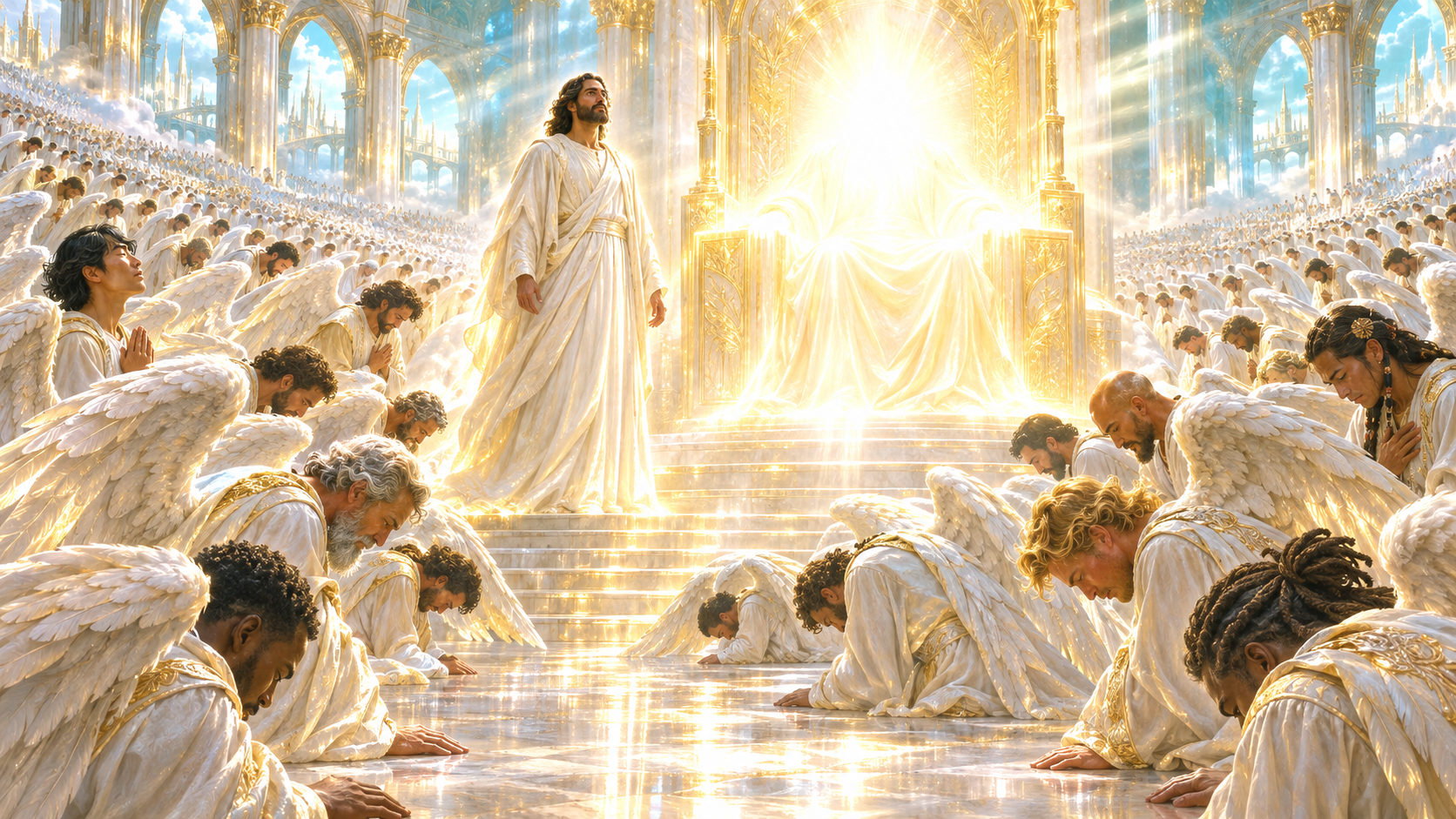
The Greek verb is proskyneō — the same word Jesus used when He said, “Thou shalt worship the Lord thy God, and him only shalt thou serve” (Matthew 4:10). And when John fell before an angel with that verb, the angel stopped him: “See thou do it not … worship God” (Revelation 22:9). Peter stopped Cornelius the same way (Acts 10:26). Yet God commands every angel to give it to His Son.
The 1984 NWT footnote on this verse read, “Or, ‘let . . . worship.’” The 2013 study note admits, “Many Bible translators use the term ‘worship’ here.” Early editions of the NWT are reported to have read “worship him” in the text itself.
Refs · Heb 1:6 · Matt 4:10 · Rev 22:8-9 · Acts 10:25-26
Worship & prayer · Objection 2
“Worship belongs to Jehovah alone. We do not worship Jesus.”
So we do not worship Jesus, as we do not believe that he is Almighty God.
Read Revelation 5 together. The elders fall before the Lamb (v. 8); every creature cries, “Blessing, and honour, and glory, and power, be unto him that sitteth upon the throne, and unto the Lamb for ever and ever” (v. 13) — the same praise, to both. Jesus said “all men should honour the Son, even as they honour the Father” (John 5:23). He accepted worship from the disciples, the women at the tomb, and the man born blind, and never once said “See thou do it not.” We worship the Father as the one true God, and the Son because the Father has commanded it — to the glory of God the Father (Philippians 2:11). Who Do We Truly Worship? →
Refs · Rev 5:8-14 · John 5:23 · Matt 14:33; 28:9 · John 9:38
Worship & prayer · Objection 3
“Christians pray only to Jehovah, never to Jesus.”
Stephen, full of the Holy Spirit, died praying: “Lord Jesus, receive my spirit” (Acts 7:59) — the NWT itself reads “he made this appeal: ‘Lord Jesus, receive my spirit.’” The first Christians were those who “call upon the name of Jesus Christ our Lord” (1 Corinthians 1:2). Paul asked the Lord three times about his thorn, and the answer came, “My grace is sufficient for thee … my strength is made perfect in weakness” — and he goes on, “that the power of Christ may rest upon me” (2 Corinthians 12:8-9). We ordinarily pray to the Father in Jesus’ name, as Jesus taught; but Scripture never forbids calling on the Son.
On John 14:14 (“If ye shall ask any thing in my name”), the NWT study note admits that “Other ancient manuscripts read: ‘ask me.’”
Refs · Acts 7:59 · John 14:14 · 2 Cor 12:8-9 · 1 Cor 1:2
Worship & prayer · Objection 4
“Thomas’s ‘My Lord and my God!’ was an exclamation of surprise.”
“And Thomas answered and said unto him, My Lord and my God” (John 20:28). He was speaking to Jesus. No devout Jew would blurt out “my God” as an oath — it would break the third commandment — and Jesus did not rebuke him; He blessed those who would believe the same (v. 29). The NWT’s own study note says it is “Lit., ‘The Lord of me and the God [ho the·osʹ] of me!’” Heresies sheet, U8 →
Refs · John 20:28-29 · Exod 20:7
Part III · The resurrection & the stake
The resurrection & the stake · Objection 1
“Jesus was raised as a spirit creature, not in His body of flesh.”
Jesus’ own words showed that he would not be resurrected with his flesh-and-blood body.
But His own words were these: “Behold my hands and my feet, that it is I myself: handle me, and see; for a spirit hath not flesh and bones, as ye see me have” (Luke 24:39). He told Thomas to put his finger into the nail prints (John 20:27). He had promised, “Destroy this temple, and in three days I will raise it up” … he spake of the temple of his body (John 2:19, 21) — not another body, but this one. And the angels said “this same Jesus” would come again (Acts 1:11).
Refs · Luke 24:39 · John 2:19-21 · John 20:27 · Acts 1:11
The resurrection & the stake · Objection 2
“If He had taken His body back, He would have canceled the ransom.”
That is jw.org’s own argument. But Scripture never says the resurrection takes the ransom back; it says the resurrection proves it was accepted: He “was delivered for our offences, and was raised again for our justification” (Romans 4:25), and “if Christ be not raised, your faith is vain” (1 Corinthians 15:17). He gave His life in death; death could not keep it. He took our flesh to redeem it (Hebrews 2:14), and He keeps it, glorified, as our Brother and High Priest.
Refs · Heb 2:14 · Rom 4:25 · 1 Cor 15:17 · Heb 13:8
The resurrection & the stake · Objection 3
“1 Corinthians 15:44 says He was ‘raised a spiritual body’, and 1 Peter 3:18 says ‘made alive in the spirit’.”
A “spiritual body” is still a body — raised incorruptible and glorious, but real. Paul is contrasting the body as it is now with the body as God will make it, not body with no body. And He “shall change our vile body, that it may be fashioned like unto his glorious body” (Philippians 3:21) — our bodies, changed, not discarded. 1 Peter 3:18 says He was “put to death in the flesh, but quickened by the Spirit”: raised by the power of God’s Spirit, not turned into one.
Refs · 1 Cor 15:42-44 · 1 Pet 3:18 · Phil 3:21
The resurrection & the stake · Objection 4
“Jesus didn’t die on a cross but on a torture stake.”
jw.org itself admits “no one can know its shape with absolute certainty.” Still, the Gospels give two clues. Thomas spoke of “the print of the nails” — plural — in His hands (John 20:25; the NWT also reads “nails”). And the accusation was “set up over his head” (Matthew 27:37), not over His hands, as on a single upright stake with hands above. But this is not the hill to stand on. The shape matters far less than Who died on it and why: “God forbid that I should glory, save in the cross of our Lord Jesus Christ” (Galatians 6:14).
Refs · John 20:25 · Matt 27:37 · Gal 6:14
Part IV · 1914 & the dates
1914 & the dates · Objection 1
“Christ’s Kingdom began ruling invisibly in heaven in 1914.”
God’s Kingdom started ruling in heaven in the year 1914.
Jesus warned in advance against an unseen coming: “if they shall say unto you, Behold, he is in the desert; go not forth: behold, he is in the secret chambers; believe it not. For as the lightning cometh out of the east, and shineth even unto the west; so shall also the coming of the Son of man be” (Matthew 24:26-27). His return is as visible as lightning: “every eye shall see him” (Revelation 1:7).
Refs · Matt 24:23-27, 30 · Rev 1:7 · Acts 1:11
1914 & the dates · Objection 2
“Parousia means ‘presence’, so His presence can be invisible.”
Parousia can mean presence or arrival — but in Matthew 24:27 Jesus Himself defines His parousia by lightning shining from east to west. The NWT itself translates that verse, “so the presence of the Son of man will be.” Paul describes it with a shout, a voice, a trumpet, the dead rising, and the living caught up (1 Thessalonians 4:16-17). Nothing about it is hidden.
Refs · Matt 24:3, 27 · 1 Thess 4:16-17 · 2 Thess 2:8
1914 & the dates · Objection 3
“Daniel 4’s ‘seven times’ are 2,520 years from 607 B.C.E. to 1914.”
Daniel 4 is fulfilled in the chapter itself: “The same hour was the thing fulfilled upon Nebuchadnezzar” (v. 33). Nothing in the text applies the seven times to a second, 2,520-year period. And the starting date is a problem. A Watchtower article on the question concedes, “Secular historians usually say that Jerusalem was destroyed in 587 B.C.E.” (Oct. 1, 2011, p. 31). The 1914 calculation rests on 607, a date almost no historian accepts. See side note 6 →
Refs · Dan 4:16, 25, 32-33 · Jer 52:12-13
1914 & the dates · Objection 4
“The light gets brighter. Adjustments are not false prophecy.”
Proverbs 4:18 describes the path of the just person, not permission to announce dates and revise them. Russell pointed to 1914 as “the farthest limit of the rule of imperfect men”; Rutherford said “we may confidently expect that 1925 will mark the return of Abraham, Isaac, Jacob”; and 1975 followed. Jesus foresaw exactly this: “many shall come in my name … and the time draweth near: go ye not therefore after them” (Luke 21:8). Scripture’s test is simple: “if the thing follow not, nor come to pass, that is the thing which the LORD hath not spoken” (Deuteronomy 18:22). 1874, 1914, 1925, 1975 →
Fairness: Adventists came out of a mistaken date too. The difference is that they confessed it, found the error in the event, and have set no date since 1844.
Refs · Prov 4:18 · Deut 18:21-22 · Luke 21:8
1914 & the dates · Objection 5
“‘This generation’ shows the end comes within the lifetime of those who saw 1914.”
The teaching has been redefined more than once. In 1995 The Watchtower wrote that “Jehovah’s people have at times speculated about the time when the ‘great tribulation’ would break out, even tying this to calculations of what is the lifetime of a generation since 1914” (Nov. 1, 1995). Jesus closed the subject two verses later: “But of that day and hour knoweth no man, no, not the angels of heaven, but my Father only” (Matthew 24:36).
Refs · Matt 24:34-36 · Acts 1:7
Part V · The two hopes
The two hopes · Objection 1
“Only 144,000 go to heaven. Everyone else hopes to live forever on earth.”
Only one group is promised everlasting life in heaven—the 144,000.
Look where John sees the great multitude: “before the throne, and before the Lamb” — “before the throne of God, and serve him day and night in his temple” (Revelation 7:9, 15). In 19:1 the same “great multitude” is “much people in heaven.” Jesus promised all His disciples, “I go to prepare a place for you … that where I am, there ye may be also” (John 14:2-3). The Bible’s hope is one hope: the redeemed with Christ in heaven during the thousand years, and then on the earth made new — all of them together (Revelation 5:10; 21:1-3).
Refs · Rev 7:9, 15 · Rev 19:1 · John 14:2-3 · 2 Pet 3:13
The two hopes · Objection 2
“The ‘other sheep’ of John 10:16 are the earthly class.”
Read the end of the verse: “and there shall be one fold, and one shepherd” (John 10:16). Jesus was speaking to Jews; the other sheep are the Gentiles He would bring in — and He brings them into one fold, not a second class. “There is neither Jew nor Greek … for ye are all one in Christ Jesus” (Galatians 3:28).
Refs · John 10:16 · Eph 2:14 · Gal 3:28
The two hopes · Objection 3
“Only the anointed should partake of the Memorial bread and wine.”
Jesus said, “Except ye eat the flesh of the Son of man, and drink his blood, ye have no life in you” (John 6:53), and of the cup, “Drink ye all of it” (Matthew 26:27). Paul told the whole church at Corinth, “as often as ye eat this bread, and drink this cup, ye do shew the Lord’s death till he come” (1 Corinthians 11:26). Nowhere is the Lord’s Supper reserved for a small class who only watch the others.
Refs · John 6:53 · 1 Cor 11:24-26 · Matt 26:27
The two hopes · Objection 4
“Jesus is mediator only for the anointed.”
So in this strict Biblical sense Jesus is the ‘mediator’ only for anointed Christians.
Paul wrote, “there is one God, and one mediator between God and men, the man Christ Jesus; Who gave himself a ransom for all” (1 Timothy 2:5-6) — between God and men, for all. “He is able also to save them to the uttermost that come unto God by him, seeing he ever liveth to make intercession for them” (Hebrews 7:25). Ask gently: if Jesus is not your Mediator, who is?
Refs · 1 Tim 2:5-6 · Heb 7:25 · John 14:6 · 1 John 2:1
Part VI · The organization
The organization · Objection 1
“Jesus appointed the ‘faithful and discreet slave’ to feed His people today.”
…that slave is made up of a small group of anointed brothers who are directly involved in preparing and dispensing spiritual food during Christ’s presence. … In recent decades, that slave has been closely identified with the Governing Body of Jehovah’s Witnesses.
Matthew 24:45 is a parable about every servant’s faithfulness while the Master is away — followed by the evil servant and the ten virgins, which no one reads as a committee. And the teaching itself was redefined in 2013. Jesus said, “one is your Master, even Christ; and all ye are brethren” (Matthew 23:8). The Bereans were praised for checking even an apostle against the Scriptures (Acts 17:11).
Refs · Matt 24:45-46 · Matt 23:8-10 · Acts 17:11
The organization · Objection 2
“We must obey the organization’s direction, even when it doesn’t seem sound.”
…the life-saving direction that we receive from Jehovah’s organization may not appear practical from a human standpoint. All of us must be ready to obey any instructions we may receive, whether these appear sound from a strategic or human standpoint or not.
Scripture never asks for that kind of trust in men. “To the law and to the testimony: if they speak not according to this word, it is because there is no light in them” (Isaiah 8:20). Paul said even an apostle or an angel must be tested by the gospel already given (Galatians 1:8). The Word judges every organization — ours too.
Refs · Acts 5:29 · Isa 8:20 · Gal 1:8
The organization · Objection 3
“We use God’s name, Jehovah — even in the New Testament.”
We share the love of God’s name. The KJV prints it in the Old Testament (Exodus 6:3; Psalm 83:18), and Adventists honor it. But no surviving Greek manuscript of the New Testament contains the divine name; the NWT inserts “Jehovah” there by its translators’ judgment. And the New Testament’s own emphasis is plain: God “hath highly exalted him, and given him a name which is above every name: That at the name of Jesus every knee should bow” (Philippians 2:9-10).
Refs · Exod 3:15 · Isa 42:8 · Phil 2:9-11 · Acts 4:12
The organization · Objection 4
“Isaiah 43:10 says ‘Ye are my witnesses’ — that is why we are called Jehovah’s Witnesses.”
Isaiah 43:10 was spoken to Israel. The risen Christ gave His church its commission in different words: “ye shall be witnesses unto me” (Acts 1:8). John was exiled “for the testimony of Jesus Christ” (Revelation 1:9), and the remnant “have the testimony of Jesus Christ” (12:17). A Christian witnesses to God by witnessing to His Son.
Refs · Isa 43:10 · Acts 1:8 · Rev 1:9; 12:17
Part VII · Spirit, blood & Sabbath
Spirit, blood & Sabbath · Objection 1
“The holy spirit is God’s active force, like electricity — not a person.”
The holy spirit is God’s power in action, his active force.
We agree the Spirit is not a third person beside the Father and the Son. But Scripture says more than “force.” The Spirit is God’s own presence and life: “what man knoweth the things of a man, save the spirit of man which is in him? even so the things of God knoweth no man, but the Spirit of God” (1 Corinthians 2:11). The Spirit of God is also “the Spirit of Christ” (Romans 8:9) — and through it, “my Father … and we will come unto him, and make our abode with him” (John 14:23). It can be grieved (Ephesians 4:30) because it is the Father and the Son Themselves present with us — not an impersonal power.
Refs · Rom 8:9 · John 14:23 · 1 Cor 2:11 · Eph 4:30
Spirit, blood & Sabbath · Objection 2
“The Bible forbids blood transfusions.”
The texts forbid eating blood: “whatsoever man … that eateth any manner of blood” (Leviticus 17:10), alongside meats offered to idols and things strangled (Acts 15:29). A transfusion is not a meal; it is a gift of life from one person to another. Note the current policy accurately: since September 2026 the Witnesses still refuse whole blood, but now leave red cells, white cells, plasma, platelets, and fractions to personal conscience. See side note 7 →
Refs · Acts 15:29 · Lev 17:10-11 · Gen 9:4
Spirit, blood & Sabbath · Objection 3
“Christians are not required to observe a weekly sabbath.”
That is jw.org’s wording, and it says the Sabbath was taken away with the Law covenant. But the Sabbath began at creation, before there was an Israelite (Genesis 2:2-3), and the commandment points back there (Exodus 20:11). Jesus said “The sabbath was made for man” — not for Jews only — and called Himself its Lord (Mark 2:27-28). It will be kept in the new earth (Isaiah 66:23), the very earth Witnesses hope to inherit. Ask: if the Sabbath is kept in Paradise, why not now? Sabbath Cheat Sheet →
Refs · Gen 2:2-3 · Exod 20:8-11 · Mark 2:27-28 · Isa 66:22-23 · Rev 14:12
Part VIII · Side notes
Side note · 1
The NWT’s own study notes concede more than most Witnesses know.
On Colossians 1:16, that the literal Greek is “all things.” On Hebrews 1:8, that the Greek allows “Your throne, O God.” On Hebrews 1:6, that many translators use “worship.” On John 14:14, that other ancient manuscripts read “ask me.” On Luke 23:43, that the grammar allows the comma on either side of “today.” Most Witnesses read the text, not the notes. Show them the notes.
Refs · NWT 2013 Study Edition notes · Col 1:16 · Heb 1:6, 8 · John 14:14 · Luke 23:43
Side note · 2
Where we stand with them — and they will be surprised.
Witnesses teach, “The soul, then, is the entire creature, not something inside that survives the death of the body” (jw.org, “What Is a Soul?”), and that the dead “do not suffer in a fiery hell of torment.” Adventists have taught the same since the 1840s. State of the Dead Cheat Sheet →
Refs · Ezek 18:4 · Mal 4:1 · Luke 23:43 · Dan 12:1
Side note · 3
The Witnesses did not come from the Adventists.
Charles Taze Russell, born in 1852, learned from the Second Advent date-setters and Nelson Barbour, not from Sabbath-keeping Adventists. The link to 1844 is real but distant, and it runs through the road Adventists refused. Read the history →
Refs · Are Seventh-day Adventists Millerites?
Side note · 4
Quote them accurately — two common misquotes.
Russell did not teach that Jesus’ body “dissolved into gases.” He wrote, “Whether it was dissolved into gases or whether it is still preserved somewhere … no one knows.” And the 2013 Watchtower line is often merged into one sentence; it says direction “may not appear practical,” then speaks of instructions that may not “appear sound.” A misquote ends the conversation. Quote them exactly.
Refs · Russell, The Time Is at Hand (1889), pp. 129-130 · The Watchtower, Nov. 15, 2013
Side note · 5
On worship, the present Witness position was settled in 1954.
…no distinct worship is to be rendered to Jesus Christ now glorified in heaven. Our worship is to go to Jehovah God.
Refs · The Watchtower, Jan. 1, 1954, pp. 30-31
Side note · 6
607 or 587? Why the date matters.
The 1914 date depends on Jerusalem falling in 607 B.C.E. Witness publications say they hold it “because of evidence within the Bible itself”, reading Jeremiah’s seventy years as seventy years of desolation. Historians date the destruction to 587 or 586 B.C. Adventists have no stake in 1914; the point is only that the calculation is not as solid as it is presented.
Refs · The Watchtower, Oct. 1, 2011 · Jer 52:12-13 · 2 Kgs 25:8-9
Side note · 7
The 2026 change on blood.
The Governing Body of Jehovah’s Witnesses announced on Friday that the decision to accept red cells, white cells, plasma or platelets from another person’s blood is a matter of personal conscience.
Whole-blood transfusion is still refused. Many older guides are now out of date — be accurate, and be gentle: some Witness families have lost loved ones over this.
Refs · jw.org news release, Sept. 18, 2026 · “How Do Jehovah’s Witnesses Show Respect for Life?”
Side note · 8
Agree on Luke 23:43 — the thief did not go to heaven that day.
The NWT reads, “Truly I tell you today, you will be with me in Paradise.” We agree on the sense: Jesus Himself had not ascended to the Father three days later (John 20:17), and the dead know not any thing (Ecclesiastes 9:5). Common ground is worth naming out loud.
Refs · Luke 23:43 · John 20:17 · Eccl 9:5
Talking with a Witness
The answers above are tools, not a script. Most conversations with a Witness are won or lost on the spirit in which they are held. “Be ready always to give an answer to every man that asketh you a reason of the hope that is in you with meekness and fear” (1 Peter 3:15).
1 · Be the friend, not the opponent
Witnesses are used to doors closing on them. Invite them in, offer water, and remember their names. “The servant of the Lord must not strive; but be gentle unto all men, apt to teach, patient” (2 Timothy 2:24).
2 · Begin with what you share
Say it plainly: you also reject the immortal soul, eternal torment, and the trinity. It disarms the script, and it is true. Then they will listen to where you differ.
3 · Stay on one question
Do not chase 1914, blood, and birthdays in one visit. Keep coming back to the question that matters most: who is Jesus? Everything else follows from it.
4 · Use their Bible
Ask them to open the New World Translation. Hebrews 1:6, John 20:28, and Luke 24:39 work in their own version, and its study notes concede more than most Witnesses know.
5 · Ask, don’t lecture
A good question stays with them after they leave; a lecture leaves with them. “What do you think Thomas meant?” does more than a page of Greek grammar.
6 · Remember what it costs them
A Witness who leaves may lose the friendship of almost everyone they know. Be patient, be a real friend, and let the Bible do the persuading, not pressure.
A sample conversation
Here is one way a first visit might go — not a formula, just an example of the tone. Two Witnesses are at the door; one does the talking. The Bible quotations from the Witness’s side are from the New World Translation (2013).
Witness
Good morning! We’re sharing a short message about God’s Kingdom. Many people today wonder whether God really cares about the suffering in the world. Have you ever wondered that?
Adventist
I have, and I believe He does. Come in out of the sun — would you like some water? I’m a Seventh-day Adventist, and I think you’ll find we agree on more than you expect.
Welcome them. Name the common ground early.
Witness
Thank you. What do you mean, agree?
Adventist
Well — I don’t believe in an immortal soul. I believe the dead sleep until the resurrection. I don’t believe God tortures people forever. And I don’t believe in the trinity. The Father is the one true God.
Witness
That’s… not what we usually hear at the door. So where do we differ?
Adventist
Mostly on one question — the one Jesus asked: “Who do you say I am?” Can I show you something in your own Bible? Would you read Hebrews 1:6 for me?
Stay on one question. Ask them to read.
Witness
“But when he again brings his Firstborn into the inhabited earth, he says: ‘And let all of God’s angels do obeisance to him.’”
Adventist
Thank you. Do you know what Greek word “do obeisance” translates there? It’s proskyneō — the same word Jesus used in Matthew 4:10, “Thou shalt worship the Lord thy God.” And when John bowed to an angel with that same word in Revelation 22, the angel stopped him at once. Yet here God commands every angel to give it to His Son. Why would God tell the angels to do for Jesus what an angel refused to accept for himself?
Witness
Obeisance can just mean respect — bowing to a king. We honor Jesus very much. We just worship Jehovah.
Adventist
I appreciate that. Your Study Edition actually has a note on that verse. It says many translators use the word “worship” there. Could we look at one more? Revelation 5, verse 13.
Witness
“To the One sitting on the throne and to the Lamb be the blessing and the honor and the glory and the might forever and ever.”
Adventist
Every creature in heaven gives the same blessing and honor and glory to the Father and to the Lamb. I don’t think heaven would do that for a creature. That’s why I believe Jesus is not created but begotten — the Son, born of the Father before all things, sharing His nature. Not a second God, and not a third of one. The Son.
Explain the begotten Son in one breath. Don’t argue the trinity — you both reject it.
Witness
But Colossians says he is “the firstborn of all creation.” That means he was created first.
Adventist
I’m glad you brought up Colossians. Would you read verse 16, and then the study note on the word “other”?
Witness
“…because by means of him all other things were created…” And the note says, “A literal rendering of the Greek text would be ‘all things.’ However, such a rendering could give the impression that Jesus was not created but was the Creator himself.”
Adventist
What do you make of that? If Paul’s own words give the impression that Jesus is the Creator, maybe that’s the impression Paul meant to give. “Firstborn” is a word about birth, not manufacture. He came out from the Father — and then everything else was made by Him.
Let the silence work. Don’t rush to win the point.
Witness
I’d have to look into that more. The organization has explained these verses carefully.
Adventist
I understand, and I don’t want you to take my word for it either. The Bereans checked even Paul against the Scriptures (Acts 17:11). Would you be willing to come back next week, and we’ll read through John chapter 1 together — just the text, in your Bible and mine?
Witness
We can do that. Same time next week?
Adventist
I’ll have the water ready. And thank you — honestly — for caring enough about God to knock on my door.
Leave the door open. A second visit is worth more than a clever reply.
A pastoral note
Behind every Witness at the door is a person who has given up comfort, weekends, and often friendships for what they believe is the truth. That deserves respect, not ridicule. Our goal is not to win an argument but to introduce them to the Son they have been taught to honor from a distance — the Son the Father commands all heaven to worship, who died for them, rose in the same body, and is coming again where every eye shall see Him.
And this is the record, that God hath given to us eternal life, and this life is in his Son. He that hath the Son hath life; and he that hath not the Son of God hath not life.