
A common objection holds that the offices of king and priest were never united in one person — that Scripture keeps the throne and the altar permanently apart, so that no single figure could ever be both. It is often raised to argue that the Messiah could not be what the New Testament says He is: a King who is also a great High Priest. The objection contains a real and important truth. But as a universal claim it does not survive the Hebrew Scriptures themselves — which unite the two offices before the Law, foretell their union in the Messiah, and are confirmed by a chapter of Jewish history in which the two were openly held together.
The objection, fairly stated
Let us put the argument at its strongest, because it deserves a real answer and not a straw man. Under the covenant God gave at Sinai, the priesthood belonged to the tribe of Levi — specifically the house of Aaron — and the kingship, when it came, belonged to the tribe of Judah, the house of David. The two were assigned to different tribes and different families, and the line between them was guarded. A Davidic king was not an Aaronic priest. So far, the objection is simply correct.
The mistake is in the leap from “the Law of Moses kept them apart” to “they could never be joined in one person.” That second statement is not what the Hebrew Scriptures teach. It reads a temporary feature of one covenant as if it were an eternal law of God — and the Bible itself, on both sides of the Mosaic period, says otherwise.
The grain of truth: Sinai separated them
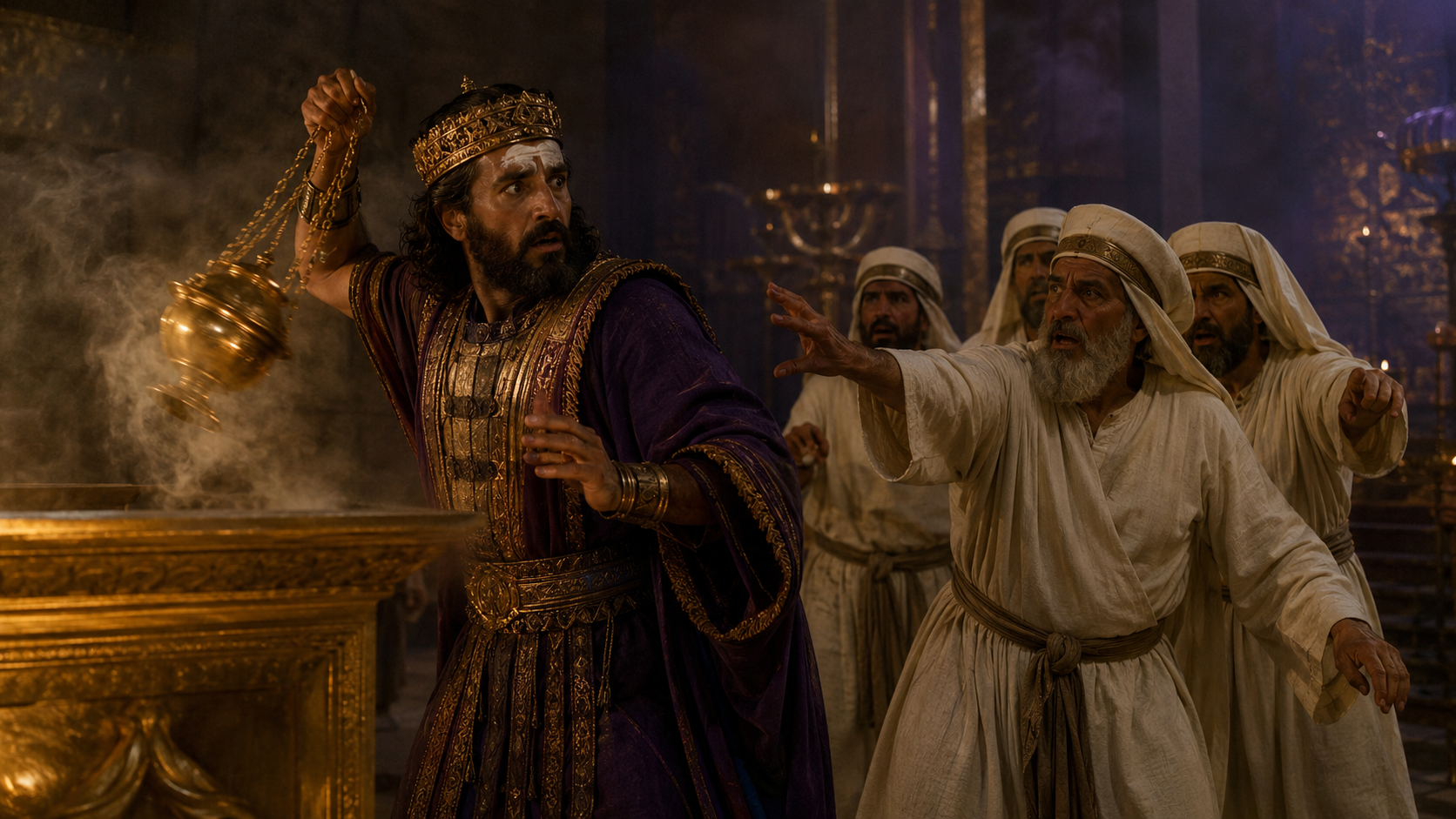
The separation was real, and it was enforced. The clearest case is King Uzziah of Judah, a good king who overstepped. When he entered the temple to burn incense — a strictly priestly act — the priests confronted him, and judgment fell at once:
It appertaineth not unto thee, Uzziah, to burn incense unto the LORD, but to the priests the sons of Aaron, that are consecrated to burn incense… And while he was wroth with the priests, the leprosy even rose up in his forehead.
The same boundary undid King Saul, who offered a burnt offering when the prophet Samuel delayed, and heard the verdict: “Thou hast done foolishly: thou hast not kept the commandment of the LORD thy God… now would the LORD have established thy kingdom upon Israel for ever. But now thy kingdom shall not continue” (1 Samuel 13:13-14). Under the Sinai covenant the answer is genuinely no: the throne could not reach into the priest’s office. Any honest treatment must grant this. The question is what it means — and whether it was meant to be the last word.
Why the separation was deliberate
Here is the turn the objection misses. The Mosaic separation was not an accident of history and not a statement that the two offices are incompatible. It was a deliberate arrangement with a purpose: to keep the offices distinct, in trust, until the One came who could rightly hold both. A king who could seize the altar whenever he pleased would have corrupted the priesthood; a priesthood that could seize the throne would have corrupted the kingship. So God held them apart — under guard, as it were — through the whole length of the Law. As we will see, the Hebrew prophets who lived under that separation are the very ones who announced that it would one day be resolved in a single person. The fence was temporary, and the prophets knew it.
Before the Law, the priest-king was the norm
The separation of priest from king began at Sinai. It did not exist before it. For the whole patriarchal age, the head of a household or clan was ordinarily both its ruler and its priest — he governed his people and he offered their sacrifices, with no separate priestly caste standing between him and God. Scripture simply assumes this as the settled order of things:
And Noah builded an altar unto the LORD; and took of every clean beast, and of every clean fowl, and offered burnt offerings on the altar.
Noah is the head of the entire post-flood world, and he acts as its priest without apology or appointment. The pattern is clearest of all in Job, a man explicitly described as a great ruler — “the greatest of all the men of the east” (Job 1:3) — who also served as the standing priest of his own family:
And… Job sent and sanctified them, and rose up early in the morning, and offered burnt offerings according to the number of them all… Thus did Job continually.
He ruled, and he priested, at the same time, as a matter of course. The union of the offices is therefore the older and more natural arrangement; the Mosaic separation is the later and temporary one. And even after Sinai, the calling God spoke over the whole nation was not “a kingdom or a priesthood” but both at once: “ye shall be unto me a kingdom of priests, and an holy nation” (Exodus 19:6). The vocation of king and priest in one body was always Israel’s own destiny.
The prophets foretold a priest-king
This is the decisive point, because it is drawn entirely from the Hebrew Scriptures and concerns the Messiah by name. The prophets did not merely leave room for a priest-king; they promised one. Zechariah, ministering after the exile, is told to crown the high priest as a living sign of a coming figure called “the BRANCH” — and the sign says, in plain words, that this One will rule and minister in a single person:
Behold the man whose name is The BRANCH… he shall build the temple of the LORD; and he shall bear the glory, and shall sit and rule upon his throne; and he shall be a priest upon his throne: and the counsel of peace shall be between them both.
Read it slowly. A priest upon his throne. The throne and the altar are joined in one figure — and the closing phrase, “the counsel of peace shall be between them both,” describes the two offices, kingship and priesthood, resting at peace together in Him rather than warring for precedence. David had already sung the same thing of his own Lord a thousand years before, addressing One who is at once seated as King (verse 1) and sworn in as Priest (verse 4):
The LORD said unto my Lord, Sit thou at my right hand, until I make thine enemies thy footstool… The LORD hath sworn, and will not repent, Thou art a priest for ever after the order of Melchizedek.
One figure: enthroned as King and sworn as Priest, in the same short psalm. The union of the two offices in the Messiah is therefore not a Christian idea pressed onto the Hebrew Bible from outside. It is the Hebrew Bible’s own announced expectation — and notice that the priesthood it names is not Aaron’s, but a named older order. We will return to that.
And in Jewish history it happened
Beyond prophecy, the combination is a matter of plain record. In the second and first centuries before Christ, the Hasmonean dynasty — the family of the Maccabees and their heirs — held the high priesthood and the civil rule of the nation together. Simon Maccabeus was formally confirmed as both leader and high priest at once: the people resolved “that Simon should be their governor and high priest for ever, until there should arise a faithful prophet” (1 Maccabees 14:41). His successors went further and took the royal title as well. Alexander Jannaeus, who reigned from 103 to 76 BC, minted coins inscribed on one side “Jonathan the High Priest” and on the other “King Alexander” — one man, two offices, struck onto a single coin.
Whatever one makes of the Hasmoneans — and the union of offices in a line not descended from David was controversial in their own day — the bare historical claim that no Jew was ever both high priest and king at the same time is simply not true. It demonstrably happened, in Jerusalem, within living memory of the New Testament period. The objection has the facts against it as well as the prophecies.
The original pattern had a name
All of this has a single fountainhead, and Psalm 110 already named him. Long before Levi or Aaron existed — before there was a tribe of priests to separate from a tribe of kings — Abraham was met by a man who was, in one person and without any sense of contradiction, both king and priest:
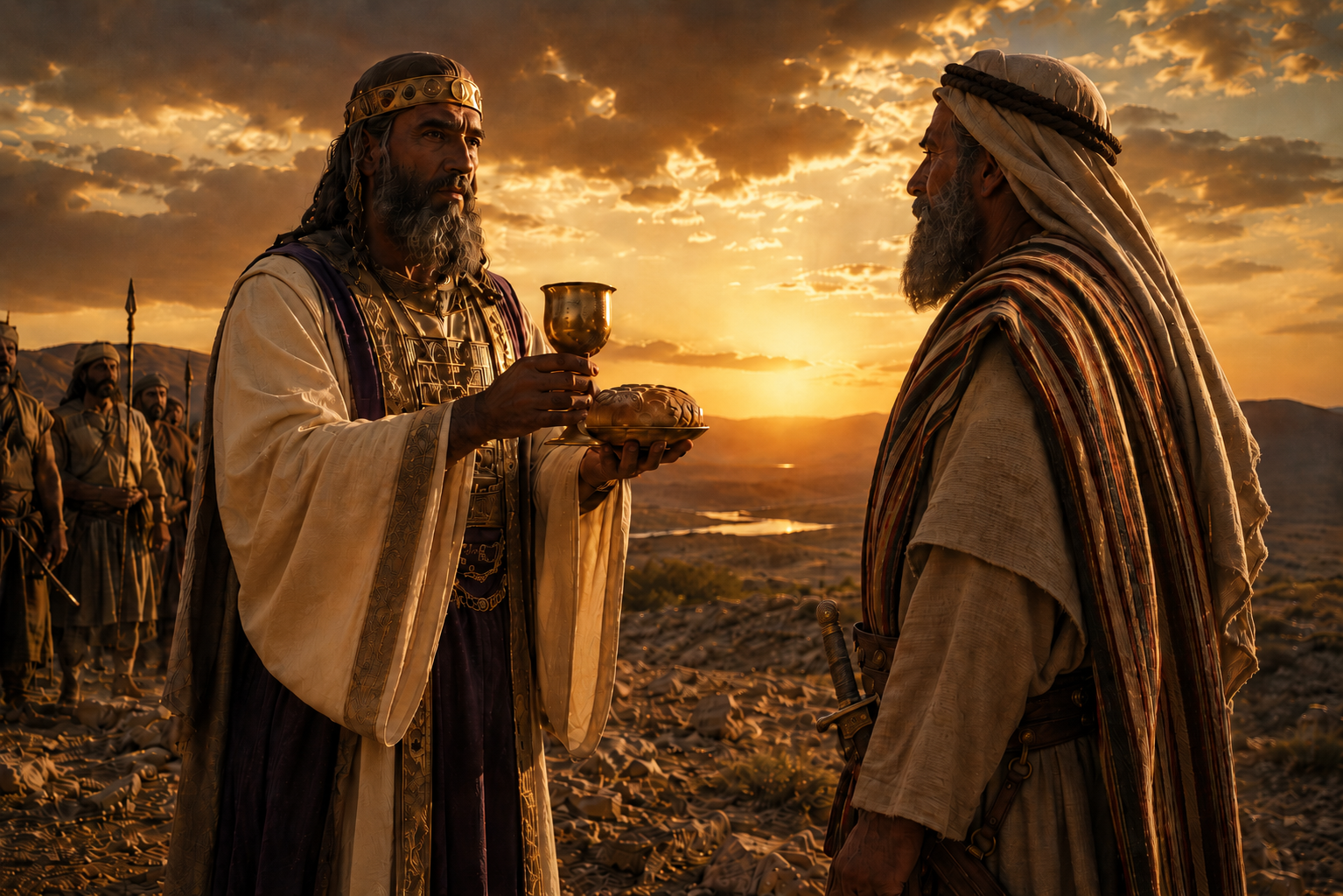
And Melchizedek king of Salem brought forth bread and wine: and he was the priest of the most high God.
King and priest, in a single sentence. His very name and title carry both offices: the New Testament unfolds them as “first being by interpretation King of righteousness, and after that also King of Salem, which is, King of peace” (Hebrews 7:2), while Genesis calls him the priest of the Most High God. He is not an embarrassing exception that Scripture stumbles into and quietly drops. He is the model Scripture deliberately chose — and to which the great Messianic psalm points when it swears the coming King into a priesthood “after the order of Melchizedek.”
The two offices meet in the Messiah
Now the whole picture resolves. The Messiah comes from the royal tribe of Judah, so by birth He is heir to the throne of David. But a son of Judah can never be an Aaronic priest — the Law gave that office to Levi alone. So how can the prophets call Him a priest at all? Precisely because the priesthood promised to Him is not Aaron’s but the older order of Melchizedek — a priesthood that was always free to belong to a king:
For he of whom these things are spoken pertaineth to another tribe, of which no man gave attendance at the altar. For it is evident that our Lord sprang out of Juda; of which tribe Moses spake nothing concerning priesthood.
This is the hinge of the entire argument, and it is built straight out of the Hebrew Scriptures. Because the Messiah’s priesthood is Melchizedek’s and not Aaron’s, the Mosaic rule that kept Judah’s kings out of Levi’s office simply does not bind Him. He can be what Uzziah could not be — King and Priest together — not by breaking the Law, but by belonging to an order older and higher than the Law’s own priesthood. The Sinai separation guarded the offices until exactly this Person arrived to unite them:
For he testifieth, Thou art a priest for ever after the order of Melchizedek.
So the One whom the prophets foretold sits where Zechariah said He would — a priest upon His throne. He bears the crown of David and the censer of intercession in the same hands. The two offices that the Law held carefully apart are, at last and in Him, at peace between them both.
Why it matters
The question is not a piece of trivia about ancient offices. It goes to whether the Messiah can be everything His people need Him to be. A King alone could rule us, but could not stand between us and God. A priest alone could intercede for us, but could not reign and set the world right. The hope of Scripture is for One who does both — who governs as the rightful King and pleads as the merciful Priest — and that hope is written into the Hebrew Bible from Melchizedek at the dawn of the story to Zechariah after the exile.
So when the objection says the offices were always kept apart, the gentle and complete answer is: under the Law, yes — and on purpose. But before the Law, after the prophets, in the page of history, and at the very center of Messianic hope, the King who is also the Priest is the Hebrew Scriptures’ own promise — not a claim imposed upon them, but the One they were waiting for all along.