In brief
This article presents the editorial position of the institute’s founder on the cosmological question of the earth’s shape. It is paired with a gospel-centred companion piece on what Ellen White actually wrote — and what she pointedly did not — on the same subject. The case is set forth in two registers: an extensive survey of the observational arguments that the founder finds compelling, and a catalogue of more than two hundred Bible verses grouped by theme — the firmament, the ends of the earth, the four corners, the stationary earth, the moving sun, the immovable foundations. The article does not make the earth’s shape a test of salvation or a pillar of present truth. It asks the reader to weigh the evidence prayerfully against his own study of Scripture, and to follow the Bible wherever its plain testimony leads.
Note on the images
Some of the photographs and illustrations on this page have been AI-generated. They were produced to closely resemble actual photographs the author chose not to use directly — to avoid copyright issues with the original creators. These are not dishonest depictions but nearly identical visual stand-ins for the real-world evidence the arguments rest on. Per-image attribution is provided in the credits section at the foot of this page.
Before you read this — a reset on what flat-earth actually means
Most readers come to a page like this carrying a mental image of what “flat earth” means, an image built up over a lifetime of schoolbook illustrations, news pieces, and casual references. The image is almost always the same: a flat disc floating freely in space, with waterfalls cascading off the edges and ships toppling over them into a void. If that is the picture you have in mind, you have been handed a caricature, not the position. The position this article presents is not that, and it has never been that.
The actual claim made by virtually every flat-earth thinker — and, more importantly, by virtually every ancient civilisation that ever recorded a cosmology — is something quite different. It is the claim of an outstretched, level earth that is fundamentally enclosed and stationary. The earth is not a free-floating object surrounded by vacuum. It is bounded above by what Genesis 1 calls the firmament — a structural enclosure dividing the waters above from the waters below — and supported beneath by what the Psalms and Job explicitly describe as pillars and foundations.
Different schools hold different specific views. Some hold that the earth is an infinite plane extending well beyond what has been mapped. Some interpret the picture as a simulation. But the great majority — and the position taken in this article — is the biblical view: an outstretched, level earth, set firm upon foundations, beneath an enclosing firmament, with the sun, moon, and stars contained within that enclosure as Scripture describes.
In that picture there is no edge to fall off. There are no cascading waterfalls running into a void. There are no ships sailing over an unseen lip into nothingness. The cartoon flat earth of the schoolbook is a model nobody actually defends, and a model the Bible itself never describes. It is the strawman that has been handed to readers, generation after generation, in place of the position. Set it aside. What follows is the case for the cosmology Scripture actually teaches.
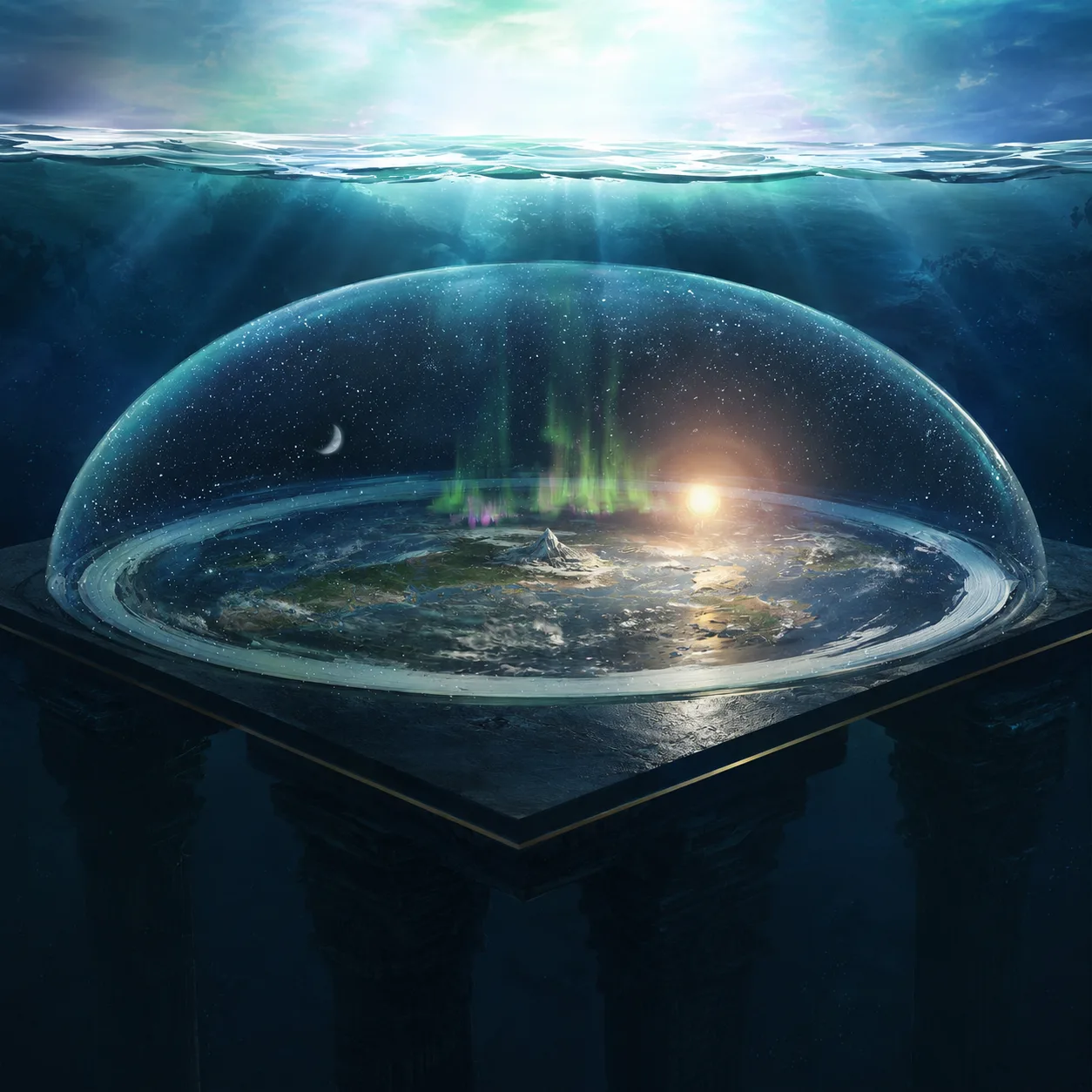
The enclosed model in cross-section
A modern artist’s rendering of the cosmology Scripture actually describes: an outstretched disc-earth, a domed firmament dividing the waters above from the waters below, the sun and stars contained within the enclosure, and the foundations of the earth set beneath. Illustrative — not a literal map — but truer to the Bible’s own language than the model commonly taught today.
A note on terminology. Throughout this article the words plain and plane are both used, and both spellings are intentional. Plain (p-l-a-i-n) is the geographical term — a flat region of land, as in the KJV phrase “Christ stood upon the plain” (Luke 6:17). Plane (p-l-a-n-e) is the geometric term — a flat surface. The two words are related by more than spelling: a geographical plain presupposes a geometric plane, and neither can exist on the outside of a ball.
What follows is structured for honest engagement: a framing observation about the foundation of the modern model, a brief survey of the observational arguments the author finds compelling, and a catalogue of more than two hundred Bible verses grouped by theme. Where this article’s position differs from the doctrinal pillars elsewhere on this site, that difference is intentional. The pillars carry the institute’s historic-Adventist editorial discipline; this article carries the founder’s own conviction, set apart so the two are not confused.
Do I support the Flat Earth Society?
A second caricature deserves naming plainly, before the structured argument begins. The Flat Earth Society — an organisation founded by Samuel Shenton in 1956 and continued today in various online forms — has, over the last several decades, become the public face of “flat earth” in most newspapers, search results, television segments, and dismissive popular references. The Society maintains a website, issues membership cards, runs a forum, and publishes a set of doctrinal positions which the press routinely treats as representative of all flat-earth thinking. It is not representative of this article’s position. The author of this article does not support the F.E.S., and the great majority of serious biblical-flat-earth observers explicitly reject the Society and its positions.
The biblical position differs from the Flat Earth Society on every load-bearing point:
- The Society’s structural model is a bounded disc with Antarctica framed as an ice wall around the perimeter, depicted in the Society’s own published framing as a free-floating object in otherwise empty space — the Society, in other words, accepts the conventional outer-space cosmology and merely substitutes a disc for the globe. A separate infinite-plane variant circulates among related but distinct communities; those communities typically reject the conventional outer-space framing altogether and often affirm a firmament with the luminaries set within it — on that specific point much closer to the biblical position than the Society itself. Scripture teaches a bounded enclosure under a firmament (Gen 1:6–8) with foundations beneath (Ps 104:5; Job 38:4–6) and ends or borders (Job 28:24; Ps 65:5). The earth is not free-floating in a void; it is enclosed and set on foundations.
- The Society explains the sensation of gravity by what it calls Universal Acceleration— the proposal that the disc itself is constantly accelerating upward at 9.8 m/s² through space, so that what we feel as gravity is actually the floor of the earth pushing up against our feet. Scripture nowhere proposes this. The biblical earth has foundations and pillars (1 Sam 2:8; Ps 104:5); it does not float, and it does not accelerate.
- The Society treats the position as a matter of philosophical contrarianism — what its founders called Zeteticism. The biblical position rests on the plain testimony of Moses, the prophets, the apostles, and Christ Himself.
- The Society predates the modern biblical-flat-earth revival by only some sixty years (1956 to the present). The biblical position predates the Society by approximately five thousand.
- Several of the Society’s distinctive secondary claims — the sun and moon at fixed altitudes of a few dozen miles, the spotlight model of day and night, the dismissal of any organised celestial mechanics — are absent from Scripture and are not held by serious biblical-flat-earth observers.
A further observation about the Society’s institutional character is worth making plainly. The Society performs — whether by deliberate design or by accident of its founding posture — the function of what is sometimes called controlled opposition. It keeps the public conversation about the shape of the earth in a frame so eccentric, so easily caricatured, and so distant from the Scripture-based case, that serious inquiry into biblical cosmology can be dismissed by association. Whoever funds the Society, and whatever its members sincerely believe, the effect on the wider conversation has been to attach to the biblical position a public face much easier to laugh at than to refute. A reader looking up “flat earth” in a search engine today is almost certain to land on the Society’s framing before encountering any of the case that follows here.
The reader is therefore asked to evaluate this article on its own terms — on the biblical text it cites, the observational evidence it surveys, the cross-cultural cosmology it references, and the institutional and historical record it documents — and not on the basis of what an unrelated organisation that happens to share two words of its name has chosen to teach.
A note on the foundations of the modern model
A framing observation
Almost every common rebuttal to the material gathered here depends, in the end, on a single foundational assumption: that the claims handed down by mainstream scientific institutions, government agencies, universities, and media are essentially one hundred per cent factual. This is itself a substantial assumption. It is not a conclusion derived from personal observation, controlled experiment, or independent verification by the reader. It is a posture of trust placed in institutions whose claims few of us are ever in a practical position to independently check.
Once that foundation is set aside — even provisionally, even just to weigh the evidence on its own merits — many of the standard rebuttals to the verses and observations set forth here lose much of the strength their advocates think they carry. They were not, in the main, independent verifications. They were appeals to the authority of the very institutions whose authority is the question.
This article does not ask the reader to suspend reason. It asks the reader to bring reason all the way back to its starting point — to the things he/she can personally observe and to the Scripture he/she can personally read — and to weigh from there.
One admission against interest from the institutional side itself is worth recording before the case opens. Bill Nye — widely regarded as the face of popular science television for the past generation and one of the loudest public defenders of the modern globe-and-vacuum cosmology — said this on camera in a Big Think segment, answering a student’s question on the possibility of disposing of pollution by launching it into space:
“Now, one thing I really want your generation to embrace is that the Earth is a closed system. We cannot leave the Earth. There’s no place to go. There’s no place to throw your trash.”The framing in which Nye said this was environmental (the impracticality of launching waste into space); the words themselves are about something larger. The modern world’s premier popular-science educator, when describing the earth plainly to the next generation, called it a closed system from which no one leaves and beyond which there is no destination. That is, in every essential respect, the description the biblical cosmology has always given: a contained earth under an enclosing firmament, from which no creature has ever left, has ever travelled to “other planets,” or has ever escaped the boundary God set at creation. The reader is invited to weigh the admission.
The reading principle
Before the verses and observations are set forth, a brief word on how this article reads them. The Bible signals figurative or symbolic language openly when it employs it — Revelation, Ezekiel, and Daniel announce their visions as visions, and their apocalyptic figures as figures. Outside that signalled framework, the default position of this article is that the Bible means what it plainly says. Where a narrative reports an event (the sun standing still over Gibeon), the report is taken as reported. Where the structure of the cosmos is described (a firmament dividing the waters, foundations of the earth that cannot be moved, four corners), the description is taken as descriptive of something real — not as a poetic device applied to a structure modern cosmology has independently fixed.
That hermeneutic is the load-bearing choice of this article. The reader who shares it will read what follows the way the author does. The reader who does not share it is asked to consider whether the figurative-everywhere reading can be applied consistently — or whether it tends to surface only where the plain reading would conflict with the cosmological assumptions of the modern age.
Part I — The case from observation
Before the biblical catalogue, a brief survey of the observational arguments the author finds compelling. The aim of this section is not to deliver a comprehensive scientific treatise on cosmology but to register, plainly, the kinds of everyday observations that drew the author to the position this article sets out — and to which mainstream rebuttals depend, almost invariably, on the foundational assumption addressed in the section above.
Sensory experience and the horizon
The horizon, at every altitude the ordinary observer can reach, appears flat. It does not curve away in the manner the globe model predicts. It rises to eye level even at the high altitudes accessible to balloons, drones, and commercial flight. The visible curvature in some high-altitude footage is consistent with the distortion produced by wide-angle lenses rather than the curvature of a sphere — a fact easily confirmed by comparing the same scene shot with different lens configurations.
The everyday sensory experience of the human observer — a flat horizon, the felt stillness of the ground under one’s feet, the apparent motion of the sun and stars overhead — is the experience of a stationary, level earth. Whether one accepts that testimony as decisive depends on whether one treats sensory observation or institutional claim as the higher court.
The physics of water
Water, left to itself, finds its level — and the level it finds is straight, not curved. Engineers and surveyors do not in practice introduce corrections for the curvature of the earth’s surface when building canals, railways, or long bridges. Rivers flow consistently to sea level over hundreds of miles without the climbing and descending that a rotating sphere would require. The Bedford Level experiment in the nineteenth century, and many similar experiments since, set out to measure the predicted curvature over a long stretch of still water and found no curvature.
Distant landmarks visible past predicted curvature
Numerous well-documented sightings show distant cities, islands, and landmarks visible at distances that the globe model says should hide them entirely behind the curvature of the earth. The Chicago skyline visible across Lake Michigan, the visibility of distant islands from elevated coastal points, long-range photography that captures landmasses hundreds of miles distant — these recur often enough to constitute a pattern, not a fluke.
Atmospheric and rotational anomalies
The atmosphere does not exhibit the consistent rotational behaviour the spinning-globe model predicts. Clouds move independently in different directions and at different speeds. High-altitude winds shift unpredictably. The Coriolis effect, when actually tested in controlled small-scale experiments rather than computed, produces inconsistent results. A projectile fired straight up does not land hundreds of metres away in the direction opposite to the supposed rotation of the earth — it lands where it was fired from. None of these observations match what a spinning sphere of 25,000 miles circumference, rotating at over a thousand miles per hour at the equator, should produce.
Astronomical observations
Polaris remains fixed in the same position relative to the observer throughout the year, despite the earth’s supposed travel of hundreds of millions of miles around the sun. Stars cluster in patterns consistent with a localised celestial structure overhead rather than vast distances of empty space. The motion of the sun and moon across the sky is consistent with the bodies themselves moving — which is the plain reading of the biblical text.
What this section is not
This survey is not a scientific monograph. It is a register of the kinds of observations that, taken seriously and weighed against the foundational assumption addressed earlier, brought the author to the position the rest of this article sets out from Scripture. The reader who finds these observations unpersuasive is free to dismiss them. The reader who finds them suggestive is invited to bring them with him into the verses that follow.
Part II — The biblical catalogue
More than two hundred verses bear on the question. They are grouped below by theme. For each grouping, the load-bearing verses are quoted in full from the King James Bible; additional references in the same category are listed underneath so the reader can verify the pattern for himself without the article becoming an unmanageable wall of text.
The earth was created before the sun
Genesis records the earth as the first object of God’s creative work, with the sun, moon, and stars formed and placed on the fourth day. The order is the reverse of every heliocentric origin model.
Genesis 1:1-2
In the beginning God created the heaven and the earth. And the earth was without form, and void; and darkness was upon the face of the deep. And the Spirit of God moved upon the face of the waters.
Genesis 1:14-19
And God said, Let there be lights in the firmament of the heaven to divide the day from the night… And God made two great lights; the greater light to rule the day, and the lesser light to rule the night: he made the stars also. And God set them in the firmament of the heaven to give light upon the earth… And the evening and the morning were the fourth day.
The universe was finished — it is not expanding
Genesis 2:1
Thus the heavens and the earth were finished, and all the host of them.
The earth’s measurements are unknown to man
Scripture repeatedly says that the dimensions of the earth and the heavens cannot be searched out by man — language difficult to reconcile with a body whose circumference has been calculated since antiquity.
Job 38:4-5
Where wast thou when I laid the foundations of the earth? declare, if thou hast understanding. Who hath laid the measures thereof, if thou knowest? or who hath stretched the line upon it?
Job 38:18
Hast thou perceived the breadth of the earth? declare if thou knowest it all.
Jeremiah 31:37
Thus saith the LORD; If heaven above can be measured, and the foundations of the earth searched out beneath, I will also cast off all the seed of Israel for all that they have done, saith the LORD.
Proverbs 25:3
The heaven for height, and the earth for depth, and the heart of kings is unsearchable.
The earth is a circle (Heb. chug), not a ball
Where Scripture describes the shape of the earth, the word is circle (Hebrew chug), the same word used elsewhere for a disc or compass — not the word for a ball or sphere (Hebrew dur), which the Bible employs in entirely different contexts.
A note on Isaiah’s own vocabulary
The same prophet who chose chug (circle) for the earth at Isaiah 40:22 used dur (ball) plainly, unambiguously, and in his own book — to describe a literal ball being thrown. Isaiah 22:18: “He will surely violently turn and toss thee like a ball into a large country.” The word translated “ball” there is dur — the proper Hebrew word for a ball or sphere.
The point is straightforward. If Isaiah had wanted to describe the earth as a ball, the word for ball was on his shelf and he had already used it in his own writing. He chose not to use it for the earth. He chose chug — the word for a flat disc, circle, or compass-drawn round. That is not an oversight or a limitation of the ancient Hebrew vocabulary; it is a deliberate authorial choice, made by an author who plainly knew both words.
Isaiah 40:22
It is he that sitteth upon the circle of the earth, and the inhabitants thereof are as grasshoppers; that stretcheth out the heavens as a curtain, and spreadeth them out as a tent to dwell in.
Job 38:13-14
That it might take hold of the ends of the earth, that the wicked might be shaken out of it? It is turned as clay to the seal; and they stand as a garment.
The earth is measured with a line, not a curve
Job 38:4-5
Where wast thou when I laid the foundations of the earth?… Who hath laid the measures thereof… or who hath stretched the line upon it?
A geographical “plain” (p-l-a-i-n) presupposes a geometric “plane” (p-l-a-n-e)
A plane — the geometric concept of a flat surface — is what a plain — a flat geographical region — requires in order to exist. Neither can exist on the outside of a ball. Christ stood upon “the plain” (Luke 6:17), and a plain presupposes a plane.
Luke 6:17
And he came down with them, and stood in the plain, and the company of his disciples, and a great multitude of people out of all Judaea and Jerusalem, and from the sea coast of Tyre and Sidon, came to hear him, and to be healed of their diseases.
The waters are straight, not curved
Job 37:10
By the breath of God frost is given: and the breadth of the waters is straitened.
Earthquakes shake the earth — but the earth itself does not move
2 Samuel 22:8
Then the earth shook and trembled; the foundations of heaven moved and shook, because he was wroth.
Isaiah 13:13
Therefore I will shake the heavens, and the earth shall remove out of her place, in the wrath of the LORD of hosts, and in the day of his fierce anger.
Revelation 6:12-13
And I beheld when he had opened the sixth seal, and, lo, there was a great earthquake; and the sun became black as sackcloth of hair, and the moon became as blood; and the stars of heaven fell unto the earth.
The earth is fixed and immovable
One of the largest verse-groups in Scripture on this question. Many of these passages are quoted on this site’s doctrine pillars in other contexts; here they are gathered together for the cosmological reading.
1 Chronicles 16:30
Fear before him, all the earth: the world also shall be stable, that it be not moved.
Psalm 33:9
For he spake, and it was done; he commanded, and it stood fast.
Psalm 93:1
The LORD reigneth, he is clothed with majesty… the world also is stablished, that it cannot be moved.
Psalm 96:10
Say among the heathen that the LORD reigneth: the world also shall be established that it shall not be moved.
Psalm 104:5
Who laid the foundations of the earth, that it should not be removed for ever.
Psalm 119:89-90
For ever, O LORD, thy word is settled in heaven. Thy faithfulness is unto all generations: thou hast established the earth, and it abideth.
Further references — earth fixed and immovable
Isaiah 14:7 · Isaiah 45:18 · Zechariah 1:11 · 2 Peter 3:5
“Be still, and know that I am God”
Psalm 46:10
Be still, and know that I am God: I will be exalted among the heathen, I will be exalted in the earth.
The earth has pillars — and hangs upon nothing
Two seemingly opposite images held together: foundations and pillars on the one hand, hanging upon nothing on the other. Both belong to the biblical description.
1 Samuel 2:8
He raiseth up the poor out of the dust… for the pillars of the earth are the LORD’s, and he hath set the world upon them.
Job 9:6
Which shaketh the earth out of her place, and the pillars thereof tremble.
Job 26:7
He stretcheth out the north over the empty place, and hangeth the earth upon nothing.
Psalm 75:3
The earth and all the inhabitants thereof are dissolved: I bear up the pillars of it. Selah.
A note on Job 26:7
The verse is sometimes used to argue that the earth has no foundation — that it floats freely in space. The argument runs: the earth hangs upon nothing; therefore the earth has no support. But that conclusion does not follow from the premise. To say a thing does not hang on anything is not to say it does not stand on anything. These are two different relationships. A thing can fail to hang from anywhere and still rest on something perfectly solid. The two questions — does it hang? and does it stand on something? — are independent of one another. The Hebrew verb here, talah (תָּלָה), is the ordinary word for hanging an object on a hook, peg, or branch; it does not address what is or is not beneath the object.
What is beneath the earth, the Bible answers plainly in the verses on this same page. The pillars of the earth are the LORD’s, and He has set the world upon them (1 Samuel 2:8). Those pillars tremble when God shakes the earth (Job 9:6). God Himself bears them up (Psalm 75:3). The earth has pillars and foundations; the earth literally stands upon them. We are not told how many pillars there are, or how they are arranged, or by what means they hold. We are told that they exist, and that they are God’s. The Bible is taken at its word.
The earth has a “face” — a flat geometrical surface
A face is, geometrically, a flat surface. The Hebrew Scriptures repeatedly describe the earth as having one. The verses below are a representative sampling; the full set spans Genesis, Exodus, Deuteronomy, Samuel, Kings, Jeremiah, Ezekiel, Amos, Zechariah, and Luke.
Genesis 1:29
And God said, Behold, I have given you every herb bearing seed, which is upon the face of all the earth, and every tree, in the which is the fruit of a tree yielding seed; to you it shall be for meat.
Genesis 6:1
And it came to pass, when men began to multiply on the face of the earth, and daughters were born unto them.
Genesis 11:8
So the LORD scattered them abroad from thence upon the face of all the earth: and they left off to build the city.
Luke 12:56
Ye hypocrites, ye can discern the face of the sky and of the earth; but how is it that ye do not discern this time?
Further references — face of the earth
Genesis 4:14 · Genesis 6:7 · Genesis 7:3 · Genesis 7:4 · Genesis 8:9 · Genesis 11:9 · Genesis 41:56 · Exodus 32:12 · Exodus 33:16 · Numbers 12:3 · Deuteronomy 6:15 · Deuteronomy 7:6 · 1 Samuel 20:15 · 1 Kings 13:34 · Job 37:12 · Psalm 104:30 · Jeremiah 25:26 · Jeremiah 28:16 · Ezekiel 34:6 · Ezekiel 38:20 · Ezekiel 39:14 · Amos 9:6 · Amos 9:8 · Zechariah 5:3
The waters have a “face”
Genesis 1:2
And the earth was without form, and void; and darkness was upon the face of the deep. And the Spirit of God moved upon the face of the waters.
Genesis 7:18
And the waters prevailed, and were increased greatly upon the earth; and the ark went upon the face of the waters.
Job 38:30
The waters are hid as with a stone, and the face of the deep is frozen.
The sky has a “face”
Matthew 16:3
And in the morning, It will be foul weather to day: for the sky is red and lowring. O ye hypocrites, ye can discern the face of the sky; but can ye not discern the signs of the times?
Luke 12:56
Ye hypocrites, ye can discern the face of the sky and of the earth; but how is it that ye do not discern this time?
The earth has “ends”
A ball has no ends. Scripture, however, speaks repeatedly and across many books of the “ends of the earth.” The verses below are a representative sampling of a category that spans more than thirty references.
Deuteronomy 28:49
The LORD shall bring a nation against thee from far, from the end of the earth, as swift as the eagle flieth.
Deuteronomy 28:64
And the LORD shall scatter thee among all people, from the one end of the earth even unto the other.
1 Samuel 2:10
The LORD shall judge the ends of the earth; and he shall give strength unto his king, and exalt the horn of his anointed.
Psalm 98:3
He hath remembered his mercy and his truth toward the house of Israel: all the ends of the earth have seen the salvation of our God.
Isaiah 40:28
Hast thou not known? hast thou not heard, that the everlasting God, the LORD, the Creator of the ends of the earth, fainteth not, neither is weary?
Acts 13:47
For so hath the Lord commanded us, saying, I have set thee to be a light of the Gentiles, that thou shouldest be for salvation unto the ends of the earth.
Further references — ends of the earth
Deuteronomy 33:17 · Job 37:3 · Job 38:13 · Psalm 46:9 · Psalm 48:10 · Psalm 59:13 · Psalm 61:2 · Psalm 65:5 · Psalm 67:7 · Psalm 72:8 · Psalm 135:7 · Proverbs 8:29 · Proverbs 17:24 · Proverbs 30:4 · Isaiah 5:26 · Isaiah 26:15 · Isaiah 40:28 · Isaiah 41:5 · Isaiah 41:9 · Isaiah 42:10 · Isaiah 43:6 · Isaiah 45:22 · Isaiah 48:20 · Isaiah 49:6 · Isaiah 52:10 · Jeremiah 10:13 · Jeremiah 16:19 · Jeremiah 25:31 · Jeremiah 25:33 · Jeremiah 51:16 · Daniel 4:22 · Micah 5:4 · Zechariah 9:10 · Matthew 12:42 · Luke 11:31
The earth has four corners and four quarters
Isaiah 11:12
And he shall set up an ensign for the nations, and shall assemble the outcasts of Israel, and gather together the dispersed of Judah from the four corners of the earth.
Ezekiel 7:2
Also, thou son of man, thus saith the Lord GOD unto the land of Israel; An end, the end is come upon the four corners of the land.
Revelation 7:1
And after these things I saw four angels standing on the four corners of the earth, holding the four winds of the earth, that the wind should not blow on the earth, nor on any tree, nor on any sea.
Revelation 20:8
And shall go out to deceive the nations which are in the four quarters of the earth, Gog and Magog, to gather them together to battle.
Further references — four corners
Ecclesiastes 1:6
The firmament — a solid dome separating waters above from waters below
Genesis describes a firmament — Hebrew raqia, the same word used for a beaten or stretched-out solid surface — placed in the midst of the waters at creation. The sun, moon, and stars are set in it. The waters above are held back by it. References to the firmament recur throughout Scripture.
Genesis 1:6-8
And God said, Let there be a firmament in the midst of the waters, and let it divide the waters from the waters. And God made the firmament, and divided the waters which were under the firmament from the waters which were above the firmament: and it was so. And God called the firmament Heaven.
Genesis 1:14-18
And God said, Let there be lights in the firmament of the heaven to divide the day from the night… And God set them in the firmament of the heaven to give light upon the earth, and to rule over the day and over the night.
Genesis 1:20
And God said, Let the waters bring forth abundantly the moving creature that hath life, and fowl that may fly above the earth in the open firmament of heaven.
Job 37:18
Hast thou with him spread out the sky, which is strong, and as a molten looking glass?
Psalm 19:1
The heavens declare the glory of God; and the firmament sheweth his handywork.
Ezekiel 1:22
And the likeness of the firmament upon the heads of the living creature was as the colour of the terrible crystal, stretched forth over their heads above.
Further references — firmament
Genesis 7:11 · Genesis 8:2 · Job 9:8 · Job 26:7 · Job 28:24 · Job 37:11 · Psalm 150:1 · Isaiah 40:22 · Isaiah 44:24 · Isaiah 45:12 · Isaiah 48:13 · Daniel 12:3 · Amos 9:6 · Revelation 4:6 · Revelation 6:14
The sun moves — not the earth
Of all the categories in this catalogue, this is the largest: more than fifty references across the Hebrew and Greek Scriptures describe the sun as the moving object, the earth as the stationary frame. The verses below are a representative sampling.
Genesis 15:12
And when the sun was going down, a deep sleep fell upon Abram; and, lo, an horror of great darkness fell upon him.
Genesis 19:23
The sun was risen upon the earth when Lot entered into Zoar.
Joshua 1:15
Until the LORD have given your brethren rest, as he hath given you, and they also have possessed the land which the LORD your God giveth them: then ye shall return unto the land of your possession, and enjoy it, which Moses the LORD’s servant gave you on this side Jordan toward the sunrising.
Ecclesiastes 1:5
The sun also ariseth, and the sun goeth down, and hasteth to his place where he arose.
Psalm 19:4-6
In them hath he set a tabernacle for the sun, which is as a bridegroom coming out of his chamber, and rejoiceth as a strong man to run a race. His going forth is from the end of the heaven, and his circuit unto the ends of it: and there is nothing hid from the heat thereof.
Matthew 5:45
He maketh his sun to rise on the evil and on the good, and sendeth rain on the just and on the unjust.
Further references — sun moves
Genesis 15:17 · Genesis 32:31 · Exodus 17:12 · Exodus 22:3 · Exodus 22:26 · Leviticus 22:7 · Numbers 23:25 · Numbers 25:4 · Deuteronomy 4:41 · Deuteronomy 4:47 · Deuteronomy 11:30 · Deuteronomy 16:6 · Deuteronomy 24:13 · Deuteronomy 24:15 · Joshua 8:29 · Joshua 10:27 · Joshua 12:1 · Joshua 13:5 · Joshua 19:12 · Joshua 19:27 · Joshua 19:34 · Judges 8:13 · Judges 9:33 · Judges 14:18 · Judges 19:14 · Judges 20:43 · 2 Samuel 2:24 · 2 Samuel 3:35 · 2 Samuel 23:4 · 1 Kings 22:36 · 2 Chronicles 18:34 · Psalm 50:1 · Psalm 113:3 · Ecclesiastes 1:5 · Isaiah 41:25 · Isaiah 45:6 · Isaiah 59:19 · Jeremiah 15:9 · Daniel 6:14 · Amos 8:9 · Jonah 4:8 · Micah 3:6 · Nahum 3:17 · Malachi 1:11 · Mark 16:2 · Ephesians 4:26 · James 1:11
The sun stops moving
If the apparent motion of the sun across the sky were caused by the earth’s rotation, a command for the sun to stand still would have to be a command for the earth to halt — an event the modern model says would tear the planet apart. The text says the sun stopped, and the moon stayed.
Joshua 10:12-14
Then spake Joshua to the LORD… and he said in the sight of Israel, Sun, stand thou still upon Gibeon; and thou, Moon, in the valley of Ajalon. And the sun stood still, and the moon stayed, until the people had avenged themselves upon their enemies… So the sun stood still in the midst of heaven, and hasted not to go down about a whole day. And there was no day like that before it or after it.
Habakkuk 3:11
The sun and moon stood still in their habitation: at the light of thine arrows they went, and at the shining of thy glittering spear.
Isaiah 60:20
Thy sun shall no more go down; neither shall thy moon withdraw itself: for the LORD shall be thine everlasting light, and the days of thy mourning shall be ended.
Job 9:7
Which commandeth the sun, and it riseth not; and sealeth up the stars.
The sun moves backwards
2 Kings 20:8-11
And Hezekiah said unto Isaiah, What shall be the sign that the LORD will heal me?… And Hezekiah answered, It is a light thing for the shadow to go down ten degrees: nay, but let the shadow return backward ten degrees. And Isaiah the prophet cried unto the LORD: and he brought the shadow ten degrees backward, by which it had gone down in the dial of Ahaz.
The moon has its own light
The modern model describes the moon as a passive reflector of sunlight. Scripture consistently describes the moon as a light-giving body in its own right.
Genesis 1:16
And God made two great lights; the greater light to rule the day, and the lesser light to rule the night: he made the stars also.
Isaiah 13:10
For the stars of heaven and the constellations thereof shall not give their light: the sun shall be darkened in his going forth, and the moon shall not cause her light to shine.
Isaiah 30:26
Moreover the light of the moon shall be as the light of the sun, and the light of the sun shall be sevenfold, as the light of seven days.
Jeremiah 31:35
Thus saith the LORD, which giveth the sun for a light by day, and the ordinances of the moon and of the stars for a light by night.
Matthew 24:29
Immediately after the tribulation of those days shall the sun be darkened, and the moon shall not give her light, and the stars shall fall from heaven.
Further references — moon has own light
Isaiah 60:19-20 · Mark 13:24 · Ezekiel 32:7 · Revelation 21:23
High-altitude perspectives — the whole earth from one vantage
Several passages describe a vantage from which the whole earth is visible at once. On a sphere of 25,000 miles circumference, no such vantage exists at any altitude.
Daniel 4:11
The tree grew, and was strong, and the height thereof reached unto heaven, and the sight thereof to the end of all the earth.
Daniel 4:20
The tree that thou sawest, which grew, and was strong, whose height reached unto the heaven, and the sight thereof to all the earth.
Matthew 4:8
Again, the devil taketh him up into an exceeding high mountain, and sheweth him all the kingdoms of the world, and the glory of them.
The breadth of the earth, spread out flat
Genesis 13:17
Arise, walk through the land in the length of it and in the breadth of it; for I will give it unto thee.
Job 38:18
Hast thou perceived the breadth of the earth? declare if thou knowest it all.
Isaiah 8:8
And he shall pass through Judah; he shall overflow and go over, he shall reach even to the neck; and the stretching out of his wings shall fill the breadth of thy land, O Immanuel.
Revelation 20:9
And they went up on the breadth of the earth, and compassed the camp of the saints about, and the beloved city: and fire came down from God out of heaven, and devoured them.
The Matthews Bible (1537) explicitly says “flat earth”
The pre-King-James Matthews Bible (1537) — compiled by John Rogers and drawing heavily on Tyndale’s translation work — renders 2 Samuel 11:11 with the phrase “vpon the flat earthe” where the later KJV reads “in the open fields.” Both translations render the same underlying Hebrew. The sixteenth-century English translators evidently read it as describing a flat surface; the seventeenth-century translators, working a generation closer to the new cosmology, chose a phrase that left the geometry open. The verbatim Matthews text is reproduced below alongside the KJV for direct comparison.
2 Samuel 11:11 — Matthews Bible (1537)
And Vrias sayd vnto Dauid: the arck and Israel & Iuda dwell in pauilions: & my Lord Ioab and the seruauntes of my Lorde lye in tentes vpon the flat earthe: and shulde I then go into myne house, to eate and to dryncke & to lye wyth my wyfe? By thy lyfe and as sure as thy soule lyueth, I wyll not do that thyng.
2 Samuel 11:11 — KJV (1611)
And Uriah said unto David, The ark, and Israel, and Judah, abide in tents; and my lord Joab, and the servants of my lord, are encamped in the open fields; shall I then go into mine house, to eat and to drink, and to lie with my wife? as thou livest, and as thy soul liveth, I will not do this thing.
The cosmology every ancient civilisation remembered
The verses gathered above describe a specific cosmological picture: an outstretched earth with foundations that cannot be moved, a firmament dividing waters above from waters below, the sun and moon and stars set within that firmament, windows and storehouses in the heavens through which rain, snow, and hail are released. That picture is not unique to the Hebrews. It is the picture nearly every ancient civilisation independently preserved — until the sixteenth century, when one new model began to displace it.
What the Hebrew Scriptures actually describe
Two modern diagrams reconstruct what Genesis, Job, Isaiah, and the Psalms set forth in cosmological terms. Both render the same essential elements: God above the heaven of heavens, the firmament as a literal vaulted structure, the waters above, the lights set in the firmament, the storehouses, the foundations of the earth, and the great deep beneath.
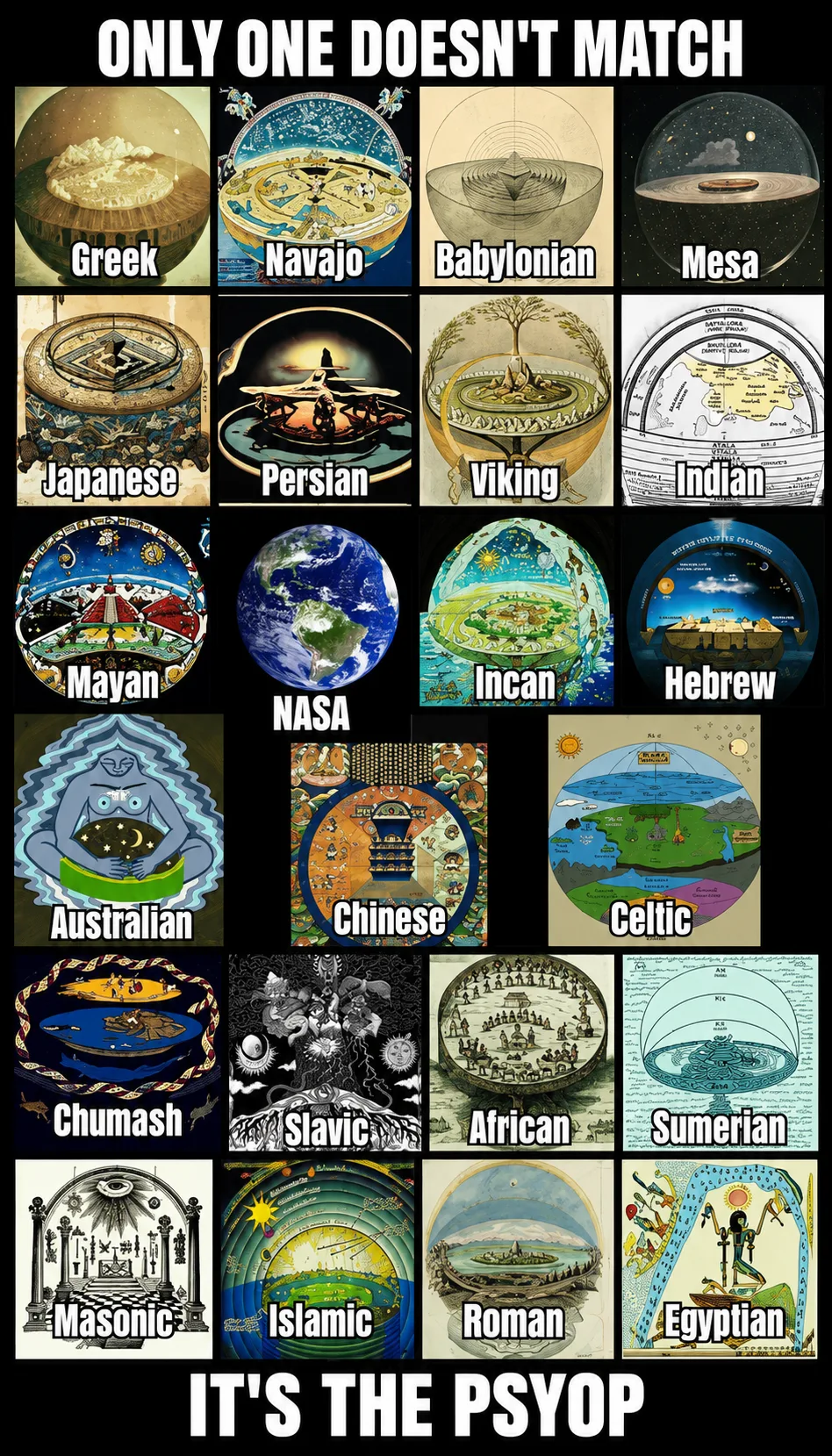
More than twenty cosmologies · one outlier
Greek, Navajo, Babylonian, Mesa, Japanese, Persian, Viking, Indian, Mayan, Incan, Hebrew, Australian, Chinese, Celtic, Chumash, Slavic, African, Sumerian, Masonic, Islamic, Roman, Egyptian — all independently describe an enclosed, level earth with a covering above and the lights set inside it. Only NASA’s modern depiction stands apart from every pre-Copernican human tradition.
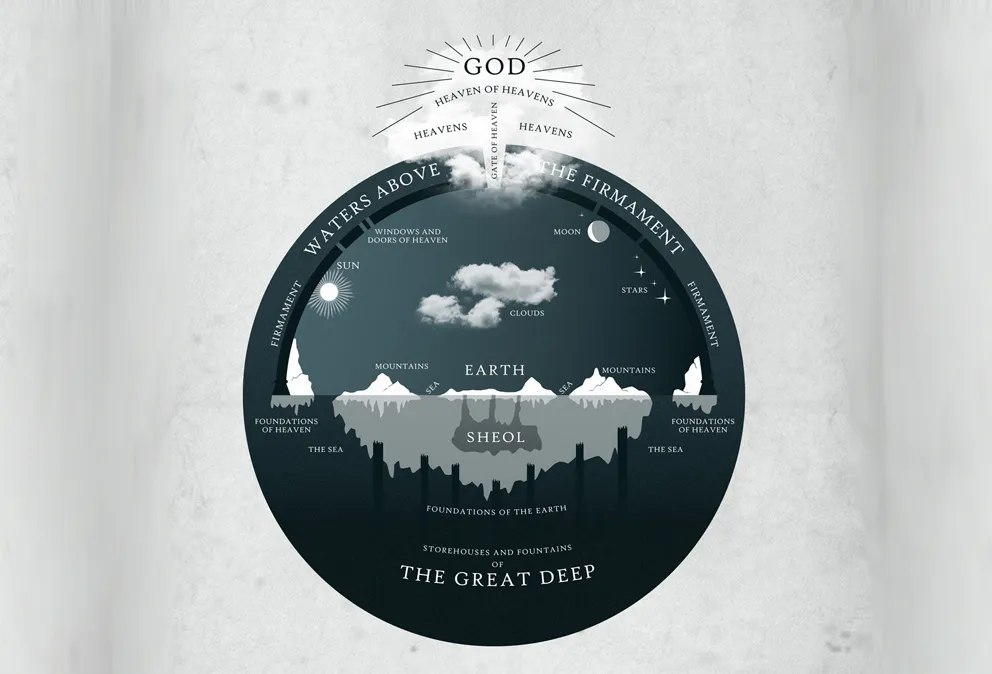
The same model · explicitly labelled
Published by Faithlife / Logos Bible Software (2012) as a teaching diagram. Even sources that do not personally hold the position acknowledge this is what the Hebrew Scriptures literally describe.
Only one cosmology stands apart from all the rest
Set the Hebrew cosmology next to the cosmologies independently preserved by ancient Egypt, Norse Scandinavia, India, Mesoamerica, the Inca, the Navajo, and a dozen other peoples spread across the globe. The astonishing fact is that they essentially agree. Each describes an outstretched, level earth covered by some form of dome, vault, or covering, with the celestial bodies contained within. The remembered cosmology of nearly every civilisation in human history is the same.
Only one model breaks the pattern. It is the one the modern world has been taught is unquestionable.
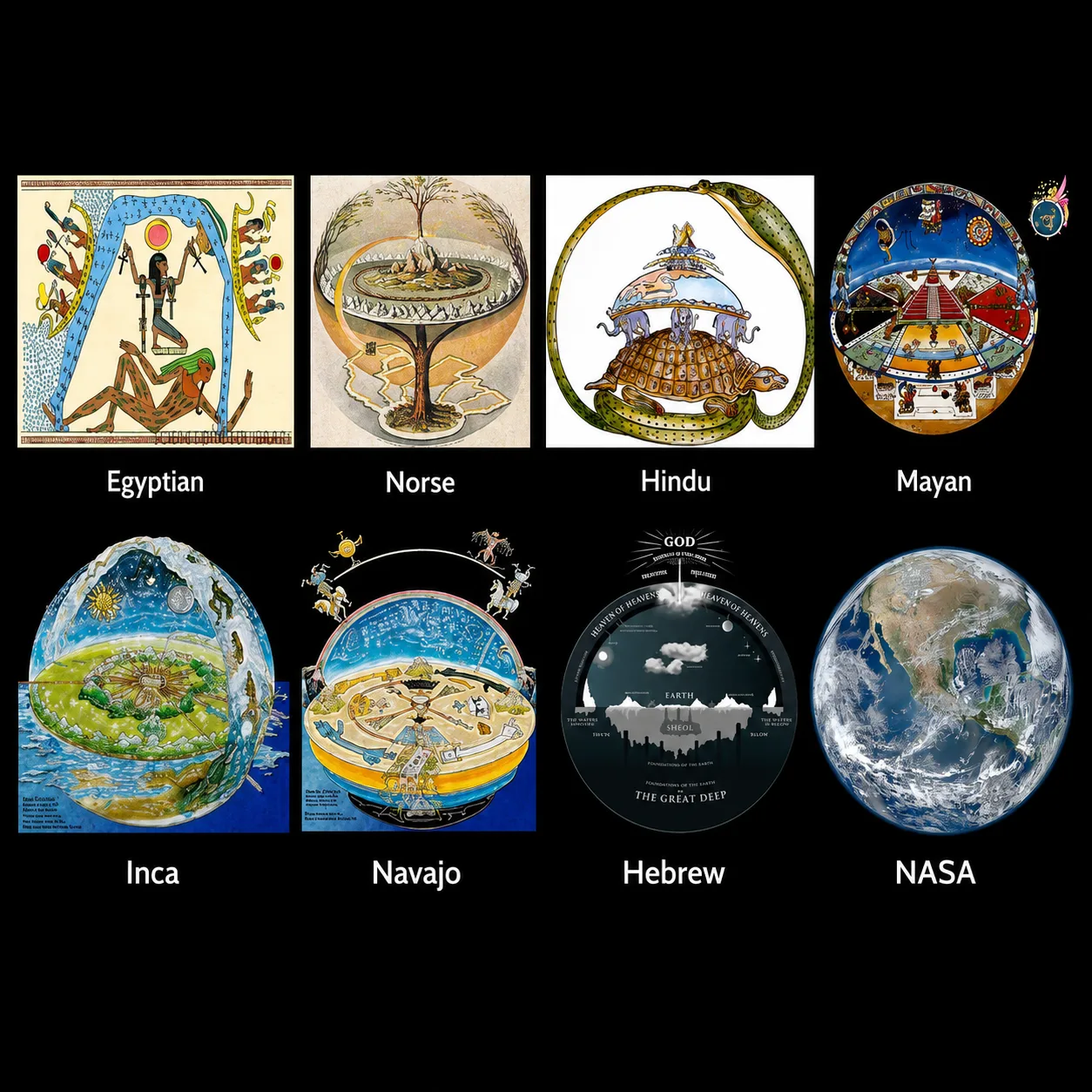
Eight cosmologies · one outlier
Egyptian, Norse, Hindu, Mayan, Inca, Navajo, Hebrew — all independently describe an enclosed, level earth with a covering above and the lights set inside it. Only NASA’s modern depiction — a ball spinning through empty space — has no parallel in any pre-Copernican human tradition. The reader is asked to weigh which is more likely: that every civilisation in recorded history was wrong in the same specific way, or that a single sixteenth-century innovation replaced what humanity had always known.
And in case any reader supposes that the cosmology illustrated across the ancient cultures above has no modern advocate of consequence — and certainly no advocate of consequence inside the Seventh-day Adventist tradition that this institute is built to recover — the historical record offers the following object.
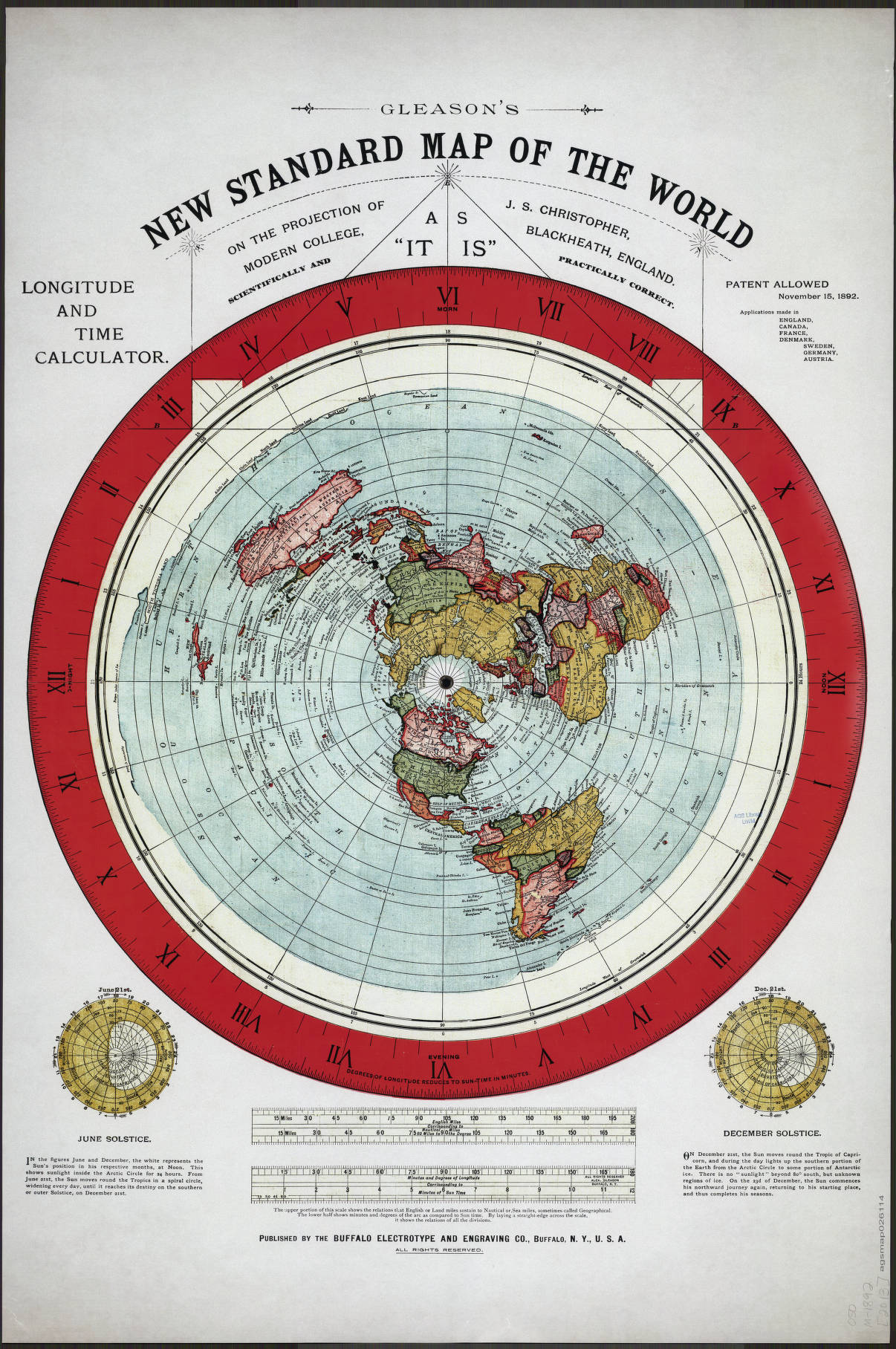
Gleason’s New Standard Map of the World · 1892
Drafted by Alexander Gleason — a Seventh-day Adventist.
Gleason, of Buffalo, New York, helped establish a local Seventh-day Adventist congregation in 1889, according to contemporary Buffalo-area newspaper accounts, and was later characterised by the flat-earth historian Robert Schadewald as “the most important Seventh-day Adventist flat-earther” in the United States. He patented his map in 1893 under US Patent 497,917, and it remains the single most widely-reproduced flat-earth map in print today, more than a hundred and thirty years after its publication.
The map is, in plain terms, a pioneer-era Adventist’s rendering of the very same azimuthal projection on which the modern flight routes catalogued elsewhere in this article, the published ice-wall testimony, and the sun’s observed circling path all resolve into straight, sensible lines. It is the United States Geological Survey’s own preferred polar projection, and (in slightly stylised form) the emblem on the flag of the United Nations. The same azimuthal-equidistant projection — wrapped in the UN’s olive-branch wreath — also appears on the official emblems of the World Health Organization (with the Rod of Asclepius overlaid), the World Meteorological Organization, the International Civil Aviation Organization, and the International Maritime Organization. The map the modern world insists no informed person could take seriously as a depiction of the earth is, in fact, the map most of its globe-managing institutions choose to display. The Adventist reader is invited to consider the historical inheritance this represents — a pioneer of the very tradition this institute is meant to recover, drafting the flat-earth map the rest of the world is still using.
Visual confirmations
A curated set of visual confirmations the author finds compelling. Each pairs with one of the observational arguments set out in Part I and the extended catalogue below; the captions register the key claim each image makes.
Reminder
Several of the images in this gallery are AI-generated renderings rather than photographs (each is individually marked in the credits section at the foot of the page). They closely resemble the real-world photographic evidence the arguments rest on but were generated to avoid copyright issues with the original creators.

Chicago skyline · 60 mi across Lake Michigan
The Chicago skyline is observed at full height from roughly sixty miles across Lake Michigan — well documented in real photographs, including the widely circulated 2015 image by Joshua Nowicki. The globe model requires the skyline to be hidden behind roughly 2,400 feet of curvature.
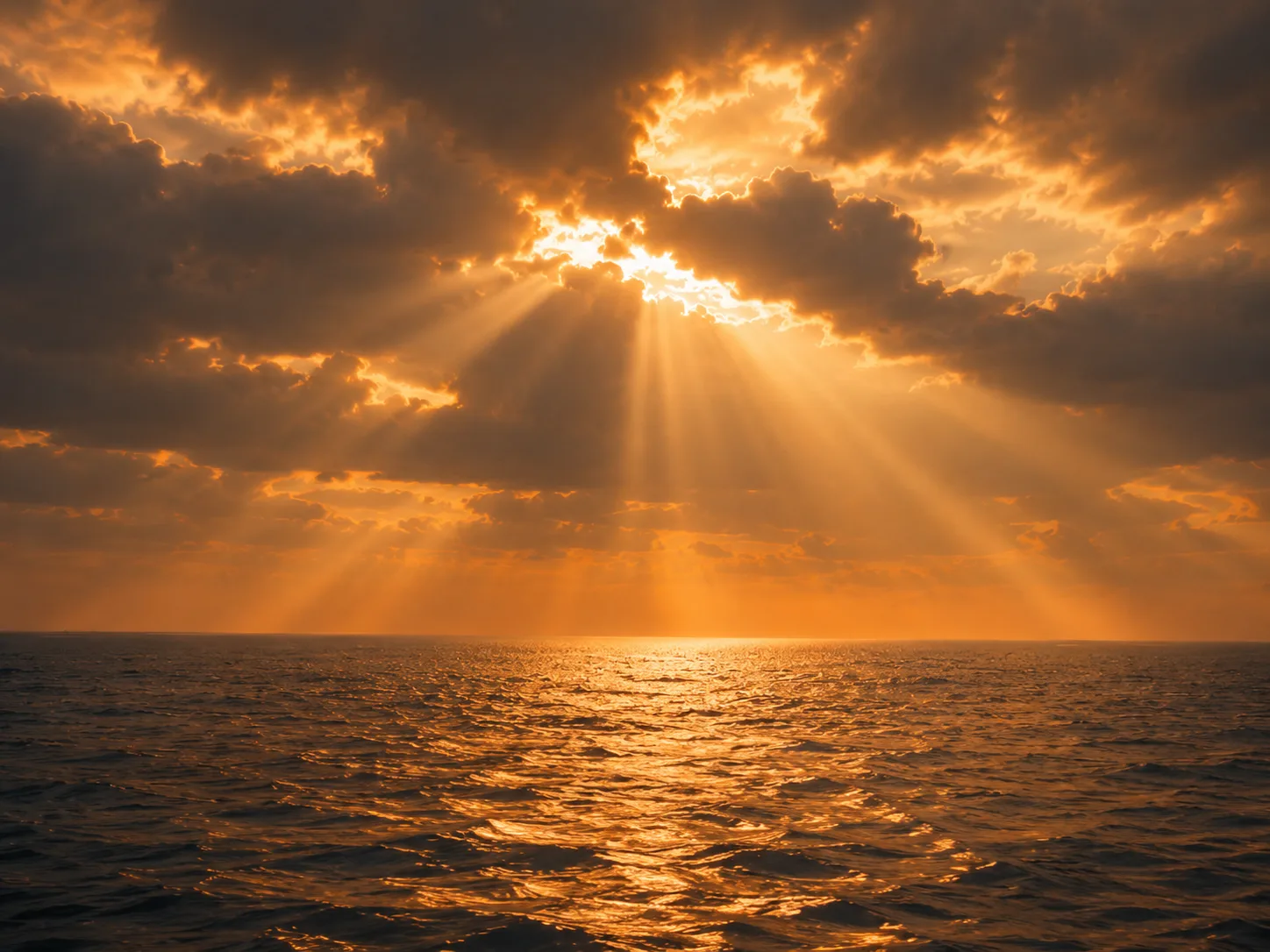
Crepuscular rays · converging above the clouds
Trace the rays back and they converge at a point not far above the cloud layer — the behaviour of a near, local light source, not one ninety-three million miles away.
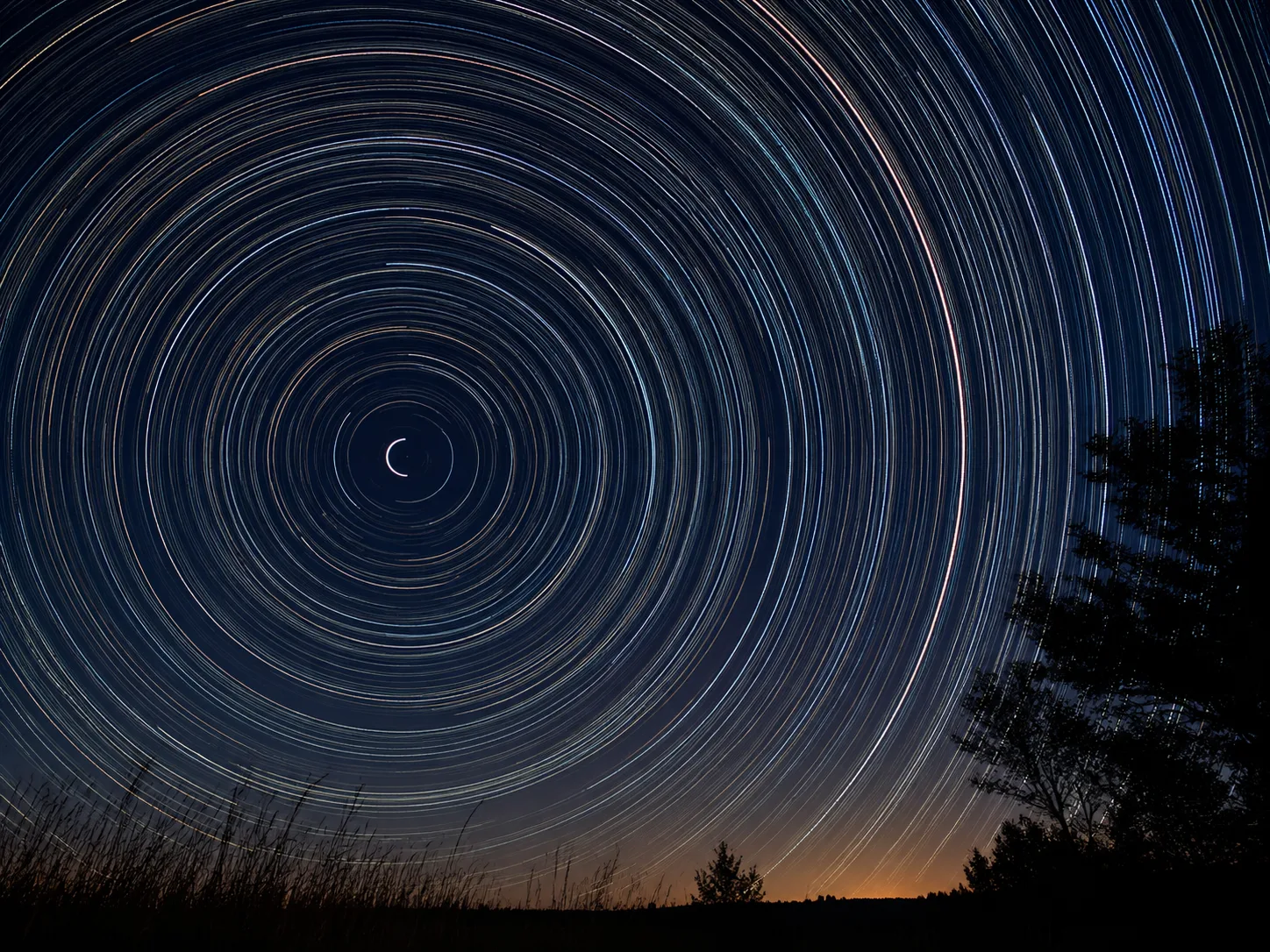
Polaris · star trails in long exposure
Perfect concentric circles around an immovable polestar. Polaris has occupied the same fixed point in the night sky throughout all of recorded human history — a stability that defies any model in which the earth tumbles, wobbles, and hurtles through space. It can also be observed up to roughly twenty degrees south of the equator, geometrically impossible on a globe.
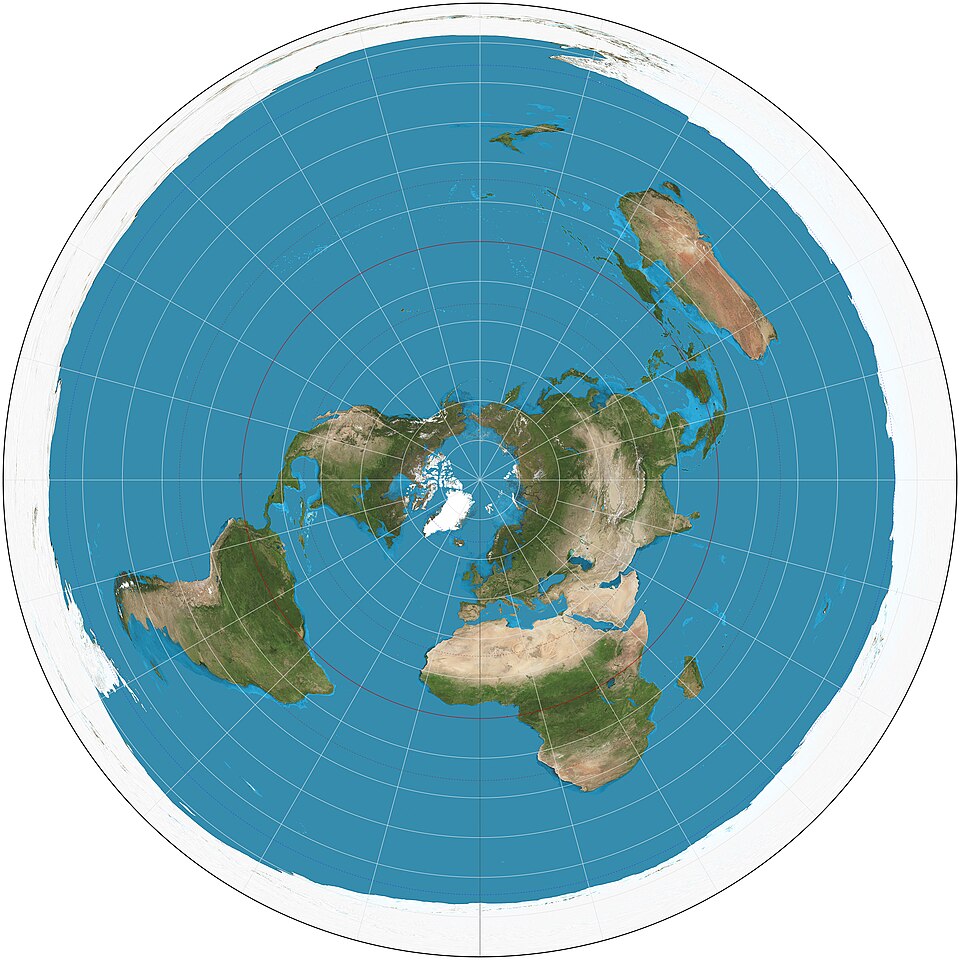
Azimuthal projection · southern hemisphere routes
Major southern routes overlaid: Sydney → LAX → Santiago, Johannesburg → London → São Paulo, Santiago → Dakar → Johannesburg. Each forms a near-straight line on this projection. On a globe they read as deeply illogical detours through the northern hemisphere.
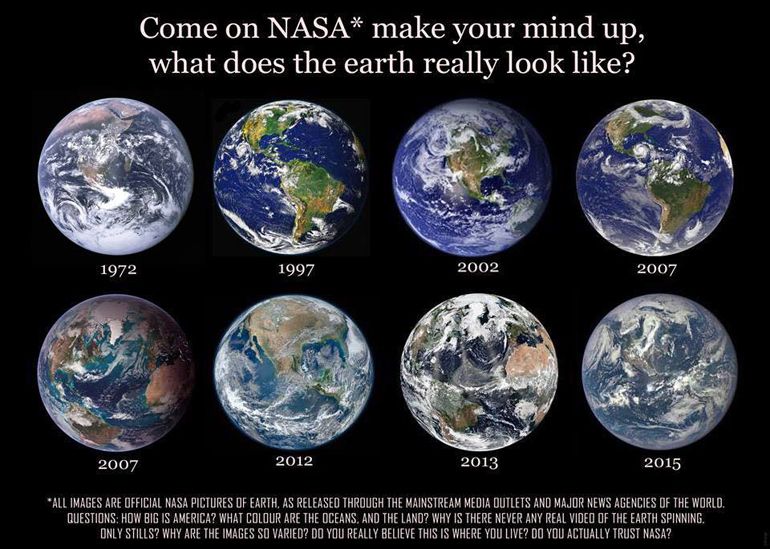
Eight official NASA “Earth” images, 1972–2015
All released through major news agencies as photographs of the same planet. Compare the size of America, the colour of the oceans, and the apparent geography. If these are photographs, what has changed between them?
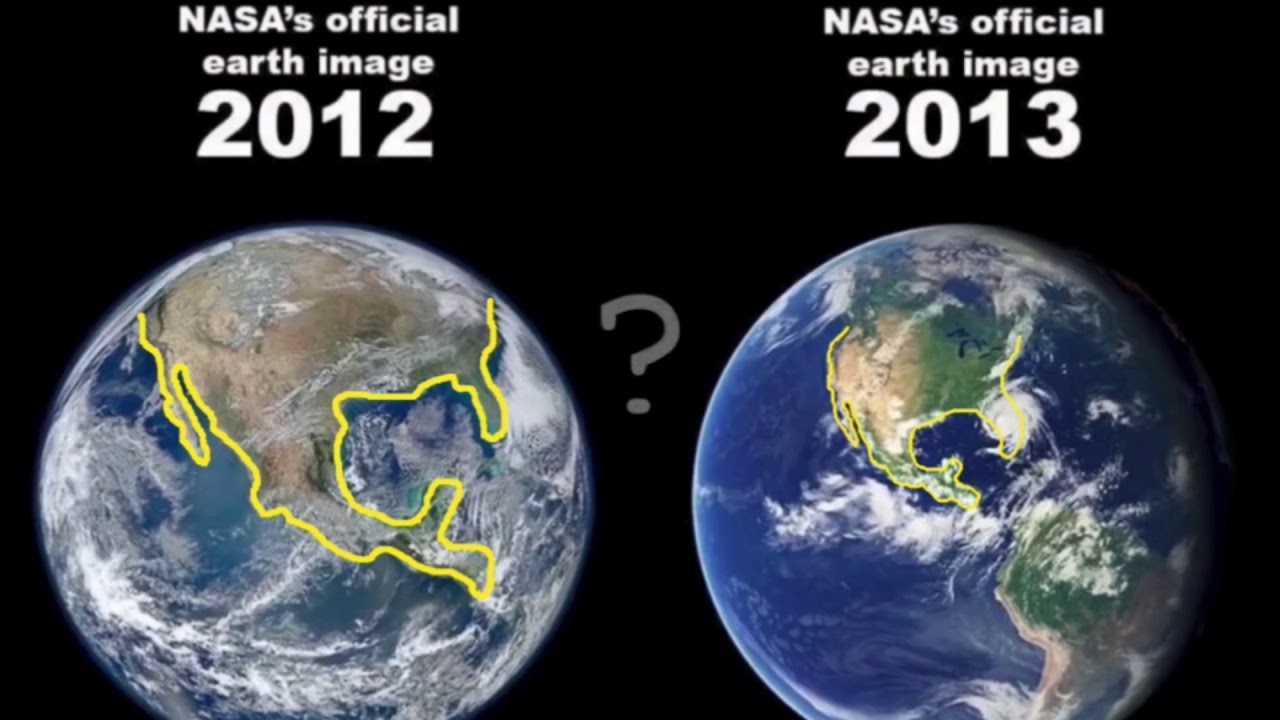
NASA’s Earth · 2012 vs 2013
The outline of North America has been highlighted on both images at matching scale. The continent has visibly changed size between the two official releases — a problem for the photograph hypothesis but not for the composite-image hypothesis NASA itself admits.
A note on atmospheric lensing — what is really happening across the lake
The standard rebuttal to the Chicago-across-the-lake image is that any visibility of a distant skyline at sixty miles must be a “mirage” or “temperature inversion” rather than evidence against curvature. There is a kernel of truth here that, examined honestly, runs the other direction. The atmosphere is, in fact, a giant optical medium. The United States Geological Survey reports that the atmosphere holds, at any given moment, roughly 3,100 cubic miles of water in vapour form — enough, if precipitated at once, to cover the entire surface of the earth with about one inch of rain. Those zillions of microscopic convex water droplets, layered above water bodies and varying in density with temperature, collectively act as one enormous convex lens. The same physics that bends a pencil in a water glass bends light across the atmosphere — refracting, magnifying, and, under the right conditions, partially obscuring what lies far away.
This is not a fringe claim. Mainstream optics texts treat atmospheric refraction as a standard effect that surveyors, astronomers, and aviation engineers correct for as a matter of routine. The flat-earth researcher Rob Skiba demonstrated the underlying mechanism with a tabletop apparatus a child can replicate: a flexible plastic magnifying sheet from Walmart, held over a printed cutout of the Chicago or Toronto skyline, produces precisely the same pattern of lower-portion cropping and middle-band magnification that critics attribute to the earth’s curve. As the camera is pulled back across a three-foot desk, the lower stories of the skyline drop away while the middle and upper buildings remain visible — exactly the image one captures looking across Lake Michigan from the Michigan shoreline.
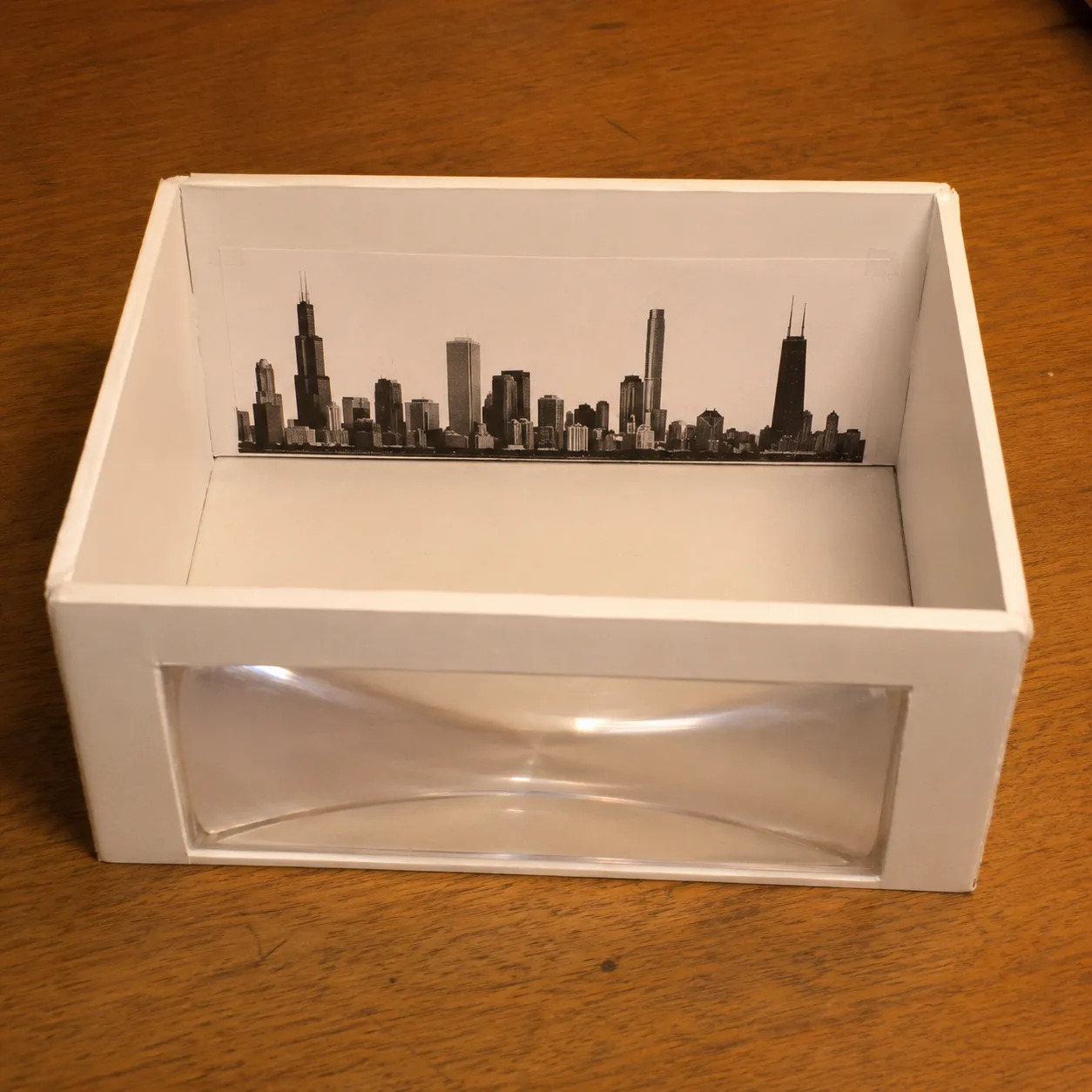
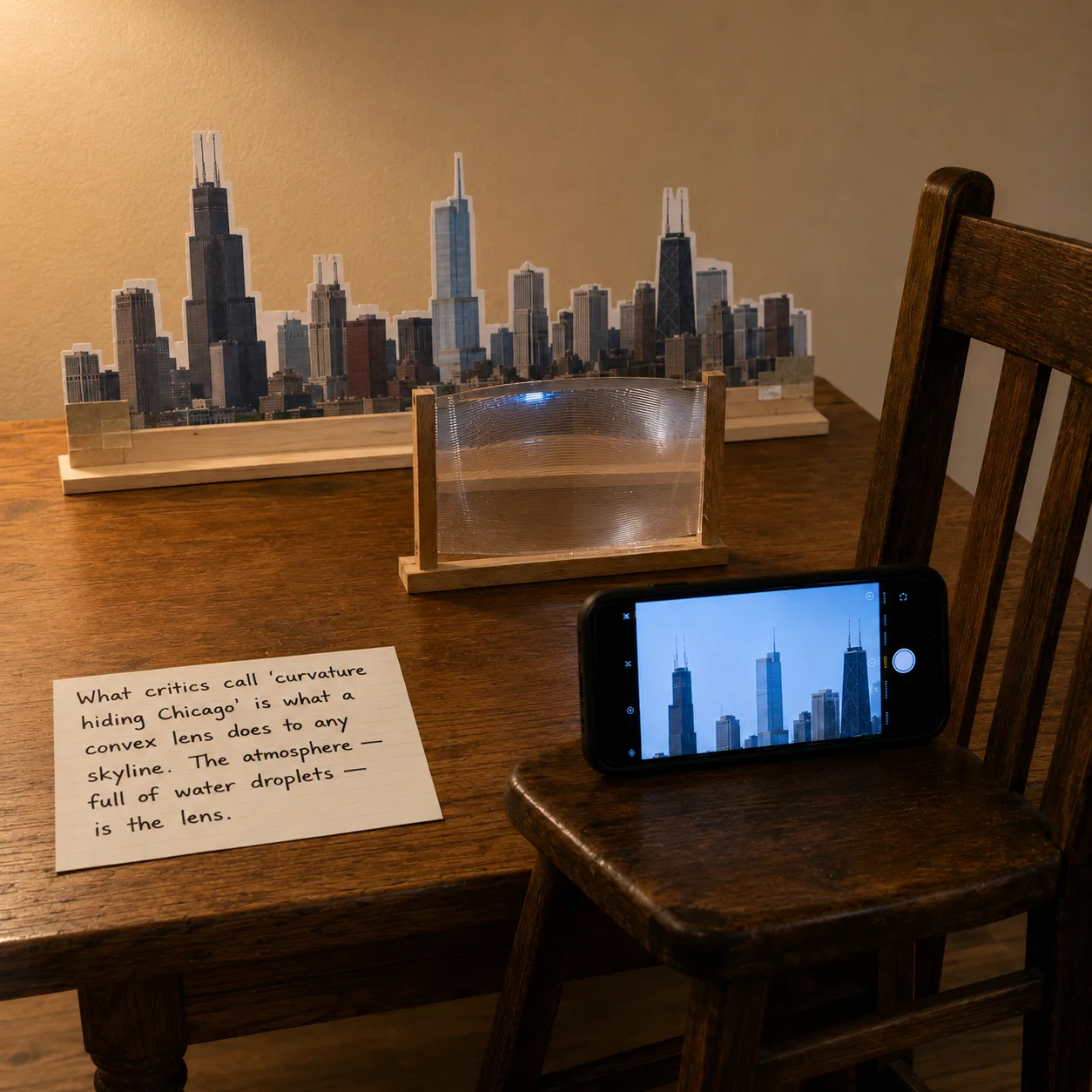
The Skiba experiment · atmospheric refraction at the kitchen table
A convex magnifying sheet — or, in the simpler enclosed version on the left, a Fresnel lens window mounted in the front face of a foam-core box — placed between the viewer and a printed skyline cutout reproduces the exact visual pattern critics attribute to the earth’s curve: the lower stories of the buildings drop away through the lens while the middle and upper bands remain visible. The atmosphere, dense with water-vapour droplets, is a vastly larger version of this same lens.
Note — Both images above are AI-generated illustrations of the kinds of tools used to perform a Skiba-style atmospheric-lensing demonstration. They are not photographs of the actual experiment. The original demonstration was conducted by independent researcher Rob Skiba and is publicly available in video form; the optical principles illustrated here are the same.
Two implications follow. First, the partial “hiding” of distant skylines is fully accounted for by atmospheric refraction, without any need to invoke a curved earth at all. Second, the high-zoom recoveries documented elsewhere in this article — the boat that vanishes to the naked eye but is restored in full by a Nikon P-900’s 83× optical zoom, the mountain that “should” be hidden by thirty-five miles of curvature but appears sitting on the horizon when the camera reaches through the haze — are not anomalies. They are the lens behaving as a lens. The standard objection is therefore not a refutation of the flat-earth observation but an unwitting confirmation of the optical conditions that make the observation work.
More from amateur high-altitude balloon footage
A wider sample drawn from amateur high-altitude balloon flights — at elevations between roughly sixty thousand and a hundred and twenty thousand feet, well above commercial aviation. Two of the article’s key claims are visible across the set. First: the horizon remains flat. Second: the sun behaves as a near, local light — illuminating a bounded region directly beneath it rather than the cloud layer uniformly.
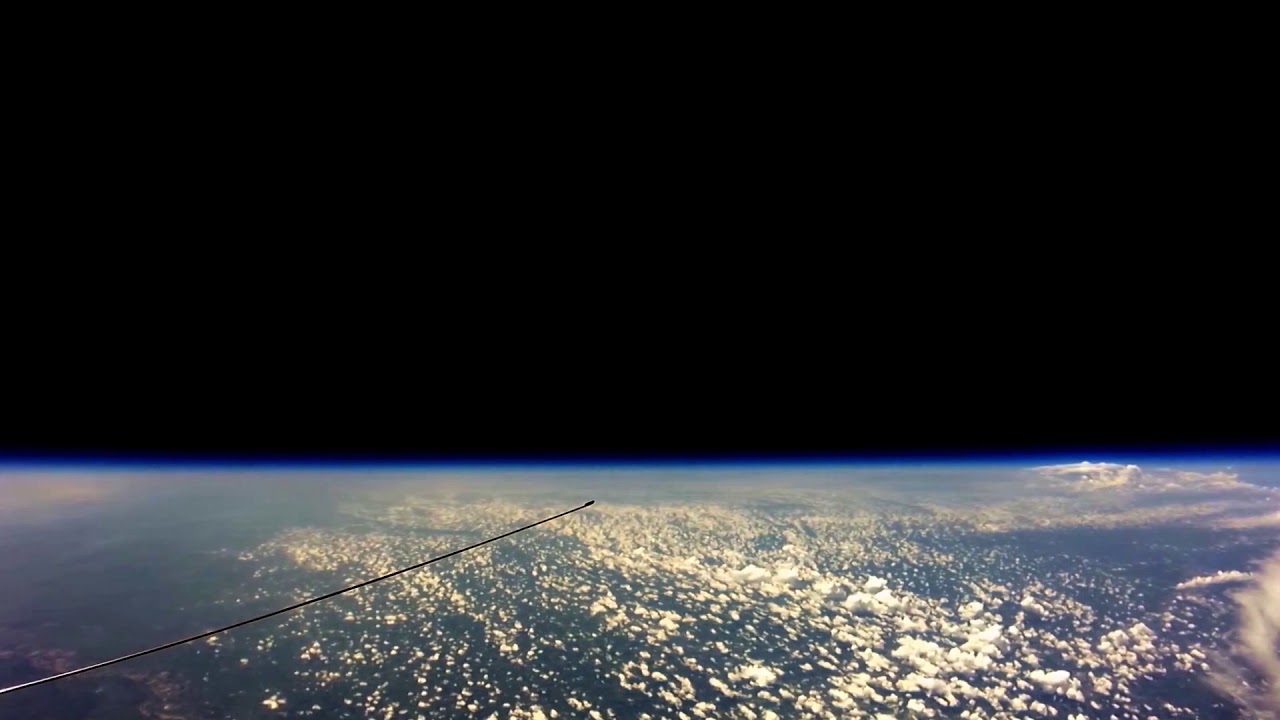
Wide flat horizon · very high altitude
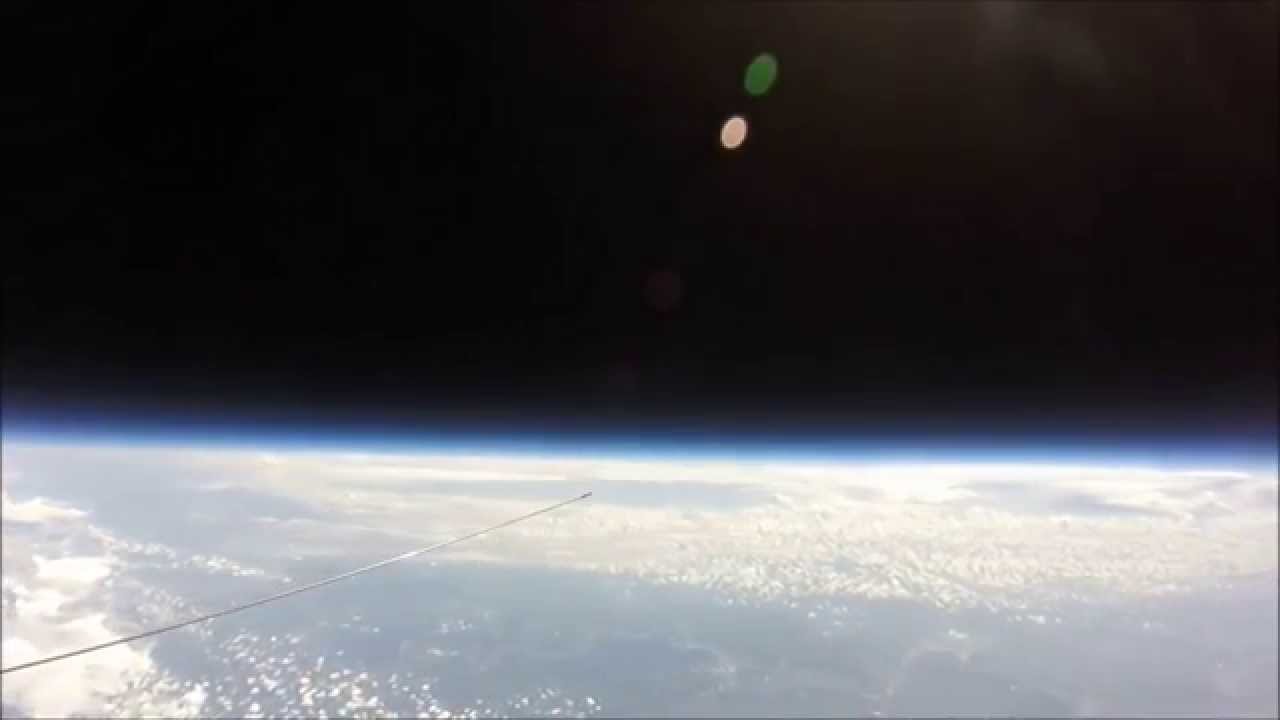
Flat horizon · tether visible
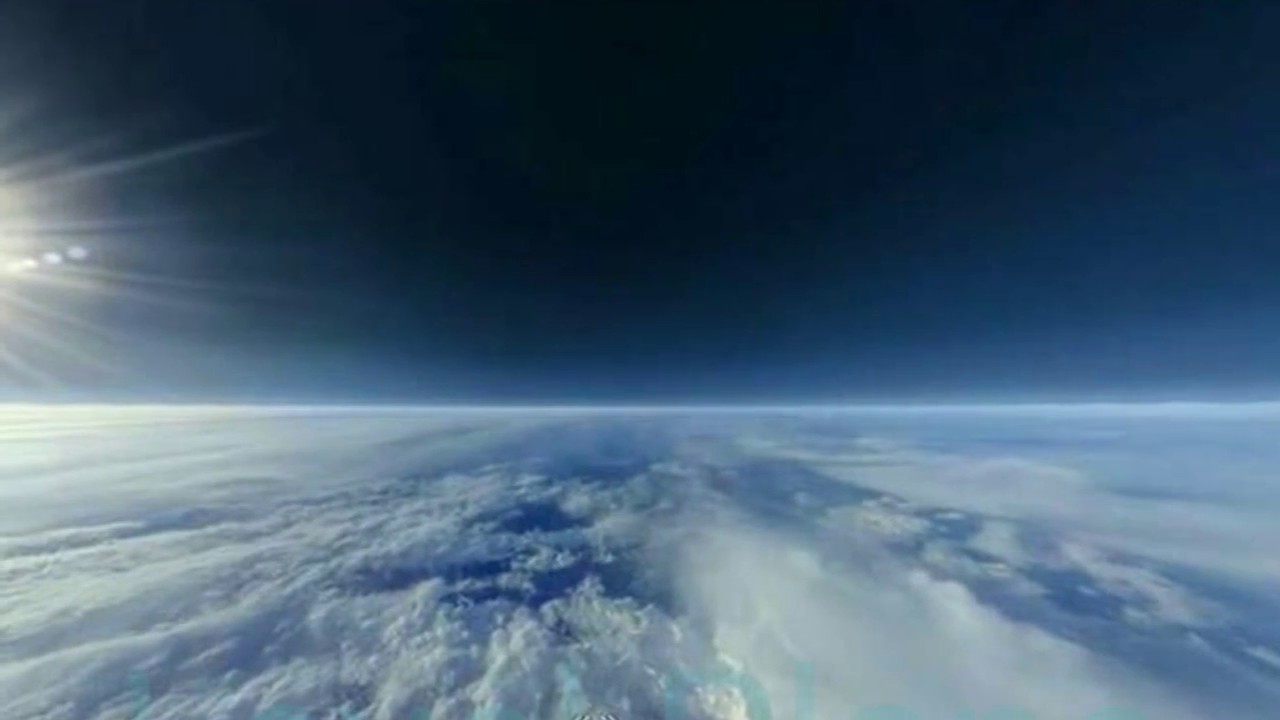
Flat horizon · layered atmosphere
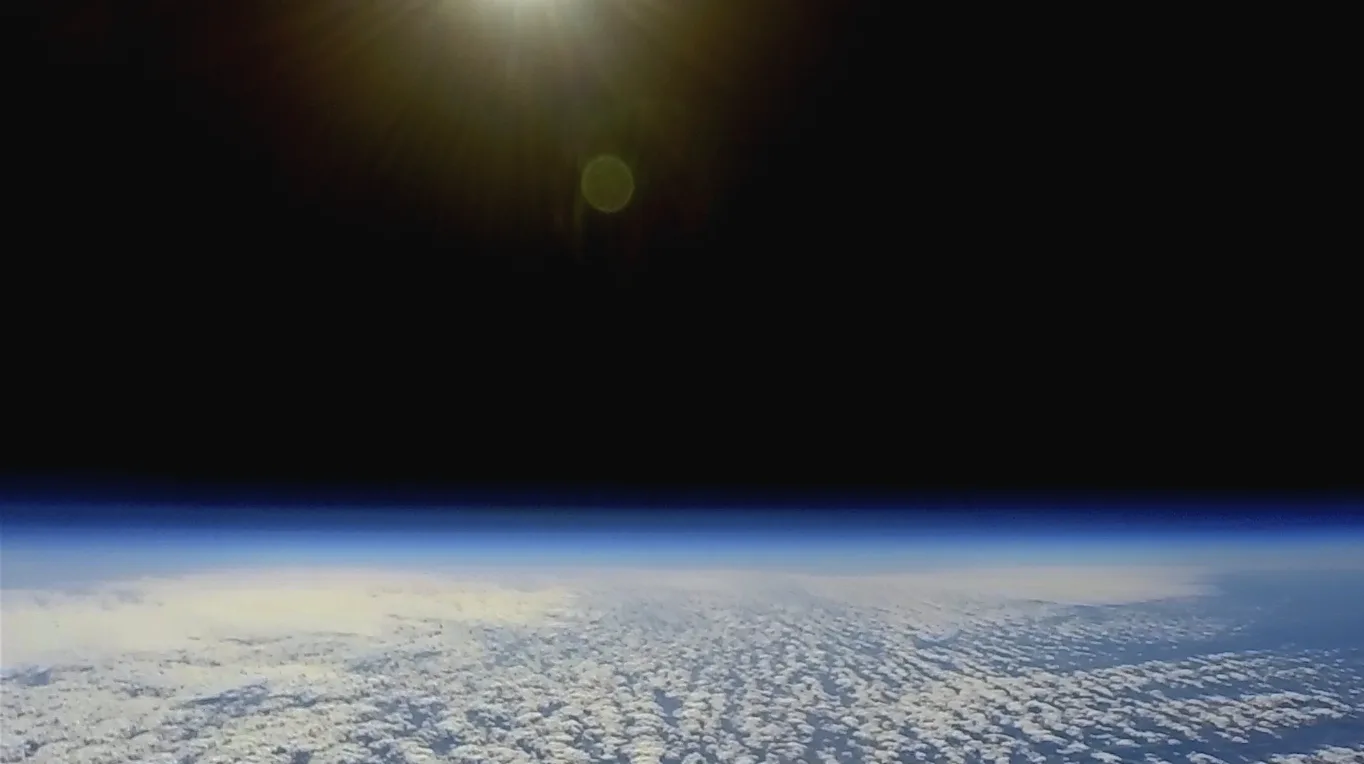
Flat horizon · sun overhead
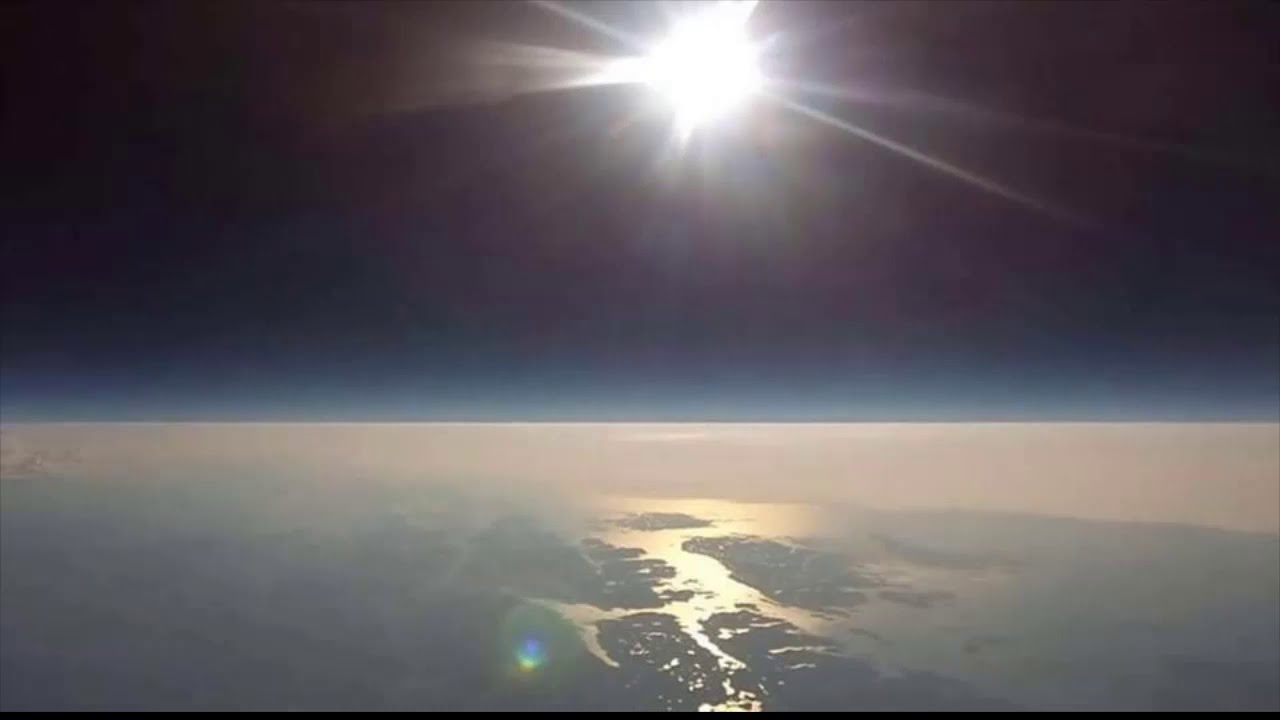
Sun spotlight · over water
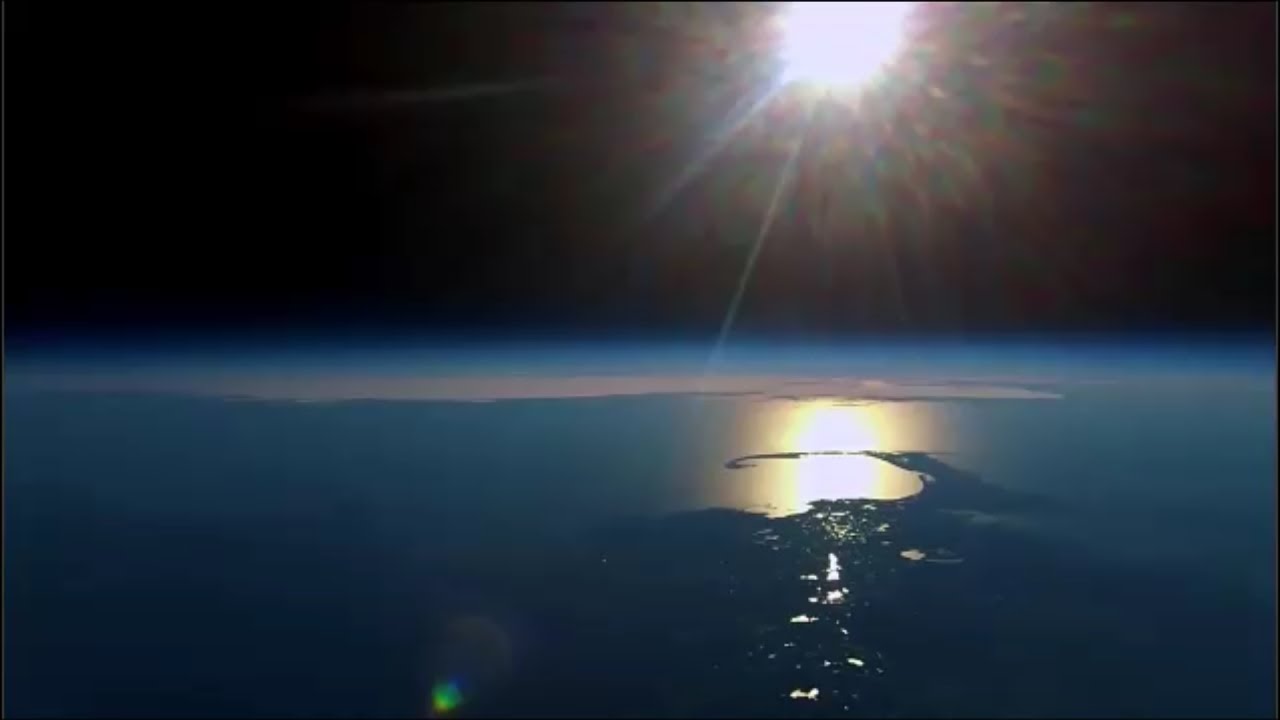
Sun reflection · localized
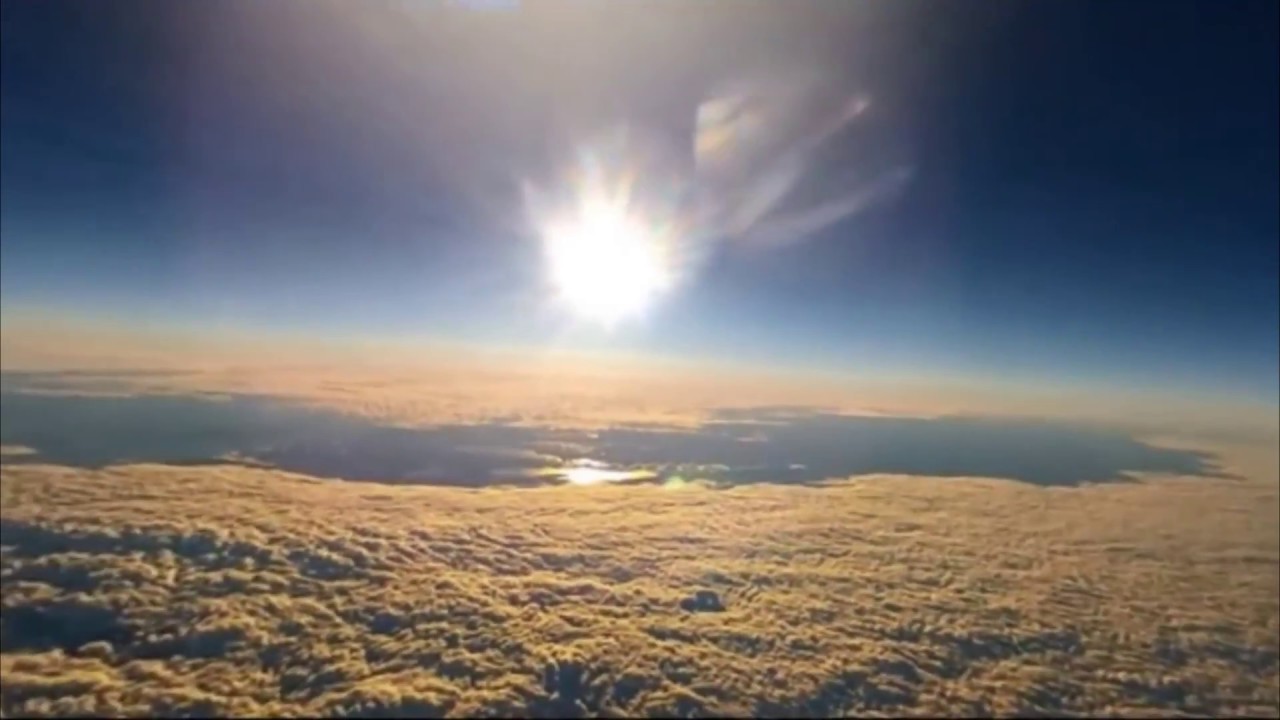
Sun on clouds · hot-spot
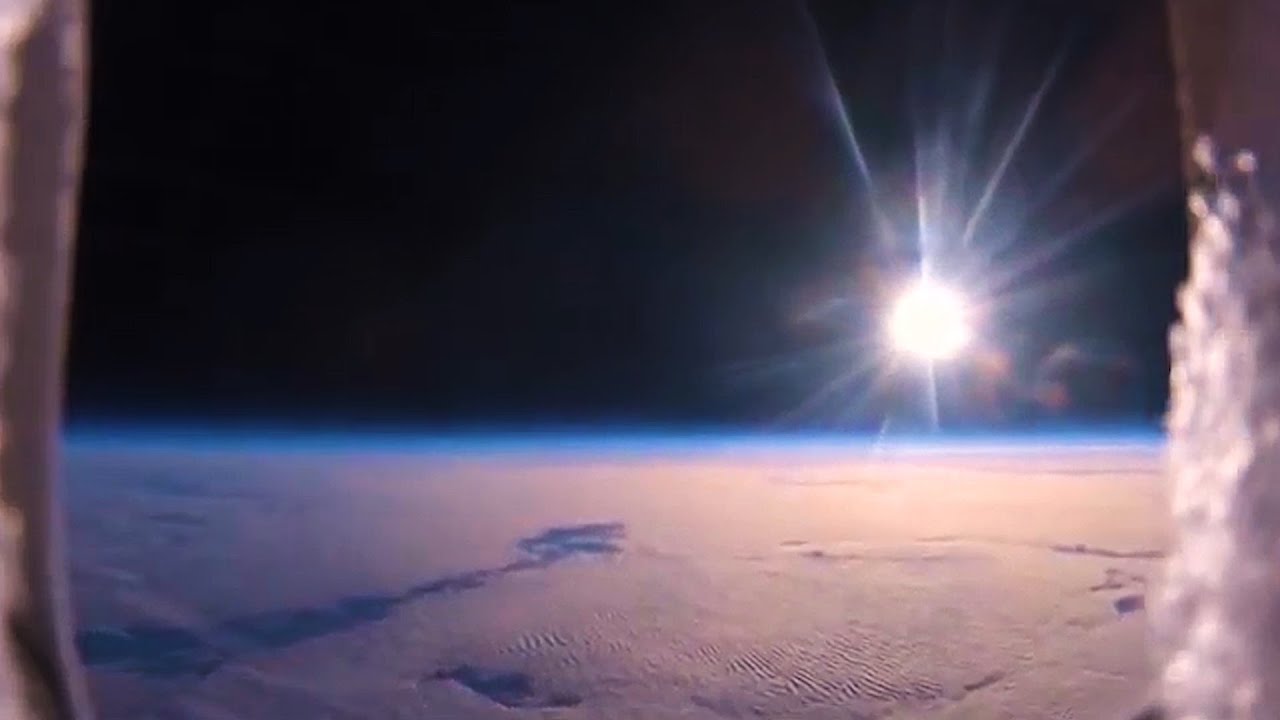
Sun spotlight · over cloud sheet
NASA’s own admissions, in their own words
The remarkable thing is that none of the above is hidden. The descriptions NASA publishes alongside its own “Earth” imagery state plainly what the images are. They are composites, mosaics, and renderings — not photographs. A small sample of the official captions:
“In 2002, NASA released the most detailed true-color image of the Earth’s surface ever produced up to that point. Scientists and data visualizers created the image by stitching together data collected over 4 months from NASA’s Terra satellite.”
“This image is a mosaic showing South America from September 2004 (with clouds removed).”
“Known as the ‘Black Marble’, this image of North and South America at night is a composite assembled from data acquired by the Suomi NPP satellite in April and October 2012.”
“This composite image uses a number of swaths of the Earth’s surface taken on 4 Jan. 4, 2012.”
Read those descriptions plainly. The images are not photographs. They are renderings — stitched, mosaicked, “with clouds removed,” assembled from data gathered across months. The man who built them said so himself, on the record:
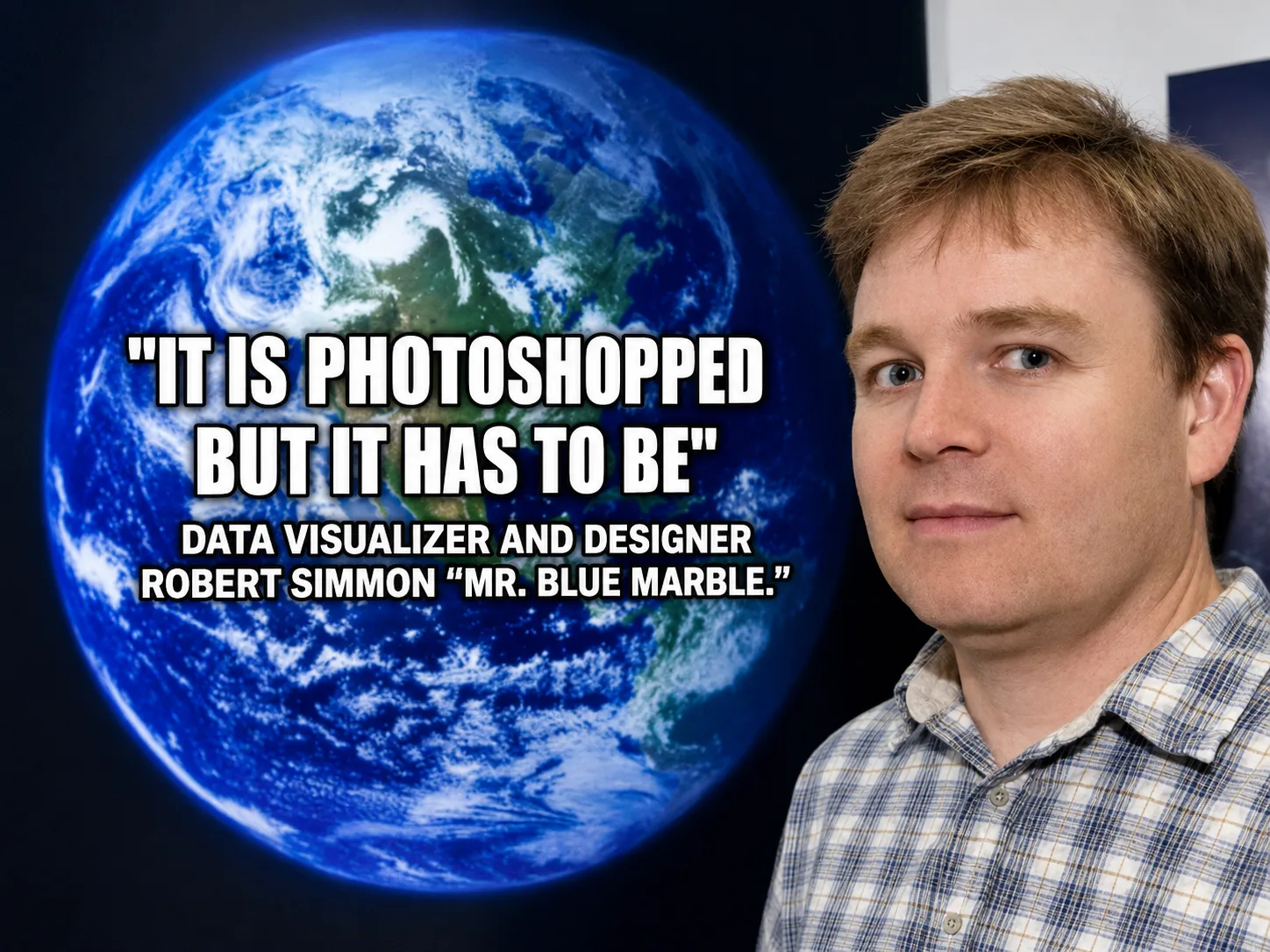
Robert Simmon · “Mr. Blue Marble” · in his own words
Robert Simmon is the NASA data visualiser who built the 2002 Blue Marble — arguably the single most reproduced image of the earth in human history. His on-the-record summary of how it was made: “It is photoshopped, but it has to be.” The point is not that Simmon was dishonest — he was, in fact, being candid. The point is that the iconic image the modern world has been handed as a photograph of the earth from space was, by its own designer’s admission, composed in Photoshop.
The full quote, in context, is even more revealing. Simmon was interviewed on the record for NPR’s Science Fridayin 2012, in a segment titled “Blue Marble: The Making Of.” Asked to describe how the image was assembled, he set out the process not as photography but as iterative artistic composition — layering, simulating, adding the bright reflection of sunlight off water, undoing with command-Z when something did not look right. The transcript reads:
“It is photoshopped, but it has to be. Then there was another layer to sort of simulate the atmosphere, and then there’s this little bright spot — it’s called the specular highlight — so it’s the reflection of sunlight off of water. Those are the pieces, but you can’t just slap them all together. It just didn’t look realistic. It looks kind of flat, or the clouds are sort of see-through. So I just take command-Z a lot. There’s artistry to creating the world — what I imagined it to be. Unfortunately I’m not an astronaut. I’ve never been to space, but I’ve looked at these images over and over again, trying to sort of get the essence of it.”
Read what he is actually saying. He is not describing the reconstruction of a photograph that was taken. He is describing the construction of an image of the world as he imagined it to be — built layer by layer, atmosphere simulated, specular highlight added, command-Z when something did not look right. He is an artist with great skill, working honestly within the constraints of his brief. But the brief was never “reproduce a photograph.” The brief was “produce what the world ought to look like, if it were a photograph.” That is a different thing entirely.
A second class of admission sits inside the agency’s own technical literature. A widely-circulated example is a NASA Dryden Flight Research Center paper — Derivation and Definition of a Linear Aircraft Model (Reference Publication 1207, Duke et al., 1988). In its concluding remarks, the report describes the model it has just derived as suited to “a rigid aircraft of constant mass, flying in a stationary atmosphere over a flat, nonrotating earth.” The wording is not a slip. Inertial frame conventions standard across aerospace engineering routinely treat the earth, for the duration of a given calculation, as flat and non-rotating — because the curvature and rotation said to obtain on the official model are not present in the data the engineers are actually fitting. The line is reproduced below from the document itself.
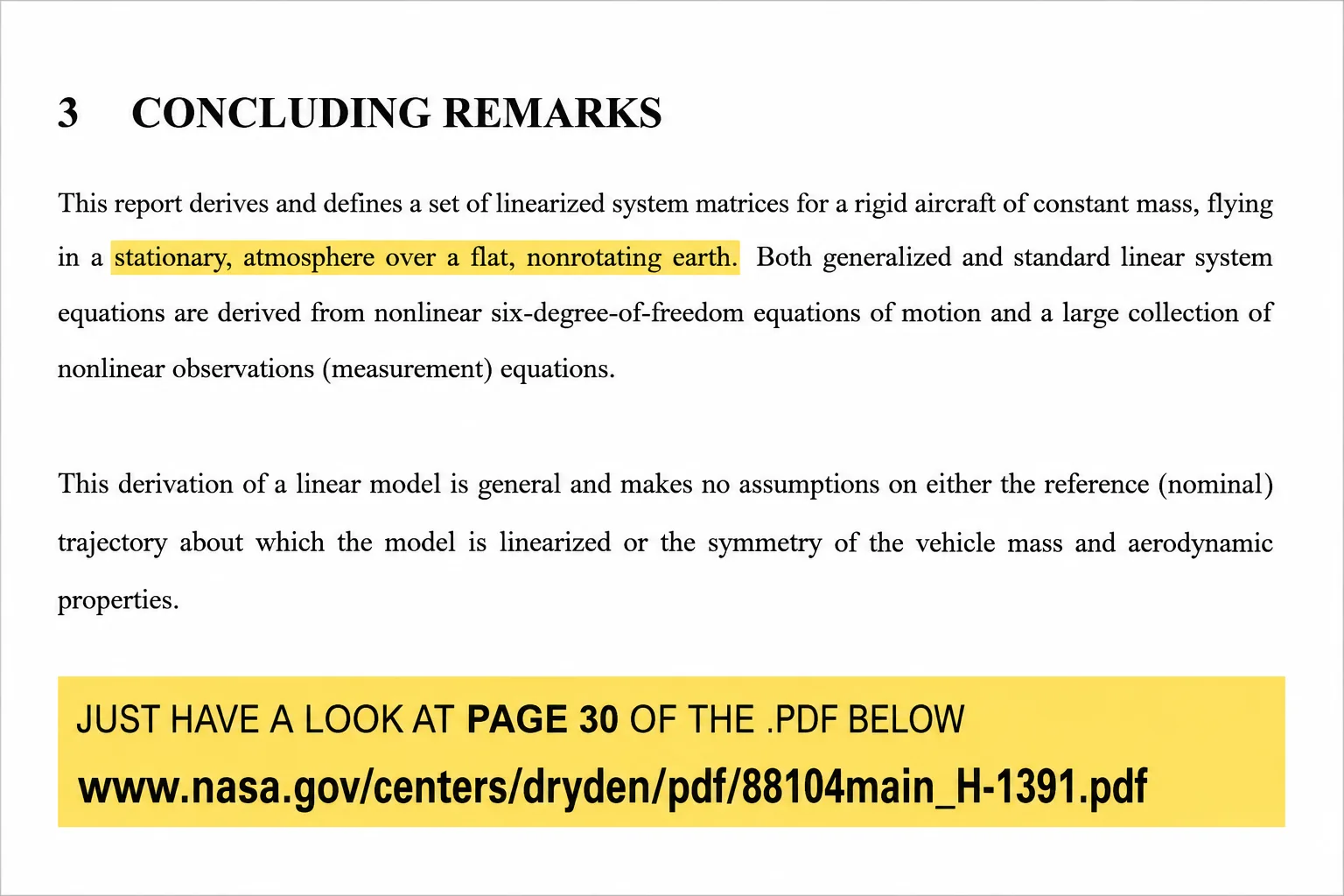
NASA Dryden · Reference Publication 1207 · concluding remarks
Excerpt from Derivation and Definition of a Linear Aircraft Model, Eugene L. Duke et al., NASA Dryden Flight Research Center, 1988. The highlighted line states that the derivation assumes “a rigid aircraft of constant mass, flying in a stationary atmosphere over a flat, nonrotating earth.” The original document is hosted on NASA’s own servers; the URL in the annotation (nasa.gov/centers/dryden/pdf/88104main_H-1391.pdf) was added by whoever first circulated the screenshot, but the underlying paper is real, public, and can be retrieved from the NASA Technical Reports Server.
A wider chorus — the astronauts in their own words
Simmon’s candour and the Dryden paper’s engineering language are not isolated incidents. A surprising amount of the most interesting material comes from the men the public has been asked to trust most directly — the astronauts themselves and the prominent public scientists who speak for the agencies. What follows is a small collection of on-the-record statements, each quoted at length so the reader can judge them without the intermediation of summary.
Don Pettit is a veteran NASA astronaut with multiple long-duration stays on the International Space Station. Asked at a 2008 public Q&A whether he would like to return to the moon, he gave an answer that has been widely circulated and never disputed:
“I’d go to the moon in a nanosecond. The problem is, we don’t have the technology to do that anymore. We used to, but we destroyed that technology, and it’s a painful process to build it back again.”
Read that statement plainly. A national space agency does not “destroy” the engineering it actually used to put men on another world. Blueprints get archived. Tooling gets warehoused. Documentation is preserved. What Pettit is describing, in the most charitable possible reading, is the loss of an institutional capability his agency cannot now reproduce. The less charitable reading — that there was no such capability to lose — is the one the author finds harder to argue against.
(A footnote worth recording: Artemis II — the long-delayed crewed lunar fly-by intended to demonstrate the recovery of the very capability Pettit said had been destroyed, the first beyond-low-earth-orbit human spaceflight in over fifty years — was finally rescheduled after years of slippage and a last-minute Vehicle Assembly Building rollback, and was launched on April 1st, 2026 — April Fool’s Day. The reader can make of the scheduling what he wishes.)
A second Pettit moment is worth recording alongside the first, this one from his 2015 interview with engineer and YouTube science host Destin Sandlin of Smarter Every Day. Sandlin had travelled to NASA’s Johnson Space Center to learn how the mechanical shutter system on the International Space Station’s Cupola window — the seven-window observation dome from which Pettit had taken many of his most-circulated photographs — actually operates. Asked plainly how the shutters function, the astronaut who had lived in that very dome for months on end answered:
“That’s just real good engineering.”
That was the answer. Not an explanation of the mechanism, not a diagram, not a recollection of the panel he had operated — a one-line deflection to the unnamed engineers who, presumably, did know. Sandlin’s film records what he had to do next: he tracked down the original designer of the shutter system, who had by then left NASA and was working at a motorcycle parts shop, and obtained from him the engineering drawings that explain — in real mechanical terms — how the shutters actually open and close. The shutters are interesting, in their own right, as a piece of design. The interesting thing for our purposes is that an astronaut who supposedly lived in the Cupola for one hundred and ninety-three consecutive days could not, when asked, describe the operation of the single most prominent piece of mechanism in it.
Pettit’s line is illuminated by an even more remarkable moment from Buzz Aldrin — the second man, by the official record, ever to have walked on the moon. Speaking at the Conrad Schools of Science in Delaware in 2015, Aldrin was asked by a small girl in the audience why nobody had been back to the moon in such a long time. His answer, transcribed from the live recording:
“That’s not an eight-year-old’s question — that’s my question. I want to know. ... But I think I know. Because we didn’t go there. And that’s the way it happened. And if it didn’t happen, it’s nice to know why it didn’t happen, so in the future, if we want to keep doing something, we need to know why something stopped in the past that we wanted to keep going. But I think I know — because we didn’t. Because we didn’t.”
The transcript is rough because the live audio is rough. The substance is not. An eight-year-old child asks the man billed as the second person ever to walk on the moon why no human being has been back, and he answers, more than once and unprompted: because we didn’t go there. Pair that with Pettit’s “we destroyed the technology,” and one is looking at the same hole in the official story, described from two different angles.
For comparison, here is the same man on the official podium, addressing a televised public audience as part of the Apollo anniversary publicity machine:
“Distinguished ladies and gentlemen, it is with a great sense of pride as an American, and with humility as a human being, that I say to you today what no men have been privileged to say before — we walked on the moon.”
Two registers, one man. The contemporaneous footage of the three Apollo 11 astronauts at the press conference following their alleged return is also worth a careful look on its own terms. None of the three men smiles. None hugs, shakes hands, or shows the demeanour one would expect of human beings who have just done what no one in history has done. They look, instead, like men under instruction.
Did We Go? — the filmmaker who set out to prove it and came back with questions
Among the more honest documents on the moon-landing question is a feature-length film by the American documentary filmmaker Aron Ranen, titled simply Did We Go? The project was funded by a grant from the State of Ohio and executive-produced by Ben Britton of Third Wave Media in Los Angeles, copyrighted in 1999 and released in expanded form by 2005. Ranen did not begin the project as a sceptic. His stated objective — and the editorial framing he held to until the closing minutes of his own film — was to produce the definitive popular defence of the Apollo programme by interviewing the original astronauts, mission controllers, and engineers, gathering the documentary record, and laying out the proof.
He travelled across the United States and visited multiple NASA facilities. He spoke with high-level NASA scientists, Apollo-era mission staff, and the surviving programme leadership. What he found, by his own honest summary in the film’s conclusion, was that he could not find the kind of conclusive primary-source evidence he had expected to find. Ranen himself, to his credit, still says he believes the missions happened. But he closes the film by stating plainly that he came home with more questions than he left with — questions to which the agency had no clean answers.
The missing telemetry tapes
Chief among the unanswered questions was the matter of the original Apollo 11 telemetry tapes — the raw mission data on which any independent verification of the landings would depend. When Ranen pressed NASA on the location of those tapes, the agency’s answer was that the reels had simply gone missing. Gene Kranz, Apollo 11 Flight Director, told him on camera: “I haven’t seen anything that indicates the telemetry data is even in existence, and as I said, even if we had it, we don’t have the machines to play it back.” NASA formally acknowledged in 2006 that the original Apollo 11 mission tapes are missing and cannot be located. The reader is asked to weigh, on his own terms, the proposition that the most consequential scientific record in modern human history has simply been mislaid.
A more confrontational complement to Ranen’s honest investigation is the work of the American documentary filmmaker Bart Sibrel, who in the early 2000s set out to ask the surviving Apollo astronauts a single question on camera — namely, whether they would swear an oath, with their hand on a Bible, that they had personally walked on the moon. Sibrel managed to secure brief meetings with most of the surviving moon-walking astronauts of the era — among them Neil Armstrong, Buzz Aldrin, Michael Collins, Eugene Cernan, Alan Bean, John Young, and Edgar Mitchell — drawn from Apollo 11, 12, 14, 15, 16, and 17. The pattern of the encounters is in itself the editorial point.
Of the astronauts approached, none agreed to swear the oath. Several became openly hostile. One — Buzz Aldrin, then aged seventy-two — physically struck Sibrel in the face outside a Beverly Hills hotel. Edgar Mitchell, of Apollo 14, physically kicked Sibrel out of his Florida home after a brief sit-down interview. The language used by several of the astronauts during these encounters is too vulgar to reproduce on the present website; the reader who wants the verbatim record can find it in Sibrel’s own footage. The author offers no endorsement of every claim in Sibrel’s broader work — he is also the director of a feature-length film titled A Funny Thing Happened on the Way to the Moon (2001), which the reader can pursue or not at his discretion — but the on-camera record of these particular confrontations is striking on its own.
Most striking of all is a single line captured on a hot microphone during the Edgar Mitchell encounter. As Sibrel was leaving the property, Mitchell’s son — believing the recording equipment was off — can be heard asking his father, plainly and without prompting, whether they ought to call the Central Intelligence Agency and have the filmmaker permanently dealt with. The remark is near-inaudible in the original release but becomes unambiguous in the volume-normalised versions circulating publicly. The reader is asked to consider why the son of an American astronaut, in the presence of his father, would consider an extra-judicial response to a documentary filmmaker asking a question the astronaut could plainly have answered.
Scott Kelly — twin brother of Mark Kelly and one of NASA’s most-photographed long-duration astronauts — has twice now, in public Q&A format, been asked to explain the air bubbles visible rising from astronauts’ helmets in spacewalk footage. The first time, he attempted a substantive answer:
“Often, on the outside of the space station, you’ll liberate little pieces of — you know, it’s a really harsh environment out there, and the outside of the space station gets beat up pretty good. And sometimes you’ll see these little flecks of paint or something that you might have disrupted floating away from the suit. And that’s generally what that is. I’ve never seen any kind of air bubble anywhere.”
Read what Kelly actually says. The bubbles are not air; they are flecks of paint dislodged from the exterior of the space station. The reader is asked to weigh this on its face. Flecks of paint do not float upward in a vacuum the way air bubbles float upward in a fluid medium; they would, if liberated from the suit, simply drift along whatever trajectory the suited astronaut’s motion last gave them. The artefact visible repeatedly in the footage, by contrast, behaves identically to air bubbles in water: rising, accelerating, occasionally collecting and merging.
Months later, in a different city, Kelly was approached again about the same question by a different independent questioner who explicitly cited the Tampa exchange. His second answer is remarkable in a way the first is not:
Questioner: “Bubbles in space, brother — what’s your word on it?”
Kelly: “Yeah, I don’t know what that is.”
Questioner: “You don’t remember the question from Tampa about the bubbles in space coming up from the helmets?”
Kelly: “Uh, yeah... I don’t know what that is.”
That should give the reader pause. Only months earlier, asked the same question in Tampa, Kelly gave a substantive technical answer — paint flecks dislodged from the exterior of the space station, drifting away from the suit, certainly not air bubbles. He took the question seriously and offered an explanation. In this second exchange, with the questioner explicitly reminding him that he had been asked this very question publicly only months before, Kelly — rather than repeating his Tampa answer or expanding on it — claims, twice, not to know what is being talked about. The man who answered the question with technical confidence in one city claims ignorance of the same subject in the next. The reader is asked to weigh why that might be.
NASA’s neutral buoyancy laboratory at the Sonny Carter Training Facility in Houston is, of course, a real and openly-documented underwater training pool where every spacewalking astronaut trains for months before launch. The question independent researchers have raised is whether the footage marketed as “spacewalk” is, in some or all cases, filmed in that same facility rather than in orbit. The visible behaviour of the rising artefacts in the footage — accelerating upward, occasionally merging, identical to air bubbles in water — is what motivates the question.
Chris Hadfield — the Canadian-born former commander of the International Space Station and arguably the most photogenic astronaut of his generation — has offered the public, on multiple occasions, an account of what space allegedly smells like:
Space, he says, smells “like gunpowder and burnt steak” — and, separately, “sort of like brimstone, as if a witch had just been there.”
The reader is invited to weigh, on his own terms, the claim that the vacuum of outer space has a discernible smell at all — let alone the smell of a steakhouse grill, or a witch’s recent passage. The author offers no commentary beyond a suggestion to read the line out loud once and then read it again.
Neil deGrasse Tyson is not an astronaut — he is an astrophysicist by training and, more importantly, the most visible public face of the institutional cosmology. In a 2014 appearance on a major podcast he offered, within the space of two consecutive sentences, the following twin descriptions of the earth’s shape:
“If you shrunk earth down to the size of a cue ball, it would be one of the smoothest, roundest cue balls ever made. That’s how round earth is. ... So it’s not actually a sphere. It’s oblate. It’s like pear-shaped.”
Smooth as a cue ball and pear-shaped. Whatever else one makes of the official model, the public-facing descriptions of its central object cannot keep their story straight across two adjacent sentences from the same speaker.
Whether the stars are visible from space — astronauts contradicting astronauts
The most direct test of whether the men selling the official story have actually been where they say they have been is also one of the simplest questions imaginable: can you see the stars from space? A reader untrained in astronautics would suppose this is the kind of question on which all astronauts would converge instantly and identically. The actual record shows nothing of the sort. The men of the Apollo programme give one answer. The men of the modern International Space Station era give the exact opposite answer. The two camps are not describing nuanced gradations of the same scene; they are describing scenes that cannot both be true.
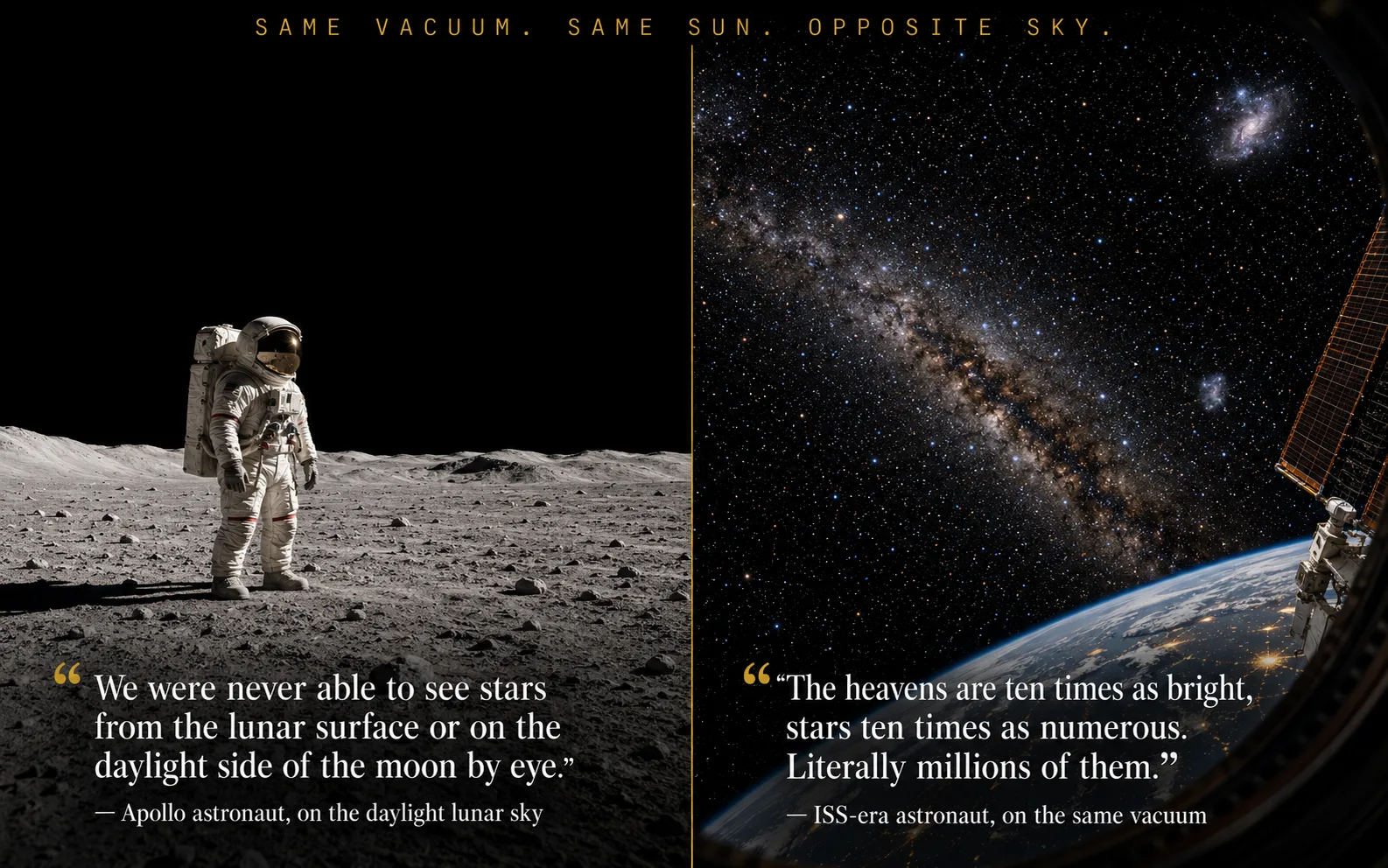
The contradiction at a glance
Quotes verbatim from the public record. The Apollo astronauts say they could not see stars from the daylight lunar surface. The ISS-era astronauts say space is so star-rich it can be seen through daylight, in the millions, with colours. Same medium, same eye — opposite reports.
The Apollo camp — the men who say they walked on the moon — uniformly report that the sky was a featureless black void, and that stars were not visible by the naked eye at all:
“The sky is deep black when viewed from the moon, as it is when viewed from cislunar space — the space between the earth and the moon. The earth is the only visible object other than the sun that can be seen. ... I myself did not see planets from the surface, but I suspect they might be visible.”
“We were never able to see stars from the lunar surface or on the daylight side of the moon by eye without looking through the optics. I don’t recall, during the period of time that we were photographing the solar corona, what stars we could see. I don’t remember seeing any.”
“The biggest visual surprise was just how black the sky was. You have a brilliant sun, brighter than any sun you normally would see even here in New Mexico. You have these extraordinarily high mountains — we were in a valley deeper than the Grand Canyon — but then you have this black sky, a sky blacker than black, as the old vidicon expression used to be. ... And we could not see stars. The sky, of course, was black, but it had sort of a velvet sheen to it.”
The ISS camp — the men who say they have lived for months at a time in low earth orbit roughly four hundred kilometres above the surface — describe a wholly different sky. They report, on the record, that the stars are visible essentially all the time, including in broad daylight, in numbers and colours impossible from any location on the ground:
“We have to realise that in space, without the intervening atmosphere, the heavens are ten times as bright, stars ten times as numerous, because there’s no atmosphere to block the light.”
“Yeah, because you can see the stars — and pretty much all the time you can see the stars. It’s not a black void. I mean, it’s black, but there’s all kinds of little polka dots. There’s all the stars there. And the cool thing is about it, you can see it during the day.”
“You can see planets. You can see moons. You see the Magellanic clouds — there’s a large one and a small one. And then you can see the zodiacal lights. Whoa. Those are amazing.”
“They’re brighter, but they’re different. One, you don’t have the atmospheric distortion, so they don’t twinkle. So you see lots of points, and you see lots of points — and literally millions of them. I live in Colorado, and you get up on a clear night in the mountains where there’s no light and you can see all these stars — well, multiply that by a thousand. That’s what it’s like in space. And then when you’re outside doing a spacewalk, and you have that one or two opportunities where you can let your eyes adjust, you can start to notice that some of the stars have colours we don’t see here on the ground.”
Lay the two camps’ statements side by side and the problem is inescapable. Armstrong, photographed standing on the surface of an airless body in the direct light of the sun, says the sky was a featureless black and that no stars were visible to the naked eye. A modern astronaut, in a craft orbiting at roughly four hundred kilometres altitude — still well within the influence of the earth’s atmosphere by the official model’s own physics — says the stars are ten times as numerous, ten times as bright, visible in millions, with colours, in broad daylight, all the time. The two reports cannot both describe the same medium with the same eye. One of them is wrong. The reader is left to weigh which group has a stronger motive to misremember.
The narrator of the documentary from which several of these quotations were drawn adds, in passing, a small observation that is worth recording. Michael Collins — the Apollo 11 command-module pilot, who initially confirmed Armstrong’s account that no stars were visible — later, in his autobiographical writings, began to recall seeing the “elusive stars” after all. As the narrator dryly puts it: it seems his memory improved the older he got.
Where are the actual photographs of satellites?
The same question that applies to the earth itself applies, in a stranger form, to the objects we are told are orbiting it. We are told there are tens of thousands of satellites currently in orbit — geostationary satellites at high altitude, low-earth-orbit satellites circling closer, and a much larger field of dead satellites and debris said to be cluttering the space alongside them. Official figures from NASA and various tracking organisations run into the hundreds of thousands of trackable objects. The environment is described, in the agencies’ own risk-assessment documents, as hazardously crowded.
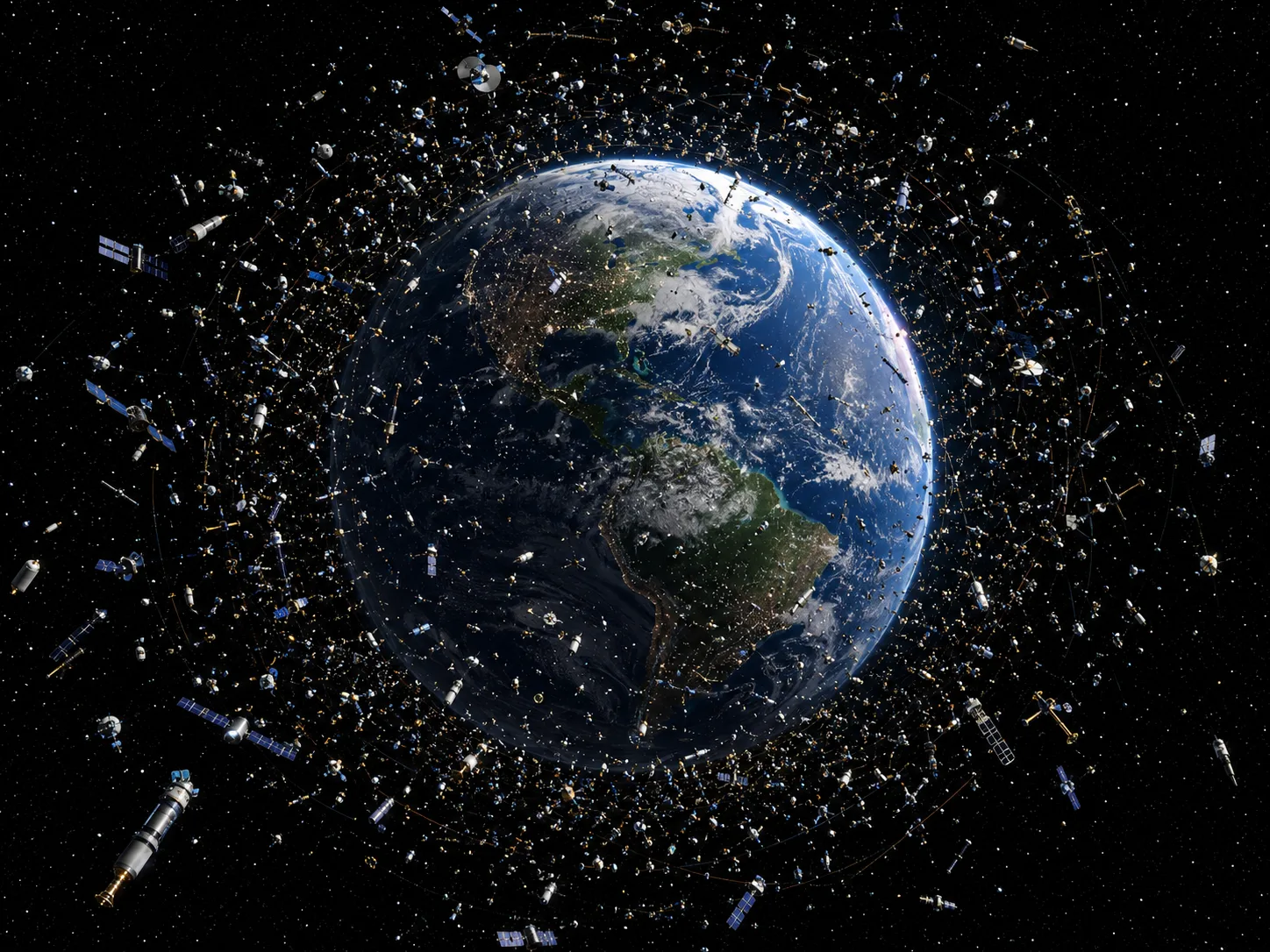
The official picture · earth surrounded by orbital traffic
This is the picture given to us: a planet hemmed in by a dense field of operational satellites, dead satellites, spent rocket stages, and fragments large and small. And yet when NASA operated round-the-clock live feeds from the International Space Station — feeds that have since been quietly discontinued — observers noted something curious: in years of uncut footage, the feeds never once showed a passing satellite, a tumbling fragment of debris, or any of the alleged tens of thousands of objects said to share roughly the same orbital altitude. For a region of space officially described as hazardously cluttered, the official window into it showed it consistently empty.
Set the dense official picture aside for a moment and ask a simpler question: where are the actual photographs of any of these objects? Search for images of any specific satellite — by name, by mission, by agency — and what comes back, almost without exception, is the same kind of imagery gathered below. Detailed, polished, beautifully lit renderings, with the earth dramatically curved beneath and the satellite floating in striking three-quarter perspective. The agencies themselves typically caption these as artist’s renderings, illustrations, or simulations in their own image libraries.
Reminder
The eight images in the gallery below are AI-generated illustrations rendered in the same visual style as the official agency renderings. They are stand-ins for the official images, used to make the same point without reproducing third-party copyrighted material. The point is about the genre of imagery, not any specific copyrighted piece.
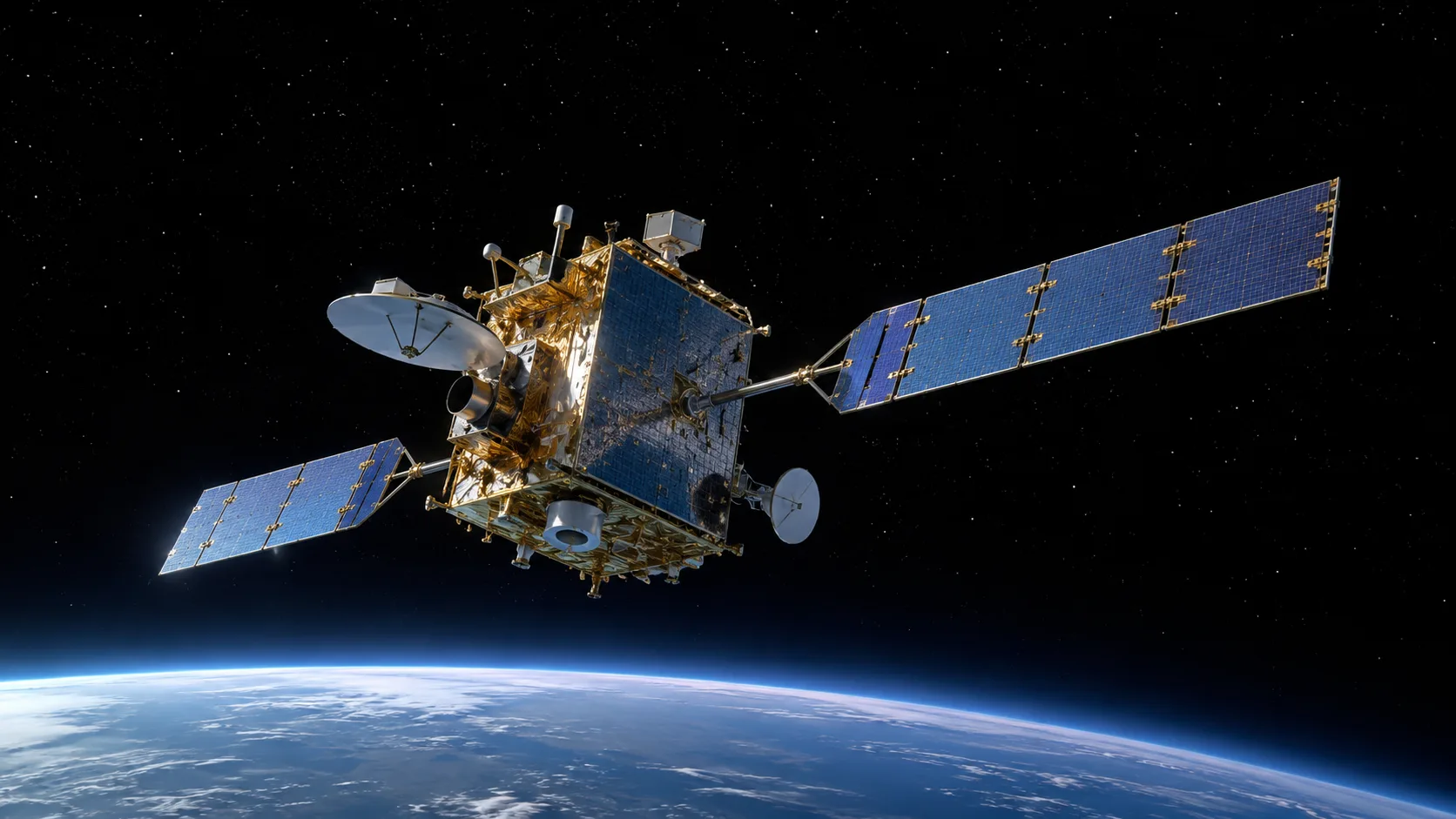
Communications satellite · rendering
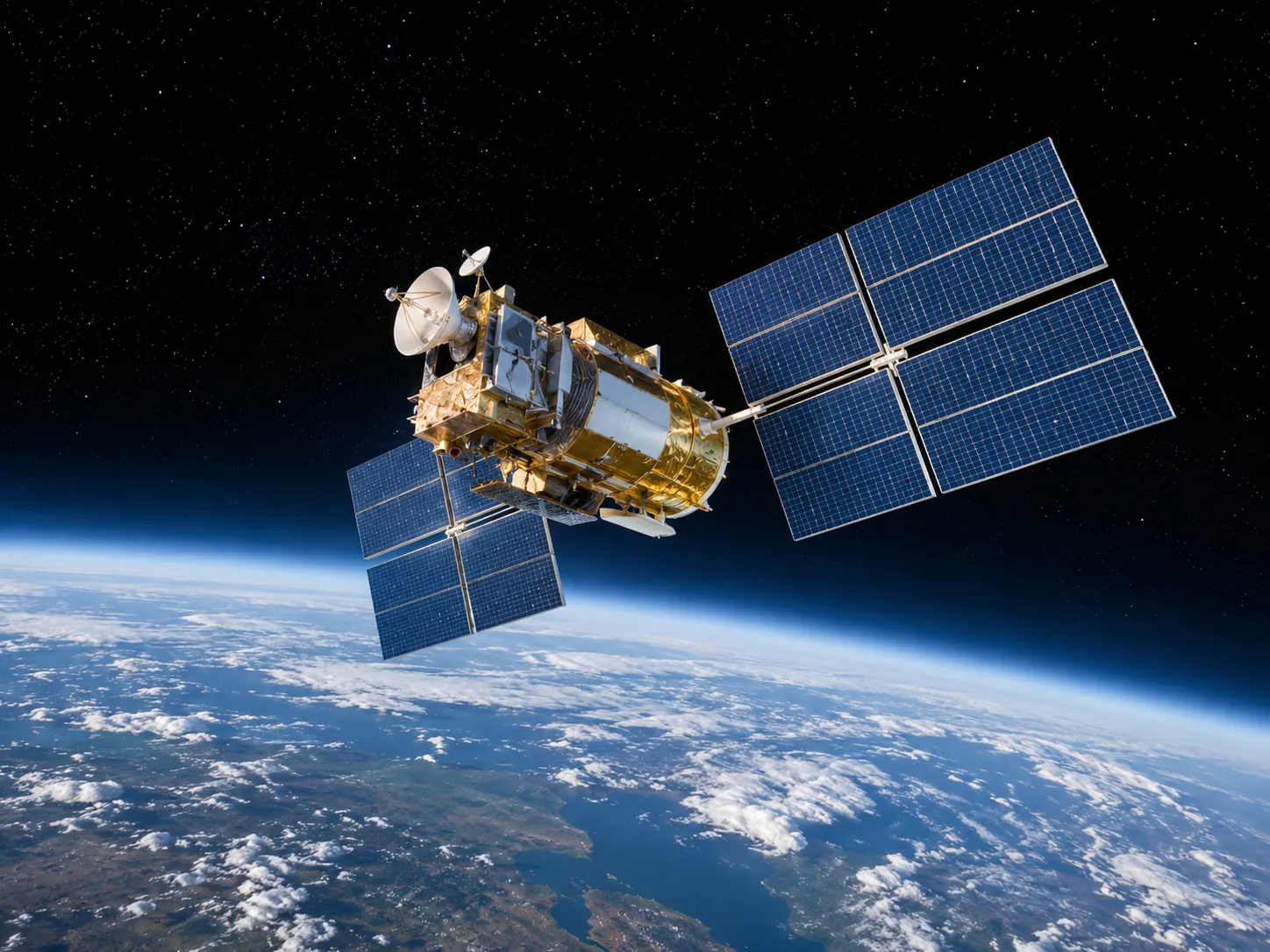
Observation satellite · rendering
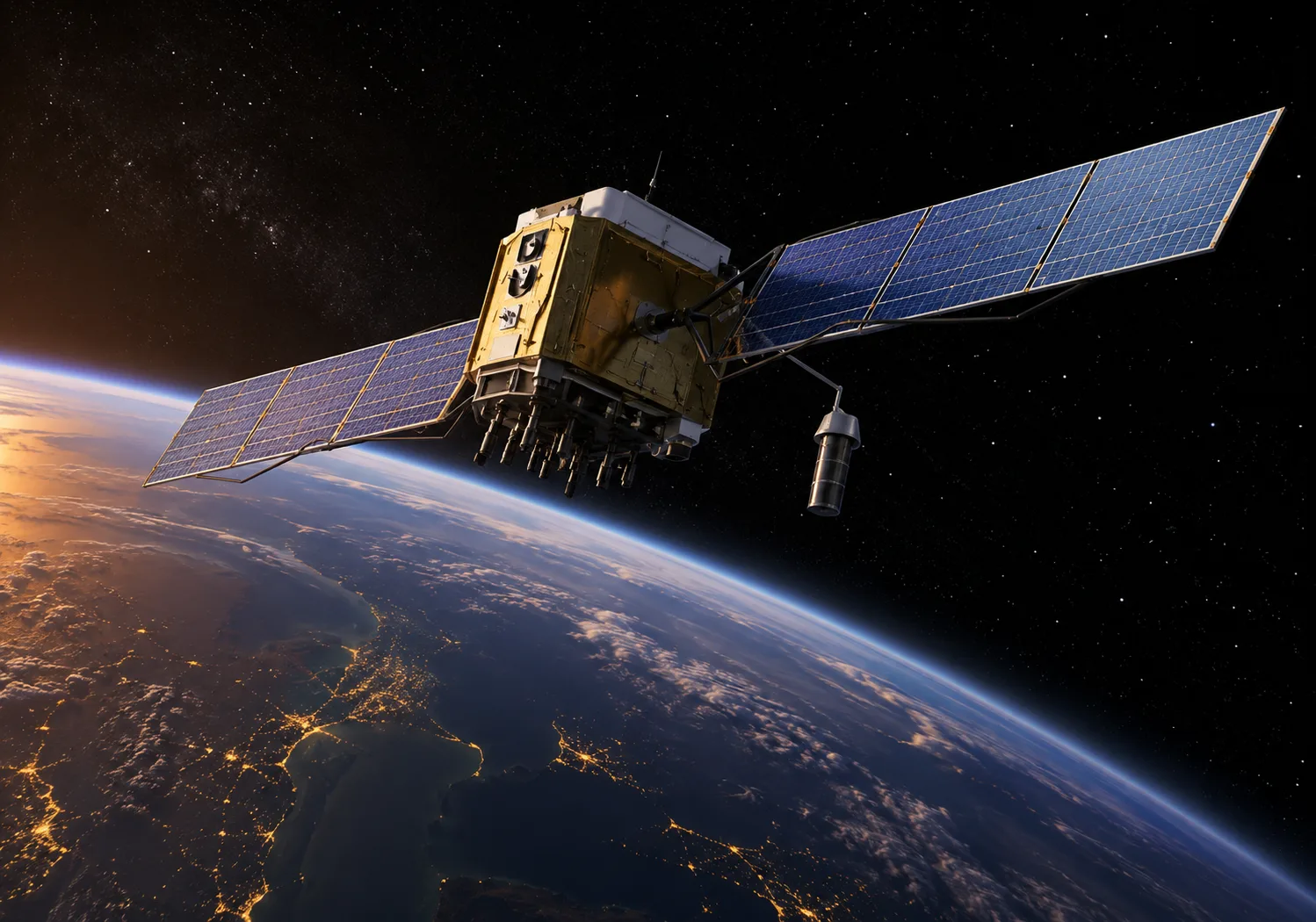
Night-side satellite · rendering
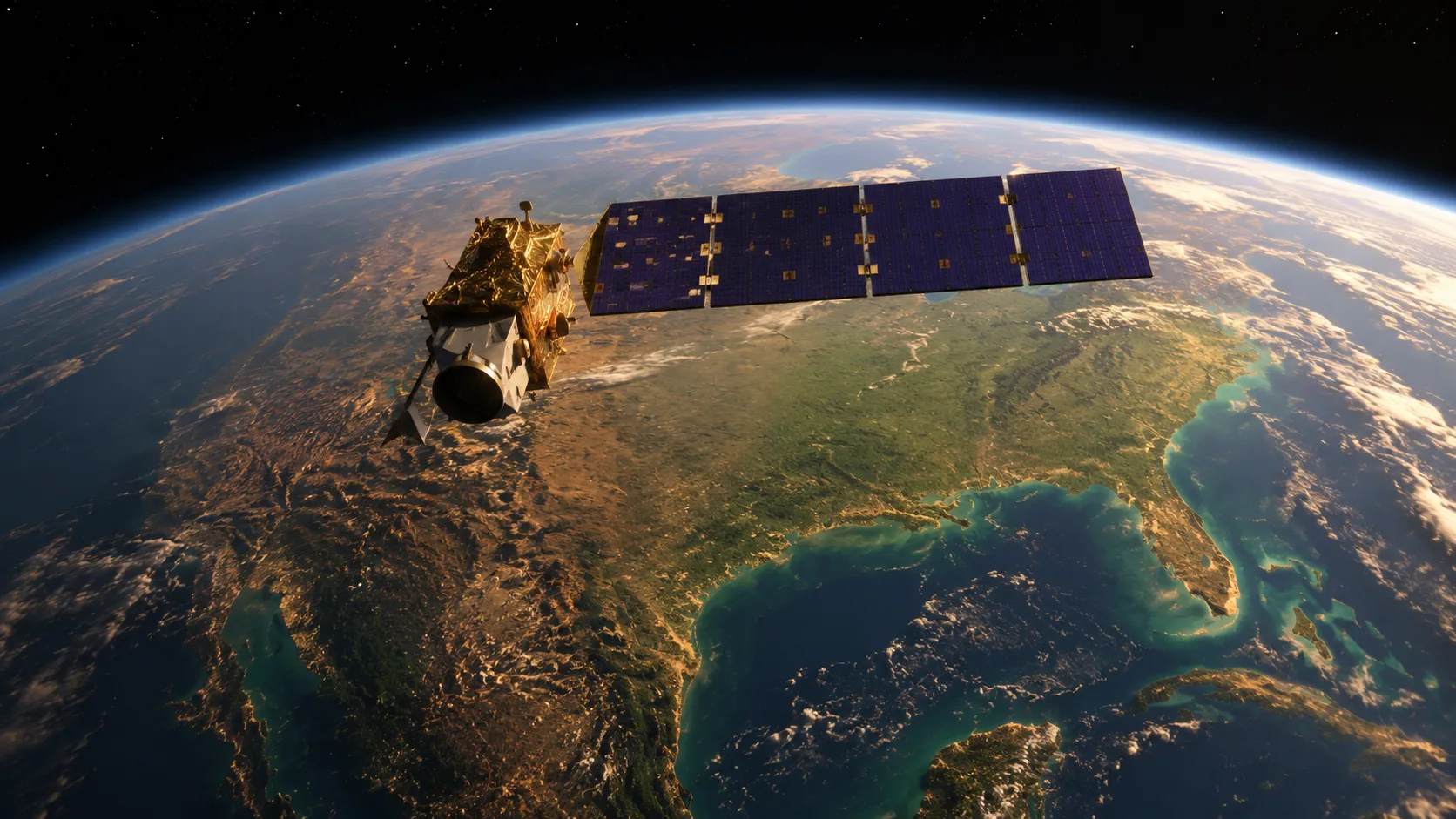
Imaging satellite · rendering
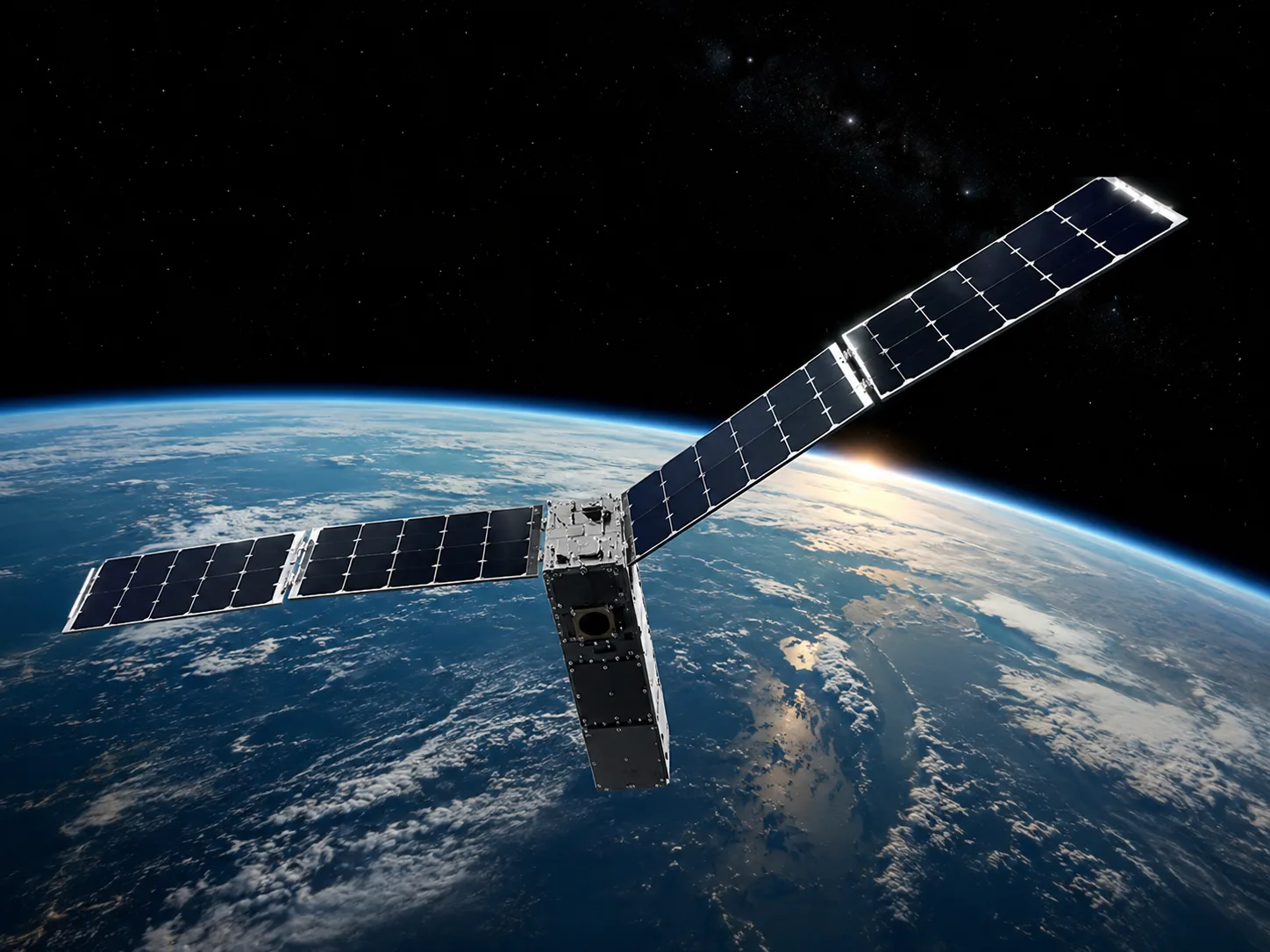
CubeSat-style · rendering
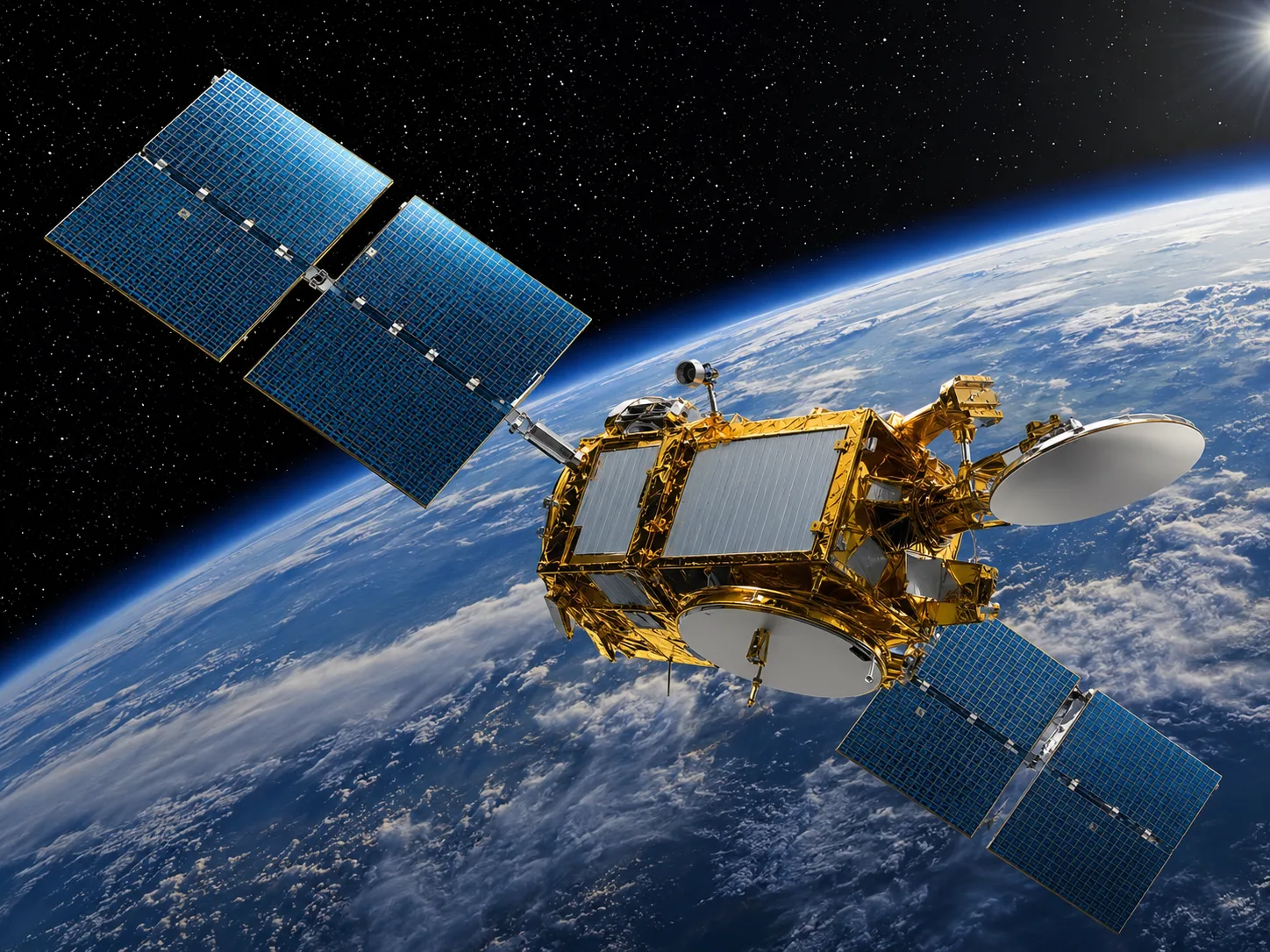
Geostationary satellite · rendering
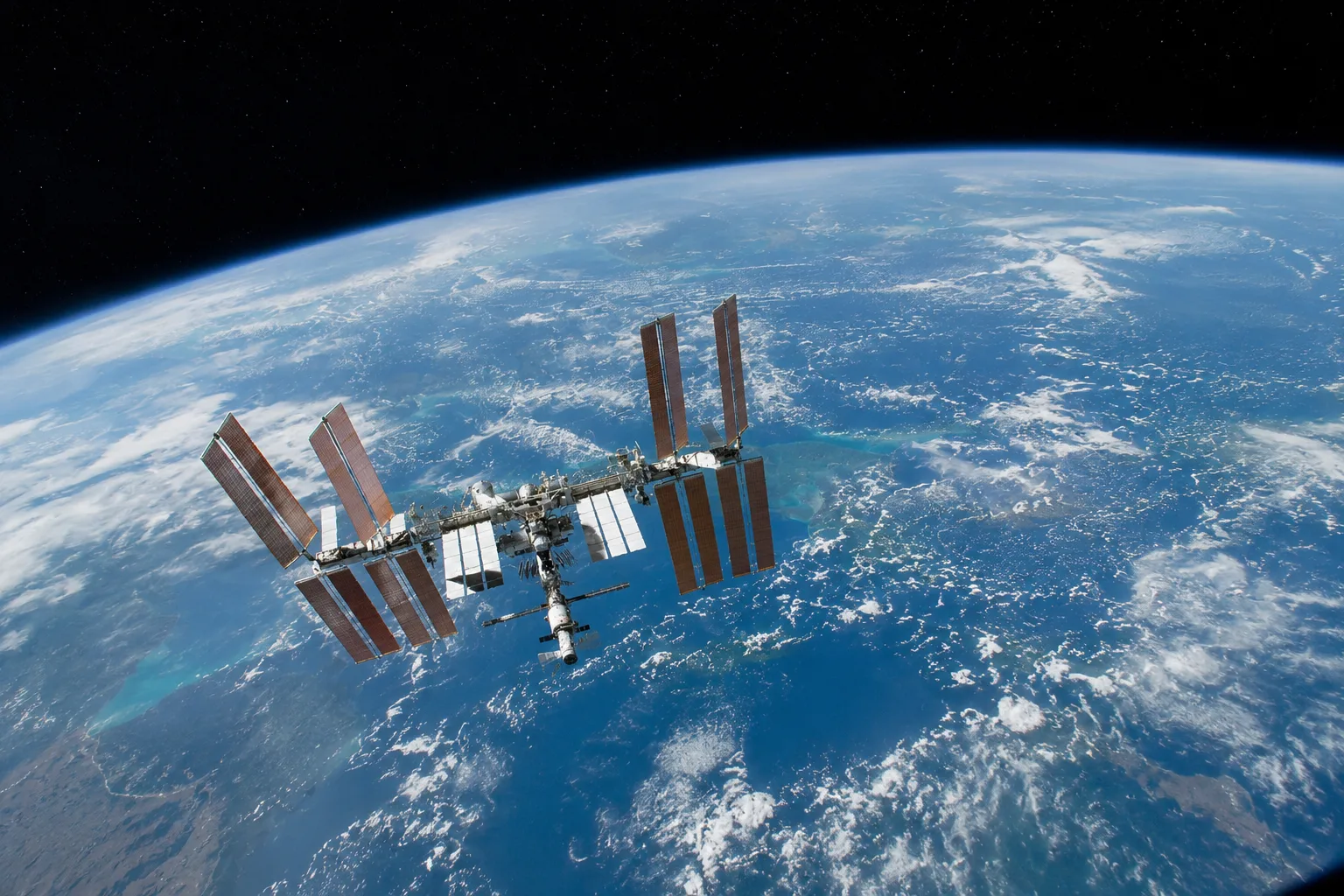
ISS-style station · rendering
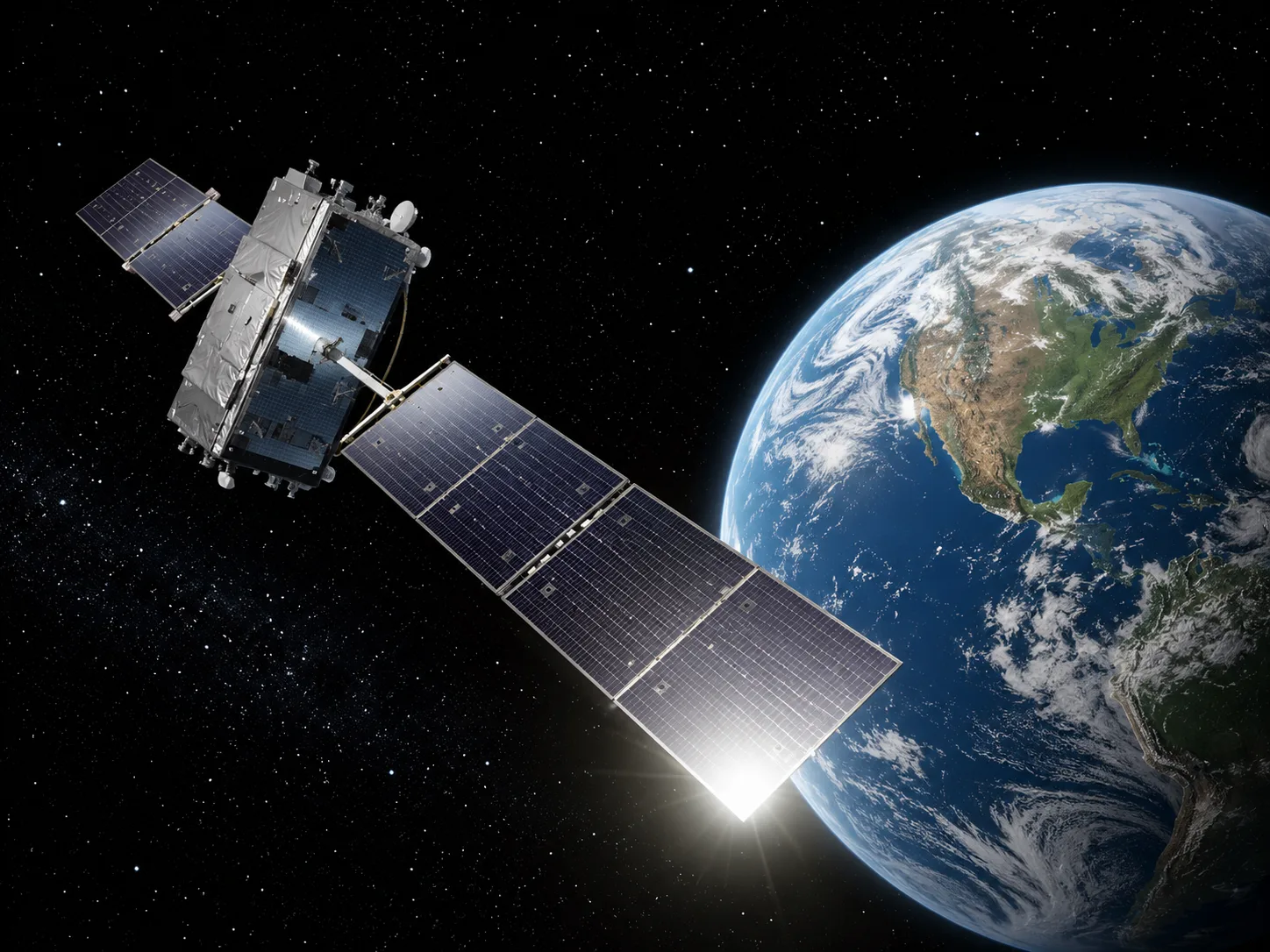
Earth-facing satellite · rendering
Two things are worth noticing about the genre. First, every rendering shows a satellite that is perfectly alone. The earth is curved beneath, the starfield extends behind, the solar panels are catching the sun at a flattering angle — and there are no other satellites anywhere in the frame, despite the dense official picture set out above this gallery. Second, and more strangely: every one of these renderings, if it were a photograph, would require another satellite a short distance away with another camera pointed back at the first one. And that second camera-bearing satellite never itself appears in any of the renderings either. Each image isolates one object in an empty field; together they imply a population that none of them ever depict.
And a third thing — quieter, and in its own way the strangest of all. The eight AI-generated stand-ins above were produced on a consumer laptop by a publicly available image generator, prompted in plain English, working from the same visual conventions as the official agency renderings they are modelled on. Examined side by side with the originals, the author found that the AI renderings arguably look more photographically convincing than the official images: better lighting, more grounded surface materials, more consistent shadow direction, fewer of the airbrushed-CGI tells that mark the agency outputs. When a consumer image generator on a laptop outperforms the official renderings produced by the agencies that supposedly operate the hardware being depicted, the genre has quietly answered a question about itself.
This is the same pattern the article has set out elsewhere. The signal infrastructure we use every day — cellular service, GPS, weather radar, fibre-optic internet — clearly exists. Its operation is observable. What is in dispute is not the existence of that infrastructure but the specific spatial picture of it the agencies have given us: tens of thousands of photogenic objects orbiting overhead, none of which can be photographed in their actual habitat, and all of which somehow fail to appear in the official live feeds from the one platform that is supposed to be among them.
What is, in fact, being launched: NASA’s balloon program
Alongside the unphotographable orbital population sits a second, far less publicised programme that the agency talks about openly when it talks about it at all — a programme that actually does loft hardware into the upper atmosphere, and whose physical existence is not in any dispute. NASA operates a continuous Scientific Balloon Program out of its Columbia Scientific Balloon Facility in Texas and the Wallops Flight Facility in Virginia, with major launch campaigns conducted from McMurdo Station in Antarctica. The agency’s own outreach is candid about both the scale and the purpose:
“Hi, I’m Matt, and this is NASA Now. NASA’s been using balloons for science research for over thirty years — the exploration that can be done on balloons is continuing to grow. A standard balloon that I fly is about six hundred and sixty feet long when it’s made; when it’s inflated, it’s over four hundred feet tall by four hundred and forty feet wide. Think of a dome stadium — that’s how big my balloons are.”
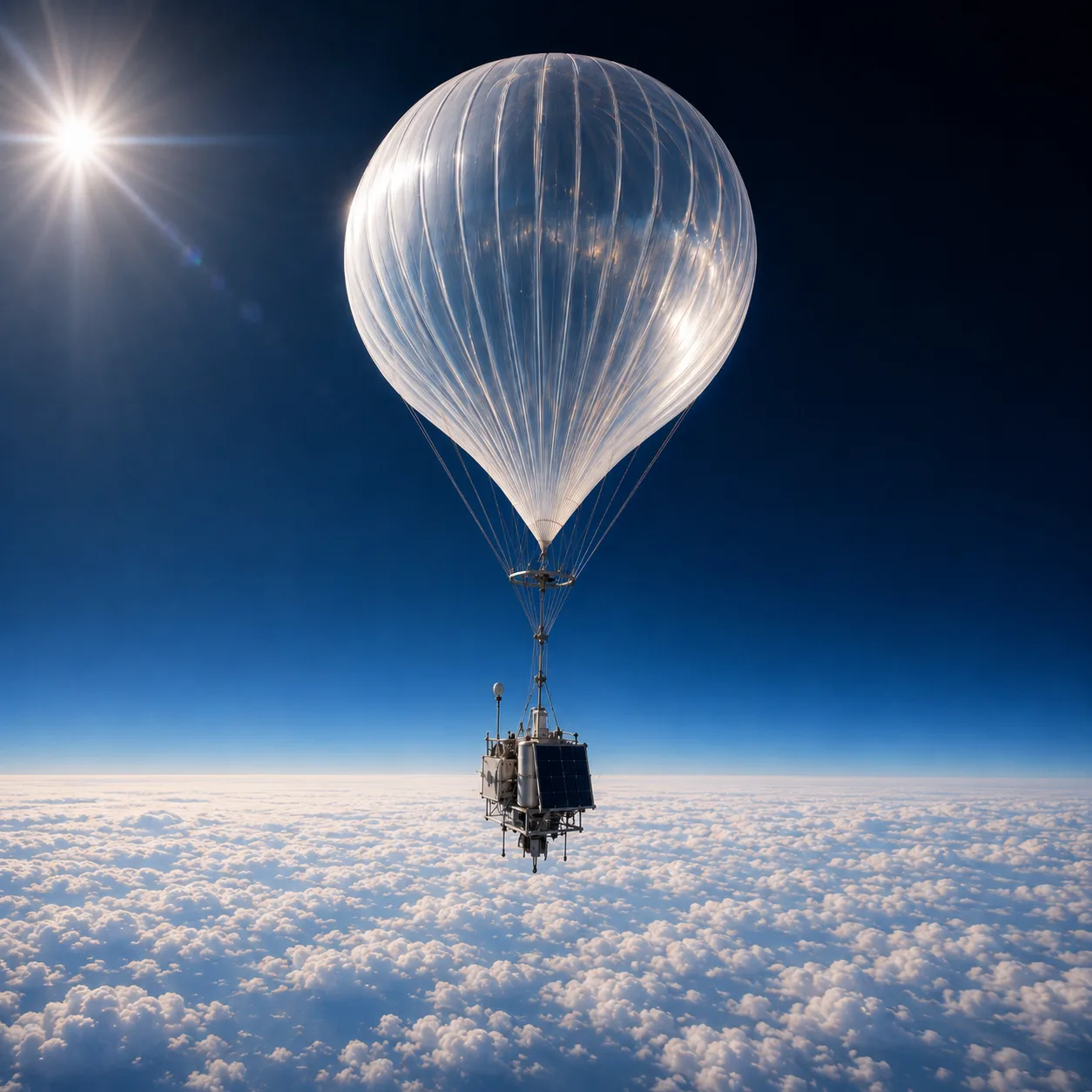
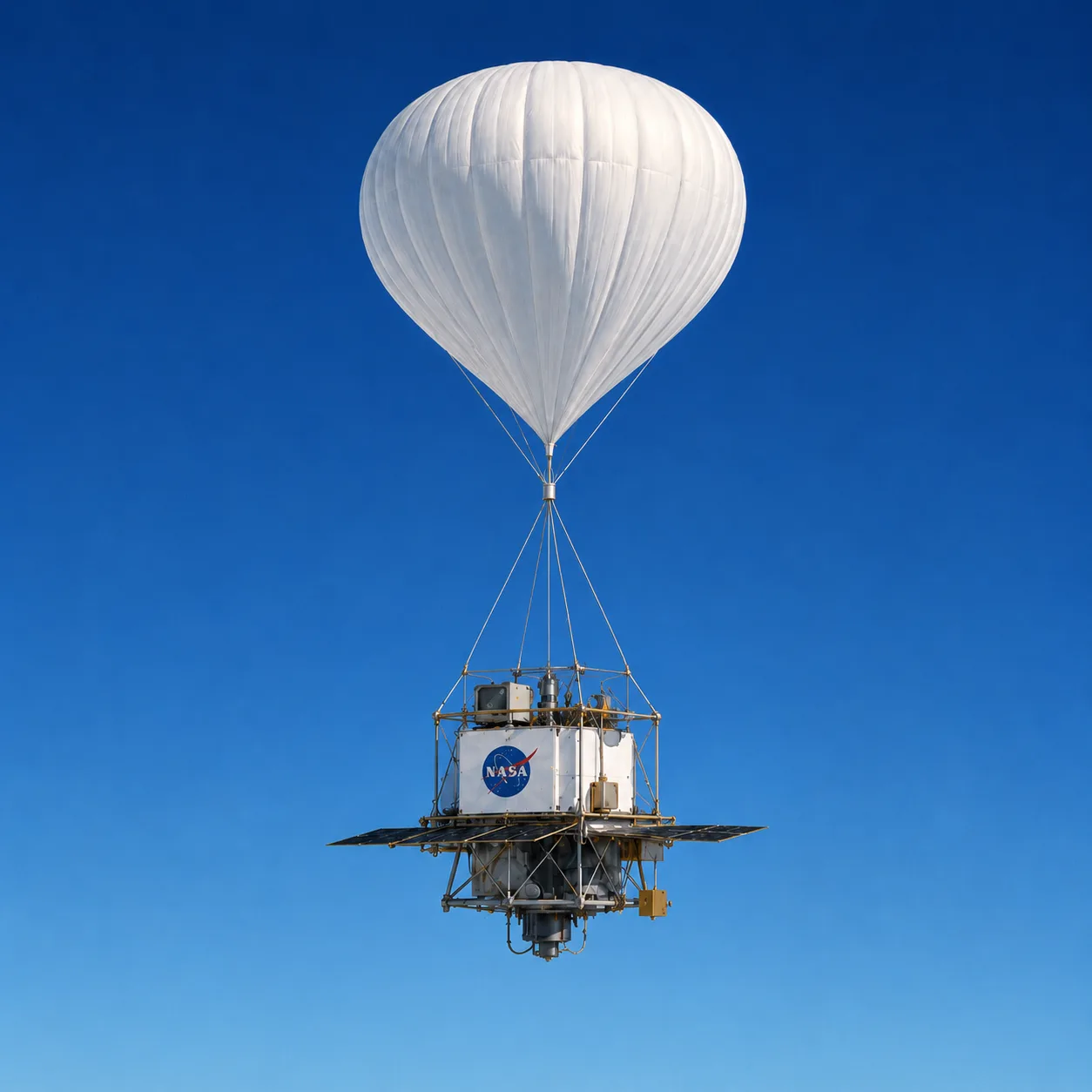
Balloon-borne instrument platforms · what NASA actually launches
Editorial illustrations of the kind of balloon-borne instrument platform NASA’s Scientific Balloon Program lofts to the upper atmosphere. Note the cubical payload, the suspension cabling, the solar panel array, and the antennae — visually almost indistinguishable from the hardware popularly depicted in the orbital-satellite renderings on the previous page. The substantive difference is altitude: tens of kilometres up, well within the atmosphere, returned to earth at the end of the mission.
These are not toy weather balloons. They are dome-stadium-sized, super-pressure helium platforms that carry instruments traditionally said to live on satellites: telescopes, atmospheric sensors, communications relays. NASA is, by a substantial margin, the largest single consumer of helium in the United States — a fact reported routinely in industry helium-supply analyses. When debris purported to be a fallen satellite has been recovered in remote areas of South America and elsewhere over the years, observers have noted on more than one occasion that the recovered hardware came down attached to what looked unmistakably like balloon or parachute apparatus, not to the remains of an orbiting platform. The author of this article will not press the recovered-debris anecdotes further than the photographic record warrants. The documented programme by itself is the point: the hardware we are told reaches a vacuum in low earth orbit is, in the cases where it is publicly launched and photographed end to end, lifted by helium to the top of the atmosphere and nowhere further.
A second, smaller observation belongs alongside the balloon programme. The dishes mounted on the sides of houses for “satellite” television service do not, in any country, point straight up at the sky. They point at roughly forty-five degrees toward the nearest ground-based repeater tower. If they were genuinely receiving from objects twenty-two thousand miles overhead in geostationary orbit they would, near the equator, point nearly to zenith. They do not, because the signals come from terrestrial infrastructure. The point is not that satellite-style television does not work — it plainly does. The point is that the picture we have been given of how it works does not match the way the dishes themselves are aimed.
A note on the internet’s actual backbone
The shape of the internet itself is a quiet case in point. The popular picture — data beamed down from a galaxy of satellites overhead — is broadly mistaken. By the industry’s own published figures, between 95 and 99 percent of all international internet traffic moves not through space but through roughly three hundred fibre-optic cables, each about the diameter of a garden hose, laid directly on the floor of the world’s oceans. They are manufactured by companies like Alcatel Submarine Networks in Calais, owned by consortiums of telecoms and the major tech platforms, and carry an estimated ten trillion dollars per day in economic activity. They have been the actual backbone of intercontinental communication since the first transatlantic telegraph cable was laid between Dover and Calais in 1850.
The relevant testimony is from the agencies themselves. Amazon Web Services, asked directly why the company invests so heavily in subsea infrastructure, answered plainly: “Without subsea, you’d have to rely on satellite connectivity, which can work. But satellite has higher latency, higher costs, and you just can’t get enough capacity or throughput.” The single most consequential piece of physical infrastructure in the modern world — the one your bank, the stock market, your video calls, and your streaming services actually depend on — is sitting silently on the ocean floor, not in orbit. The satellite picture circulating in textbooks and news graphics does not match how the internet actually works. It pairs neatly, however, with the broader spatial mythology this article has been examining.
A note on how the conversation has been managed
The case set out above has not been argued in a neutral information environment. Between 2018 and 2019, the largest video platform in the world made two formal, public decisions to suppress the visibility of flat-earth content specifically — by name. Both decisions were celebrated by major outlets at the time. Both bear directly on why this conversation has been difficult to have at all, and they deserve to be noted on the record.
2018 — “Information panels” under conspiracy content
In early 2018, YouTube introduced what it called information panels — fact-check links and Wikipedia-sourced summaries placed directly beneath videos the platform had categorised as advancing conspiracy theories. Flat-earth content was an explicit early target. The framing positioned the platform itself as the authoritative arbiter of what counted as conspiracy and what counted as established fact, with the linked Wikipedia article serving as the implicit standard of truth.
January 2019 — algorithmic demotion, with flat earth named
On 25 January 2019, YouTube published a formal blog post and gave statements to the BBC and other outlets announcing a complete overhaul of its recommendation algorithm. The platform would no longer push what it called borderline content via its “Up Next” sidebar. Unusually for this kind of corporate communication, YouTube named flat earth specifically as a prime example of the kind of content the new algorithm would demote.
The change followed research presented at the American Association for the Advancement of Science by Dr Asheley Landrum, who framed the spread of flat-earth belief as a rabbit hole problem — driven by YouTube’s recommendations and, in her own words, by viewers’ “combination of a conspiracy mindset and lower science intelligence.” The wording is worth noting. It is the framing under which the demotion was justified.
The press response
The response from the mainstream press was uniformly celebratory. Forbes, in a piece by Fruzsina Eordogh dated 28 January 2019, headlined the move “YouTube Stops Recommending Conspiracy Videos, Finally.” The adverb at the end did the editorial work. No prominent piece in the mainstream press at the time engaged seriously with the question of whether the largest video platform in the world ought to be empowered to demote content categories by name, or whether the readers and viewers framed as holding “lower science intelligence” had any standing to be heard before being algorithmically demoted.
Why this matters for the article in front of you
The point is not that YouTube was wrong to make business decisions about its own algorithm. It is a private company; it can do as it wishes. The point is that the conversation about whether the modern cosmology is what it claims to be has been actively managed — by named institutions, at platform scale, with the explicit cooperation of mainstream press — for the better part of a decade. A reader who reaches this page in 2026 is reading something that the dominant information infrastructure has spent years working to keep them from encountering.
That fact does not prove the case set out above; the case still has to stand on its own merits. But it does answer a question a reasonable reader is entitled to ask: why is this the first I am seeing of any of this? The answer is not that the case is too weak to have surfaced naturally. The answer is that the surfaces on which it might have appeared were retuned, by name, to ensure that it did not.
Why I hold this position
A personal note from the founder
I hold this position for the simplest of reasons. I do not believe the Bible describes a globe flying through a void. The plain language of more than two hundred verses describes something quite different — an outstretched, enclosed realm that God created and placed His people within. Where Scripture and man’s institutions disagree, I stand with Scripture. That alone would be sufficient ground.
But the path that brought me here did not begin with Scripture, and that detail is worth knowing.
I first encountered this material in late 2016. From then through 2019 I followed the subject closely, and have continued to examine it in the years since. What appears on this page is not the product of a recent investigation; it is the accumulated reading of close to a decade.
Before I looked at the biblical evidence, I looked at the historical record and at the kind of scientific evidence a person can verify with his own eyes — not the kind that requires the world’s most expensive equipment to mediate. What I found there was substantial on its own. The horizon, observed honestly from high altitude, refuses to curve. Distant skylines and landmarks remain visible far past the distances the standard curvature math would permit. Cameras with adequate magnification have repeatedly shown landmarks at distances where they should be hundreds or thousands of feet below the line of sight. Other observers, using considerably more expensive equipment, have produced footage suggesting the stars are far closer than the official figures claim.
The astronaut record told its own story — on-camera blunders, self-contradicting statements, footage from inside the ISS that clearly betrayed harnesses, green-screen and blue-screen techniques (a backdrop visibly caught on a large monitor in at least one NASA video clip), and what appeared to be augmented-reality compositing. I watched astronauts fade off screen between cuts. I watched objects supposedly in zero gravity fall to the floor when their handlers released them. I watched more air bubbles than I can count rise through the supposed vacuum during spacewalk footage. Any one of these things, taken alone, could perhaps be dismissed as an outlier. The accumulation could not.
The biblical evidence came weeks — perhaps as much as a month or so — after the historical and observational investigation was already well under way. By the time I opened my Bible with this question in mind, I was prepared to read it without the assumption I had carried all my life. What I found there did not contradict what I had been seeing in the record. It confirmed it.
This position has a social cost. Holding it openly invites mockery from people who have never examined the underlying evidence — and, I have learned, sometimes that mockery comes from professing Christians who hold the Bible to be the Word of God in every other domain except this one. That cost is real and I would not pretend otherwise.
But truth is worth the cost. Especially truth that any reader, with patience and an open Bible, can verify for himself.
If you want to read more about the cosmology subject
Extended cosmology — for the reader who wants to go further
The handful of observational arguments above represents only a small fraction of the case. What follows is a more extensive survey, drawn from two source documents. The first is a published list of two hundred observational and historical proofs, popularly attributed to Eric Dubay and widely circulated since. The second is a documentary entitled Heliosorcery, produced by a Seventh-day Adventist ministry, that traces the religious and political history of the heliocentric model from the Counter-Reformation forward. The author of this article does not adopt every tonal claim in either source. What is gathered below is what he finds substantively significant — the kind of material readers who have heard only the standard institutional account are owed the chance to weigh.
The proofs come first; the historical context follows. No single observation here is intended as a knock-down case in isolation. The cumulative weight is what carries the argument: dozens of independent observations, drawn from engineering, navigation, optics, astronomy, history, and Scripture, each pointing the same direction.
Part A — A more complete catalogue of observational proofs
The full list contains two hundred items. They are not all of equal weight. Some are repetitive variations on a single principle; some are stronger than others; a few are historical anecdotes rather than reproducible experiments. What follows is a thematic condensation. The verses-by-theme catalogue above remains the centre of this article’s case. This section gives the curious reader more of the kind of material that, on the author’s own reading, mainstream rebuttals tend to wave away by appealing to institutional authority rather than answer on its own terms.
1. The horizon and the curvature that isn’t there
The horizon always appears perfectly flat, 360 degrees around the observer, regardless of altitude. All amateur balloon, rocket, plane, and drone footage — taken up to more than twenty miles high — shows a completely flat horizon. Only NASA and other government space agencies produce footage showing curvature, and that footage relies almost universally on wide-angle (“fish-eye”) lenses, which produce the same convex distortion when pointed at a flat horizon. Lens- corrected high-altitude footage (such as the inside camera of the Felix Baumgartner stratosphere dive, at 128,000 feet) shows a perfectly level horizon.
Furthermore, the horizon rises to the observer’s eye level as altitude is gained. On a globe, no matter how large, the horizon would remain fixed and the observer would have to tilt his gaze downward further and further to see it. On an extended plane, the horizon rises with the observer — which is exactly what is reported. Looking out an airliner window at 35,000 feet, the horizon is visible at eye level out both port and starboard windows simultaneously. On a globe, those views should show nothing but outer space.
2. Water finds its level — everywhere
The natural physics of standing water is to find and maintain its level. If the earth were a giant sphere, no truly flat, consistently level surface would exist anywhere; every standing body of water would have to curve at eight inches per mile squared. Along a six-mile channel of still water, the centre would have to bulge six feet above the line drawn between the ends. Every time such experiments have been conducted, standing water has proven to be perfectly level.
Samuel Rowbotham’s nineteenth-century experiments at the Old Bedford Level are the best-known of these. Standing in the canal with a telescope held eight inches above the water, Rowbotham watched a five-foot flag on a boat sail away six miles. On a globe, the entire boat and flag should have disappeared behind six feet of curvature in the centre. They did not. A second experiment with five-foot flags set at every mile marker showed all six flags in a perfectly straight line — impossible if the canal lay on a curved surface.
Engineering practice corroborates this. The Suez Canal, one hundred miles long with no locks, was cut along a horizontal datum line passing through several lakes, with no allowance whatever made for curvature. The Manchester Ship Canal Company stated plainly: “It is not the practice in laying out public works to make allowances for the curvature of the earth.” Engineer W. Winkler, writing in the Earth Review, put it more sharply: “I have projected many miles of railways and many more of canals and the allowance has not even been thought of, much less allowed for.”
3. Visible landmarks well beyond the calculated curve
The standard globe formula gives the drop below the line of sight as eight inches multiplied by the square of the distance in miles. Yet a long list of routinely observed sightings make no sense under that formula. A representative sample:
Skylines and mountains seen beyond their predicted curve
Chicago skyline visible from 60 miles across Lake Michigan — should be hidden behind 2,400 feet of curve · Philadelphia skyline from Apple Pie Hill, NJ, 40 miles away — should be hidden behind 335 feet · New York skyline from Bear Mountain, 60 miles — should be hidden behind 1,700 feet · Statue of Liberty from 60 miles — should be 2,074 feet below horizon · From Genoa, Italy: Gorgona (81 mi), Corsica (99 mi), Capri (102 mi), Elba (125 mi) — each well below predicted line of sight · Mount McKinley from Anchorage, 130 miles — should have nearly half its 20,320-foot height covered by curve · Notre Dame spire seen from 150 miles — should be a full mile (5,280 ft) below horizon
Lighthouses present the same pattern — repeatedly visible at distances far exceeding what the globe model permits. The Dunkirk light (194 ft) is visible from twenty-eight miles at sea, where it should be 190 feet below the horizon. The Port Said light in Egypt (60 ft) has been seen from fifty-eight miles, where it should be more than 2,180 feet below the line of sight. The Statue of Liberty, Cape Bonavista, Cape Lagoulas, the Isle of Wight light, and the Notre Dame entrance spire are among many other documented cases. Across the Irish Sea, Douglas Harbour on the Isle of Man and Great Ormes Head in North Wales are mutually visible on clear days at sixty miles, with the Welsh coast appearing as a perfectly straight 50-mile line — neither observation possible on a curved surface.
4. Engineering, surveying, and ship navigation
Surveyors, engineers, and architects are not required to factor the supposed curvature of the earth into their projects. Canals, railways, bridges, and tunnels are cut and laid horizontally, often over hundreds of miles, without any such allowance. The London and North Western Railway forms a 180-mile straight rail between London and Liverpool; the line’s highest point at Birmingham station sits only 240 feet above sea level. If the earth curved as taught, Birmingham would have to stand more than five thousand feet higher than the endpoints.
At sea, both plane sailing and great-circle sailing use plane trigonometry, not spherical, in their most popular forms — making all calculations on the assumption that the earth is perfectly flat. This has worked accurately for thousands of years. Where it has notoriously failed is in the deep southern hemisphere: Captain James Clark Ross and Lieutenant Charles Wilkes both recorded their southern voyages as being persistently “out of reckoning” — by twelve to sixteen miles per day, sometimes by twenty-nine — in a pattern entirely inconsistent with a globe but exactly consistent with a flat azimuthal projection in which southern latitudes describe ever-larger concentric circles, not smaller.
Antarctic circumnavigations make the same point. Cook, Ross, and the British Challenger expedition each clocked between fifty and sixty-nine thousand miles in their voyages around Antarctica — against the globe model’s claim that the southern circumference should be no more than twelve thousand miles at most.
5. The sun, the moon, and the local-light evidence
Amateur high-altitude balloon footage repeatedly shows a clear hot-spot reflection on the cloud cover directly below the sun. That is the behaviour of a near, local source illuminating a bounded area — not of a uniformly distant body 93 million miles away. Photographs of sun rays converging through cloud breaks similarly show those rays meeting at a point not far above the clouds themselves. Trace the rays back and the convergence point is local, not astronomical.
Sun and moon appear, to the unaided eye, the same size in the sky and to trace similar paths at similar speeds. The globe model is forced to claim that this near-identical appearance is a coincidence produced by the sun being precisely four hundred times larger than the moon and precisely four hundred times farther away. A simpler reading is that the two bodies are in fact comparable in size and distance and behave like what Genesis 1 calls them: two lights set in the firmament.
The moon, on closer examination, is not a passive reflector but an independent source. Sunlight is warm, drying, antiseptic; moonlight is cool, damp, and septic. Sunlight collected to a focal point creates heat; moonlight collected the same way does not — and the Lancet medical journal recorded in 1856 that concentrated moonlight could in fact reduce a thermometer reading by more than eight degrees. The light of the two bodies is qualitatively different, which is impossible if the second is merely reflecting the first.
Lunar eclipses are sometimes claimed as proof of the globe because the curved shadow on the moon is said to be the earth’s. But notice that the very word “shadow” already assumes the cause it is meant to prove. What is actually seen is a darkening that creeps across the moon; whether it is the earth’s shadow at all is the question, not the answer. And there is reason to hold it open. Selenelions — eclipses in which both the sun and the moon stand above the horizon at the same time — have been recorded since antiquity; on the standard account the sun, earth, and moon must be in a straight 180-degree line for the eclipse to occur, which cannot be if both luminaries are above the horizon. Some other explanation is required, and the curved shadow alone is not it.
The moon, in fact, is stranger than the schoolbook allows. A number of careful observers report things hard to reconcile with a solid, opaque sphere — among them stars apparently seen through the moon, sometimes of different colours, along with other anomalies in its light and its phases. The craters raise a question of their own: they are so uniformly round that one fairly wonders why bodies arriving from every angle did not leave long, oval scars — though the standard reply deserves a hearing, that a strike at such speeds is less a collision than an explosion, and an explosion digs a circular pit whatever the angle of approach. Whether that fully accounts for what the eye sees on the moon, I leave to the reader to weigh. I do not present any of this as settled, and I will not tell you with certainty what the moon is, what it is made of, or what causes the darkening men call its eclipse. I have my own opinions, and I will not hand them to you as facts. This much only is the point here: the darkened moon does not, by itself, prove that the ground beneath your feet is a spinning ball.
Centuries-old stone sundials and moon dials continue to tell time accurately to the minute. They would not, if the earth and its luminaries were in fact subject to the many overlapping rotations, revolutions, wobbles, and translations modern astronomy attributes to them.
6. Stars, parallax, and the immovable polestar
Polaris stands directly above the north central point and does not move. It can be observed not only at high northern latitudes but well into the southern hemisphere — up to more than twenty degrees south of the equator. On a globe, this is geometrically impossible; the observer would have to be looking through miles of bulging earth and ocean to see it. The constellations surrounding Polaris turn perfect circles around it, all the way down to the Tropic of Capricorn — also impossible if the earth beneath the observer were rotating at a thousand miles per hour.
Tycho Brahe’s parallax argument has never been answered on the globe’s own terms. If the earth orbits the sun at ninety-three million miles distance, then over six months the baseline of observation shifts by some 186 million miles, and the relative positions of nearby stars ought to shift accordingly. After centuries of looking, no stellar parallax of the kind expected has been detected — only minuscule oscillations that fit equally well, or better, with a near and stationary cosmos.
The same constellations have remained in the same fixed patterns for thousands of years. If the entire galaxy were speeding through space at the velocities modern astronomy claims, while the solar system also moved within it and the earth tilted, wobbled, rotated, and revolved beneath us, the night sky should never repeat. It does — to the minute.
7. Cannons, projectiles, planes, and the “spin” question
If the earth were spinning eastwards at over a thousand miles per hour at the equator, vertically fired projectiles should land hundreds of feet to the west of where they were fired. In practice, vertically fired cannonballs land within a few feet of the cannon — often back into the muzzle. East-firing and west-firing cannons cover the same distance, when on a spinning earth the eastward and westward shots should differ dramatically.
Helicopters and hot-air balloons do not hover and wait for their destinations to rotate beneath them. Felix Baumgartner, ascending for three hours over New Mexico, landed a few dozen miles east of his takeoff point, not 2,500 miles west in the Pacific Ocean as the spin model would require. Commercial flight times tell the same story: Los Angeles to New York takes about 5.5 hours eastbound and roughly 6 hours westbound — a near-symmetry that is incompatible with a 500-mph eastward rotation underneath but exactly what one would expect on a stationary earth.
A note on the equator water-rotation demonstration
The popular tourist demonstration — usually performed at some marked “equator line” with a portable basin showing water draining one direction north of the line and the opposite direction south of it — is a confirmed hoax. The demonstrator manipulates basin shape and the angle of water entry; the same trick works in either direction at any location on earth. Mainstream physics is actually on the right side of this one: the Coriolis effect, which does measurably influence very large weather systems, is far too weak to overcome basin geometry and residual water motion at bathroom scale. Sinks and toilets in the same household regularly drain in opposite directions on the same day.
What is worth noting is that the demonstration is still presented as everyday casual evidence of the earth’s rotation — in textbooks, in tourist brochures, in schoolyard explanations — even though the underlying claim has been falsified for decades. It is the kind of background “proof” that does its work not by surviving scrutiny but by never being scrutinised.
8. The atmosphere and the gravity problem
The atmosphere cannot be both perfectly “stuck” to a spinning earth (so that the thousand-mile-per-hour spin is nowhere felt or measured) and simultaneously fluid enough for birds, insects, clouds, fireworks, smoke, and aircraft to move freely against it in every direction. The two requirements are mutually exclusive. The proposed answer — that gravity drags the atmosphere along in perfect lockstep up to some unspecified altitude where it meets the vacuum of space — has never been observed, measured, or coherently described.
Gravity itself, on closer examination, is an unfalsifiable invocation. No experiment has ever shown an object massive enough, by virtue of its mass alone, to attract a smaller mass to it. The phenomenon is asserted on the basis of theory and applied retroactively to whatever needs explaining: oceans bound to a sphere, atmospheres co-rotating with it, satellites held in orbit, planes free to take off, birds free to fly. The ordinary physics of density and buoyancy fully account for falling objects and rising ones — and did so for centuries before Newton ever wrote.
The second law of thermodynamics adds another problem. Any physically spinning earth would experience drag and slowing over time — measurably, observably so over the course of recorded history. No such slowing has been observed. The day is the same length it has been since astronomical records began.
9. Flight paths in the southern hemisphere
On a flat azimuthal projection of the earth — north pole at the centre, Antarctica forming the outer ring — many otherwise inexplicable commercial flight paths make immediate sense. Cape Town to Buenos Aires routes north through London, Turkey, or Dubai rather than straight across the South Atlantic. Sydney to Santiago goes via Los Angeles. Johannesburg to Perth goes via Dubai, Hong Kong, or Malaysia. Johannesburg to São Paulo refuels in London. Santiago to Johannesburg refuels in Senegal — in the northern hemisphere — which on a globe makes no sense and on a flat azimuthal map lies precisely on the straight line between the two cities.
No verified non-stop north-south circumnavigation of the earth is on the public record. Commercial flights do not cross Antarctica even when doing so would represent the most direct route. The Antarctic Treaty, signed in 1959, severely restricts independent access to the continent, with military enforcement — an unusual posture for a body of land claimed to be merely the bottom of a globe.
The reader will have noticed a date pattern emerging across the foregoing sections. The most consequential events in the modern human record on what lies overhead — and on what lies beyond what is conventionally said to be the bottom of the world — cluster within a single generation, between roughly 1946 and 1969. A widely-circulated visual summary of the sequence is reproduced below.
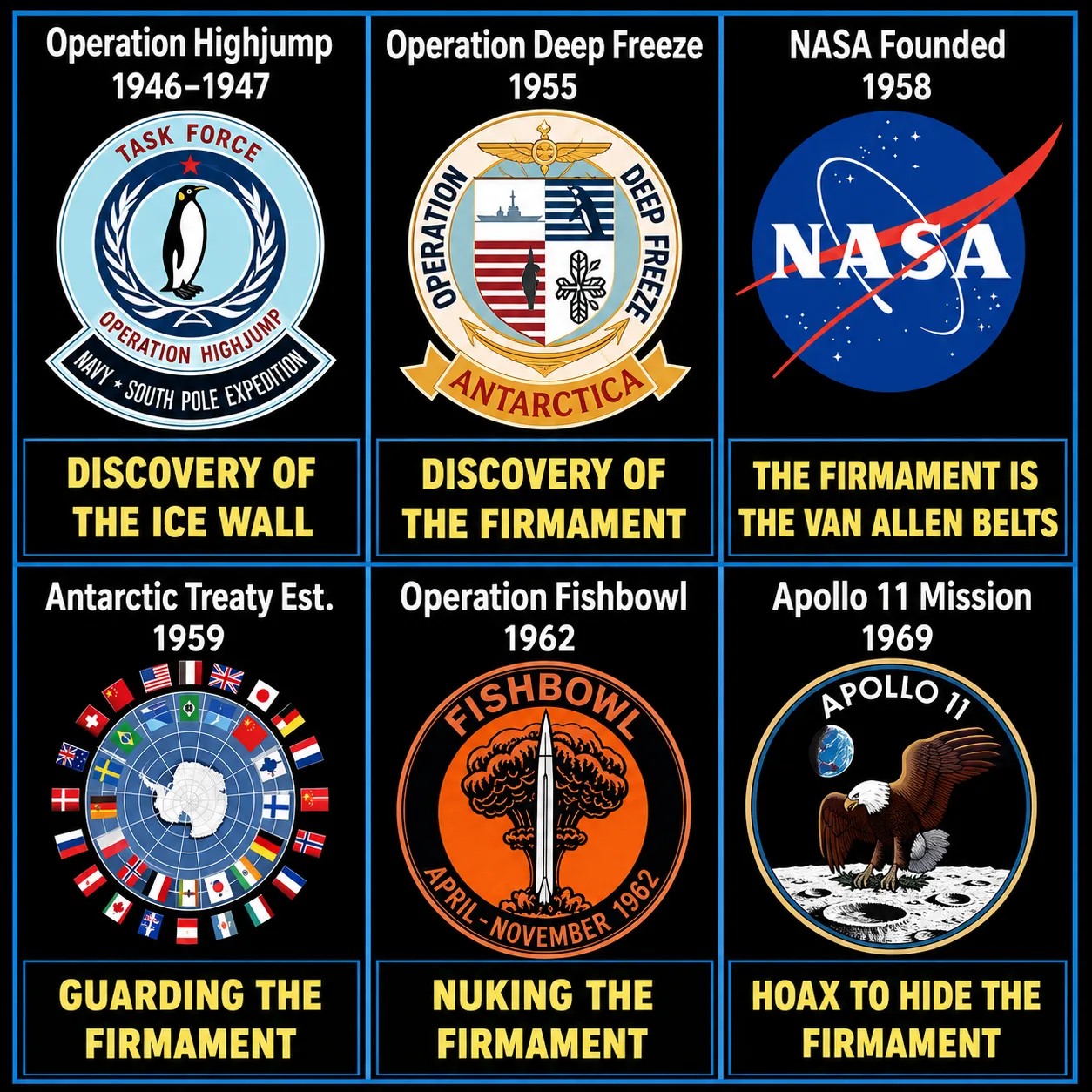
1946–1969 · the most consequential twenty-three years in modern cosmology
Six events, each individually verifiable from US government and treaty-organisation records, presented together as a single sequence. The editorial captions are interpretations; the dates and operations themselves are historical fact.
Each of the six events on the panel is a matter of public record. Operation Highjump (1946–1947) was a US Navy expedition under the operational command of Admiral Richard E. Byrd, comprising approximately 4,700 men, thirteen ships, and the aircraft carrier USS Philippine Sea — directed not toward the Arctic, where any postwar Soviet threat then lay, but southward toward Antarctica. Operation Deep Freeze (beginning 1955 and continuing today) is a series of US Navy logistical operations supporting research on the same continent. NASA was established by the National Aeronautics and Space Act on 29 July 1958 — the same year James Van Allen’s Explorer 1 satellite identified the radiation belts now bearing his name. The Antarctic Treaty was signed on 1 December 1959 by twelve original nations, designating the entire continent off-limits to military activity, mining, and territorial claim — an arrangement now subscribed to by fifty-six nations and unique in international law for its scope and duration. Operation Fishbowl (April–November 1962, conducted from Johnston Atoll as part of the larger Operation Dominic) detonated a series of high-yield thermonuclear devices at high altitude. The most famous — Starfish Prime, 9 July 1962, approximately 400 km altitude, 1.4-megaton yield — produced an electromagnetic pulse strong enough to disable power infrastructure in Hawaii a thousand miles distant and left artificial aurora visible across the Pacific for days. Apollo 11 is the moon-landing claim itself, in July 1969.
The editorial captions on the infographic are interpretations, and the author will not press every one of them. The dates and the events themselves, however, are not in dispute. The reader is invited to weigh the convergence: in the span of twenty-three years, the world’s two great industrial powers militarised the southernmost continent on a scale unprecedented in peacetime, sealed it off by treaty to all unofficial exploration, founded an agency whose subsequent published imagery of the earth has been — by its own designers’ admission — photographically composed rather than photographed, and detonated megaton-class nuclear weapons at altitudes well above commercial aviation. Each event has been given an institutional explanation. What is in dispute is whether those explanations, taken together, suffice.
Antarctica is not, in practical terms, an explorable continent
The popular image of Antarctica is of a remote but accessible continent — a place tourists visit by cruise ship, scientists study from research stations, and adventurers occasionally cross on foot. The legal reality is something very different. Independent travel below the 60th parallel south — the latitude at which the Antarctic Treaty’s jurisdiction begins, roughly four hundred to nine hundred miles north of the actual shoreline — is not permitted under any conventional sense of the word. Every activity, every vehicle, every pathway must be pre-approved by the traveller’s home government, by the US Environmental Protection Agency or its national equivalent, by the international Committee for Environmental Protection, and effectively by every one of the fifty-six signatory nations through the public-comment provisions of the protocol.
The practical effect is that the only Antarctica the public ever sees is a handful of designated tourist locations — a small ice shelf along the perimeter, an overflight to a ceremonial pole and back, a guided visit to a research base. A genuine independent traverse, of the kind required to verify what does or does not lie beyond the continent’s interior, is structurally impossible. No motorised vehicles are permitted for non-governmental travellers. Sled dogs were banned outright in 1994. Walking on plants or frightening wildlife is grounds for permit revocation. Human waste must be packed out under a separate permit from the National Science Foundation. And the comprehensive environmental evaluation a multi-thousand-mile expedition would trigger costs an estimated quarter of a million to two million dollars to prepare — payable up front, with no guarantee of approval, and the further risk that any private environmental group reading the public Federal Register filing can sue to block the expedition outright.
The full list of operative restrictions is reproduced in collapsed form below, sourced from the Antarctic Treaty Handbook, the US Code of Federal Regulations (40 CFR Part 8), and the Madrid Protocol. The reader is invited to weigh whether this is the legal posture normally adopted toward a continent of mere ice and penguins, or whether something about the southern boundary of the world is being kept out of public reach for reasons other than the environmental ones the cover story names.
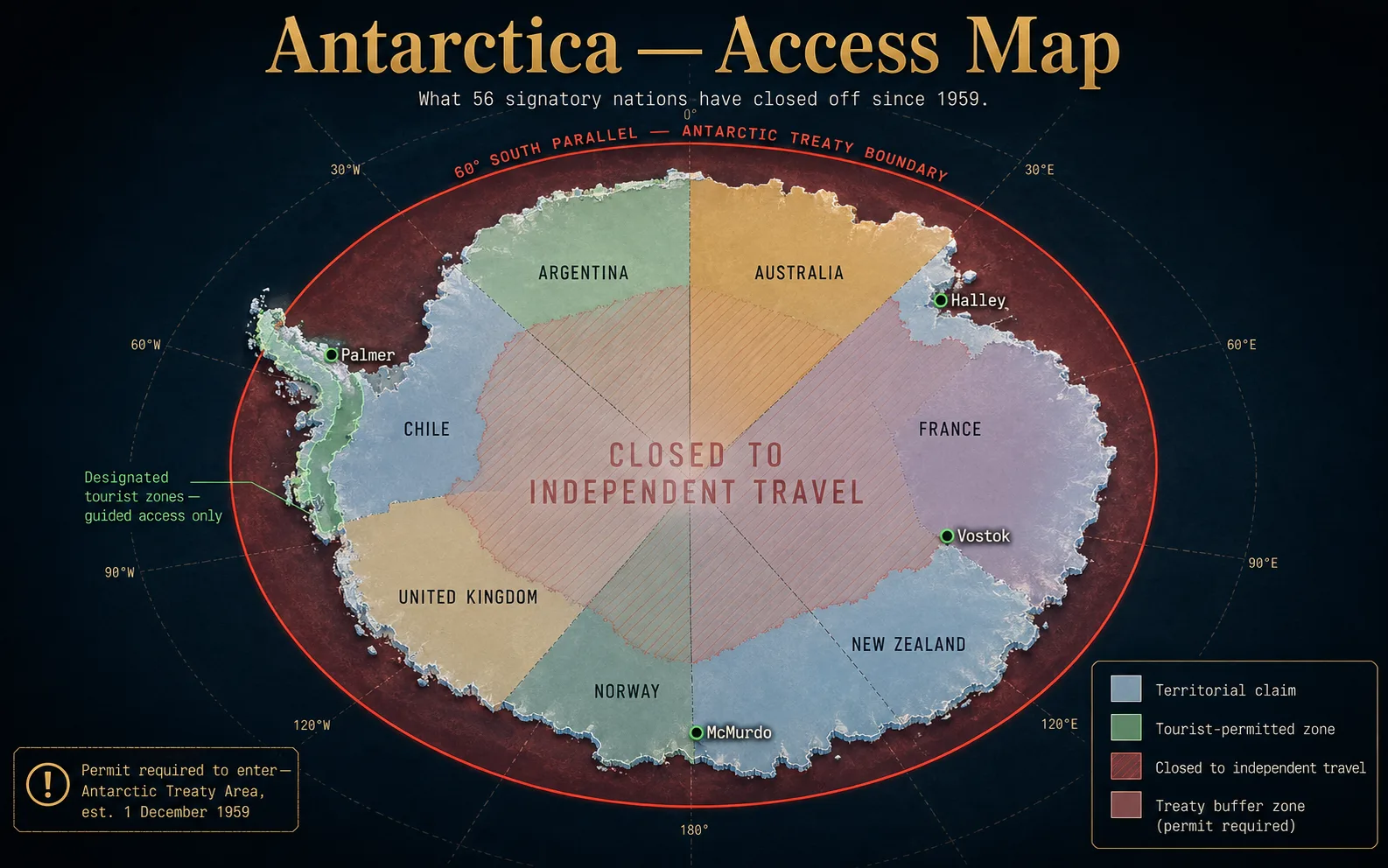
Antarctica access · the legal map
What the public sees on a globe as a single white continent is, legally, a layered patchwork of overlapping territorial claims by seven nations, a ring of permit-required buffer zone above 60° south, a handful of guided tourist corridors along the coast, and a vast interior closed to independent travel altogether.
List of Antarctic restrictions — click to expand
- Treaty area defined as everything below the 60th parallel south. This is approximately four hundred to nine hundred miles north of Antarctica’s actual shoreline. A vessel cannot legally sail into this zone without a permit from the traveller’s national authority.
- Form DS-4131 is the entry-level US State Department application for non-governmental Antarctic travel, and is only the first of several required filings.
- Every activity, vehicle, and pathway must be pre-approved. Spontaneous travel of any kind is prohibited as a matter of treaty law.
- Antarctica is treated as a single giant natural reserve — comparable in regulatory access to a US military installation. Visitors are confined to designated tourist routes.
- Specially Protected Areas (ASPAs) — entire designated swaths of land off-limits to all non-emergency travel. Permits to enter are essentially never granted to non-governmental personnel.
- No motorised equipment of any kind is permitted for non-governmental travellers — no aircraft, vessels, small boats, or “other means of transport in ways that disturb wildlife either at sea or on land” (Antarctic Treaty Handbook, p. 308). For a 3,400-mile round-trip traverse this means everything must be hauled by hand.
- No sled dogs. Banned outright in 1994 under Annex II of the Madrid Protocol, which required the removal of all non-native species from the treaty area.
- No walking on plants and no frightening of wildlife. Antarctic vegetation (mosses, lichens) is legally protected; any infraction across the duration of the expedition is grounds for permit revocation.
- All human waste must be packed out. On-continent disposal requires a separate permit from the US National Science Foundation.
- Environmental Impact Assessment (EIA) required at one of three escalating levels: preliminary review, Initial Environmental Evaluation (IEE), or Comprehensive Environmental Evaluation (CEE).
- A Comprehensive Environmental Evaluation (CEE) — required for any expedition of substantial scope — must be drafted and submitted to the EPA by 1 December of the year preceding the planned activity.
- CEE review chain. The draft is forwarded by the State Department to all fifty-six treaty parties; reviewed by the international Committee for Environmental Protection; published in the US Federal Register for a ninety-day public-comment period; evaluated by the EPA “in consultation with other interested federal agencies”; and presented at the Antarctic Treaty Consultative Meeting before any permit may issue.
- Estimated CEE preparation cost: $250,000 to $2,000,000 — payable up front by the applicant, with no guarantee of approval.
- Federal Register publication triggers lawsuit exposure. Any private environmental organisation may sue to enjoin the expedition during the public-comment window.
- Seven nations maintain overlapping territorial claims to portions of Antarctica — Argentina, Australia, Chile, France, New Zealand, Norway, and the United Kingdom. Additional permits may be required from each nation whose claimed sector the route crosses.
- The treaty itself has no expiration date. The Madrid Protocol’s prohibition on mineral resource activities can be reviewed by consensus beginning 2048 — but the treaty’s core access restrictions have held substantively unchanged since the original signature on 1 December 1959, through the Cold War, the Cuban Missile Crisis, the Soviet-Afghan war, the collapse of the Soviet Union, and the present geopolitical alignment. The treaty has been ratified by every major industrial power on earth, including North Korea (acceded 1987).
10. Rockets, satellites, and the imagery question
Rockets do not, in fact, go “up.” Every launched rocket on public record traces a parabolic arc, curving out over the ocean and falling. The supposed transition from a gravity-bound atmosphere to an infinite vacuum has no described mechanism; a vacuum cannot be physically connected to a non-vacuum while maintaining its properties. Jet and rocket propulsion, which works by pushing against a medium, has nothing to push against in a true vacuum — yet shuttles and spacecraft are claimed to manoeuvre freely in just such conditions.
Spacewalk footage repeatedly shows air bubbles forming and rising in the supposed vacuum — a tell consistent with the admitted fact that astronauts train for spacewalks in NASA’s neutral buoyancy lab, an underwater facility. Interior International Space Station footage is indistinguishable from vomit-comet zero-gravity airplane footage and shows clear evidence of wires, harnesses, and green-screen technology. The ISS observed through high-zoom cameras displays prismatic distortion characteristic of an optical projection rather than a physical object.
So-called “satellite” television dishes point at roughly 45 degrees toward the nearest ground-based repeater tower, not at the sky. If they were genuinely picking up signals from objects in geostationary orbit, they would point nearly straight up. They do not, anywhere, because the signals come from terrestrial infrastructure.
NASA’s pictures of the whole earth are admittedly composite images — assembled in Photoshop from “ribbons of imagery,” in their own words — and not photographs. Different official whole-earth images show drastically different continent sizes, different colourations of land and ocean, and duplicate cloud patterns that betray copy-and-paste editing. The materials from which satellites are built — aluminium (melts at 1,221°F), gold (1,948°F), titanium (3,034°F) — could not survive thermosphere temperatures of up to 4,530°F that NASA itself reports for the layer in which satellites supposedly orbit. NASA’s own technical manuals, written for internal use, routinely treat the earth as “flat and non-rotating” for engineering purposes — as in the agency’s own Dryden Reference Publication 1207 (Duke et al., 1988), reproduced below.
NASA Dryden · RP-1207 · concluding remarks
Derivation and Definition of a Linear Aircraft Model, Duke et al., 1988. NASA Technical Reports Server.
11. The sun, the seasons, and the polar asymmetry
The arctic and antarctic regions, at comparable latitudes north and south, behave nothing alike — entirely unlike what a tilted, uniformly spinning globe orbiting a distant sun would produce. Antarctica is by far the coldest place on earth, with an average annual temperature of approximately negative fifty-seven degrees Fahrenheit; the average temperature at the north pole is a relatively warm four degrees. Iceland, at 65° north, hosts 870 species of native plants and abundant animal life; the Isle of Georgia, at 54° south, has eighteen species of native plants and almost no animal life. James Cook described the southern islands as “doomed by nature to perpetual frigidness, never to feel the warmth of the sun’s rays.” The asymmetry has no good explanation on the globe model; it has a straightforward one on a flat azimuthal model in which the sun circles in tighter loops over the north and sweeps in wider, faster ones over the south.
The midnight sun is well documented in the arctic, with hours of uncut amateur footage showing the sun making visible circles overhead during the summer solstice. The corresponding antarctic phenomenon is claimed but has never been similarly documented; access to the antarctic at the relevant time of year is, as noted above, restricted.
12. The cumulative case
None of the observations above is offered as a single knock-down proof. The case is cumulative. Dozens of independent lines — drawn from the engineering of canals and railways, the practice of sea navigation, the optics of distant skylines and lighthouses, the behaviour of cannonballs and aircraft and balloons, the qualities of the moon’s light, the immobility of Polaris, the asymmetry of the polar regions, the documented behaviour of southern hemisphere flights, the physical impossibility of the rocket-satellite paradigm, and the consistent testimony of Scripture — converge on a single picture. That picture is not the one in the textbook.
Standard rebuttals to most of these observations follow a single pattern: they reassert the institutional model and attribute the anomalous observation to refraction, mirage, optical illusion, lens distortion, or simple error on the observer’s part. Each rebuttal, examined on its own merits, would have to be evaluated. But the cumulative rebuttal — that every observation of the kind above is somehow mistaken in some way, all of them, always — is itself a large and unproven claim, resting in the end on the same institutional authority whose authority is the question.
A note from the author
The author first came across most of this material in late 2016. What is gathered on this page is only a fraction of the evidence that is actually out there. It hardly even covers, for instance, the extensive documentation of CGI, blue screen, augmented reality, and other production techniques that the major space agencies have used — and have been caught using — over and over again, repeatedly, in their official imagery and broadcasts. Nor does it touch the long catalogue of blunders and inconsistencies in astronauts’ own first-hand accounts of what they claim to have seen in space — the stars, the satellites, the nebulae, the appearance of the earth itself — accounts which, when laid side by side from one astronaut to another and from one mission to another, repeatedly contradict each other and contradict what the same agencies have shown in their official footage and images. There is a great deal more that independent researchers have uncovered across the past decade and longer. What appears here is intended as a small glimpse into the subject and the evidence. A reader who finds these proofs compelling is encouraged to keep searching.
Part B — Heliosorcery: the historical context
The second source draws from a documentary entitled Heliosorcery, produced by a Seventh-day Adventist ministry, which traces the religious and political history of the heliocentric model from the Protestant Reformation forward. The thesis is straightforward: the modern cosmology did not arise from neutral, independent observation. It arose from a specific historical conflict, was actively promoted by a specific institution with specific theological interests, and was given its modern form by men whose private commitments were to esoteric traditions in many cases openly hostile to the Bible.
Readers will weigh the documentary’s tonal claims as they see fit. What follows is a condensation of its substantive historical points — those that can be verified in the documentary record and that bear directly on how the modern cosmological consensus came to be.
1. The consensus before Copernicus
Before the sixteenth century, sun-centred cosmology was a dormant idea, recorded chiefly in ancient hermetic and Pythagorean writings. The plain witness of the senses — the sun and stars moving overhead, the earth at rest beneath — combined with the equally plain testimony of Scripture, was held by essentially all Christendom. The historian Andrew Dickson White, no friend of biblical cosmology, recorded in his History of the Warfare of Science with Theology that the older theological conception of the universe — a fixed earth and an enthroned Creator above the firmament — remained intact until the work of Copernicus, Kepler, Galileo, Descartes, and Newton displaced it.
2. The Reformation crisis and the Counter-Reformation strategy
Luther’s ninety-five theses in 1517, and the subsequent rapid multiplication of vernacular Bibles via the printing press, threw the medieval papacy into a crisis it could no longer suppress by force. Cardinal Thomas Wolsey, advising Pope Clement VII, outlined the strategic response in a sentence often cited and worth weighing: “Since printing cannot be put down, it is best to set up learning against learning, and by introducing all persons to dispute, to suspend the laity between fear and controversy. This at most will make them attentive to their superiors and teachers.”
The objective, in plain terms, was not to refute the Bible directly. It was to surround the Bible with competing learning until its singular authority was lost. Wolsey’s policy is the lens through which the rest of this history can be usefully read.
3. The Medici library and the revival of hermetic learning
Cosimo de’ Medici (d. 1464) had assembled, decades before the Reformation, an enormous library of pagan philosophical, scientific, and mystical texts brought westward by Greek scholars fleeing the fall of Constantinople. Among them were the writings of Hermes Trismegistus, the legendary Egyptian sage whose works contained an explicit sun-centred cosmology. The Renaissance, celebrated in our textbooks as a flowering of learning, was in significant measure a flowering of hermetic, gnostic, and pagan thought — material the early reformers, particularly Erasmus and Luther, warned against.
The point is not that every Renaissance figure was a secret pagan. The point is that the intellectual material out of which the new cosmology would be built was already in circulation, in Rome’s libraries and her sympathisers’ studies, when the crisis hit.
4. Copernicus, Clement VII, and the heliocentric revival
Nicolaus Copernicus (1473–1543) was a Catholic cleric, and the immediate intellectual provenance of his heliocentric model was the hermetic literature in which he was deeply read. The documentary record is plain. In 1533 — well before the publication of his book — the pope’s personal secretary, Johann Albrecht Widmannstetter, lectured on the Copernican theory before Pope Clement VII and his cardinals. The pope was impressed and gave the theory his personal approval. In 1536, Cardinal Nikolaus von Schönberg wrote to Copernicus urging him to publish; that letter Copernicus would later include in the published edition of De Revolutionibus. He delayed publication until the year of his death, well aware that the Protestant world would oppose it on the basis of Scripture.
Copernicus’s own published preface to De Revolutionibus names Trismegistus directly and calls the sun “a visible god.” Kepler, writing in his Harmony of the World, described himself as “stealing the golden vessels of the Egyptians to build a tabernacle to my God from them.” These were not throwaway figures of speech. The founding cosmologists were openly drawing on a religious tradition. Their theory was not a neutral scientific observation; it was the empirical articulation of a hermetic religious commitment.
It is worth registering, then, that the Protestant reformers of the sixteenth century — Luther, Calvin, Melanchthon — all opposed the heliocentric model on biblical grounds, and that the early opposition to Copernicus came not from Rome but from the Protestant world. Rome, the actual sponsor of the new cosmology, would later perform the Galileo affair (see below) with such dramatic flair that the historical impression survives to this day that Rome had been on the wrong side of the science. She was not.
5. The Jesuit order and Ratio Studiorum
Ignatius of Loyola founded the Society of Jesus in 1540 — twenty-three years after Luther’s theses. The Jesuit Spiritual Exercises trained adherents in what Loyola termed obedience of the understanding: not merely doing what the church commanded but believing what the church defined, regardless of contrary evidence. Section 365.13 of the Exercises states it plainly: “What seems to me white, I will believe black if the hierarchical Church so defines.” That principle would become the backbone of the educational method Loyola pioneered, known as Ratio Studiorum, and eventually the template for modern Western education.
Loyola’s pitch to Pope Paul III was direct: while other orders cloistered themselves for study and meditation, the Jesuits would enter Protestant universities and chairs of learning, train doctors, lawyers, scholars, and scientists, and recast minds in line with Roman commitments. The Jesuit order’s subsequent role in the development of Western science, philosophy, and education is well-documented in their own records.
6. The Galileo affair, reconsidered
The Galileo affair is the great public showpiece of the science-versus-religion narrative. Closer inspection complicates the story. Galileo was a devout Catholic and was treated as a hero by the church for most of his life. The formal verdict of his “trial” was not guilty of heresy but guilty of vehement suspicion of heresy. Jesuit astronomer Guy Consolmagno — director of the Vatican Observatory — has stated openly that nobody really knows why Galileo was prosecuted, that the trial “is not what you think it is,” and that it occurred at the height of the Reformation and the Thirty Years’ War.
Read in the context of Wolsey’s policy — “learning against learning” — the Galileo affair functions as a publicity device. The dramatic image of a brave scientist persecuted by religious obscurantism implanted, in the Protestant imagination, the impression that the Roman church opposed the new cosmology. In fact Rome had revived and sponsored that cosmology a full century earlier. The Galileo affair did not slow heliocentrism. It did the opposite: it recommended the new model to the very Protestant audience that had been rejecting it on biblical grounds.
7. The Douay-Rheims Bible and the “globe” of 1610
The Jesuit-produced Douay-Rheims Bible (New Testament 1582, complete Bible 1610) was Rome’s English-language response to the Tyndale-derived Protestant translations. It contains a striking rendering at Isaiah 40:22. The Hebrew word chug, which describes a flat disc or circle (and is rendered “circle” in the KJV and most other English translations before and after), is translated in the Douay- Rheims as “globe.” No English Bible before the Douay-Rheims uses the spherical word for this verse, and even the Latin Vulgate from which the Douay-Rheims was translated does not. The choice is documentary evidence that by the early seventeenth century, a globular earth was authorised Roman Catholic doctrine.
8. Newton, alchemy, and the deification of gravity
Isaac Newton is widely received as the rationalist whose laws of motion sealed the heliocentric model in scientific form. The private Newton was something else. He wrote more than a million words on alchemy; the Royal Society, when his papers were examined after his death, deemed those writings “not fit to be printed” and shelved them. In 1936 the economist John Maynard Keynes acquired a substantial collection of these manuscripts and, after studying them, told the Royal Society outright: “Newton was not the first of the age of reason. He was the last of the magicians, the last of the Babylonians and Sumerians.”
Newton himself translated Hermes Trismegistus’s Emerald Tablet into English. That document’s description of the sun — “Its force is above all force, for it vanquishes every subtle thing and penetrates every solid thing” — reads remarkably like a description of gravity. The relationship between Newton’s public physics and his private hermetic theology is at the very least suggestive. He urged his fellow alchemist Robert Boyle, in a private letter, to keep “high silence” about their work because of the “immense damage” that would follow if the public learned what they were really studying.
9. The Enlightenment and the French Revolution
Voltaire spent two years in England, where he absorbed Newtonian philosophy, and brought it back to France. Professor John Lienhard, writing for the University of Houston, observes: “It was, at length, Isaac Newton who put the terribly disruptive engines of the French Revolution into motion.” Newton’s mechanistic universe rendered the personal, intervening Creator-God unnecessary in educated minds. What Voltaire and Rousseau wrote in deistic philosophy, the revolutionaries took to its logical political end. The Reign of Terror was the practical fruit of a cosmology in which God was an absent first cause.
10. Darwin, the Big Bang, and the capstone
Charles Darwin’s grandfather Erasmus Darwin — a master Mason at the famous Canongate Lodge in Edinburgh — set out an explicit evolutionary scheme in his poem Zoonomia(1794), more than half a century before his grandson’s On the Origin of Species (1859). The evolutionary framework was not the discovery of the younger Darwin; it was the natural extension of the cosmological frame already in place.
The capstone came in 1928, when the Catholic priest Georges Lemaître proposed what would later be called the Big Bang — the only mechanism that could give the modern heliocentric system an origin without a Creator. Father Andrew Pinsent of Oxford has stated the matter cheerfully: “Quite often young people ask me the following question, ‘How can you be a priest and believe in the Big Bang?’ To which I am delighted to respond, ‘We invented it!’” Pope Francis has openly affirmed evolution as consistent with Catholic creation doctrine.
From Copernicus in 1543 to Lemaître in 1928, the architects of the modern cosmology have, at the decisive turns, been figures in or sponsored by the Roman church. The Protestant world, which had opposed the model on biblical grounds, was won over by the cumulative cultural weight of the academic, scientific, and educational institutions Wolsey’s strategy had set in motion.
11. Why this history matters
The point of this historical sketch is not that everyone who accepts the modern cosmology is a knowing participant in any deception. Most who hold the globe model do so because they were taught it and have never encountered a reason to doubt it. The historical point is more modest, but more important: the modern cosmology was not handed down to us by a neutral, independent process of observation and verification. It was promoted by an institution with specific theological interests that ran directly counter to the plain reading of the Bible, and it was given its mathematical form by men whose private commitments lay in traditions openly hostile to the Scriptures.
A Protestant reader, in particular, has reason to consider this history. The Reformation cry was sola scriptura: the Bible above human tradition and human institution. If the Bible plainly describes a cosmology — a firmament, an outstretched earth, foundations that cannot be moved, a sun that moves and an earth that does not — and the contrary picture comes to us by the historical path traced above, then the question is no longer a question of science against faith. It is a question of which authority the Protestant will, in the end, allow to be supreme.
That is, in the end, the same question Wolsey’s policy was designed to obscure.
12. A closing note on charity
The case set out in this article — observational, biblical, and historical — is what the author finds compelling. He does not ask the reader to accept it on his authority, and he does not treat those who weigh the evidence and reach a different conclusion as outside the faith. The companion piece on Ellen White makes that posture explicit, and it governs this article as well. The shape of the earth is not the centre of the gospel. The shape of the character is. The reader is asked only this: to weigh what has been set forth here without first conceding the assumption that the institutional consensus is beyond question. The case for that consensus is weaker than the confidence with which it is asserted. The Scripture, by contrast, is plain.
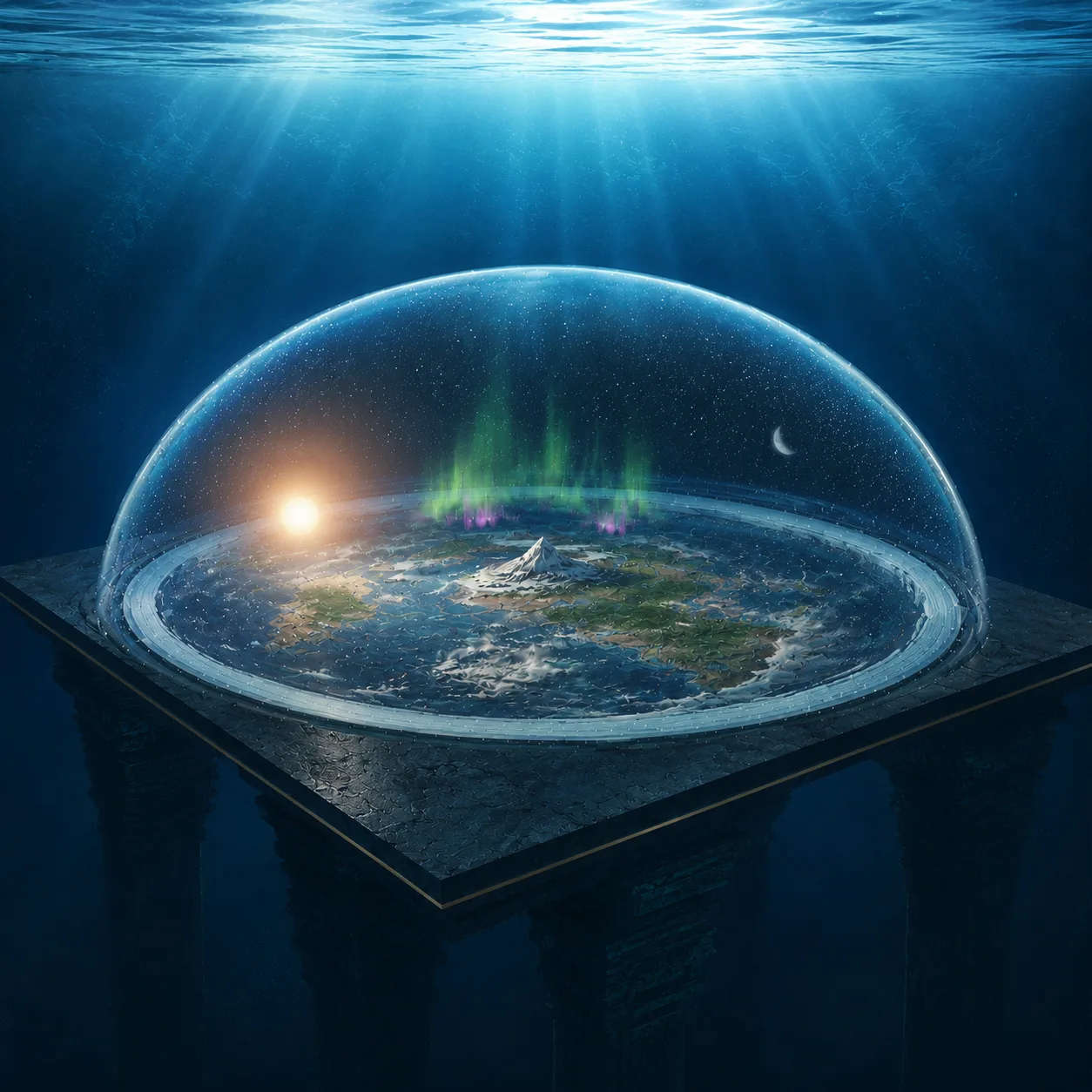
The biblical model · alternate perspective
A second rendering of the same Scripture-described structure shown in the labelled Hebrew cosmology earlier in the article — the outstretched, level earth, the firmament above, the luminaries set within it, the foundations beneath. Offered here as a closing visual bookend before the credits.
The lights above, and the ground beneath
Much of the argument about the earth’s shape never touches the earth at all. It happens with the head tilted back. People point to the sun, the moon, the stars — what they are doing, how they move, how far off they are said to be — and treat the answer as though it settled the question of the ground under their feet. But the leap is a strange one. The behaviour of the lights in the sky and the shape of the surface a person stands on are two different questions, and the first does not decide the second.
Picture the oddness of it plainly. Suppose you looked up through a window at the ceiling light of the room above yours — or across the street into a neighbour’s window, and saw the round glow of their lamp — and from that concluded that the floor you were standing on must therefore be round, or curved, or shaped like the lamp. No one reasons that way about a room. The light on the ceiling tells you nothing about the floor; they are not the same object, not the same surface, not the same question. Yet this is very nearly the reasoning we have all been handed about the sky and the earth: that because the lights overhead behave in a certain way, the ground beneath must be a spinning ball.
Why does the mind fuse the two so readily? Not because the logic compels it, but because the picture was installed early. From the first schoolbook we were shown a small blue ball hanging in black space among countless other balls — ourselves a speck on its surface, the sun another ball, the stars yet more, all of one kind and all of a piece. Once that single image is in place, it feels natural that the sky and the ground are one system, one geometry, telling one story. But that is a taught assumption doing the work, not an observation.
Scripture, tellingly, keeps the two apart. It speaks of the earth with its foundations, its pillars, its established place that cannot be moved — the ground — and separately of the lights God set in the firmament above, to divide the day from the night and to be for signs and for seasons. The luminaries are placed in the expanse over the earth; they are not the earth, and the earth is not measured by them. What is above our heads and what is beneath our feet are, in the Bible’s own account, two distinct works of one Maker. We are free to wonder at the one without letting it dictate our conclusions about the other — which is exactly why the honest word that follows can leave the luminaries an open question and still speak plainly about the ground.
An honest word
What we claim, and what we don’t
We hold that the evidence points to something important and worth saying plainly: the earth is not the spinning ball, hurtling through empty space, that we were handed. That much we are willing to defend.
But here our honesty cuts both ways. We are not willing to do what the modern scientific establishment has done — manufacture confident explanations for things no one has ever touched, measured at close hand, or truly understood, and then present them as settled fact. There is a great deal we do not know. We cannot tell you what the luminaries are, nor what the sun and moon are made of — no one who has not been there can, and we have only been asked to take their word for it. We do not know the deep reason density and buoyancy behave as they do, or why the downward pull men named “gravity” exists at all. We do not have a demonstrated mechanism for the lunar eclipse.
We could invent answers to fill these gaps. We will not — to do so would be to repeat the very error we are pointing out. So we leave the unknown as unknown, and say so. We are not God. We have found that the world is not shaped as we were told, and we trust that the One who made it knows perfectly how every part of it works, even where we do not.
And a personal word, since this is a question I have lived with for years. There are tens of thousands of sincere people running experiments and forming hypotheses about these very things — the eclipse, the nature of the luminaries, the cause of the fall we have been taught to call gravity — and some of their explanations may yet prove to be good ones. But in more than ten years of looking hard at this subject, I have settled one rule for myself: I will not adopt a theory merely because it sounds good and fills a gap, when I cannot actually demonstrate it. There is no need to. The case does not stand on the gaps; it stands on what can be shown — the earth that will not be made to move, the curvature that refuses to appear across miles of still water, and the rest of the evidence walked through here. We have already opened real holes in globe arguments that stand on their own; we do not need to patch our own case with guesses to make up for it. Better a few honest unknowns than a stack of confident errors.
“The secret things belong unto the LORD our God: but those things which are revealed belong unto us and to our children for ever….”Deuteronomy 29:29Image credits & fair-use notice
The images on this page fall into two categories. Several are AI-generated renderings — produced to closely resemble actual photographs the author chose not to use directly, to avoid copyright issues with the original creators. These are not dishonest depictions but nearly identical visual stand-ins for the real-world evidence the arguments rest on, and each is marked as AI-generated in its individual entry below. Other images are reproduced under a good-faith claim of fair use for educational commentary; where the original creator can be identified, they are credited.
To request a correction, attribution, or takedown of any image, please email adamstrosawork@gmail.com and reference the image’s credit anchor below.
A small icon appears on each image. Clicking it scrolls to that image’s entry in the list below.
- The enclosed model in cross-section · hero illustration
- Original illustration generated by ChatGPT (OpenAI), May 2026, from a prompt written by this site. Per US Copyright Office guidance, AI-generated images without substantial human authorship are not copyrightable. No copyright claim attaches to the image; it may be freely reproduced.
- More than twenty cosmologies · one outlier
- Original composite generated by ChatGPT (OpenAI), May 2026, depicting the cosmological diagrams of more than twenty civilisations (Greek, Navajo, Babylonian, Mesa, Japanese, Persian, Viking, Indian, Mayan, Incan, Hebrew, Australian, Chinese, Celtic, Chumash, Slavic, African, Sumerian, Masonic, Islamic, Roman, Egyptian) alongside a modern NASA depiction. The header text (“Only one doesn’t match”) and footer text (“It’s the psyop”) are built into the AI-generated image. The underlying cosmological traditions are historical facts not owned by any individual. Per US Copyright Office guidance, AI-generated images are not copyrightable; no copyright claim attaches.
- Ancient Hebrew Conception of the Universe · labelled diagram
- © Faithlife Corporation / Logos Bible Software, 2012. Originally produced as a teaching diagram. Reproduced here under fair use for educational commentary.
- Biblical earth · alternate perspective
- AI-generated rendering, commissioned for this article as a closing visual bookend to the Hebrew cosmology diagram shown earlier. Depicts the same Scripture-described structure from a different angle.
- Eight cosmologies · one outlier · cross-cultural comparison
- Original composite generated by ChatGPT (OpenAI), May 2026, depicting the cosmological diagrams of eight civilisations (Egyptian, Norse, Hindu, Mayan, Inca, Navajo, Hebrew) alongside a modern NASA depiction. The underlying cosmological traditions are historical facts not owned by any individual; the rendering itself is an original AI-generated illustration. Per US Copyright Office guidance, AI-generated images are not copyrightable; no copyright claim attaches.
- Chicago skyline across Lake Michigan
- Original illustration generated by ChatGPT (OpenAI), May 2026, depicting a generic distant city skyline at twilight across calm water. Not modelled on any specific protected photograph. The general “skyline visible at an impossible distance across a body of water” composition is a category many photographers and artists have used and is not unique to any one creator. Per US Copyright Office guidance, AI-generated images are not copyrightable; no copyright claim attaches.
- Crepuscular rays converging above the clouds
- Original illustration generated by ChatGPT (OpenAI), May 2026, depicting a generic sunset-over-water scene with sunbeams converging through a cloud break. Not a copy of any specific protected photograph. Per US Copyright Office guidance, AI-generated images are not copyrightable; no copyright claim attaches.
- Polaris star trails · long-exposure rendering
- Original illustration generated by ChatGPT (OpenAI), May 2026, rendered in the visual style of a long-exposure astrophotograph. Per US Copyright Office guidance, AI-generated images are not copyrightable; no copyright claim attaches.
- Azimuthal equidistant projection map
- Source likely Wikimedia Commons (Creative Commons or public domain), but provenance unverified. The flight-path overlay is original work by this site, drawn as SVG using the azimuthal equidistant projection formula and real lat/long coordinates for the cities named in the caption.
- Eight official NASA “Earth” images, 1972–2015
- Base imagery: NASA, public domain (NASA media usage policy). The composite arrangement and editorial text overlay were assembled by an unidentified party. Reproduced under fair use for educational commentary on NASA’s own published imagery.
- NASA’s Earth · 2012 vs 2013 comparison
- Base imagery: NASA, public domain. The side-by-side comparison and continent-outline annotation were assembled by an unidentified party. Reproduced under fair use for educational commentary.
- Balloon · wide flat horizon at very high altitude
- Frame capture from amateur high-altitude balloon footage. Original videographer unidentified. Reproduced under fair use for educational commentary on observed atmospheric phenomena at altitude.
- Balloon · flat horizon with tether visible
- Frame capture from amateur high-altitude balloon footage. Original videographer unidentified. Reproduced under fair use for educational commentary.
- Balloon · flat horizon with layered atmosphere
- Frame capture from amateur high-altitude balloon footage. Original videographer unidentified. Reproduced under fair use for educational commentary.
- Balloon · flat horizon with sun overhead
- Frame capture from amateur high-altitude balloon footage. Original videographer unidentified. Reproduced under fair use for educational commentary.
- Balloon · sun spotlight over water
- Frame capture from amateur high-altitude balloon footage. Original videographer unidentified. Reproduced under fair use for educational commentary on the localised illumination pattern produced by the sun.
- Balloon · sun reflection on water and island
- Frame capture from amateur high-altitude balloon footage. Original videographer unidentified. Reproduced under fair use for educational commentary.
- Balloon · sun’s hot-spot on the cloud layer
- Frame capture from amateur high-altitude balloon footage. Original videographer unidentified. Reproduced under fair use for educational commentary.
- Balloon · sun spotlight through frost-edged camera window
- Frame capture from amateur high-altitude balloon footage. Original videographer unidentified. Reproduced under fair use for educational commentary.
- The official picture · earth surrounded by orbital traffic
- Original illustration generated by ChatGPT (OpenAI), May 2026, depicting the earth surrounded by tens of thousands of satellites and pieces of debris. Rendered in the visual style of similar widely-circulated artist’s concept illustrations of orbital traffic. Per US Copyright Office guidance, AI-generated images are not copyrightable; no copyright claim attaches.
- Satellite gallery · communications satellite rendering
- Original illustration generated by ChatGPT (OpenAI), May 2026, in the visual style of standard agency-published artist’s renderings of satellites. Not modelled on any specific protected image. Per US Copyright Office guidance, AI-generated images are not copyrightable; no copyright claim attaches.
- Satellite gallery · observation satellite rendering
- Original illustration generated by ChatGPT (OpenAI), May 2026, in the visual style of standard agency-published artist’s renderings. Not modelled on any specific protected image. AI-generated; no copyright claim attaches.
- Satellite gallery · night-side rendering
- Original illustration generated by ChatGPT (OpenAI), May 2026, in the visual style of standard agency-published artist’s renderings. Not modelled on any specific protected image. AI-generated; no copyright claim attaches.
- Satellite gallery · imaging satellite rendering
- Original illustration generated by ChatGPT (OpenAI), May 2026, in the visual style of standard agency-published artist’s renderings. Not modelled on any specific protected image. AI-generated; no copyright claim attaches.
- Satellite gallery · CubeSat-style rendering
- Original illustration generated by ChatGPT (OpenAI), May 2026, in the visual style of standard agency-published artist’s renderings. Not modelled on any specific protected image. AI-generated; no copyright claim attaches.
- Satellite gallery · geostationary satellite rendering
- Original illustration generated by ChatGPT (OpenAI), May 2026, in the visual style of standard agency-published artist’s renderings. Not modelled on any specific protected image. AI-generated; no copyright claim attaches.
- Satellite gallery · ISS-style station rendering
- Original illustration generated by ChatGPT (OpenAI), May 2026, depicting a space station with multiple solar arrays in the visual style of agency renderings of the International Space Station. Not modelled on any specific protected image. AI-generated; no copyright claim attaches.
- Satellite gallery · earth-facing satellite rendering
- Original illustration generated by ChatGPT (OpenAI), May 2026, in the visual style of standard agency-published artist’s renderings. Not modelled on any specific protected image. AI-generated; no copyright claim attaches.
- Robert Simmon · “It is photoshopped, but it has to be”
- Original illustration generated by ChatGPT (OpenAI), May 2026, depicting a generic data-visualizer alongside an Earth image with the now widely-circulated quotation overlaid. The quotation itself is from Robert Simmon’s interview with Flora Lichtman for NPR’s Science Friday segment “Blue Marble: The Making Of”, 3 February 2012 — a documented primary source. The AI illustration is not a portrait of any specific living person. Per US Copyright Office guidance, AI-generated images are not copyrightable; no copyright claim attaches to the rendering.
- Apollo vs ISS · stars-from-space contradiction · two-panel composite
- Original editorial composite generated by ChatGPT (OpenAI), May 2026, depicting generic spacesuited figures and orbital views with overlaid verbatim quotes from the Apollo programme and modern ISS-era astronauts. No specific living persons are depicted; no mission patches or agency logos appear. Per US Copyright Office guidance, AI-generated images are not copyrightable; no copyright claim attaches to the rendering. The quoted statements themselves are matters of recorded public testimony.
- Balloon-borne instrument platform · illustration 01
- Original illustration generated by ChatGPT (OpenAI), May 2026, depicting a generic super-pressure helium balloon at high altitude with a suspended instrument gondola of the kind used in scientific ballooning programmes. Not modelled on any specific protected image. AI-generated; no copyright claim attaches.
- Balloon-borne instrument platform · illustration 02
- Original illustration generated by ChatGPT (OpenAI), May 2026, in the visual style of NASA Scientific Balloon Program publicity imagery. The NASA insignia shown on the payload is a US-government work in the public domain (NASA media usage policy). AI-generated; no copyright claim attaches to the rendering.
- Atmospheric lensing · apparatus illustration
- Original illustration generated by ChatGPT (OpenAI), May 2026, depicting a generic foam-core enclosure with a Fresnel-style lens window — the kind of homemade apparatus used in publicly-available atmospheric-lensing demonstrations by independent researcher Rob Skiba. This is an illustration of the tools, not a photograph of the actual experiment. AI-generated; no copyright claim attaches.
- Atmospheric lensing · tabletop demonstration
- Original illustration generated by ChatGPT (OpenAI), May 2026, depicting a generic tabletop optical demonstration in the style of the experimental setup described publicly by independent researcher Rob Skiba. AI-generated; no copyright claim attaches.
- Antarctica access map · polar-projection infographic
- Original editorial infographic generated by ChatGPT (OpenAI), May 2026, on a polar azimuthal-equidistant projection. Territorial-wedge labels reflect the seven nations that have lodged formal Antarctic claims under the framework of the 1959 Antarctic Treaty (Argentina, Australia, Chile, France, New Zealand, Norway, United Kingdom). Research-base markers correspond to real installations. The simplified pie-slice geometry is editorial; for precise claim boundaries see the Antarctic Treaty Secretariat’s published maps. AI-generated; no copyright claim attaches.
- 1946–1969 timeline infographic
- Composite infographic by an unidentified third party widely circulated in independent-research circles. Component imagery is drawn from US-government insignia (Operation Highjump, Operation Deep Freeze, NASA, and Operation Fishbowl emblems), the Antarctic Treaty Secretariat emblem, and the Apollo 11 mission patch (designed by Michael Collins) — all of which are US-government works in the public domain or treaty-body emblems in standard public use. The editorial captions beneath each panel are the work of the unidentified compiler. Reproduced under fair use for educational commentary on the historical sequence.
- Gleason’s New Standard Map of the World · 1892
- Gleason’s New Standard Map of the World on the Projection of J. S. Christopher, Modern College, Blackheath, England — Scientifically and Practically Correct, as It Is. Alexander Gleason, Buffalo Electrotype and Engraving Co., Buffalo, New York, 1892; US Patent 497,917, granted 23 May 1893. The original map is in the public domain (copyright long expired). The biographical note in the figcaption draws on contemporary Buffalo newspaper accounts of Gleason’s involvement in founding a local Seventh-day Adventist congregation in 1889, and on flat-earth historian Robert Schadewald’s characterisation of Gleason as the most prominent Seventh-day Adventist flat-earther in the United States.
- NASA Dryden · RP-1207 · “flat, nonrotating earth” excerpt
- Excerpt screenshot from Derivation and Definition of a Linear Aircraft Model, Eugene L. Duke, Robert F. Antoniewicz, and Keith D. Krambeer, NASA Reference Publication 1207, NASA Ames Research Center / Dryden Flight Research Facility, August 1988. The underlying document is a US-government work in the public domain and is hosted on the NASA Technical Reports Server. The yellow highlighting on the phrase “stationary, atmosphere over a flat, nonrotating earth,” and the annotated reference to the original NASA URL, were added by an unidentified third party who first circulated the screenshot. Reproduced under fair use for educational commentary on the agency’s own published technical literature.
Fair-use claim: the use of third-party images on this page is for the purpose of criticism, comment, and educational discussion of the cosmological question. The reproduction is non-commercial, transformative in context, and intended to support critique rather than to substitute for the original works. Where claims are made about the imagery (such as composite construction or visible artefacts), the underlying images are essential to the commentary and could not be replaced with summary text. Owners who object to the use of their work are invited to contact adamstrosawork@gmail.com for credit, modification, or removal.
Foundational text
“To the law and to the testimony: if they speak not according to this word, it is because there is no light in them.”
— Isaiah 8:20