In brief
The earth records a global flood. The mainstream calls it everything except that.
The geological record displays a set of features which, on the standard uniformitarian model, require either highly unusual local catastrophes or vast spans of time and a remarkable run of coincidences. Marine fossils sit on the summits of every continent’s mountain ranges, including the very top of Mount Everest. Mass fossil graveyards stretch across thousands of square kilometres in disordered jumbles consistent with violent water transport. Trees stand upright through tens of metres of rock strata representing, on the conventional dating, millions of years — yet they are neither rotted nor toppled. Mount St Helens, in two eruption sequences in 1980 and 1982, laid down 180 metres of finely-stratified deposits in an afternoon and carved a canyon comparable in form to the Grand Canyon in a single day. Soft tissue, blood vessels, and intact proteins have been recovered from dinosaur bones conventionally dated to sixty-eight million years before the present. Radiocarbon — which by physical law should be undetectable in anything older than roughly fifty thousand years — is consistently found in coal, oil, and diamonds. And every habitable continent on earth preserves an indigenous tradition of a global flood, transmitted by cultures that had no contact with one another.
This article catalogues eight independent lines of evidence that the mainstream model must explain away on multiple separate hypotheses, and that the biblical flood account explains under a single, unified one. It takes seriously the conventional counter-explanations — including the asteroid-impact theory at the Cretaceous-Paleogene boundary — and asks the reader to consider whether the simpler account is, in fact, the more honest one.
1. Marine fossils on every mountaintop
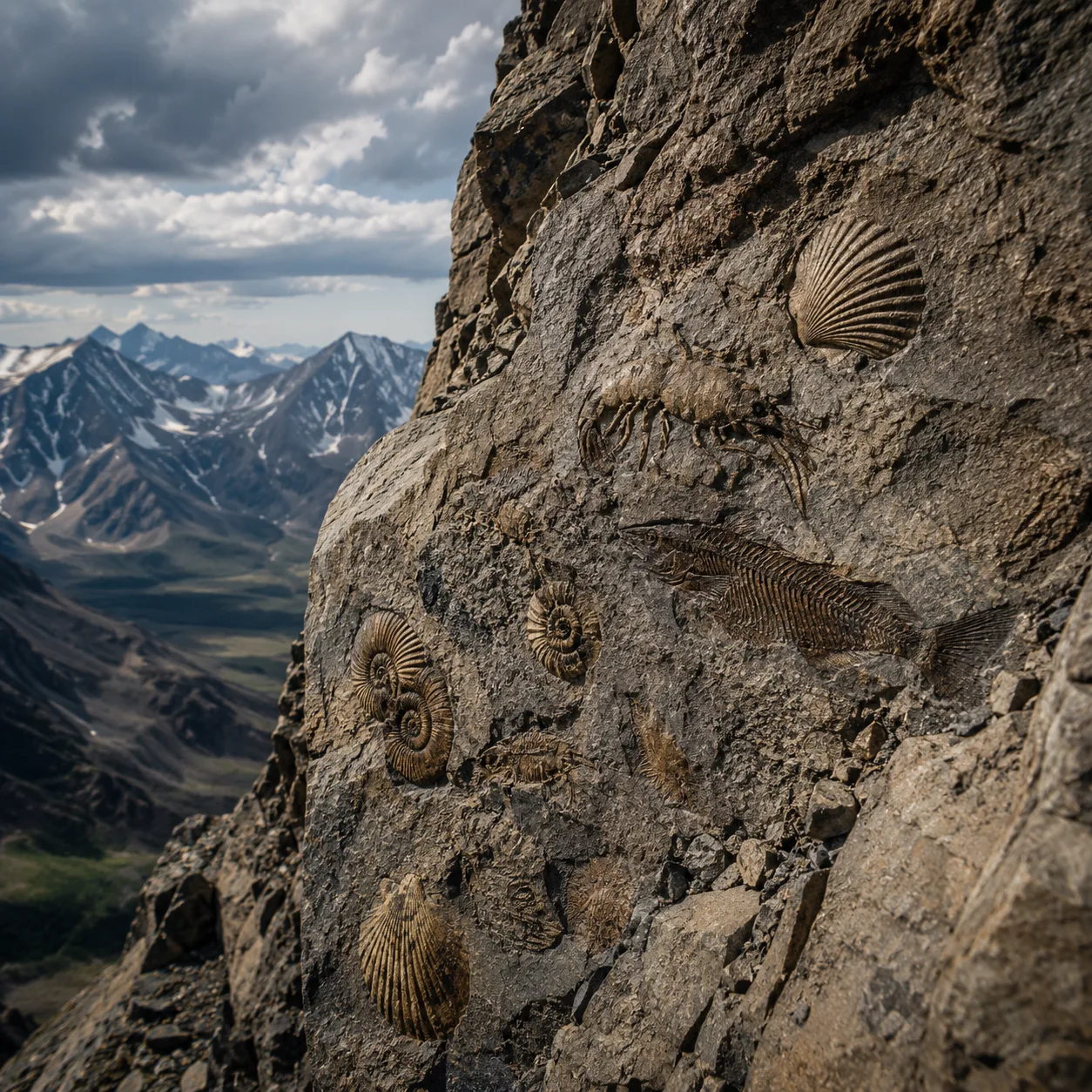
The single most well-attested fact in field geology is this: the sedimentary rocks that cap virtually every major mountain range on earth — the Himalayas, the Alps, the Rockies, the Andes, the Appalachians — contain the fossilised remains of marine creatures. Trilobites, crinoids, brachiopods, ammonites, sea-lily stems, shark teeth, and the limestone signatures of warm shallow seas are recovered from elevations thousands of metres above the present sea level. The summit of Mount Everest — the highest dry land on earth, at 8,849 metres — consists of Ordovician marine limestone, and yields fossils of seabed organisms at the top of the world.
The mainstream explanation is plate tectonics. On this model, the Indian subcontinent broke away from Gondwana, drifted north, and collided with the Eurasian plate over tens of millions of years, forcing the seabed of an ancient ocean (the Tethys) upward to form the Himalayas. The marine fossils on Everest are the residue of a sea bed that has been lifted nine kilometres into the sky over geological time. There is nothing inherently implausible about plate motion as a mechanism; modern instruments measure continental drift at a few centimetres per year, and over hundreds of millions of years the cumulative motion is significant.
The explanatory difficulty is not that the plates have moved. It is that the fossils have remained intact and undisturbed through the process. A seabed lifted gradually over forty or fifty million years would, on the way up, be subject to every form of erosion the atmosphere produces: wind, rain, freeze-thaw cycling, biological weathering. The Tethys-seabed fossils we recover on Everest, by contrast, are pristine: articulated skeletons, delicate echinoderm plates, paper-thin shells preserved in recognisable form. They look like the floor of a sea that was buried rapidly, sealed under sediment, and then only afterwards lifted into elevation. A global flood, with catastrophic mass burial first and tectonic adjustment afterwards, accounts for both observations at once. The slow-uplift model accounts for the lift but not for the preservation.
2. Mass fossil graveyards and polystrate trees
Across every habitable continent, the geological record preserves enormous concentrations of fossilised remains buried in postures consistent with violent, rapid transport by water. The Karoo Supergroup in southern Africa contains the disarticulated remains of an estimated eight hundred billion vertebrate animals across an area of more than half a million square kilometres. The Morrison Formation of the American west yields dinosaur bone-beds in which thousands of individuals lie in chaotic jumbles, with no anatomical articulation, in a sedimentary matrix of mixed clay and gravel that is signature for sudden flood deposition. The Agate Springs beds in Nebraska preserve the intermingled bones of more than nine thousand mammals from species that did not live together in life. The Messel Pit in Germany preserves complete soft-tissue anatomies of fish, mammals, and insects so finely that stomach contents are visible — a level of preservation impossible without catastrophic burial under fine sediment within hours.
The most arresting single example is the phenomenon of polystrate fossils: upright tree trunks fossilised through multiple sedimentary strata representing, on the conventional dating, thousands or millions of years between deposition events. At the Joggins Fossil Cliffs on the Bay of Fundy in Nova Scotia — a UNESCO World Heritage Site — more than seventy-six coal seams alternate with shale, and within those seams stand more than sixty polystrate lycopsid trees, some of them five and six metres tall, passing vertically through multiple strata of supposedly widely-separated ages. Identical polystrate trees are found in Yellowstone’s Specimen Ridge, in the Cumberland coalfields of Britain, and in the Yellow Cat member of the Cedar Mountain Formation in Utah.
An exposed tree trunk decays rapidly: under aerobic conditions, a fallen log of the size in question rots through and topples in ten to fifty years. A standing tree cannot be preserved upright in sediment over the spans of time conventional geology assigns between the strata around it. The trunk must have been buried — rapidly, completely, by a single depositional event covering the full length of the trunk in a single episode — or the rot would have toppled it long before the next stratum arrived. Conventional geology now acknowledges this, and treats polystrate fossils as evidence of localised catastrophic deposition (volcanic ash falls, river floods, deltaic surges). The honest reader will note that every single polystrate tree, on every continent, thus requires a separate localised catastrophe. A single global flood is a more economical hypothesis than dozens of local ones.
3. Rapid deposition — what we can watch happen
The case for slow gradual deposition rests on an assumption the framework itself cannot test: that the rates of geological process observed in the present have always governed the past. The technical name is uniformitarianism — the present is the key to the past. The premise is testable in only one direction: by observing what catastrophic processes actually do when permitted to run their course. The opportunity to do so on the modern record came on the morning of 18 May 1980, when Mount St Helens in Washington State erupted laterally and stripped the north face of the mountain into the surrounding terrain. The results have been studied in detail ever since.
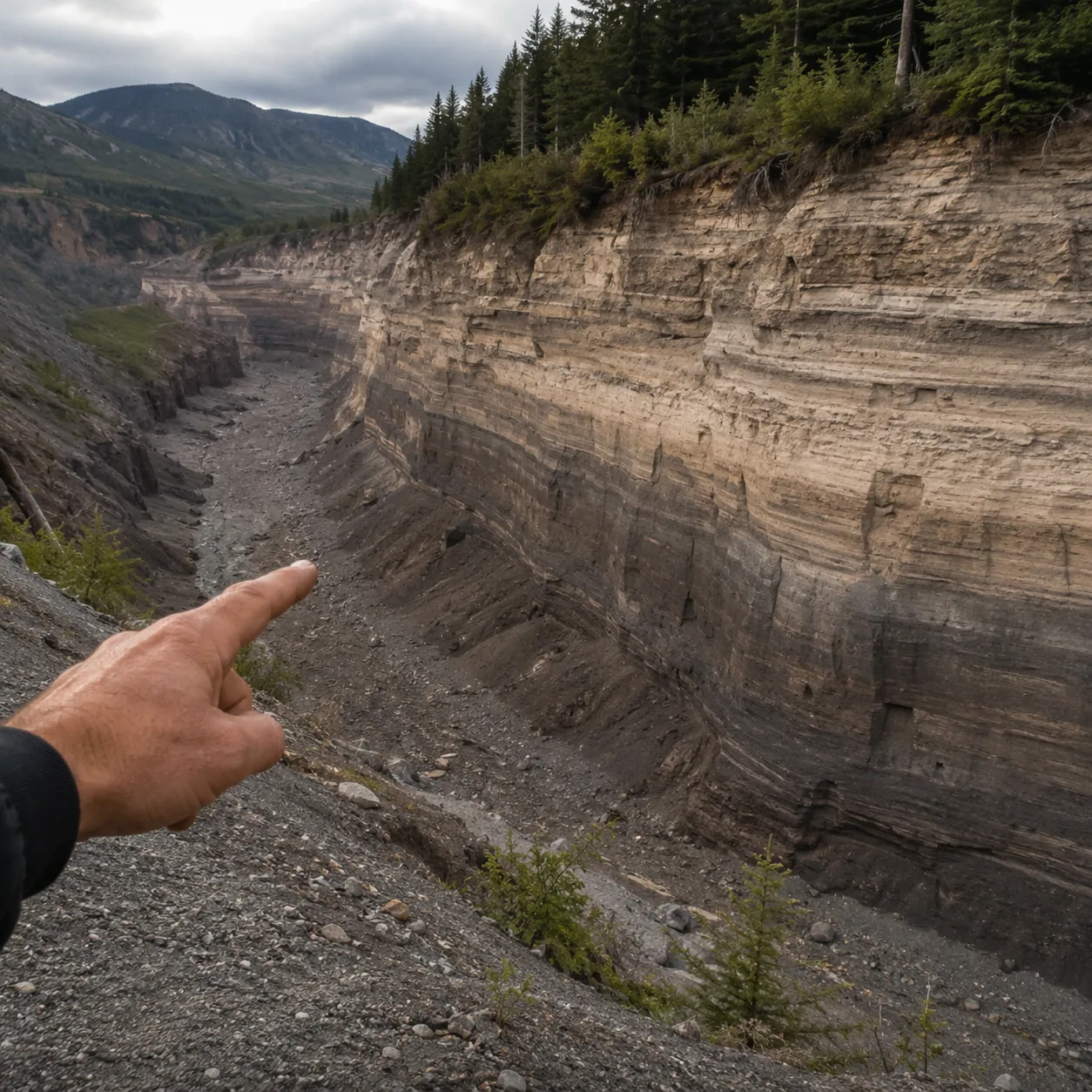
Within hours of the lateral blast, pyroclastic flows surging down the north slope laid down more than 180 metres of finely-stratified sediment in a single afternoon — thin horizontal laminae of alternating fine and coarse material, indistinguishable in field appearance from sequences elsewhere in the column that are read as the deposits of thousands of years of seasonal sedimentation. Less than two years later, on 19 March 1982, a relatively modest mudflow associated with the same eruption sequence cut a canyon system through those deposits to a depth of more than thirty metres along a 1.5-kilometre course — the feature known locally as the “Little Grand Canyon of Mount St Helens.” It was carved in a single day. The Colorado River’s Grand Canyon, on the conventional reading, is attributed to between five and seventy million years of slow fluvial erosion. The Little Grand Canyon shows that morphology alone does not establish timescale; a canyon of comparable form can develop in twenty-four hours when the conditions are right.
The same eruption sequence furnished an independent test of the radiometric dating method on which the standard geological timescale rests. In 1996, geologist Steven Austin submitted to a commercial potassium-argon dating laboratory five samples of dacite drawn from a lava dome that had formed inside the Mount St Helens crater between 1980 and 1986. The samples were known to be ten years old or younger. The laboratory results, when returned, ranged from 0.35 million years to 2.8 million years of age. The procedure was the standard one used on formations across the geological column. The results indicate not laboratory error but systematic failure of the underlying method on samples whose true age is independently established. The K-Ar dating framework, applied to a sample whose actual age was a decade, returned results off by factors of approximately thirty thousand to three hundred thousand.
The Coconino Sandstone of the Grand Canyon offers a complementary case from the column itself. Conventionally read as a Permian desert dune-field deposit dating to approximately 270 million years before the present, the formation is a 315-metre-thick sequence of pure quartz sandstone with prominent large-scale cross-bedding. The desert interpretation rests on the cross-beds; in modern dry sand dunes, cross-beds form at the angle of repose, between thirty and thirty-four degrees from horizontal. The cross-beds of the Coconino, by contrast, are measured at average inclinations of twenty to twenty-five degrees — well below the dry-sand angle of repose, and consistent with subaqueous (underwater) dune formation under flowing water. The fossil trackways preserved in the Coconino, examined in detail by Leonard Brand of Loma Linda University in the 1970s and 1980s, are consistent with amphibian-scale animals walking up-slope and against a current with their toes splayed for grip — precisely the trace patterns produced in laboratory studies of amphibians walking underwater, and precisely the patterns not produced by animals walking on dry sand. No raindrop impressions, no plant rootlets, no animal burrows, no other markers of a subaerial desert environment are found anywhere in the formation. The Coconino is significantly easier to read as a flood-current sediment than as an ancient desert.
A body of laboratory work has reinforced the field findings. The French sedimentologist Guy Berthault, in flume experiments published between 1986 and 1994, demonstrated that when sediment of mixed grain size is delivered to a tank of horizontally-flowing water, the resulting deposits stratify simultaneously rather than sequentially: graded bedding forms by hydraulic sorting in the moving current, with multiple apparent “annual layers” produced in a single depositional event. The same mechanism is documented in natural turbidity currents on modern submarine fans, where the deposit of a single underwater landslide can produce a stratified sequence many metres thick. The inference from layering to time, taken on the evidence of layering alone, is not safe. The same column of stratified rock that the slow model attributes to millions of years can, on the catastrophic model, be the product of hours. Mount St Helens stratified, Mount St Helens carved, Mount St Helens dated young as ancient, the Coconino preserves an underwater dune trace masquerading as a desert: at every joint where the uniformitarian premise can be tested directly, it fails. The biblical flood is a year-long catastrophic event on precisely the scale the field record requires. A complementary critique of the deep-time dating framework itself — Big Bang cosmology, radiometric assumptions, and the geological column — is treated in the companion article on this site, Genesis vs Deep Time.
4. Soft tissue in dinosaur bones
In 2005, the American palaeontologist Mary Schweitzer, then at North Carolina State University, published in the journal Science a finding that has reverberated through her field ever since. Working on a sample of femur from a Tyrannosaurus rex excavated from the Hell Creek Formation in Montana — a specimen conventionally dated to approximately sixty-eight million years before the present — Schweitzer dissolved the surrounding bone mineral with weak acid and recovered, from the inside of the bone, what no palaeontologist had previously thought possible: soft, flexible tissue. Blood vessels that stretched when pulled with tweezers. Cells that could be seen, under microscopy, to contain what appeared to be nuclei. Fibrous matrix material that retained the microscopic architecture of original collagen.
The finding has been published, peer-reviewed, replicated in multiple subsequent papers and across multiple dinosaur specimens (including a hadrosaur recovered later from Montana, and various other Late Cretaceous and Jurassic specimens). In 2007 and again in 2017, mass-spectrometry sequencing recovered actual amino-acid sequences from Tyrannosaurus rex collagen protein — sequences that aligned, on phylogenetic analysis, most closely with chickens. The data are real. The reader can pull the papers from Science and Nature and read them.
The difficulty is one of basic biochemistry. Soft tissue, intact cells, and identifiable protein sequences do not, by any laboratory model of organic decay, survive for sixty-eight million years. The protein collagen has a measured decomposition half-life that depends on temperature and environment, but under any plausible burial conditions the upper bound on detectable collagen survival is on the order of one to two million years — not sixty-eight. The mainstream response, advanced by Schweitzer herself, is that iron ions liberated from blood haemoglobin during decay provide a chemical preservation mechanism that vastly extends protein stability. The hypothesis is testable, and laboratory experiments with iron-saturated tissues do show extended preservation — though not on the order of sixty-eight million years.
The simpler explanation is that the bones are not sixty-eight million years old. They are the remains of animals buried in a flood event within recent human history — recent enough that their soft tissue is still recoverable. On that reading, the soft-tissue findings are not anomalies requiring exotic preservation mechanisms. They are exactly what one would expect to find. The same reading explains why fully articulated, three-dimensional dinosaur skeletons — rather than the scattered, partly-mineralised fragments slow-burial would produce — turn up repeatedly in flood-style depositional matrices around the world.
5. Radiocarbon where it cannot exist
The radiocarbon dating method depends on a single physical fact: the carbon-14 isotope has a measured half-life of approximately 5,730 years. After roughly ten half-lives (about fifty-seven thousand years) the original C-14 in any sample is reduced to so small a fraction of its starting amount that it is no longer detectable above background radiation, even by modern accelerator mass spectrometry. For this reason, the radiocarbon method has an upper limit of approximately 50,000–55,000 years; samples older than that should yield a flat background reading indicating the complete absence of measurable C-14.
The Institute for Creation Research’s RATE project (Radioisotopes and the Age of the Earth, 1997–2005) submitted, to independent accelerator-mass-spectrometry laboratories at major universities, samples of carbonaceous material drawn from formations conventionally dated at hundreds of millions of years before the present: ten coal samples from US Department of Energy collections, sourced from coal beds across the Pennsylvanian, Cretaceous, and Eocene; and a series of diamonds, the hardest naturally-occurring carbonaceous substance, drawn from kimberlite pipes conventionally dated to between one and three billion years before the present.
The results were the same in every sample: detectable radiocarbon. The coal samples returned C-14 levels equivalent to ages between forty-eight and fifty thousand years — not the hundreds of millions of years their formations are conventionally assigned, but vastly above the zero reading the conventional dating predicts. The diamonds returned C-14 equivalent to roughly fifty-five thousand years — this from a substance which, on the conventional model, is supposed to have crystallised billions of years before any C-14 could possibly be incorporated into it. The findings were published in the Proceedings of the Fifth International Conference on Creationism and have been replicated in independent runs by other laboratories.
The mainstream response is that the radiocarbon found in these samples is contamination — either picked up in the field, or introduced in the laboratory, or originating from nearby uranium decay producing free neutrons. Contamination is a real laboratory phenomenon and the objection deserves to be taken seriously. But it should also be noted that the same accelerator-mass-spectrometry laboratories that contaminated the RATE samples are the ones whose other measurements are accepted as authoritative elsewhere in the field; that the contamination explanation was not advanced when the C-14 was first measured but only after the implications became uncomfortable; and that the consistency of the reading across coal, diamond, marble, graphite, and bone — substances with very different geochemical histories — argues against a contamination mechanism specific to any one of them. The simpler reading is that the C-14 is real, the samples are real, and the conventional ages assigned to the formations are wrong.
6. The meteor question — Chicxulub, the K-Pg boundary, and the flood alternative
One of the most striking features of the geological column is a thin, globally-distributed clay layer marking the boundary between the Cretaceous and Paleogene strata. The layer is enriched in iridium — an element rare in terrestrial crust but common in asteroids — and contains shocked quartz grains, micro-tektites, and a global ejecta signature. Below the layer, dinosaurs, ammonites, mosasaurs, and a substantial fraction of marine invertebrates are abundant in the fossil record. Above it, they are gone.
The conventional explanation, established since the Alvarez father-and-son team’s 1980 paper and reinforced by the 1990s discovery of a buried 180-kilometre-wide crater at Chicxulub on the Yucatán Peninsula in Mexico, is that an asteroid approximately ten to fifteen kilometres in diameter struck the earth roughly sixty-six million years ago, deposited the iridium layer worldwide as the atmospheric ejecta settled, and triggered the K-Pg mass extinction. Variants of the explanation invoke the Deccan Traps — a vast contemporaneous flood-basalt volcanic province in India that erupted over hundreds of thousands of years and may itself have produced global atmospheric darkening sufficient to trigger extinction. Most contemporary geological treatments now treat the K-Pg event as a combined catastrophe: an asteroid and a major volcanic episode, both at approximately the same moment.
The flood model accommodates the same evidence with considerably less ad-hoc invocation of unrelated catastrophes. The Genesis account of the flood describes not merely rainfall but the breaking open of “the fountains of the great deep” (Genesis 7:11) — a phrase consistent with massive submarine volcanic and tectonic activity. A flood event of that scale would produce: (a) the worldwide volcanic signature visible in the Deccan Traps and in similar flood-basalt provinces on every continent; (b) the global iridium layer, attributable either to a contemporaneous impact event or to upwelling mantle material rich in iridium and other siderophile elements; (c) the chaotic, mass-burial, water-transported character of the K-Pg fossil graveyards; and (d) the extinction event itself, accomplished by drowning rather than by atmospheric darkening over decades. The model is unified rather than concatenated.
Note carefully what is not being claimed. The argument is not that the Chicxulub crater is fictional — the crater exists, the impact happened. Nor is it that there was no contemporaneous volcanic activity — the Deccan Traps are real and their dating overlaps the K-Pg boundary. The argument is rather that the events conventionally separated by sixty-six million years from the rest of the geological column may all be elements of the same global flood event: an impact, the breaking-up of the antediluvian crust, the catastrophic volcanic eruption of the Deccan Traps and related provinces, the mass deposition of the fossil-bearing strata, and the extinction of much of pre-flood biology — all compressed into the single year described in Genesis 7–8. The conventional model requires three roughly contemporaneous catastrophes to coincide; the flood model integrates them as facets of one.
7. The flood remembered on every continent
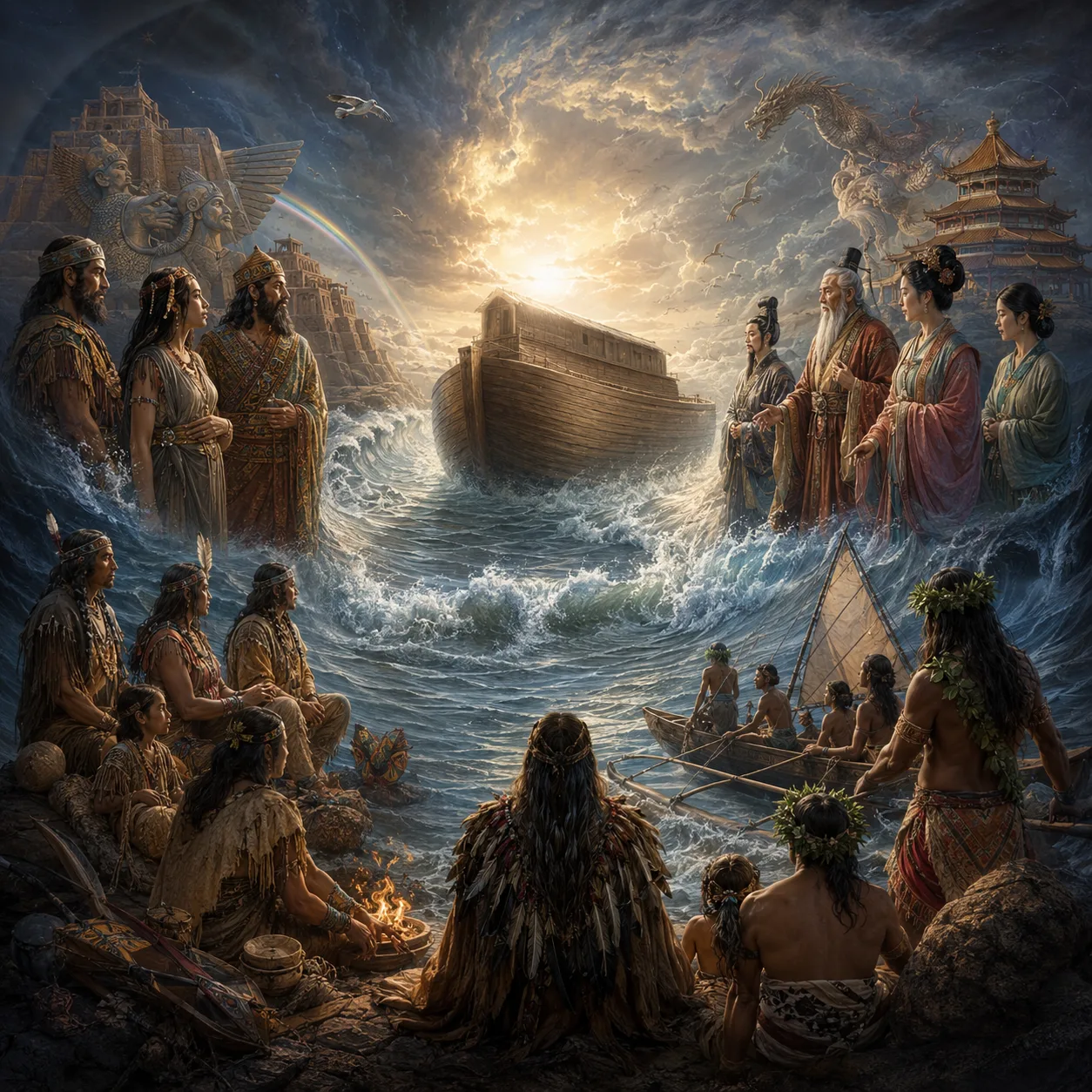
Few facts of comparative anthropology are as well-established as this one: virtually every indigenous culture on earth preserves an oral or written tradition of a great flood. The Australian aboriginal tribes have one. The North and South American native peoples have multiple independent versions — the Hopi, the Algonquin, the Inca, the Maya, the Aztec, the Toba of Argentina. The Pacific islanders — Hawaiian, Tahitian, Maori — have theirs. China’s oldest historical tradition records the flood of Da Yu. India preserves the flood of Manu in the Shatapatha Brahmana. Greek mythology records the flood of Deucalion. The Norse Edda records a flood that wiped out the giants. The flood traditions of Africa, of Siberia, of the Andamanese, of the highland peoples of Burma and Cambodia: hundreds of distinct accounts have been documented across cultures with no plausible historical contact with one another.
The mainstream anthropological response has typically been that flood is a near-universal human experience — rivers flood, coastlines flood — and that the commonality of the narrative reflects nothing more than the commonality of the underlying disaster. That objection has some force for stories of local flooding. It has very little force when the stories share specific structural elements: a single righteous family forewarned by a deity; the construction of a great vessel; the loading of animals; the destruction of all other life; a landing on a mountain; the release of birds to test the receding waters; a sacrifice upon disembarking; a covenant or sign from the deity at the conclusion.
These features do not arise spontaneously from the experience of a local flood. They are the distinguishing marks of a single account, transmitted from a common origin and differentiated by language and local imagery as the descendants of the survivors dispersed. The biblical record accounts for this directly: Genesis 10–11 traces the dispersion of the post-flood human population from the plain of Shinar after the confusion of tongues at Babel. If that account is read on its own terms, the worldwide distribution of structurally-parallel flood narratives is precisely what should be expected. On any other model, it is a remarkable cultural coincidence.
8. The Epic of Gilgamesh — the closest non-biblical parallel
Of the documented flood narratives, the one which most closely parallels the biblical Genesis account in structure and detail is recorded on Tablet XI of the Epic of Gilgamesh, an Akkadian text recovered from the library of the Assyrian king Ashurbanipal at Nineveh in 1853. The Gilgamesh narrative was composed somewhere in the second millennium BC; the older Sumerian Atrahasis and Eridu Genesis traditions on which Gilgamesh appears to draw are older still, dating to the early second or late third millennium BC. These are the oldest written records of any flood narrative anywhere on earth. They predate the redaction of the Hebrew text of Genesis by many centuries.
The mainstream-critical inference drawn from this chronological sequence has been that the Hebrew text of Genesis must be derivative of the older Mesopotamian sources: that Genesis is a late, polished, monotheistic rewriting of pagan flood myths the Hebrew patriarchs encountered during their sojourn in Babylon or earlier. That conclusion does not, however, follow from the data. Older written attestation does not establish older origin. Both the Mesopotamian and the Hebrew accounts could equally descend from a common original event — the actual flood — transmitted orally through the post-flood generations and recorded in writing at different points by different cultures. The Hebrew text records itself as descending from Noah, the flood survivor, through his son Shem; the Mesopotamian texts record themselves as descending from Utnapishtim (the Atrahasis figure), who plays an equivalent role.
The structural parallels between the two accounts are too specific to be coincidental; the divergences are exactly the differences one would expect between a polytheistic Mesopotamian retelling and a monotheistic Hebrew preservation. The table below sets the eight most striking parallels side by side.
| Element | Genesis (KJV) | Gilgamesh Tablet XI |
|---|---|---|
| The deity warns one righteous man | Genesis 6:13 — God tells Noah of the coming destruction | Tablet XI — Ea warns Utnapishtim through the reed wall |
| Instructions to build a great vessel | Genesis 6:14–16 — three decks, sealed with pitch, dimensions given | Tablet XI — six decks, sealed with bitumen, dimensions given |
| Pairs of every creature taken aboard | Genesis 7:2–3 — clean and unclean animals, male and female | Tablet XI — "all the beasts and animals of the field" loaded |
| Catastrophic flood covers the earth | Genesis 7:19 — "all the high hills, that were under the whole heaven, were covered" | Tablet XI — even the gods are terrified; the storm levels the land |
| The vessel comes to rest on a mountain | Genesis 8:4 — "upon the mountains of Ararat" | Tablet XI — the boat lodges on Mount Nisir |
| Birds released to test the waters | Genesis 8:7–12 — a raven, then doves in succession | Tablet XI — a dove, a swallow, and finally a raven that does not return |
| Sacrifice offered upon disembarking | Genesis 8:20 — Noah builds an altar; the LORD smells "a sweet savour" | Tablet XI — Utnapishtim offers sacrifice; "the gods gathered like flies" |
| A divine sign of covenant follows | Genesis 9:13–17 — the rainbow, the everlasting covenant | Tablet XI — the goddess Ishtar holds up her necklace as a covenant token |
Eight parallel elements in eight specific narrative beats: warning, ark, animals, flood, landing, birds, sacrifice, covenant-sign. The probability that two cultures independently invented this specific narrative architecture by coincidence is vanishingly small. What is far more likely is the inverse of the mainstream-critical assumption: not that Genesis copied Gilgamesh, but that both accounts preserve the memory of an actual event from which the cultural descendants of the survivors transmitted their respective versions.
9. The cumulative case
The mainstream model of earth history is committed to explaining each of the foregoing eight lines of evidence on independent terms: marine fossils on mountains by slow tectonic uplift; mass fossil graveyards by repeated local catastrophes; polystrate trees by dozens of distinct rapid local deposition events; Mount St Helens stratification, canyon-carving, and “old” K-Ar dates on decade-old dacite as a local anomaly with no implications for the wider column; soft tissue in dinosaur bones by exotic iron-mediated preservation mechanisms; radiocarbon in deep-time samples by laboratory contamination; the K-Pg boundary by a coincidence of asteroid impact and volcanism; and the worldwide flood narratives by independent cultural invention from common minor experience. Each individual explanation has some defenders; none is securely established; several stretch the underlying physics to a breaking point.
The biblical flood account explains all eight under a single hypothesis. A global, year-long deluge accompanied by massive tectonic and volcanic activity would deposit marine sediments at altitude, bury fossil graveyards across every continent, entomb upright trees rapidly, lay down vast stratified sequences in hours rather than millennia, preserve soft tissue and detectable radiocarbon by recency, generate the K-Pg geochemical and palaeontological signature, and leave a single common ancestral memory in the descendants of its survivors. The flood model is parsimonious in a way the patchwork mainstream model is not.
It also has the modest advantage of being, on the biblical record, simply true. The reader is not asked to take Scripture as a scientific manual. The reader is asked to consider whether a model that requires one event to explain eight facts is more rationally defensible than a model that requires eight separate events to explain the same eight facts — and whether the simpler model, in addition to being simpler, happens to be the one a witness wrote down.
Scripture testimony
The biblical record of the flood is detailed, internally coherent, and quoted as historical fact by Jesus Christ and by the apostle Peter. The most important anchor passages:
- Genesis 7:11
- In the six hundredth year of Noah's life, in the second month, the seventeenth day of the month, the same day were all the fountains of the great deep broken up, and the windows of heaven were opened.
- Genesis 7:19–20
- And the waters prevailed exceedingly upon the earth; and all the high hills, that were under the whole heaven, were covered. Fifteen cubits upward did the waters prevail; and the mountains were covered.
- Genesis 7:23
- And every living substance was destroyed which was upon the face of the ground, both man, and cattle, and the creeping things, and the fowl of the heaven; and they were destroyed from the earth: and Noah only remained alive, and they that were with him in the ark.
- 2 Peter 3:5–6
- For this they willingly are ignorant of, that by the word of God the heavens were of old, and the earth standing out of the water and in the water: whereby the world that then was, being overflowed with water, perished.
- Matthew 24:37–39
- But as the days of Noe were, so shall also the coming of the Son of man be… and knew not until the flood came, and took them all away; so shall also the coming of the Son of man be.
Sources
- Mary H. Schweitzer, J. L. Wittmeyer et al., “Soft-Tissue Vessels and Cellular Preservation in Tyrannosaurus rex,” Science 307: 1952–1955 (2005); and follow-up papers in Science 316: 277–280 (2007) and Nature 514: 547–549 (2014).
- L. Vardiman, A. A. Snelling, and E. F. Chaffin (eds.), Radioisotopes and the Age of the Earth: A Young-Earth Creationist Research Initiative (Institute for Creation Research and Creation Research Society, 2005) — the RATE project final report, including the carbon-14-in-coal and carbon-14-in-diamonds findings.
- John D. Morris, The Young Earth: The Real History of the Earth — Past, Present, and Future (Master Books, revised edition 2007) — standard survey of the flood-geology field with full chapter on mass fossil graveyards.
- Andrew A. Snelling, Earth’s Catastrophic Past: Geology, Creation & the Flood, two volumes (Institute for Creation Research, 2009) — primary reference work on flood geology including the K-Pg, fossil graveyard, and polystrate-tree material.
- Steven A. Austin, “Excess Argon within Mineral Concentrates from the New Dacite Lava Dome at Mount St. Helens Volcano,” Creation Ex Nihilo Technical Journal 10(3): 335–343 (1996) — the original publication of the K-Ar dating of decade-old Mount St Helens dacite returning ages of 0.35 to 2.8 million years.
- Steven A. Austin, Grand Canyon: Monument to Catastrophe (Institute for Creation Research, 1994) — field-guide treatment of the Mount St Helens rapid-stratification and Little Grand Canyon evidence, with full chapters on the Coconino Sandstone cross-bedding and Brand’s trackway analysis.
- Leonard R. Brand and Thu Tang, “Fossil Vertebrate Footprints in the Coconino Sandstone (Permian) of Northern Arizona: Evidence for Underwater Origin,” Geology 19: 1201–1204 (1991) — peer-reviewed publication of the trackway evidence for subaqueous origin of the Coconino formation.
- Pierre Y. Julien, Yongqiang Lan and Guy Berthault, “Experiments on Stratification of Heterogeneous Sand Mixtures,” Bulletin de la Société Géologique de France 164(5): 649–660 (1993) — the foundational flume experiments demonstrating simultaneous lateral stratification of mixed-grain sediment under flowing water.
- Luis W. Alvarez, Walter Alvarez et al., “Extraterrestrial Cause for the Cretaceous-Tertiary Extinction,” Science 208: 1095–1108 (1980) — the foundational paper for the mainstream asteroid-impact theory at K-Pg.
- Gerta Keller and Andrew C. Kerr (eds.), Volcanism, Impacts, and Mass Extinctions: Causes and Effects, Geological Society of America Special Paper 505 (2014) — major edited volume covering the Deccan Traps as alternative/contributory explanation for K-Pg.
- Andrew George (translator), The Epic of Gilgamesh (Penguin Classics, 2003) — standard English translation of all Mesopotamian flood traditions including the Sumerian Atrahasis and the Akkadian Gilgamesh Tablet XI.
- James G. Frazer, Folk-Lore in the Old Testament: Studies in Comparative Religion, Legend, and Law, three volumes (Macmillan, 1918) — classic comparative survey of worldwide flood traditions, volume one, chapter four. Frazer’s own conclusions about the origin of the parallels differ from those of the present article; his catalogue of the parallels themselves remains foundational.