
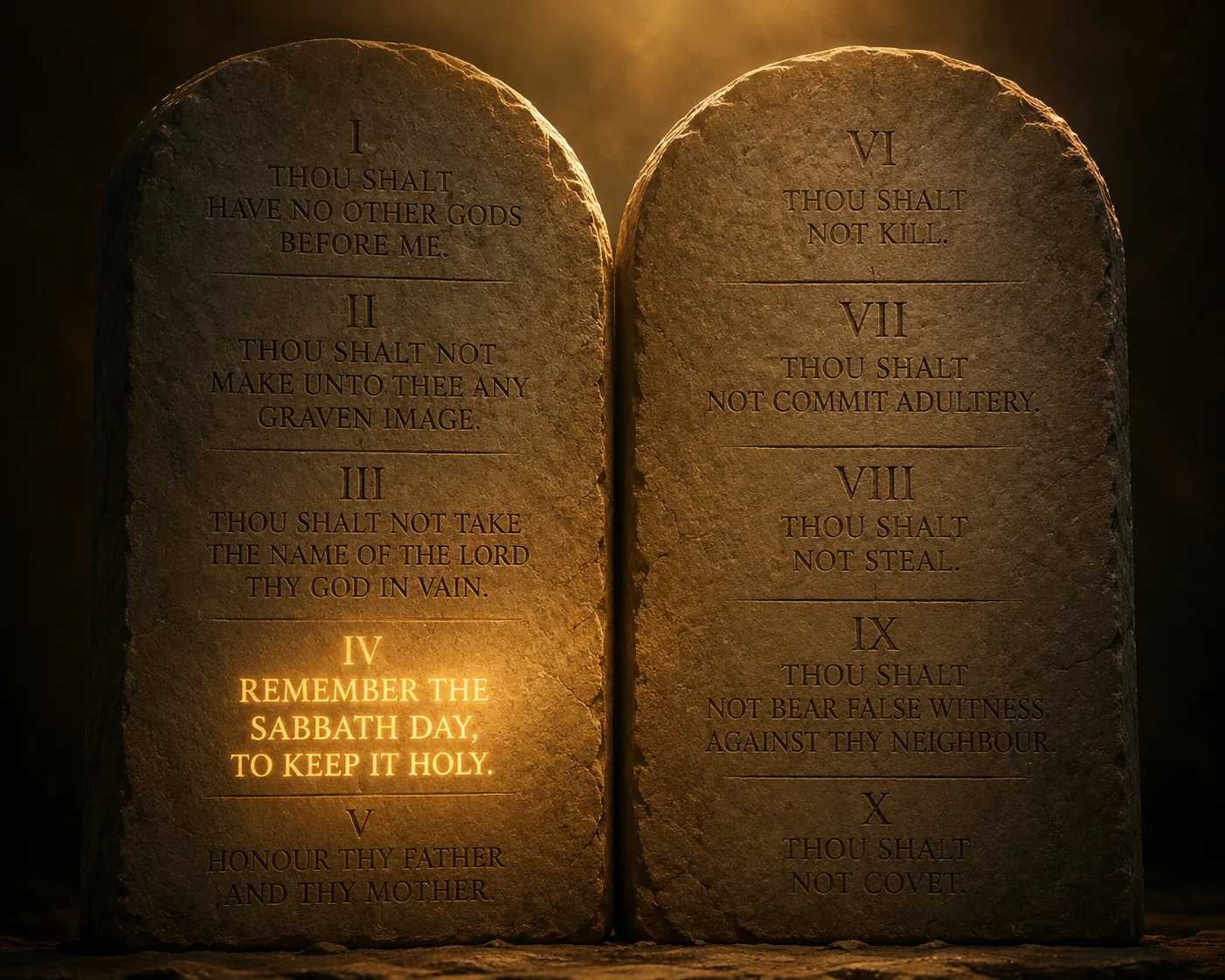
"Remember the sabbath day, to keep it holy."
Exodus 20:8, KJV
The Sabbath is the only commandment in the Decalogue that begins with the word Remember. The word is deliberate. The fourth commandment was not new at Sinai — it was already known, already given, already in the earth, and already being forgotten by a people whose four hundred years in Egypt had laid the dust of pagan worship over the day God blessed at creation. The whole of Scripture treats the Sabbath as a creation institution older than every nation, older than the law of Moses, older than the Jewish people, older than sin itself. The commandment at Sinai is a call to recover what was always true. The verb is remember, not begin.
This article walks the Sabbath through the four arcs by which it is best read: that it is older than Sinai, that it was kept by Christ and the apostles and given to the Gentile too, that it was changed by the little horn and not by God, and that it stands at the centre of the closing crisis of human history as the seal of the God Who made heaven and earth. The standard texts used to argue the Sabbath away — Colossians 2:16, Romans 14, Matthew 11:28, Hebrews 4 — are read in their own contexts and found to teach something different from what the modern church has taught. The argument closes with the apostolic invitation: try it. The God Who made the day will meet the soul who comes to it.
The Sabbath at Creation
"Thus the heavens and the earth were finished, and all the host of them. And on the seventh day God ended his work which he had made; and he rested on the seventh day from all his work which he had made. And God blessed the seventh day, and sanctified it: because that in it he had rested from all his work which God created and made."
Genesis 2:1-3, KJV
The Sabbath stands at the close of the creation week as the seventh and crowning gift of the Creator. Three verbs in three sentences define the day: He rested in it, He blessed it, He sanctified it — that is, He set it apart for holy use. No other day in the calendar is so marked. No other day carries this triple consecration. The Sabbath is unique among the days of the week because the Creator made it so on the day He completed His creative work.
Adam and Eve were created on the sixth day, near its close. Their first full day of conscious life — their first whole day in the garden, their first sunrise, their first walk through the world that had just been spoken into being — was the seventh-day Sabbath. The Sabbath was given to them as the first gift of the new world. Before any commandment had been formally written, before any nation existed, before sin had entered the earth, the seventh day was the day God spent with His new family. The Sabbath was, from the first hour of human history, the day of relationship between the Creator and His creation.
Two institutions came out of Eden into the long flow of human life. The first was marriage, given on the sixth day. The second was the Sabbath, given on the seventh. Both are pre-fall, pre-Sinai, pre-Jewish, pre-national. Both belong to humanity as humanity, not to any one tribe or covenant administration. The Sabbath is the older of the two only by hours, but the order is the order of God's own arrangement: relationship between human persons first, and relationship between the human family and God second. The seventh day is the appointment with the Maker that the first six days of work make space for.
The Sabbath Before Sinai
The common modern claim is that the Sabbath began at Sinai. The text of Scripture will not bear that claim. Long before the Decalogue was written on the tablets of stone, the moral law it codified was already in operation — and the Sabbath, as the fourth of those moral commandments, was already known and kept.
The evidence begins before earth itself. Ezekiel 28:14-17 traces Lucifer's fall to a moment before the creation of Adam: "Thou wast perfect in thy ways from the day that thou wast created, till iniquity was found in thee." The word iniquity in the apostolic vocabulary is the word for lawlessness — and lawlessness is the transgression of the law (1 John 3:4). For Lucifer to have committed iniquity in heaven before Adam was created, the law had to have been in heaven before earth was made. The law of God is older than the world.
After the creation, the evidence continues. Cain killed his brother Abel (Genesis 4:8). God charged him with the deed: "The voice of thy brother's blood crieth unto me from the ground" (Genesis 4:10). The charge would have no force without a commandment against murder, and the commandment against murder belongs to the same Decalogue as the commandment about the Sabbath. The book of Job, set in patriarchal times before Sinai, repeatedly testifies to a moral law in operation among the descendants of Noah. Noah himself "found grace in the eyes of the LORD" (Genesis 6:8); grace is the answer to sin, and sin is the transgression of the law — Noah's need for grace assumes a law to transgress, centuries before Moses.
Abraham, the father of the faithful, is testified to by Yahweh Himself as a commandment-keeper: "Because that Abraham obeyed my voice, and kept my charge, my commandments, my statutes, and my laws" (Genesis 26:5). Four hundred years before Sinai, the patriarch of the covenant was already keeping God's commandments. Joseph in Potiphar's house refuses adultery on a single ground: "How then can I do this great wickedness, and sin against God?" (Genesis 39:9). Sin is the transgression of the law; Joseph's refusal presupposes a law against adultery in operation centuries before the seventh commandment was written at Sinai. The whole moral structure of the Decalogue is in force from Eden through the patriarchs to the bondage of Israel in Egypt.
Exodus 5 and Exodus 16: Pharaoh and the Manna
Two passages in Exodus place the seventh-day Sabbath squarely before the giving of the Decalogue. The first is in Exodus 5. Pharaoh, angry that Moses and Aaron have come asking for time off for the Hebrew slaves to worship, complains to his taskmasters in these terms: "Behold, the people of the land now are many, and ye make them rest from their burdens" (Exodus 5:5). The Hebrew word translated rest in that sentence is shabbat. Pharaoh's own accusation against Moses is that Moses is making the Hebrews keep the Sabbath. The Egyptian throne knew the word. The Israelites in the brickyards knew the day. The Sabbath was already there, in operation, before the law was given at Sinai.
The second passage is Exodus 16, four chapters before the Decalogue itself. Israel is in the wilderness, complaining of hunger, and the LORD sends manna. The instruction is precise: gather every day, but on the sixth day gather a double portion, "for tomorrow is the rest of the holy sabbath unto the LORD" (Exodus 16:23). On the seventh day no manna falls. Some go out to gather anyway, and the LORD rebukes Moses: "How long refuse ye to keep my commandments and my laws?" (Exodus 16:28). Four chapters before Sinai, the Sabbath is already God's commandment, already binding, already being tested in the camp of Israel. The Decalogue at Sinai did not invent the Sabbath. It republished it for a nation that had been forgetting it for four hundred years in Egypt.
The Sabbath at Sinai was not new law. It was old law brought back into the open after four centuries under the dust of Egyptian bondage.
The Sabbath in the World's Languages
A second body of evidence runs through the languages of mankind. Genesis 11 records the confounding of the world's tongues at Babel — every people group that scattered from that plain carried into its new language the vocabulary it had used in the old. Whatever the seventh day was called before Babel, its name should still echo in the daughter languages that came out of the dispersion. And it does.
The Hebrew word for the seventh day is shabbat. The Arabic word for Saturday is as-sabt. The Spanish word for Saturday is sábado. The Italian, sabato. The Portuguese, sábado. The Romanian, sâmbătă. The Russian, суббота (subbota). The Polish, sobota. The Greek, Σάββατο (Sávvato). The Indonesian, Sabtu. The Swahili, Jumamosi (the sixth day-of-the-week reckoning, but the religious word remains Sabato). Across the language families that came out of Babel — Semitic, Romance, Slavic, Hellenic, Austronesian — the seventh day still carries the Hebrew name, sometimes only the consonants, sometimes the whole word. The languages were scattered, but the day kept its name.
The implication is simple. Before Babel, when the whole earth was of one language, the seventh day was already called by the name God Himself had given it. The Sabbath was not a Jewish invention; it was the inheritance of mankind from Eden, carried through the line of Noah, scattered across the new tongues, and still bearing the original name into the vocabularies of nations that have long forgotten Whose day it is.
The Fourth Commandment
"Remember the sabbath day, to keep it holy. Six days shalt thou labour, and do all thy work: but the seventh day is the sabbath of the LORD thy God: in it thou shalt not do any work, thou, nor thy son, nor thy daughter, thy manservant, nor thy maidservant, nor thy cattle, nor thy stranger that is within thy gates: for in six days the LORD made heaven and earth, the sea, and all that in them is, and rested the seventh day: wherefore the LORD blessed the sabbath day, and hallowed it."
Exodus 20:8-11, KJV
The fourth commandment carries a structure no other commandment in the Decalogue has. It bears the threefold seal of God's authority. The name of the Lawgiver: the LORD. The title of the Lawgiver: thy God. The domain of the Lawgiver: who made heaven and earth, the sea, and all that in them is. In the legal language of the ancient world a seal carried exactly these three elements. The fourth commandment is therefore the seal of the Decalogue — the only one of the ten that names whose law this is and over what jurisdiction it stands.
It is also the only commandment that opens with the word Remember. Every other commandment begins with a present or future imperative. The fourth commandment alone reaches back into memory. Israel was not being asked to begin a new observance. Israel was being asked to recover an old one. The verb assumes the Sabbath had been kept and forgotten. Sinai brought it back.
And the commandment explicitly extends to the stranger within the gates. The fourth commandment is not a tribal ordinance restricted to ethnic Jews. From its first delivery the commandment binds the household of Israel and any non-Israelite who has joined himself to that household. The Sabbath was given for mankind.
The Sabbath Is for Mankind, Not the Jew Alone
Christ stated the principle plainly: "The sabbath was made for man, and not man for the sabbath" (Mark 2:27). The Greek behind man is ánthrōpos — the generic word for mankind, the same root from which the English word anthropology comes. The Sabbath was made for the species, not for a tribe within it. Christ's claim runs against the rabbinical framing of His day and against the modern dispensational framing of ours.
A mixed multitude went out with Israel from Egypt (Exodus 12:38). They camped at Sinai. They received the Decalogue alongside the Hebrews. From the first delivery of the fourth commandment the Sabbath was being kept by Gentiles within the gates of Israel. And in Isaiah's prophecy of the gospel's reach to the nations, the Sabbath is named as the sign of the Gentile's acceptance into the household of God:
"Also the sons of the stranger, that join themselves to the LORD, to serve him, and to love the name of the LORD, to be his servants, every one that keepeth the sabbath from polluting it, and taketh hold of my covenant; even them will I bring to my holy mountain, and make them joyful in my house of prayer… for mine house shall be called an house of prayer for all people."
Isaiah 56:6-7, KJV
The Gentile who joins himself to the LORD and keeps the Sabbath is brought into the holy mountain and made joyful in the house of prayer. The Sabbath is not the sign of a closed national covenant. It is the sign by which the stranger publicly identifies himself with the worship of the true God. Paul completes the line in Romans 2:25-29 and Romans 10:12: "There is no difference between the Jew and the Greek." The Jew who breaks the commandments is no longer reckoned a Jew before God. The Gentile who keeps them is reckoned a son of Abraham. Spiritual Israel is the people of God in every age — and the Sabbath remains the sign between the Lord and His people.
Christ and the Apostles Kept the Sabbath
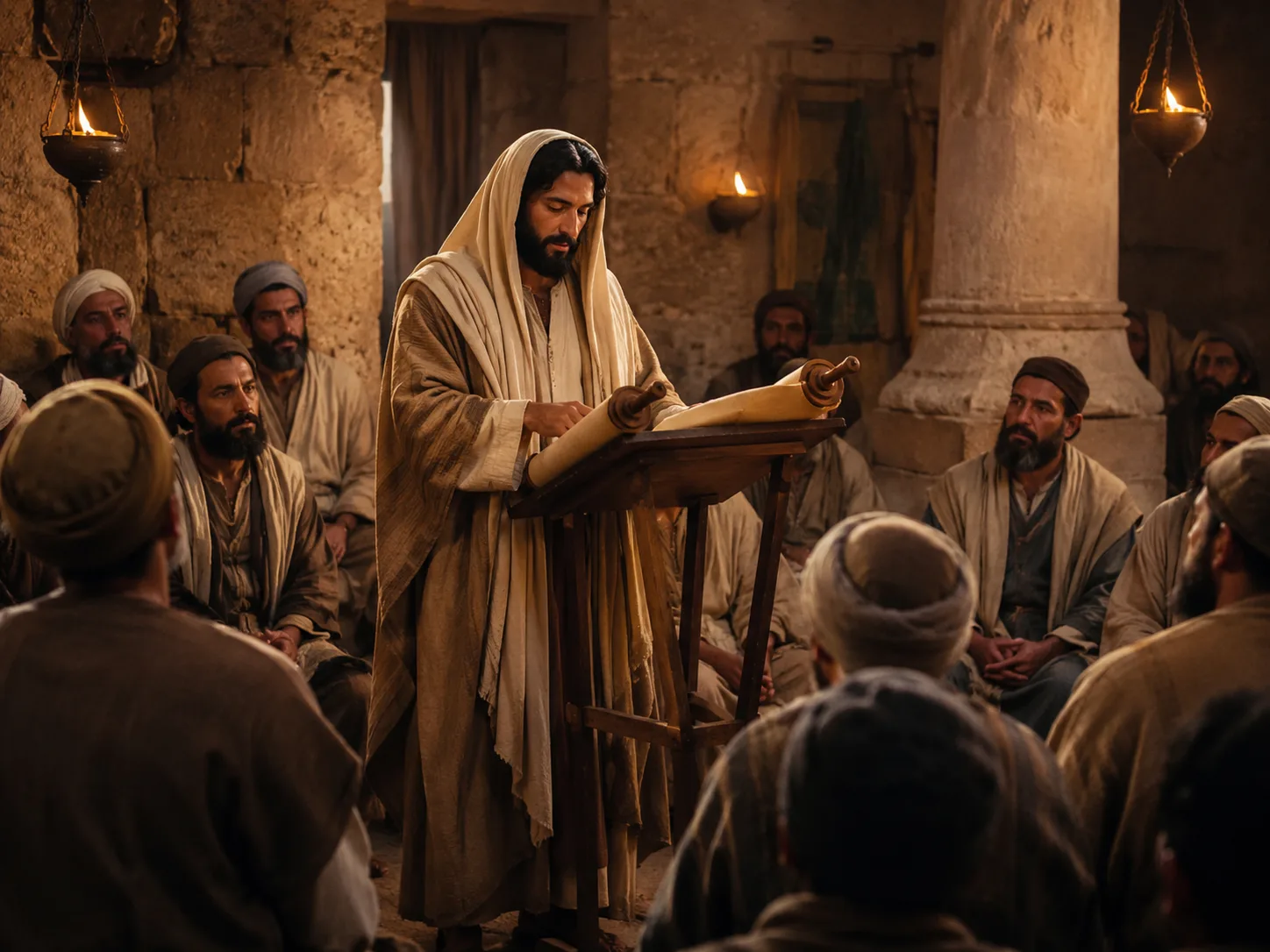
If the Sabbath had been quietly transferred to another day at the cross — or if its observance had ceased — the New Testament would be the place to find the announcement. The New Testament records the opposite. Luke writes of Christ: "And he came to Nazareth, where he had been brought up: and, as his custom was, he went into the synagogue on the sabbath day, and stood up for to read" (Luke 4:16). It was His custom. It had been His custom from boyhood. The Son of God observed the Sabbath as the regular and habitual practice of His life.
Christ taught about the Sabbath at length — but always to correct the Pharisaical accretions that had buried the day under human regulations, never to abolish it. "The sabbath was made for man, and not man for the sabbath: therefore the Son of man is Lord also of the sabbath" (Mark 2:27-28). Christ's lordship over the Sabbath is precisely the lordship of its Maker — the Word by Whom all things were made (John 1:3), the same Word Who rested at the close of the creation week. He healed on the Sabbath because "it is lawful to do well on the sabbath days" (Matthew 12:12). He never spoke a word that suggested the day itself would be repealed.
Even more directly, in His Olivet prophecy concerning the destruction of Jerusalem in AD 70, Christ instructed His disciples: "Pray ye that your flight be not in the winter, neither on the sabbath day" (Matthew 24:20). Forty years after the cross Christ expected His followers still to be keeping the Sabbath — concerned enough about its observance that they would not want to be forced to flee from invading armies on the day. The expectation rules out any quiet transfer of the Sabbath to another day during His earthly ministry.
The book of Acts records the same pattern through the apostolic generation. Paul preached in the synagogues "every sabbath" (Acts 17:2; 18:4). He spent eighteen months in Corinth, reasoning in the synagogue "every sabbath" (Acts 18:11) — by the simple arithmetic of that span, well over seventy Sabbaths of recorded ministry in one city alone. Acts 13:42-44 records the Gentiles of Antioch in Pisidia asking that "these words might be preached to them the next sabbath" — and the next Sabbath "came almost the whole city together to hear the word of God." Acts 15:21 — written some twenty years after the cross — states matter-of-factly that "Moses of old time hath in every city them that preach him, being read in the synagogues every sabbath day." Two decades after the resurrection, the Sabbath was still being read and preached in every synagogue across the Roman world. The transfer had not happened.
The Lord's Day Is the Sabbath, Not Sunday
John, in exile on Patmos, writes that he was "in the Spirit on the Lord's day" (Revelation 1:10). The phrase is unique in the New Testament — it appears only in that verse. Modern Christendom takes the phrase to mean Sunday, but Scripture itself supplies a different identification. Christ, in His own voice, named the day He owned: "the Son of man is Lord also of the sabbath" (Mark 2:28). The day of which Christ is Lord is the seventh-day Sabbath. The Lord's day, in the only sense Scripture defines, is the Sabbath day.
Isaiah states the equivalence still more plainly: "If thou turn away thy foot from the sabbath, from doing thy pleasure on my holy day; and call the sabbath a delight, the holy of the LORD" (Isaiah 58:13). The LORD calls the Sabbath His holy day. The text is decisive. Where Scripture speaks of "the Lord's day" or of "my holy day," it speaks of the seventh day, not the first.
Sunday observance in the New Testament has no such anchor. The first day of the week is mentioned eight times in the New Testament and never once called a Sabbath, never once called the Lord's day, and never once commanded as a day of worship. The cumulative record is the inverse of what the modern Sunday-keeping tradition assumes: dozens of Sabbath-keeping observations, and not one transfer announcement.
Colossians 2:16 — Feast Sabbaths, Not the Weekly
The verse most often used to argue the Sabbath's abolition is Colossians 2:16: "Let no man therefore judge you in meat, or in drink, or in respect of an holyday, or of the new moon, or of the sabbath days: which are a shadow of things to come; but the body is of Christ" (Colossians 2:16-17). Read in isolation, the verse looks like a license to ignore the Sabbath. Read against the rest of the Bible, it is doing something else.
Leviticus 23 distinguishes carefully between two kinds of sabbaths. The seventh-day Sabbath is one category (Leviticus 23:3): the weekly rest established at creation, written into the Decalogue, kept perpetually. The annual feast-day sabbaths are another (Leviticus 23:4-44): the Passover, the Feast of Unleavened Bread, the Feast of Weeks, the Feast of Trumpets, the Day of Atonement, the Feast of Tabernacles. These feast sabbaths fell on calendar dates, not on a fixed weekday; they were tied to the agricultural cycle and to the sacrificial system; they accompanied "meat offerings" and "drink offerings" (Leviticus 23:13, 18, 37). They were the shadow of Christ's sacrificial work — pointing forward to the cross, fulfilled in His death and resurrection, and therefore properly set aside once the substance had arrived.
Paul's vocabulary in Colossians 2:16 matches the feast-sabbath vocabulary of Leviticus 23 exactly. "Meat, drink, holyday, new moon, sabbath days" — these are the categories of the ceremonial law, not the moral law. The ceremonial system had its end in Christ; the moral system, written by God's own finger in stone, did not. The seventh-day Sabbath of the fourth commandment was established before sin entered the world (Genesis 2:1-3); it cannot be a shadow of Christ's remedy for a problem that did not yet exist. The Sabbath of Colossians 2:16 is the feast sabbath, not the weekly.
The handwriting of ordinances "that was against us, which was contrary to us" (Colossians 2:14) which Christ nailed to His cross was likewise the ceremonial law — handwritten by Moses and placed beside the ark (Deuteronomy 31:24-26) as a witness against Israel's transgressions. The Decalogue was different. It was written by the finger of God Himself (Exodus 31:18) and placed inside the ark (Exodus 25:16; Hebrews 9:4). The two were never the same body of law. The cross took away the ceremonial. The moral remained.
Romans 14 — Fasting Days, Not Worship Days
The second most-quoted text against Sabbath observance is Romans 14:5-6: "One man esteemeth one day above another: another esteemeth every day alike. Let every man be fully persuaded in his own mind." Read in isolation, the passage seems to license each Christian to choose his own holy day. Read in context, the passage is not about the Sabbath at all — and the Sabbath is not mentioned anywhere in the entire book of Romans.
Verse 1 sets the frame: "Him that is weak in the faith receive ye, but not to doubtful disputations." Paul is addressing a particular dispute that was troubling the Roman church. Verse 2 names it: "For one believeth that he may eat all things: another, who is weak, eateth herbs." The dispute is about eating — about the practices of fasting and feasting. Some Jewish Christians were observing the Pharisaic custom of fasting twice a week (Luke 18:12); some were observing other private fasts; some were not. Verses 3-6 work through the matter: do not judge one another over what you eat, do not judge one another over which days you fast, do not judge one another over what you abstain from.
The Sabbath is not in view. The Sabbath was not a "doubtful disputation" in any first-century Jewish community — its observance was not optional and not under dispute. The days of verse 5 are the private fast-days the Pharisees had multiplied into a calendar of their own. Paul's instruction is to leave one another alone in those personal practices, not to redefine the fourth commandment.
Matthew 11:28 and Hebrews 4
A third class of arguments asks whether Christ Himself, or the rest of Hebrews, has displaced the Sabbath. Christ says, "Come unto me, all ye that labour and are heavy laden, and I will give you rest" (Matthew 11:28). The verse is one of the most loved in the New Testament. It is not a verse about repealing the seventh day. Christ offers spiritual rest — the rest of the soul that has come to Him in faith — to the soul that comes to Him. He does not say He has replaced the day. To take Matthew 11:28 as the abolition of the Sabbath is to read into the text a claim it nowhere makes.
Hebrews 4 is more direct. The author of Hebrews is making the argument that there remains a rest for the people of God, and he reasons explicitly from the seventh-day Sabbath of Genesis 2 — quoting Genesis 2:2 itself in Hebrews 4:4 — to the larger spiritual rest into which the believer enters by faith. Verse 9, the key verse, is decisive:
"There remaineth therefore a rest [σαββατισμός — sabbatismos, a Sabbath-keeping] to the people of God."
Hebrews 4:9, KJV
The Greek word the King James translates "rest" in verse 9 is sabbatismos — literally, a Sabbath-keeping. The word does not occur anywhere else in the New Testament. The author of Hebrews is making the express point that the Sabbath-keeping rest remains for the people of God. Hebrews 4 is not the abolition of the Sabbath. Hebrews 4 is the New Testament's clearest statement that the seventh-day rest continues into the gospel age and is to be entered into by the believer through faith.
The Little Horn Thought to Change the Times and the Law
The prophecy of Daniel 7:25 names the power that would arise after Rome and would dare what no earthly authority is permitted to dare:
"And he shall speak great words against the most High, and shall wear out the saints of the most High, and think to change times and laws: and they shall be given into his hand until a time and times and the dividing of time."
Daniel 7:25, KJV
Only one commandment in the Decalogue concerns time itself — the fourth. Daniel's prophecy foretold the rise of a religious-political power that would attempt to change the only time-bound law in the law of God. History records the attempt with date and name. In AD 321 the Roman emperor Constantine, by then a professing convert to Christianity but still presiding over a syncretic empire of sun-worshippers and Christians, issued the first civil Sunday law: "Let all judges and townspeople and all occupations of trades rest on the venerable day of the sun." The law was a political compromise, not a divine command. It was the first formal substitution of the day of the sun for the day of the LORD in the public life of the Christianised Roman state.
In AD 363-364 the Council of Laodicea — a synod of the Eastern church — formally anathematised Sabbath-keeping Christians (Canon 29): "Christians must not Judaize by resting on the Sabbath, but must work on that day, rather honouring the Lord's Day; and, if they can, resting then as Christians. But if any shall be found to be Judaizers, let them be anathema from Christ." The Bishop of Rome of that period, Sylvester, has been credited in the Roman tradition with formalising the title "Lord's day" for Sunday. The exchange was complete: the day God blessed at creation, written into the moral law by His own finger, was traded by an apostate church for the day of the sun, by no biblical command but by the church's own claimed authority.
The Roman Catholic Church has openly acknowledged the substitution in its own catechisms and apologetic writings: the change of the Sabbath to Sunday is presented as evidence of the Church's authority to alter the divine law itself. Daniel 7:25's prophecy of a power that would "think to change times and laws" has its historical fulfilment in that exact admission. The change was not God's. It was the little horn's.
The Lost Coin: A Parable of the Recovered Commandment
Christ's parable of the lost coin in Luke 15:8-10 has been read by generations of pioneer Adventists as a figure of the loss and recovery of the Sabbath through the long centuries between Constantine and the Reformation. A woman who has ten pieces of silver loses one. She lights a candle, sweeps the house, and seeks diligently until she finds the lost piece. When she finds it, she calls her friends and neighbours together: "Rejoice with me; for I have found the piece which I had lost."
A woman in prophecy represents the church (Jeremiah 6:2; 2 Corinthians 11:2; Revelation 12:1). The ten pieces of silver are the Ten Commandments, "more to be desired than gold, yea, than much fine gold" (Psalm 19:10; Psalm 119:72). The lost piece is the Sabbath, dropped from the church's public confession during the long Dark Ages when the Sunday-substitution stood unchallenged. The candle is the Word: "Thy word is a lamp unto my feet, and a light unto my path" (Psalm 119:105). The diligent search is the work of the Reformation — Wycliffe, Tyndale, Zwingli, the Anabaptists, the Sabbatarian Baptists of the seventeenth century, the Adventist pioneers of the nineteenth — searching the Word until the lost coin was recovered. When the woman finds the coin, she calls her friends and neighbours together; the recovered Sabbath has been preached to the nations ever since the recovery began.
The Sabbath in the End-Time Crisis
The Sabbath stands at the centre of the final conflict over worship that the book of Revelation describes. The first angel of Revelation 14, in the threefold message that goes to every nation before the second coming, calls the world to "worship him that made heaven, and earth, and the sea, and the fountains of waters" (Revelation 14:7) — a phrase that is a near-verbatim citation of the fourth commandment (Exodus 20:11). The first angel's call to worship the Creator is a call to the Sabbath, the only commandment that names the Creator as such.
Revelation 7:1-3 shows four angels holding back the four winds of the earth until "the servants of our God" are sealed in their foreheads. Revelation 14:1 shows the same sealed company standing with the Lamb on Mount Zion with the Father's name written in their foreheads. The seal of God is the badge of the Father's authority on the saints. The Sabbath, the only commandment in the Decalogue that bears the Lawgiver's name, title, and domain, is the seal of God's law. To keep it under pressure of civil law is to receive the seal of God.
Over against the seal stands the mark of the beast. The third angel's warning in Revelation 14:9-11 falls on those who worship the beast and his image and receive his mark in their forehead or in their hand. The mark of the beast, on the pioneer-Adventist reading the book of Daniel's prophecy requires, is the enforced observance of the substitute day of worship — the day the beast power has appointed in defiance of the day the Creator gave. When the Sabbath/Sunday test breaks upon the world in the closing crisis, every soul on earth will receive one of the two badges. Revelation 12:17 names the company on the Creator's side: "the dragon was wroth with the woman, and went to make war with the remnant of her seed, which keep the commandments of God, and have the testimony of Jesus Christ." The remnant is a commandment-keeping people. The dragon is making war on a Sabbath-keeping church.
The Sabbath in the New Earth
And the Sabbath does not end at the second coming. Isaiah's vision of the new heavens and the new earth places the Sabbath at the centre of worship in the eternal state:
"For as the new heavens and the new earth, which I will make, shall remain before me, saith the LORD, so shall your seed and your name remain. And it shall come to pass, that from one new moon to another, and from one sabbath to another, shall all flesh come to worship before me, saith the LORD."
Isaiah 66:22-23, KJV
In the world made new, "all flesh" will come from one Sabbath to another to worship before the LORD. The Sabbath is therefore not a temporary ordinance for one nation in one age. It is the day of worship for the redeemed across the eternal weeks of the new creation. Christ's model prayer asked that the Father's will be done "in earth, as it is in heaven" (Matthew 6:10). The Sabbath is kept in heaven. The Sabbath is kept in the new earth. The Sabbath was kept in Eden. The arc is continuous. The day God blessed at the close of the first creation will be kept at the centre of the worship of the last.
The Sabbath as Relationship
Through the whole of this argument it is easy to miss the heart of the day. The Sabbath is not, finally, a doctrine. It is a relationship — the appointment the Creator made with His creation in Eden for the weekly renewal of fellowship. Christ stated the heart of it in two sentences: "The sabbath was made for man, and not man for the sabbath" (Mark 2:27). The day was given to humanity as a gift, not laid upon humanity as a burden. The Pharisaical accretions that had piled rules upon the Sabbath in Christ's day were not the Sabbath. The Sabbath, in its original form, was Eden's rest in the company of the Creator.
Christ's own Sabbath ministry is the model. He worshipped in the synagogues. He taught. He healed — and when His critics objected, He answered: "It is lawful to do well on the sabbath days" (Matthew 12:12). He withdrew with His disciples for fellowship. He spent the day in the work of redemption that is itself a Sabbath work, because redemption is the rebuilding of what creation gave and sin tore down. The Sabbath was, for Him, a delight (Isaiah 58:13) — the highlight of His week, the appointed meeting with His Father in the rhythm of His incarnate life.
For the saint in the present age, the Sabbath is exactly that. A whole day set apart for the worship of the Creator and the fellowship of His people. A day on which the burdens of the six are laid down and the joy of the seventh is taken up. The world looks at it and asks what is gained by keeping it. The saint who has kept one knows the answer. The day God blessed at creation still carries that blessing into the heart of every soul that enters into it.
The Invitation
The closing word is not argument but invitation. The reader who has never kept a Sabbath in his life is invited to keep one. Try it. Set apart twenty-four hours from sundown Friday to sundown Saturday. Lay aside the work of the week. Pick up the Word of God. Worship with the saints. Walk in the world the Creator made and look upon it as His. Hold the day as a delight and not as a burden. See what the day was made to be.
The God Who made the day will meet the soul who comes to it. The Sabbath is the sign He gave between Himself and His people that they might know that He is the LORD that sanctifies them (Exodus 31:13). It is not the badge of a sect. It is not the property of a denomination. It is the day of the Creator, kept by Eden's first family, kept by the patriarchs, kept by Christ, kept by the apostles, kept by the faithful through the long centuries, recovered by the Reformation, lifted up by the closing message of Revelation 14, and kept in the new earth where every Sabbath all flesh will come to worship the LORD. The reader is invited into that company. The day is open. The Creator is waiting.
Scripture Index
- Genesis 2:1-3. The first Sabbath at creation — God rested, blessed, and sanctified the seventh day before sin entered the world.
- Genesis 26:5; Genesis 39:9; Genesis 4:8-10. The pre-Sinai witness — Abraham kept God's commandments and statutes; Joseph called adultery a sin against God; Cain was charged with murder.
- Exodus 5:5; Exodus 16:22-30. The Sabbath before Sinai — Pharaoh accuses Moses of making the Hebrews shabbat; the manna falls in pattern for the seventh-day rest four chapters before the Decalogue.
- Exodus 20:8-11. The fourth commandment — Remember, the seal of God's law, bearing the Lawgiver's name, title, and domain.
- Exodus 31:13, 16-17. The Sabbath as the sign between the LORD and His people that they might know He is the LORD Who sanctifies them.
- Isaiah 56:6-7; Isaiah 58:13. The Sabbath given to the stranger who joins himself to the LORD; the Sabbath named as the holy of the LORD, His holy day.
- Mark 2:27-28; Luke 4:16; Matthew 12:12; Matthew 24:20. Christ's Sabbath teaching — made for mankind, His weekly custom, lawful to do good, expected to be kept at the AD 70 destruction of Jerusalem.
- Acts 13:42-44; Acts 17:2; Acts 18:4, 11; Acts 15:21. The apostolic Sabbath — Paul preached every Sabbath in the synagogues for some eighty Sabbaths on record; twenty years after the cross Moses was still being read in every synagogue every Sabbath.
- Romans 2:25-29; Romans 10:12. Spiritual Israel — the Gentile who keeps the commandments is reckoned a son of Abraham; no difference between Jew and Greek.
- Colossians 2:14-17. The handwriting of ordinances nailed to the cross — the ceremonial feast sabbaths of Leviticus 23, not the seventh-day Sabbath of the Decalogue.
- Romans 14:1-6. The Roman dispute over fasting days, not over the Sabbath; the Sabbath is not mentioned anywhere in the book of Romans.
- Hebrews 4:4, 9-10. "There remaineth therefore a sabbath-keeping [σαββατισμός] to the people of God" — the seventh-day rest continues into the gospel age.
- Daniel 7:25. The little horn would think to change times and laws — fulfilled in Constantine AD 321, the Council of Laodicea AD 363-364, and the Roman Church's own admission that it changed the day on its own authority.
- Revelation 14:7, 9-12; Revelation 7:1-3; Revelation 12:17. The end-time call to worship the Creator (Exodus 20:11 verbatim); the seal of God on the foreheads of the saints; the mark of the beast on the foreheads of those who worship the substitute day; the remnant who keep the commandments.
- Isaiah 66:22-23; Matthew 6:10. The Sabbath in the new earth — from one Sabbath to another all flesh shall come to worship before the LORD; the Father's will done on earth as in heaven.