Revelation does not file the final conflict as a disagreement between governments or a season of bad politics. It files it as a spiritual war over worship — and it names one of the two combatants by name. The system that opposes the people who keep the commandments of God and have the testimony of Jesus is called Babylon, and its weapon is not a sword. It is wine.
The charge of this article is straightforward. The doctrines, symbols, vestments, and rituals of the Roman papal system are not the slow refinement of apostolic Christianity. They are the wine of Babylon — the carry-over of pre-Christian sun, fertility, and mother-goddess worship, baptized with Christian names and pressed on the conscience under the authority of an institution that claims to stand in Christ’s place. Scripture exposes it. History confirms it. Revelation summons every honest soul out of it.
This is not a verdict on Catholic people. Revelation 18:4 says God has “my people” inside the system. The verdict is on the structure, the priesthood, the doctrines, and the worship. The call is not contempt — it is, “Come out of her, my people.”
Central thought — Babylon in Revelation is a religious-political system that intoxicates the nations with false doctrine. The Roman papal system fits that name not by accident or by polemic, but by the unbroken thread of pagan worship its symbols and rites still carry.
The Wine That Maddens the Nations
Scripture is its own dictionary. Christ said, “I am the vine” (John 15:5), and the wine that proceeds from the true vine is His own teaching. Babylon also has wine — and Revelation says the nations have been made drunk by it.
“Babylon hath been a golden cup in the LORD’s hand, that made all the earth drunken: the nations have drunken of her wine; therefore the nations are mad.”
Jeremiah 51:7, KJV
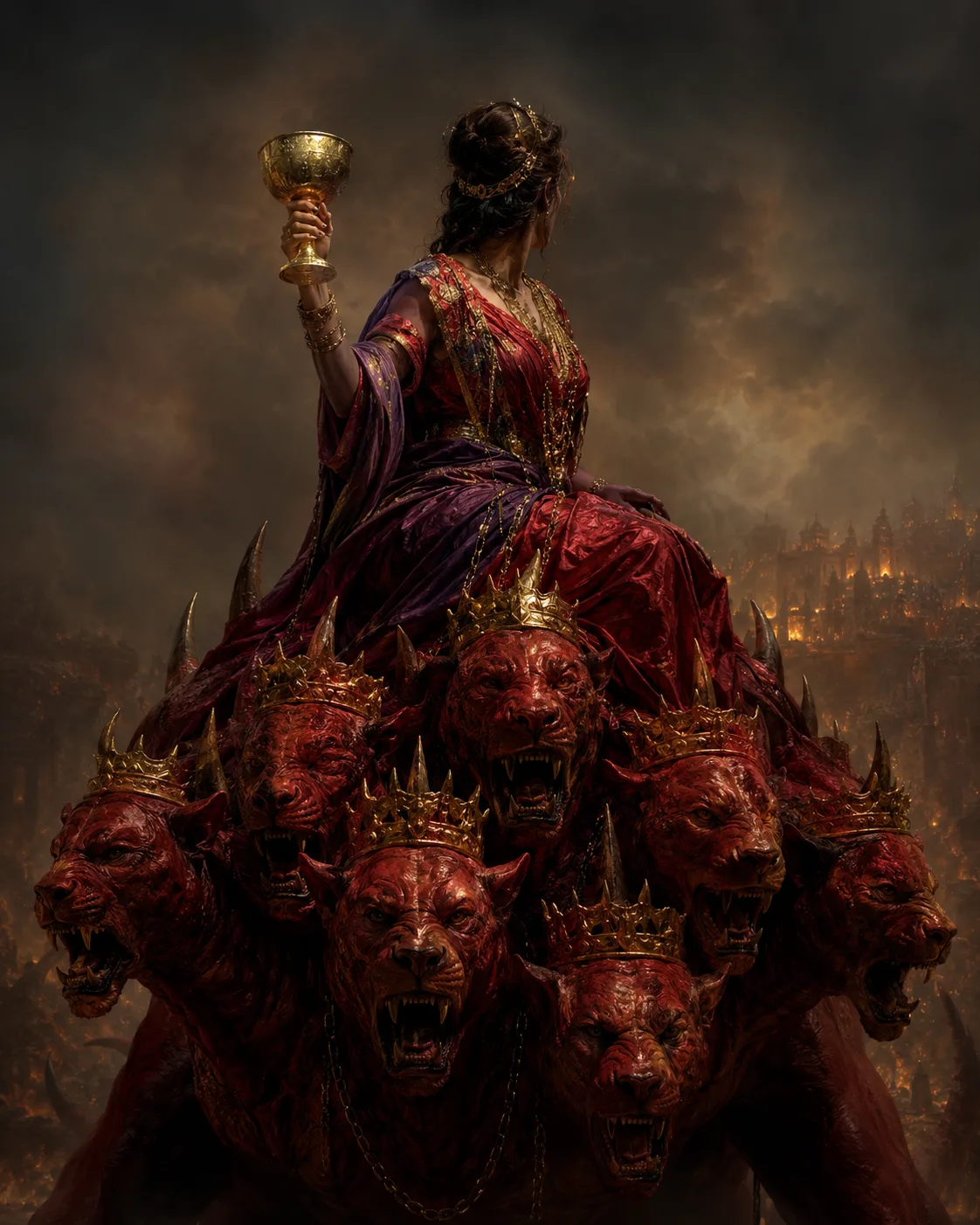
A maddened world is not a metaphor for a few bad opinions. It is the picture of an earth so saturated with religious error that the very faculty of discernment has been numbed. Revelation 17 shows the same image with the woman who holds the golden cup — “full of abominations and filthiness of her fornication” (Revelation 17:4) — and Revelation 14:8 hears the warning angel: “Babylon is fallen, is fallen, that great city, because she made all nations drink of the wine of the wrath of her fornication.” The cup is doctrine. The drunkenness is the spiritual paralysis that lets a counterfeit Christianity be received as the real thing.
When this article speaks of Rome’s wine, it is speaking on those terms. Not personalities. Not individuals. The teachings — what they actually are, where they actually came from, and what they actually do to those who drink them.
Babel Re-Built: From Genesis 11 to Revelation’s Antitype
The name Babylon means confusion, and the Bible’s first Babylon — Babel — was an act of organized rebellion. After the Flood, men gathered on the plain of Shinar and said, “let us build us a city and a tower, whose top may reach unto heaven; and let us make us a name” (Genesis 11:4). It was unity in apostasy: a single religion, a single tower, a single human project to climb to God on man’s terms. God Himself broke it up.
“Let us go down, and there confound their language, that they may not understand one another’s speech.”
Genesis 11:7, KJV
The scattering of the nations was a mercy. A divided world is a world in which God can still be sought. A consolidated world under one apostate religion is the very condition the enemy needs in order to be worshipped by all (Revelation 13:8). Babel was the prototype. Revelation’s Babylon is the antitype — and it is much larger.
Revelation cannot mean literal Babylon rebuilt in modern Iraq: God said the ancient city would never be rebuilt (Jeremiah 51:62-64). The type is always smaller than the antitype. Just as the lamb of Passover was a small example of the Lamb of God, ancient Babylon is a small example of a global Babylon — a worldwide religious system, sitting on many waters (Revelation 17:15, that is, on “peoples, and multitudes, and nations, and tongues”), with a single visible head, a single sacrificial liturgy, and a single mother-goddess at its centre.
The Threefold Counterfeit: Dragon, Beast, False Prophet
Revelation 16:13 sees three unclean spirits like frogs come out of three mouths — the dragon, the beast, and the false prophet — and gather the kings of the earth to the battle of the great day of God Almighty. This is the satanic answer to the people of God who keep His commandments and have the faith of Jesus. It is not a holy triune. It is a counterfeit alliance of three powers.
- The dragon — Satan himself, working through spiritism, occultism, signs, and direct supernatural deception. Revelation 12:9 names him outright.
- The beast — the papal system, identified already in Daniel 7 as the little horn, in Revelation 13 as the sea beast that received its seat, power, and great authority from the dragon, and in 2 Thessalonians 2 as the man of sin who exalts himself above all that is called God.
- The false prophet — apostate Protestantism: those who once had the truth of the Reformation and are now joining hands with the mother system, working miracles to validate her authority.
“And the dragon gave him his power, and his seat, and great authority.”
Revelation 13:2, KJV
That last verse settles the question of pedigree. Whatever the papal system is, the dragon is its sponsor. The throne it occupies is the throne Satan handed it. The miracles by which the false prophet certifies it are the spirits of devils (Revelation 16:14). The Bible labels this combination a confederacy against God Almighty — and a confederacy is what Revelation calls Babylon.
Constantine, Simon Magus, and the Strategy of the Garb
Christianity did not slowly become paganized by accident. It was overlaid deliberately. The historian Augustus Neander recorded that Constantine, in order to recommend the new religion to the heathen, transferred into it the outward ornaments to which they had been accustomed in their own. The pagan temples were rededicated. The pagan priesthoods were absorbed. The pagan symbols were rebranded. The mass conversions of the fourth century were not the triumph of the apostolic gospel — they were the absorption of paganism with a Christian veneer.
The thread reaches back further still. Acts 8 introduces Simon Magus, a Samaritan magician who attached himself to the apostolic church for the power it carried. Peter rebuked him to his face (Acts 8:20-23). Tradition outside the New Testament — preserved both by early Christian writers and by the secret societies themselves — records that Simon followed the apostles to Rome and there built up a counterfeit Christianity that fused his Samaritan cabalism with the gospel name. The garb was Christian. The interior was magus.
Paul saw it coming and named it in advance.
“For I know this, that after my departing shall grievous wolves enter in among you, not sparing the flock. Also of your own selves shall men arise, speaking perverse things, to draw away disciples after them.”
Acts 20:29-30, KJV
Rome did not invent her doctrines from the New Testament. She inherited them from the cult-cities of the Mediterranean — Babylon by way of Pergamos, Alexandria by way of Osiris, Athens by way of Mithras, Rome herself by way of Saturn — and then she dressed them in Christian language. This is the strategy of Babylon’s wine: never deny every truth, but always blend the truth with the lie until the original cannot be distinguished from the substitute.
Mother and Child: From Semiramis to the Queen of Heaven
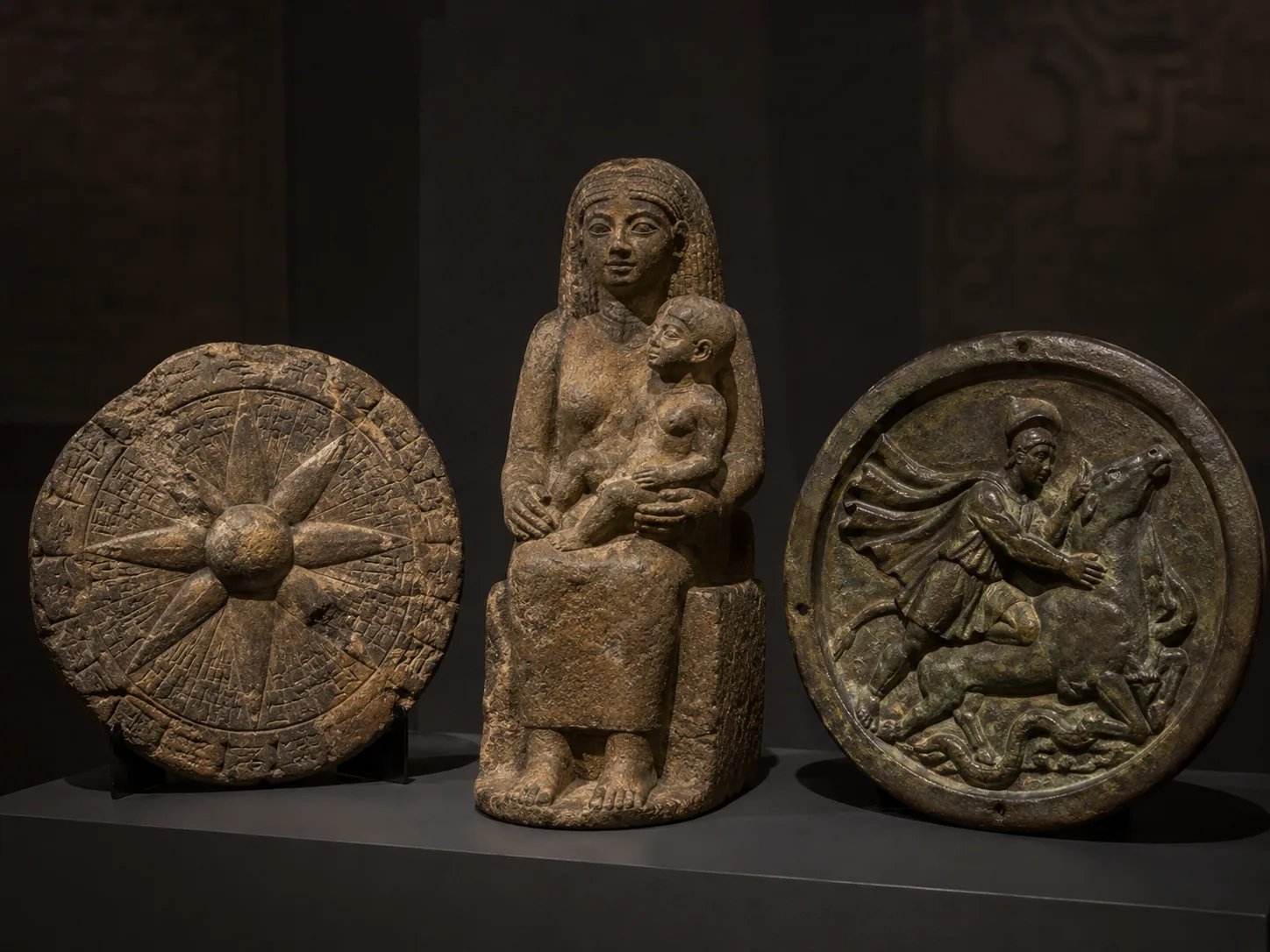
The Babylonian system was built on a mother and a son. Nimrod the warrior was killed; his widow Semiramis announced that he had been transported to the sun and reborn through her as the divine child Tammuz. The mother became the mediatrix — the one through whom the son was accessible, the goddess who softened the heart of heaven. The child was the suffering and rising saviour, the counterfeit Messiah whom the women of Israel were already weeping for in Ezekiel’s day (Ezekiel 8:14).
The same religion reappears in every ancient culture under different names. Isis and Horus in Egypt. Isi and Iswara in India. Cybele and Deoius in Asia Minor. Ceres and Plutus in Greece. Fortuna and Jupiter-puer in Rome. Venus and Cupid. Astarte and Tammuz. Always the mother. Always the child. Always the queen of heaven.
“The children gather wood, and the fathers kindle the fire, and the women knead their dough, to make cakes to the queen of heaven, and to pour out drink offerings unto other gods, that they may provoke me to anger.”
Jeremiah 7:18, KJV
The Old Testament names this worship a provocation. The New Testament gives no quarter to any mediator besides Christ.
“For there is one God, and one mediator between God and men, the man Christ Jesus.”
1 Timothy 2:5, KJV
And yet the Roman system has crowned Mary Queen of Heaven by official act. Pius XII inserted her feast as Queen into the universal calendar on May 31, 1954, and consecrated the world to her Immaculate Heart. Catholic devotion now openly teaches that no one comes to the Father except through Christ, and no one comes to Christ except through Mary — that she is the mediatrix, the dispenser of grace, the wrath-subduer. The vocabulary is exactly the vocabulary Babylon used for Semiramis: she crushes the serpent, she nurses the divine child, she is the gate of heaven, she is the wrath-subduer of her son. The titles are the same. The role is the same. The name has been changed.
Mary of Nazareth was a faithful woman who bore the Son of God. Scripture honours her. Scripture does not pray to her. Scripture does not crown her. Scripture does not let any creature stand between the believer and Christ. Every fertility shrine, every milk grotto, every black madonna, every weeping icon, every consecration to the Immaculate Heart is the queen of heaven of Babylon under a borrowed name.
Pontifex Maximus: A Pagan Title in Christian Robes
The chief title of the bishop of Rome is not a New Testament title. It is Pontifex Maximus — the supreme bridge-builder — and Scripture never gives any man that office. Christ alone is the bridge between heaven and earth (1 Timothy 2:5; John 14:6).
The historical trail of the title is well documented. It originated as the chief priestly office of the Babylonian mystery religion. When the Medo-Persians overran Babylon and the priesthood of the mysteries was driven out, it settled at Pergamos — which is exactly the city Revelation calls the place “where Satan’s seat is” (Revelation 2:13). From Pergamos the title and the regalia were eventually willed to the Roman emperor. Caesar after Caesar took it, until Gratian in the late fourth century refused the office as incompatible with Christianity. When the seat fell vacant, the bishop of Rome quietly assumed it. The pope of Rome wears, by formal title, the very office of the high priest of Babylon.
The keys come with the title. They are advertised as the keys of Peter; they are the petra keys of the lion-god of Babylon, carried by the high priest of the mysteries on every monument the British Museum still owns. The triple tiara comes with the title — the same triple crown worn by the Assyrian sun-god 1800 years before Christ. The throne, the rod, the kissed slipper, the celibate priesthood, the cardinals lying prostrate at ordination — every element of the Roman papal ritual has a pagan archetype older than the cross. None of it comes from the apostles. All of it comes from the mysteries.
Christ said, “One is your Master, even Christ; and all ye are brethren. And call no man your father upon the earth: for one is your Father, which is in heaven” (Matthew 23:8-9). Babylon answers with a man on a portable throne whom the world calls Holy Father.
Mithras and the Celibate Pater
The pagan archetype of the Roman priesthood is not buried in some obscure tablet. It is preserved in the cult of Mithras, which the Roman legions carried into every province of the empire and which is documented in archaeological detail. Mithraism had seven grades. The highest was called Pater — Father. The priest who attained it was celibate, having been ritually married as a male bride to the goddess Venus at a lower grade.
- Corax the raven, under Mercury.
- Nymphus the male bride, under Venus — the grade requiring celibacy.
- Miles the soldier, under Mars.
- Leo the lion, under Jupiter.
- Perses the Persian, under Luna.
- Heliodromus the sun-courier, under Sol.
- Pater the Father, under Saturn — and the priest in this grade is called by the very title Christ forbade His followers to claim.
Read those grades back into the present religious world. A celibate male priesthood. A devotion to a goddess that requires renunciation of marriage. A hierarchy that culminates in a man called Father. The pattern is not Catholic in origin. It is Mithraic. It is the seventh grade of the Roman legion’s favourite mystery religion, lifted whole into the cathedral, restamped with Christian language, and pressed on the conscience as apostolic.
“But be not ye called Rabbi: for one is your Master, even Christ; and all ye are brethren. And call no man your father upon the earth.”
Matthew 23:8-9, KJV
The Wafer in the Monstrance: Bal-Hadad in Christian Dress
The Mass is the heart of Catholic worship, and its central object is the round host. The roundness is doctrinal, not incidental. Hislop’s research, drawing on the Babylonian and Egyptian monuments, traced the round wafer to the solar disk of Bal-Hadad — the sun-god rendered as a round wheel held aloft by the priest. The same solar disk appears in Assyrian carving, in Egyptian relief, in Hindu temple — always round, always lifted up for adoration.
The monstrance — the gold instrument in which the consecrated host is exposed for worship — completes the picture. The wafer is set into a half-moon, with straight and wavy rays of the sun radiating outward. The half-moon is the womb of the female deity (Isis, Astarte, the queen of heaven). The disk is the sun-son being born from her. The straight rays are the male principle; the wavy rays are the female. Every monstrance on every Catholic altar is the union of the sun-god and the moon-goddess. The exact symbol used today in the crescent of Islam is the same symbol carried by Catholic priests in solemn procession every Holy Thursday — because they are servants of the same pagan deity behind different veils.
And then the Mass claims to re-sacrifice Christ at every offering. Scripture answers in one verse what the entire system cannot.
“For by one offering he hath perfected for ever them that are sanctified.”
Hebrews 10:14, KJV
Hebrews 9 and 10 will not give an inch. Christ entered “not into the holy places made with hands… but into heaven itself, now to appear in the presence of God for us” (Hebrews 9:24). His sacrifice was offered once. The earthly priests stood daily; Christ sat down. To represent Him at the altar and crucify Him again, day after day on tens of thousands of altars at once, is — in the precise language of Hebrews 6:6 — to “crucify to themselves the Son of God afresh, and put him to an open shame.” The Mass is not the perpetuation of Calvary. It is its open contradiction.
Christmas, Easter, and the Day of the Sun
The festivals of the Roman calendar are not the festivals Scripture appoints. They are the old pagan year repainted.
- December 25 — the winter solstice, the day on which the sun was reborn in every Northern pagan calendar. Birthday of Tammuz, of Mithras, of Sol Invictus. The New Testament gives no date for the nativity and no warrant to celebrate one. Rome assigned the date to absorb the solstice festival.
- The Christmas tree — the evergreen of Osiris cut down and revived by the life of the serpent in the trunk, decorated with round ornaments (sun-disks) and lights, set up under the form of a mother (the Babylonian Madonna), and offered the goose or the pig — the two unclean Christmas sacrifices that survive in the European Christmas table.
- Easter — the feast of Eostre / Ishtar / Astarte, the spring fertility goddess. The eggs are her eggs. The rabbits are her rabbits. The hot cross buns are the cakes baked to the queen of heaven that Jeremiah condemned (Jeremiah 7:18). The English name itself is a goddess’s name — and the King James preserves the trace by leaving it untranslated at Acts 12:4.
- Sunday — the day of the sun. The Catholic encyclopedias do not hide it. Rome shifted the day of rest from the seventh-day Sabbath to the venerable day of the sun in order, in the words of one Catholic apologist, “to be not causelessly peevish” — that is, to align Christian practice with pagan reverence for the sun. The change is openly admitted in Catholic catechisms as a mark of the authority of the church above Scripture.
“He brought me into the inner court of the LORD’s house, and, behold, at the door of the temple of the LORD, between the porch and the altar, were about five and twenty men, with their backs toward the temple of the LORD, and their faces toward the east; and they worshipped the sun toward the east.”
Ezekiel 8:16, KJV
God called that sun-toward-the-east worship the greatest abomination among the abominations of His own people. Rome has carried it into Christian disguise and the Protestant world has, by and large, accepted the swap without protest. The trade is not innocent.
Symbols That Do Not Belong
Once the lens is set, the pagan symbols in the cathedrals stop being decoration and start being signage.
- The solar wheel — the eight-spoked sun-disk of Babylon and Assyria — paved into the floor of St. Peter’s Square, with the Egyptian obelisk (a Stella of Osiris taken from Heliopolis) set up dead in its centre.
- The crozier — the shepherd’s rod with a pine-cone tip. The pine cone was the universal pagan symbol of fertility, carried by Osiris, Dionysus, the Assyrian winged cherub, and the Hindu deity Shiva. The largest pine cone in the world stands today in the courtyard of the Vatican.
- The fish mitre — the original headgear of the priests of Dagon at Nineveh, with the gaping fish-mouth opened over the priest’s head. The Catholic mitre on the head of every bishop is the mitre of Dagon with the embroidery refreshed.
- The IHS monogram — explained by Rome as Iesus Hominum Salvator (Jesus, Saviour of men), but read by the occult tradition itself as Isis-Horus-Seb, the three names of the Egyptian trinity.
- The halo — the sun-disk behind the head, found around every pagan sun-god from Apollo to Krishna to Mithras to Buddha, transferred without modification to Catholic statuary.
- The serpent — coiled around the croziers, twined around the canopy of Bernini in St. Peter’s, etched into the Vatican’s own crest. The word Vatican itself is Latinised from older words meaning the place of divination; the dragon-coat-of-arms only confirms what the etymology suggests.
There is no need to chase down every symbol. The point is the pattern. When a single religious system can be shown, in monument after monument, to be carrying the iconography of every pre-Christian sun, fertility, and mother-goddess cult of the Mediterranean world, the burden of proof is no longer on those who say it is Babylon. It is on those who insist it is not.
Rome’s Trinity Is Babylon’s Trinity
Most of this article concerns Rome’s ritual and structure. But there is one doctrine the prosecution must not skip — because it is the doctrine the modern world will not even let be discussed.
The Bible does not teach a triune God. Scripture teaches one God, the Father, “of whom are all things,” and one Lord Jesus Christ, His only begotten Son, “by whom are all things” (1 Corinthians 8:6). The Spirit of God and the Spirit of Christ are the personal presence of the Father and the Son with the believer. The pioneer Adventists held this position. The apostles held this position. Every Bible writer held this position.
The doctrine of three co-equal, co-eternal persons in one essence was not handed down from the apostles. It was hammered into shape by Roman imperial councils — Nicaea, Constantinople, Chalcedon — under bishops of the same system whose pagan provenance this article has documented at length. The same hands that placed the wafer in the monstrance, that crowned Mary Queen of Heaven, that wrote the title Pontifex Maximus across the Vatican floor, also defined the trinity. To accept Rome’s pagan calendar as suspect and Rome’s mass as suspect and Rome’s Marian devotion as suspect, and then receive Rome’s trinity as the foundation of biblical faith, is to drink the wine selectively. There is no clean cup at that bar.
“And this is life eternal, that they might know thee the only true God, and Jesus Christ, whom thou hast sent.”
John 17:3, KJV
The Father is the only true God. The Son is the One Whom He has sent. That is not a partial confession that needs the council fathers to complete it. It is the whole confession that the council fathers obscured. Rome’s trinity is part of Rome’s wine.
The False Trinity Against the True Father and Son
The reason this matters at the end of the world is that Revelation 16 sets two trinities against each other. On one side stand the dragon, the beast, and the false prophet, gathering the kings of the earth to the battle of the great day of God Almighty (Revelation 16:13-14). On the other side stand the Father, His Son Jesus Christ, and the people who keep the commandments of God and have the testimony of Jesus (Revelation 14:12).
The dragon-beast-false-prophet alliance is a counterfeit triune. It mimics the only true God and His only begotten Son and the personal presence of Their Spirit, and it offers the world a substitute for each. Spiritism for the Father’s revelation. The Pope for the Son’s mediation. Apostate Protestantism for the Spirit’s witness. Three mouths, three lies, one confederacy. Babylon.
The drum-beat warning of Revelation 14 is therefore not a footnote. It is the everlasting gospel for the last generation: fear God, and give glory to Him; Babylon is fallen; do not receive her mark. The question for every soul in earshot is not whether Babylon is real. It is which trinity one is going to belong to.
Come Out of Her, My People
Revelation 18:4 is one of the most merciful sentences in the Bible.
“Come out of her, my people, that ye be not partakers of her sins, and that ye receive not of her plagues.”
Revelation 18:4, KJV
God still has His people inside Babylon. He calls them by name — “my people” — even while they sit in the cathedral, even while the priest lifts the wafer, even while the rosary is in their hand. The verse is not contempt. It is a rescue order. And it leaves no neutral ground: not coming out is partaking. Not coming out is receiving the plagues. The summons is loving, and the summons is absolute.
A great many sincere Catholics across the centuries have served God to the best of the light they had. When the light of His Word reached them, they followed it — out of the system that had held them. That same call goes out now. The wine has had its run. The plagues are coming. The Father is waiting. The Son is mediating. The voice from heaven is calling honest hearts home.
The Safest Path Is the Word of God
Babylon’s offer is grand. A continuous church. An infallible chair. A perpetual sacrifice. A heavenly mother. A celibate priesthood with the keys. A calendar full of feasts. A liturgy older than memory. The eye and the ear can be filled in a single high Mass.
The Bible’s offer is simpler and infinitely greater. The Father is reachable directly through His only begotten Son. The sacrifice is finished — once, for all, perfectly. The High Priest is at the right hand of God in the true sanctuary, not on ten thousand earthly altars. The mediator is one, and He is Christ. The festivals appointed are God’s, not Rome’s. The Sabbath He blessed at creation still stands. The Spirit witnesses with the spirit of the believer that he is a child of the Father. Nothing else is needed. Nothing else is wanted. Nothing else is safe.
Test every doctrine by Scripture. Test every ritual by Scripture. Test every priest, every pope, every council, every calendar, every monstrance, every relic, every title by Scripture. The wine of Babylon does not survive the test. The Word of God does — and so do those who stand on it.
“To the law and to the testimony: if they speak not according to this word, it is because there is no light in them.”
Isaiah 8:20, KJV