

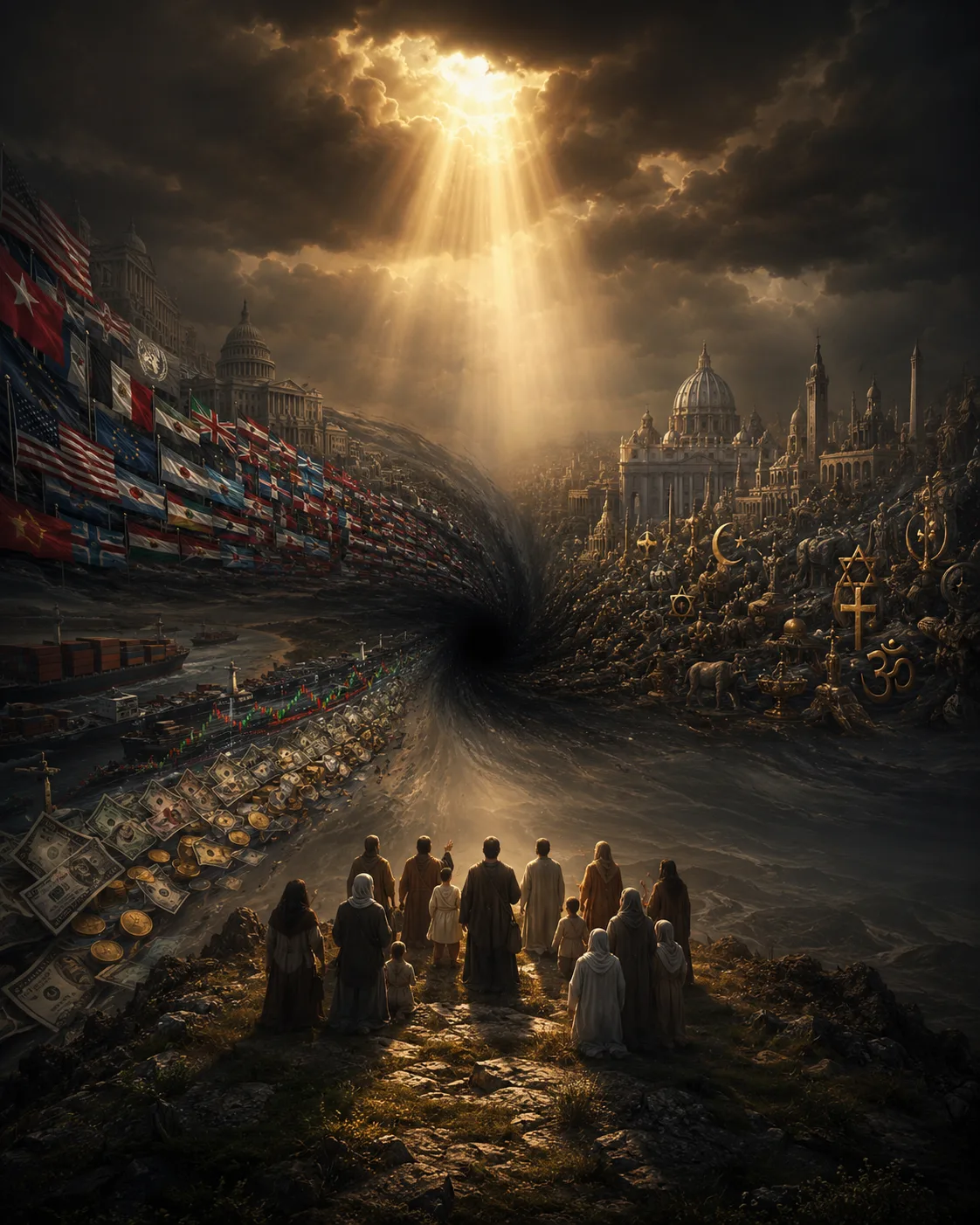
The six previous lessons have set out the architecture; this seventh lesson is the synthesis. The Babylonian mystery religion (Lesson 1), the Jesuit institutional war on the Reformation (Lesson 2), the secret-society initiatic layer (Lesson 3), the New World Order political project (Lesson 4), the cosmological deception (Lesson 5), and the religious-one-world project (Lesson 6) converge in the closing crisis of Revelation 13–18. The mark of the beast, the image of the beast, the third angel’s message of Revelation 14:9–12, the call to come out of her, my people of Revelation 18:4, and the personal return of Christ in His own voice and on His own divine self-designations supply the structural climax of the apostolic-prophetic record. The lesson ties the threads, walks the third angel’s identifying marks of the closing-hour remnant, and commends the willing reader’s personal response in the apostolic gospel of the Father’s only-begotten Son.
Lessons 1 through 6 of this short course traced the institutional, religious, secret-society, political, cosmological, and ecclesiastical architecture of the confederacy Revelation 13–18 identifies as the closing-hour Babylon. Lesson 7 is not a new subject; it is the synthesis. What the six prior lessons set out as architecture, the seventh lesson identifies as prophetic feature. The two beasts of Revelation 13:1–17, the three angels’ messages of Revelation 14:6–12, the seven last plagues of Revelation 16, the fall of Babylon of Revelation 17–18, and the personal return of Christ in Revelation 19 form a single prophetic structure into which the documented architecture of Lessons 1–6 falls with precision. The willing reader who has walked the prior six lessons is invited to receive the synthesis in its own measure and to weigh the personal response to which the apostolic-prophetic record commends him.
Three preliminary observations frame the lesson. First, the synthesis is held on the historicist hermeneutic the Reformers commended and the pioneer-Adventist editorial tradition recovered. Revelation is read as a prophetic outline of church history from the apostolic era through the second coming, with the closing-crisis events the climax of a long prior arc. The institute does not hold a preterist reading (which collapses Revelation into first-century events) nor a futurist reading (which projects the bulk of Revelation into a future seven-year tribulation after a secret rapture). Both alternatives are post-Reformation Counter- Reformation innovations Lesson 2 walked. The institute commends the Reformation reading on its own documentary grounds. Second, the mark of the beast is held on the both-and editorial line: the outward sign of allegiance is the historic Catholic identifier of Sunday observance as Rome’s mark of ecclesiastical authority (Catechism §2174 etc.); the inward substance is the worship of the post-Nicene Trinitarian framework that travelled with the Constantinian package (Lesson 5). The willing reader who has walked Lesson 6’s treatment of the Constantinian-package synthesis will recognise that the day question and the God question are constitutive of a single test. Neither is reducible to the other. Third, the closing-test is future relative to this writing (May 2026); the institutional preparation for it is, however, on the documentary record of the present hour. The call of Revelation 18:4 sounds before the imposition. The institute commends the willing reader to weigh both.
Question 01
What is the third angel’s message, and why is it the synthesis of the seven-lesson arc?
Answer
And the third angel followed them, saying with a loud voice, If any man worship the beast and his image, and receive his mark in his forehead, or in his hand, the same shall drink of the wine of the wrath of God, which is poured out without mixture into the cup of his indignation; and he shall be tormented with fire and brimstone in the presence of the holy angels, and in the presence of the Lamb: and the smoke of their torment ascendeth up for ever and ever: and they have no rest day nor night, who worship the beast and his image, and whosoever receiveth the mark of his name. Here is the patience of the saints: here are they that keep the commandments of God, and the faith of Jesus.
The third angel’s message is the closing proclamation of the everlasting gospel to the world at the end of human probation. It follows in sequence the first angel’s announcement of the hour of judgment (Rev 14:6–7) and the second angel’s proclamation that Babylon is fallen, is fallen (Rev 14:8). The third angel’s message contains three load-bearing elements the willing reader is invited to receive in their own terms:
- A specific warning. Against worship of the beast, worship of the image to the beast, and reception of the mark of the beast in the forehead or in the hand. The warning specifies three distinct objects of allegiance and two distinct loci of the mark (forehead = belief / conviction; hand = practice / outward act). The third angel’s warning is precise; the willing reader is asked to weigh each element in its specific scriptural form (Q2–Q3 below).
- A specific consequence. Those who worship the beast and his image and receive his mark drink of the wine of the wrath of God… poured out without mixture into the cup of his indignation. The language echoes Babylon’s own cup at Rev 17:4 and 18:6 — the wine that the harlot mixed and that the kings of the earth drank (Rev 18:3). The closing-test consequence is the inversion: those who drank the wine of her fornication now drink the wine of God’s wrath. The wrath is described as without mixture, indicating the cessation of mercy during the period of the seven last plagues (Rev 16). The willing reader who has walked the main Study Guides treatment of the sanctuary ministry (Lesson 13 of the main course) will recognise the close-of-probation framework in which this language operates.
- A specific identification. Here is the patience of the saints: here are they that keep the commandments of God, and the faith of Jesus. The closing-hour remnant is identified by three marks: perseverance under tribulation (the patience of the saints), obedience to all ten commandments of God (which the historic pioneer-Adventist editorial tradition reads as including the seventh-day Sabbath specifically), and the faith of Jesus (which the institute reads as both the apostolic confession Jesus held and the saving faith Jesus imparts). The identification is positive: it tells the willing reader not only what to refuse but what to hold. Lesson 7 walks each element at Q8 below.
The third angel’s message is therefore the synthesis of the entire seven-lesson arc because it identifies, in a single prophetic proclamation, both the system the willing reader is called to refuse and the apostolic substance the willing reader is called to hold. The architecture Lessons 1–6 set out is the architecture the third angel warns against. The apostolic confession the institute commends throughout this course is the substance the third angel identifies as the patience of the saints. The willing reader who has walked the prior lessons has, on the institute’s reading, been receiving the third angel’s message in its parts; Lesson 7 sets the parts together in their unity.
Question 02
What is the mark of the beast — in its specific scriptural form?
Answer
And he causeth all, both small and great, rich and poor, free and bond, to receive a mark in their right hand, or in their foreheads: and that no man might buy or sell, save he that had the mark, or the name of the beast, or the number of his name.
The mark of the beast is, in its specific scriptural form, the visible sign of allegiance to the beast power’s authority, imposed by the second-beast power (Rev 13:11–17) on every human being under the second beast’s jurisdiction at the closing crisis. The verbs are decisive: the second beast causeth all to receive the mark (institutional coercion); the consequence of refusal is that no man might buy or sell (economic exclusion); the mark is received in the right hand, or in the foreheads (outward act or inward conviction). The institute holds, on the historic pioneer-Adventist and broader Reformation editorial line, that the mark has both an outward and an inward dimension, and that both must be held together as the closing-test identifier.
The outward dimension: Sunday observance as Rome’s historic mark of ecclesiastical authority. Rome’s own catechetical and conciliar literature has, across the post-Reformation centuries, repeatedly identified the change from Sabbath to Sunday as the specific mark of Roman ecclesiastical authority over the practice of the church. Catechism of the Catholic Church Article 2174 identifies Sunday as “the day of the sun… the first day after the Jewish Sabbath, but also the first day, on which God made the world from the darkness of matter.” Catechism Article 2190 designates Sunday “the most ancient and first holy day of all.” Multiple post-Tridentine catechisms have stated the matter even more pointedly:
Question. Have you any other way of proving that the Church has power to institute festivals of precept?
Answer. Had she not such power, she could not have done that in which all modern religionists agree with her; — she could not have substituted the observance of Sunday, the first day of the week, for the observance of Saturday, the seventh day, a change for which there is no scriptural authority.
Question. How prove you that the church hath power to command feasts and holydays?
Answer. By the very act of changing the Sabbath into Sunday, which Protestants allow of; and therefore they fondly contradict themselves, by keeping Sunday strictly, and breaking most other feasts commanded by the same church.
On Rome’s own documentary self-description, the Sunday observance her authority instituted is the identifier of her ecclesiastical authority over the post-apostolic Christian practice. The institute holds, on this Reformation-grounded historical reading, that Sunday observance in the closing-test confederacy is the outward sign of submission to the beast power. The identification is not Adventist novelty; it is the consistent application of the Reformation principle of sola Scriptura to the one commandment of the Decalogue Rome formally amended.
The inward dimension: the post-Nicene Trinitarian framework as the Constantinian theological signature. Lesson 5 walked the Constantinian package: the imperial Sunday law of March 321 AD and the Council of Nicaea of May–July 325 AD issued by the same emperor in the same five-year window as components of a single imperial-ecclesiastical synthesis. The institutional memory of the package has travelled through the post- Constantinian centuries on both rails together. Lesson 6 walked Pope Leo XIV’s 1700th-anniversary commemoration of Nicaea (28 November 2025) and the Apostolic Letter In Unitate Fidei (23 November 2025) re-affirming the Nicene formulary as the basis of Christian unity in the present hour, in the same year as the federal-Sabbath proclamation of 4 May 2026 (Lesson 6 Q8). The willing reader is invited to weigh the consequence: the institutional memory the closing-test confederacy is re-affirming is a memory in which the post-Nicene Trinitarian formulary and the post-Constantinian Sunday observance travelled together as a single package. Neither was the apostolic confession; both bore the imperial signature.
The apostolic confession the institute commends is held on its own ground at John 17:3 and 1 Corinthians 8:6: the Father is the only true God, and the Lord Jesus Christ is the One Whom He sent, His only- begotten Son. The full divinity of Christ is held through Christ’s own self-disclosed divine titles — the first and the last (Rev 1:17), the Alpha and Omega (Rev 1:8; 22:13), the Almighty (Rev 1:8), the I AM (Jn 8:58) — without recourse to the post-biblical philosophical formulary of the Constantinian council. The willing reader who has walked Lesson 6’s editorial discussion of John 17:21 read against John 17:3 will recognise the substance: the unity Christ prayed for is unity grounded on the apostolic confession; the unity Rome re-proposes is unity grounded on the post- apostolic creedal innovation. The mark of the beast, on the institute’s OTG editorial reading, is not finally about a day in isolation or a creed in isolation. It is about the institutional package that binds the day to the creed and demands worship of the beast power in both at once.
A pastoral observation belongs here. The institute does not teach that every observer of Sunday is marked by the beast in the Revelation 13:16–17 sense. The mark is received under conditions of institutional coercion and economic enforcement that have not, as of this writing, been imposed. What the institute identifies is the architecture, the institutional preparation, and the trajectory the documentary record discloses. The willing reader who has received the apostolic gospel within a Sunday-observing communion is not, for that reason, marked. The willing reader is invited to receive the apostolic Sabbath on the conviction of Scripture, in anticipation of the closing-test moment in which Sunday observance will become the imposed mark of the beast power. The pace of the conviction is the pace of the Holy Spirit’s working in the heart; the substance, however, is on the documentary record now.
Question 03
What is the image of the beast — and is it already being constructed?
Answer
And I beheld another beast coming up out of the earth; and he had two horns like a lamb, and he spake as a dragon. And he exerciseth all the power of the first beast before him, and causeth the earth and them which dwell therein to worship the first beast, whose deadly wound was healed… saying to them that dwell on the earth, that they should make an image to the beast, which had the wound by a sword, and did live. And he had power to give life unto the image of the beast, that the image of the beast should both speak, and cause that as many as would not worship the image of the beast should be killed.
The image of the beast is, in its specific scriptural form, an institutional structure made by the second-beast power that replicates the political-ecclesiastical pattern of the first beast. The historic pioneer-Adventist editorial reading identifies the second beast as the United States, emerging as a global power across the late eighteenth and nineteenth centuries with two horns like a lamb (the founding constitutional commitments to civil and religious liberty) but eventually speaking as a dragon (legislative coercion of religious conscience in the closing crisis). The image the second beast causes to be made replicates the first-beast pattern of ecclesiastical-political union with civil-coercive enforcement — precisely the structural configuration Lesson 6 Q9 documented as the present institutional preparation in the United States across 2024–26.
The institute does not, in this lesson, repeat the detailed treatment Lesson 6 supplied. The willing reader who has walked Lesson 6 has the institutional documentation in view: the Christian-nationalist ecclesiastical infrastructure built three blocks from the United States Capitol (Christ Church Washington DC, Doug Wilson, February 2025); the Pentagon monthly Christian prayer service (Hegseth, March 2025); the White House faith office (Paula White-Cain, with Franklin Graham and Mark Burns); the 22-foot golden statue dedicated by Pastor Burns at Trump National Doral on 8 October 2025; the Eucharistic procession consecrating the United States to Mary Immaculate at Mar-a-Lago and subsequent rallies; the US Department of Labor Solicitor (Jonathan Berry) publicly commending the Constantinian Sunday law as the precedent for renewed Sunday-rest legislation; the 4 May 2026 federal-Sabbath proclamation and the 17 May 2026 Rededicate 250 event on the National Mall. The architecture is on the documentary record of the year this lesson is being written.
Three structural features of the image-construction warrant specific weighing in the closing-test frame:
- The image speaks (Rev 13:15). The image is not a passive statue; it is given life and causes its own decrees to be enforced. The institutional architecture of executive-branch faith offices, Pentagon prayer services, and Department-of-Labor advocacy for Sunday-rest legislation supplies the documented mechanism by which the image speaks: through the institutional voices of an apostate-Protestant ecclesiastical-political confederacy operating in the legislative, executive, and judicial organs of the United States government.
- The image enforces worship by economic coercion (Rev 13:16–17). The Lesson 4 architecture of central bank digital currency, ID2020, and the Chinese social-credit prototype supplies the documented mechanism by which economic exclusion of dissenters becomes technologically and legally feasible at scale. The infrastructure for that no man might buy or sell, save he had the mark is, in its hardware and software components, currently built and operational in pilot deployment. The willing reader is invited to weigh the convergence of Lesson 4’s digital architecture with the present religious-political confederacy as the specific mechanism by which the Revelation 13:17 verse will be fulfilled at the closing-test moment.
- The image kills those who will not worship (Rev 13:15b). The historic pioneer-Adventist editorial reading takes this provision as the literal closing-test decree of death against the remnant who refuse the mark, fulfilled in the final crisis of tribulation under the seven last plagues (Rev 16) and the closing legal proscription of the Sabbath-keeping remnant. The institute does not press the timing of this provision; it observes the documentary trajectory of the broader European-North-American legislative environment (Lesson 6 Q9 noted the Finland Räsänen case, the United Kingdom Clive Johnson conviction, the Hungarian and Austrian Sharia-law jurisprudence) within which religious speech-acts on conviction-of-conscience are already being criminalised at the misdemeanour level. The escalation pattern is on the public record; the institutional environment for Revelation 13:15’s ultimate provision is in active construction.
The willing reader is therefore invited to receive the image of the beast as a present institutional reality whose final form is future relative to this writing but whose architecture is documentably in place. The third angel’s warning against worship of the image is not a warning against a hypothetical future configuration; it is a warning against a configuration whose preparation has, on the public documentary record, been visibly accelerated across the year 2025–26.
Question 04
How do Lessons 1–6 converge in Revelation 13–18?
Answer
The six prior lessons of this course are not, on the institute’s reading, six independent threads. They are six aspects of a single architecture whose prophetic identification is given at Revelation 13–18. The willing reader is invited to weigh the mapping the institute commends:
- Lesson 1 (the Babylonian mystery religion) = Revelation 17 (the mother of harlots). The woman of Rev 17 is named on her forehead: MYSTERY, BABYLON THE GREAT, THE MOTHER OF HARLOTS AND ABOMINATIONS OF THE EARTH (Rev 17:5). The Babylonian mystery religion Lesson 1 walked — the sun-worship cult, the mother-and-child paganism, the priesthood with its mediation between the faithful and the deity, the sacramental apparatus — is the cultic substance the woman carries. The historical succession from Babel through Babylon, Egypt, the Hellenistic mystery cults, the imperial Roman state religion, and the post-Constantinian Christian- paganism converges in the figure Revelation 17 names. The identification is on Rome’s own forehead in the prophetic vision.
- Lesson 2 (the Jesuit Counter-Reformation) = the institutional renewal of the first beast after its deadly wound (Rev 13:3, 12). The first beast of Rev 13:1–10 receives a deadly wound (Rev 13:3 and 13:14) but the wound is healed and the world wonders after the beast. The historicist reading dates the wound to 1798 (Napoleon’s general Berthier removing Pope Pius VI from Rome on 10 February 1798) and the healing to the extended institutional recovery of papal Rome across the nineteenth and twentieth centuries. The Jesuit-led Counter-Reformation Lesson 2 walked is the institutional engine of that healing. The Society of Jesus, the Tridentine doctrinal consolidation, the Jesuit re-engagement with Protestant Europe, the Vatican II re-engagement with separated Christianity (Lesson 6), and the post-2024 institutional consolidation under Pope Leo XIV all belong on this prophetic feature.
- Lesson 3 (the secret- society initiatic layer) = the dragon behind the beasts (Rev 13:2, 4). The first beast receives his power, and his seat, and great authority from the dragon (Rev 13:2); the world worships both the dragon and the beast (Rev 13:4). The Kabbalistic-Gnostic-Hermetic- Masonic-Illuminist chain Lesson 3 walked is the initiatic substrate by which the dragon’s power is transmitted into the institutional forms of the visible beasts. Behind the public ecclesiastical-political architecture is the initiatic layer; behind the initiatic layer is the dragon. The Lesson 3 chain — Kabbalah through Hasidism through Chabad to Public Law 102-14 (Lesson 3 Q3 addition), through medieval Gnosticism into Freemasonry and the Illuminati — supplies the documentary trace of the dragon’s transmission into modernity.
- Lesson 4 (the New World Order political project) = the kings of the earth who give their power to the beast (Rev 17:12–13). Revelation 17:12–13 describes ten kings who have received no kingdom as yet but receive power one hour with the beast and have one mind, and shall give their power and strength unto the beast. The institutional architecture Lesson 4 documented — the UN system, the Bilderberg Group, the World Economic Forum, the central-banking consortium, the digital-identity programme — is the modern institutional form of the kings-of-the-earth confederacy Revelation 17 identifies. The convergence is documented in the WEF-UN climate-religion fusion (Lesson 4 addition on Returning to Sinai, 2022) and in the explicit institutional support of the post-2024 ecclesiastical-political consolidation by international financial and intergovernmental organs.
- Lesson 5 (the cosmological deception) = the preparation for the counterfeit Christ and the demonstration of the seventh-plague spiritualistic deception (Rev 16:13–14, 19:20). Revelation 16:13–14 describes three unclean spirits like frogs coming out of the mouth of the dragon, the beast, and the false prophet, working miracles, which go forth unto the kings of the earth and of the whole world, to gather them to the battle of that great day of God Almighty. The Hermetic-Pythagorean- Copernican cosmological deception Lesson 5 walked — with its modern outer-space cosmology, its state-funded space agencies as authority on cosmological matters, its preparation for UFO/contactee/“ascended master” deception in the closing hour — is the institutional preparation by which the second-beast power will demonstrate the miracle- working spiritualistic capability of Rev 13:13–14 (he doeth great wonders, so that he maketh fire come down from heaven on the earth in the sight of men) to the assembled kings of the earth. The closing-hour counterfeit Christ, the false prophet’s spiritualistic operation, and the UFO/contactee framework converge in the cosmological-religious architecture Lesson 5 documented.
- Lesson 6 (the religious-one-world project) = the image of the beast and the threefold-union confederacy (Rev 13:11–17; Rev 16:13). The institutional architecture Lesson 6 documented — the post-Vatican-II re-engagement, the Joint Declaration on Justification, the Anglican Gift of Authority, the charismatic pan-confessional solvent, the Assisi summits, the Document on Human Fraternity, the Abrahamic Family House, the Synod on Synodality, Pope Leo XIV’s consolidating pontificate, the Christian- nationalist ecclesiastical infrastructure — is the institutional form of the image of the beast at Rev 13:11–17 and the threefold- union confederacy at Rev 16:13. Ellen White’s 1888 statement on the threefold union (cited at Lesson 6 Q9) frames the structure: when Protestantism stretches her hand across the gulf to grasp the hand of the Roman power, and when she reaches over the abyss to clasp the hands of spiritualism, the threefold union is complete. Lesson 6 walked all three pieces in their present institutional documentation.
Read together, the mapping presents the Revelation 13–18 prophecy as the prophetic identification of the documented architecture Lessons 1–6 set out. The architecture is not a sectarian Adventist construction projected onto a neutral prophetic text; it is the apostolic-prophetic text’s own identification of an architecture whose documentary trace is on the public record. The willing reader who has walked the prior six lessons is invited to receive the synthesis: what has been documented institutionally is what Revelation prophesied apostolically.
Question 05
What is the seal of God — and what distinguishes the sealed from the marked?
Answer
And I saw another angel ascending from the east, having the seal of the living God: and he cried with a loud voice to the four angels, to whom it was given to hurt the earth and the sea, saying, Hurt not the earth, neither the sea, nor the trees, till we have sealed the servants of our God in their foreheads.
And I looked, and, lo, a Lamb stood on the mount Sion, and with him an hundred forty and four thousand, having his Father’s name written in their foreheads.
The seal of God is, in its specific scriptural form, the inward identification of the closing-hour remnant by the Father’s name written in their foreheads. The seal is the divine counterpart of the mark of the beast: as the mark is the visible sign of allegiance to the beast power’s authority, the seal is the inward sign of allegiance to the Father’s authority. The two are symmetrical and they are mutually exclusive. No man receives both.
Four observations frame the institute’s treatment of the seal, held on the pioneer-Adventist editorial line and on the apostolic-OTG confession the broader course commends:
- The seal is the Father’s name. Revelation 14:1 specifies his Father’s name — the name of the Father Whom Jesus calls the only true God at John 17:3. The seal is therefore the apostolic confession of the Father as the only true God, held in the heart of the closing-hour remnant. The institute’s OTG editorial position is not a sectarian addition to the seal; it is the seal’s own specification. The Father’s name — singular, personal, particular — is what the sealed remnant carry in their foreheads.
- The Sabbath commandment uniquely contains the seal’s three elements. A king’s seal in the ancient Near East contained three load-bearing elements: the king’s name, his dominion (the title and authority by which he reigned), and his territory (the extent of his rule). The Sabbath commandment alone among the Ten Commandments contains all three: (i) the name — the Lord thy God (Ex 20:10); (ii) the dominion — for in six days the Lord made (Ex 20:11, identifying Him as Creator); (iii) the territory — heaven and earth, the sea, and all that in them is (Ex 20:11, identifying His extent of rule). The other nine commandments contain rules; the fourth commandment contains rule and seal together. This is the historic pioneer-Adventist editorial reading the institute commends.
- The Father’s name and the Sabbath belong together. The seal in the forehead and the keeping of the commandments are correlatives on the institute’s reading. The Father’s name is the personal identifier; the Sabbath is the temporal observance in which the Father’s creative dominion is honoured. The closing-hour remnant carries both: the confession of the Father in the heart, and the observance of the Sabbath in the practice. The two are not equivalents; the Father’s name is the inward substance, the Sabbath is the outward act. But they are mutually constitutive, and the closing-test crisis tests both at once. Sunday observance without the Father’s confession is the outward mark of the beast; Sabbath observance without the Father’s confession is, on Brother Mansour’s editorial observation cited at Lesson 6, a road sign with no destination. The institute holds the day and the God together.
- The sealing is a present and progressive work. The sealing angel of Revelation 7:1–3 holds back the judgmental winds till we have sealed the servants of our God in their foreheads. The sealing is not a future eschatological event disconnected from the present. It is the progressive work of the Holy Spirit, sealing into the conscience of God’s people the apostolic confession and the commandment-keeping obedience that will be tested at the closing crisis. The willing reader who is receiving the apostolic confession of John 17:3 and the Sabbath observance of Exodus 20:8–11 in the present hour is, on the institute’s reading, being sealed. The sealing is not postponed to the final crisis; the sealing is preparing the heart for the final crisis.
The mark of the beast and the seal of God are therefore not abstract eschatological tokens; they are present spiritual realities being progressively formed in human hearts under the institutional conditions Lessons 1–6 documented and the Revelation 13–14 prophecy specifies. The closing-test crisis is the public demonstration of an inward distinction that has been forming all along.
Question 06
The come-out call of Revelation 18:4 — what does Christ’s own voice from heaven require?
Answer
And after these things I saw another angel come down from heaven, having great power; and the earth was lightened with his glory. And he cried mightily with a strong voice, saying, Babylon the great is fallen, is fallen, and is become the habitation of devils, and the hold of every foul spirit, and a cage of every unclean and hateful bird… And I heard another voice from heaven, saying, Come out of her, my people, that ye be not partakers of her sins, and that ye receive not of her plagues.
Revelation 18:4 sounds the call to Christ’s people in Babylon at the closing hour. The voice is from heaven — the same heavenly origin as the Revelation’s disclosing voice and, on the structural reading the institute commends, the voice of the Lord Jesus Christ Himself in His glorified High-Priestly capacity (compare Rev 1:13–18, where John identifies the speaking figure as the Son of man with the divine self- designations of Rev 1:8 and 1:17). The addressees are my people — presupposing that Christ’s people are still inside the Babylonian system at the moment the call sounds. The call is therefore not retrospective; it is contemporaneous. Christ’s people are inside Babylon now; the call is now sounding.
The call has three load-bearing elements the willing reader is invited to receive:
- The command is come out. Not reform from within, not stay in fellowship and bear witness, not maintain dual membership. The verb is exclusive and terminal: exelthate in the Greek, aorist imperative active, the formal command form. The closing-hour call is for departure, not internal reform.
- The reason is two-fold: sin and plague. That ye be not partakers of her sins — the moral rationale, in the present tense, addressing what continued membership in the system makes the willing reader complicit in. That ye receive not of her plagues — the prophetic rationale, in the anticipatory tense, addressing what continued membership exposes the willing reader to at the closing-crisis judgment of Revelation 16. Both rationales are equally load-bearing. The call to come out is therefore a call to spiritual separation from the moral substance of the system and a call to anticipatory protection from the closing judgment.
- The form is pastoral, not polemical. The voice from heaven addresses Christ’s people in Babylon as my people. The form of the address presupposes affection, ownership, anticipatory rescue. Christ does not call out with cold institutional condemnation; He calls with the tenderness of the Good Shepherd Who calls His own sheep by name (Jn 10:3). The willing reader is invited to receive the call in its actual pastoral form, not in the institutional caricature the system has sometimes attached to the verse. The call comes from love. It is meant to be received in love. It is, however, also meant to be obeyed.
The pace and form of obedience to the call are the willing reader’s own. The institute commits no formula on the institutional pace; that is between the reader and the Holy Spirit. The substance, however, is the same for every willing reader: the apostolic confession of John 17:3 received against the post-Nicene formulary; the Sabbath observance of Exodus 20:8–11 received against the Constantinian Sunday; the apostolic gospel of justification by faith in the Father’s only-begotten Son received against the sacramental-mediatorial apparatus; the biblical cosmology of Lesson 5 received against the Hermetic-Pythagorean-Copernican framework; the historicist prophetic reading received against preterist and futurist alternatives; the doctrine of the unfallen worlds and the personal return received against the secret-rapture and the UFO/contactee counterfeit. The substance is the apostolic gospel in its specifically restored Reformation and pioneer-Adventist editorial form. The substance is what coming out of Babylon means.
Question 07
Christ’s own voice on His personal return
Answer
Behold, he cometh with clouds; and every eye shall see him, and they also which pierced him: and all kindreds of the earth shall wail because of him. Even so, Amen.
And then shall appear the sign of the Son of man in heaven: and then shall all the tribes of the earth mourn, and they shall see the Son of man coming in the clouds of heaven with power and great glory. And he shall send his angels with a great sound of a trumpet, and they shall gather together his elect from the four winds, from one end of heaven to the other.
Ye men of Galilee, why stand ye gazing up into heaven? this same Jesus, which is taken up from you into heaven, shall so come in like manner as ye have seen him go into heaven.
For the Lord himself shall descend from heaven with a shout, with the voice of the archangel, and with the trump of God: and the dead in Christ shall rise first: then we which are alive and remain shall be caught up together with them in the clouds, to meet the Lord in the air: and so shall we ever be with the Lord.
Christ’s personal return is set forth in Scripture with deliberate plainness. The return is (i) literal — the same Jesus, in the same body, in the same manner of going (Acts 1:11); (ii) visible — every eye shall see him (Rev 1:7), they shall see the Son of man (Matt 24:30); (iii) audible — with a shout, with the voice of the archangel, and with the trump of God (1 Thess 4:16); and (iv) personal — the Lord himself shall descend from heaven (1 Thess 4:16). Nothing in these texts supports a secret prior phase, a partial return, or a return at any moment other than the trumpet-sound climax the apostolic record describes. The historic Reformation reading of the second coming, recovered in pioneer-Adventist editorial form, is the apostolic plain reading of these passages.
A cosmological observation belongs here, as the willing reader who has walked Lesson 5 will recognise. Rev 1:7’s assertion that every eye shall see him at the return presupposes a geometric configuration in which a single appearance in the sky is simultaneously visible to every observer on the earth’s surface. On the biblical stationary enclosed plane Lesson 5 walked, this is geometrically straightforward: the appearance in the firmament above the plane is visible to every observer on the plane. On the modern globe model of Lesson 5’s critique, the same event is geometrically impossible without recourse to ad-hoc multi-stage harmonisations Scripture itself does not supply. The willing reader is invited to weigh the consequence: the apostolic doctrine of the personal return of Christ requires, for its plain execution, the biblical cosmology Scripture elsewhere describes. The cosmological deception of Lesson 5 is therefore not a peripheral matter; it is structurally connected to the closing-hour Christological event.
A further observation on the unfallen worlds. The Heb 1:2, 11:3, Job 1:6, 38:7 framework of multiple inhabited worlds, walked in Lesson 5 Q9, supplies the larger creation-witness frame within which Christ’s personal return occurs. The sons of God of Job 38:7 who shouted for joy at this world’s creation are present at the closing scene as witnesses to the vindication of the Father’s government against the satanic rebellion (the great-controversy framework Ellen White set out in Patriarchs and Prophets chapter 1). The willing reader who has held the distinction between the apostolic doctrine of other worlds and the modern UFO/contactee counterfeit (Lesson 5 Q9) will recognise the consequence: the closing-hour false christ deception, gathered to the battle of the great day of God Almighty (Rev 16:14–16), will use the counterfeit-other- worlds framework to deceive those who have not received the apostolic distinction. The willing reader is invited to receive the apostolic doctrine in its specific form, in anticipation of the counterfeit’s closing-hour appearance.
Behold, I come quickly: blessed is he that keepeth the sayings of the prophecy of this book… And, behold, I come quickly; and my reward is with me, to give every man according as his work shall be… He which testifieth these things saith, Surely I come quickly. Amen. Even so, come, Lord Jesus.
The closing chapter of the apostolic-prophetic record sounds three times, in Christ’s own voice, the promise I come quickly. The promise is held by the Lord Himself; the institute’s commendation of the doctrine of the personal return is not the institute’s commendation but Christ’s own self-disclosure. The willing reader is invited to receive the promise in the form Christ Himself gave it.
Question 08
The patience of the saints — the three identifying marks of the closing-hour remnant
Answer
Here is the patience of the saints: here are they that keep the commandments of God, and the faith of Jesus.
The closing-hour remnant is identified, on Scripture’s own specification, by three marks. The willing reader who has walked the architecture of Lessons 1–6 and received the synthesis of Q1–Q7 above is invited to receive the identification in its own measure:
- The patience of the saints. Greek hupomoné — not passive endurance but active perseverance under tribulation. The closing-hour remnant perseveres against the institutional pressure of the religious-political confederacy documented across Lessons 1–6, against the economic exclusion of Rev 13:17, against the legal proscription of Rev 13:15b, and against the threefold-spiritistic deception of Rev 16:13–14. The patience is sustained not by human moral courage in isolation but by the indwelling of the Holy Spirit working the apostolic gospel into character. Christ’s own promise at Matt 28:20 (lo, I am with you alway, even unto the end of the world) is the warrant.
- Keeping the commandments of God. All ten commandments of the Decalogue, including the fourth commandment’s seventh-day Sabbath. The closing-hour remnant is not identified by a partial obedience to nine commandments while the fourth remains amended by ecclesiastical tradition. The remnant is identified by the apostolic Decalogue in its entirety, on the conviction that the Lawgiver has not amended His own commandments and that the post-Constantinian alteration is not binding. The willing reader who has walked Lesson 6 Q2 and Lesson 7 Q2–Q5 will recognise the structural significance of the fourth commandment as the seal-bearing commandment Q5 walked.
- The faith of Jesus. On the institute’s reading, the genitive “of Jesus” is held on its dual force: (i) the faith Jesus personally held — the apostolic Sonship confession of the Father as the only true God (Jn 17:3), the obedience of faith unto the cross, the High-Priestly mediation continuing on the right hand of the Father; and (ii) the faith Jesus imparts — justification by faith in His blood, the regeneration of the heart by the Holy Spirit, the new-covenant writing of the law on the heart (Jer 31:33; Heb 8:10). Both readings are scripturally warranted; both are constitutive of the closing-hour remnant’s identification. The willing reader holds the faith that Jesus held and receives the faith Jesus gives.
The three identifying marks are not three achievements the willing reader must independently attain. They are three aspects of a single inward work of the Holy Spirit, formed in the heart of the believer who receives the apostolic gospel and responds to the third angel’s message. The marks are descriptive of grace-formed character, not prescriptive of moral self-construction. The willing reader is invited to receive the identification not as accusation but as the apostolic identification of those Christ keeps in His name through the closing-hour crisis.
Question 09
What does the willing reader do with this synthesis?
Answer
The synthesis of the seven-lesson arc is, in its final form, a personal call. The architecture Lessons 1–6 documented and Lesson 7 has identified prophetically is not, at the close, a subject of dispassionate study. It is the institutional landscape in which the willing reader is presently located, against which the willing reader is presently called to respond. The institute commits no formula on the form of the response; that is between the willing reader and the Holy Spirit. The substance, however, the institute commends in the seven-fold pattern of the seven lessons:
- From Lesson 1: Renounce the Babylonian content. The mother-and- child cult, the sacramental-mediatorial apparatus, the post-apostolic theology that has carried the mystery-religion substance under Christian terminology. Receive in its place the apostolic confession the Lesson 1 close-of-the-arc walks.
- From Lesson 2: Recognise the Jesuit Counter-Reformation operation. Receive the Reformation gospel of justification by faith in the Father’s only-begotten Son, on the apostolic ground the Reformers recovered. Refuse the post-Tridentine counter-deflections (preterism, futurism, the secret rapture, the Marian-mediatorial apparatus).
- From Lesson 3: Refuse the secret-society and initiatic layer. The Kabbalistic-Gnostic-Hermetic-Masonic-Illuminist chain is not a neutral cultural tradition; it is the documented transmission of the dragon’s authority into the institutional forms of the visible beasts. The willing reader who has received the apostolic confession is invited to recognise the chain in its institutional present and to separate from it deliberately.
- From Lesson 4: Refuse the New World Order political project. The institute commits no political-partisan position; the call is not to the right or to the left. The call is to recognise the documented architecture of the kings-of-the-earth confederacy of Rev 17:12–13 and to refuse personal participation in the structures, allegiances, and ideological frames of that confederacy.
- From Lesson 5: Recover the biblical cosmology. The willing reader is invited to receive the stationary enclosed plane Scripture describes, with the sun moving over the earth as Scripture consistently testifies, with the unfallen inhabited worlds Hebrews and Job affirm, against the Hermetic-Pythagorean-Copernican framework Lesson 5 documented. The cosmological recovery is not a peripheral curiosity; it is structurally connected to the closing-hour counterfeit-Christ deception (Lesson 5 Q9; Q7 above).
- From Lesson 6: Come out of the religious-one-world confederacy. The willing reader who is presently in a communion that has, through the documentary record of Lessons 6 walked, formally aligned itself with the Roman ecclesiastical primacy or with the broader interfaith convergence is invited to weigh, prayerfully and on the documentary record, the apostolic call of Revelation 18:4. The pace and form of obedience is the willing reader’s own.
- From Lesson 7: Receive the third angel’s message and the personal return of Christ. The closing-hour remnant is identified by the patience of the saints, the commandments of God, and the faith of Jesus. The willing reader is invited to receive the identification in its specific apostolic form and to anticipate the personal return of Christ in His own voice and on His own divine self-designations as the climax of the entire arc.
The seven-fold response is not a programme of seven separate decisions. It is one decision worked out across seven dimensions: the decision to receive the apostolic gospel of the Father’s only-begotten Son in its specifically restored Reformation and pioneer-Adventist editorial form, and to live out the decision under the institutional conditions Revelation 13–18 prophesied and the documented architecture of Lessons 1–6 has identified. The willing reader who is making the decision is making it now, in the year 2026, on the documentary record of the present hour. The institute commends the decision to the willing reader’s prayerful weighing.
Question 10
What about the standard objections to this reading?
Answer
Eight standard objections to the third angel’s message reading and the seven-lesson synthesis circulate in modern conversation. Each is addressed in its own terms below:
| Standard objection | Why the apostolic Scripture resists it |
|---|---|
| The mark of the beast is futurist — it has not yet been imposed and will not be in our time | The institute affirms readily that the formal imposition of the mark, in the Revelation 13:16–17 sense of universal economic coercion (that no man might buy or sell save he had the mark), is future. The May 2026 federal-Sabbath proclamation walked in Lesson 6 is institutional precedent, not enforcement. The institute’s position is not that the mark has been imposed. The institute’s position is that the documented architecture for its imposition is in place, that the institutional preparation has accelerated visibly across 2024–26, and that the call of Revelation 18:4 to Christ’s people in Babylon is sounding now, in advance of the formal closing test. The futurist objection is correct about the timing of the imposition; it errs in inferring that the call of Rev 18:4 is therefore also future. The call sounds before the imposition; the willing reader is invited to weigh both. |
| The mark of the beast is preterist — it referred to Nero or to a first-century event already past | The preterist reading attaches Revelation 13 to first-century imperial Rome, with the “number of the beast” (Rev 13:18) interpreted as a Hebrew-numerical encoding of Nero Caesar. The historicist reading the institute holds receives Revelation as a prophetic outline of church history from the apostolic era through the second coming, with Revelation 13’s two beasts identifying respectively the papal-ecclesiastical sovereignty (post-AD 538, with deadly wound 1798 and healing across the modern period) and the United States as the second-beast power (rising 1798 forward, with two horns like a lamb and dragon speech). The preterist reading does not account for Revelation 13:3’s wound and its healing (post-1798 development), for Revelation 13:11’s second beast rising as the first beast received its wound, or for Revelation 13:14’s image to be made to the first beast (a future fabrication relative to John’s vision). The historicist reading the Reformers held and the institute commends is on the documentary record. |
| Sabbath observance as the test of the closing crisis is Adventist sectarianism | The fourth commandment of the Decalogue (Ex 20:8–11) names the seventh day as the day God blessed, sanctified, and commanded to be kept holy; the historical record of the early church and the Reformation tradition is that the Sabbath was changed not by apostolic authority but by post-apostolic ecclesiastical decision attributable to Rome (Catechism of the Council of Trent, 1566; modern Catholic Catechism Article 2174; the Council of Trent’s argument from tradition; the Pope Leo XIII encyclical Rerum Novarum, 1891; the Pope John Paul II apostolic letter Dies Domini, 1998). The Reformation rejected the change on Scripture-supreme grounds (Calvin’s commentary on the Decalogue; the Westminster Confession on the day) without yet acting on it. The Adventist recovery of the Sabbath in the nineteenth century brought the Reformation principle to its consistent application on this specific point. The Sabbath as the closing-test point is not Adventist sectarianism but the consistent extension of the Reformation principle of sola Scriptura to the one commandment Rome formally amended. |
| Revelation 18 doesn’t refer to organised Christianity — it’s about pagan or commercial Babylon | Revelation 17 identifies the figure clearly as a woman (Rev 17:1, 3, 4, 18), arrayed in purple and scarlet (the canonical colours of papal vestments), holding in her hand a golden cup full of abominations (the eucharistic chalice of the Mass, on the Reformation reading), seated upon a beast with seven heads (a city upon seven hills, Rev 17:9, the canonical identifier of Rome from antiquity), and reigning over the kings of the earth (Rev 17:18; cf. the political-ecclesiastical dominion of medieval and modern Roman Catholicism). Revelation 18 describes the fall of that same Babylon, identifying her as the institutional persecutor of prophets, and of saints, and of all that were slain upon the earth (Rev 18:24). The identification of papal Rome with the prophesied Babylon is the apostolic-patristic-Reformation consensus (1 Pet 5:13, Tertullian Against Marcion 3.13, the Westminster Confession 25.6 identifying the Pope as antichrist, Luther’s repeated identifications across the German treatises); the pagan-Rome or commercial-Babylon readings are post-Tridentine Catholic counter-Reformation manoeuvres (Francisco Ribera’s futurism, Luis de Alcázar’s preterism) designed to deflect the Reformation identification. The institute holds the apostolic-Reformation reading on the documentary record. |
| The second coming of Christ is a secret rapture before a future tribulation | The secret-rapture reading was first articulated by the Jesuit Manuel de Lacunza (writing as “Rabbi Juan Josafat Ben-Ezra”, c. 1791), transmitted into English Protestantism through Edward Irving’s 1827 translation, popularised through John Nelson Darby’s 1830s dispensationalism, codified in the Scofield Reference Bible (1909), and is now the default eschatology of the American evangelical world. It is a post-Reformation innovation traceable to a Jesuit author in service of the Counter-Reformation deflection programme Lesson 2 documented. Scripture’s plain account of Christ’s return is at Rev 1:7 (every eye shall see him), Matt 24:30 (then shall appear the sign of the Son of man in heaven… and they shall see the Son of man coming in the clouds of heaven with power and great glory), Acts 1:11 (this same Jesus… shall so come in like manner), and 1 Thess 4:16–17 (the Lord himself shall descend from heaven with a shout, with the voice of the archangel, and with the trump of God). The return is literal, visible, audible, and personal. Nothing in these texts supports a secret prior phase. The willing reader who has walked Lesson 2 of this course will recognise the Lacunza-Irving-Darby genealogy as part of the Counter-Reformation deflection programme. |
| The seal of God is metaphorical — there is no literal sealing of a remnant | Revelation 7:1–4 narrates the sealing of 144,000 from the twelve tribes of Israel in the foreheads. Revelation 14:1 describes the same company standing with the Lamb on Mount Zion with his Father’s name written in their foreheads. The Father’s name is the identifying mark of the sealed. The seal is metaphorical in the sense that it is not a physical brand visible to other human eyes; it is literal in the sense that it is a specific divinely-perceived identification of those who have received the apostolic confession of the Father as the only true God and the begotten Son as Saviour (Jn 17:3; 1 Cor 8:6). The Sabbath commandment, alone among the Ten, contains the full identification of the Lawgiver by name, dominion, and territory (Ex 20:8–11) — the structural elements of a king’s seal. The sealing of the closing-hour remnant is therefore not a sectarian Adventist novelty but the apostolic doctrine drawn directly from Revelation’s own text. |
| The patience of the saints (Rev 14:12) is a perfectionist standard no Christian can actually meet | Revelation 14:12 reads: Here is the patience of the saints: here are they that keep the commandments of God, and the faith of Jesus. The verse identifies the closing-hour remnant by three marks: (i) patience (Greek hupomoné, perseverance through tribulation), (ii) keeping the commandments of God (all ten, including the Sabbath), and (iii) the faith of Jesus (which the institute reads as both the faith Jesus held and the faith Jesus imparts — the apostolic gospel of justification by faith in His blood, His mediation, and His personal return). The verse is not a perfectionist standard demanding sinless flesh; it is the identifying confession of a people whose perseverance, obedience, and apostolic gospel mark them visibly to the unfallen worlds and the angelic witnesses. The standard is met not by human achievement but by the indwelling of the Holy Spirit working the apostolic gospel into character — the very promise of the new covenant of Jer 31:33 and Heb 8:10 (I will put my laws into their mind, and write them in their hearts). The willing reader is invited to receive the standard in its own measure, not as accusation but as the apostolic identification of those Christ keeps in His name. |
| Other inhabited worlds in Scripture are sci-fi, not the apostolic doctrine | Heb 1:2 and Heb 11:3 (the worlds, plural, framed by the word of God), Job 1:6 and Job 2:1 (the sons of God came to present themselves before the Lord, presupposing a corporate body distinct from this fallen world), and Job 38:7 (the morning stars sang together, and all the sons of God shouted for joy at the founding of this earth, presupposing a created intelligent witnessing creation prior to this world’s formation) supply the apostolic doctrine of multiple inhabited worlds within the biblical-cosmological frame. Ellen White’s Early Writings p. 39 and Patriarchs and Prophets chapter 1 expand the apostolic doctrine in the pioneer-Adventist editorial tradition. The doctrine is to be distinguished sharply, as Lesson 5 Q9 walks, from the modern outer-space cosmology and the UFO/contactee counterfeit. The unfallen worlds are present in the closing-crisis frame as witnessing creation to the vindication of God’s government in the great-controversy theatre. The objection conflates the apostolic doctrine with its modern counterfeit. |
Eight objections weighed; eight responses on the apostolic-prophetic ground. The institute commends the willing reader to the full apostolic record at Revelation 13–22 and to the broader doctrinal treatment in the main Study Guides course of the institute.
A note on what is being identified
The third angel’s message and the identification of the closing-hour confederacy are not, in the institute’s commendation, polemical weapons against individual believers in the various communions Lesson 6 named. The institute affirms readily that Christ has His people inside every visible communion at the moment Revelation 18:4 is sounded; the very form of the call presupposes precisely that. The institutional architecture identified across Lessons 1–6 is identified at the institutional level, not at the level of the individual believer’s eternal standing. The pastoral imperative is the loving call out, in anticipation of the closing plagues, in the tone the heavenly voice itself sounds it — tender, urgent, unmistakable, addressed to the willing. The doctrine corrected is the doctrine, not the love. The willing reader is invited to receive the call in its actual pastoral form, and to extend the same pastoral form to fellow travellers who have not yet weighed the documentary record this course has set out. The third angel’s message is, in the end, the everlasting gospel preached to the world in the closing hour. It is good news, even where it requires costly response.
Summary of Lesson 7
- The third angel’s message (Rev 14:9–12) is the closing proclamation of the everlasting gospel and the synthesis of the seven-lesson arc. It contains a specific warning (against worship of the beast, image, and mark), a specific consequence (the wine of God’s wrath without mixture), and a specific identification of the closing-hour remnant (the patience of the saints, the commandments of God, and the faith of Jesus).
- The mark of the beast is held on the both-and reading: outwardly Sunday observance as Rome’s historic mark of ecclesiastical authority (Catechism §2174; Tuberville and Keenan catechisms quoted); inwardly the Constantinian post-Nicene Trinitarian framework that travelled with the imperial Sunday law as a single package (Lessons 5 and 6).
- The image of the beast is the institutional structure made by the second-beast power (the United States) replicating the political-ecclesiastical pattern of the first beast. Lesson 6 Q9 documented the architecture’s present construction across 2024–26.
- Lessons 1–6 converge in Revelation 13–18 with structural precision: Babylonian mystery religion = Rev 17 mother of harlots; Jesuit Counter-Reformation = institutional healing of the deadly wound; secret societies = the dragon behind the beasts; New World Order = the kings of the earth confederacy; cosmological deception = preparation for the counterfeit Christ; religious one-world project = the image and the threefold union.
- The seal of God (Rev 7:2–3; 14:1) is the inward identification of the closing-hour remnant by the Father’s name in their foreheads. The Sabbath commandment alone among the Ten contains the king’s-seal elements of name, dominion, and territory. The seal and the Sabbath belong together; the apostolic OTG confession is the seal’s own specification.
- The come-out call of Revelation 18:4 sounds in Christ’s own voice from heaven, addresses Christ’s people still in Babylon, commands exit (not internal reform), warns of moral partaking and prophetic plague-exposure, and comes in pastoral tone as the call of the Good Shepherd to His own sheep.
- Christ’s personal return is literal, visible, audible, and personal (Rev 1:7; Matt 24:30; Acts 1:11; 1 Thess 4:16–17). The return requires the biblical cosmology Lesson 5 walked for its plain geometric execution. The unfallen worlds (Heb 1:2; 11:3; Job 1:6; 38:7) witness the closing scene as creation’s vindication of the Father’s government.
- The closing-hour remnant is identified by three marks (Rev 14:12): the patience of the saints (hupomoné), keeping the commandments of God (the entire Decalogue including the Sabbath), and the faith of Jesus (held on its dual force: the faith Jesus held and the faith Jesus imparts).
- The willing reader’s response is one decision worked out across seven dimensions (Q9), made personally on the documentary record of the present hour, and commended to the reader’s prayerful weighing.
Personal response
The seven-lesson arc closes with a personal call. The Babylonian mystery religion at the root, the Jesuit institutional war on the Reformation, the secret-society initiatic chain, the New World Order political confederacy, the Hermetic-Pythagorean cosmological deception, the religious-one-world project, and the convergence in the third angel’s message of Revelation 14:9–12 — these seven are not subjects of academic curiosity. They are the institutional and theological landscape within which the willing reader is presently called to confess Jesus Christ as Lord, to keep the commandments of the Father in their entirety, and to anticipate the personal return of the Lord in the clouds of heaven with power and great glory. The institute commends the apostolic gospel of the Father’s only-begotten Son to the willing reader as the substance of every decision the seven-lesson arc commends. The pace of the response is the pace of the Holy Spirit’s working in the willing reader’s own heart. The substance, however, is the apostolic gospel in its specifically restored Reformation and pioneer-Adventist editorial form. That gospel, and no other, is what coming out of Babylon means.
Father in heaven, the only true God, the Lord of all creation and the only true Father of our Lord Jesus Christ, thank You for the apostolic gospel of Your only-begotten Son. Thank You for the recovery of Your name, Your Sabbath, Your sanctuary ministry, and Your second-coming hope through the Reformation and the pioneer-Adventist editorial line the institute commends. Grant me, by the indwelling of Your Holy Spirit, to receive the apostolic gospel in its specifically restored form. Grant me the patience of the saints under the institutional pressure of the closing-hour confederacy. Grant me the obedience to all Your commandments including Your fourth, the Sabbath of Your creation and the seal of Your Lawgiver-name. Grant me the faith of Your Son — the faith He held in You as the only true God and the faith He imparts to those who receive Him as Saviour. Where my present ecclesiastical position is identified in the architecture this course has walked, give me grace to weigh the call of Revelation 18:4 with prayer and Scripture, and grace to obey at the pace Your Spirit works conviction in my heart. Let me be found, at the closing hour and the personal return of Your Son, among those who keep Your commandments and have the faith of Jesus. In the name of the Lord Jesus Christ, the first and the last, the Alpha and Omega, the bright and morning star whose coming is even now at the door. Amen.
The seven-lesson arc of The Hidden Architecture closes here. The willing reader who has walked the course is commended to the main Study Guides course of the institute for the broader doctrinal treatment, to the Library articles on cosmology, the Godhead, the sanctuary ministry, and the closing-crisis convergence for deeper study, and above all to the apostolic Scripture itself, opened prayerfully and read in the pioneer-Adventist editorial line the institute commends. The Lord Jesus is at the door. Maranatha.
Foundational text
“And, behold, I come quickly; and my reward is with me, to give every man according as his work shall be. I am Alpha and Omega, the beginning and the end, the first and the last.”
— Revelation 22:12–13 (Christ in His own voice)