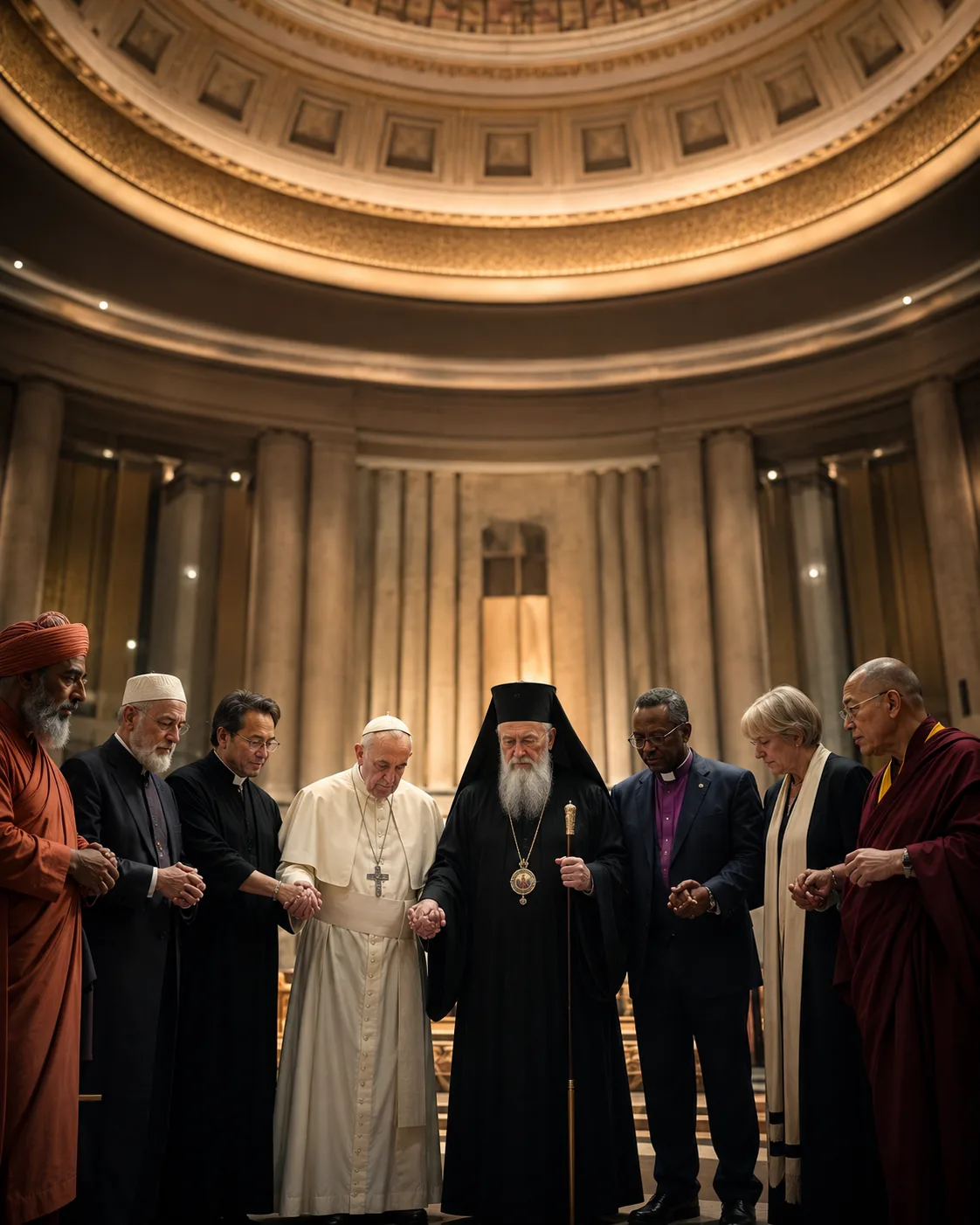
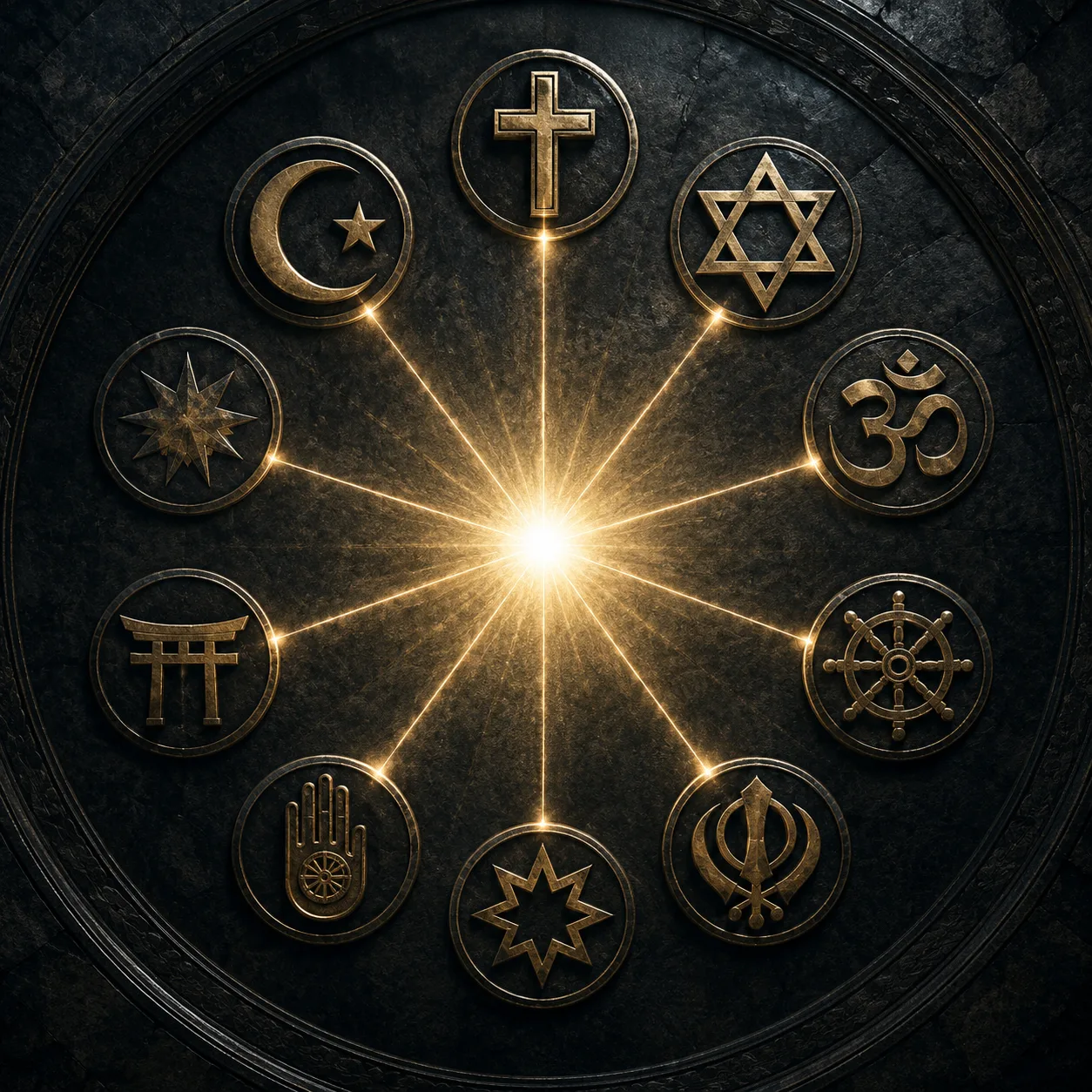
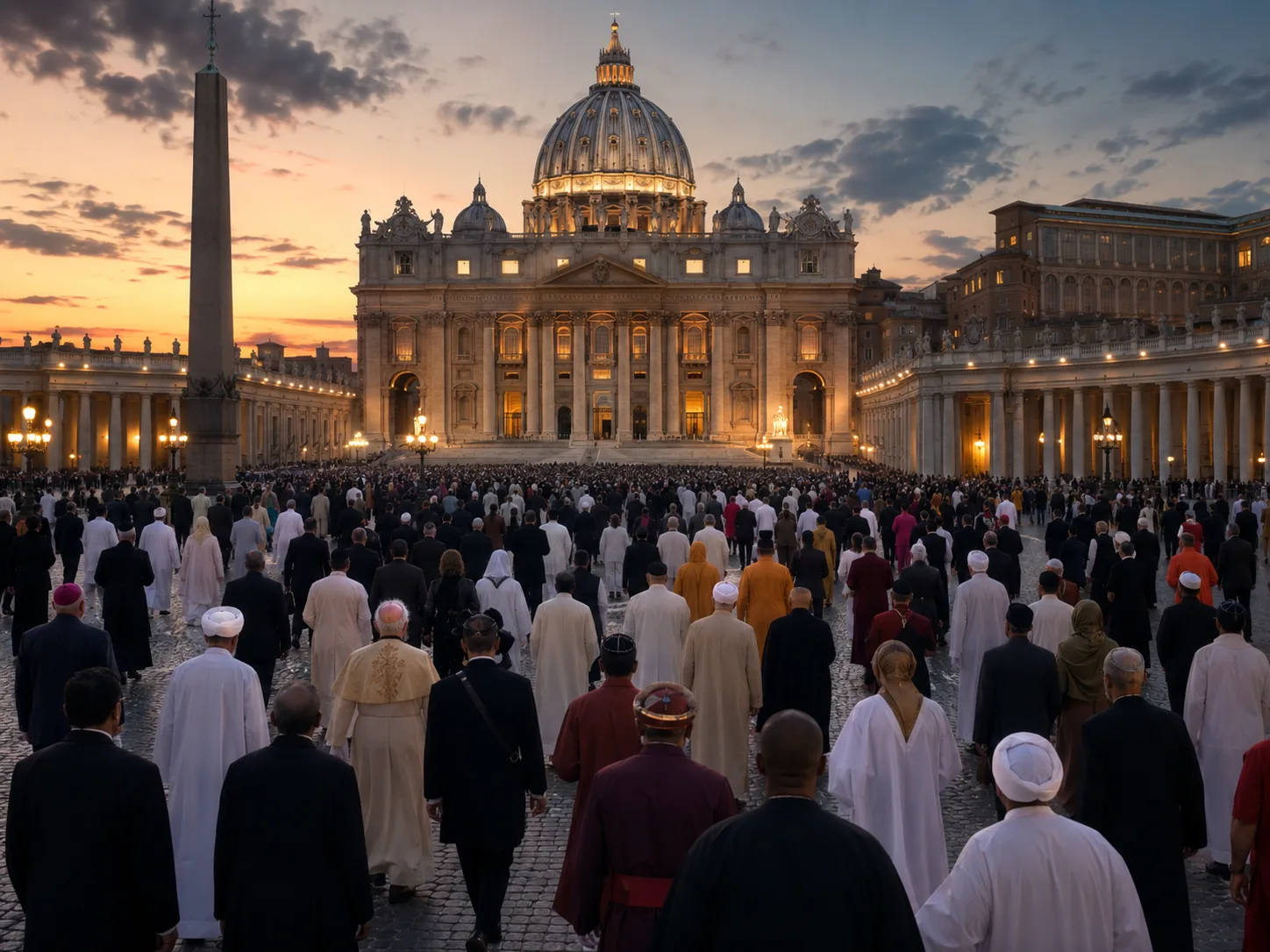
Alongside the political New World Order of Lesson 4 and the cosmological deception of Lesson 5 runs a third architectural project: the unification of the world’s religions under the moral and institutional leadership of Rome. This lesson walks Vatican II’s strategic re-engagement with the separated Protestant communions, the Joint Declaration on Justification, the Anglican-Catholic Gift of Authority, the charismatic-movement solvent that allowed pan-confessional convergence beneath the level of theology, the Assisi interfaith summits and the Document on Human Fraternity, the 2024 Synod on Synodality’s restructuring of Rome itself, and the institutional continuity from Pope Francis through Pope Leo XIV’s 1700th- anniversary commemoration of the Council of Nicaea. The closing-crisis frame is Revelation 17–18: Babylon the Great, the religious-political confederacy whose call to Christ’s people in the closing hour is Come out of her.
Lessons 1 through 5 traced the religious, institutional, secret-society, political-economic, and cosmological architecture of the closing-crisis confederacy. Lesson 6 takes up the religious-one-world project being constructed alongside those threads: the formal, documented, institutional re-unification of the world’s religions under the moral and structural leadership of the same Roman ecclesiastical authority Lessons 1 and 2 identified. The project is not a future prediction; it is a present, documented architecture in operation across the past sixty years and entering in 2025–26 a phase of public visibility the institute treats as the institutional opening of the closing-hour confederacy of Revelation 13:11–17 and Revelation 17–18.
Three preliminary observations frame the lesson. First, the project is not concealed. Its documentary record is published on the Vatican’s own servers and in the Lutheran, Anglican, and World Council of Churches archives. The willing reader can retrieve the Vatican II decrees, the Joint Declaration on Justification, the Gift of Authority document, the Document on Human Fraternity, the Synod on Synodality final document, and Pope Leo XIV’s Apostolic Letter In Unitate Fidei from their institutional issuers without subscription or special access. The case rests on the institutions’ own published self-description. Second, the project’s strategic posture follows Cardinal Wolsey’s Counter-Reformation policy walked in Lesson 5: learning against learning, surrounding the recovered Reformation gospel with competing learning until its singular authority is lost in the din. The instruments of the present phase are ecumenical dialogue, synodal restructuring, and interfaith convergence; the strategic logic is the same. Third, the institute’s identification of the project as the prophesied confederacy of Revelation 17–18 is not a polemical move but a pastoral one. The pastoral imperative attached to the identification is the angelic call of Revelation 18:4 — Come out of her, my people — in anticipation of which the willing reader is invited to weigh the documentary record on its merits.
Question 01
What is the religious one-world project, and how does it differ from biblical Christian unity?
Answer
The religious one-world project is the institutional programme, pursued in the documentary record across the past six and a half decades, of restoring the world’s separated Christian communions and ultimately the world’s major non-Christian religions to formal recognition of the moral and institutional leadership of the bishop of Rome. Father J. O’Connell stated the objective in unusually plain terms on the documentary record:
The final object of ecumenism as Catholics conceive it is unity in the faith, worship, and the acknowledgement of the supreme spiritual authority of the bishop of Rome.
The reader will weigh that statement in its own terms. The objective is unity, but the structure of the unity is unity-under-the-pope. The Catechism of the Catholic Church (1997 edition, Article 816) formalises the underlying ecclesiology: the Church of Christ “subsists in the Catholic Church… for it is through Christ’s Catholic Church alone, which is the universal help towards salvation, that the fullness of the means of salvation can be obtained.” The Protestant separations are framed at Article 817 as “sins… divisions, schisms and heresies”. The official Roman position on the question is that the separated communions are not equal sister churches but children to be returned to the mother. As the Jesuit theologian Karl Rahner stated: “The one holy catholic and apostolic universal church is not the sister but the mother of all the churches.”
This is not, structurally, the unity Scripture sets forth. Scripture sets forth a unity of the apostolic body around the apostolic faith, with Christ as the head of the body (Eph 1:22–23; Col 1:18) and no human intermediary between Christ and His people (1 Tim 2:5: “For there is one God, and one mediator between God and men, the man Christ Jesus”). The institute distinguishes sharply between the apostolic unity Scripture commands and the institutional re-incorporation under Roman primacy the documented project pursues. The two are not the same. The willing reader who has not previously weighed the distinction is invited to do so on the documentary record this lesson sets out.
Question 02
How did the Second Vatican Council (1962–65) reposition Rome toward the separated Christian communions?
Answer
The Second Vatican Council (Vatican II), convened by Pope John XXIII in 1962 and concluded under Pope Paul VI in 1965, produced sixteen documents covering liturgy, Scripture, missionary activity, ecumenism, interfaith relations, religious freedom, and the responsibilities of clergy and laity. Two of the documents bear directly on the religious-one-world project: Unitatis Redintegratio (the Decree on Ecumenism, 21 November 1964) and Nostra Aetate (the Declaration on the Relation of the Church to Non-Christian Religions, 28 October 1965). The strategic move in both is the same: a reframing of Rome’s posture toward the separated Christian and non-Christian communions that leaves the underlying doctrinal claims intact while opening institutional channels for the gradual return of the separated bodies to Roman authority.
The relevant passage from Unitatis Redintegratio sets out the objective in the Council’s own published words:
The unity of all Christians may at last be restored to shine forth. For all peoples are called to be a single new people confessing one Jesus Savior and Lord, professing one faith, celebrating one Eucharistic mystery… All Christians should be of an ecumenical mind.
The phrasing rewards careful reading. The unity to be restored presupposes that there is a prior unity to which separated parties must return; the one Eucharistic mystery presupposes the Roman sacramental doctrine of the Mass which the Reformers identified as the central liturgical departure from apostolic teaching; the ecumenical mind the document calls for is, in Roman terms, the disposition to seek that one-directional restoration. After Vatican II the message was carried to the separated communions by Jesuit theologians chief among whom was Father Karl Rahner; the redefined posture became, by the late 1960s and early 1970s, the operating frame of Roman engagement with Protestant and Orthodox Christianity.
Two further Vatican II details belong in the documentary record. First, the Council reaffirmed and modernised the Roman commitment to Sunday as the central day of worship. The conciliar document on the sacred liturgy (Sacrosanctum Concilium, 4 December 1963) and the Catechism (Article 2174) set this out plainly:
Sunday… we all gather on the day of the sun, for it is the first day after the Jewish Sabbath, but also the first day, on which God made the world from the darkness of matter, and on the same day, Jesus Christ the Saviour rose from the dead.
The phrasing is exact and worth weighing. The day is identified as the day of the sun; the term is not euphemistic, it is etymological. The institute does not press the Sabbath-Sunday issue further here — Lesson 7 of this course will return to the closing-crisis significance, and the main Study Guides treat the underlying biblical case in detail — but the willing reader records the documentary fact that post-Vatican-II Rome continues to identify the Lord’s Day with the institutional Sunday on the basis stated openly above.
Second, Vatican II reframed the Roman posture toward non-Christian religions in Nostra Aetate. The document is short (only five sections) but consequential. Its central move is to assert positive spiritual standing for Judaism, Islam, Hinduism, and Buddhism within the framework of Catholic engagement, opening institutional channels for the broader interfaith convergence (Q7 below) that would unfold across the next six decades from the Assisi summits through the Document on Human Fraternity to the Abrahamic Family House. The doctrinal claim that salvation is mediated through the Roman Church alone is retained at Article 816 of the Catechism; the institutional posture toward non-Christians is adjusted in Nostra Aetate. The two are held in tension that the documentary record does not resolve.
The post-Vatican-II Catechism repeatedly insists that Vatican II changed nothing in the underlying doctrine. The German cardinal Joseph Ratzinger (later Pope Benedict XVI), then head of the Congregation for the Doctrine of the Faith, issued in September 2000 the declaration Dominus Iesus (On the Unicity and Salvific Universality of Jesus Christ and the Church), which restated the Roman position with unusual clarity:
The ecclesial communities which have not preserved the valid Episcopate and the genuine and integral substance of the Eucharistic mystery, are not Churches in the proper sense.
The willing reader is invited to weigh what was being said. Thirty-five years after Vatican II, the Vatican’s own doctrinal congregation, signed off by the future pope, restated on the documentary record that the separated Protestant communions are not churches in the proper sense. The institutional posture of Unitatis Redintegratio toward separated Christianity is, on Rome’s own statement, a posture toward bodies that are not, in Rome’s own doctrine, fully churches. The ecumenical engagement is unilateral by Roman construction: separated bodies return to the mother; the mother does not become a sister.
Question 03
What was the Joint Declaration on Justification (1999) and what did it actually change?
Answer
The Joint Declaration on the Doctrine of Justification (JDDJ) was signed by the Lutheran World Federation and the Pontifical Council for Promoting Christian Unity at Augsburg on 31 October 1999 — the 482nd anniversary of Luther’s posting of the Ninety-Five Theses at Wittenberg, the symbolic founding act of the Protestant Reformation. The editorial choice of date was deliberate. The Methodist World Council acceded to the JDDJ in 2006; the Anglican Consultative Council associated itself in 2016; the World Communion of Reformed Churches signed in 2017. By 2017 every major Protestant world body outside the Adventist and evangelical-fundamentalist traditions had formally placed its name on the document.
The JDDJ declared that “a consensus in basic truths of the doctrine of justification exists between Lutherans and Catholics” and that the mutual condemnations of the Reformation era no longer applied as previously understood. Time magazine headlined the event as a “half- millennium rift” ended; the BBC, the New York Times, and most of the secular and religious press celebrated the document as the formal conclusion of the Reformation controversy.
Read with care, the JDDJ is not what it has been widely received to be. The institute observes three documentary features the willing reader should weigh:
- The Tridentine anathemas remain on the Roman books. The Council of Trent (Session 6, 13 January 1547) issued thirty- three canons on justification, of which Canons 9, 12, 24, and 32 specifically anathematise the Reformation formula of justification by faith alone in Christ’s imputed righteousness. The JDDJ did not annul these canons; it neither referenced them in its operative paragraphs nor obtained their formal withdrawal from the body of Roman doctrine. The thirty-three canons remain in force as Catholic dogma; the JDDJ functions as a convergence text alongside them.
- The convergence language was carefully ambiguous. The document’s key paragraphs employ terminology (e.g. “by grace alone”) on which the two parties hold substantively divergent understandings of the relation of grace to human cooperation, sacramental mediation, and merit. The JDDJ allows each side to retain its respective interpretation while signing the same words. The appearance of agreement was achieved; the substance of agreement was not.
- The strategic effect was asymmetric. The Protestant signatories retreated from Reformation language; the Catholic counterparty did not retreat from Tridentine language. The institutional weight of the agreement therefore moves the Protestant communions toward Rome’s position, not Rome toward the Protestant. By 2017 the Lutherans, Methodists, Anglicans, and Reformed had effectively endorsed a formula compatible with the Tridentine doctrine of justification; Rome had endorsed nothing it had not previously held. This is the documentary feature.
A further documentary detail belongs with the JDDJ. In the same year, 1999, the Lutheran Synod in Germany formally voted to discontinue characterising the papacy as Antichrist — the historical Lutheran identification on which Luther himself had stood and on which the Lutheran confessional documents (the Smalcald Articles, 1537, II.IV.10–14) had been composed. The newspaper headline at the time, on a common German Lutheran source, was “Germany Calls to Ask Forgiveness from Luther” — an extraordinary inversion of the historical Lutheran self-understanding. The institute records the documentary feature: the Lutheran national church of Luther’s own homeland publicly retracted the principal identification on which the Lutheran Reformation stood, in the same year as the JDDJ surrendered the principal doctrine on which it stood. The two acts are related and the willing reader is invited to weigh them together.
Question 04
How did the Anglican communion accept papal primacy? The 1989 Runcie visit and the 1999 Gift of Authority document
Answer
The Anglican accommodation to Roman primacy proceeded on a parallel track in the same decades. The Anglican–Roman Catholic International Commission (ARCIC), established in 1969, issued a sequence of agreed statements across the 1970s and 1980s addressing the central historical issues between the two communions: eucharistic doctrine (1971), ministry and ordination (1973), authority in the Church I and II (1977 and 1981). On 2 October 1989, the Archbishop of Canterbury Robert Runcie travelled to Rome for a state visit with Pope John Paul II and urged Christians to consider “the primacy of the bishop of Rome” on a fresh basis. The visit was choreographed for visibility: the Pope and the Archbishop signed a Common Declaration; their photograph at Canterbury, with the Pope blessing the assembled and Runcie standing with bowed head, circulated globally.
The Anglican capitulation reached formal documentary expression on 12 May 1999 with the publication of the ARCIC II statement The Gift of Authority (forty-three pages). The document concluded that “the bishop of Rome has a specific ministry concerning the discernment of truth” and urged Christians of all communions to “receive the universal primacy of the bishop of Rome as a gift to be received by all the churches.”The willing reader will recognise the substance: the Anglican communion, on the signature of its own international commission, accepted the universal primacy of the bishop of Rome and the papal office’s specific ministry concerning the discernment of truth. That last phrase — discernment of truth — is, in Roman doctrinal vocabulary, the formal description of papal infallibility (Vatican I, Pastor Aeternus, 18 July 1870).
A visual confirmation of the same trajectory is on the architectural record. The interior of St. Paul’s Cathedral in London — the principal Anglican cathedral of the English-speaking world — was substantially restructured across the twentieth century to incorporate features architecturally derivative of St. Peter’s Basilica in Rome: a baldachin above the high altar directly modelled on Bernini’s 1623–34 canopy in St. Peter’s; black-and-white marble flooring patterns; Marian iconography; and the ceremonial geometry of Counter-Reformation Catholic liturgical space. The willing reader who walks the interior of post-restoration St. Paul’s with Bernini’s canopy in mind will recognise the institutional alignment the architecture announces.
The Lutheran general secretary Ishmael Noko gave the accommodation its plain expression on the documentary record. Speaking in March 2001, Noko, then general secretary of the Lutheran World Federation, declared:
Lutherans can certainly look to the Pope as one of the spiritual leaders in the world today. The ecumenical movement requires Christians to look into the possibility that the Pope should become the global spokesperson for all Christians.
Read what Noko is saying. The general secretary of the principal world Lutheran body, in his institutional capacity, publicly proposed that the Pope of Rome — whose office Luther identified as Antichrist on the Smalcald Articles — should become the global spokesperson for all Christians. The Anglican primacy of the bishop of Rome and the Lutheran global-spokesperson proposal, taken together, mark the structural completion of the institutional Protestant capitulation by the close of the twentieth century.
Question 05
How did the charismatic movement function as the pan-confessional solvent the project required?
Answer
The institutional ecumenical agreements above could not have succeeded if the populations of the Protestant congregations had retained the confessional distinctives their pastors had subscribed at ordination. What was required was a movement that operated below the level of confessional theology — a movement that bound the disparate denominations together by shared experience rather than shared doctrine, and that thereby made the doctrinal compromises of the institutional agreements acceptable to the laity. The modern charismatic movement supplied precisely that solvent.
The documentary chronology is on the record:
- 1960. The Episcopal (Anglican) priest Dennis Bennett of Van Nuys, California, publicly disclosed his experience of speaking in tongues, marking the conventional beginning of the charismatic movement within the historic Protestant communions.
- 1967 — Duquesne University, Pittsburgh. Faculty and students at the Catholic Duquesne University began to experience charismatic phenomena. The Catholic Charismatic Renewal dates its institutional origin to this event. Within a decade the movement spread to Catholic universities and parishes across the United States and Europe.
- 1968 — World Council of Churches admits Catholic observers. The WCC General Assembly at Uppsala admitted Catholic observers for the first time. By the 1975 General Assembly at Nairobi, Catholic participation was institutionally normalised.
- 1975 — Pope Paul VI and the Catholic Charismatic Renewal at Rome. In May 1975 a mass gathering of the Catholic Charismatic Renewal took place at Rome under official papal patronage. Christianity Today (6 June 1975) reported the event: “Bishops, archbishops, cardinals struggling to keep their hats in place sang and danced in ecstasy, embracing one another, raising their arms to heaven. Pope Paul VI’s address was punctuated with glossolalia.” The sitting Pope, on the public record, exercised the charismatic gift of tongues at the close of the Roman gathering. The papacy itself had publicly received the movement that was binding the separated communions together at the laity level.
The institute does not engage here the wider theological question of contemporary spiritual gifts; the institute records the documentary feature of the movement’s historical function. By the late 1970s the charismatic movement had crossed every major denominational boundary — Catholic, Episcopal, Presbyterian, Methodist, Lutheran, Baptist, Pentecostal, non-denominational — and provided the shared experiential vocabulary on which institutional ecumenical agreements could rest. Cardinal Walter Kasper, then president of the Pontifical Council for Promoting Christian Unity, observed in the early 2000s that the charismatic movement had been “the best hope of renewal” for the ecumenical project — a description the willing reader is invited to weigh in its own terms.
A parallel solvent operated through the high-profile evangelical preachers of the late twentieth century whose public ministries served as conduits between the post-Reformation Protestant world and the Roman institutional centre. The institute records the documentary feature without polemic. Billy Graham, on his own published statements (cf. his autobiography Just As I Am, 1997), met with Pope John Paul II for nearly two hours on 13 January 1981 (Religious News Service, that date); operated his international crusades with substantial Catholic personnel including Jesuit advisors; and channelled enquiring converts in Catholic-majority regions to Catholic parishes for follow-up discipleship. Graham received an honorary doctorate from the Roman Catholic Belmont Abbey College and publicly stated, on accepting it, that “the gospel that founded this college is the same gospel which I preach today.” The willing reader is invited to weigh whether the Reformation-era distinction between the Roman doctrine of salvation and the recovered apostolic gospel was, on Graham’s public statement, retained or surrendered. The institute makes no judgment on Graham’s personal Christian standing; the documentary record of his institutional posture is what is at issue.
Question 06
How does the interfaith convergence work? The Assisi summits, Damascus mosque, Document on Human Fraternity, and Abrahamic Family House
Answer
Parallel to the Christian-ecumenical track runs a broader interfaith track that extends the project beyond the Christian boundary to the world’s non-Christian religions. The interfaith convergence has proceeded in a sequence of documented institutional events the willing reader can examine on the public record:
- 27 October 1986 — the first Assisi World Day of Prayer for Peace. Pope John Paul II convened in the Italian town of Assisi a meeting of representatives of the world’s major religions: Christianity (Catholic, Orthodox, and Protestant), Judaism, Islam, Hinduism, Buddhism, Sikhism, Jainism, the Bahá’í faith, Zoroastrianism, and various traditional and animist religions. The Dalai Lama attended; the Patriarch of Constantinople attended; representatives of the principal Sunni and Shia Islamic authorities attended. The meeting set the institutional template for everything that followed.
- 24 January 2002 — second Assisi summit. Convened after the September 11 attacks, this gathering further consolidated interfaith institutional posture and issued the Decalogue of Assisi for Peace committing the world’s religions to common action.
- 27 October 2011 — third Assisi summit. Pope Benedict XVI convened the third Day of Reflection, Dialogue, and Prayer for Peace and Justice in the World on the twenty-fifth anniversary of the original 1986 gathering.
- 6 May 2001 — Pope John Paul II at the Umayyad Mosque, Damascus. Pope John Paul II became the first pope in history to enter a mosque, visiting the Umayyad Mosque in Damascus — reputed to house the head of John the Baptist — and praying alongside Muslim leaders. On a subsequent occasion the Pope publicly kissed the Quran. The symbolic move was unprecedented in the documented history of the papacy and signalled the institutional opening to Islamic ecumenical engagement.
- 4 February 2019 — the Document on Human Fraternity. In Abu Dhabi, Pope Francis and Grand Imam Ahmed el-Tayeb of al-Azhar signed A Document on Human Fraternity for World Peace and Living Together, jointly declaring that “the pluralism and the diversity of religions, colour, sex, race and language are willed by God in His wisdom, through which He created human beings.” The document is on the Vatican’s public archive. The willing reader will weigh the theological claim: the willed pluralism of religions, including the religions that deny the deity and exclusive saviourship of Jesus Christ, is presented as the design of God. The implications for the apostolic doctrine of salvation by Christ alone (Acts 4:12; Jn 14:6) are documented elsewhere; here the institute records the documentary feature.
- 16 February 2023 — the Abrahamic Family House opens in Abu Dhabi, UAE. A purpose-built interfaith complex housing a mosque, a church, and a synagogue on adjacent plots within a single architectural ensemble, designed by Ghanaian-British architect David Adjaye. Each house of worship is deliberately constructed at the same height (thirty metres) and overall dimensions. The complex is described in its own institutional literature as “a physical manifestation of the Document on Human Fraternity.” By the close of its first year of operation, more than 100,000 worshippers had attended services across the three houses. In February 2025 the complex hosted the first formal training course in ecumenical and interreligious dialogue for delegates of the Catholic Episcopal Conferences working in interfaith fields.
Three further documentary items belong on the chronology and deserve specific recording because they shape the legal and institutional architecture within which the broader project operates:
- 20 March 1991 — Public Law 102-14 and the federal incorporation of the Noahide Laws. On 20 March 1991 President George H. W. Bush signed into law H.J. Res. 104, designated Public Law 102-14, establishing 26 March 1991 (the ninetieth birthday of Rabbi Menachem Mendel Schneerson, the Lubavitcher Rebbe of the Chabad-Lubavitch movement) as “Education Day, U.S.A.” The statutory text of the resolution incorporated into federal law the assertion that the “Seven Noahide Laws” — the rabbinic interpretive framework of seven universal commandments derived from the early chapters of Genesis and applied by Orthodox-Jewish tradition to all non-Jewish humanity — are “the ethical values and principles which are the basis of all civilized society” and that without them “society stands in peril.” Every US president since 1991, of both political parties, has continued the Education Day proclamation tradition. The institute observes without polemic the documentary feature: the United States federal legal record, since 1991, contains the formal incorporation of a non-Christian religious legal framework as the asserted ethical foundation of civilised society. The implications of the Noahide framework for the post-apostolic confession of Christ — the rabbinic interpretation of the first Noahide law (against idolatry) historically applies to any worship of a person other than the unitary Most High, which on rabbinic terms includes any worship offered to Jesus of Nazareth — will be walked in detail in Lesson 7 of this course. Here the institute records the legal precedent: the institutional bridgehead by which a non-Christian religious framework has entered US federal law is on the documentary record as of 20 March 1991.
- 1997 — the Elijah Interfaith Institute and its Board of World Religious Leaders. Founded in Jerusalem in 1997 by Rabbi Alon Goshen-Gottstein under UNESCO sponsorship, the Elijah Interfaith Institute operates the Elijah Board of World Religious Leaders, an institutional convocation of approximately seventy religious figures spanning Judaism, Christianity (Catholic, Orthodox, Anglican, evangelical), Islam (Sunni and Shia), Buddhism, Hinduism, Sikhism, and the religions of India. The Board has included figures such as the Dalai Lama, Cardinal Christoph Schönborn of Vienna, the late Grand Mufti of Bosnia Mustafa Cerić, and the Hindu spiritual teacher Mata Amritanandamayi. The Board convenes biennially in rotating international settings and operates as a continuous infrastructure for the institutional interfaith convergence the wider Assisi-tradition has set out at high-profile public gatherings. The institutional architecture for world-religious convocation outside the immediate Roman ecclesiastical orbit is, on Elijah’s documentary record, in continuous operation since 1997.
- 6–18 November 2022 — the “Returning to Sinai” faith-based climate gathering on Jebel Musa, Egyptian Sinai. Coinciding with the COP27 climate conference at Sharm el-Sheikh, an interfaith coalition of religious leaders and climate activists ascended Jebel Musa (traditional Mount Sinai) and conducted a ceremony framed as the issuance of “new commandments” for the climate era. Stone tablets — one painted by the Israeli branch of Strike 4 Future in blue with the Hebrew inscription “Broken Promises,” a second painted green to symbolise “green commandments” — were carried to the summit and ritually smashed against the ground, in deliberate parody of Moses’s breaking of the original tablets at Exodus 32:19. The event was reported in The Times of Israel (8 November 2022) and in the broader interfaith-environmental press as the launch of a coordinated faith-based climate advocacy. The willing reader is asked to weigh the documentary feature: a public-relations event at the traditional site of the giving of the Decalogue, executed by an interfaith coalition, has, on the public record, broken the symbolic continuity of the original commandments and proposed a replacement framing for the contemporary moral crisis. The institute makes no polemical judgment on the sincerity of the participants; it records that the institutional architecture for the replacement of biblical moral authority with a new interfaith-climate moral authority has been publicly inaugurated.
The institute does not, in this lesson, attempt a comprehensive theological evaluation of every event in the chronology. The institute observes the documentary feature: across the past forty years the institutional architecture of interfaith convergence has been built, openly, by named institutions, with published source documents, in a sustained trajectory of institutional consolidation. The willing reader who has heard the project described in popular accounts as either non-existent or as an uncoordinated drift is invited to examine the chronology on the public record. The architecture is real, named, dated, and visible.
Question 07
What does Christ’s own voice say about the project — both the unity He prayed for and the separation He commanded?
Answer
The pivotal Christological texts on the question are in Christ’s own voice, and the modern ecumenical project cites the first of them ceaselessly while passing silently over the second. The willing reader is invited to read both in their own contexts:
Neither pray I for these alone, but for them also which shall believe on me through their word; that they all may be one; as thou, Father, art in me, and I in thee, that they also may be one in us: that the world may believe that thou hast sent me.
This is the verse cited at the head of nearly every ecumenical document the project has produced. Vatican II’s Unitatis Redintegratio opens with an extended meditation on it. The Gift of Authority (ARCIC II, 1999) appeals to it. The Joint Declaration on Justification cites it. Pope Francis’s Spes Non Confundit (the bull of indiction for Jubilee 2025) cites it. Pope Leo XIV’s Apostolic Letter In Unitate Fidei (23 November 2025) cites it. The phrase that they all may be one is the institutional warrant of the religious-one-world project.
Three verses earlier in the same chapter, however, Christ defines the substance on which His prayed-for unity stands. The verse the modern ecumenical project does not place at the head of its documents reads:
And this is life eternal, that they might know thee the only true God, and Jesus Christ, whom thou hast sent.
Read the two verses together. The unity Christ prayed for at John 17:21 is not unity in the abstract; it is unity grounded on the eternal life of John 17:3 — the knowledge of the only true God, and Jesus Christ whom thou hast sent. The unity has a content, and the content is the apostolic confession of the Father as the only true God and Jesus Christ as the One Whom He sent. Severed from that content, the language of unity becomes a hollow vehicle for whatever institutional configuration the strongest party in the room wishes to construct. Christ did not pray for unity-on-any-basis; He prayed for unity- in-the-truth (Jn 17:17: “Sanctify them through thy truth: thy word is truth”).
The institute holds this distinction as load-bearing. The willing reader who has received the apostolic gospel through the recovered Reformation tradition and through TAHBRI’s pioneer-Adventist editorial line will recognise the substance: the Father is the only true God; the Lord Jesus Christ is His only-begotten Son sent forth in the fullness of time; eternal life is the knowledge of the Father in and through the Son. The unity Christ prayed for is the unity of those who hold that confession. The modern ecumenical project, on the documentary record, retains the language of John 17:21 while progressively evacuating the substance of John 17:3 in favour of an interfaith convergence in which non-Christian religions (themselves explicit deniers of the Father-Son confession of the apostles) are included as valid approaches to God. The willing reader is invited to weigh whether what the project has built is the unity Christ prayed for or its institutional substitute.
The companion text from Christ’s own voice, on the closing-crisis side of the question, is the angelic call from heaven Christ Himself discloses to the apostle John on Patmos:
And I heard another voice from heaven, saying, Come out of her, my people, that ye be not partakers of her sins, and that ye receive not of her plagues.
The vocabulary is decisive. The voice is from heaven — the same heavenly origin as the Revelation’s disclosing voice. The addressees are my people — Christ’s own people, presupposed as still present inside the system at the moment of the call. The command is come out of her — a separation, not a reform; an exit, not an internal renovation. The rationale is twofold: that ye be not partakers of her sins (the moral rationale), and that ye receive not of her plagues (the prophetic rationale, referring to the seven last plagues of Revelation 16). The unity Christ prayed for at John 17 and the separation Christ commands at Revelation 18 are not opposites; they are correlatives. The first describes the inward bond of His apostolic people; the second describes the outward posture toward the system that has displaced the apostolic faith.
A further Christological observation belongs with these texts. The voice from heaven of Revelation 18:4 is, by the structure of the Revelation, the voice of the same Christ Who walks among the lamp- stands in chapter 1 (Rev 1:13–18), Who speaks as the first and the last (Rev 1:17, the divine self-designation of Isaiah 44:6), Who calls Himself the Alpha and Omega, the beginning and the ending (Rev 1:8; 22:13). The institute affirms readily Christ’s full divinity through these self-designations in His own voice. The call Come out of her, my people is not, on the Revelation’s own structure, a marginal apocalyptic flourish; it is the voice of the Lord Himself addressing His people in the closing hour.
Question 08
Current events 2024–26: the Synod on Synodality, the death of Pope Francis, and the election of Pope Leo XIV
Answer
The years 2024 through 2026, in which this lesson is composed and the willing reader is engaging it, mark a phase of unusual public visibility in the project’s development. Four documentary events stand on the record from this period and bear directly on the lesson’s subject:
- 26 October 2024 — the Synod on Synodality final document. The two-session Synod of Bishops on Synodality (October 2023 and October 2024), convened by Pope Francis, approved its 52-page Final Document on 26 October 2024. Pope Francis made the unprecedented decision to accept the document as authoritative magisterial teaching — ordinarily, Synod final documents are advisory and submit to subsequent papal review. The document calls for structural reform of canon law to remove the formula that consultative bodies have “merely a consultative” vote, expanding lay participation in decision-making processes; for greater participation of lay people, including women, in ministry; and for ongoing reform of seminary formation, pastoral councils, and ecclesial structures. Pope Francis subsequently launched a three-year implementation phase culminating in an ecclesial assembly at the Vatican in October 2028. The willing reader records the documentary feature: in the same decade that the institutional architecture of interfaith convergence has been consolidated externally, Rome has begun a structural re-engineering of its own internal governance to make the institution more participatory and visibly inclusive.
- 21 April 2025 — the death of Pope Francis. Pope Francis died on Easter Monday at 07:35 CEST in the Domus Sanctae Marthae, Vatican City, at the age of 88, following a five-week hospitalisation for a respiratory tract infection and double pneumonia; the cause of death was registered as a stroke followed by irreversible cardiac arrest. His Requiem Mass was celebrated on 26 April with over 250,000 in attendance during the lying-in- state. He was buried at Santa Maria Maggiore.
- 8 May 2025 — the election of Pope Leo XIV. The conclave convoked on 7 May 2025 elected Cardinal Robert Francis Prevost, OSA — an Augustinian friar of Chicago, Illinois — on the second day of voting. Prevost took the regnal name Leo XIV and was inaugurated on 18 May 2025 in St. Peter’s Square. He is the first United States-born pontiff in the documented history of the papal office. The institutional implications of an American pope, in the closing-crisis frame of Revelation 13:11–17 (which Adventist historicism has traditionally identified with the land-beast emerging from the United States), are for the willing reader to weigh.
- November 2025 — Pope Leo XIV at the 1700th anniversary of the Council of Nicaea. On 28 November 2025 Pope Leo XIV commemorated the 1700th anniversary of the First Council of Nicaea (AD 325) at the archaeological site of the ancient Basilica of Saint Neophytos on the shore of Lake Iznik (ancient Nicaea), southeast of Istanbul, jointly with the Ecumenical Patriarch Bartholomew I of Constantinople. Five days earlier, on 23 November 2025, the Pope had issued the Apostolic Letter In Unitate Fidei setting out the anniversary’s ecumenical significance.
Pope Leo XIV’s public programme since his election has consolidated the project’s trajectory under a fresh institutional face. In his first ecumenical Vespers for the Week of Prayer for Christian Unity (January 2026), he urged Christians to “deepen their common witness by growing in ecumenical synodal practices,” explicitly fusing the synodality reform programme of 2024 with the ecumenical-unity programme of the past sixty years. In May 2026 he convened his first major interfaith and ecumenical audience in the Vatican’s Clementine Hall, receiving leaders of the Orthodox, Anglican, and Protestant communions alongside representatives of Judaism, Islam, Hinduism, Buddhism, Sikhism, and Jainism. He has spoken publicly of an “ecumenism of the saints” — a working concept in which the shared veneration of martyrs and saintly figures across confessional boundaries supplies the affective base on which institutional convergence proceeds.
The 1700th-anniversary Nicaea commemoration deserves particular weighing. The Council of Nicaea (May– July 325 AD) was convened by the unbaptised Roman emperor Constantine I, who presided over the proceedings in the imperial palace at Nicaea, in Bithynia. The Council issued the original Nicene Creed, the formula by which the church under imperial sponsorship resolved a contested Christological question by introducing the non-biblical term homoousios (“of the same substance”) into the confession of faith. The Apostolic Letter In Unitate Fidei (23 November 2025) presents the Nicene formula as the foundational expression of Christian unity to which all Christian communions should return.
TAHBRI’s editorial position on the Nicene formula is held openly elsewhere on the institute’s site (the forthcoming Godhead studies) and need not be argued here at length. The institute affirms readily the full divinity of Christ on the basis of Christ’s own self-disclosed divine titles — the first and the last (Rev 1:17), the Alpha and Omega (Rev 1:8; 22:13), the I AM (Jn 8:58), the Almighty (Rev 1:8) — and on the apostolic confession of the Father as the only true God and Jesus Christ as the One Whom He sent (Jn 17:3; 1 Cor 8:6). The institute does not affirm the post- biblical philosophical formula introduced at Nicaea under imperial sponsorship. The willing reader will weigh, on the institute’s broader doctrinal line, what it signifies that Pope Leo XIV’s signature ecumenical document of his first year in office is a reaffirmation of the imperial-Constantinian Nicene formula as the basis of Christian unity. The institute observes the documentary feature: the unity being institutionally proposed in the closing hour rests not on the apostolic confession of John 17:3 but on the post-apostolic creedal innovation of Nicaea 325. The willing reader is invited to weigh the difference.
A documentary observation on the Constantinian package the project is institutionally reaffirming. The Council of Nicaea (May–July 325 AD) is commonly remembered for the homoousios formula. Less commonly remembered is that the same emperor, in the same decade, issued in March 321 AD the first civil Sunday law in human history — the imperial edict requiring all judges, townspeople, and artisans to rest “on the venerable day of the sun” (dies Solis). The Nicene Christological formula and the imperial Sunday law were issued by the same hand, in the same five-year window, as components of a single imperial- ecclesiastical synthesis. They have travelled together through history as a package, and they are being institutionally reaffirmed together in the present hour. The willing reader who has walked Lesson 5’s treatment of the Hermetic-imperial cosmological project will recognise the documentary feature: the same imperial sponsorship that codified the post-apostolic Christology codified the pagan- sun-day worship at the same institutional moment.
Three further events between November 2025 and May 2026 deserve specific weighing because they bear directly on the project’s public emergence in the period this lesson is being engaged. The first is Pope Leo XIV’s September 2025 apostolic journey to Algeria, in the course of which on 18 September 2025 the Pope visited the Grand Mosque of Algiers — the largest mosque in Africa and the third-largest in the world, with a capacity of 37,000 worshippers. The Pope walked through the mosque shoeless according to Muslim custom, paused for a moment of silence accompanied by the Grand Mufti, and afterwards engaged in an interreligious dialogue at which he stressed “the importance of coexistence between the two religions.” The visit was framed as a continuation of the Document on Human Fraternity (Q6 above) and consolidated the Pope’s personal commitment to the interfaith track in his first year.
The second event is the United States President’s Jewish American Heritage Month proclamation of 4 May 2026. Donald J. Trump, in his second term as US president, issued under official presidential seal a proclamation calling Jewish Americans to observe a “national Sabbath” from sundown 15 May 2026 to nightfall 16 May 2026 in honour of the 250th anniversary of American independence (1776–2026). The text of the relevant paragraphs is on the public record:
In special honor of 250 glorious years of American independence, and on the weekend of Rededicate 250, a national jubilee of prayer, praise, and thanksgiving, Jewish Americans are encouraged to observe a national Sabbath from sundown May 15 to nightfall May 16. Friends, families, and communities of all backgrounds may come together in gratitude for our great nation. … I further call on all Americans to celebrate their faith and freedom throughout this year, during this month, and especially on Shabbat, to celebrate our 250th year.
The willing reader is invited to read the proclamation carefully. Three documentary features bear weighing. First, the proclamation is the first occasion in the documented history of the United States presidency on which a sitting president has formally called all Americans by name to observe the seventh-day Sabbath. Neither Washington, nor Lincoln, nor Reagan, nor any prior president has, on the official record, issued such a call. The proclamation does not call all Americans to observe Sunday; it calls all Americans to observe Shabbat. The verb is encouraged, not required; the rationale is anniversary and thanksgiving, not religious enforcement. The proclamation does not constitute the Revelation 13 mark-of-the-beast test — Revelation 13:16–17 specifies causeth (institutional coercion) and that no man might buy or sell save (economic sanction), neither of which is present in the May 4 text. The willing reader who has walked Lessons 1 through 6 of this course is asked to receive the proclamation in its own measure: it is the federal precedent for formal governmental coordination of nationwide religious observance from the highest office in the land. The Ellen White prophetic framework calls this category “make provision” (cf. Ellen White, Review and Herald, 23 February 1888): the institutional mechanism through which the religious- political confederacy of the closing crisis is constructed by stages, the first of which is the federal call, the later of which is enforcement. The first stage is on the documentary record as of 4 May 2026.
Second, the proclamation is paired with the public event Rededicate 250 scheduled for 17 May 2026 on the National Mall in Washington, DC, directly in front of the United States Capitol. The event was framed by its organisers as “a national jubilee of prayer, praise, and thanksgiving” in which Americans of every faith background would gather in scripture reading, prayer, and re-dedication of the country to God for the next 250 years. Morning fellowship at the Capitol, an evening musical worship anchored at a main stage on 12th Street, and televised proclamations from administration officials (including Secretary of State Marco Rubio, US Ambassador to Israel Mike Huckabee, and others) made the day a sustained civic-religious convergence on federal soil. The institutional architecture for coordinated national religious observance is, on the documentary record of 4–17 May 2026, formally exercised for the first time in modern American history.
Third, the same presidential administration had already, in March 2025 and March 2026, issued official presidential proclamations on Irish-American Heritage Month explicitly praising Saint Patrick for spreading “the mystery of the Holy Trinity” to pagans through the device of the three-leaf shamrock. The text from the 2026 proclamation reads, on the White House’s own public archive:
Tradition holds that St. Patrick taught the mystery of the Holy Trinity to pagans using the three-leaf shamrock, setting untold hearts on fire for Christ.
The willing reader is asked to weigh the documentary sequence. The White House’s official record across 2025–26 contains, in chronological order: (i) two successive presidential proclamations (March 2025, March 2026) praising the spread of the Trinity doctrine; (ii) a proclamation (4 May 2026) calling all Americans to observe the seventh-day Sabbath in commemoration of the 250th anniversary; (iii) a national civic-religious event (17 May 2026) re-dedicating the country to God. Per the editorial line of the institute and the apostolic OTG confession (Jn 17:3; 1 Cor 8:6), this sequence does not represent the consolidation of biblical worship. It represents the consolidation of a Constantinian-package framework — Trinity-theology paired with Sabbath/Sunday federal coordination — under the official seal of the highest office in the United States. The first beast’s theological signature (post-Nicene Trinitarian formulary) and the closing- crisis institutional architecture (federal coordination of nationwide religious observance) are now on the documentary record together.
A documentary clarification at this point is warranted, lest the willing reader misread the institute’s position. The institute does not read the 4 May 2026 proclamation calling Americans to observe Shabbat as itself the mark of the beast. The seventh-day Sabbath is the biblical day God blessed and sanctified before the fall (Gen 2:1–3) and reaffirmed in the fourth commandment of His own law (Ex 20:8–11). That the seventh-day Sabbath has appeared, for the first time in American presidential history, in an official federal proclamation is, on the apostolic cosmological reading, a providential development whose long-term consequence is for the willing reader to weigh. The institute observes, however, that the Sabbath the proclamation invokes is being institutionally received in a religious frame whose theological centre has already been federally proclaimed to be Trinitarian. The day question and the God question must, on the apostolic reading, be held together; the institute holds the OTG confession of Jn 17:3 as the load-bearing identifier of the God to Whom the Sabbath belongs (Ezek 20:12, 20: “I am the Lord your God”, singular). The willing reader is invited to receive this distinction in its own measure.
Question 09
Where does the closing-test fit? Revelation 13:11–17 and the call of Revelation 18:4
Answer
Per the editorial line of this course, the detailed exposition of the closing-test of Revelation 13:11–17 — the image of the beast, the mark of the beast, the test on worship at the close — is reserved for Lesson 7 (the synthesis) and is treated at length in the main Study Guides (particularly Lesson 14 on the third angel’s message). Lesson 6’s task is to identify the religious-one-world project as the architecture within which that closing test will be administered. The willing reader who has walked Lessons 1 through 6 of this course now has the institutional shape of the confederacy in view: Babylonian mystery religion as the religious root (Lesson 1), the Jesuit counter-Reformation as its modern political- ecclesiastical re-entrenchment (Lesson 2), the secret-society initiatic layer (Lesson 3), the New World Order political project (Lesson 4), the cosmological deception (Lesson 5), and the religious- one-world project (Lesson 6). Lesson 7 will tie the threads to Revelation 13–18 and the third angel’s message.
Two observations belong here, however, as the institutional architecture this lesson has set out bears directly on the structural form of the closing test:
- The two beasts of Revelation 13 align with the two architectures already named. The first beast of Revelation 13:1–10 — receiving its seat, power, and great authority from the dragon (Rev 13:2), wounded unto death and healed (Rev 13:3), worshipped by all the world (Rev 13:4), blasphemous against God (Rev 13:5–6), making war with the saints (Rev 13:7) — corresponds in Adventist historicist interpretation to the papal-ecclesiastical sovereignty whose modern form Lessons 1 through 6 have walked. The second beast of Revelation 13:11–17 — emerging from the earth, with two horns like a lamb but speaking as a dragon, exercising all the authority of the first beast in his sight (Rev 13:12), making fire come down from heaven (Rev 13:13), causing an image to be made to the first beast (Rev 13:14), giving life to the image and enforcing its worship (Rev 13:15), and imposing the mark of the beast on every economic transaction (Rev 13:16–17) — corresponds, on the Adventist historicist reading, to the United States as the closing-hour partner of the papal ecclesiastical system. The election of the first US-born pope in May 2025 collapses, at one institutional point, the two architectures the prophecy identifies as cooperating.
- The institutional architecture for an image-of-the-beast structure is in place. What Revelation 13:14–15 describes — the second beast causing an image to the first beast to be made, and the image being given life and enforced worship — presupposes an institutional architecture within which the apostate-Protestant world (the second-beast power) replicates the papal-ecclesiastical structure (the first beast) and binds the world’s religious authority to that replication. The architecture set out in Q2 through Q8 above is, in its structural form, precisely that. The Lutheran, Anglican, Methodist, Reformed, evangelical-charismatic, and post- Protestant communions have, through the documented agreements walked in Q3 through Q6, effectively acknowledged the papal primacy and the broader Roman ecclesiastical pattern. The institutional preparation for the image-of-the-beast structure is on the documentary record.
Beyond the structural alignment, the institutional infrastructure for the closing-test mechanism has been documentably erected in the United States across 2024–26 at a pace and visibility that bear specific recording on the documentary feature. The institute observes the following on the public record:
- The first US-born pope is openly identified as a Constantinian archetype. On 4 October 2024, Greek Orthodox Archbishop Elpidophoros of America, standing beside President-Elect Donald Trump at a public Hellenic event, addressed Trump with the words: “You remind me of the great Roman Emperor Constantine the Great.” The willing reader is asked to weigh the historical content of that comparison. Constantine (c. 272–337 AD) was the Roman emperor who (i) issued the first civil Sunday law in 321 AD; (ii) convened and presided over the Council of Nicaea in 325 AD; and (iii) institutionalised the imperial-ecclesiastical fusion that became the structural model of Western religious-political confederacy for the next seventeen centuries. The public address of a sitting US president as the new Constantine, eight months before that president would issue the first federal-Sabbath proclamation in American history, sits on the documentary record for the willing reader’s weighing.
- A confessedly Christian nationalist church has opened three blocks from the United States Capitol. In February 2025, Pastor Doug Wilson opened Christ Church Washington DC, a satellite of his Moscow, Idaho congregation, three blocks from the Capitol building. The opening service was attended by Defense Secretary Pete Hegseth, who is a public member of the broader Communion of Reformed Evangelical Churches that Wilson chairs. Wilson has stated on the record (CNN interview, June 2025; Tucker Carlson interview, March 2025) that his explicit objective is to make the United States a Christian nation and the world a Christian world. His position on Sabbath legislation, on the documentary record of a June 2025 interview, is that “I am in favor of legislating the first table of the law” — the first table of the Decalogue being commandments one through four, which include the Sabbath commandment. Wilson holds the Sunday position and has stated publicly that the simplest harmonisation of the day question would be for seventh-day communities (he names Adventists specifically) to accept Sunday observance, citing the engineering ease of harmonising the calendar week if the seventh-day position were relinquished.
- The Pentagon hosts a monthly prayer service initiated by the Secretary of Defense. Beginning in March 2025, Secretary of Defense Hegseth instituted a monthly Christian prayer service at the Pentagon. The service is led by clergy associated with Wilson’s broader CREC network. The White House faith office, led by evangelical pastor Paula White-Cain, coordinates a parallel faith-engagement programme that has included public prayer services on the White House lawn with speakers including White-Cain, the Reverend Franklin Graham (son of Billy Graham), and Pastor Mark Burns.
- A twenty-two-foot golden statue of the sitting US president has been dedicated at a public ceremony. On 8 October 2025, a twenty-two-foot golden statue of Donald Trump — depicting the president with raised fist in the posture of his 13 July 2024 Butler, Pennsylvania attempted-assassination response — was dedicated at Trump National Doral Golf Club, Florida, by Pastor Mark Burns of the South Carolina-based Pastors for Trump organisation. The statue is gold from head to base; donations were reportedly secured only after the gold finish was confirmed. The dedication ceremony included Burns’s public statement, drawing on Christological language:
Mr. President, no one has paid the price like you have paid the price. It almost cost you your life. You were betrayed and arrested and falsely accused. It’s a familiar pattern that our Lord and Savior showed us. But it didn’t end there for him and it didn’t end there for you. God always had a plan. On the third day, he rose, he defeated evil… And because he rose, we all know that we can rise. And sir, because of his resurrection, you rose up. Because he was victorious, you were victorious.
The institute does not press a judgment on the intent of those who attended the dedication. The institute records the documentary feature: a twenty-two-foot statue of pure gold dedicated to a sitting US president by an ordained evangelical pastor employing the Christological vocabulary of the resurrection (he rose, you rose up; he was victorious, you were victorious) sits on the public photographic and video record of October 2025. The willing reader who has walked Lesson 1 of this course on the Babylonian mystery religion will recognise the typology. The willing reader who recalls Daniel 3 — Nebuchadnezzar’s gold image, threescore cubits by six cubits, set up in the plain of Dura, with the call to all peoples, nations, and languages to fall down and worship at the sound of the music — will weigh the documentary feature in its own measure.
A Eucharistic procession at a Trump rally has consecrated the United States to Mary Immaculate. At a Mar-a-Lago Catholic gathering in October 2024 and a repeat ceremony in September 2025, a Roman Catholic bishop processed with the Eucharistic host through the assembled crowd, who were invited to kneel before the host as Christ-the-King. The accompanying prayer, addressed to the Holy Trinity through the mediation of Mary Immaculate, ran in part:
Most Holy Trinity, we place the United States of America into the hands of Mary Immaculate in order that she may present the country to you… Mary, Immaculate Virgin, our mother, patroness of our land, we praise and honor you and give ourselves to you. Protect us from every harm. Pray for us that acting always according to your will and the will of your divine Son, we may live and die pleasing to God.
The institutional reference frame for the prayer is the 1859 Wisconsin Marian apparition at Champion (Green Bay), which remains the only Marian apparition formally approved by the United States Conference of Catholic Bishops and the only one approved on US soil by the Vatican. The apparition is recorded as having issued the instruction: “Gather the children in this wild country, and teach them what they should know for salvation. Teach them how to make the sign of the cross, how to approach the sacraments.” The institutional posture is that Mary is the formally recognised patroness of the United States within the Catholic frame. The willing reader will weigh what it signifies that a sitting US president’s rallies have included Eucharistic processions consecrating the country to Mary Immaculate.
The US Department of Labor has signalled a return to Sunday blue laws on the Constantinian precedent. Jonathan Berry, US Department of Labor Solicitor (the department’s chief legal officer overseeing federal labour-law enforcement) from 2025, has publicly advocated re-establishing state and local Sunday-rest legislation. In a public interview from June 2025, Berry stated:
I think this is more a question of state and local law, is reinvigorating, where possible, Sabbath rest laws. Really going literally dating back to Constantine and his recognition of Christianity in the Roman Empire, that you’ve had a pretty consistent tradition in Western civilisation of taking like taking Sunday off from from commerce. And having a time not only for — it’s not merely from rest in the sense of abstinence from work, but it’s rest for time with God, time worshiping God.
The Solicitor of the United States Department of Labor, in his institutional capacity, publicly commended Constantine’s 321 AD Sunday law as the historical precedent for renewed contemporary Sunday-rest legislation. The willing reader records the documentary feature: at the level of federal executive personnel charged with labour-law enforcement, the explicit institutional template being commended for revival is the Constantinian imperial Sunday law. The institutional preparation for Sunday-rest legislation under federal influence is, on Berry’s own statement, currently underway.
The institute does not, on the basis of these events in isolation, declare that the closing test of Revelation 13–14 has been imposed. It has not. Sunday-rest legislation is not in force in the United States as of the publication of this lesson; no economic exclusion has been imposed; no seventh-day observer has been criminally penalised. What the institute observes is the documentary feature: the institutional architecture, the theological language, the public personnel, and the ceremonial typology are all on the public record across the very months in which the lesson is being engaged. The willing reader is asked to weigh the pattern. Stage one of Ellen White’s threefold union framework — Protestantism stretching its hand across the gulf to grasp the hand of the Roman power — is on the documentary record. Stage two — clasping the hands of spiritualism — is documentably underway in the broader interfaith and contactee environment Lesson 5 walked. Stage three — the country repudiating every principle of its constitution and making provision for the propagation of papal falsehoods — is the institutional category the 4 May 2026 proclamation has formally inaugurated. The institute commends the willing reader to weigh the documentary record on its merits.
The Sunday-Sabbath dimension of the closing test, the mark of the beast in its formal definition, and the third angel’s message will be walked in Lesson 7. The willing reader is asked, for now, to receive the architectural picture this lesson has set out and to register that the institutional preparation for the closing test of Revelation 13–14 is not a future hypothetical but a present documentary feature of the year 2026 in which this lesson is being engaged.
Question 10
What about the standard objections?
Answer
Seven standard objections to the identification of the religious-one-world project as the prophesied Babylonian confederacy circulate in modern conversation. Each is addressed in its own terms below:
| Standard objection | Why the documentary record resists it |
|---|---|
| Christian unity is biblical — Christ Himself prayed “that they all may be one” in John 17 | Christ’s prayer for unity in John 17:21 is in the same chapter as His prior definition of eternal life at John 17:3: “And this is life eternal, that they might know thee the only true God, and Jesus Christ, whom thou hast sent.” The unity Christ prayed for is unity grounded in knowledge of the only true God and the apostolic gospel of His only-begotten Son. The modern ecumenical project appropriates the language of John 17:21 while severing it from John 17:3. The institute affirms readily the unity Christ prayed for; it rejects the appropriation that retains the word one and discards the substance on which the oneness is to stand. |
| The institute is anti-Catholic; sincere Catholics are saved Christians too | The institute makes no judgment on the eternal standing of any individual Catholic; the institute affirms readily that the apostolic gospel has been received, by sovereign grace, in every century and inside every visible communion, including the Roman. The institute does not equate the institutional system with the individuals who hold membership within it. What is identified in this lesson is the institutional system — its documentary self-description, its published doctrine, and its strategic posture toward the recovered Reformation gospel — not the eternal status of any individual believer who has not yet examined the system on the documentary record. Revelation 18:4’s call “Come out of her, my people” presupposes precisely that there are Christ’s people inside the system at the moment of the call. |
| Vatican II changed Catholic doctrine in a more open direction; the Catechism reflects modernised positions | The Catechism of the Catholic Church (1992, 2nd ed. 1997) is on the documentary record: Article 816 confirms that the Church of Christ “subsists in the Catholic Church”, that the fullness of the means of salvation is obtained “through Christ’s Catholic Church alone, which is the universal help towards salvation”; Article 817 frames the Protestant separations as “sins… divisions, schisms and heresies”; Article 820 retains the rule of the church through its supreme pontiff and bishops; Article 2174 designates Sunday “the day of the sun” as the day on which Christians gather. Vatican II repackaged the institutional posture toward the separated communions; it did not amend the doctrinal core. The official Vatican declaration Dominus Iesus (5 September 2000) restated, against contemporary misunderstanding, that other Christian communities “are not Churches in the proper sense.” |
| The Joint Declaration on Justification (1999) shows Lutherans and Catholics agree on the central Reformation issue | The Joint Declaration on the Doctrine of Justification (Augsburg, 31 October 1999) was signed by the Lutheran World Federation and the Pontifical Council for Promoting Christian Unity; the Methodist World Council acceded in 2006, the Anglican Consultative Council associated itself in 2016, and the World Communion of Reformed Churches signed in 2017. What was actually agreed is not the Reformation doctrine of justification by faith alone in Christ’s imputed righteousness, but a carefully constructed convergence text that allowed both parties to retain their respective interpretive traditions while signing the same words. The Roman doctrine of justification — Council of Trent (1547), Session 6, Canons 9, 12, 24, 32 — remains formally on the books with its anathemas against the Protestant formula intact. What was achieved at Augsburg was the appearance of doctrinal convergence; what was retained beneath the appearance was the doctrinal divergence. The willing reader is invited to read the JDDJ alongside the Tridentine canons on its own terms. |
| Revelation 17–18 is about the literal city of Babylon or the Roman empire, not the modern church | The literal city of Babylon on the Euphrates fell to Cyrus in 539 BC and was a ruin already by the apostle John’s lifetime; Revelation 17–18, written c. AD 95, cannot refer to a city already fallen for six centuries. The Roman empire of the apostolic age fell, in the West, in AD 476; Revelation 17–18 cannot exhaustively refer to a power already long fallen by the time of the Reformation reading. The historicist interpretation Adventism inherits identifies Babylon the Great as the religious-political system that survived Rome’s political collapse and continued under ecclesiastical form — the system whose continuous documentary identity from the Trent counter-Reformation forward this lesson has walked. The mark of identification in Rev 17:18 — “that great city, which reigneth over the kings of the earth” — fits one and only one institution on the historical record after AD 538: the papal-ecclesiastical sovereignty of Rome. |
| Pope Francis and now Pope Leo XIV are personally humble men who have softened Rome’s historic posture | The institute affirms readily that individual pontiffs may be, by all natural standards, personally amiable, intellectually distinguished, and pastorally attentive. What is identified in this lesson is the institutional architecture and the documentary self-description of the office itself, not the personal character of any individual occupant. Pope Leo XIV’s 23 November 2025 Apostolic Letter In Unitate Fidei on the 1700th anniversary of the Council of Nicaea, his stated programme of “ecumenism of the saints” and synodal-ecumenical convergence, and his May 2026 reception of interfaith leaders in the Clementine Hall situate his pontificate squarely in the continuity of the project this lesson walks. The institutional posture is what is at issue. |
| Identifying the ecumenical movement as Babylon is divisive and unchristian; we should be uniters, not separators | The unity Christ prayed for and the separation Christ commanded are not opposites; they are correlatives. Christ prayed for the unity of His people in the truth (Jn 17:17, 21). Christ commanded the separation of His people from the apostate system at the close (Rev 18:4 in His own self-disclosed voice, “I heard another voice from heaven, saying, Come out of her, my people”). The institute treats the two commands as the two faces of one apostolic posture: unity with the apostolic faith requires, at the close, separation from the system that has displaced it. The institute is not anti-unity. The institute is for the apostolic unity Christ prayed for and against the substitute that retains the language while abandoning the substance. |
Seven objections weighed; seven responses on the documentary evidence. The institute commends the willing reader to the further treatment of the closing-test material in Lesson 7 of this course and in Lesson 14 of the main Study Guides on the third angel’s message.
A note on what is being identified
This lesson is not addressed against the hundreds of millions of sincere Christians — Catholic, Anglican, Lutheran, Methodist, Reformed, evangelical, Pentecostal, Orthodox, and others — who hold their faith in good conscience and have not had occasion to weigh the institutional documentary record this lesson sets out. The institute affirms readily that Christ has His people in every visible communion at the moment Revelation 18:4 is sounded; the very form of the call — Come out of her, my people — presupposes precisely that. The institute’s identification is of the institutional architecture, not the individual believer’s eternal standing. The pastoral imperative attached to the identification is the loving call out, in anticipation of the closing plagues; the institute commends the call in the tone the angelic voice sounds it — tender, urgent, unmistakable, addressed to the willing. The doctrine corrected is the doctrine, not the love.
Summary of Lesson 6
- The religious-one-world project is the institutional programme of restoring the separated Christian communions and the world’s major religions to formal recognition of Roman moral and structural leadership.
- Vatican II (1962–65), via Unitatis Redintegratio and Nostra Aetate, repositioned Rome institutionally toward separated Christianity and non-Christian religions while retaining the doctrinal core (Catechism Articles 816, 817, 820; Dominus Iesus, 2000).
- The Joint Declaration on Justification (Augsburg, 31 October 1999) functioned as the formal Lutheran retreat from the Reformation doctrine of justification by faith alone; the Tridentine anathemas (1547) remain on the Roman books. Methodists (2006), Anglicans (2016), Reformed (2017) subsequently acceded.
- The Anglican–Catholic Gift of Authority (ARCIC II, 12 May 1999) formally commended the universal primacy of the bishop of Rome and a specific papal ministry concerning the discernment of truth.
- The charismatic movement (Dennis Bennett 1960, Duquesne 1967, Pope Paul VI’s glossolalia at Rome May 1975) supplied the pan-confessional experiential solvent required for institutional convergence below the level of confessional theology.
- The Assisi summits (1986, 2002, 2011), the Damascus Umayyad Mosque visit (2001), the Document on Human Fraternity (Abu Dhabi, 4 February 2019), and the Abrahamic Family House (UAE, 16 February 2023) constitute the interfaith track extending the project beyond Christianity to the world’s major religions.
- Christ’s own voice frames both sides of the question. Unity at John 17:21 is grounded on knowledge of the only true God at John 17:3; the modern project retains the language of verse 21 while progressively evacuating the substance of verse 3. Revelation 18:4 supplies the closing-hour call Come out of her, my people in Christ’s self-disclosed heavenly voice.
- Current events 2024–26: the Synod on Synodality final document (26 October 2024), the death of Pope Francis (21 April 2025), the election of Pope Leo XIV (8 May 2025, the first US-born pontiff), and Leo XIV’s 1700th- anniversary Nicaea commemoration with Patriarch Bartholomew I and Apostolic Letter In Unitate Fidei (November 2025) consolidate the project under a fresh institutional face and tie its theological capstone to the imperial- Constantinian Nicene formula.
- The architectural picture aligns structurally with Revelation 13–18: papal- ecclesiastical sovereignty as the first-beast architecture, post-Protestant accommodation as the second-beast image, the world’s religions converging under common Roman moral leadership. The detailed closing-test exposition (Sabbath-Sunday, mark of the beast, third angel) is reserved for Lesson 7.
Personal response
The religious-one-world project is the most personally consequential of all the architecture this course has set out, because every reader is engaged with it at the level of his own church membership and his own weekly worship. Lessons 1 through 5 invited the willing reader to weigh ancient religious roots, institutional history, secret societies, political structures, and cosmology — subjects that, for most readers, are external to the weekly rhythm of confessing the faith. Lesson 6 names the institutional confederacy the reader’s own communion may have signed agreements with, may have endorsed under names the reader has never heard, and may be on the documentary record as a participant in. The pastoral question is the one Revelation 18:4 places before the willing reader plainly: are you, in your present ecclesiastical alignment, a partaker in the sins of the system the angelic voice from heaven is calling Christ’s people out of?
The institute does not press the question polemically. The institute presses it pastorally. The call Come out of her, my people is addressed in tenderness and in love, to a people whom Christ knows by name and whom He will not lose in the closing-hour confederacy. The willing reader is invited to weigh his own position, in his own conscience, on the documentary record this lesson has set out, with his open Bible and the apostolic confession of John 17:3 in view.
Father in heaven, the only true God, the Lord of all flesh and of every visible and invisible creature, thank You for the gift of Your only-begotten Son who prayed for the unity of His people in the truth and who calls His people, at the closing hour, out of the system that has confused His name. Grant me the clarity to see the architecture this lesson has set out for what it is on the documentary record. Grant me the discernment to distinguish the unity Your Son prayed for from the unity Your Son did not pray for. Grant me the courage, if my own ecclesiastical position is named in the architecture, to weigh afresh where I stand. Where I am Your child within a system that has departed from the apostolic confession, give me grace to hear the voice from heaven and to come out. Where I am already separated but unsteady in the closing hour, give me grace to stand. In the name of the Lord Jesus Christ, the first and the last, the Alpha and Omega, by whom all things were made and through whom all things consist. Amen.
From the religious-one-world project, Lesson 7 brings the entire seven-lesson architecture to its closing synthesis: the convergence of the Babylonian mystery religion, the Jesuit institutional war on the Reformation, the secret-society initiatic layer, the New World Order political project, the cosmological deception, and the religious-one-world project in the closing crisis of Revelation 13–18 — the mark of the beast, the image of the beast, the third angel’s message, and the personal return of Christ. The seven threads come together in a single picture, and the willing reader who has walked Lessons 1 through 6 is invited to receive the synthesis in Lesson 7.
Foundational text
“And this is life eternal, that they might know thee the only true God, and Jesus Christ, whom thou hast sent.”
— John 17:3
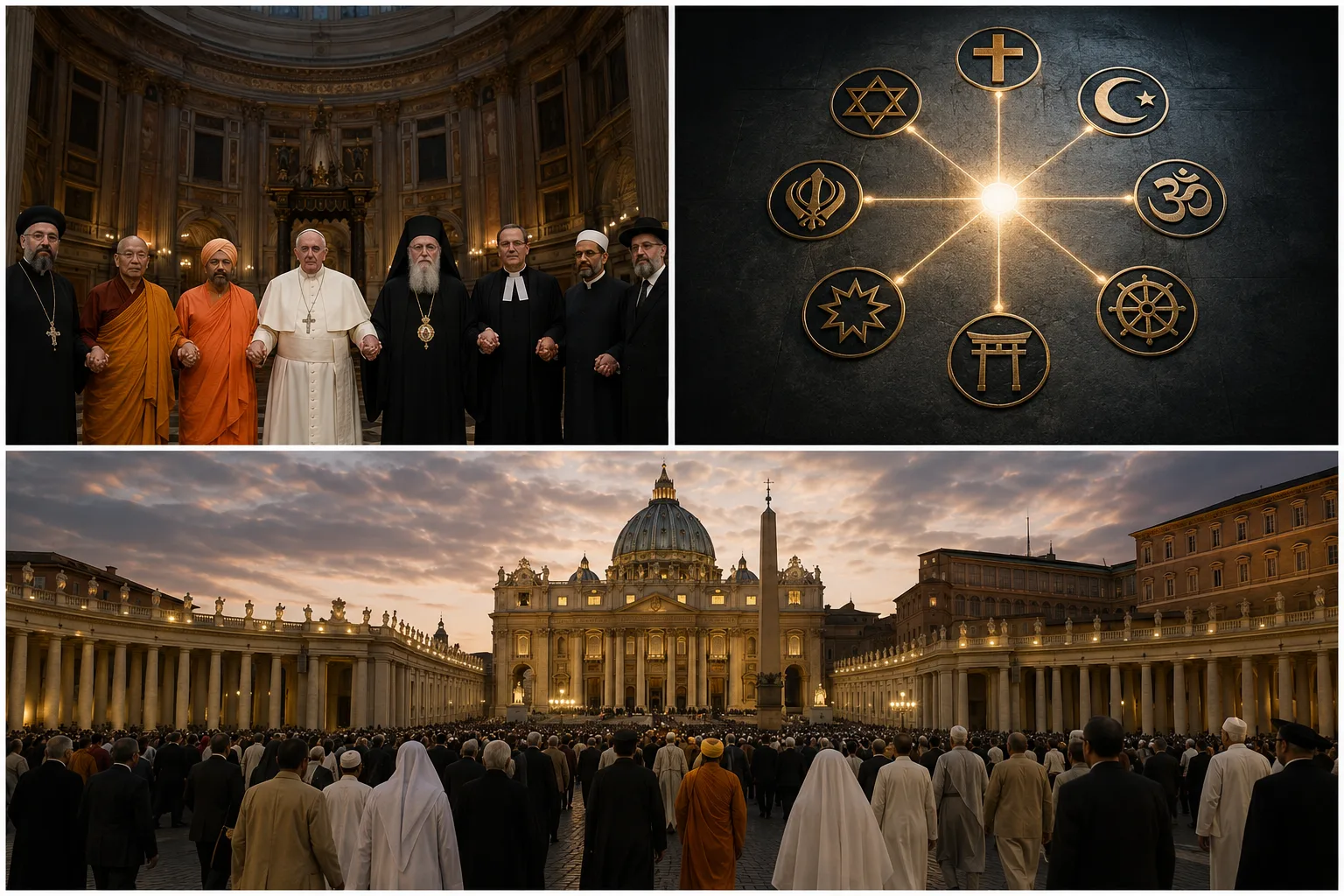
The project in one frame
The three faces of the religious one-world project — the joined hands of its leaders, the many faiths drawn to a single light, and the multitude gathered to Rome.