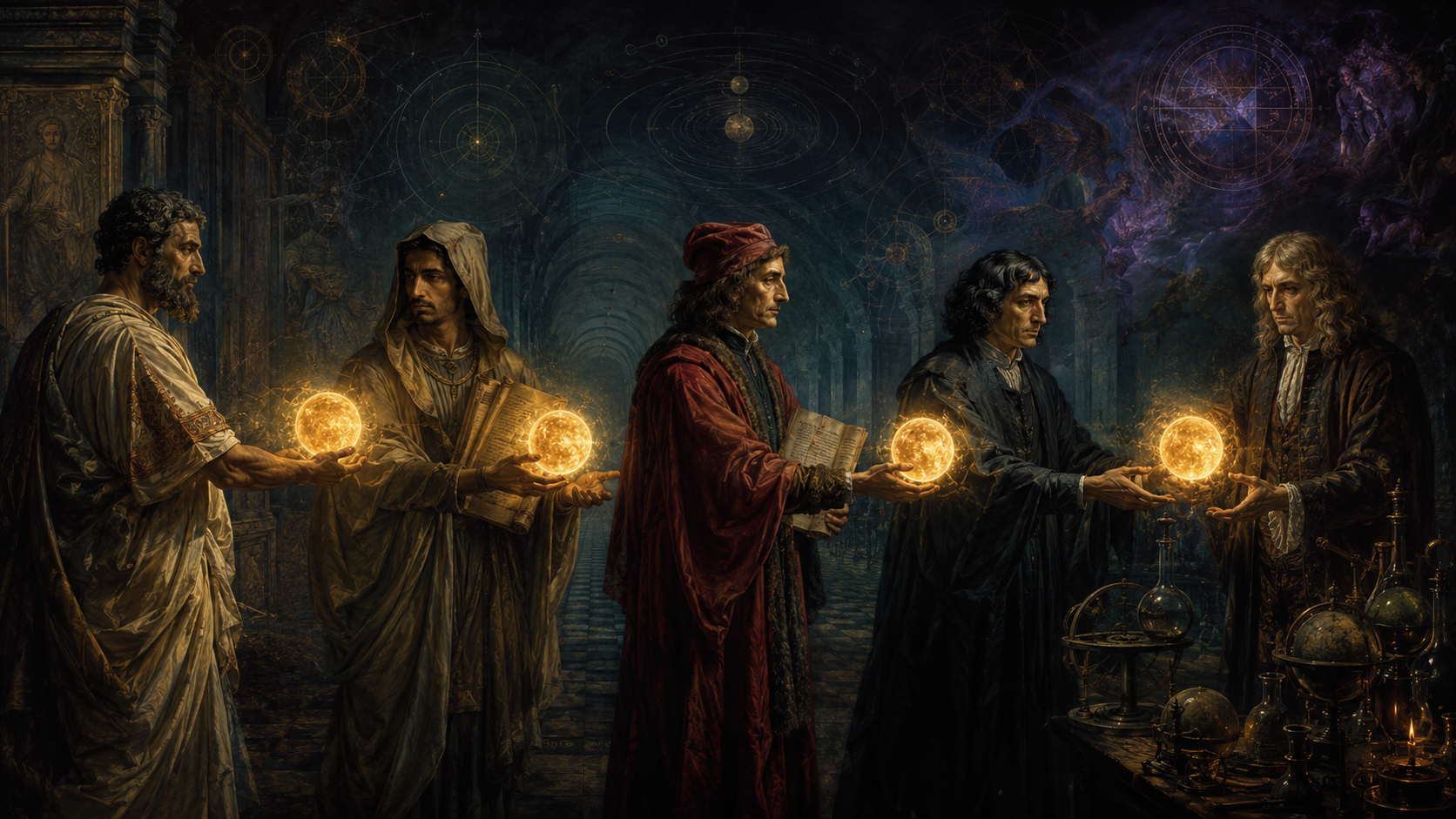
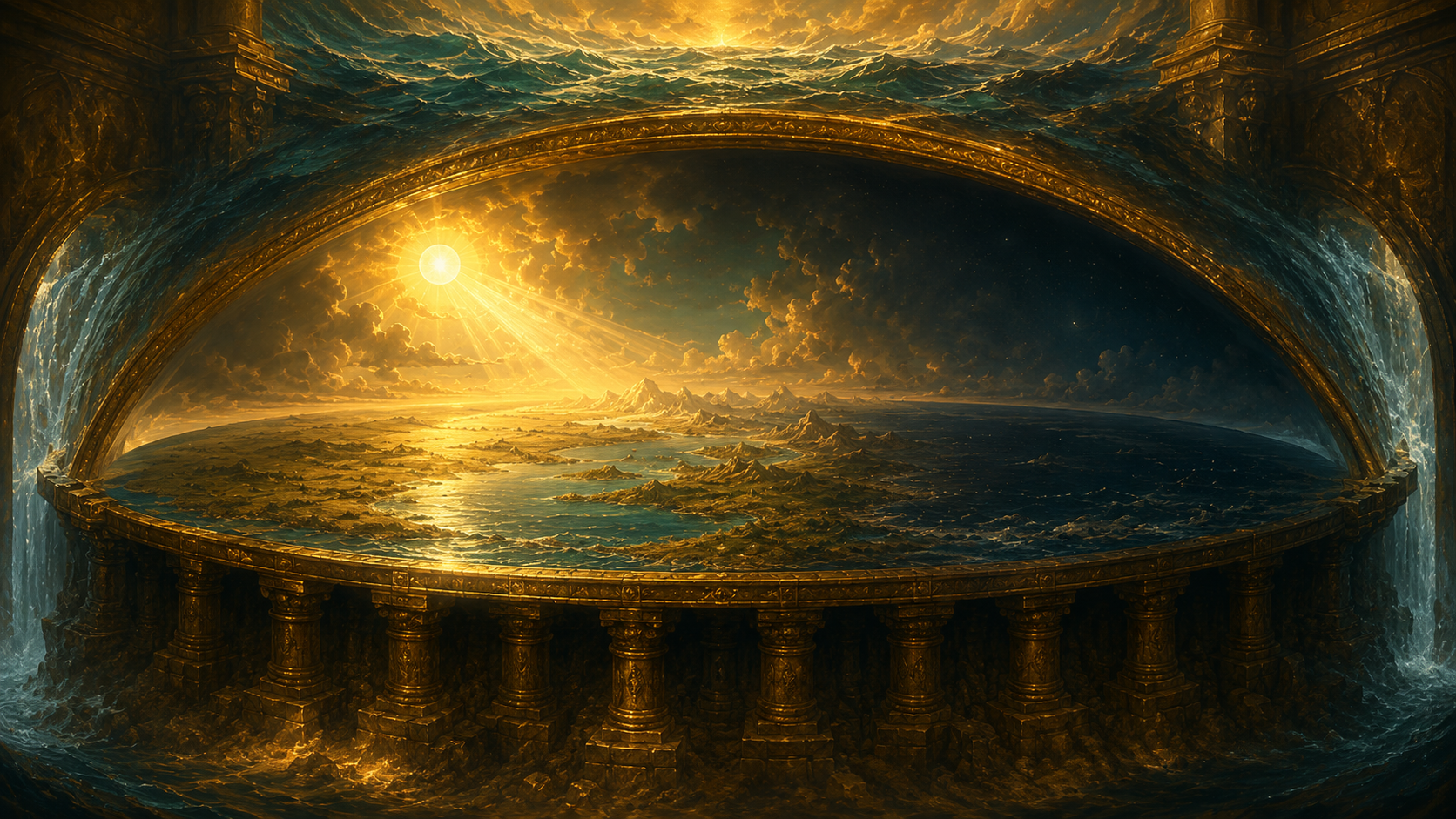
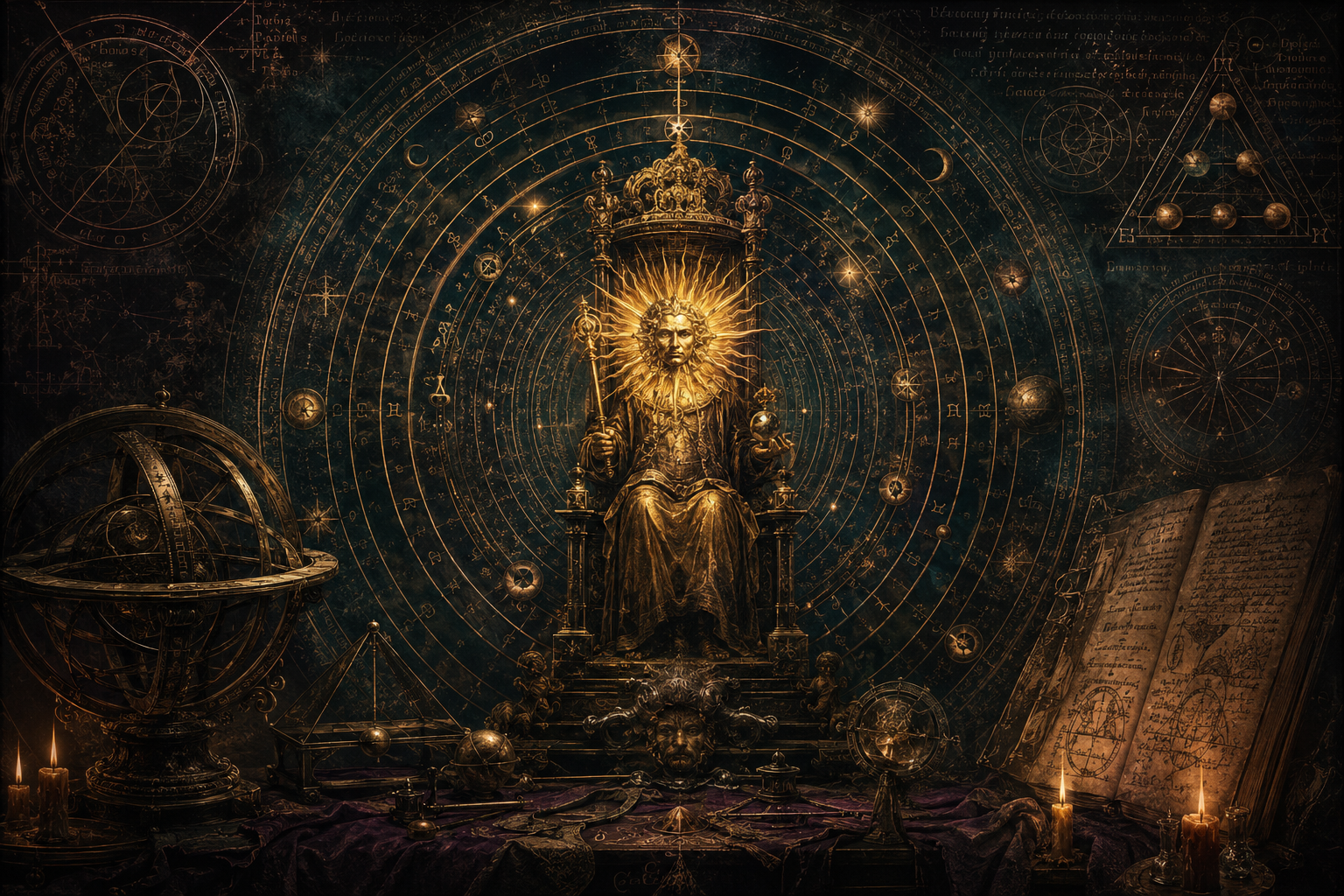
A note before you begin:If hearing a view of the shape of the earth different from the one you were raised with would genuinely trouble you or sour your mood, feel free to skip this lesson entirely. The great majority of what this course teaches stands fully on its own and remains highly relevant whether or not you take up the cosmological question — you will still gain enormous value from the rest, so do not let one lesson keep you from it.
Skip to the next studyThe cosmological model the modern world has been taught from earliest childhood is not the cosmology of Scripture. This lesson walks the biblical doctrine of the stationary enclosed plane as the Hebrew prophets, Christ, and the apostles taught it; the Hermetic- Pythagorean-Copernican origin of the modern heliocentric globe; the Reformers’ opposition to it on biblical grounds; Newton’s alchemical completion of the synthesis; the institutional monopoly state-funded space agencies hold on cosmological authority from 1957 forward; and the closing-crisis significance of the cosmological deception in preparing the world for the counterfeit Christ.
The biblical model
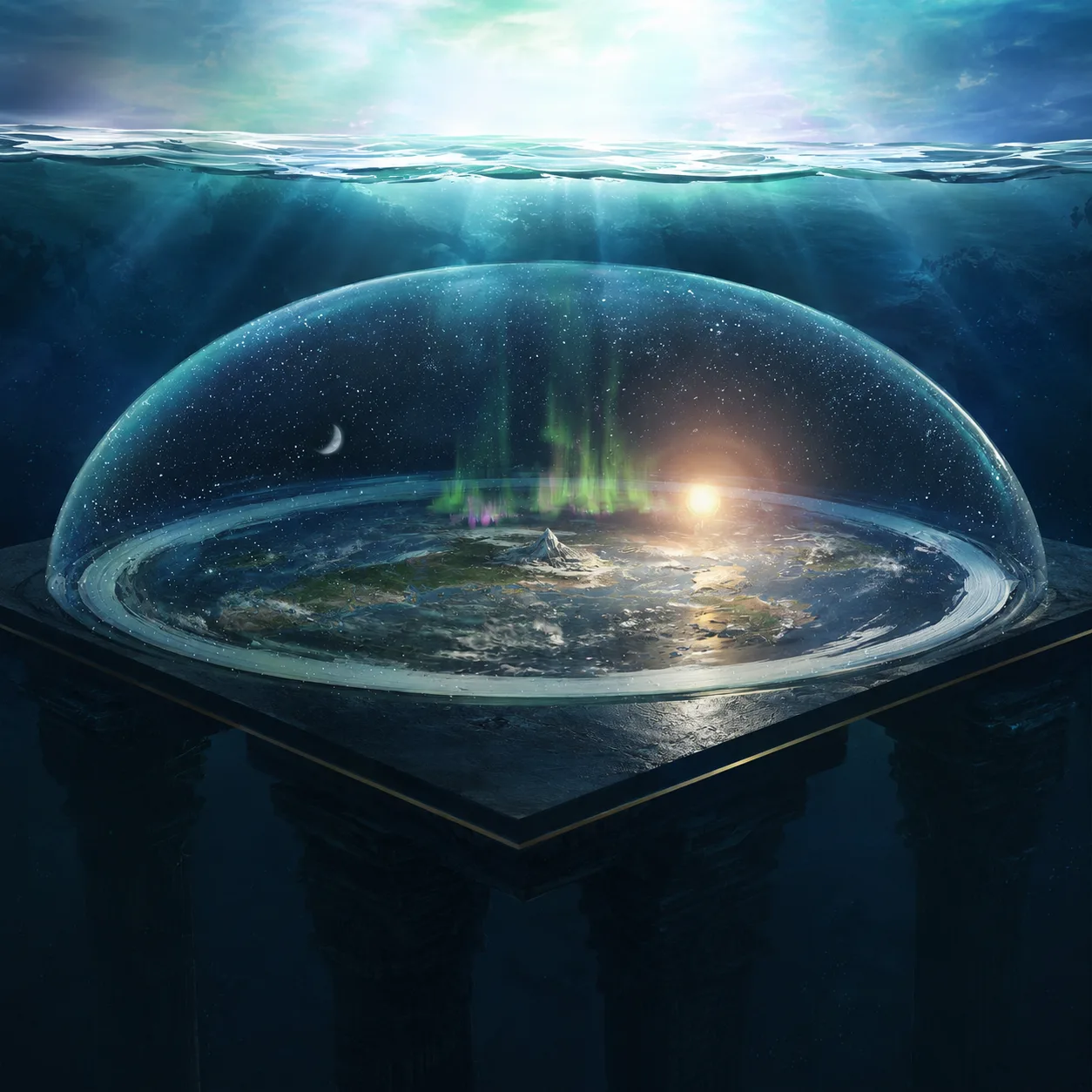
The enclosed cosmos in cross-section — a solid firmament arched over the outstretched earth, the waters above and the waters below, exactly as the Hebrew Scriptures describe it.
Lessons 1 through 4 traced the religious, institutional, secret-society, and political-economic architecture of the closing-crisis confederacy. Lesson 5 takes up the cosmological architecture — the framework through which the modern reader has been taught to picture the world itself. Per the editorial line of the institute, the TAHBRI position is the biblical position: a stationary enclosed plane under a stretched firmament, with the sun, moon, and stars moving over it as Scripture plainly describes. The willing reader who has not previously weighed the question is asked to do so on the documentary record. For the deeper biblical and observational case, the institute commends the founder’s long-form article in the Library: The Shape of the Earth, with its gospel-centred companion piece Ellen White on the Shape of the Earth. The present lesson focuses on the institutional and historical architecture of how the alternative model was inserted, and where it sits in the closing-crisis frame.
Three preliminary observations frame the lesson. First, the question is not, in the first instance, about gravity, latitude calculations, or flight routes; it is about Scripture’s own cosmological language and whether the willing reader receives it as accurate or treats it as accommodated mythology. The Reformers received it as accurate. The institute commends the same. Second, the modern heliocentric globe model has a documented genealogy: from Aristarchus of Samos in pagan antiquity through the Hermetic Corpus through the Renaissance Hermeticist revival to Copernicus’s 1543 publication under Rome’s sponsorship to Newton’s 1687 alchemically-informed gravitational synthesis. The chain is genealogically Hermetic, not biblical. Third, the question is institutionally unverifiable for the private investigator. Independent access to the regions where the question could be decisively settled is closed under treaty law. The institutional closure is itself a fact the lesson treats.
Question 01
What cosmology does Scripture itself describe?
Answer
Scripture’s cosmological language is consistent across sixty-six books, forty authors, and fifteen hundred years. Four structural features recur, and the willing reader is invited to read them off the text:
- The earth is stationary. The world also is stablished, that it cannot be moved (Ps 93:1; cf. Ps 96:10; Ps 104:5; 1 Chron 16:30; Job 9:6 of the pillars of the earth). The Hebrew is decisive: not moves slowly nor moves imperceptibly, but cannot be moved. The Reformers cited this language against Copernicus on its plain meaning.
- The earth is a circle, not a sphere. It is he that sitteth upon the circle of the earth… that stretcheth out the heavens as a curtain, and spreadeth them out as a tent to dwell in (Isa 40:22). The Hebrew word for circle is chug, a two- dimensional circle (the same root as the modern Hebrew word for a compass-drawn circle), distinct from the word for a ball or sphere (dur, used in Isa 22:18). Scripture uses the circle word, not the sphere word.
- The earth is enclosed by a firmament. And God said, Let there be a firmament in the midst of the waters, and let it divide the waters from the waters… And God called the firmament Heaven (Gen 1:6–8; cf. Job 37:18 of the firmament as a molten looking glass; Ps 19:1 of the firmament sheweth God’s handywork; Ezek 1:22–26 of the firmament with a throne above it). The Hebrew raqia means a beaten-out solid expanse, not a vacuum. Genesis 1 places it between the waters above (Gen 1:7) and the waters of the earth.
- The sun moves over the earth. The sun also ariseth, and the sun goeth down, and hasteth to his place where he arose (Eccl 1:5). His going forth is from the end of the heaven, and his circuit unto the ends of it (Ps 19:6). The decisive narrative account is Joshua 10:12–13: Sun, stand thou still upon Gibeon… And the sun stood still, and the moon stayed… So the sun stood still in the midst of heaven, and hasted not to go down about a whole day. The Reformers recognised this as the decisive text against the Copernican proposition: a moving sun is the grammatical and narrative subject of the miracle.
Read together, these features describe a stationary enclosed plane under a stretched firmament, with the sun, moon, and stars moving over it on circuits Scripture names. This is the cosmology of Genesis 1, of the Psalms, of the prophets, of the gospel narratives, and of the Revelation. The willing reader who receives Scripture as accurate on what it plainly says receives this cosmology on the same evidentiary basis on which the reader receives any other biblical doctrine.
Three further structural features round out the scriptural picture and deserve careful weighing. The willing reader will notice that each of them is completely incompatible with the modern globe-in-vacuum synthesis and is comfortably at home in the stationary enclosed-plane cosmology Scripture describes:
- The earth has foundations and pillars. Where wast thou when I laid the foundations of the earth?… Whereupon are the foundations thereof fastened? or who laid the corner stone thereof; when the morning stars sang together, and all the sons of God shouted for joy? (Job 38:4–7). He shaketh the earth out of her place, and the pillars thereof tremble (Job 9:6). The pillars of the earth are the Lord’s, and he hath set the world upon them (1 Sam 2:8). A foundation and a corner stone, a set of pillars on which the world is established — this is a building-vocabulary, not a planetary-body vocabulary. Scripture treats the earth as a constructed structure with a base.
- The earth has ends and a visible centre. Scripture refers repeatedly to the ends of the earth as a literal geographic limit (Deut 33:17; Job 28:24; Job 37:3; Ps 22:27; Ps 48:10; Ps 65:5; Ps 67:7; Ps 72:8; Ps 98:3; Prov 30:4; Isa 41:9; Isa 43:6; Jer 16:19; Mat 12:42; Acts 1:8; Acts 13:47; Rev 7:1 the four corners of the earth). In Daniel 4:11 Nebuchadnezzar sees a tree in his vision whose sight thereof reached to the end of all the earth — a vision intelligible on a flat extended plane and unintelligible on a sphere where no possible elevation grants line-of-sight to every point of the surface. In Matthew 4:8 the devil takes Christ up into an exceeding high mountain, and sheweth him all the kingdoms of the world, and the glory of them — again unintelligible on a sphere, intelligible on a plane.
- The Lord cometh and every eye shall see Him. Behold, he cometh with clouds; and every eye shall see him, and they also which pierced him: and all kindreds of the earth shall wail because of him (Rev 1:7). The second coming is described as a single global event visible simultaneously to every kindred of the earth. On the stationary enclosed plane this is intelligible: the Lord appears in the firmament above the plane, every eye on the plane sees Him. On the modern globe the event is geometrically impossible without recourse to ad-hoc multi-stage harmonisations Scripture itself does not supply.
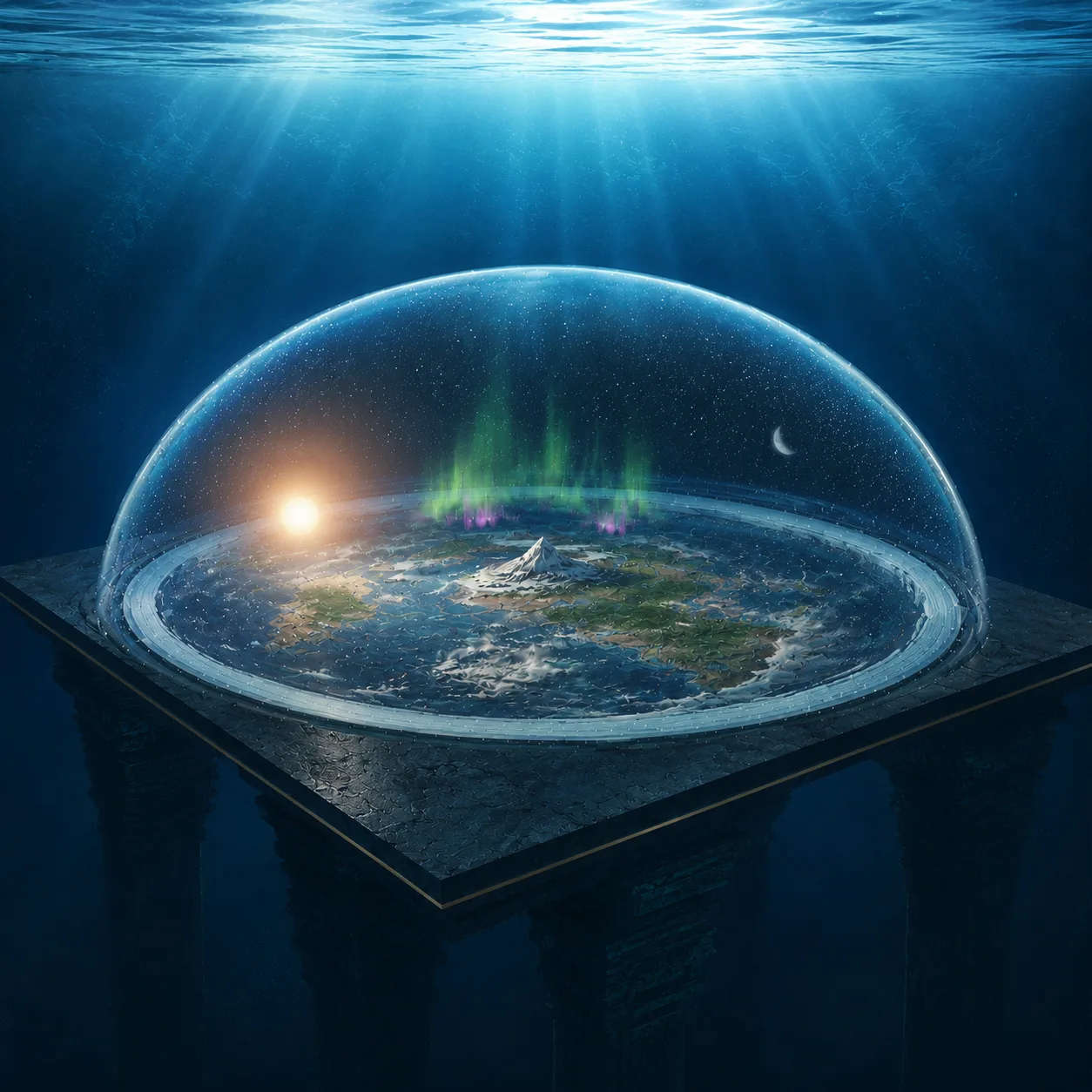
The enclosed earth
The stationary, enclosed earth under its firmament — the structure these features describe when read together rather than reinterpreted.
A short Hebrew-word note on the contrast between chug and dur in the Isaiah passages cited above will help the willing reader. The word chug (חוּג, Strong’s H2329) appears in Job 22:14 (the circuit of heaven), Job 26:10 (the boundary of light and darkness compassed upon the face of the waters), Prov 8:27 (the Lord set a compass upon the face of the depth), and Isa 40:22 (the circle of the earth). The verbal root means to draw a circle with a compass — a flat circle on a flat surface. The word for a ball or sphere is dur (דּוּר, H1754), used in Isaiah 22:18 of God’s exiling judgment (the Lord will surely violently turn and toss thee like a ball) — a three-dimensional object thrown through space. The Hebrew biblical authors had both words available and used them with precision. They consistently chose the flat-circle word for the earth.
A short Hebrew-word note on raqia (רָקִיעַ, H7549, the firmament). The verbal root raqa (H7554) means to beat out flat, as a metalsmith beats out a sheet of metal — the same verb used in Exodus 39:3 of beating out gold into thin plates and in Isaiah 40:19 and Jeremiah 10:9 of overlaying idols with beaten metal. Job 37:18 makes the connection explicit: Hast thou with him spread out the sky, which is strong, and as a molten looking glass? The firmament is described as a beaten-out solid structure with the visual properties of a polished metal mirror. This is not the modern outer-space vacuum into which the heliocentric globe rotates; it is a solid bounded enclosure of the cosmos with the waters of Genesis 1:7 above it — the heavens (plural) that Christ in Matthew 24:35 includes among the things that shall pass away.
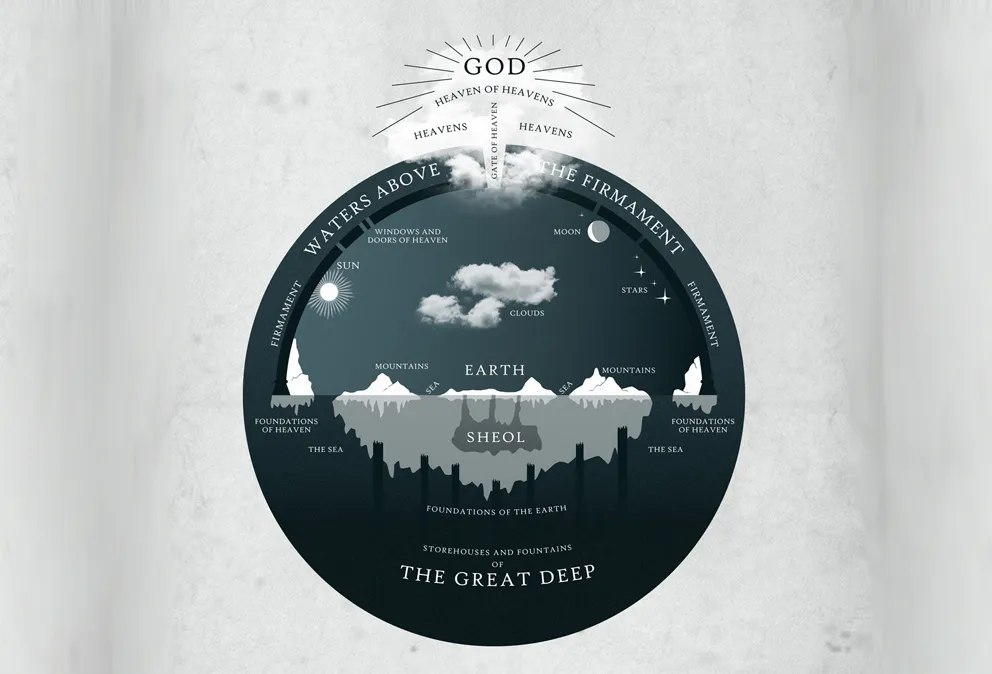
The same model, labelled
The “Ancient Hebrew Conception of the Universe,” as diagrammed in mainstream reference works — the beaten-out firmament, its pillars, and the waters above and beneath.
Question 02
What cosmology did ancient civilisations hold before Greek philosophy intervened?
Answer
The cosmological consensus of the ancient world, before the Greek philosophical revolution of the sixth century BC, was substantially uniform with the biblical picture. Every major ancient civilisation for which the cosmological documents survive held to a flat or disc- shaped earth enclosed by a solid dome or firmament under which the sun, moon, and stars travelled. The pattern is documented across:
- Sumerian and Babylonian cosmology. The Enuma Elish creation text and the cuneiform astronomical tablets describe a flat earth under a hemispherical dome of heaven (shamamu), with the gods of the firmament above and the watery deep below. The Babylonian world map (the Imago Mundi, c. 700 BC, in the British Museum) depicts the earth as a flat circular disc surrounded by an ocean.
- Egyptian cosmology. The sky-goddess Nut arches her body over a flat earth as the firmament; the sun-god Ra travels her body daily in a barge. The Book of the Dead, the Pyramid Texts, and the Egyptian temple ceilings (preserved at Dendera and elsewhere) depict the stretched-out heavens above the flat plane of the earth.
- Chinese cosmology. The classical Gai Tian (canopy heaven) model held the heavens as a hemispherical dome over a flat or slightly-domed earth. The variant Hun Tian (egg-like heaven) model emerged later under Hellenistic influence; the original Chinese cosmology was canopy-heaven.
- Hindu cosmology. The Puranic texts describe a flat circular earth (Bhumi) divided into concentric continents, with Mount Meru at the centre and a celestial dome above. Hellenistic and later Islamic influences modified portions of the Hindu astronomical literature, but the foundational Puranic cosmology is flat-earth.
- Native American cosmology. The cosmologies of the Pueblo, Iroquois, Lakota, Maya, Aztec, and Inca peoples, recorded in their pre-contact documentary and oral traditions, are uniformly flat-earth with a sky dome or firmament.
- Hebrew cosmology. Genesis 1, the Psalms, Job, Isaiah, and the historical books all reflect the same structural features: stationary, flat or disc-shaped, enclosed by a firmament, sun moving over the earth.
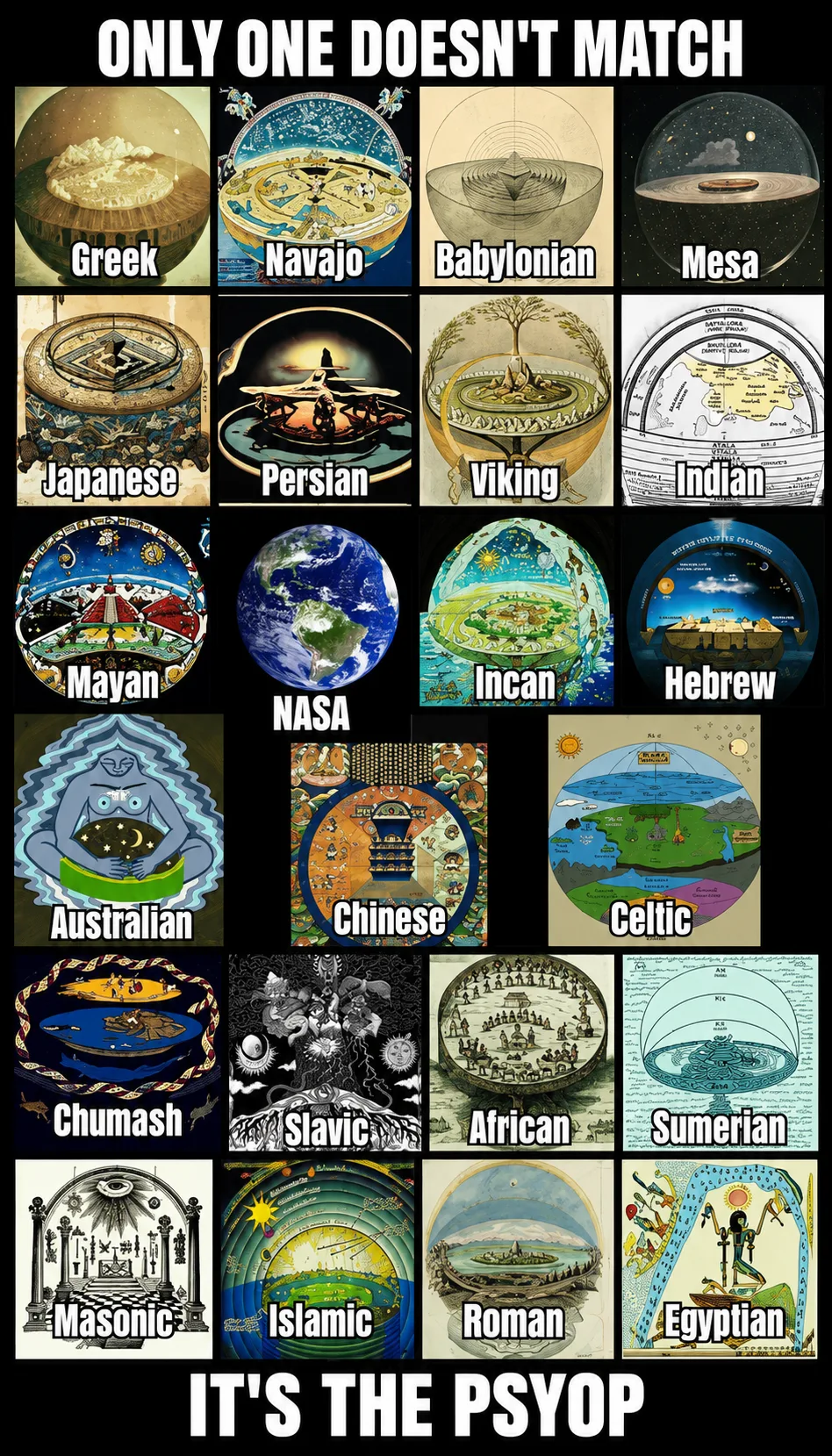
One outlier
More than twenty civilisations independently remembered an enclosed, stationary earth. Only the modern model stands apart from all of them.
Two further civilisational witnesses deserve mention for the record:
- Norse cosmology. The Prose Edda of Snorri Sturluson (c. AD 1220) and the older Poetic Edda preserve a cosmology in which the inhabited earth (Midgard) is a flat circular region surrounded by an ocean and a vast outer wilderness (Utgard), with the world-tree Yggdrasil supporting the structure and a sky-vault overhead. The northern tradition, like every other pre-Greek-influenced tradition for which records survive, did not derive a sphere from observation.
- Mesoamerican cosmology. The Mayan Popol Vuh, the Aztec codices (the Codex Borgia, the Codex Fejérváry- Mayer), and the Quiché cosmological tradition describe a flat earth at the centre of a four- directional structure under a celestial dome with an underworld below. The five world-trees of the Mesoamerican map (one at each cardinal direction and one at the centre) support the heavens. The cosmology was preserved in stone, codex, and oral tradition centuries before Spanish contact.
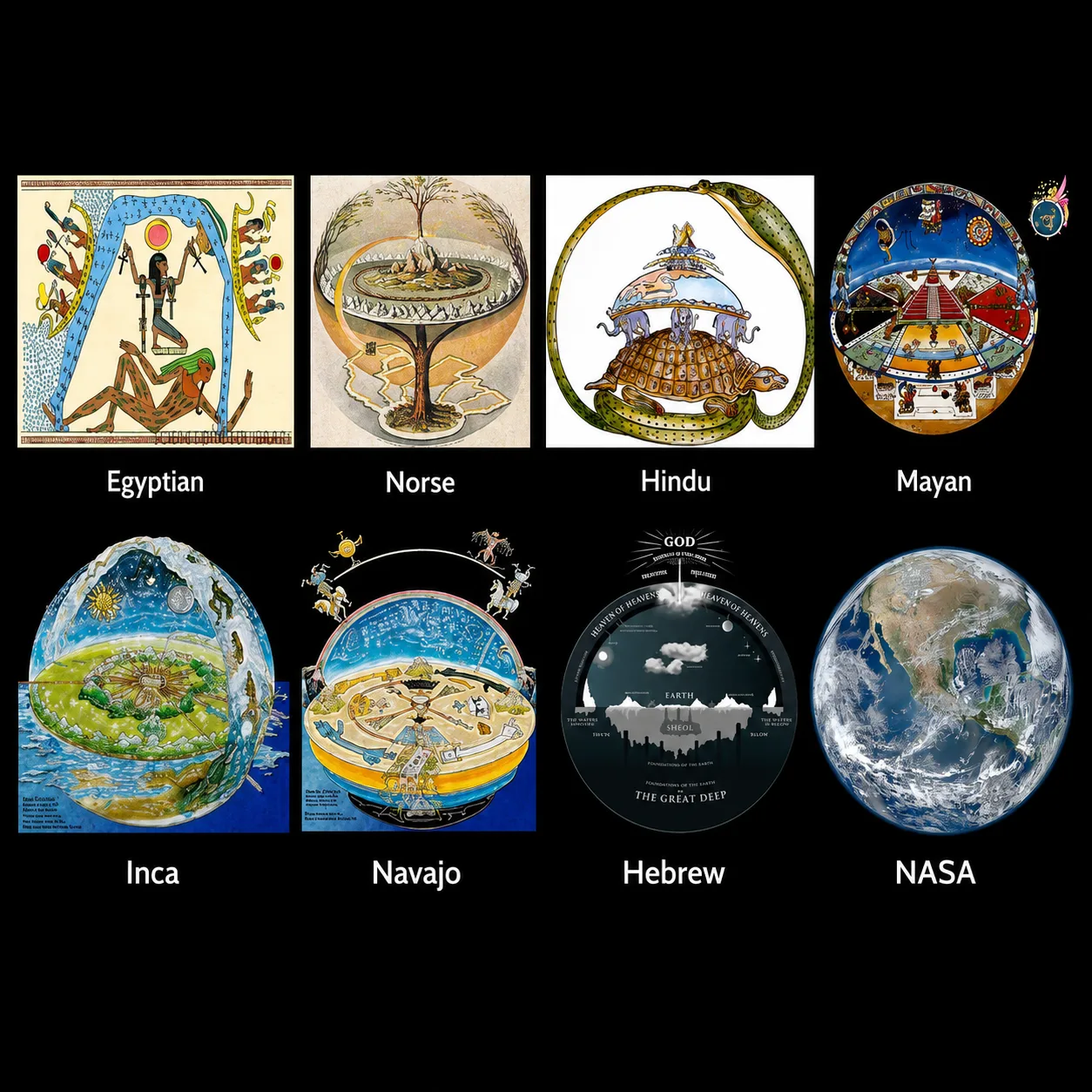
Eight cultures, one globe
Egyptian, Norse, Hindu, Mayan, Inca, Navajo, Hebrew — enclosed worlds, every one — beside the lone modern globe.
The agreement of every ancient civilisation, including those with no documented contact with each other, on a flat enclosed cosmology is a documentary fact. The modern reader, taught from infancy that the spherical earth is the natural inference of any unbiased observer, is invited to weigh the documentary evidence that no unbiased observer in any ancient civilisation drew that inference. The spherical earth emerged as a specific Greek philosophical innovation, not as a universal observation.
A brief note on the standard counter-claim that ancient cosmologies were “primitive mythology” whereas the Greek philosophical synthesis was the first attempt at “real science.” The argument assumes precisely what is in question. The Sumerian, Babylonian, Egyptian, and Chinese astronomers were sophisticated practical observers. They tracked planetary positions with precision sufficient to predict eclipses; they kept multi-century records; they oriented monumental architecture to astronomical alignments accurate to fractions of a degree. The Babylonian astronomical diaries (the BAS tablets in the British Museum) span over seven centuries of nightly observations. The Egyptian astronomical ceilings at Senenmut’s tomb (c. 1473 BC), Dendera (c. 50 BC), and elsewhere catalogue constellations with care. These were not pre-scientific primitives projecting unexamined mythology. They were skilled observers whose centuries of accumulated record nowhere prompted them to infer sphericity from data. That inference was a Greek philosophical commitment prior to data, not a conclusion derived from data.
Question 03
How did the spherical earth and the heliocentric variant emerge in Greek philosophy?
Answer
The spherical earth was first proposed in the sixth century BC by Pythagoras of Samos (c. 570–495 BC), a Greek philosopher whose school combined mathematics, music theory, and mystery-religion initiation. The Pythagoreans, deeply influenced by Egyptian and Babylonian initiatic traditions, asserted the sphericity of the earth on aesthetic-mathematical grounds — the sphere as the most perfect geometric form — rather than on empirical observation. Aristotle (384–322 BC) later supplied speculative arguments for the proposition, and Ptolemy (c. AD 100–170) in his Almagest codified the geocentric spherical model that would dominate Mediterranean astronomy through the Hellenistic, Roman, Islamic, and medieval European periods.
The heliocentric variant — with the sun, not the earth, at the centre of the spheres — was first proposed by Aristarchus of Samos (c. 310–230 BC). His proposal was rejected by his contemporaries on multiple grounds (philosophical, observational, religious) and remained a fringe pagan curiosity for the next seventeen centuries. The heliocentric idea did not die; it was preserved through a specific channel — the Hermetic literature — that would supply the Renaissance recovery.
For the Sun is situated at the centre of the cosmos, wearing it like a crown. Around the Sun are the six spheres that depend from it: the sphere of the fixed stars, the six of the planets, and the one that surrounds the Earth.
The Hermetic Corpus — a body of Greek-language philosophical-religious treatises composed in Roman Egypt in the second and third centuries AD and attributed pseudonymously to the mythical Hermes Trismegistus — preserved Aristarchus’s heliocentric proposition under a religious-occult wrapper. The Hermetic theology presented the sun explicitly as a visible god, the centre of the cosmos as the throne of divinity, and the human soul’s ascent through the planetary spheres as the path of salvation. Lesson 3 of this course walked the broader Hermetic genealogy; here it is enough to note that the heliocentric model and the sun-worship substance were not historically separable. They came bundled.
The Pythagorean substrate of Greek cosmological speculation deserves a closer look, because its commitments shaped everything that followed. Pythagoras’s school was a religious-philosophical brotherhood with explicit initiatic mysteries. Its members took oaths of secrecy and were sworn to silence on penalty of death; the legendary execution of Hippasus of Metapontum for disclosing the existence of irrational numbers (the famous √2 problem) was reported by Iamblichus and other ancient sources. The school’s cosmological doctrines were derived not from observation but from a metaphysical commitment to mathematical perfection. Number was the substance of reality. The sphere was the perfect geometric form. The heavens therefore must be spherical — not because observation demonstrated it, but because the perfection of the divine required it. The Pythagoreans named the ten celestial bodies by aesthetic and numerological necessity (ten being the perfect number, expressed in the tetractys) and proposed a “central fire” cosmology in which the earth orbited a non-solar central flame, balanced by an imaginary “counter-earth” (Antichthon) added to the scheme so that the count would reach ten. The willing reader is invited to weigh this: at the foundation of Western philosophical cosmology stands a religious brotherhood whose model required an invented invisible body to satisfy numerological perfection.
Plato (c. 428–348 BC), the founder of the Athenian Academy, inherited the Pythagorean commitment to mathematical-mystical perfection and built it into his cosmological treatise Timaeus. Plato’s creation account presented a Demiurge fashioning the world-soul through geometric proportion, with the sphere as the form of divine perfection. Aristotle’s arguments built on Plato’s metaphysics; Ptolemy’s codification of the geocentric spheres built on Aristotle’s. The entire Greek philosophical edifice rests on the prior Pythagorean commitment to sphericity-as-divinity. The Greeks did not derive a sphere from the data; they imposed a sphere on the data.
On the Hermetic Corpus itself: the documentary record is clear. The Greek-language treatises now collected as the Corpus Hermeticum were composed in Hellenistic and Roman Egypt by anonymous authors writing pseudonymously under the name of Hermes Trismegistus (“Thrice-Greatest Hermes”), a Greco-Egyptian syncretic deity combining the Greek Hermes with the Egyptian Thoth. Eighteen treatises survive in the principal Corpus, with additional related material (the Asclepius, the Hermetic fragments preserved by Stobaeus, the Nag Hammadi Hermetic codices recovered in 1945). The treatises blend Egyptian theology, Greek philosophical cosmology, magical theurgy, and astrological salvation-mysticism into a coherent religious system whose central claim is that the human soul ascends through the celestial spheres back to the divine source by initiatic gnosis. Heliocentric cosmology, sun-worship, and salvation by ascent through the planetary spheres are woven together throughout the Corpus as a single religious package. The willing reader is asked to weigh this when the heliocentric model is presented in subsequent centuries as religiously neutral.
Question 04
How did Renaissance Hermeticism revive heliocentrism — and what was Rome’s role?
Answer
The Hermetic Corpus reached the West in 1460 when a Macedonian monk delivered a Greek manuscript to the court of Cosimo de’ Medici in Florence. Cosimo, in his final illness, ordered his court philosopher Marsilio Ficino to set aside an in-progress Plato translation and complete the Hermetic translation first — an unusual priority, reflecting the contemporary belief that Hermes Trismegistus was a contemporary of Moses preserving an even more ancient divine wisdom. Ficino’s Latin translation, published in 1471 as the Pimander, ran to twenty-four editions in the sixteenth century and became foundational reading for the Renaissance humanist project (Lesson 3 walked the chain in detail).
It is from this Hermetic ferment that Copernican heliocentrism emerged seventy years later. Nicolaus Copernicus (1473–1543) was a Catholic cleric and canon of Frombork Cathedral in Polish Prussia. His De Revolutionibus Orbium Coelestium(On the Revolutions of the Heavenly Spheres), published at Nuremberg in 1543 in the year of his death, set out the modern heliocentric proposition in mathematical form. Two features of the publication deserve particular attention:
In the middle of all sits Sun enthroned. In this most beautiful temple could we place this luminary in any better position from which he can illuminate the whole at once? He is rightly called the Lamp, the Mind, the Ruler of the Universe; Hermes Trismegistus names him the Visible God… So the Sun sits as upon a royal throne ruling his children the planets which circle round him.
Copernicus cites Hermes Trismegistus by name as authority for the proposition. The heliocentric model is not advanced on independent observational grounds; it is advanced as a recovery of Hermetic ancient wisdom with the sun as the Visible God. The Hermetic sun-worship substance is on the page in the founding document of modern heliocentrism.
The second feature is the publication’s institutional sponsorship. De Revolutionibus opens with a prefatory letter from Cardinal Nikolaus von Schönberg of Capua, dated 1 November 1536, urging Copernicus to publish his work and offering to bear the costs:
Some years ago word reached me concerning your proficiency, of which everybody constantly spoke… Therefore, learned man, without wishing to be inopportune, I beg you most emphatically to communicate this discovery of yours to scholars, and at the earliest possible moment to send me your writings on the sphere of the universe together with the tables and whatever else you have that is relevant to this subject.
Three years earlier, in 1533, the papal secretary Johann Albrecht Widmannstetter had delivered a lecture on the Copernican theory before Pope Clement VII and his cardinals in the Vatican gardens. The Pope was sufficiently impressed to reward Widmannstetter with a valuable Greek manuscript. The heliocentric proposition was therefore not, at its publication, a Protestant scientific challenge to Catholic authority; it was a Roman-sponsored proposition, advanced by a Catholic cleric, dedicated to a Catholic pope, opened by a Catholic cardinal’s letter, citing a pagan Hermetic authority for the sun’s centrality. The Counter-Reformation context of Lesson 2 supplies the political setting: the heliocentric theory entered the world in the same generation as the Society of Jesus (founded 1540), and from the same Roman ecclesiastical environment.
The strategic logic of Rome’s sponsorship of the new cosmology is on the documentary record, in the words of one of her own architects. Cardinal Thomas Wolsey, advising Pope Clement VII on how to respond to the spread of Tyndale’s English Bible and the broader vernacular-Scripture movement, set out the Counter-Reformation’s editorial policy in a sentence often cited and worth quoting in full:
Since printing cannot be put down, it is best to set up learning against learning, and by introducing all persons to dispute, to suspend the laity between fear and controversy. This at most will make them attentive to their superiors and teachers.
The objective on the documentary record is not to refute the Bible directly — that had been tried and had failed — but to surround it with competing learning until its singular authority was lost in the din. The Copernican proposition, advanced through the same ecclesiastical channels in the same decades, functions precisely as Wolsey’s strategy required: a competing learning that suspended the willing reader between fear of error and controversy among authorities, making him attentive to whichever superior he chose to trust. The willing reader is invited to read the sponsorship of De Revolutionibus as Wolsey himself would have read it.
Johannes Kepler’s own self-description of his cosmological project, in his 1619 Harmonices Mundi (The Harmony of the World), is on the same page. He wrote of his cosmological endeavour that he was “stealing the golden vessels of the Egyptians to build a tabernacle to my God from them” — a self-description as unambiguous a confession of Hermetic-Pythagorean-pagan sourcing as the documentary record contains. The founders of the new cosmology were not merely influenced by Hermetic religion; they understood themselves to be drawing on it deliberately and named the source openly. The willing reader is invited to weigh this confession in its own terms.
The well-known Galileo affair of 1616–33 is often cited as evidence that Rome opposed Copernicanism, but the documentary record is more nuanced and the willing reader should weigh it carefully. The Vatican’s eventual placement of De Revolutionibus on the Index of Forbidden Books in 1616 was a tactical manoeuvre during the Counter-Reformation, in the context of the broader Tridentine push to reassert Roman doctrinal supremacy. Copernicus’s book had been openly tolerated and even promoted within the ecclesiastical establishment for seventy-three years before its placement on the Index, and the Index entry itself was a request for minor corrections rather than an outright prohibition. Galileo’s 1633 trial was as much about his personal defiance of cardinals he had previously been on cordial terms with as it was about the model itself. The formal verdict was not guilty of heresy but guilty of vehement suspicion of heresy — an intermediate canonical category. Brother Guy Consolmagno, the current Jesuit director of the Vatican Observatory, has been remarkably candid on the documentary record about the affair, stating publicly that nobody really knows why Galileo was prosecuted, that the trial “is not what you think it is,” and that the proceedings occurred at the height of the Reformation and the Thirty Years’ War. The Vatican’s own current astronomer concedes the conventional Galileo narrative is not the actual history. By the mid-eighteenth century the Index entry had been quietly withdrawn; by the nineteenth century Catholic education was teaching the Copernican-Newtonian synthesis as fact. The Roman rejection of Copernicanism was temporary and political; the genealogical sponsorship of Copernicanism by Rome was constitutive and went back to the source.
The historian Andrew Dickson White, a hostile witness whose A History of the Warfare of Science with Theology in Christendom (Appleton, 1896) is normally cited in defence of the secular-progress reading of the cosmological transition, nevertheless concedes on the documentary record that the older theological conception of the cosmos — a fixed earth, a stretched-out firmament, an enthroned Creator above — remained intact across all of Christendom until the work of Copernicus, Kepler, Galileo, Descartes, and Newton displaced it. The unanimity is conceded even by the hostile witness. What is in dispute is whether the displacement constituted progress from error to truth or regression from biblical Scripture to recovered Hermeticism.
Between Copernicus and Newton, three further figures moved the model from a mathematical proposal toward the institutional default of Western thought. Each carried substantial occult or Hermetic baggage on the documentary record:
- Giordano Bruno (1548–1600), a Dominican friar turned itinerant Hermetic philosopher, advanced an explicitly religious cosmology of an infinite universe with innumerable inhabited worlds, an ensouled sun, and human ascent to the divine through Hermetic gnosis. Frances Yates’s landmark scholarly study Giordano Bruno and the Hermetic Tradition (Routledge, 1964) established on primary-source evidence that Bruno’s commitment to heliocentrism was inseparable from his commitment to the Hermetic religion. Bruno was burned at the stake by the Roman Inquisition in 1600 not for cosmology per se but for his open rejection of Trinitarian Christology, his denial of the sacraments, and his Hermetic religious system; his heliocentrism was bundled with the package. The modern reception of Bruno as a martyr of science is historically inaccurate; he was a martyr of Hermetic religion who happened to hold a heliocentric cosmology because his religion required it.
- Tycho Brahe (1546–1601), the Danish astronomer who compiled the most accurate naked-eye observations of the planetary positions ever made, rejected Copernicus’s heliocentric model on observational and biblical grounds. He proposed instead the Tychonic system: a geocentric earth around which the sun and moon revolved, with the other planets revolving around the sun. The Tychonic system was mathematically equivalent to the Copernican on the observational record then available and was preferred by the Jesuit astronomers in the late sixteenth and seventeenth centuries. Brahe died in 1601 under disputed circumstances; modern forensic analysis of his exhumed remains in 1901 and again in 2010 has detected significant levels of mercury, with debate continuing as to whether the cause was accidental alchemical exposure or deliberate poisoning. He had been openly opposed to the Copernican project.
- Johannes Kepler (1571–1630), Brahe’s assistant and successor, was a working astrologer who personally cast horoscopes for noble patrons, and a Hermetic- Pythagorean mystic who believed the planetary distances were divinely ordained according to the geometric ratios of the five Platonic solids. His published Mysterium Cosmographicum (1596) sets out the geometric-mystical case explicitly. Kepler’s three laws of planetary motion (formulated 1609–19) supplied the mathematical refinement Copernicus’s circular- orbit model lacked, and they did so on the basis of Brahe’s painstakingly assembled observations. Kepler held the heliocentric arrangement to be theologically necessary on Hermetic-Pythagorean grounds before he derived its mathematical form on Brahe’s data.
The cumulative documentary record from Copernicus through Kepler is unmistakable. Every major figure in the Renaissance-and-early-modern installation of the heliocentric cosmology held, in his own writings, an explicit religious commitment to the sun-as-divine, an explicit involvement in Hermetic-magical-alchemical practice, or both. The architecture is not religiously neutral.
Question 05
Why did the Protestant Reformers oppose Copernicus?
Answer
The Reformers, having recovered the Scripture as the supreme authority over tradition (Lesson 2), recognised the Copernican proposition as the substitution of a Hermetic philosophical claim for Scripture’s plain cosmological language. Their opposition was on the same hermeneutic principle that drove their rejection of Rome’s other unbiblical claims: Scripture as supreme authority, plain reading, no accommodation to pagan philosophy.
There was mention of a certain new astrologer who wanted to prove that the earth moves and not the sky, the sun, and the moon. This would be as if somebody were riding on a cart or in a ship and imagined that he was standing still while the earth and the trees were moving. So it goes now. Whoever wants to be clever must agree with nothing that others esteem. He must do something of his own. This is what that fellow does who wishes to turn the whole of astronomy upside down. Even in these things that are thrown into disorder I believe the Holy Scriptures, for Joshua commanded the sun to stand still and not the earth.
Luther’s objection was hermeneutic, not anti-scientific. Joshua 10:12–13 narrates a stationary sun as the miracle; the sun’s motion is the grammatical and narrative subject of the suspension. Luther held that the willing reader of Scripture receives Joshua’s narrative on its plain terms. Subsequent Reformers, on the same hermeneutic grounds, declined the Copernican proposition through the sixteenth and seventeenth centuries. The 1611 King James Version translators, completing their work sixty-eight years after Copernicus’s publication, rendered every cosmological passage in Scripture in geocentric stationary-earth language without amendment — Joshua 10, Ecclesiastes 1:5, Psalm 19:4–6, Psalm 93:1, Psalm 104:5, 1 Chronicles 16:30, Isaiah 40:22 all in the unaltered biblical terms. The KJV reads natively on the biblical cosmology because the translators themselves held it.
Luther was not alone among the Reformers in opposing the Copernican proposition on biblical grounds. Philip Melanchthon (1497–1560), Luther’s closest theological collaborator and the principal author of the Augsburg Confession, addressed the question directly in his Initia Doctrinae Physicae (Wittenberg, 1549). Melanchthon noted the Copernican proposition and rejected it explicitly on the ground that Ecclesiastes 1:5, Psalm 19, and Joshua 10 set forth a moving sun and a stationary earth as Scripture’s plain teaching, and that a wise civil magistrate should restrain teachers who advanced contrary doctrine as a matter of public-order necessity. Melanchthon’s engagement with the question was at the highest intellectual level of the Reformation and was not made on the basis of personal ignorance of the mathematical case; he had read Copernicus carefully and weighed the astronomical arguments. He rejected the conclusion on Scripture-supreme grounds.
John Calvin’s Genesis commentary (1554) likewise held to the stationary geocentric reading of Scripture on Genesis 1, Joshua 10, and the Psalmic cosmology, on the same hermeneutic principle of receiving Scripture’s plain meaning. Calvin’s famous “who will venture to place the authority of Copernicus above the Holy Spirit” quotation is widely circulated but disputed by Calvin scholars on provenance grounds, and the institute does not press the quotation here. What is not disputed is that Calvin’s actual published cosmological readings of Scripture, in his Genesis and Psalms commentaries, consistently presuppose the stationary geocentric cosmology of the biblical authors. The Reformation cosmological mind, in Luther, Melanchthon, and Calvin, was uniform on this question, and uniform on the underlying hermeneutic of Scripture-supreme authority that produced the answer.
The seventeenth-century Westminster Assembly (1643–52), which produced the Westminster Confession of Faith, the Larger and Shorter Catechisms, and the Directory for Public Worship, met in the years when Copernicanism was making its first sustained Protestant inroads. The Confession’s creation chapter (IV.1) follows Genesis 1 in its plain order without amendment in the light of the new astronomy. The Westminster Divines were not unaware of the Copernican proposition; they chose to remain with the scriptural cosmological language in their public confessional documents. The same is true of the Belgic Confession, the Heidelberg Catechism, the Thirty-Nine Articles, and the Baptist Confession of 1689: every major Protestant confessional document of the sixteenth and seventeenth centuries was written on the assumption that the biblical cosmological language was accurate and binding. The modern Protestant accommodation to heliocentrism is confessionally innovative, not confessionally traditional.
Two pieces of documentary translation evidence are worth recording at this point in the narrative, as they capture the cosmological commitments of the period more economically than any further argument. The first is the Matthews Bible of 1537 — compiled by John Rogers under the pseudonym “Thomas Matthew” and drawing heavily on William Tyndale’s translation work. At 2 Samuel 11:11 the Matthews Bible renders the relevant phrase as “vpon the flat earthe.” The phrase rests on the same Hebrew text the later King James translators (1611) rendered as “in the open fields.” The Reformation-era English translators evidently read the Hebrew as describing a flat surface; the seventeenth- century KJV translators, working in the generation when the new cosmology was beginning to spread through the universities, chose a phrase that left the geometry open. The shift between the two English translations is not in the Hebrew text; it is in the cosmological commitments of the translators.
The second piece is more striking. The Jesuit-produced Douay-Rheims Bible (New Testament 1582, complete Bible 1610), commissioned as Rome’s English-language counter-Reformation response to the Tyndale-derived Protestant translations, contains a remarkable rendering at Isaiah 40:22. The Hebrew word chug — the flat-circle word that every English Protestant Bible before and after the Douay- Rheims renders as “circle”— is rendered in the Douay-Rheims as “globe.” No English Bible before the Douay-Rheims uses the spherical word for this verse; not even the Latin Vulgate from which the Douay- Rheims was translated supports the spherical reading. The choice is documentary evidence that by the early seventeenth century, a globular earth was authorised Roman Catholic doctrine and was being inserted into the biblical text itself by Catholic translators precisely on the verse the Protestant translators were still rendering on the flat-circle reading. The willing reader is invited to weigh this: the Hermetic-Copernican cosmology was sufficiently established in Roman doctrinal circles by 1610 that a Catholic Bible translation team altered the English rendering of Isaiah 40:22 to bring it into line with the new model Rome had sponsored.
A separate documentary point bears on the Protestant side of the picture as Counter-Reformation pressure continued to apply. Ignatius Loyola’s Spiritual Exercises, the foundational training manual of the Society of Jesus (Lesson 2 of this course), sets out at Section 365 (Rule 13) the principle of Jesuit submission of intellect to Roman authority in language whose cosmological implications the willing reader will recognise:
What seems to me white, I will believe black if the hierarchical Church so defines.
The principle is intellectual submission of the ordinary perception of the senses to the prior authority of the institutional church. The willing reader sees the cosmological application immediately: if the ordinary perception of the senses is a stationary earth and a moving sun, but the hierarchical church (in its post-1530s sponsorship of the new astronomy) defines the model otherwise, the trained Jesuit intellect is to submit. The principle is the operative one across the entire arc of the Counter- Reformation educational project (the Jesuit Ratio Studiorum, 1599), which placed the new cosmological model at the heart of the curriculum and eventually shaped the broader Western university model that institutionalised it.
The shift in Protestant cosmological consensus — from the Reformers’ geocentric stationary earth to the modern Protestant church’s acceptance of Copernican heliocentrism — did not occur on the basis of new biblical evidence. It occurred on the basis of cultural pressure as the heliocentric model was institutionalised through state-funded education across the eighteenth and nineteenth centuries. The Reformation hermeneutic on Scripture’s authority was retained verbally but surrendered in practice on the cosmological question. The historical mechanism was not a single decisive theological capitulation but a slow drift: as compulsory state schooling spread across Protestant Europe (the Prussian model from 1717, Britain from 1880, the United States from the mid-nineteenth century), the next generation of Protestant pastors and theologians arrived at seminary having been taught the Copernican-Newtonian synthesis as established fact from childhood. Theology adjusted to the new cosmological commitments rather than the cosmology adjusting to the theology. The willing reader is invited to weigh whether this drift represents the apostolic principle of Scripture-supreme authority or its slow surrender. The TAHBRI position holds the Reformation hermeneutic on this question as on every other.
One Adventist-historical detail rounds out this section. Alexander Gleason of Buffalo, New York — a Seventh-day Adventist who helped establish a local Adventist congregation in 1889 — drafted Gleason’s New Standard Map of the World in 1892 and was granted US Patent 497,917 on its azimuthal projection in 1893. The map renders the earth as a flat circular plane with the North Pole at the centre and the southern circumferential ring at the outer edge. The historian Robert Schadewald later characterised Gleason as “the most important Seventh-day Adventist flat-earther” in the United States. Gleason’s map is, in plain terms, a pioneer-era Adventist’s rendering of the very same azimuthal projection on which modern southern- hemisphere flight routes resolve into straight lines, which the US Geological Survey still uses as its preferred polar projection, and which (in slightly stylised form) appears on the flag of the United Nations. The same azimuthal-equidistant projection — framed by the UN’s signature olive-branch wreath — also appears on the official emblems of multiple specialised UN agencies: the World Health Organization (with the Rod of Asclepius overlaid), the World Meteorological Organization, the International Civil Aviation Organization, and the International Maritime Organization. The map the modern world insists no informed person could take seriously as a depiction of the earth is, in fact, the map most of its globe-managing institutions choose to put on their own letterheads. The institute records the Gleason map as a documentary feature of the TAHBRI Adventist inheritance: a pioneer of the very tradition this institute is meant to recover drafted the flat-earth map of the world the rest of the world is still looking at.
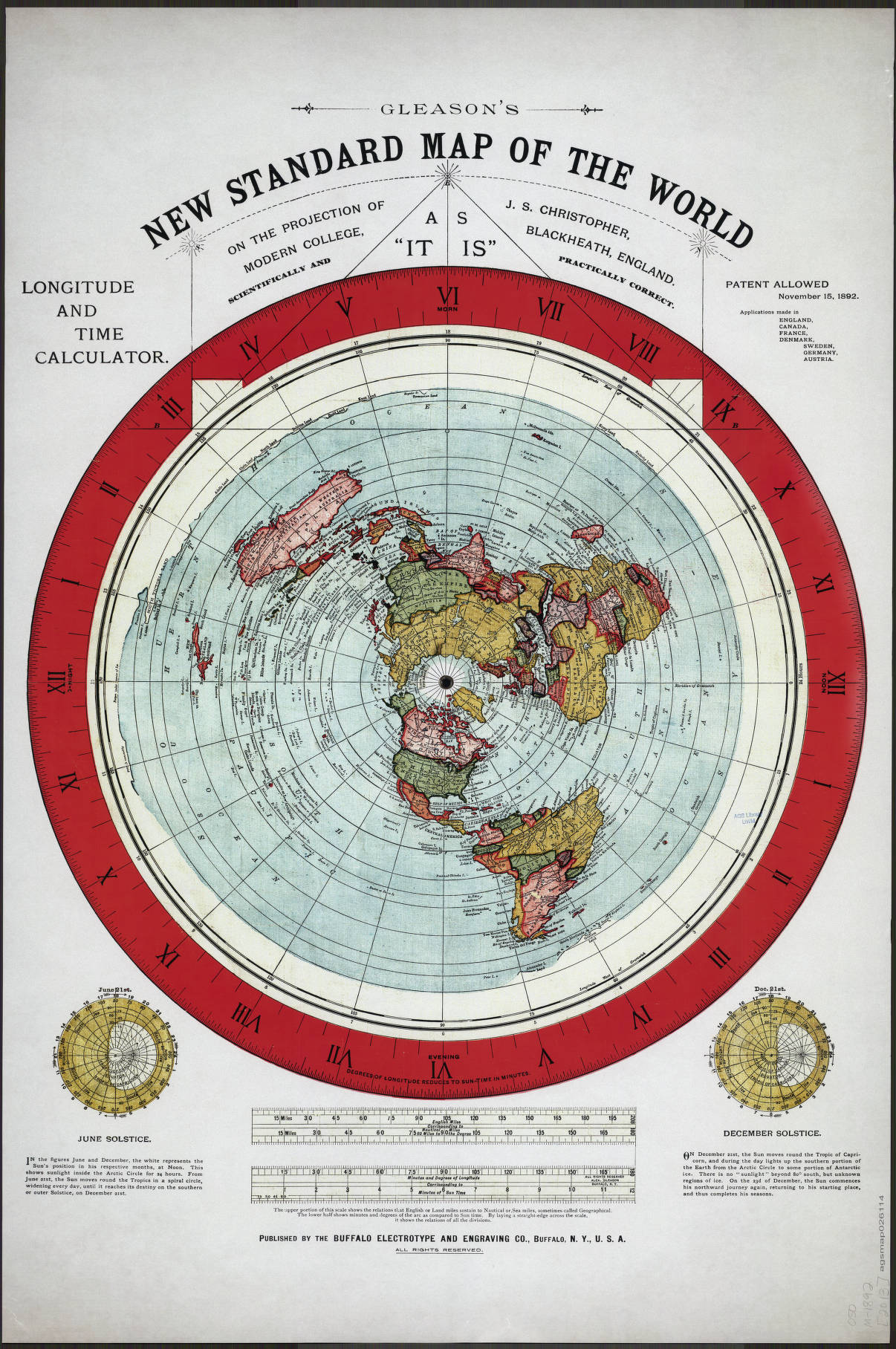
Gleason’s map · 1892
Drafted by a Seventh-day Adventist; the azimuthal projection it uses is the same one embedded in the United Nations and World Health Organisation emblems.
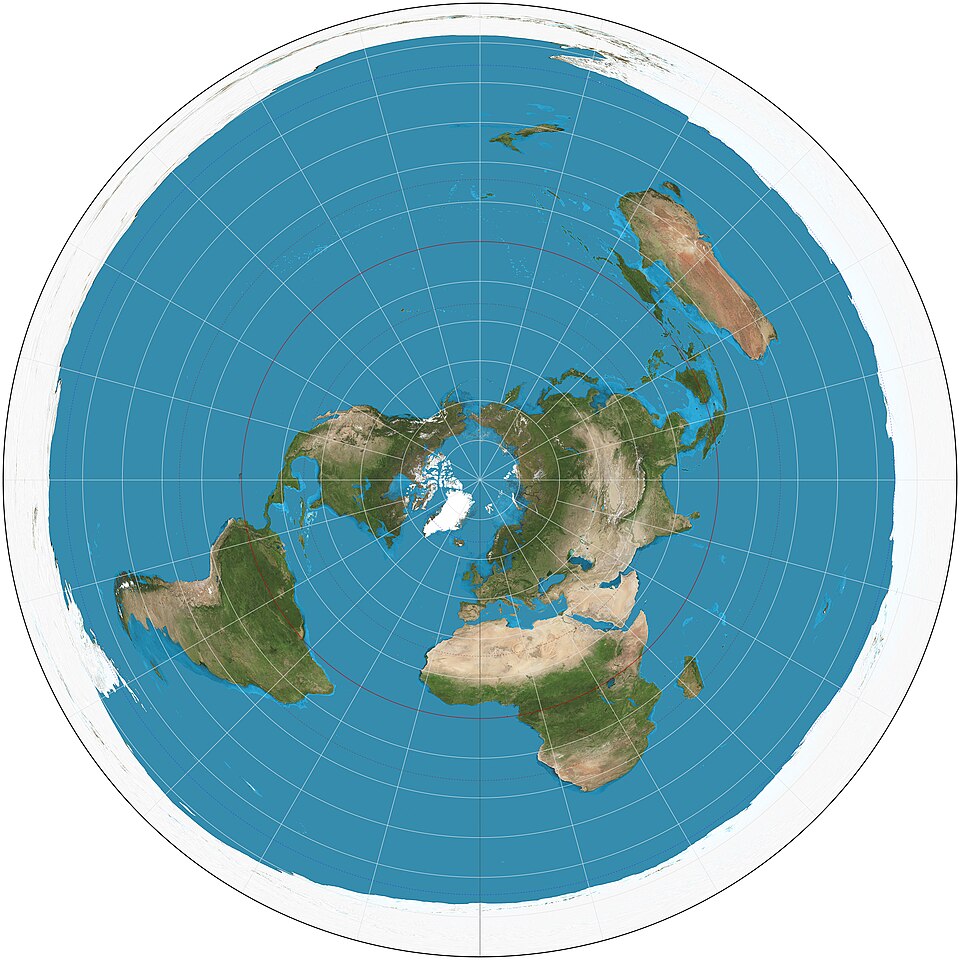
Routes that straighten
Major southern routes overlaid: Sydney → LAX → Santiago, Johannesburg → London → São Paulo, Santiago → Dakar → Johannesburg. Each forms a near-straight line on this projection. On a globe they read as deeply illogical detours through the northern hemisphere.
Question 06
Who was Isaac Newton — and what did his alchemy reveal about the synthesis?
Answer
The completion of the heliocentric model into the mathematical synthesis the modern world inherits came with Isaac Newton (1643–1727). Newton’s Philosophiae Naturalis Principia Mathematica (Cambridge, 1687) supplied the gravitational mathematics that bound the Copernican heliocentric arrangement into a coherent system — or appeared to. Newton, more than any other single figure, is credited with establishing the modern globe model as the cosmological default of Western education. What is less commonly known about Newton is the underlying intellectual world he actually inhabited.
Newton was a working alchemist for most of his adult life. Roughly one million words in his hand survive on alchemical subjects — more than he wrote on physics. He was a serious student of the Hermetic Corpus, which he translated portions of personally. He was, by his own private writings, an anti-Trinitarian in the Arian-leaning sense: he believed the Father alone to be the supreme God and Christ to be subordinate, begotten of the Father; he refused holy orders in the Church of England rather than subscribe the Athanasian formula, an exemption secured for him by personal royal warrant. His private biblical writings, particularly Observations upon the Prophecies of Daniel and the Apocalypse of St. John (published posthumously in 1733), set out a historicist prophetic reading much closer to the Reformation tradition than to the dispensational and preterist alternatives.
These details about Newton were largely suppressed in the centuries following his death, because they were embarrassing to the picture of Newton as the founder of the modern scientific worldview. The papers were finally examined in detail in the twentieth century after the economist John Maynard Keynes purchased a substantial collection of Newton’s unpublished manuscripts at auction in 1936. After studying them, Keynes presented a paper before the Royal Society on the tercentenary of Newton’s birth in 1942. His conclusion is on the documentary record:
In the eighteenth century and since, Newton came to be thought of as the first and greatest of the modern age of scientists, a rationalist, one who taught us to think on the lines of cold and untinctured reason. I do not see him in this light. I do not think that any one who has pored over the contents of that box which he packed up when he finally left Cambridge in 1696 and which, though partly dispersed, have come down to us, can see him like that. Newton was not the first of the age of reason. He was the last of the magicians, the last of the Babylonians and Sumerians, the last great mind which looked out on the visible and intellectual world with the same eyes as those who began to build our intellectual inheritance rather less than 10,000 years ago.
Keynes — himself a believer in the modern scientific worldview — reluctantly concluded from the documentary evidence that the founding synthesiser of modern physics was, in his actual intellectual practice, a working magician in the Hermetic-alchemical tradition. The architecture of the modern globe-and-gravity cosmology was completed by a man who simultaneously took the Hermetic Corpus, the philosopher’s stone, and the early Babylonian astronomy entirely seriously. The willing reader is asked to weigh what this means. A genealogically Hermetic cosmology was completed by a working Hermeticist who personally believed the source traditions to be valid.
A discrete observation on the Newton-as-Arian point. Newton’s rejection of the Athanasian formula and his affirmation of the Father as the supreme God and Christ as begotten are, taken in isolation, formally similar to the TAHBRI OTG position the institute commends. The similarity is, however, coincidental and the substrate is different. Newton held the position as a Hermeticist for whom monotheism in some form was natural; the apostolic OTG framework rests on the apostolic confession of 1 Cor 8:6 and Jn 17:3 and on the begotten-Son framework Christ Himself revealed in His own voice (Study Guides Lesson 3). Per the editorial line of the institute, TAHBRI’s case for the apostolic OTG framework does not piggyback on Newton’s Hermeticism but is made independently from Scripture. The Newton Arianism is a curiosity of historical record, not a load-bearing piece of the TAHBRI case.
A closer look at the documentary record of Newton’s alchemical practice will help the willing reader weigh Keynes’s judgment. The Newton papers Keynes purchased and others held by Cambridge, the Royal Society, and the National Library of Israel include the following kinds of material in Newton’s own hand: detailed laboratory notebooks recording years of alchemical experiments aimed at the philosopher’s stone and the transmutation of base metals; a great mass of indexed notes from his readings in the alchemical and Hermetic literature (the Index Chemicus); a personal partial translation of the Emerald Tablet, the foundational text attributed to Hermes Trismegistus on the alchemical great work; an extensive correspondence with the Hartlib Circle alchemists and with Robert Boyle on transmutation experiments; and a large theological corpus including anti-Trinitarian treatises, historicist prophetic interpretations of Daniel and the Apocalypse, and chronological studies seeking to identify the original pre-Mosaic religion. The total volume of these alchemical-theological writings exceeds the volume of his published physics by roughly a factor of three.
The institutional setting in which Newton wrote and published is part of the documentary record. The Royal Society, of which Newton became president in 1703 and held the office for twenty-four years until his death, was founded in 1660 in significant measure out of an informal predecessor known as the “Invisible College,” whose members included Robert Boyle, John Wilkins, Christopher Wren, and Elias Ashmole. Several of these figures were active Freemasons in the early speculative-Masonic period; Ashmole’s personal diary records his Masonic initiation in 1646, making him one of the earliest documented English Freemasons, and his collection at Oxford (the Ashmolean Museum) contains substantial alchemical and Hermetic manuscripts he assembled and published. The Royal Society’s early decades operated in close personal and intellectual proximity to the speculative-Masonic and Hermetic networks Lesson 3 of this course walked. The institutional channel through which the Copernican- Newtonian synthesis became the cosmological default of Western thought was not separable from the broader Hermetic-Masonic environment its founding members moved in.
Newton’s alchemical and theological papers were suppressed for two centuries after his death. The Royal Society, examining the papers in 1727–28, decided that significant portions were “not fit to be printed.” The bulk of the papers passed through private hands to descendants of the Conduitt and Portsmouth families and were not put up for public sale until the Sotheby’s auction of 13–14 July 1936, at which Keynes acquired the largest single lot. The Hebrew-language theological papers were acquired by the Jewish scholar Abraham Yahuda and now reside in the National Library of Israel in Jerusalem. The willing reader is invited to weigh the implications: the founding synthesiser of the modern cosmological worldview kept a body of private writings — alchemical, Hermetic, anti-Trinitarian, prophetic — whose contents were judged unfit for public knowledge by the very institution he had presided over, and which the Western academic public did not examine for two full centuries. What was being protected was not Newton; what was being protected was the picture of the modern scientific worldview as a rational disenchanted enterprise distinct from the Hermetic religion it actually emerged from.
Two further documentary details deserve a moment’s weighing. The first is Newton’s private correspondence with Robert Boyle on their shared alchemical project. In a personal letter (preserved in the surviving Newton-Boyle correspondence) Newton urged his fellow alchemist to keep “high silence” about their work, citing the “immense damage” that would follow if the public learned what they were actually studying. The two most prominent natural philosophers of late seventeenth-century England, on the documentary record, understood their alchemical-Hermetic researches to be sufficiently consequential and sufficiently dangerous to public reception that disclosure had to be suppressed. The willing reader is invited to weigh what content would warrant the use of those words by the men who otherwise published openly on optics, mathematics, and chemistry.
The second detail concerns the Hermetic source-text Newton personally translated. The Emerald Tablet attributed to Hermes Trismegistus is the foundational text of the alchemical great work; it sets out the principle of as above, so below and describes a single mediating force binding the heavens to the earth. The text’s central paragraph reads, in Newton’s own English translation now preserved in the King’s College Cambridge collection:
Its force or power is entire if it be converted into earth. Separate thou the earth from the fire, the subtle from the gross, sweetly with great industry. It ascends from the earth to the heaven, and again it descends to the earth, and receives the force of things superior and inferior. By this means you shall have the glory of the whole world… Its force is above all force, for it vanquishes every subtle thing and penetrates every solid thing.
The willing reader who sets that passage next to Newton’s published doctrine of gravity in the Principia — a single force binding the heavens to the earth, acting through every body regardless of size, vanquishing every subtle thing (penetrating without resistance every interposing substance) and binding every solid thing into orbital motion — will draw his own conclusion. The institute observes the documentary feature: the founding text of Hermetic alchemy, in Newton’s own translation, describes a universal mediating force in language structurally identical to the universal gravitational force Newton would shortly afterward publish as the central postulate of his physical synthesis. The Hermetic source-text is on the table.
A small documentary note on the cultural consequences of the Newtonian synthesis is worth recording. Voltaire spent two years in England (1726–28), where he absorbed the new Newtonian-mechanistic philosophy and returned to France as one of its principal evangelists. Professor John Lienhard of the University of Houston, in the long-running radio segment The Engines of Our Ingenuity, drew the line plainly: “It was, at length, Isaac Newton who put the terribly disruptive engines of the French Revolution into motion.” A universe of pure mechanism — in which a clockmaker God set the machinery running and stood at a distance from it thereafter — renders the personal, intervening Creator-God of Scripture an unnecessary hypothesis. The political consequences followed: Voltaire’s deism, Rousseau’s social contract, the Estates- General of 1789, the Reign of Terror, the de-Christianisation of revolutionary France. The cosmological commitment had political and pastoral consequences the willing reader is invited to weigh.
The capstone of the cosmological project, by an institutional irony the willing reader will already anticipate, was supplied not by a secular scientist but by a Roman Catholic priest. Georges Lemaître (1894–1966), a Belgian Jesuit-educated priest and astronomer, proposed in 1927–31 the cosmological model now known as the Big Bang — an expanding universe originating from a primeval atom or singular point. Lemaître’s model supplied the Hermetic- Newtonian-Darwinian synthesis with a mechanism by which the modern materialist cosmology could be presented as having an origin without recourse to the Creator-God of Genesis. Father Andrew Pinsent of Oxford, then Research Director of the Ian Ramsey Centre for Science and Religion, has spoken on the documentary record about the institutional provenance of the model:
Quite often young people ask me the following question: ‘How can you be a priest and believe in the Big Bang?’ To which I am delighted to respond, ‘We invented it!’
The willing reader is invited to read that exchange plainly. The cosmological model the modern world receives as the secular-scientific consensus on the origin of the universe was, in its own institutional self-description, invented by Rome. From Copernicus (1543) through Lemaître (1927–31), the architecture of the modern cosmology has, at every decisive turn, been advanced by figures either in the Roman ecclesiastical institution or sponsored by it — precisely on the strategic logic Cardinal Wolsey set out at the opening of the Counter-Reformation: learning against learning as the long-game response to the Bible recovered by the Protestant world.
One concluding documentary observation about the evolutionary capstone Lemaître’s model now crowns. Charles Darwin’s grandfather Erasmus Darwin (1731–1802) was a master Mason at the Canongate Lodge in Edinburgh and set out an explicit evolutionary scheme — an early naturalistic account of organic descent — in his poem Zoonomia (1794) more than half a century before his grandson’s On the Origin of Species (1859). The evolutionary framework was not the empirical discovery of the younger Darwin; it was the natural extension of a Masonic-Hermetic cosmological frame already in place in the elder Darwin’s working environment. Pope Francis has in our own time publicly affirmed evolution as consistent with Roman creation doctrine. The institutional chain — Hermetic-Pythagorean cosmology, Copernican-Newtonian mechanics, Lemaître Big Bang, Darwinian evolution — converges in the same institutional sponsor across every one of its decisive turns.
Question 07
How did the modern space age institutionalise the cosmological monopoly from 1957 forward?
Answer
From 1543 through the early twentieth century, the heliocentric globe model was disseminated through state- funded education, but it remained in principle a model the educated reader could evaluate on the published observational record. From 1957 forward, that changed. The cosmological question became institutionally monopolised by state-funded space agencies whose observations cannot be independently replicated. The documented sequence of events:
- 4 October 1957. The Soviet Union launched Sputnik 1, the first artificial object claimed to have been placed in orbit around the earth. The launch initiated what was publicly framed as a Cold War “space race” between the United States and the USSR.
- 1958–1962 — the high-altitude nuclear tests. Between 1958 and 1962 the United States conducted at least five major high-altitude nuclear test series (Operation Hardtack I, 1958; Operation Argus, 1958; Operation Dominic, 1962; Operation Fishbowl, 1962, including the Starfish Prime detonation at 250 miles altitude on 9 July 1962). The Soviet Union conducted parallel high-altitude tests in 1961–62. The institutional justification was atmospheric and radiation research. The institute draws no specific conclusion about the tests’ purpose; the documentary record of their occurrence and intensity, in close proximity to the establishment of the institutional space programme, is on the public archive.
- 29 July 1958. President Eisenhower signed the National Aeronautics and Space Act, establishing the National Aeronautics and Space Administration (NASA). NASA became the institutional centre of US cosmological claims, with all subsequent independent verification of those claims regulated through it.
- 1 December 1959 — the Antarctic Treaty. Twelve nations signed the Antarctic Treaty in Washington, including the United States, the Soviet Union, the United Kingdom, France, Australia, New Zealand, Norway, Argentina, Chile, Belgium, Japan, and South Africa. The treaty established the entire region south of 60° south latitude as a non-militarised scientific- cooperative zone under multinational regulation, entering into force 23 June 1961. Now 54 nations are signatories, including, remarkably, North Korea (1987). The Treaty has remained in force without amendment through the Cold War, the collapse of the Soviet Union, and every subsequent international conflict. Two superpowers in adversarial competition agreed, at the height of their mutual hostility, to multinational restriction of a continental-scale region of the earth, with the agreement holding for six and a half decades. The willing reader is invited to weigh whether the stated rationale (environmental protection, prevention of military escalation) is sufficient to explain the continuity of the agreement across every other international rupture.
- 1969–1972 — the Apollo missions. Between July 1969 and December 1972, NASA claimed six successful crewed lunar landings (Apollo 11, 12, 14, 15, 16, 17). The missions produced the iconic “Earthrise” and “Blue Marble” images that became the visual archetype of the spherical earth in global culture. The Soviet space programme, which had reached most prior milestones first, achieved no manned lunar landing. After Apollo 17 in December 1972, no human is on the public record as having travelled beyond low-earth orbit, despite half a century of subsequent technological development. NASA itself acknowledges that the tooling, software, and design specifications of the Apollo programme have not been preserved in a form permitting reproduction.
- 1991 — the Madrid Protocol. The Protocol on Environmental Protection to the Antarctic Treaty (the “Madrid Protocol”) extended the closure of independent travel below 60° south by adding the comprehensive environmental impact assessment requirement now in force. Non-governmental expeditions require approval from multiple national agencies and the international Committee for Environmental Protection. Specially protected areas are entirely off-limits. Motorised independent transport is restricted. The cumulative institutional effect: there is no private route by which the willing investigator can independently establish what the earth’s extent is below 60° south on first-hand observation.
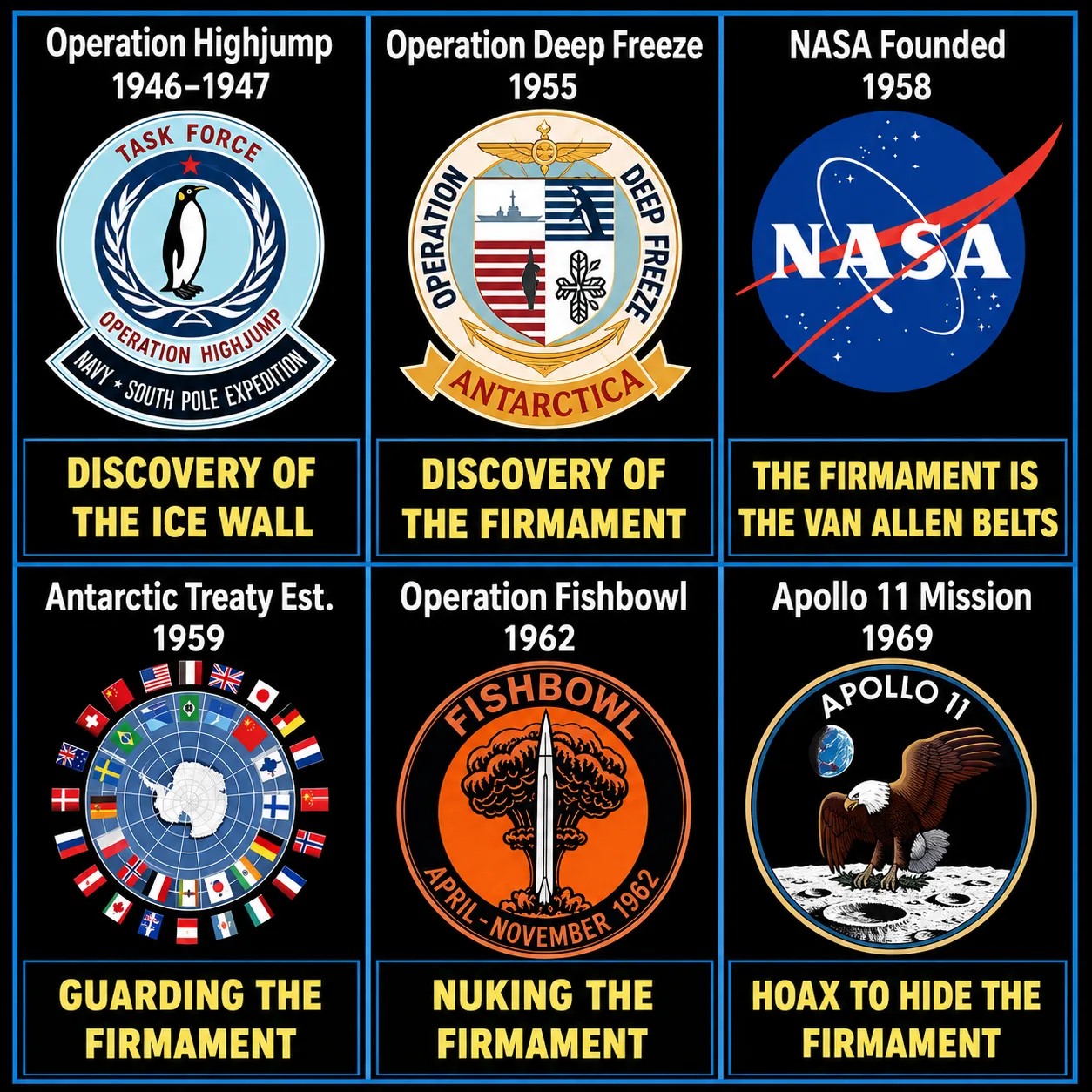
1946–1969
From Operation Highjump to Apollo 11 — twenty-three years in which the space agencies, the Antarctic treaty system, and the moon program all took their modern shape.
The institutional architecture established between 1957 and 1991 monopolises the cosmological question. The photographic record of the earth from above the atmosphere is produced by state-funded space agencies and acknowledged by NASA itself to be composite rendering, not raw photographs. The region where the question of the earth’s outer extent could be decisively settled is closed under treaty law to independent travel. The educational system disseminates the heliocentric globe model as settled fact from the first day of primary schooling. The institutional monopoly is the documentary feature. The institute invites the willing reader to weigh what the monopoly means.
Several supplementary documentary facts deserve weighing on this question, and the willing reader is invited to examine each on the public record:
- Operation Paperclip and the personnel pipeline. The architect of the United States rocket programme, Wernher von Braun (1912–1977), was a former SS officer and the principal designer of Nazi Germany’s V-2 ballistic-missile programme. Von Braun and roughly 1,600 other German scientists, engineers, and technicians were brought to the United States after World War II under Operation Paperclip, a programme declassified in stages between 1973 and 2017. Von Braun became director of NASA’s Marshall Space Flight Center in 1960 and was the chief architect of the Saturn V rocket used in the Apollo missions. The United States space programme’s upper engineering leadership in the foundational decade was staffed substantially by personnel whose prior institutional formation had been in the secret-state military projects of the Third Reich. The willing reader is invited to weigh the institutional character this transfer implies.
- The Van Allen radiation belts. James Van Allen’s 1958 Explorer 1 and Explorer 3 measurements established the existence of two zones of intense ionising radiation surrounding the earth above approximately 600 miles altitude (inner belt) and 8,000–36,000 miles (outer belt). The Apollo trajectory passed directly through both belts en route to the moon. NASA’s own published engineering analyses of the radiation problem are inconsistent across the documentary record. In a 2014 promotional video for the unmanned Orion spacecraft test, NASA engineer Kelly Smith stated on camera: “Radiation like this could harm the guidance systems, onboard computers, or other electronics on Orion. Naturally, we have to pass through this danger zone twice — once up and once back. But Orion has protection… before we can send astronauts through this region in space, or beyond, we must solve these challenges.” The willing reader is invited to weigh how a problem said in 2014 to remain unsolved is reconciled with six successful manned traversals of the same region between 1969 and 1972.
- The lost Apollo telemetry. In 2006 NASA acknowledged publicly that the original telemetry tapes of the Apollo 11 lunar landing, along with the high-resolution slow-scan television video, had been lost. The agency’s official inquiry concluded that the tapes had likely been erased and re-used during the late-1970s and 1980s data tape shortages. The agency simultaneously acknowledged that substantial engineering documentation, software, and tooling specifications for the Saturn V and the Lunar Module had been discarded or are no longer in a form permitting reproduction. The willing reader is invited to weigh how the institution that produced the most consequential single piece of cosmological evidence in human history failed to preserve its primary source documentation.
- The fifty-year gap beyond low-earth orbit. No human is on the public record as having travelled beyond low-earth orbit since Apollo 17’s splashdown on 19 December 1972. Five decades of subsequent technological development — in materials science, computing, propulsion, life-support — have not produced any successor crewed mission beyond low-earth orbit. The stated reasons across the period have included budgetary, political, and prioritisation factors, but no engineering successor architecture exists. The International Space Station (operational since 2000) orbits at approximately 250 miles altitude, well beneath the Van Allen belts. The willing reader is invited to weigh how the asserted 1969–72 capability has not been retained as a routine engineering practice.
- NASA’s own composite- imagery acknowledgements. NASA has stated on its public-affairs websites and through its principal scientific spokespersons that the iconic “Blue Marble” series of full-earth images are composites assembled from multiple low-orbit satellite passes, with the colour, contrast, and atmospheric haze adjusted for visual effect. The 2002 and 2012 “Blue Marble” releases were created by Robert Simmon at NASA’s Earth Observatory and have been openly described in interviews as artistic renderings. Subsequent full-disc earth images attributed to satellites such as DSCOVR’s EPIC camera are presented as single frames but cannot be independently verified against non-state observational records. The full-disc images from the Apollo missions of 1968–72 remain the most-cited evidence for the spherical earth in global culture; the willing reader is invited to examine independent analyses of the documented inconsistencies in those images (continental positioning, cloud patterns identical across frames separated by hours, etc.) that have been catalogued in the alternative literature.
- The high-altitude balloon record. Private high-altitude amateur balloon footage from approximately 100,000–130,000 feet altitude — well above the altitude at which spherical curvature should be plainly visible if the mainstream radius of the earth (3,959 miles) is correct — consistently shows a flat horizon at eye level when filmed through non-fisheye lenses. The apparent curvature visible in commercial-aviation window footage and GoPro action-camera footage is the documented optical distortion of curved cabin glass and wide-angle fisheye lenses; the same distortion produces curved horizons when filming a level floor. The willing reader is invited to examine independent high-altitude footage shot with corrected (rectilinear) lenses.
- The astronaut record on documentary witness. Buzz Aldrin’s 2015 on-camera statement to an eight-year-old girl who asked why no human had returned to the moon — “Because we didn’t go there” — circulates widely in the alternative literature. The full context of Aldrin’s statement has been variously interpreted, and the institute draws no specific conclusion from a single video clip. What can be documented from the broader record is that the surviving Apollo astronauts have been, by historical standards, remarkably few in their public discussion of the lunar surface experience, and that several have publicly displayed unusual reactions when questioned (Aldrin’s 2002 response to filmmaker Bart Sibrel; Neil Armstrong’s veiled remarks at the 25th anniversary about “layers of protection removed” that lay ahead; the breakdowns documented in the book In the Shadow of the Moon). The willing reader is invited to weigh the corpus of testimony as a whole.
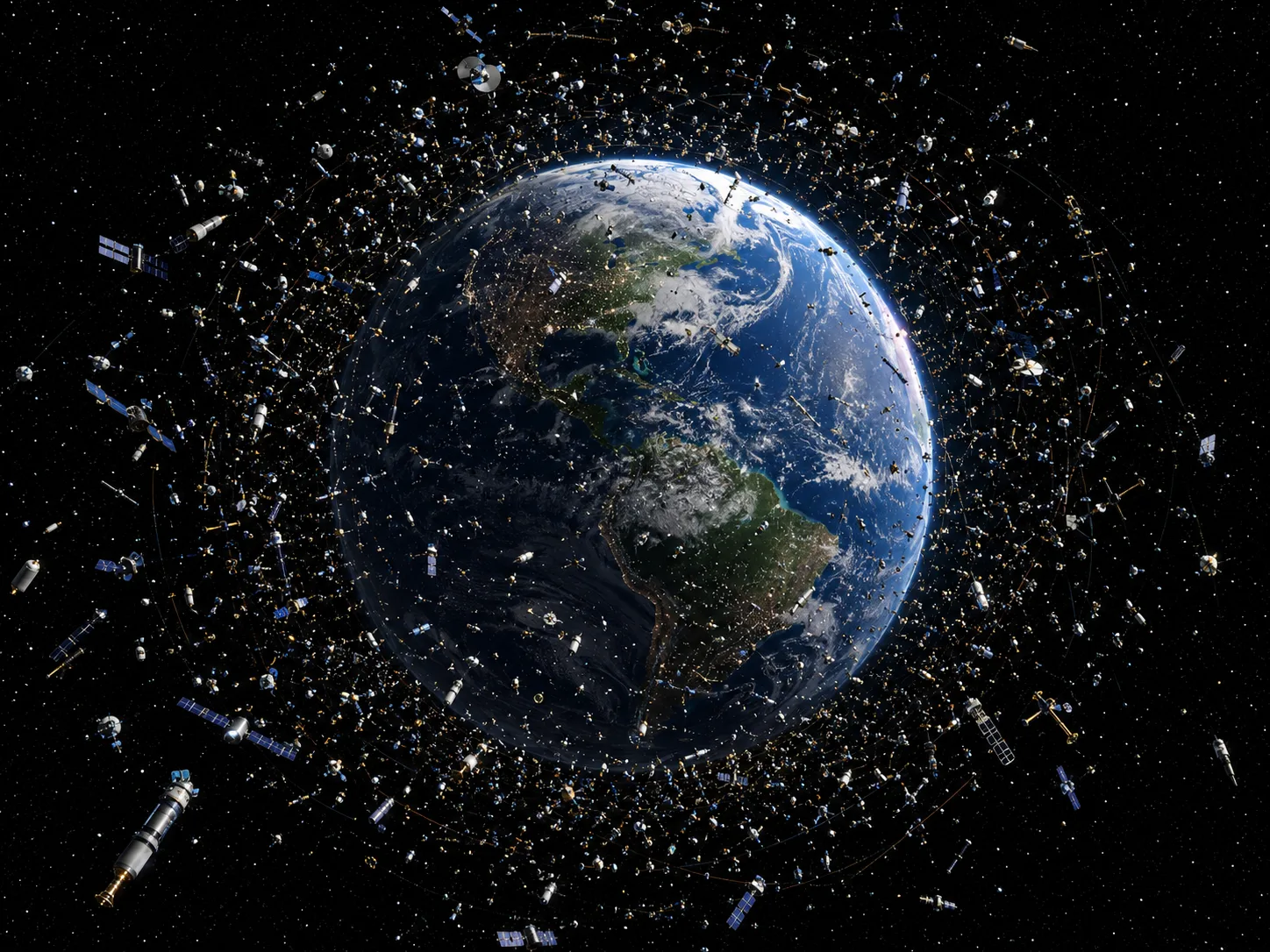
The official picture
Earth depicted ringed with thousands of orbiting satellites and debris — none of which appears in the long-duration “live” feeds.
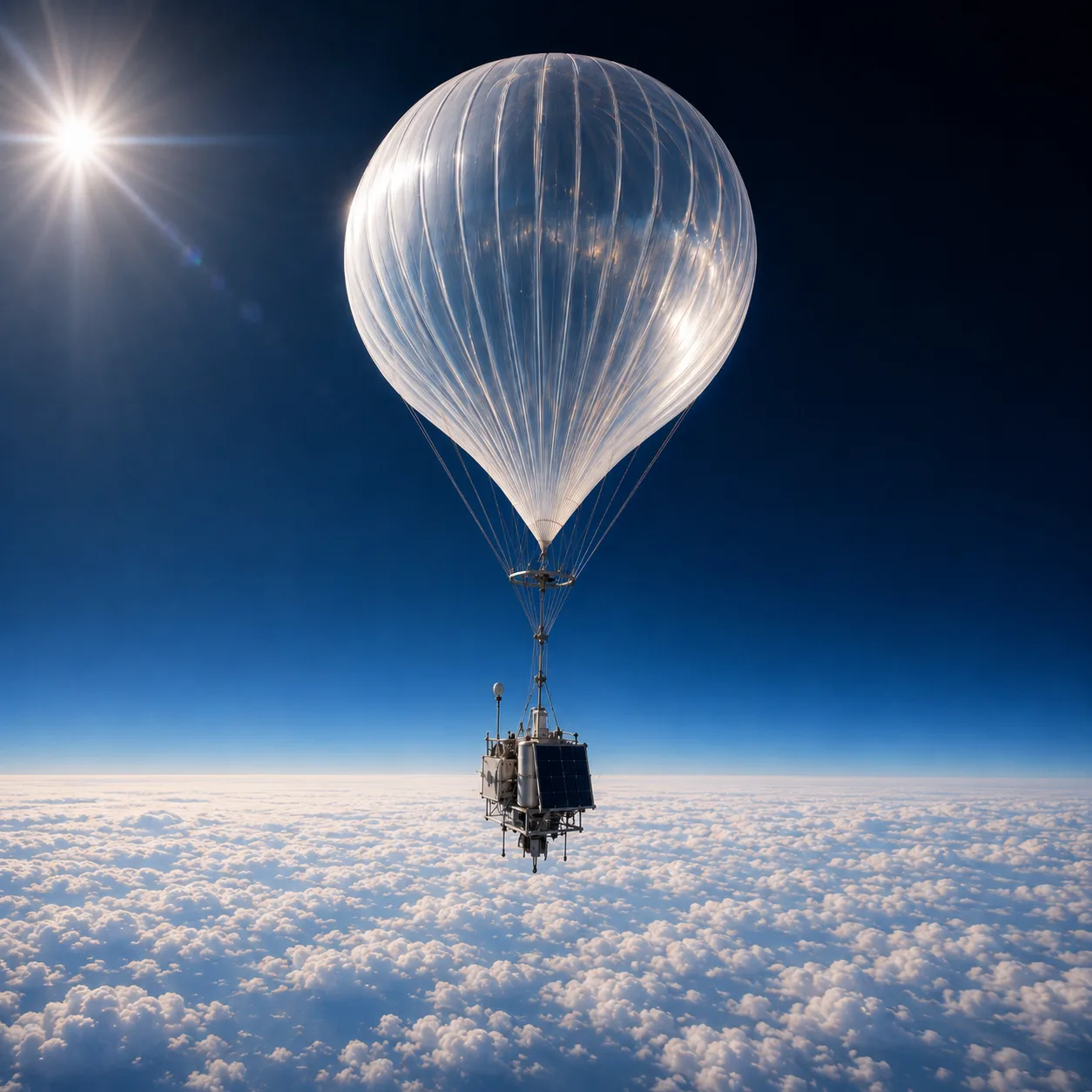
What is actually launched
Balloon-borne instrument platforms — indistinguishable in function from “satellites,” floating within the atmosphere rather than above it.
Two further pieces of institutional documentary material deserve quoting at length, as each is in the agency’s or astronaut’s own words and each shifts the evidentiary weight by itself. The first is the public testimony of Robert Simmon, the NASA data visualiser who built the 2002 Blue Marble image — arguably the single most reproduced image of the earth in human history. Simmon was interviewed on the record for NPR’s Science Friday on 3 February 2012 in a segment titled Blue Marble: The Making Of, in which he set out his process not as photography but as iterative artistic composition. The relevant transcript:
It is photoshopped, but it has to be. Then there was another layer to sort of simulate the atmosphere, and then there’s this little bright spot — it’s called the specular highlight — so it’s the reflection of sunlight off of water. Those are the pieces, but you can’t just slap them all together. It just didn’t look realistic. It looks kind of flat, or the clouds are sort of see-through. So I just take command-Z a lot. There’s artistry to creating the world — what I imagined it to be. Unfortunately I’m not an astronaut. I’ve never been to space, but I’ve looked at these images over and over again, trying to sort of get the essence of it.
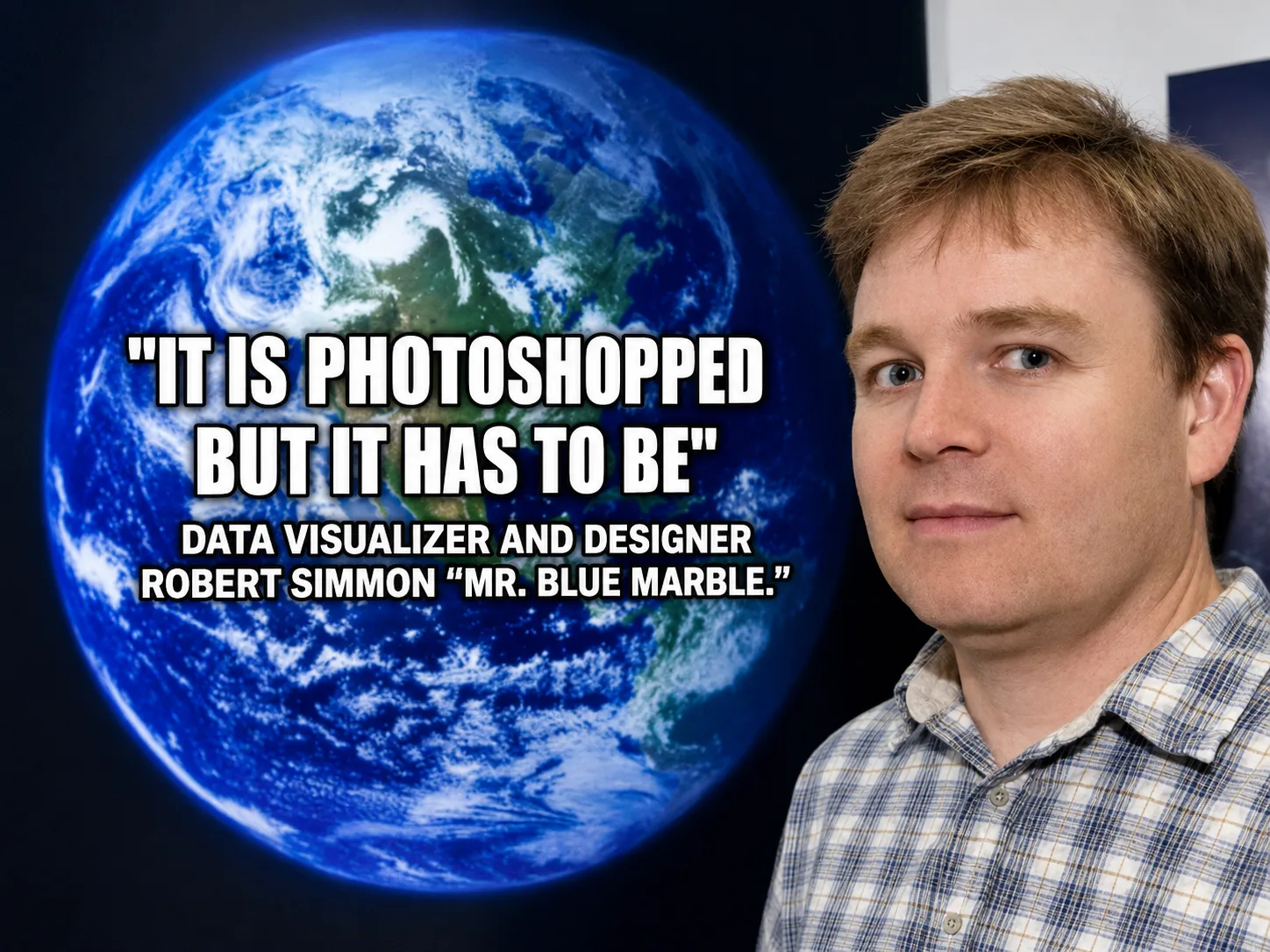
“Mr. Blue Marble”
The designer of NASA’s most famous “photograph” of the earth, on how it was made: “It is photoshopped, but it has to be.”
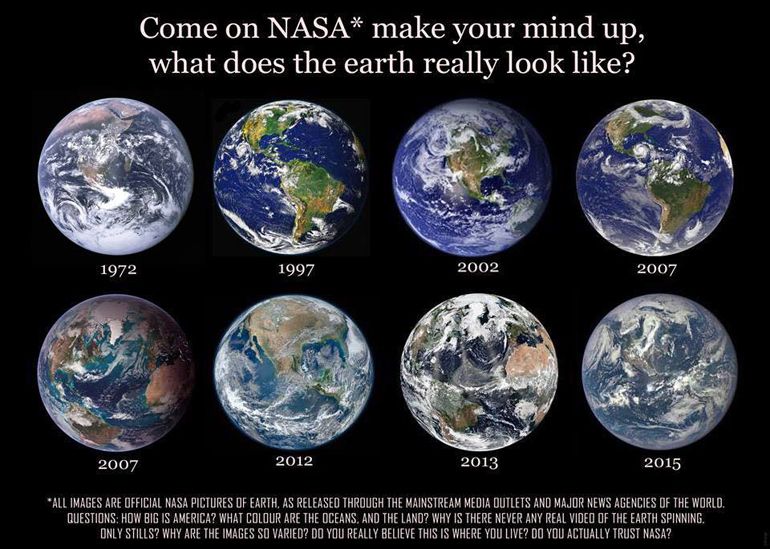
Eight “Earths,” 1972–2015
Official NASA images of the whole earth in which the geography, the colour, and the size of the continents visibly disagree.
Read what Simmon is actually saying. He is not describing the reconstruction of a photograph that was taken. He is describing the construction of an image of the world as he imagined it to be — built layer by layer, atmosphere simulated, specular highlight added, command-Z when something did not look right. He is, by his own account, an artist working honestly within the constraints of his brief; the brief, however, was never “reproduce a photograph,” but “produce what the world ought to look like, if it were a photograph.” The willing reader is invited to weigh this against the institutional presentation of the same image in global culture as a photograph of the earth.
The second piece is a NASA Dryden Flight Research Center technical publication, Derivation and Definition of a Linear Aircraft Model (Reference Publication 1207), authored by Eugene L. Duke, Robert F. Antoniewicz, and Keith D. Krambeer and published by NASA in August 1988. In its concluding remarks the document describes the engineering model it has just derived as suited to “a rigid aircraft of constant mass, flying in a stationary atmosphere over a flat, nonrotating earth.” The wording is not a slip. Inertial frame conventions standard across aerospace engineering routinely treat the earth, for the duration of a given calculation, as flat and non- rotating because the curvature and rotation said to obtain on the official model are not present in the data the engineers are actually fitting. The agency whose public presentations to the world rest on the rotating-spherical model produces, in its internal engineering literature, calculations on the flat-non- rotating model. The willing reader is invited to weigh the institutional inconsistency.
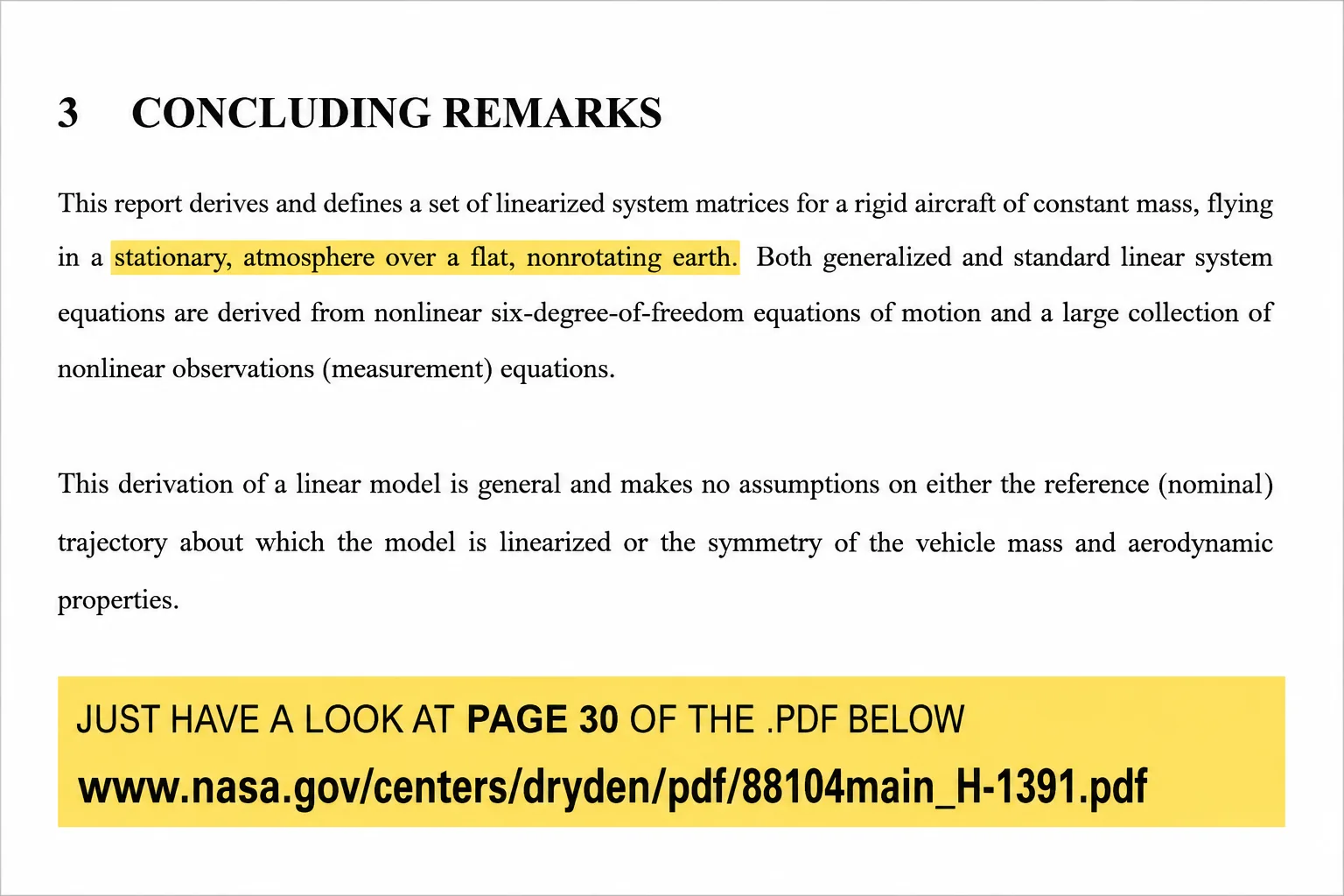
In their own equations
NASA Dryden technical paper RP-1207 derives its equations of motion for “a rigid aircraft … over a flat, nonrotating earth.”
A further documented event from the institutional prehistory of the space age belongs alongside the 1957–91 chronology already given. Between 1946 and 1947, the United States Navy conducted Operation Highjump, a massive military expedition under the operational command of Rear Admiral Richard E. Byrd, comprising approximately 4,700 personnel, thirteen naval vessels, and the aircraft carrier USS Philippine Sea. The expedition was directed not toward the Arctic — where any postwar Soviet adversary then sat — but southward toward Antarctica. The publicly stated purposes (training personnel for cold-weather operations, testing equipment, establishing a research base at Little America IV) have never adequately explained the scale of the deployment or its unexpectedly abrupt termination in March 1947, six months earlier than the planned conclusion. Byrd’s subsequent public remarks about the expedition (the disputed 1954 Chilean newspaper interview, his 1955 National Geographic statements about lands “beyond the South Pole”) have been the subject of decades of speculation; the institute does not press them beyond the documentary record. The expedition itself, in the scale of its forces and the geographic direction of its deployment, is on the public record as the institutional opening of the period that closes with the Antarctic Treaty of 1959.
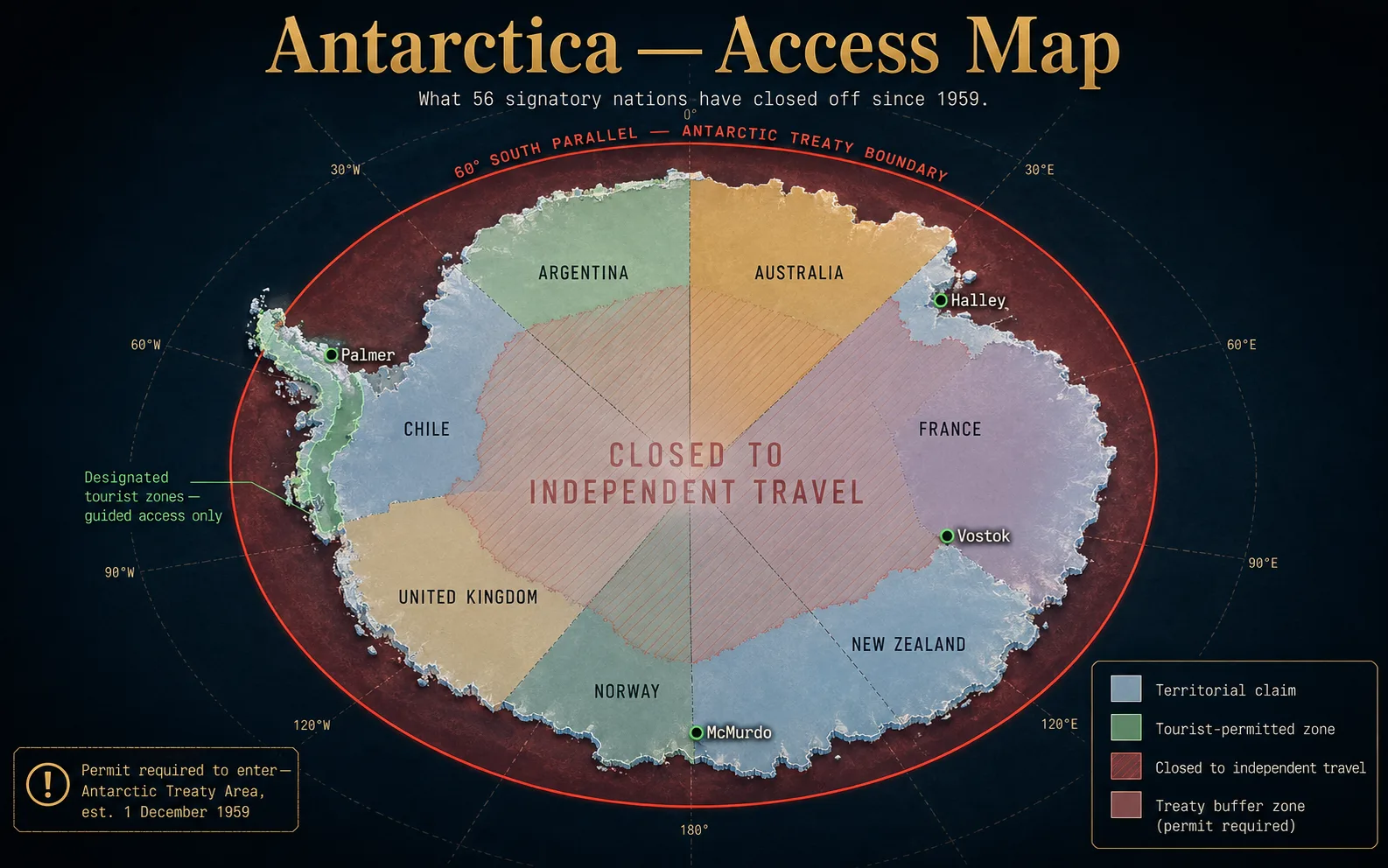
The sealed perimeter
Antarctica’s legal map: the 60°S treaty ring and an interior across which no private expedition may freely travel.
The astronaut record itself deserves a sustained look, because the language the men selling the modern cosmological story have used about their own claimed experiences is, on the documentary record, less consistent than the public reception of their accounts suggests. A representative selection of on-the-record statements follows. The willing reader is invited to weigh them not in isolation but as a corpus.
Don Pettit, a veteran NASA astronaut with multiple long-duration ISS residencies, was asked at a 2008 public Q&A whether he would like to return to the moon. His answer has been widely circulated and never disputed:
I’d go to the moon in a nanosecond. The problem is, we don’t have the technology to do that anymore. We used to, but we destroyed that technology, and it’s a painful process to build it back again.
A national space agency does not destroy the engineering it actually used to put men on another world. Blueprints get archived. Tooling gets warehoused. Documentation is preserved. What Pettit is describing, on the most charitable reading, is the loss of an institutional capability his agency cannot now reproduce. A second Pettit moment from 2015 is worth recording alongside the first. In Destin Sandlin’s engineering documentary Smarter Every Day, Pettit was asked to explain how the mechanical shutter system on the International Space Station’s Cupola observation window operates — the same Cupola from which he had taken many of his most-circulated photographs during 193 consecutive days of claimed residency. His answer:
That’s just real good engineering.
Sandlin’s film records what happened next: he tracked down the original designer of the shutter system, who had by then left NASA and was working at a motorcycle parts shop, and obtained from him the engineering drawings that explain in real mechanical terms how the shutters open and close. The interesting thing for our purposes is not the shutters — they are an ordinary piece of design — but the documentary feature that an astronaut who supposedly lived in the Cupola for 193 consecutive days could not, when asked, describe the operation of the single most prominent piece of mechanism in it.
Pettit’s “we destroyed the technology” is illuminated by an even more remarkable moment from Buzz Aldrin, the second man (by the official record) ever to have walked on the moon. Speaking at the Conrad Schools of Science in Delaware in 2015, Aldrin was asked by an eight-year-old girl in the audience why nobody had been back to the moon in such a long time. The full extended transcript:
That’s not an eight-year-old’s question — that’s my question. I want to know. … But I think I know. Because we didn’t go there. And that’s the way it happened. And if it didn’t happen, it’s nice to know why it didn’t happen, so in the future, if we want to keep doing something, we need to know why something stopped in the past that we wanted to keep going. But I think I know — because we didn’t. Because we didn’t.
An eight-year-old asks the man billed as the second person ever to walk on the moon why no human being has been back, and he answers, more than once and unprompted: because we didn’t go there. Set that beside Pettit’s “we destroyed the technology” and the same hole in the official story is being described from two different angles by two different astronauts. For comparison, here is the same Aldrin on the official podium, in a televised public appearance as part of the Apollo anniversary publicity machine:
Distinguished ladies and gentlemen, it is with a great sense of pride as an American, and with humility as a human being, that I say to you today what no men have been privileged to say before — we walked on the moon.
Two registers, one man. The contemporaneous footage of the three Apollo 11 astronauts at the press conference following their alleged return is worth a careful look on its own terms. None of the three men smiles. None hugs, shakes hands, or shows the demeanour one would expect of human beings who have just done what no one in history has done. They look, instead, like men under instruction.
The single most honest documentary on this question is a feature-length film by the American filmmaker Aron Ranen, titled simply Did We Go?, funded by a grant from the State of Ohio, executive-produced by Ben Britton of Third Wave Media in Los Angeles, copyrighted 1999 and released in expanded form by 2005. Ranen did not begin the project as a sceptic; his stated objective was to produce the definitive popular defence of the Apollo programme by interviewing the original astronauts, mission controllers, and engineers. He travelled across the United States, visited multiple NASA facilities, and spoke with high-level Apollo-era leadership. By his own honest summary at the film’s conclusion he came home with more questions than he had left with. Chief among them was the matter of the original Apollo 11 telemetry tapes — the raw mission data on which any independent verification of the landings would depend. When Ranen pressed NASA on the location of those tapes, he received on camera the answer of Gene Kranz, Apollo 11 Flight Director:
I haven’t seen anything that indicates the telemetry data is even in existence, and as I said, even if we had it, we don’t have the machines to play it back.
NASA formally acknowledged in 2006 that the original Apollo 11 mission tapes are missing and cannot be located. The institute does not press an inference beyond the documentary fact: the most consequential scientific record in modern human history has, by the agency’s own admission, been mislaid. A more confrontational complement to Ranen’s film is the work of the documentary filmmaker Bart Sibrel, who in the early 2000s sought brief on-camera interviews with the surviving Apollo astronauts asking each whether he would swear an oath, with his hand on a Bible, that he had personally walked on the moon. Sibrel reached Armstrong, Aldrin, Collins, Cernan, Bean, Young, and Mitchell among others — men drawn from Apollo 11, 12, 14, 15, 16, and 17. None agreed to swear the oath. Buzz Aldrin, then aged seventy-two, physically struck Sibrel in the face outside a Beverly Hills hotel; the encounter is preserved on Sibrel’s own footage. Edgar Mitchell of Apollo 14 physically kicked Sibrel out of his Florida home after a brief sit-down. The institute offers no endorsement of every claim in Sibrel’s broader work, but the on-camera record of these particular encounters speaks for itself: a question that could plainly have been answered was, in every recorded instance, met with refusal, hostility, or physical assault.
The most striking moment in the Sibrel material is a single line captured on a hot microphone at the conclusion of the Edgar Mitchell encounter. As Sibrel was leaving the property, Mitchell’s son — believing the recording equipment was no longer running — can be heard asking his father, plainly and without prompting, whether they ought to call the Central Intelligence Agency and have the filmmaker permanently dealt with. The remark is near-inaudible in the original release but unambiguous in the volume-normalised versions circulating publicly. The willing reader is asked to weigh why the son of an American astronaut, in the presence of his father, would consider an extra-judicial response to a documentary filmmaker asking a question the astronaut could plainly have answered.
Scott Kelly, twin brother of Mark Kelly and one of NASA’s most- photographed long-duration astronauts, was twice asked in public Q&A format to explain the air bubbles visible rising from astronauts’ helmets in spacewalk footage. The first time, in Tampa, he attempted a substantive answer:
Often, on the outside of the space station, you’ll liberate little pieces of — you know, it’s a really harsh environment out there, and the outside of the space station gets beat up pretty good. And sometimes you’ll see these little flecks of paint or something that you might have disrupted floating away from the suit. And that’s generally what that is. I’ve never seen any kind of air bubble anywhere.
Read what Kelly is actually saying. The bubbles are not air; they are flecks of paint dislodged from the exterior of the space station. The willing reader is invited to weigh this on its face. Flecks of paint do not float upward in a vacuum the way air bubbles float upward in a fluid medium; they would, if liberated from the suit, drift along whatever trajectory the suited astronaut’s motion last gave them. The artefact visible repeatedly in the footage, by contrast, behaves identically to air bubbles in water: rising, accelerating, occasionally collecting and merging. NASA’s Neutral Buoyancy Laboratory at the Sonny Carter Training Facility in Houston is, of course, a real and openly-documented underwater training pool where every spacewalking astronaut trains for months before launch. Months later, in a different city, Kelly was approached again about the same question by a different independent questioner who explicitly cited the Tampa exchange. His second answer is remarkable in a way the first is not:
Questioner: “Bubbles in space, brother — what’s your word on it?”
Kelly: “Yeah, I don’t know what that is.”
Questioner: “You don’t remember the question from Tampa about the bubbles in space coming up from the helmets?”
Kelly: “Uh, yeah… I don’t know what that is.”
The man who answered the question with technical confidence in Tampa, months later claims, twice, not to know what is being talked about — even after the questioner explicitly reminds him of his prior answer. The willing reader is asked to weigh why that might be.
Chris Hadfield, the Canadian-born former commander of the International Space Station and arguably the most photogenic astronaut of his generation, has offered the public, on multiple occasions, an account of what outer space allegedly smells like. The relevant on-the- record descriptions:
Space smells like gunpowder and burnt steak. … Sort of like brimstone, as if a witch had just been there.
The willing reader is invited to weigh, on his own terms, the claim that the vacuum of outer space has a discernible smell at all — let alone the smell of a steakhouse grill, or a witch’s recent passage. The institute records the descriptions without further commentary.
Neil deGrasse Tyson is not himself an astronaut — he is an astrophysicist by training and, more importantly, the most visible public face of the institutional cosmology in the present generation. In a 2014 appearance on a major podcast he offered, within the space of two consecutive sentences, the following twin descriptions of the earth’s shape:
If you shrunk earth down to the size of a cue ball, it would be one of the smoothest, roundest cue balls ever made. That’s how round earth is. … So it’s not actually a sphere. It’s oblate. It’s like pear-shaped.
Smooth as a cue ball and pear-shaped, in two adjacent sentences from the same speaker. Whatever else one makes of the official model, the public- facing descriptions of its central object cannot keep their story straight across a single breath. The willing reader is invited to weigh the public- confidence-of-presentation gap.
Most decisive of all in the astronaut record is the inability of the Apollo-era astronauts and the ISS-era astronauts to agree on whether stars are visible from space at all. The most direct test of whether men have been where they say they have been is also one of the simplest questions imaginable: can you see the stars from space? The actual record shows nothing approaching consensus. The Apollo men — who say they walked on the moon — uniformly report that the sky was a featureless black void and that stars were not visible to the naked eye at all:
The sky is deep black when viewed from the moon, as it is when viewed from cislunar space — the space between the earth and the moon. The earth is the only visible object other than the sun that can be seen. … I myself did not see planets from the surface, but I suspect they might be visible. We were never able to see stars from the lunar surface or on the daylight side of the moon by eye without looking through the optics.
The biggest visual surprise was just how black the sky was. You have a brilliant sun, brighter than any sun you normally would see even here in New Mexico. You have these extraordinarily high mountains — we were in a valley deeper than the Grand Canyon — but then you have this black sky, a sky blacker than black. … And we could not see stars. The sky, of course, was black, but it had sort of a velvet sheen to it.
The modern ISS-era astronauts, by contrast, describe a wholly different sky. They report on the record that stars are visible essentially all the time, including in broad daylight, in numbers and colours impossible from any location on the ground:
We have to realise that in space, without the intervening atmosphere, the heavens are ten times as bright, stars ten times as numerous, because there’s no atmosphere to block the light.
Yeah, because you can see the stars — and pretty much all the time you can see the stars. It’s not a black void. I mean, it’s black, but there’s all kinds of little polka dots. There’s all the stars there. And the cool thing is about it, you can see it during the day.
They’re brighter, but they’re different. One, you don’t have the atmospheric distortion, so they don’t twinkle. So you see lots of points, and you see lots of points — and literally millions of them. I live in Colorado, and you get up on a clear night in the mountains where there’s no light and you can see all these stars — well, multiply that by a thousand. That’s what it’s like in space. And then when you’re outside doing a spacewalk, and you have that one or two opportunities where you can let your eyes adjust, you can start to notice that some of the stars have colours we don’t see here on the ground.
Lay the two camps side by side and the problem is inescapable. Armstrong, photographed on the surface of an airless body in the direct light of the sun, says the sky was a featureless black and that no stars were visible to the naked eye. A modern astronaut, at roughly 400 km altitude (still well within atmospheric influence by the official model’s own physics), says the stars are ten times as numerous, ten times as bright, visible in millions, with colours, in broad daylight, all the time. The two reports cannot both describe the same medium with the same eye. One of them is wrong. (A footnote of editorial interest: Michael Collins — the Apollo 11 command module pilot — initially supported Armstrong’s no-stars account, but in his later autobiographical writings began to recall seeing “the elusive stars” after all. His memory, as the documentary narrator dryly observes, improved the older he got.)
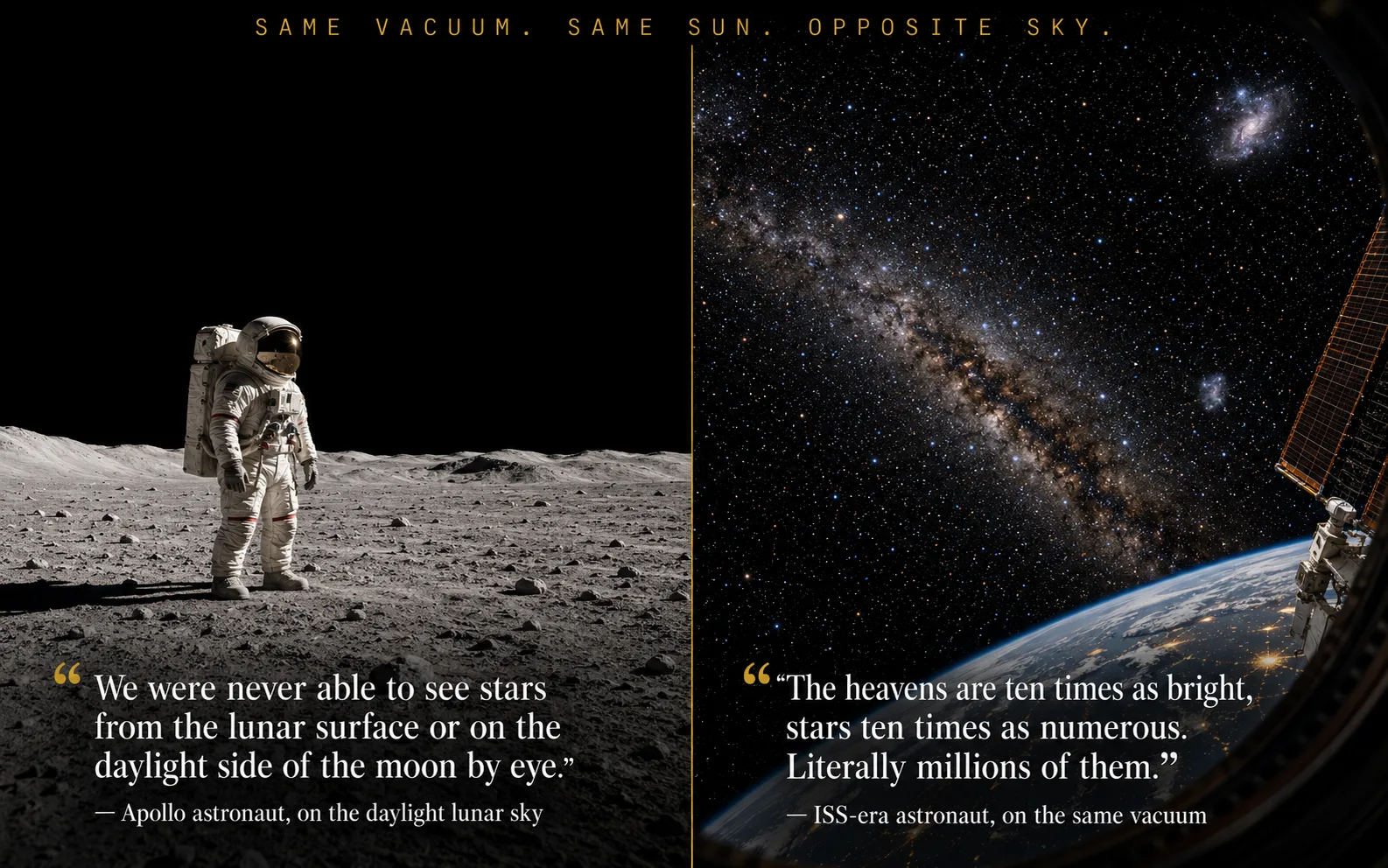
Same vacuum, opposite sky
Apollo astronauts reported seeing no stars; ISS footage shows millions. The same vacuum, the same sun, contradictory testimony.
None of these observations, taken individually, decisively settles the cosmological question. Each is offered for the willing reader’s weighing. What they cumulatively establish is the institutional and evidentiary feature the lesson emphasises: the modern reader cannot, by private observation and independent verification, settle the cosmological question on the terms the mainstream model is presented to him in. The evidence on which the spherical-earth synthesis is publicly defended is state-funded, regulated by treaty, produced by a small set of institutional actors, and acknowledged by those actors themselves to be composite rather than raw. The willing reader is not asked to credulously believe the institute’s cosmological position; he is asked to weigh the documentary feature of the alternative.
Question 08
What did Christ Himself say about the structure of heaven and earth?
Answer
Heaven and earth shall pass away, but my words shall not pass away.
Christ’s statement in His own voice locates the cosmological question precisely. Two structures are named: heaven and earth. Both are named as bounded, finite things that shall pass away. Above and beyond their passing, one thing stands: my words. The willing reader who receives Christ’s own statement on this is given the interpretive frame for the entire cosmological question. Whatever scientific synthesis the modern world hands the reader on the structure of heaven and earth, the synthesis is subordinate to Christ’s own word about what those structures are. The Reformers held this. TAHBRI holds the same.
And he arose, and rebuked the wind, and said unto the sea, Peace, be still. And the wind ceased, and there was a great calm… And they feared exceedingly, and said one to another, What manner of man is this, that even the wind and the sea obey him?
Christ’s authority over the wind and the sea is direct. He does not appeal to a natural law or negotiate with the elements. He commands them, and they obey. The disciples ask the right question — what manner of man is this, that even the wind and the sea obey him? — and Scripture has already answered it. He is the Word by Whom all things were made (Jn 1:3), and He upholds all things by the word of His power (Heb 1:3). The created world responds to the voice of its Creator.
The same pattern appears across the gospel record. He walks on the surface of the sea, and the water bears Him up (Matt 14:25–26; Mark 6:48; John 6:19). He multiplies five loaves and two fishes into a meal for five thousand (Matt 14:19–21; Matt 15:34–38). He turns water into wine in a stone jar, with no intermediate process and no time elapsed (John 2:1–11). He calls Lazarus out of the tomb four days after death, when natural decomposition has already set in (John 11:39–44). In each case Scripture treats the elements — water, bread, wine, the body of the dead — as Christ’s direct subjects, responsive to His voice, on the same ground He identified Himself: He is the One by Whom all things were made.
One more passage in the gospel record presupposes a specific geometry directly. In the temptation narrative, Satan takes Christ “up into an exceeding high mountain” and shows Him “all the kingdoms of the world, and the glory of them, in a moment of time” (Matt 4:8; Luke 4:5). On a sphere, no mountain is high enough — curvature blocks the view of more than a few hundred miles in any direction, regardless of elevation. The text presupposes a geometry in which an elevated vantage point can survey the inhabited plane in a single sweep. The biblical cosmology is the cosmology in which the text actually makes sense.
In the beginning was the Word, and the Word was with God, and the Word was God… All things were made by him; and without him was not any thing made that was made… He was in the world, and the world was made by him, and the world knew him not.
For by him were all things created, that are in heaven, and that are in earth, visible and invisible, whether they be thrones, or dominions, or principalities, or powers: all things were created by him, and for him: and he is before all things, and by him all things consist.
Who being the brightness of his glory, and the express image of his person, and upholding all things by the word of his power, when he had by himself purged our sins, sat down on the right hand of the Majesty on high.
Christ is not a teacher whose cosmological vocabulary was accommodated to a primitive worldview He privately knew to be false. The apostolic confession of John 1, Colossians 1, and Hebrews 1 identifies Him as the agent and sustainer of the very structure His teaching consistently describes. He spoke of a stationary earth and a moving sun (cf. Mark 13:24–25, where the sun is darkened, the moon does not give her light, and the stars shall fall from heaven, plain language inhabiting the same cosmology He spoke from throughout His earthly ministry) because that is the structure He made and the structure He upholds. The willing reader who receives Christ as the Word by Whom all things were made receives, on the same grounds, the cosmology His teaching presupposed.
The institute commends the simple principle: the believer’s cosmology is to be received from Christ’s own word in Scripture — my words shall not pass away — before it is received from any human philosophical or scientific synthesis. Where the two conflict, Christ’s word is final. The Reformers held this on every doctrinal question. The TAHBRI position holds the same on the cosmological question specifically.
A short Christological note on the divine self- designations. Christ’s own self-disclosure consistently uses divine titles that Scripture elsewhere reserves to the Lord God of Israel. He is I am (John 8:58, the divine name of Ex 3:14 applied to Himself). He is the first and the last (Rev 1:17, the divine self-designation of Isa 44:6 in His own voice). He is the agent of creation (John 1:3; Col 1:16; Heb 1:2; Heb 11:3). He upholds all things by the word of his power (Heb 1:3). His statement in Matthew 24:35 — that heaven and earth themselves shall pass away while His word does not — is consistent with the apostolic identification of Him as the divine sustainer of the very structures He outlasts. The willing reader who receives Christ’s self-disclosure on this receives, with it, the cosmology His self-disclosure consistently presupposed.
Question 09
Doesn’t Scripture also affirm other inhabited worlds?
Answer
A critical distinction must be drawn before the lesson closes. The TAHBRI cosmological position is not that there is nothing beyond the firmament and nothing besides this earth. The TAHBRI position is that the modern outer-space cosmology — the spherical earth in a vacuum, the solar system of spinning planetary bodies, the alleged exoplanets and prospective alien civilisations — is not biblical, but that biblical other worlds are. Scripture itself names them.
Hath in these last days spoken unto us by his Son, whom he hath appointed heir of all things, by whom also he made the worlds.
Through faith we understand that the worlds were framed by the word of God, so that things which are seen were not made of things which do appear.
Now there was a day when the sons of God came to present themselves before the Lord, and Satan came also among them.
When the morning stars sang together, and all the sons of God shouted for joy.
Scripture names multiple worlds; it identifies sons of God who present themselves before the Lord (Job 1:6, 2:1) and who shouted for joy at the founding of this world (Job 38:7); and the apostolic cosmology of Hebrews speaks of the worlds framed by the word of God. The historicist Adventist editorial tradition has consistently understood these passages to affirm the existence of other inhabited worlds — worlds whose inhabitants did not fall with this earth in Eden, who are not under the curse of sin, and who are part of the larger creation God sustains by His word.
The Lord has given me a view of other worlds. Wings were given me, and an angel attended me from the city to a place that was bright and glorious. The grass of the place was living green, and the birds there warbled a sweet song. The inhabitants of the place were of all sizes; they were noble, majestic, and lovely. They bore the express image of Jesus.
The TAHBRI cosmological position therefore distinguishes sharply between two claims that are commonly confused in modern conversation. The institute rejects the modern outer-space cosmology of a spherical earth in a vacuum among other planetary bodies, with NASA’s composite imagery and state-funded space agencies as the authority on the question. The institute affirms the biblical doctrine of other inhabited worlds beyond this earth, with Scripture as the authority on the question. These are not the same claim. The modern reader who has been taught to lump them together is invited to disentangle them on the documentary evidence Scripture supplies.
An admission against interest from one of the modern world’s most public science educators is worth recording here. Bill Nye — widely regarded as the face of popular science television for the past generation, and one of the loudest public defenders of the modern globe-and-vacuum cosmology — said the following on camera in a Big Think segment, answering a student’s question on the possibility of disposing of pollution by launching it into space:
Now, one thing I really want your generation to embrace is that the Earth is a closed system. We cannot leave the Earth. There’s no place to go. There’s no place to throw your trash.
The framing in which Nye said this was environmental (the impracticality of launching waste into space). It does not change what the words say. The modern world’s premier popular-science educator, when describing the earth plainly to the next generation, described it as a closed system from which no one leaves — with no destination beyond it for the species to escape to. That is, in every essential respect, the same description the biblical cosmology has always given: a contained earth under a firmament from which no creature ever leaves, ever travels to “other planets,” or escapes the boundary God set at creation. The institute records the admission and lets it speak.
Sin originated with him who, next to Christ, had been most honored of God… The whole universe will see the nature and results of sin. And its utter extermination, which in the beginning would have brought fear to angels and dishonor to God, will now vindicate His love and establish His honor before the universe of beings that delight to do His will, and in whose hearts is His law. Never will evil again be manifest. Says the word of God: “Affliction shall not rise up the second time.” The law of God, which Satan has reproached as the yoke of bondage, will be honored as the law of liberty. A tested and proved creation will never again be turned from allegiance to Him whose character has been fully manifested before them as fathomless love and infinite wisdom.
The Adventist editorial tradition reading these scriptures and the supplementary EGW corpus has consistently understood the biblical doctrine of other worlds in the framework of the great controversy: this earth is the singular fallen world, and the “sons of God” of Job 1:6 and 2:1 are the unfallen representatives of other inhabited worlds, gathering before the Lord at appointed convocations of the unfallen creation. Satan, having lost his place as the anointed cherub (Ezek 28:14–17), nevertheless comes also among them, claiming a place at the assembly on the basis of his usurped dominion over this fallen world. The narrative requires the existence of unfallen worlds as a background condition; without them the Job 1 scene loses its frame. The cosmological question and the great-controversy question are not independent.
The pastoral significance of this distinction will emerge in Lesson 7 of this course and is anticipated in Lesson 15 of the main Study Guides (How Will Jesus Return?) and the library articles UFOs and the Spirits of Devils and The Spirits of Devils and the Closing Crisis. The closing-hour deception will present a counterfeit of biblical other worlds — the “ascended masters” and “extraterrestrial contactees” of the modern UFO movement — as the substitute for the biblical reality. The willing reader who has the distinction in hand can recognise the counterfeit when it arrives.
The documentary character of the modern UFO/contactee phenomenon is, on examination, transparently occult. The principal twentieth-century contactees — George Adamski (the founder of the modern contactee movement, 1953 forward), George King (founder of the Aetherius Society, 1955), Helen Schucman (channeler of A Course in Miracles, 1965 forward) — operated from explicitly Theosophical and Hermetic backgrounds, with their alleged extraterrestrial contacts indistinguishable in form from classical mediumistic channeling and the “ascended master” tradition of Helena Blavatsky’s Theosophical Society (1875). The Aetherius Society’s “Cosmic Masters” are identified by name as Jesus, Buddha, Krishna, and Saint Peter, channeled through King by alleged radio contact. The Theosophical genealogy is not concealed. The willing reader is invited to weigh whether the modern UFO/alien framework is a recent secular phenomenon or the latest re-presentation of an ancient spiritualist tradition under technological costume.
The institute’s position on this is not speculative. Ellen White, writing more than a century before the modern UFO phenomenon emerged in 1947, set out the framework precisely: “the spirits of devils, working miracles, which go forth unto the kings of the earth and of the whole world” (Rev 16:14) will, at the close, accompany a deception so closely simulating the appearance and ministry of Christ that, were it possible, the very elect should be deceived (Matt 24:24). That deception will employ whatever cosmological frame the reader has been prepared to receive. The reader prepared by a hundred years of state-funded space-agency cosmology to expect contact from a vast outer-space civilisation will receive the counterfeit on the prepared expectation. The reader who has set Scripture’s cosmology in place — a stationary enclosed plane under a firmament, with biblical other worlds beyond Scripture’s named heavens accessible to God’s unfallen creation but not to lying spirits putting on a technological show in this world — will recognise the counterfeit for what it is.
Question 10
What about the standard objections?
Answer
Ten standard objections to the TAHBRI cosmological position circulate in modern conversation, from the scientific (Eratosthenes, gravity, GPS, lunar eclipses, time zones) to the historical (Magellan, the pioneers) to the institutional (photographs from space, the Antarctic Treaty) to the pastoral (the relevance to salvation). Each is addressed in its own terms below:
| Standard objection | Why the documentary record resists it |
|---|---|
| Eratosthenes proved the globe in c. 240 BC by measuring shadow angles at Syene and Alexandria | Eratosthenes’s calculation assumed two premises that have never been independently demonstrated: that the earth is a globe and that the sun is so distant that its rays arrive at the surface parallel. The observed shadow data — one stick casting a shadow at Alexandria while a stick at Syene cast none — is equally consistent with a flat earth under a local sun at approximately 3,000 miles altitude, in which case the angular geometry yields not a circumference but a height. The same observation, two cosmologies, two valid mathematical fits. Eratosthenes’s conclusion follows only when his prior commitment to Greek-philosophical sphericity is granted; the conclusion is not contained in the data alone. |
| Magellan’s circumnavigation in 1519–22 proved the globe | Magellan’s expedition sailed continuously westward and returned to its starting point — a feat that works equally on the biblical stationary enclosed plane, where the central North Pole is the fixed point and any continuous westward route describes a concentric circle returning to the starting longitude. Every east-west circumnavigation since 1522 has the same logical structure. The decisive test would be a continuous north-south circumnavigation crossing both poles — and there is no documented verifiable instance of this in the historical record. The Antarctic Treaty’s closure of independent travel below 60° south (Q7 below) makes such a test institutionally impossible. |
| Photographs from space prove the globe | Every continuous high-altitude image of the earth from above the atmosphere is produced by a state-funded space agency under conditions that cannot be independently replicated. NASA itself acknowledges that its “Blue Marble” series and most subsequent earth imagery are composite renderings — image data spliced and processed, not single photographic frames. Private high-altitude balloon footage from ~120,000 feet shows a consistently flat horizon at eye level; the apparent curvature in commercial-air-travel windows and GoPro footage is the documented distortion of curved cabin glass and wide-angle (fisheye) lenses, both of which produce curvature artefacts even when filming a level floor. The willing reader is invited to examine the documentary record of independent high-altitude footage. |
| If the earth is flat, why is Antarctica closed under international treaty? | The institute makes no specific claim about what lies beyond the treaty-closed regions of Antarctica; the institute observes the institutional closure as documented fact. The Antarctic Treaty (signed 1 December 1959 by the United States, the Soviet Union, and ten other nations during the height of the Cold War; now signed by 54 nations including North Korea) restricts independent travel below 60° south. The Madrid Protocol (1991) requires comprehensive environmental impact assessment before any non-governmental expedition; expeditions must be approved by multiple national and international bodies; specially-protected areas are entirely off-limits; motorised independent transport is restricted. The cumulative effect is that the cosmological question of what the earth’s actual extent is below 60° south cannot be settled by private observation under current treaty law — and that is itself an institutional fact worth noting. |
| Gravity proves that the earth must be a sphere | Gravity as a force-at-a-distance was Newton’s mathematical postulate of 1687. It is not a directly observed quantity; it is an inferred explanation for the observed downward fall of dense bodies and the observed orbital motions of celestial objects on the prior assumption of the spherical-heliocentric model. The observed fact — that dense bodies fall downward and lighter ones (warm air, helium) rise — is equally explained on the biblical stationary enclosed plane by the principle of density and buoyancy, which is a directly observed property of fluids and gases requiring no force-at-a-distance postulate. Newton himself confessed in his correspondence with Richard Bentley (1692–93) that he could not conceive how matter at a distance could affect other matter through empty space without mediation; he treated the gravitational equation as a mathematical description, not a physical mechanism. The modern scientific establishment has had two further centuries to identify the mechanism and has not done so — the “graviton” remains an unobserved hypothetical particle. The willing reader is invited to weigh which framework is empirically grounded and which is theoretical. |
| GPS satellites and ISS observations confirm the spherical-earth globe | The Global Positioning System works on the basis of timed radio signals between transmitting stations and receiving units. NASA and the GPS programme present these transmitting stations as orbiting satellites at approximately 12,500 miles altitude. The system would, however, work identically with land-based or atmospheric-based (high-altitude balloon, aircraft, or terrestrial tower-based) transmitting stations triangulating the receiver’s position. The willing reader cannot directly observe a GPS satellite; the user observes only that the system produces a position fix. The interpretation of the position fix as proof of orbiting satellites is the inference, not the observation. Independent astronomers have documented that observed “satellite” transits in the night sky are consistent with high-altitude (~60-mile) balloons or atmospheric phenomena rather than orbital bodies at thousands of miles altitude. The ISS itself, on close optical observation through high-power amateur telescopes, has been documented to display various optical anomalies (visible internal supports, lighting changes, occasional dropped objects of disputed identity); the willing reader is invited to weigh independent observational evidence. |
| Lunar eclipses prove the earth is a sphere — the round shadow of the earth on the moon | Honesty requires a more measured answer here than the one usually given — and it has to begin by questioning the very word “shadow.” What we see during a lunar eclipse is a darkening that creeps across the face of the moon; to call it “the earth’s shadow” already assumes we know its cause, and we do not. On the standard account it is indeed the shadow of the earth. But several honest difficulties keep the matter open. First, the curved edge of the darkened region is not by itself decisive: selenelion eclipses — in which the sun and the eclipsed moon are both seen above the horizon at once — have been recorded since antiquity, and they sit awkwardly with a model that requires the sun, earth, and moon in a straight 180-degree line; the standard account explains them by atmospheric refraction. Second, the moon itself is stranger than the textbook picture admits. A number of independent observers and researchers report things hard to square with a solid, opaque sphere — among them stars apparently seen through the moon, at times of differing colours, along with other anomalies in its light and its so-called phases. Some ask, too, why the moon’s craters are so uniformly round when bodies striking from every angle ought to have left elliptical scars; the standard reply — that a hypervelocity impact is really an explosion, which digs a round pit at nearly any angle — is a fair one, and the reader may weigh for himself whether it satisfies. The institute neither certifies nor dismisses these reports; we note them as part of why the nature of the moon remains, to us, an open question, with several competing explanations and no settled one. And so we will not pretend to a mechanism we do not have. We do not know with certainty what causes a lunar eclipse, what the moon is made of, or even whether “shadow” is the right word for what we see; the institute makes no conclusive claim here about what the luminaries are. We hold only this: the darkened moon does not by itself prove a spinning globe. The reader who still finds the eclipse a decisive point for the standard model is free to weigh it as such — this is one question we would rather leave honestly open than answer dishonestly. |
| Time zones and the simultaneity of day and night across the earth prove the globe | A central sun moving over a stationary circular plane, at the altitude Scripture and ancient cosmologies describe, would illuminate only a portion of the plane at any given moment, leaving the rest in night. The willing reader can demonstrate this with a flashlight and a flat circular surface: the localised cone of illumination at low altitude produces precisely the observed pattern of dawn, noon-overhead, sunset, and night across a wide geographic extent. The day/night pattern on the biblical cosmology is geometrically straightforward and accounts for the same observed time-zone phenomena the spherical-rotating model accounts for. The decisive observational test would be the simultaneous visibility of the sun and the antipodal sun (if any); no such observation has ever been recorded. |
| The pioneer Adventists were not unanimously flat-earth, so the TAHBRI position is sectarian | The pioneer Adventists transitioned during the very decades when the heliocentric globe model was being institutionalised through compulsory state schooling, and held a range of cosmological positions during that transition. Ellen White herself, in Early Writings p. 39 and Patriarchs and Prophets ch. 1, affirms unfallen inhabited worlds (consistent with the biblical Heb 1:2, 11:3 and Job 1:6, 38:7 framework that TAHBRI commends, Q9 above), and her stated position on the strictly cosmological question was that resolving contested cosmological questions was not her mission. The Library’s companion piece Ellen White on the Shape of the Earth walks her primary-source record in detail. The TAHBRI position rests on Scripture’s own cosmological language and the documentary record of how the alternative was institutionalised — not on pioneer unanimity. |
| The cosmological question is irrelevant to salvation and should not be raised | The institute affirms readily that the shape of the earth is not the test of salvation; the test of salvation is the apostolic gospel of justification by faith in the Father’s only-begotten Son. The cosmological question is, however, the question on which the trustworthiness of Scripture stands or falls at its most basic level. If Scripture is unreliable on the structure of the world the reader stands on, then on what basis is the reader to trust Scripture on the resurrection of the body, the second coming of Christ, the new heavens and the new earth? The Reformers identified the question correctly when they opposed Copernicus on the Joshua 10:12–13 grounds: not because they were anti-scientific, but because they recognised that surrendering Scripture’s plain language on the structure of the world was the first step toward surrendering its plain language on everything else. The pastoral implications are walked in the closing-callout below. |
Ten objections weighed; ten responses on the documentary evidence. The institute commends the willing reader to the founder’s extended biblical and observational case in The Shape of the Earth, and to the gospel-centred Ellen White companion piece for the editorial framing on the relation of the cosmological question to the closing-crisis substance.
A note on how the conversation has been managed
The case set out above has not been argued in a neutral information environment. Between 2018 and 2019 the largest video platform in the world made two formal, public decisions to suppress the visibility of biblical-flat-earth content specifically — by name. In early 2018, YouTube introduced “information panels” placed beneath videos the platform had categorised as advancing conspiracy theories; flat-earth content was an explicit early target, with Wikipedia-sourced summaries linked beneath the videos as the platform’s implicit standard of truth. On 25 January 2019 the platform announced a complete overhaul of its recommendation algorithm; flat-earth content was named specifically in the formal blog post as a prime example of what the new algorithm would demote. The change followed research presented at the American Association for the Advancement of Science by Dr Asheley Landrum framing the spread of flat-earth belief as a “rabbit hole” problem driven by, in her own words, viewers’ “combination of a conspiracy mindset and lower science intelligence.” The press response was uniformly celebratory — Forbes, in a piece by Fruzsina Eordogh dated 28 January 2019, headlined the move “YouTube Stops Recommending Conspiracy Videos, Finally.” The adverb at the end did the editorial work. The point is not that YouTube was wrong to make business decisions about its own algorithm; the point is that the conversation about whether the modern cosmology is what it claims to be has been actively managed — by named institutions, at platform scale, with the explicit cooperation of mainstream press — for the better part of a decade. A reader who reaches this lesson in 2026 is engaging material the dominant information infrastructure has spent years working to keep him from encountering. That fact does not prove the case; the case stands on its own merits. It does, however, answer the reasonable reader’s question: why is this the first I am seeing of any of this?
A note on what is being identified
This lesson is not addressed against the billions of sincere Christians who have inherited the heliocentric globe model from their childhood schooling and have never had occasion to weigh it against Scripture’s plain cosmological language. The institute affirms readily that the shape of the earth is not the test of salvation; the test of salvation is the apostolic gospel of the Father’s only-begotten Son crucified, risen, ministering as High Priest, and returning bodily for His people. What the lesson corrects is the underlying assumption that Scripture’s cosmological language is accommodated mythology to be reinterpreted in light of modern science, while its language on resurrection, second coming, and new earth is to be received literally. Scripture is consistent on both. The willing reader who has received the substance of the previous lessons of this course and the main Study Guides is invited to weigh the cosmological question on the same Scripture-supreme-authority principle that has governed every other recovery. The doctrine corrected is the doctrine, not the love. And the reader who concludes after honest weighing that the institute’s cosmological position is mistaken remains a Christian on the apostolic gospel; the institute does not insist on the cosmological conclusion as a fellowship test.
Summary of Lesson 5
- Scripture’s cosmological language is consistent across the canon: stationary (Ps 93:1; 96:10; 104:5), circular not spherical (Isa 40:22, chug not dur), enclosed by a firmament (Gen 1:6–8; Job 37:18), with the sun moving over the earth (Eccl 1:5; Ps 19:4–6; Joshua 10:12–13).
- Every ancient civilisation for which cosmological documents survive — Sumerian, Babylonian, Egyptian, Chinese, Hindu, Native American, Hebrew — held to a flat enclosed cosmology before the Greek philosophical revolution.
- The spherical earth was a Greek philosophical innovation (Pythagoras c. 570 BC; Aristotle 384 BC; Ptolemy c. AD 150). Heliocentric variant first proposed by Aristarchus of Samos c. 270 BC; remained fringe paganism until the Renaissance.
- Heliocentric revival came through the Hermetic Corpus (2nd–3rd c. AD), translated into Latin by Marsilio Ficino in 1471 at the Medici court. The Hermetic theology presents the sun as a visible god; heliocentric model and sun-worship substance are bundled together.
- Copernicus’s De Revolutionibus (1543) cites Hermes Trismegistus by name as authority for the sun’s central position. Opens with Cardinal Schönberg’s 1536 letter urging publication; preceded by Widmannstetter’s 1533 lecture before Pope Clement VII. The heliocentric proposition was Rome-sponsored before it was Protestant-known.
- The Reformers opposed Copernicus on biblical grounds. Luther’s Table Talk No. 4638 (1539) cites Joshua 10:12–13 explicitly. The 1611 KJV translators rendered every cosmological passage in stationary-earth language without amendment. The shift in Protestant consensus to heliocentrism occurred through state-funded education, not on new biblical evidence.
- Newton’s Principia (1687) completed the gravitational synthesis. Newton was a working alchemist (~1 million words on alchemy), a serious student of the Hermetic Corpus, and an anti-Trinitarian Arian who refused holy orders. Keynes’s 1942 conclusion on examining the unpublished papers: “Newton was not the first of the age of reason. He was the last of the magicians.”
- From 1957 forward the cosmological question is institutionally monopolised: Sputnik (4 Oct 1957), NASA founded (29 Jul 1958), high-altitude nuclear tests (1958–62), Antarctic Treaty signed (1 Dec 1959, now 54 signatories including North Korea), Apollo missions (1969–72) and no human beyond low-earth orbit since, Madrid Protocol (1991) closing independent travel below 60° south.
- Christ’s own self-disclosure in Matthew 24:35: Heaven and earth shall pass away, but my words shall not pass away. The believer’s cosmology is received from Christ’s word, not from any human synthesis subordinate to it.
- Biblical other inhabited worlds (Heb 1:2, 11:3; Job 1:6, 38:7; EGW Early Writings p. 39) are affirmed by Scripture and to be distinguished sharply from the modern exoplanet / alien cosmology. The closing-crisis deception will present a counterfeit of biblical other worlds through the “ascended masters” and extraterrestrial-contactee phenomena of the modern UFO movement (cross-link Library articles).
Personal response
The cosmological deception is, on first hearing, the most counter-intuitive of all the architecture this course has set out. The willing reader was taught the heliocentric globe model from the first day of schooling, has carried it without question through all the subsequent years of education, and is being asked in this lesson to weigh the question afresh on Scripture’s plain language and the documentary record of how the alternative was institutionalised. The institute does not insist on the cosmological conclusion as a fellowship test. The institute does insist on the underlying hermeneutic: Scripture is supreme on what it plainly says, and the willing reader’s cosmology, like every other doctrine of the believer’s faith, is to be received from Scripture before it is received from any human synthesis subordinate to Scripture. On this hermeneutic the Reformers stood. On this hermeneutic TAHBRI commends the willing reader to stand.
Father in heaven, the only true God, the Maker of the heavens and the earth and of every thing therein, thank You for the plainness of Your word on what You have made. I have seen the cosmological language of Scripture from Genesis through Revelation. I have seen the Hermetic genealogy of the modern alternative from Aristarchus through the Corpus Hermeticum through Copernicus, Newton, and the institutional space age. Grant me grace to receive Your word on the structure of the world I stand on with the same trust I receive Your word on the resurrection of the body and the second coming of Your Son. Where my schooling has formed in me an unconscious commitment to a model Scripture does not teach, give me grace to set the model down. Where I have confused the modern outer-space cosmology with Your scriptural affirmation of other inhabited worlds, give me grace to distinguish them. Let me be found, when the closing-crisis counterfeit appears, recognising it for what it is. In the name of the One whose word does not pass away though heaven and earth shall, Jesus Christ. Amen.
From the cosmological architecture, the next lesson asks the next question: what is the religious one- world project being constructed alongside the political and cosmological ones? Lesson 6 walks the Vatican II re-engagement with separated Christianity, the Charta Oecumenica, the Joint Declaration on Justification, and the apostate- Protestant alignment with Rome at the closing test — the second-beast image-of-the-beast structure of Revelation 13:11–17.
The lights above, and the ground beneath
Much of the argument about the earth’s shape never touches the earth at all. It happens with the head tilted back. People point to the sun, the moon, the stars — what they are doing, how they move, how far off they are said to be — and treat the answer as though it settled the question of the ground under their feet. But the leap is a strange one. The behaviour of the lights in the sky and the shape of the surface a person stands on are two different questions, and the first does not decide the second.
Picture the oddness of it plainly. Suppose you looked up through a window at the ceiling light of the room above yours — or across the street into a neighbour’s window, and saw the round glow of their lamp — and from that concluded that the floor you were standing on must therefore be round, or curved, or shaped like the lamp. No one reasons that way about a room. The light on the ceiling tells you nothing about the floor; they are not the same object, not the same surface, not the same question. Yet this is very nearly the reasoning we have all been handed about the sky and the earth: that because the lights overhead behave in a certain way, the ground beneath must be a spinning ball.
Why does the mind fuse the two so readily? Not because the logic compels it, but because the picture was installed early. From the first schoolbook we were shown a small blue ball hanging in black space among countless other balls — ourselves a speck on its surface, the sun another ball, the stars yet more, all of one kind and all of a piece. Once that single image is in place, it feels natural that the sky and the ground are one system, one geometry, telling one story. But that is a taught assumption doing the work, not an observation.
Scripture, tellingly, keeps the two apart. It speaks of the earth with its foundations, its pillars, its established place that cannot be moved — the ground — and separately of the lights God set in the firmament above, to divide the day from the night and to be for signs and for seasons. The luminaries are placed in the expanse over the earth; they are not the earth, and the earth is not measured by them. What is above our heads and what is beneath our feet are, in the Bible’s own account, two distinct works of one Maker. We are free to wonder at the one without letting it dictate our conclusions about the other — which is exactly why the honest word that follows can leave the luminaries an open question and still speak plainly about the ground.
An honest word
What we claim, and what we don’t
We hold that the evidence points to something important and worth saying plainly: the earth is not the spinning ball, hurtling through empty space, that we were handed. That much we are willing to defend.
But here our honesty cuts both ways. We are not willing to do what the modern scientific establishment has done — manufacture confident explanations for things no one has ever touched, measured at close hand, or truly understood, and then present them as settled fact. There is a great deal we do not know. We cannot tell you what the luminaries are, nor what the sun and moon are made of — no one who has not been there can, and we have only been asked to take their word for it. We do not know the deep reason density and buoyancy behave as they do, or why the downward pull men named “gravity” exists at all. We do not have a demonstrated mechanism for the lunar eclipse.
We could invent answers to fill these gaps. We will not — to do so would be to repeat the very error we are pointing out. So we leave the unknown as unknown, and say so. We are not God. We have found that the world is not shaped as we were told, and we trust that the One who made it knows perfectly how every part of it works, even where we do not.
And a personal word, since this is a question I have lived with for years. There are tens of thousands of sincere people running experiments and forming hypotheses about these very things — the eclipse, the nature of the luminaries, the cause of the fall we have been taught to call gravity — and some of their explanations may yet prove to be good ones. But in more than ten years of looking hard at this subject, I have settled one rule for myself: I will not adopt a theory merely because it sounds good and fills a gap, when I cannot actually demonstrate it. There is no need to. The case does not stand on the gaps; it stands on what can be shown — the earth that will not be made to move, the curvature that refuses to appear across miles of still water, and the rest of the evidence walked through here. We have already opened real holes in globe arguments that stand on their own; we do not need to patch our own case with guesses to make up for it. Better a few honest unknowns than a stack of confident errors.
“The secret things belong unto the LORD our God: but those things which are revealed belong unto us and to our children for ever….”Deuteronomy 29:29Go deeper
This lesson traces the institutional and historical architecture of the cosmological deception in brief. For the fuller biblical, observational, and historical case — in considerably more detail than a single lesson can hold — see the founder’s long-form article The Shape of the Earth and its gospel-centred companion Ellen White on the Shape of the Earth.
Foundational text
“It is he that sitteth upon the circle of the earth, and the inhabitants thereof are as grasshoppers; that stretcheth out the heavens as a curtain, and spreadeth them out as a tent to dwell in.”
— Isaiah 40:22