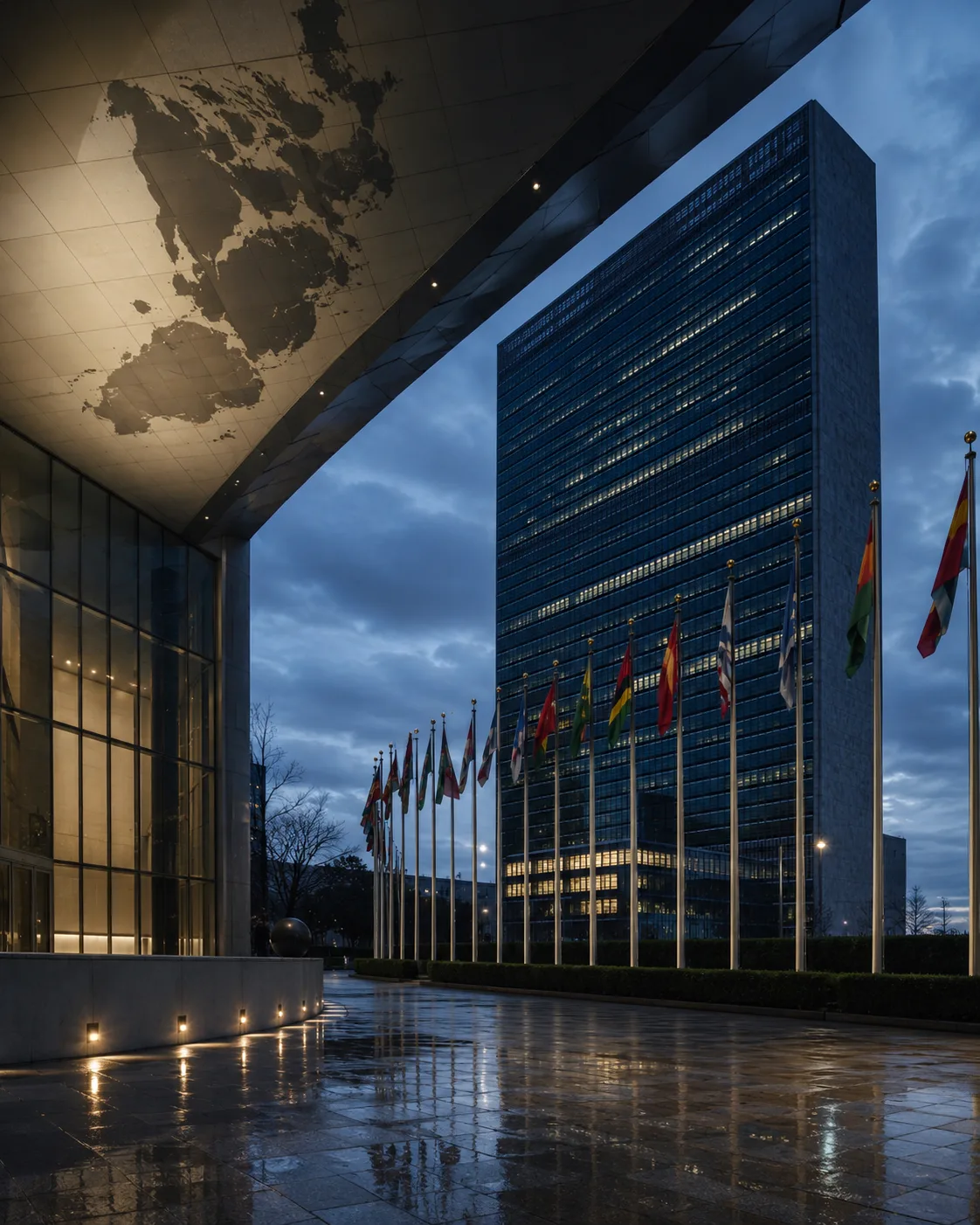


The phrase “new world order” is not a conspiracy-theory invention. It is the published self-description of an actual political project pursued by named institutions on the public record across the past century. This lesson walks the documented architecture — the United Nations and its occult founding apparatus, the Bilderberg Group, the Council on Foreign Relations and the Trilateral Commission, the World Economic Forum, the central-banking layer, and the digital-identity infrastructure of the closing buy-and-sell control system — and locates each in the prophetic framework of Revelation 13 and 17.
Lesson 3 traced the secret-society chain that has carried Babylonian mystery content forward across the past four millennia. Lesson 4 takes up the visible political architecture that the chain’s successors have built on the public stage of the past century: the modern institutions of supranational governance, central banking, and digital infrastructure that together constitute the documented “new world order” in the literal sense of the phrase. Where the secret-society layer operates by initiatory restriction, the political architecture operates by published statute, treaty, and corporate charter. Its institutions are named; its founding figures are biographied; its programmatic objectives are stated in books available in any major library. The case in this lesson is built entirely on the institutions’ own published documents.
Three preliminary observations frame the lesson. First, the institute does not claim that every diplomat at the UN or every economist at Davos consciously endorses an occult globalist programme. The institutions are large and the rank-and-file participation is generally sincere. The lesson identifies the architecture on the founding documents and the programmatic literature, not the rank-and-file on their intentions. Second, the prophetic identification of these institutions in Revelation 13 and 17 does not require any single named figure to be the antichrist or any single named institution to be the beast. The prophetic structure names systems and confederacies; the identification proceeds from the structural fit. Third, the lesson concerns the political architecture, not the theological architecture. The religious one-world project — Vatican II, the Charta Oecumenica, the post-Vatican-II ecumenical re-engagement — belongs to Lesson 6. The closing- crisis convergence of the political and the religious is the subject of Lesson 7.
Question 01
Does Scripture predict a global political consolidation in the closing hours?
Answer
After this I saw in the night visions, and behold a fourth beast, dreadful and terrible, and strong exceedingly; and it had great iron teeth: it devoured and brake in pieces, and stamped the residue with the feet of it… Thus he said, The fourth beast shall be the fourth kingdom upon earth, which shall be diverse from all kingdoms, and shall devour the whole earth, and shall tread it down, and break it in pieces.
And it was given unto him to make war with the saints, and to overcome them: and power was given him over all kindreds, and tongues, and nations. And all that dwell upon the earth shall worship him, whose names are not written in the book of life of the Lamb slain from the foundation of the world.
And the ten horns which thou sawest are ten kings, which have received no kingdom as yet; but receive power as kings one hour with the beast. These have one mind, and shall give their power and strength unto the beast.
For when they shall say, Peace and safety; then sudden destruction cometh upon them, as travail upon a woman with child; and they shall not escape.
Four scriptural witnesses converge on the same prophetic structure. Daniel 7:23 names the fourth kingdom as “diverse from all kingdoms” and devouring “the whole earth”: a totalising political reach the previous three kingdoms did not possess. Revelation 13:7 names power given the beast over all kindreds, and tongues, and nations: not regional consolidation but global. Revelation 17:13 describes ten kings of one mind who voluntarily give their power to the beast: not conquest but consolidated consent. 1 Thessalonians 5:3 names the slogan under which the consolidation will be sold: peace and safety. The prophetic specification is precise. The institutions this lesson examines are built to it.
Question 02
Is “new world order” really the published self-description?
Answer
The phrase has been used by named heads of state, major intellectuals, and senior religious figures across the twentieth and twenty-first centuries. The institute does not introduce the phrase; the institute quotes the figures who have introduced it.
Out of these troubled times, our fifth objective — a new world order — can emerge: a new era, freer from the threat of terror, stronger in the pursuit of justice, and more secure in the quest for peace. An era in which the nations of the world, East and West, North and South, can prosper and live in harmony… A new world order, where diverse nations are drawn together in common cause to achieve the universal aspirations of mankind: peace and security, freedom, and the rule of law.
What is at stake is more than one small country; it is a big idea: a new world order, where diverse nations are drawn together in common cause to achieve the universal aspirations of mankind.
The new world order is “world peace.” It is not nationalism, not internationalism, but post- nationalism. A world in which the autonomous nation state is dissolved into a wider entity.
Pope calls for new world order.
The figures who have used the phrase span the ideological and confessional spectrum. Wilson and the League of Nations architects in 1918–20. H.G. Wells in 1940. Bush in 1990–91. Gorbachev throughout the 1990s. John Paul II repeatedly, with the San Francisco Chronicle headline above as one of dozens of mainstream press references in the early 2000s. Kissinger’s 2014 book is simply titled World Order. Klaus Schwab’s 2020 publication is titled COVID-19: The Great Reset. The willing reader is invited to note one fact: the phrase has not been imported by critics. It has been spoken, written, and published repeatedly by the figures pursuing the programme. Calling attention to the phrase is not paranoia; declining to call attention to the phrase would be an editorial choice the institute does not make.
Question 03
The United Nations and its occult founding apparatus
Answer
The institutional sequence is clean. The League of Nations was constituted by the Treaty of Versailles in 1919 and held its first meeting in Geneva on 16 January 1920. The League’s first project failed structurally (the United States Senate did not ratify the Covenant, denying the League American backing) and the body dissolved in 1946 in favour of the United Nations, established by the UN Charter at the San Francisco Conference on 26 June 1945 and entered into force on 24 October 1945. The headquarters complex was built on land donated by John D. Rockefeller Jr. on the East Side of Manhattan and opened in 1952.
Embedded in the UN’s public structure from its early decades is a documented occult apparatus. The load-bearing facts:
- The Lucis Trust. Founded in New York in 1922 by Alice Bailey under the original name Lucifer Publishing Company (the company name appears on the title pages of Bailey’s earliest publications, archived copies of which survive). The name was changed in 1924 to Lucis Publishing Company; the associated charitable trust was incorporated as the Lucis Trust. Bailey publicly explained the change as a public-relations decision, not a disavowal of the original Luciferian framework. The Trust maintains a registered NGO status with consultative standing at the UN Economic and Social Council and operates offices at 866 United Nations Plaza in New York, as well as in Geneva, London, and elsewhere.
- Alice Bailey’s books. Twenty-four volumes published by Lucis Trust between 1922 and her death in 1949, attributed to her dictation from a non-incarnate occult master she called Djwhal Khul or the Tibetan. The programmatic volumes include The Externalisation of the Hierarchy (1957, posthumous), The Reappearance of the Christ (1948), The Destiny of the Nations (1949), and Discipleship in the New Age (two volumes, 1944 and 1955). The corpus presents a developed programme of “the externalisation of the spiritual hierarchy” — the gradual public emergence of an occult hierarchy that has, on Bailey’s account, governed human affairs covertly across the centuries and is now revealing itself through new global institutions, with the UN named explicitly as one of those institutions.
- Robert Muller and the World Core Curriculum. Robert Muller (1923–2010) served as UN Assistant Secretary-General from 1970 to 1986 and as Chancellor of the UN-affiliated University for Peace in Costa Rica thereafter. His programmatic publications — New Genesis: Shaping a Global Spirituality (1982), The World Core Curriculum Manual (1989, the foundational document of the UN-aligned international-school movement), and Most of All, They Taught Me Happiness (1978) — cite Alice Bailey by name as the source of the curriculum’s spiritual framework. The curriculum is now operative in approximately fifty countries through the affiliated UNESCO Associated Schools network.
- The UN Meditation Room. The Meditation Room in the General Assembly building was designed by Dag Hammarskjöld and dedicated in 1957. The room is windowless, dimly lit, oriented to the north-northeast, and configured as a trapezoidal chamber tapering toward a single rectangular block of iron ore at its far end — the architectural form of a pyramid with the capstone removed. Bailey described the iconography of the truncated pyramid in her published writings as the symbol of the externalising hierarchy awaiting its capstone.
The work of the Christ… will be made possible through the medium of the new world religion, the gradual development of which will be one of the major activities of the reappearing Christ and his attendant Hierarchy. The form of this new world religion will be a synthesis of Eastern and Western philosophy and religion, embodying the best of each.
The institute makes no claim that every UN diplomat or every UNESCO administrator consciously endorses Bailey’s framework. The institute does observe that the framework is on the founding record, that the affiliated NGO operates with consultative UN standing on a continuous basis, and that Muller’s influence on the UN-aligned educational apparatus is documented in the UN’s own publications. The willing reader is invited to consult Bailey’s books, which are sold directly by the Lucis Trust and available in every major university library.
Question 04
The Bilderberg Group
Answer
The Bilderberg Group convened its first meeting at the Hotel de Bilderberg in Oosterbeek, the Netherlands, in May 1954. The founders were Joseph Retinger (Polish political adviser, secretary to General Sikorski during the Second World War, principal architect of the post-war European integration project), Prince Bernhard of the Netherlands (consort of Queen Juliana, former SS intelligence officer who had renounced the affiliation in 1934, central figure in early Bilderberg until his 1976 resignation following the Lockheed bribery scandal), and David Rockefeller (Chase Manhattan banker, Council on Foreign Relations chairman, central American participant in post-war Atlantic institutional building).
The Group has convened annually since 1954, with the exception of years interrupted by scheduling conflicts and the 2020 COVID cancellation. Attendees are between 120 and 150 invited individuals: heads of state, heads of government, central bank governors, leading industrialists, major media executives, defence contractors, royal family members from Atlantic monarchies, and a rotating component of senior academics. The locations rotate among Atlantic-aligned countries and the venues are heavily secured. The meetings operate under the “Chatham House Rule” — attendees may use the information received but may not identify the speaker or affiliation. No minutes are published. The attendee list has been published since the early 2000s under sustained press pressure.
The institute makes no claim that any specific policy decision emerges from Bilderberg as a formal action of the Group. The institute observes the documented empirical pattern: the consistent pre-emergence of major political appointments, treaty arrangements, and financial-architecture decisions in Bilderberg-adjacent timing across the seven decades of operation, with the principal academic study (Daniel Estulin, The True Story of the Bilderberg Group, 2005; Will Hutton, Mary Ann Sieghart, and other mainstream press treatments) consistently documenting the correlation. The Group is the most influential annual private convocation of Atlantic-alliance political and economic leadership; its secrecy is institutional fact; the buy-in of the political and media class to that secrecy is the institutional feature worth noting.
Question 05
The CFR, the Trilateral Commission, and the World Economic Forum
Answer
Three sibling institutions extend the Bilderberg structure across different regional and functional jurisdictions. Each is named, registered, and publicly active. Each produces a continuous stream of published programmatic literature defining its objectives.
- Council on Foreign Relations (CFR). Founded 1921 in New York as the American sister organisation of the Royal Institute of International Affairs (Chatham House, London, founded 1920). Publishes Foreign Affairs, the foundational quarterly of the post-war Atlantic foreign-policy establishment. Membership is by invitation; the active membership comprises the bulk of senior US foreign-policy personnel across administrations of both major parties. The CFR’s published “Independent Task Force Reports” consistently pre-figure subsequent US foreign-policy positions by three to seven years.
- Trilateral Commission. Founded 1973 in New York by David Rockefeller and Zbigniew Brzezinski, the Commission was designed to extend the Bilderberg pattern of US–European coordination to include Japan and the Pacific Rim. Its published programmatic document The Crisis of Democracy (Crozier, Huntington, and Watanuki, 1975) explicitly identified “an excess of democracy” in Western societies as a structural problem requiring institutional management. Membership overlaps substantially with Bilderberg and CFR. The Carter administration (1977–81) was sometimes characterised as the Commission’s first governmental incumbency: Carter himself was a Commission member, as were Vice President Mondale, Secretary of State Vance, and National Security Adviser Brzezinski.
- World Economic Forum (WEF). Founded 1971 in Geneva by Klaus Schwab, originally as the European Management Forum. Annual Davos meetings convene approximately 3,000 senior business, political, and intellectual figures each January. Schwab’s published programmatic literature constitutes the most explicit current self-description of the consolidationist project: The Fourth Industrial Revolution (Geneva: WEF, 2016), Shaping the Fourth Industrial Revolution (2018), and COVID-19: The Great Reset (co-authored with Thierry Malleret, published 9 July 2020, approximately four months into the global pandemic shutdowns). The “Great Reset” programme calls explicitly for a structural reset of property ownership, labour relations, and identity infrastructure under cooperative multinational regulation.
The changes are so profound that, from the perspective of human history, there has never been a time of greater promise or potential peril. My concern, however, is that decision-makers are too often caught in traditional, linear (and non-disruptive) thinking or too absorbed by immediate concerns to think strategically about the forces of disruption and innovation shaping our future.
You’ll own nothing. And you’ll be happy. Whatever you want you’ll rent, and it’ll be delivered by drone. The US won’t be the world’s leading superpower. A handful of countries will dominate.
The 2016 WEF prediction quoted above is published official Forum content. It is the institutional articulation of a property-and-identity restructuring that, on the public timeline, was scheduled fourteen years out from the publication date. Whether the timeline holds is a contingent matter; that the articulation is on the published record under the Forum’s own banner is not.
A further documentary feature belongs in the WEF-UN cluster: the institutional convergence of the climate framework with the world’s religious bodies as the moral-cultural vehicle through which the broader agenda has been culturally legitimated. The UN Framework Convention on Climate Change (UNFCCC, 1992) and its annual Conference of the Parties (COP) meetings have, across the past two decades, increasingly involved religious leaders as co-signatories and ceremonial participants. Pope Francis’s 2015 encyclical Laudato Si’ was timed for the Paris COP21 in November 2015 and explicitly endorsed the UN climate agenda from the highest Roman ecclesiastical office. The Vatican-sponsored Earth Charter initiative (2000), the Religions for Peace climate statements (2009 forward), and the interfaith Faith for Earth programme run by the UN Environment Programme are the institutional channels through which the religious-cultural legitimisation of the framework has proceeded.
A particularly striking documentary moment belongs to the timeline. From 6 to 18 November 2022, coinciding with the COP27 climate conference at Sharm el-Sheikh, Egypt, an interfaith coalition of religious leaders and climate activists ascended Jebel Musa (traditional Mount Sinai) under the banner of a project called “Returning to Sinai.” The event was framed as the issuance of “new commandments” for the climate era. Stone tablets — one painted by the Israeli branch of Strike 4 Future in blue, inscribed in Hebrew with the words “Broken Promises,” a second painted green to symbolise “green commandments” — were carried to the traditional summit and ritually smashed against the ground in deliberate parody of Moses’s breaking of the original tablets at Exodus 32:19. The event was reported in The Times of Israel (8 November 2022) and across the interfaith-environmental press as the public launch of a coordinated faith-based climate advocacy.
The willing reader is asked to weigh the documentary feature. A public-relations event at the traditional site of the giving of the Decalogue, executed by an interfaith coalition coinciding with a major UN climate conference, has, on the public record, broken the symbolic continuity of the original commandments and proposed a replacement framing for contemporary moral authority. The institute draws no polemical conclusion about the personal sincerity of any participant; it observes the institutional substance: the moral- authority vacuum the Lesson 4 architecture both diagnoses and exploits has been ritually inaugurated under the joint patronage of interfaith religion and UN climate diplomacy. The religious-political consequence of this convergence is walked at length in Lesson 6 of this course (Q6).
Question 06
The central-banking architecture
Answer
Beneath the visible political institutions sits the central-banking layer that supplies the financial instruments through which the political programme is executed. Two institutional anchors:
- The Federal Reserve System (US). Drafted in secret at a meeting at the Jekyll Island Club, Georgia, in November 1910, attended by Senator Nelson Aldrich, US Treasury Assistant Frank A. Vanderlip, and senior partners of J.P. Morgan, Rockefeller, Kuhn-Loeb, and Warburg banking houses. Aldrich subsequently introduced the drafted plan as legislation. The Federal Reserve Act was signed by President Woodrow Wilson on 23 December 1913, by a thin congressional majority in a chamber largely emptied for Christmas recess. The system grants twelve regional Federal Reserve Banks (privately owned by member banks) the authority to create dollar credit and set interest rates; governance is shared with a Federal Reserve Board of Governors appointed by the President. The contemporary documentary record — including Aldrich’s son-in-law Vanderlip’s 1935 memoir From Farm Boy to Financier, and G. Edward Griffin’s documentary history The Creature from Jekyll Island (1994) — establishes the Jekyll Island origin on the participants’ own admissions.
- The Bank for International Settlements (BIS). Founded 1930 in Basel, Switzerland, originally to administer German reparations under the Young Plan. The institutional mandate expanded after the Second World War into the current role: the central bank of central banks. The BIS hosts the regular meetings of the Group of Ten (G10) central bank governors and the Basel Committee on Banking Supervision (issuer of the Basel III capital-adequacy standards governing the global banking system). The BIS’s 1930 founding statute grants the institution sovereign immunity from national governments — an extraordinary status for a private financial institution. Carroll Quigley’s Tragedy and Hope (Macmillan, 1966, p. 324) describes the BIS’s purpose in language that has been quoted continuously since: “the creation of a world system of financial control in private hands able to dominate the political system of each country and the economy of the world as a whole.”
The powers of financial capitalism had a far-reaching plan, nothing less than to create a world system of financial control in private hands able to dominate the political system of each country and the economy of the world as a whole. This system was to be controlled in a feudalist fashion by the central banks of the world acting in concert, by secret agreements arrived at in frequent private meetings and conferences. The apex of the system was to be the Bank for International Settlements in Basle, Switzerland.
Quigley (1910–77) was a professor of history at Georgetown University, Bill Clinton’s undergraduate mentor, and a sympathetic insider to the network he described — he wrote that he had reviewed the network’s records over twenty years and his only disagreement with the network was that he believed the record deserved to be public, not concealed. The Quigley passage is therefore not anti-establishment polemic; it is establishment-friendly historical observation, in print under a major commercial publisher, by a tenured professor with documented access to the relevant archives. The system Quigley described is the system the BIS continues to operate.
The 1971 closure of the gold window by President Nixon ended the post-war Bretton Woods convertibility of the US dollar into gold at $35 per ounce; from that point the global monetary system has operated on pure fiat currency, with central bank credit creation limited only by political tolerance for inflation. The architecture of unlimited credit creation, combined with the BIS-level coordination of global central bank policy, supplies the financial instrument through which the buy-and-sell control of Revelation 13:17 can be operationalised once the digital infrastructure (Q7) is in place.
Question 07
Digital identity and Central Bank Digital Currency
Answer
The Revelation 13:16–17 prophecy specifies a global system in which no man might buy or sell, save he that had the mark, or the name of the beast, or the number of his name. For nineteen centuries the specification was technologically impossible. The infrastructure to fulfil it is now being built openly on the public record under named institutional sponsorship.
- Central Bank Digital Currency (CBDC). A digital, programmable form of central- bank-issued money. Unlike physical cash, CBDC transactions are recorded at the issuing bank and can be made conditional on the holder’s satisfaction of arbitrary criteria (geographic restriction, expiry date, category-of-purchase restriction, social-credit threshold, vaccination status, climate-emission allowance). The Bank for International Settlements and IMF have coordinated CBDC research across approximately one hundred central banks since 2018; the European Central Bank’s digital euro is in advanced design; China’s digital yuan (e-CNY) is in operational rollout since 2020. The Federal Reserve’s 2022 paper Money and Payments: The U.S. Dollar in the Age of Digital Transformation outlined the framework.
- Digital identity (ID2020, WEF-affiliated). The ID2020 Alliance was launched in 2018 at a WEF-adjacent event in Geneva and includes Microsoft, Accenture, Gavi (the Vaccine Alliance), the Rockefeller Foundation, and the IDEMIA biometric-identity contractor. The published mission is the assignment of a digital identity to every human being on the planet by 2030, integrating government-issued identity, biometric verification, vaccination status, and financial transaction history into a unified personal record.
- The Chinese social credit system — the working prototype. Deployed in pilot form from 2014 and announced at national scale in 2020. The system integrates digital identity, financial transaction history, social-media activity, CCTV facial-recognition tracking, and an algorithmically-computed individual “social credit” score. Low-score individuals have been documented as restricted from purchasing rail and airline tickets, accessing certain employment categories, and educating their children in certain schools. The Chinese system is the documented working prototype of the Revelation 13:16–17 infrastructure. The Western institutions are building an analogous structure under different branding.
The institute does not claim that any of these institutions or technologies is itself the mark of the beast. The mark of the beast remains a religious- allegiance act, as Lesson 13 of the main Study Guides walks in detail. The institute observes a structural fact: the infrastructure required for the Revelation 13:17 buy-and-sell control system has been designed, funded, partly deployed, and announced under the named institutional sponsorship of the bodies this lesson has surveyed. The willing reader who has received the lesson is positioned to recognise the architecture when its religious enforcement layer is added, rather than to be surprised by it.
Question 08
What did Christ Himself say about the kingdoms of this world?
Answer
Jesus answered, My kingdom is not of this world: if my kingdom were of this world, then would my servants fight, that I should not be delivered to the Jews: but now is my kingdom not from hence.
Christ’s statement was made under direct interrogation by Pontius Pilate, the Roman governor, on the morning of His crucifixion. The political question Pilate was pressing — whether Christ claimed to be a king in rivalry to Caesar — was the most politically consequential question of the Roman judicial system. Christ’s answer separates His kingdom from the political architecture of this world by a category distinction: not of this world… not from hence. The kingdoms of this world are real; the political architecture of consolidation, conquest, and control is real; Christ’s kingdom is something else entirely, neither competing with the world’s kingdoms on their terms nor seeking to capture their machinery for its own ends.
Again, the devil taketh him up into an exceeding high mountain, and sheweth him all the kingdoms of the world, and the glory of them; and saith unto him, All these things will I give thee, if thou wilt fall down and worship me. Then saith Jesus unto him, Get thee hence, Satan: for it is written, Thou shalt worship the Lord thy God, and him only shalt thou serve.
Christ’s third temptation in the wilderness identifies the proprietor of the kingdoms of this world and their glory. Satan’s offer was real — Christ did not dispute the satanic possession of all the kingdoms of the world, and the glory of them — and Christ’s refusal was categorical. The condition of obtaining the world’s kingdoms through the channel Satan offered was worship of Satan. The political-power architecture of this world remains under that proprietorship and operates on those terms. The kingdoms of this world are not a tool for the believer to seize and redeploy; the believer’s allegiance is to a different kingdom and a different King.
And the seventh angel sounded; and there were great voices in heaven, saying, The kingdoms of this world are become the kingdoms of our Lord, and of his Christ; and he shall reign for ever and ever.
The kingdoms of this world become Christ’s kingdom at the seventh trumpet, the proclamation of the second coming — not through political capture in the present age, but through the direct intervention of Christ at the close of probation. The institute’s editorial position on the political architecture examined in this lesson is therefore clear: the institutions are real, the consolidation is real, the prophetic structural fit is real, and the believer’s response is the apostolic response of withdrawal of allegiance and active citizenship in Christ’s coming kingdom — not the response of political counter-mobilisation to redirect the institutional architecture toward Christian purposes. The architecture will fall when Christ returns. The believer’s call is to be found waiting for that return, not in the boardrooms attempting to reform what Christ Himself has named under different ownership.
Question 09
How does the documented NWO architecture fit Revelation 13’s prophetic specification?
Answer
Revelation 13 specifies a closing-hour political-religious confederacy with four operational features. The willing reader is invited to read the features off the prophetic text and ask what fits.
- Universal political reach. Power was given him over all kindreds, and tongues, and nations (Rev 13:7). The specification is global. The UN system, the WEF’s Davos-cosmopolitan network, the Bilderberg-Atlantic apparatus, and the BIS-coordinated central-banking architecture together constitute the most comprehensive supranational governance structure in human history. None of the previous four empires of Daniel 2 achieved the planetary integration the current architecture has.
- Voluntary consolidation of the kings. These have one mind, and shall give their power and strength unto the beast (Rev 17:13). The specification is consolidation by consent, not by conquest. The post-Bretton-Woods financial integration, the EU consolidation, the WTO trade regime, the WHO health regime, and the UN Sustainable Development Goals proceeded through voluntary multilateral signature. The structural fit is precise.
- Buy-and-sell control. No man might buy or sell, save he that had the mark (Rev 13:17). The specification requires unified financial-identity infrastructure. CBDC, ID2020 digital identity, and the Chinese social- credit prototype together establish the buildability of the specification. The integration is in progress on the published record.
- Religious enforcement of allegiance. As many as would not worship the image of the beast should be killed (Rev 13:15). The specification is religious-political enforcement, not merely political. The political architecture surveyed in this lesson supplies the mechanism; the religious enforcement layer is the convergence with the religious one-world project of Lesson 6 (Vatican II, the Charta Oecumenica, apostate-Protestant alignment with Rome) and the closing-crisis confederacy of Lesson 7.
Four prophetic features, four matching documented institutional realities. The institute draws the conclusion the prophetic marks themselves draw: the architecture is in place, the integration is advancing, and the closing-hour confederacy of Revelation 13 is being built on the public record in the headlines of the current decade. Whether the closing crisis arrives on the timeline of the next decade or the next half- century is not a question the institute presumes to answer; the willing reader is invited to be prepared either way.
Question 10
What about the standard objections to this reading?
Answer
Five alternative readings or critiques circulate in the modern academy and the mainstream press. Each is addressed in its own terms below:
| Alternative reading | Why the documentary record resists it |
|---|---|
| "New World Order" is a conspiracy-theory invention of fringe radicals | The phrase is published self-description by named heads of state and major political-economic figures across the twentieth and twenty-first centuries. H.G. Wells published a book titled *The New World Order* in 1940. Woodrow Wilson invoked the concept around the founding of the League of Nations in 1918–1920. George H.W. Bush used the exact phrase in his speech to a Joint Session of Congress on 11 September 1990 (no fewer than three times) and again in his State of the Union address of 16 January 1991. Mikhail Gorbachev advanced the same phrase repeatedly after 1990. Pope John Paul II called for a "new world order" in multiple encyclicals and addresses; the headline of the *San Francisco Chronicle* on 1 January 2004 read "Pope calls for new world order." Henry Kissinger published a book in 2014 titled *World Order*. The institute does not import the phrase; the institute observes its publication by the figures who chose to use it. |
| Globalist institutions are about international cooperation, not control | The published purposes of the UN, the WEF, the WHO, and the affiliated bodies do include cooperation; the question is what the cooperation has produced and what it is currently producing. The League of Nations Covenant (1919, Article 22) institutionalised colonial mandate; the United Nations Charter (1945) established the Security Council with five permanent members holding veto power; the WHO's 2005 International Health Regulations and proposed 2024 pandemic accord transfer national health-policy authority to the WHO Director-General under public-health-emergency declarations; the WEF's "Great Reset" (publicly named by Klaus Schwab in June 2020) and its "Fourth Industrial Revolution" (Schwab, 2016) programme explicitly call for a restructuring of property, labour, and identity under global regulatory frameworks. The published programme is not cooperation in any neutral sense; the published programme is consolidation under named institutional authority. The willing reader is invited to read Schwab's published books. |
| Connecting modern political institutions to ancient prophecy is paranoia | Daniel 2 named four kingdoms in succession from Daniel's own day forward: Babylon, Medo-Persia, Greece, Rome (Lessons 11–12 of the main Study Guides walk the case). Each of the four was verified by the historical record over the following centuries. Daniel 2:43 named the divided-Rome phase: iron mixed with clay, not cleaving. The phase has held for fifteen centuries. The same prophetic apparatus predicts a closing-hour confederacy of the kings of the earth giving their power to one beast (Rev 17:13). If the apparatus is judged reliable on its verified past predictions, the willing reader is in the position of either accepting the unverified predictions on the same evidentiary basis or rejecting the entire apparatus retroactively. The institute commends consistency: if Daniel 2 was correct on the four kingdoms, Revelation 17 is correct on the closing confederacy. |
| CBDC and digital identity are just modernisation, not the mark of the beast | The Revelation 13:16–17 prophecy named a specific structural feature: "no man might buy or sell, save he that had the mark, or the name of the beast, or the number of his name." The structural specification is universal financial control, conditioned on individual identification linked to a sign of allegiance. Until very recently this specification was technologically impossible. Central Bank Digital Currency, biometric digital identity (ID2020, the WEF/UN-backed digital-ID consortium), and the integration of financial and identity infrastructure under government and supranational regulation now make the specification straightforwardly buildable. China's social credit system is the working prototype. The institute does not claim that CBDC is the mark of the beast in itself; the institute observes that the infrastructure now exists, on the published record, that fulfils the Revelation 13:16–17 specification. The mark itself remains a religious-allegiance act (Lesson 13 of the main Study Guides walks it); the infrastructure for the buying-and-selling control is now in place. |
| Lucis Trust and Alice Bailey are fringe occult publishers irrelevant to actual UN operations | The Lucis Trust is a registered NGO with consultative status to the UN Economic and Social Council. It maintains offices at 866 United Nations Plaza in New York and in Geneva, London, and elsewhere. Alice Bailey published twenty-four books with the Trust between 1922 and her death in 1949, attributed to "Djwhal Khul," whom she identified as a non-incarnate occult master and to whom she ascribed the actual authorship of her texts. The publication imprint was named "Lucifer Publishing Company" from 1922 to 1924 and was then renamed "Lucis Publishing Company" for plausibility reasons publicly stated by Bailey herself. Robert Muller, UN Assistant Secretary-General from 1970 to 1986 and the architect of the World Core Curriculum (the foundational document of UN-coordinated global education), drew explicitly and repeatedly on Bailey's writings, citing her by name in his published autobiography (Muller, *New Genesis: Shaping a Global Spirituality*, World Happiness and Cooperation, 1982) as the spiritual framework for the UN's educational mission. The connections are not fringe; they are documented and acknowledged by the UN-affiliated figures themselves. |
Five alternatives, five failures on the documentary evidence. The NWO political architecture is not a conspiracy theory; it is a documented institutional project pursued under named auspices for the past century, with founding records, programmatic literature, and current institutional operations available in every major library and on every major institution’s public website. The willing reader is invited to read the institutions on their own terms.
A note on the willing reader inside or near these institutions
Many readers of this lesson work inside or adjacent to the institutions surveyed — UN agency staff, career diplomats, central bank economists, NGO professionals, university researchers in international relations, multinational corporate employees, military officers in alliance-coordinating roles. The institute’s posture toward those readers is the posture of Revelation 18:4: my people. The institutional architecture identified in the lesson is not the institutional product of every individual within the architecture; sincere Christians work inside these structures and serve well within them. The pastoral call is not to immediate resignation as a moral principle. The pastoral call is to recognition of the architecture for what it is, examination of one’s own work within it under that recognition, and an allegiance reset to Christ’s coming kingdom that the willing reader can carry inside whatever structure God’s providence has placed them within. The believer in a UN office can be a witness to Christ in that office. The believer in a central bank can be a witness to Christ in that bank. The architecture continues to operate around them; the believer’s allegiance is reset; the timing of any specific institutional departure is the Lord’s prompting, not the institute’s prescription. To the conservative Christian reader for whom “NWO” has been forbidden territory under the framing of paranoid conspiracy, the call is the recovery of the historicist prophetic frame: the institutions are real, the architecture is real, and Scripture predicted precisely this. To the progressive Christian reader for whom the same institutions have been the locus of moral aspiration, the call is the same recognition: institutions are not redeemed by their published ideals; the institutions are evaluated by their actual architecture and their actual outputs, and the architecture is what the architecture is.
Summary of Lesson 4
- Scripture predicts a global political consolidation in the closing hours (Dan 7:7, 23; Rev 13:7; 17:12–13; 1 Thess 5:3). Universal reach, voluntary consent, peace-and-safety branding.
- “New world order” is published self-description by named heads of state and major political-economic figures — H.G. Wells (1940), Bush (1990, 1991), Gorbachev, John Paul II, Kissinger (2014), Schwab (2020). The phrase is not imported by critics; it is on the record under the speakers’ own names.
- The UN was founded 1945, succeeding the failed League of Nations (1920). The Lucis Trust (founded 1922 as “Lucifer Publishing Company”) holds consultative UN ECOSOC status. Alice Bailey published 24 books with Lucis attributed to a non-incarnate occult master “Djwhal Khul.” Robert Muller (UN Assistant Secretary-General 1970–86) wrote the World Core Curriculum citing Bailey explicitly. The UN Meditation Room (1957) is a truncated pyramid configured to occult iconography Bailey described in her published works.
- The Bilderberg Group (founded 1954 by Retinger, Prince Bernhard, Rockefeller) convenes annually under Chatham House Rule; no minutes published; attendee list comprises Atlantic-alliance political and economic leadership.
- The CFR (1921), the Trilateral Commission (1973), and the WEF (1971) extend the Bilderberg pattern across different jurisdictions. Klaus Schwab’s published programme (The Fourth Industrial Revolution, 2016; COVID-19: The Great Reset, 2020) is the most explicit current articulation of the consolidationist project.
- The central-banking layer: Federal Reserve (1913, drafted at Jekyll Island 1910); BIS (1930, Basel). Carroll Quigley’s Tragedy and Hope (1966, p. 324) names the BIS as the apex of a “world system of financial control in private hands.” The 1971 Nixon shock ended gold convertibility and established the fiat-currency architecture under which unlimited credit creation became technically possible.
- CBDC + digital identity (ID2020) + the Chinese social-credit prototype together establish the buildable infrastructure for the Revelation 13:16–17 buy-and-sell control system. The infrastructure is not the mark itself; the infrastructure is the precondition for its operationalisation.
- Christ’s own statement to Pilate under interrogation: My kingdom is not of this world (Jn 18:36). The third-temptation refusal (Matt 4:8–10) identifies the proprietor of the world’s kingdoms and refuses the worship-for- kingdoms exchange. The kingdoms of this world become Christ’s at the seventh trumpet (Rev 11:15), through His direct intervention — not through political capture in the present age.
- The four operational features of Revelation 13’s prophetic specification — universal reach, voluntary consolidation, buy-and-sell control, and religious enforcement — are matched by four documented institutional realities in the current architecture.
- The pastoral call is recognition of the architecture and an allegiance reset to Christ’s coming kingdom — not political counter-mobilisation to redirect the architecture toward Christian purposes. The architecture will fall at the second coming; the believer’s call is to be found waiting.
Personal response
The political architecture surveyed in this lesson is the most consequential institutional consolidation of the modern world, advancing under named auspices on the public record across the last century. The willing reader who has received the lesson is positioned to recognise the architecture without panic and without political counter-mobilisation. Christ’s kingdom is not of this world. The architecture will fall at His coming. The believer’s allegiance, identity, and hope sit on the other side of the institutional structures the lesson has surveyed. The institute commends the apostolic posture: live faithfully within the structures as the Lord’s providence places one, watch for the signs of the architecture’s convergence with the religious enforcement layer of the closing crisis, and be found waiting when Christ returns to take the kingdoms of this world into His own hand.
Father in heaven, the only true God, the giver of Your only begotten Son, thank You for the plainness of Your word on the political architecture of the closing-hour world. I have seen the institutions and the published programme they carry. I have heard Your Son’s statement under Roman interrogation: My kingdom is not of this world. Grant me grace to live as a citizen of His kingdom within whatever earthly structures Your providence has placed me, neither in panic at the architecture nor in political idolatry of any counter-architecture. Reset my allegiance to Your Son. Make me ready for His coming. Let me be found waiting, with my lamp trimmed and my garments clean, when the seventh angel sounds and the kingdoms of this world become the kingdoms of our Lord, and of His Christ. In the name of the King whose kingdom is coming, Jesus Christ. Amen.
From the political architecture, the next lesson asks the next question: what is the cosmological model on which the modern world has been taught to see itself situated? Lesson 5 walks the biblical doctrine of the stationary enclosed plane as the Hebrew prophets, Christ, and the apostles taught it, the Hermetic- Pythagorean-Copernican origin of the modern globe model, the role of state-funded space agencies in maintaining the model, and the closing-crisis significance of cosmological deception in preparing the world for the false christ.
Foundational text
“And it was given unto him to make war with the saints, and to overcome them: and power was given him over all kindreds, and tongues, and nations.”
— Revelation 13:7