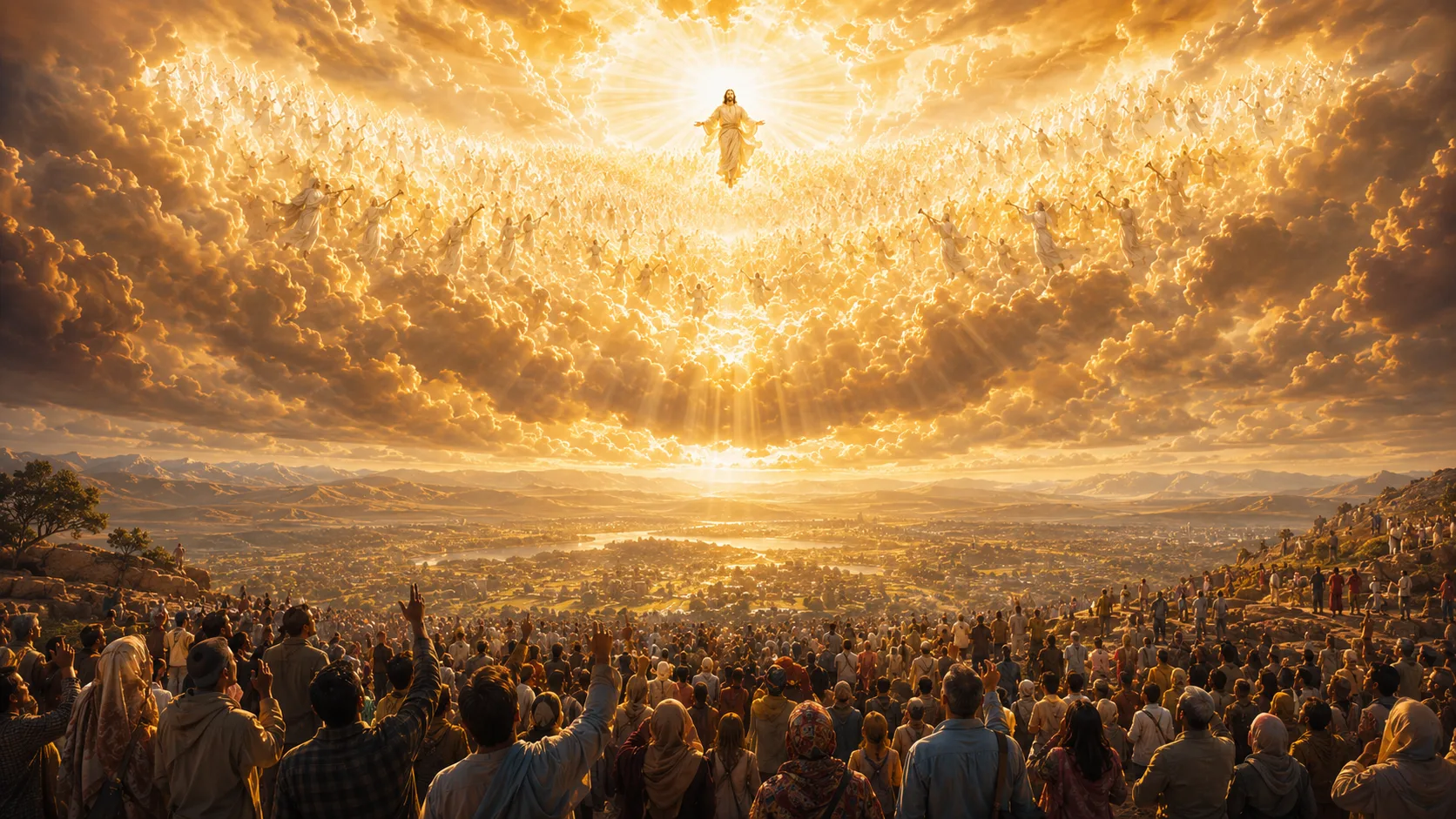
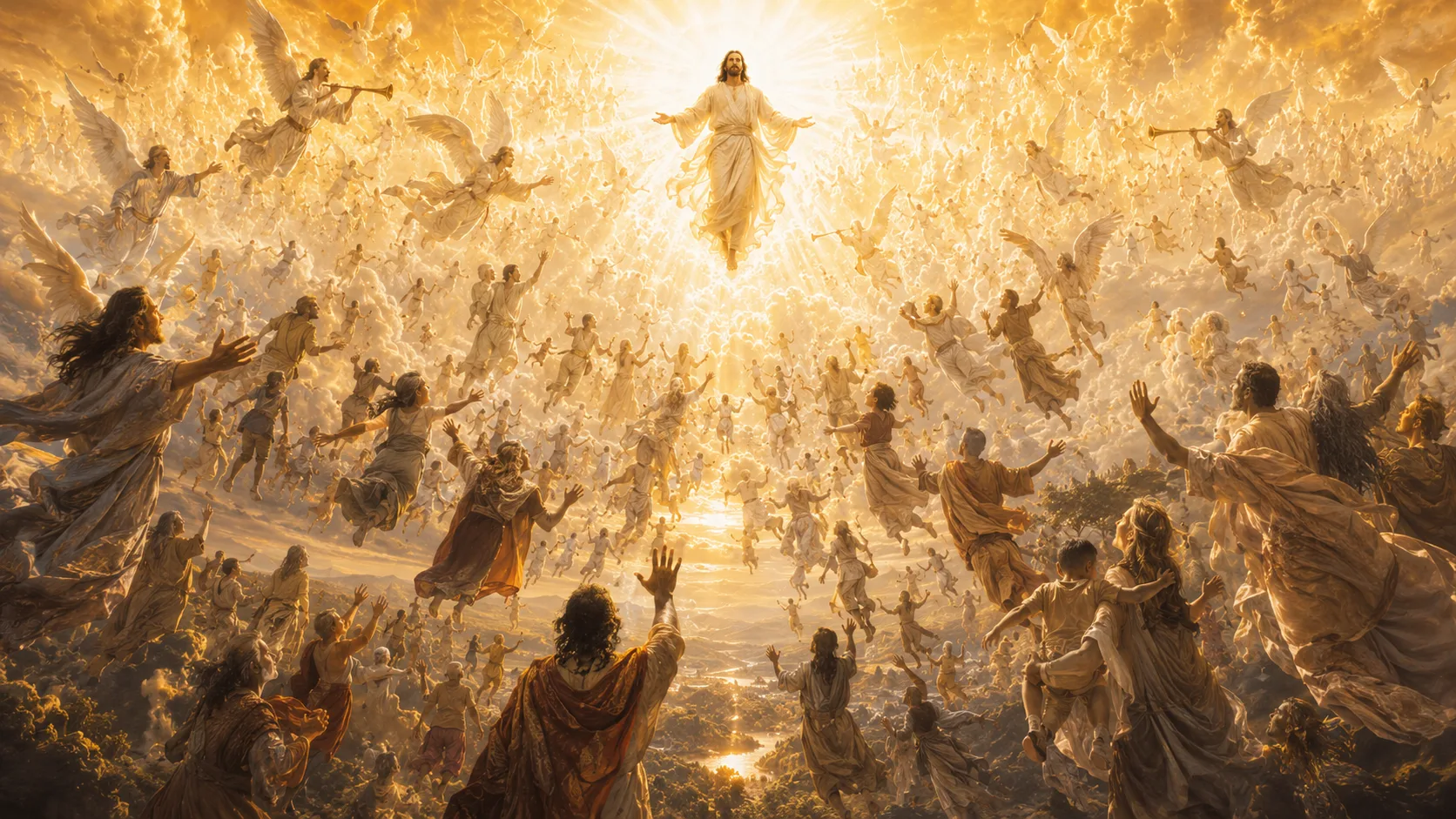
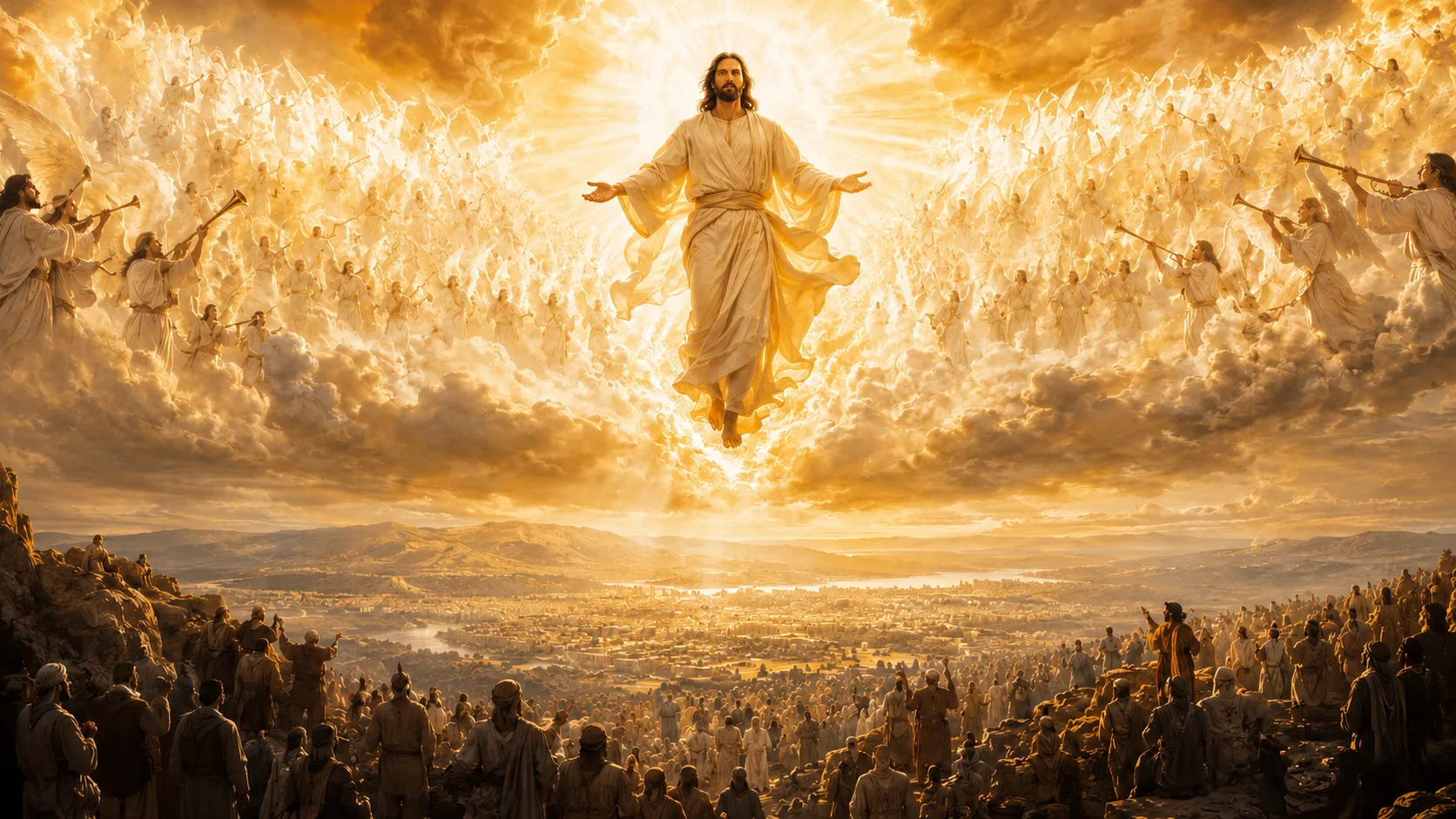
No event in the future of this earth is described in Scripture with more precision than the manner of Christ’s return — and no event is more thoroughly confused by modern Christianity. This lesson walks what the Bible actually says: how He returns, what every eye will see, and which counterfeits to refuse in advance.
Four words, drawn directly from Scripture’s own descriptions of the second coming, organise the lesson: personal, visible, audible, and unmistakable. The same Jesus Who ascended bodily from the Mount of Olives in the sight of the disciples returns bodily, visibly to every eye on the inhabited earth, audibly with the trump of God and the shout of the descending Lord, and accompanied by all the holy angels in the glory of His Father. There is one return, not two. There is no secret prior phase. There is no invisible Pentecost-style spiritualisation of the event. There are no claimants in desert places or secret chambers. The willing reader who has received the substance of the preceding fourteen lessons is now invited to receive the climactic event toward which the whole biblical narrative has been moving.
Two preliminary observations frame the chapter. First, the manner of Christ’s return is one of the most heavily-protected revelations in the New Testament. Christ Himself, before His own crucifixion, gave the disciples on Olivet an entire discourse warning against the counterfeits His enemies would mount in the last days (Matt 24:4–27). The apostles repeated the instruction in nearly every epistle. The repetition is the protection: the believer who knows the marks of the real return is the believer who is immune to the counterfeits when they arrive. Second, the closing-hour confederacy of Lesson 14 will produce deceptive manifestations on a global scale. Revelation 16:13–14 names them: spirits of devils, working miracles, which go forth unto the kings of the earth and of the whole world. 2 Thessalonians 2:9 names them again: after the working of Satan with all power and signs and lying wonders. The lesson is not a speculative exercise; it is a defensive briefing.
Question 01
Why did Christ Himself give such detail on the manner of His return?
Answer
And Jesus answered and said unto them, Take heed that no man deceive you. For many shall come in my name, saying, I am Christ; and shall deceive many… And many false prophets shall rise, and shall deceive many… For there shall arise false Christs, and false prophets, and shall shew great signs and wonders; insomuch that, if it were possible, they shall deceive the very elect.
The Olivet discourse opens not with the description of the coming itself but with the warning against the impersonations of the coming. Christ’s pastoral priority is the protection of His people, and He treats the threat as serious enough to mention four separate times in the chapter (vv. 4–5, 11, 23–26, 24). The institute commends to the willing reader the same prioritisation: receive the marks of the real return so firmly that no counterfeit can dislodge them when enforcement, deception, or both arrive.
Even him, whose coming is after the working of Satan with all power and signs and lying wonders, and with all deceivableness of unrighteousness in them that perish; because they received not the love of the truth, that they might be saved.
Paul names the closing-hour deception as a coordinated manifestation of Satanic power, working signs and lying wonders for the purpose of deceiving. The defence Paul names is not a clever technique but a substance: the love of the truth. The believer who has received the truth of Scripture, including the marks of the real return, will recognise the counterfeit by its deviation from the marks. The believer who has only a sentimental religious feeling, without doctrinal anchor, will not. The defence is doctrinal.
Question 02
What did Christ explicitly rule out about the manner of His return?
Answer
Then if any man shall say unto you, Lo, here is Christ, or there; believe it not. For there shall arise false Christs, and false prophets, and shall shew great signs and wonders; insomuch that, if it were possible, they shall deceive the very elect. Behold, I have told you before. Wherefore if they shall say unto you, Behold, he is in the desert; go not forth: behold, he is in the secret chambers; believe it not. For as the lightning cometh out of the east, and shineth even unto the west; so shall also the coming of the Son of man be.
Four explicit negations are stacked in five verses, and each one rules out a class of counterfeit:
- “Lo, here is Christ, or there.” The real return is not localised to a particular spot to which travel is required. Any claim of the form “Christ has appeared in location X” is ruled out.
- “Behold, he is in the desert.” Christ rules out remote-place return claims — the desert hermit, the wilderness prophet, the off-grid teacher. Some twentieth- and twenty-first-century claimants have arisen in precisely such settings.
- “Behold, he is in the secret chambers.” Christ rules out esoteric and private-revelation claims — the inner-circle vision, the channelled communication, the spiritual-but-not-physical inward Christ. The spiritualist and contactee branches of modern religious experience fall under the warning.
- “As the lightning cometh out of the east, and shineth even unto the west.” The positive substitute for every counterfeit. The real return is universally and simultaneously visible — a single event seen by the whole inhabited surface as a lightning-flash is seen across the sky. No travel required, no special access required, no secret chamber.
The willing reader who has heard Christ’s instruction in His own voice now has an explicit diagnostic for every claim that will be made under the name of the second coming between this hour and the real return. Localised? Refused. Hermitic or wilderness-based? Refused. Esoteric or private-revelation? Refused. Anything other than a globally visible, lightning-flash, every-eye event? Refused. The protection is in the diagnostic.
Question 03
Personal — what does Scripture say about who returns?
Answer
And when he had spoken these things, while they beheld, he was taken up; and a cloud received him out of their sight. And while they looked stedfastly toward heaven as he went up, behold, two men stood by them in white apparel; which also said, Ye men of Galilee, why stand ye gazing up into heaven? this same Jesus, which is taken up from you into heaven, shall so come in like manner as ye have seen him go into heaven.
Five elements deserve emphasis in the angels’ message at the ascension. This same Jesus: the identical Person Who walked Galilee, Who ate fish with the disciples, Who showed Thomas the prints in His hands and side. Which is taken up: He went up bodily, not by spiritualisation. Shall so come: He returns the same way. In like manner: bodily, visibly, observably. As ye have seen him go: as the disciples watched the ascension with their own eyes, every believer at the return will see the descent with their own eyes. The angelic statement settles the personal nature of the return in one sentence.
Let not your heart be troubled: ye believe in God, believe also in me. In my Father’s house are many mansions: if it were not so, I would have told you. I go to prepare a place for you. And if I go and prepare a place for you, I will come again, and receive you unto myself; that where I am, there ye may be also.
Christ’s own promise to the disciples on the night before His crucifixion is the tender first-person anchor of the doctrine. The return is described in the most personal possible terms: I will come again — not a representative, not a spirit, not a movement, but the Lord Himself. And receive you unto myself — the purpose of the coming is the gathering of His people to His presence. That where I am, there ye may be also — the destination of the gathering is the place He has gone to prepare in the Father’s house. The blessed hope of the believer is not the abolition of personal identity in some abstract eternal merger; it is the personal welcome of the believer by the Lord, into the Father’s house, to be where He is. The institute commends the promise as Christ Himself gave it.
For the Lord himself shall descend from heaven with a shout…
Paul reinforces the personal element: the Lord himself. Not an angel deputed to the task. Not the Holy Spirit in a new manifestation. Not the church gathered in a corporate Christ-event. The Lord Himself.
Question 04
Visible — what does Scripture say about every eye?
Answer
Behold, he cometh with clouds; and every eye shall see him, and they also which pierced him: and all kindreds of the earth shall wail because of him. Even so, Amen.
The first chapter of the Apocalypse sets the universal visibility of the return in one verse. Every eye shall see him. All kindreds of the earth. And, by name, they also which pierced him — meaning the soldiers and the rulers responsible for the crucifixion, raised at the special resurrection of Daniel 12:2 (cf. Matt 26:64 in Lesson 12) to behold the return of the One they crucified. The verse closes with the apostolic Even so, Amen: a personal ratification by John of the doctrine he has just stated.
And then shall appear the sign of the Son of man in heaven: and then shall all the tribes of the earth mourn, and they shall see the Son of man coming in the clouds of heaven with power and great glory.
And then shall they see the Son of man coming in the clouds with great power and glory.
And then shall they see the Son of man coming in a cloud with power and great glory.
Three of the four Gospels record the same statement of Christ Himself: at the return, they shall see the Son of man coming. The triple attestation in the synoptic Gospels — one of the most repeated statements of Christ across the four — sets the visibility of the coming on the most secure textual basis in the New Testament. The biblical cosmology in which Scripture consistently presents the earth coheres naturally with the prophecy: the inhabited surface as a stationary enclosed plane under the heavens of God’s creation is precisely the setting in which a globally visible appearance of the Lord above is, in the most natural reading of the text, observable from every quarter at once. The willing reader is invited to receive the prophecy as Scripture states it and let the cosmological details cohere as Scripture itself supplies them elsewhere.
Question 05
Audible — what does Scripture say about every ear?
Answer
For the Lord himself shall descend from heaven with a shout, with the voice of the archangel, and with the trump of God: and the dead in Christ shall rise first: then we which are alive and remain shall be caught up together with them in the clouds, to meet the Lord in the air: and so shall we ever be with the Lord.
Three audible elements arrive together at the descent. First, the Lord’s own shout — the commanding voice of the Lifegiver Himself, calling His sleeping people from their graves. Second, the voice of the archangel — the angelic herald accompanying the descent. Third, the trump of God — the same trumpet Paul names elsewhere as the last trump (1 Cor 15:52) and Christ names in the Olivet discourse as the trumpet by which the angels gather the elect (Matt 24:31). The auditory profile of the return is unmistakable, global, and impossible to suppress. There is no quiet return.
And he shall send his angels with a great sound of a trumpet, and they shall gather together his elect from the four winds, from one end of heaven to the other.
The phrasing great sound is the Greek phones megales — a loud, mighty, all-reaching sound. The trumpet of the return is not a delicate signal heard by the sensitive few; it is a sound covering the whole inhabited surface. The willing reader who has been taught that the second coming will arrive silently and invisibly should weigh the apostolic vocabulary against the inherited expectation.
Behold, I shew you a mystery; We shall not all sleep, but we shall all be changed, in a moment, in the twinkling of an eye, at the last trump: for the trumpet shall sound, and the dead shall be raised incorruptible, and we shall be changed.
Paul fixes the timing of the resurrection of the believing dead at the last trump — the same trump 1 Thess 4 names, the same trump Matt 24 names. There is no resurrection at an earlier trump; there is the resurrection, at the last. The popular two-stage rapture doctrine, with the believing dead raised seven years before the public coming, requires a prior trump Scripture does not record.
Question 06
Unmistakable — with what does the Lord return?
Answer
For the Son of man shall come in the glory of his Father with his angels; and then he shall reward every man according to his works.
When the Son of man shall come in his glory, and all the holy angels with him, then shall he sit upon the throne of his glory.
And to you who are troubled rest with us, when the Lord Jesus shall be revealed from heaven with his mighty angels, in flaming fire taking vengeance on them that know not God, and that obey not the gospel of our Lord Jesus Christ.
And Enoch also, the seventh from Adam, prophesied of these, saying, Behold, the Lord cometh with ten thousands of his saints, to execute judgment upon all, and to convince all that are ungodly among them of all their ungodly deeds.
The accompaniment of the return is set out by Christ Himself, by Paul, and by an apostolic citation of one of the oldest prophecies in Scripture (Enoch’s, from the seventh generation from Adam). Four elements appear together. The glory of His Father — the visible manifestation of divine majesty, the same glory seen briefly at the transfiguration (Matt 17:2–5). All the holy angels — not one or two attendants but the entire heavenly host. Flaming fire — the visible token of judgement on the impenitent at the moment of the descent. Ten thousands of His saints — the saints from heaven, brought with Him at the descent (1 Thess 4:14, those that sleep in Jesus, God shall bring with Him). The return is the most glorious event the inhabited earth has ever witnessed; it is, on Scripture’s own description, the precise opposite of a quiet, secret, or spiritualised event.
Question 07
What is the order of events at the descent?
Answer
Drawing the apostolic descriptions together, the sequence is precise. The willing reader is invited to follow it step by step:
- The Lord Himself descends from heaven (1 Thess 4:16), with the cloud of angels (Matt 25:31), in the glory of His Father (Matt 16:27).
- The sign of the Son of man appears (Matt 24:30): a visible, unmistakable announcement of the descent across the inhabited heaven.
- The shout, the voice of the archangel, and the trump of God sound (1 Thess 4:16; 1 Cor 15:52): the audible threefold call that wakes the sleeping believers.
- The dead in Christ rise first (1 Thess 4:16; Jn 5:28–29). The believing dead, asleep in the graves since the apostolic age, are raised first — raised incorruptible, glorified, recognisable, embodied (1 Cor 15:42–44, 51–54).
- The living believers are changed in a moment (1 Cor 15:51–52). The mortal puts on immortality. The corruptible puts on incorruption. The transformation is instantaneous — in the twinkling of an eye.
- The raised dead and the changed living are caught up together (1 Thess 4:17) to meet the Lord in the air. The two groups unite in a single embodied company, raised and transformed, and meet Christ together. Not two events. One event. The whole company gathered at one moment.
- The wicked are slain by the brightness of His coming (2 Thess 2:8). The impenitent are not removed for a later seven-year tribulation under a personal antichrist; they are destroyed at the descent itself, in the apocalyptic settlement of Rev 6:15–17 and 19:21. The judgement of the executive lake of fire awaits the second resurrection at the close of the millennium (Lesson 16).
The order presupposes the state of the dead recovered in Lesson 9 and the doctrine of the destruction of the wicked recovered in Lesson 10. The two doctrines together rule out the dispensational rapture (which requires the believing dead to be already alive in heaven at a prior moment, contradicting Lesson 9) and the eternal-torment framework of the popular doctrine (which requires the wicked to be already conscious in fire prior to the second resurrection, contradicting Lesson 10). The whole apostolic eschatology coheres as a unit on the recovered biblical doctrines of the previous lessons.
Question 08
What did Christ Himself promise to the disciples in His own voice?
Answer
Let not your heart be troubled: ye believe in God, believe also in me. In my Father’s house are many mansions: if it were not so, I would have told you. I go to prepare a place for you. And if I go and prepare a place for you, I will come again, and receive you unto myself; that where I am, there ye may be also.
The setting is the upper room, the night before the crucifixion. The disciples are troubled. Christ has just spoken of His departure, of betrayal, of the swords that are coming. And the first thing He says, before any other word of comfort, is the assurance of the return: I will come again. The whole apostolic doctrine of the second coming is anchored in this first-person promise in Christ’s own voice. Five claims arrive together in three short verses:
- “Ye believe in God, believe also in me.” Christ places His own person on the same plane of trust as the Father. Belief in God and belief in the begotten Son are not two separate operations; they are one apostolic confidence directed to the Father through the Son.
- “In my Father’s house are many mansions.” The destination of the gathering is not a vague spiritual continuation; it is the Father’s house. Many mansions: room for every redeemed believer, individually prepared.
- “I go to prepare a place for you.” The ascended Christ is now actively preparing the inheritance, between the ascension and the return. The two-thousand-year interval between His departure and His return is not empty; it is the season of His high-priestly preparation (Lesson 11) and the preparation of the home.
- “I will come again.” First-person, future tense, indicative. Not a representative, not a movement, not a spirit. I will come. The personal commitment of the Lord.
- “And receive you unto myself; that where I am, there ye may be also.” The purpose of the return is the gathering of the believer to the personal presence of Christ. The blessed hope is not abstract; it is a Person, met by name, in the place He has prepared for the believer personally.
The promise is the load-bearing assurance of the believer’s closing-hour hope. Where every preceding lesson has set out doctrines that require the believer to relinquish inherited misconceptions — the immortal soul, eternal conscious torment, the change of the Sabbath, the futurist eschatology — this lesson sets out the promise that anchors the whole revision: Christ Himself is coming back for His people, and the rest of the story arrives with Him. The willing reader is invited to hold the promise as Christ gave it, in His own voice, on the night before He shed His blood for the believer’s sins.
Question 09
What are the major modern counterfeits of the second coming?
Answer
Five major counterfeits of the second coming circulate in the modern church and the modern religious marketplace. Each one is addressed in its own terms below:
| Counterfeit | Why the text resists it |
|---|---|
| The secret pre-tribulation rapture (dispensational) | The teaching that Christ will return invisibly to remove the church seven years before His public second coming was an innovation of John Nelson Darby in the 1830s; no commentator in the previous eighteen centuries had read the New Testament that way. The texts do not support a two-stage return. 1 Thessalonians 4:16 is anything but quiet: "the Lord himself shall descend from heaven with a shout, with the voice of the archangel, and with the trump of God." 1 Corinthians 15:52 dates the resurrection of the dead at "the last trump" — not at a prior trump. Matthew 24:30–31 says all the tribes of the earth shall mourn at His coming and shall see Him directly. The "one taken, one left" of Matthew 24:40–41 is in the context of the sweeping destruction of the wicked at the coming (the flood pattern of vv. 37–39: those left were left dead) — not the removal of the church before a tribulation. There is one return, not two. |
| Christ has already returned invisibly (1914, AD 70, or any prior date) | The Jehovah's Witnesses' "invisible 1914 presence" reading and the various preterist "AD 70 return" readings share a common defect: they require Christ's explicit, repeated, unambiguous description of the return as visible and global to be reinterpreted as something else. Revelation 1:7 says "every eye shall see him, and they also which pierced him." Matthew 24:30 says "all the tribes of the earth… shall see the Son of man coming." Acts 1:11 says He will return "in like manner as ye have seen him go into heaven" — and He ascended bodily, visibly, with the disciples watching. An invisible return contradicts the apostolic gospel at the surface of its own language. |
| Christ is now appearing as a man on earth (claimant traditions) | Christ Himself ruled this out in advance in the Olivet discourse: "Then if any man shall say unto you, Lo, here is Christ, or there; believe it not. For there shall arise false Christs, and false prophets, and shall shew great signs and wonders… Wherefore if they shall say unto you, Behold, he is in the desert; go not forth: behold, he is in the secret chambers; believe it not. For as the lightning cometh out of the east, and shineth even unto the west; so shall also the coming of the Son of man be" (Matt 24:23–27). Any claimant who appears as a man on earth, in a particular location requiring travel to encounter, is the precise profile Christ said to refuse. Joseph Smith, Sun Myung Moon, the various twentieth-century Indian and Brazilian self-proclaimed Christs, and every future variant fall under the warning by name. |
| Postmillennial gradual transformation — Christ "returns" through cultural Christianisation | The postmillennial reading treats the kingdom of God as the gradual moral transformation of the world through the success of the gospel, with Christ "returning" in the sense of cultural triumph rather than personal descent. The reading flourished in the optimistic nineteenth century, did not survive the twentieth, and now persists mainly in theocratic-Reconstructionist circles. Scripture, however, names the return as a personal, datable, observable event terminating the present age (Matt 24:36; Acts 1:11; 1 Thess 4:16; Rev 1:7). Paul corrects the same misreading in his own day: "as it was in the days of Noe, so shall it be also in the days of the Son of man… they did eat, they drank, they married wives, they were given in marriage, until the day that Noe entered into the ark, and the flood came, and destroyed them all" (Lk 17:26–27). Cultural Christianisation is not what arrives; flood-pattern interruption of business-as-usual is. |
| Alien-contact / ascended-master "Christ" manifestations (closing-hour spiritualist deception) | A growing body of contemporary contactee literature, channelled-spirit communications, near-death-experience reports, and ufological New-Age teaching presents an "ascended Christ" or a benevolent extraterrestrial mediator offering guidance to the human race. Lesson 9 walked the doorway through which these manifestations enter — the immortal-soul doctrine — and the institute’s library treats the closing-hour deception in detail. Christ Himself ruled the entire category out in advance: His return is personal, visible globally, audible globally, with the holy angels and not a confederacy of "ascended masters," and accompanied by the trump of God rather than the soft voice of a channelled spirit. Every counterfeit on this branch is, by the institute's reading, a manifestation of the spirits of devils preparing the world for the final crisis Revelation 16 names. |
On the alien-contact and ascended-master branch in particular, two library articles walk the closing-hour deception in detail: UFOs and the Spirits of Devils and The Spirits of Devils and the Closing Crisis. Lesson 9’s treatment of the state of the dead supplies the doctrinal foundation; the library articles supply the contemporary case. Whatever physical or psychic manifestations appear in the closing hours under the banner of an “ascended Christ” or a benevolent extraterrestrial mediator, the willing reader who has received this lesson has the diagnostic and the refusal already in place.
A note on what is being corrected
This lesson is not addressed against the millions of sincere evangelical believers who have been taught the dispensational secret-rapture doctrine from childhood, and who have built their entire framework of hope around a coming Christ they expect to meet in the air seven years before the public return. The substance of their hope — that Christ is coming back personally for His people — is the apostolic hope, and the institute affirms it without reservation. What the lesson corrects is the chronological framework that has been overlaid on the hope, a framework that did not exist in any Christian tradition before John Nelson Darby in the 1830s, and that requires the apostolic descriptions of one return to be retro-fitted into two. The willing evangelical reader is invited to hold the apostolic hope without the dispensational chronology, and to find in the simpler reading a hope that is at least as strong and considerably less burdened by the speculative timelines the dispensational system has had to keep adjusting across two centuries. The doctrine corrected is the doctrine, not the love.
Question 10
What does this hope call for from the willing reader?
Answer
Beloved, now are we the sons of God, and it doth not yet appear what we shall be: but we know that, when he shall appear, we shall be like him; for we shall see him as he is. And every man that hath this hope in him purifieth himself, even as he is pure.
John names the moral consequence of the hope directly: every man that hath this hope in him purifieth himself, even as he is pure. The blessed hope is not a sedative on conscience; it is a sanctifier of life. The believer who is genuinely waiting for the personal return of Christ is the believer who lets the expectation work on the heart and the habits, day by day, until the day arrives.
For the grace of God that bringeth salvation hath appeared to all men, teaching us that, denying ungodliness and worldly lusts, we should live soberly, righteously, and godly, in this present world; looking for that blessed hope, and the glorious appearing of the great God and our Saviour Jesus Christ; who gave himself for us, that he might redeem us from all iniquity, and purify unto himself a peculiar people, zealous of good works.
Paul names two postures together. Negative: denying ungodliness and worldly lusts. Positive: living soberly, righteously, and godly, in this present world; looking for that blessed hope. The two postures belong together. The believer who looks for the appearing is the believer who is being shaped by the looking. The looking is sober, not anxious; it is righteous, not passive; it is godly, not speculative; and it is set in this present world, not deferred to a future spirituality. The blessed hope is a present-tense sanctifier.
So Christ was once offered to bear the sins of many; and unto them that look for him shall he appear the second time without sin unto salvation.
And the very God of peace sanctify you wholly; and I pray God your whole spirit and soul and body be preserved blameless unto the coming of our Lord Jesus Christ.
The willing reader who has heard the lesson, who has received the personal promise in Christ’s own voice, and who is now invited to walk the looking-for-Him life, is given Paul’s apostolic benediction as the prayer of the institute on the reader’s behalf: the very God of peace sanctify you wholly; and I pray God your whole spirit and soul and body be preserved blameless unto the coming of our Lord Jesus Christ. The hope is the destination; the sanctification is the road; the God of peace is the One Who carries the believer the whole distance.
Summary of Lesson 15
- Christ’s return is described in Scripture with unusual precision precisely because the closing-hour confederacy will produce counterfeit manifestations (Matt 24:24; 2 Thess 2:9). The detail is the protection.
- Christ explicitly ruled out localised, hermitic, secret-chamber, and esoteric return claims (Matt 24:23–26). The positive marker is universal visibility: as the lightning… so shall also the coming of the Son of man be.
- Personal: this same Jesus (Acts 1:11); the Lord himself (1 Thess 4:16); I will come again, and receive you unto myself (Jn 14:3).
- Visible: every eye shall see him (Rev 1:7); they shall see the Son of man coming in the clouds of heaven with power and great glory (Matt 24:30; Mk 13:26; Lk 21:27).
- Audible: with a shout, with the voice of the archangel, and with the trump of God (1 Thess 4:16); at the last trump (1 Cor 15:52); a great sound of a trumpet (Matt 24:31).
- Unmistakable: in the glory of his Father with his angels (Matt 16:27); all the holy angels with him (Matt 25:31); in flaming fire (2 Thess 1:7–8); ten thousands of his saints (Jude 14).
- The order at the descent: Lord descends — sign of the Son of man — shout, voice, trump — dead in Christ rise first — living believers changed — raised and changed caught up together — wicked slain by the brightness. One event, not two.
- Christ’s own promise of John 14:1–3 is the tender first-person anchor of the doctrine: I will come again, and receive you unto myself; that where I am, there ye may be also.
- Five major modern counterfeits are refused on the text’s own evidence: the secret pre-tribulation rapture (Darby’s 1830s innovation, no antecedent in eighteen centuries); already-returned-spiritually claims (Jehovah’s Witnesses 1914, preterist AD 70); Christ-as-a-man-on-earth claimants (Mormonism etc.); postmillennial gradual-transformation; and the alien-contact / ascended-master closing-hour spiritualist branch.
- The hope is a sanctifier: every man that hath this hope in him purifieth himself (1 Jn 3:3). The looking-for-Him life is sober, righteous, godly, and present-tense (Titus 2:12–13).
Personal response
The doctrine of the second coming is the blessed hope of the apostolic gospel and the climactic event of the biblical narrative. Through fifteen lessons the institute has walked the willing reader from the foundations of Scripture to the Father and His begotten Son, through the great controversy, the cross, the law and the Sabbath, the state of the dead, the destruction of the wicked, the judgement-hour ministry of Christ, the prophetic architecture of Daniel, the mark of the beast, the call to come out of Babylon, and the manner of the Lord’s return. One lesson remains: the new earth wherein dwelleth righteousness, with the millennium between the two resurrections and the executive judgement that finally ends the controversy. Before that lesson, the willing reader is invited to settle the question this lesson has raised: the personal return of Christ is the next event of magnitude on the prophetic calendar, and the institute commends the apostolic posture of looking for Him.
Father in heaven, the only true God, who sent Your Son to redeem us and who will send Him again to gather us, thank You for the plainness of Your word on the manner of His return. I have heard His own promise in His own voice: I will come again, and receive you unto myself; that where I am, there ye may be also. Place me, by Your grace, among those who look for His appearing. Sanctify my whole spirit and soul and body, and preserve me blameless unto the coming of our Lord Jesus Christ. Let no counterfeit deceive me. Let the lightning-flash visibility of His real return find me ready, watching, with my lamp trimmed and my garments clean. In the name of the same Jesus who is coming again, Amen.
From the manner of the return, the next and final lesson asks the closing question: what will the new earth be like? Scripture closes with the picture of a new heavens and a new earth wherein dwelleth righteousness — no more death, no more sorrow, no more pain, the tabernacle of God with men. Lesson 16 walks the millennium, the executive judgement, the desolation of the earth in the interval, and the final restoration to which the whole biblical story has been moving.
Foundational text
“Ye men of Galilee, why stand ye gazing up into heaven? this same Jesus, which is taken up from you into heaven, shall so come in like manner as ye have seen him go into heaven.”
— Acts 1:11