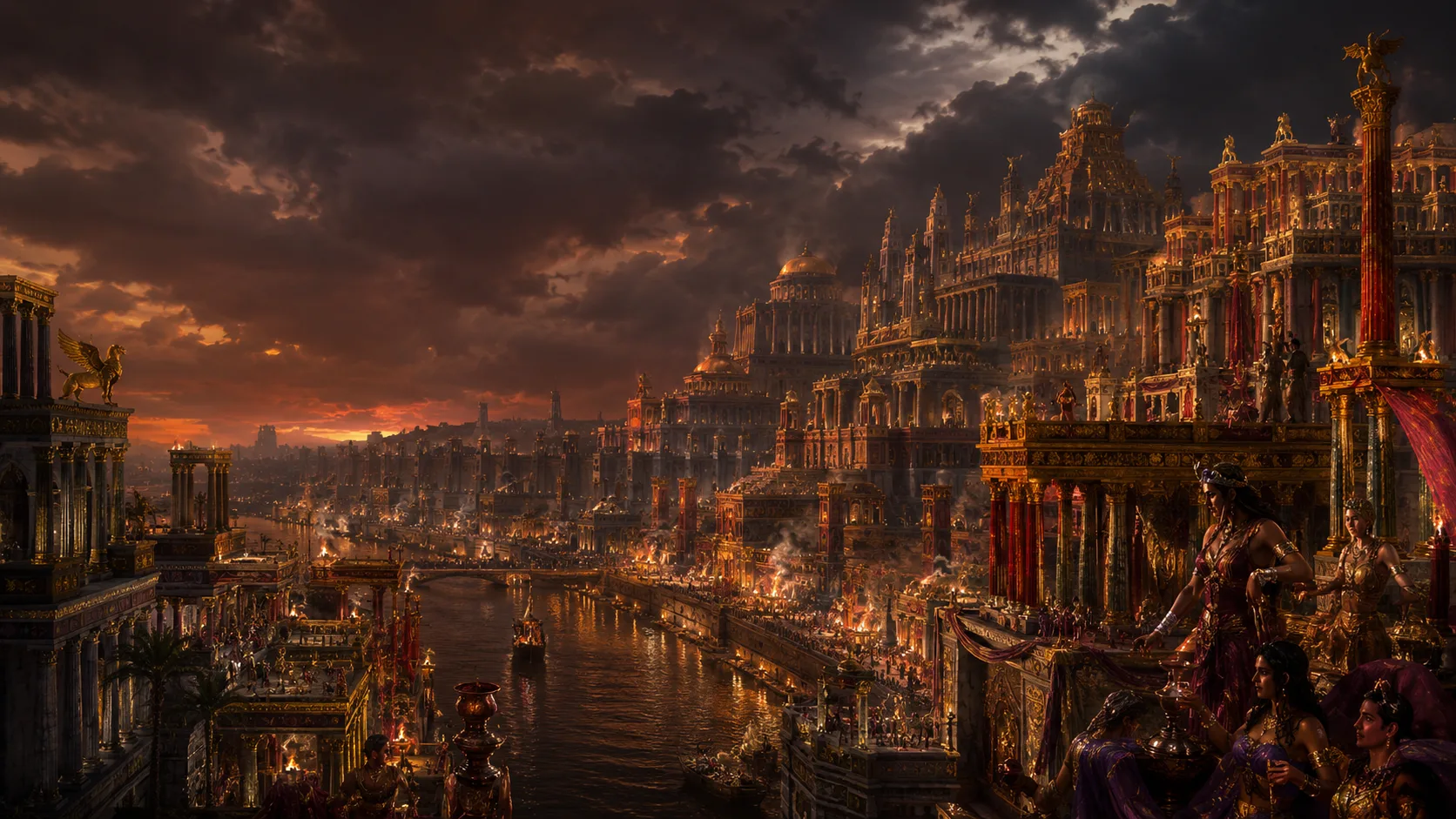
Revelation’s final-hour Babylon is a religious- political-economic system whose architecture Scripture describes in detail and whose identification John’s contemporary readers would have understood immediately. This lesson walks the seven identifying marks of Babylon, the first-century cipher behind the name, the seven mountains attested in Rome’s own literature, the threefold confederacy of the closing crisis, and the call from heaven that closes the prophecy: come out of her, my people.
Lesson 14 picks up where Lesson 13 closed. The first beast of Revelation 13 is the central religious figure of the closing crisis; the woman on the beast in Revelation 17 identifies the larger system of which the beast is the ridden mount. Babylon in Revelation is the religio-political-economic confederacy of all the systems of confused worship at the close of earth’s history — with the recovered Papacy at its centre, the apostate Protestant world allied with it, the spiritualist deception of Revelation 16 working through both, and the commercial-political structures of the inhabited earth bound to it by the wine of her doctrine and the gold of her commerce. The willing reader who has received Lessons 9, 12, and 13 already has the pieces. Lesson 14 sets them together and walks the call to come out.
Two preliminary observations frame the chapter. First, Revelation’s symbolic vocabulary is consistent with the Hebrew prophets and consistent within itself. A woman in prophecy is a church — faithful when chaste (Jer 6:2; 2 Cor 11:2; Eph 5:25–27; Rev 12:1; 19:7–8), apostate when adulterous (Ezek 16, 23; Hos 2; Rev 17:1–5). Waters are peoples (Rev 17:15). Wine is doctrine, mediated to the nations (Jer 51:7). Beasts are political powers (Dan 7:17, 23). The symbols are the symbols; the decoding is the decoding the Bible itself supplies. Second, Revelation 17:18 supplies the geographical identifier in plain language: the woman which thou sawest is that great city, which reigneth over the kings of the earth. John tells the reader the woman is a city, and a specific kind of city — the city that reigns over the kings of the earth at the moment of the prophecy. The willing reader is invited to identify the city.
Question 01
How does Revelation use the figure of a woman?
Answer
For I am jealous over you with godly jealousy: for I have espoused you to one husband, that I may present you as a chaste virgin to Christ.
Husbands, love your wives, even as Christ also loved the church, and gave himself for it… This is a great mystery: but I speak concerning Christ and the church.
And there appeared a great wonder in heaven; a woman clothed with the sun, and the moon under her feet, and upon her head a crown of twelve stars: and she being with child cried, travailing in birth, and pained to be delivered.
The faithful woman of Revelation 12 is the apostolic church — clothed with the gospel-light of the sun (the New Testament), standing on the moon (the Old Testament types reflecting the New), crowned with the twelve apostolic-and-patriarchal stars, bringing forth the man-child Christ. The faithful woman is the bride of Christ. Revelation 19:7–8 confirms the figure: the marriage of the Lamb is come, and his wife hath made herself ready.
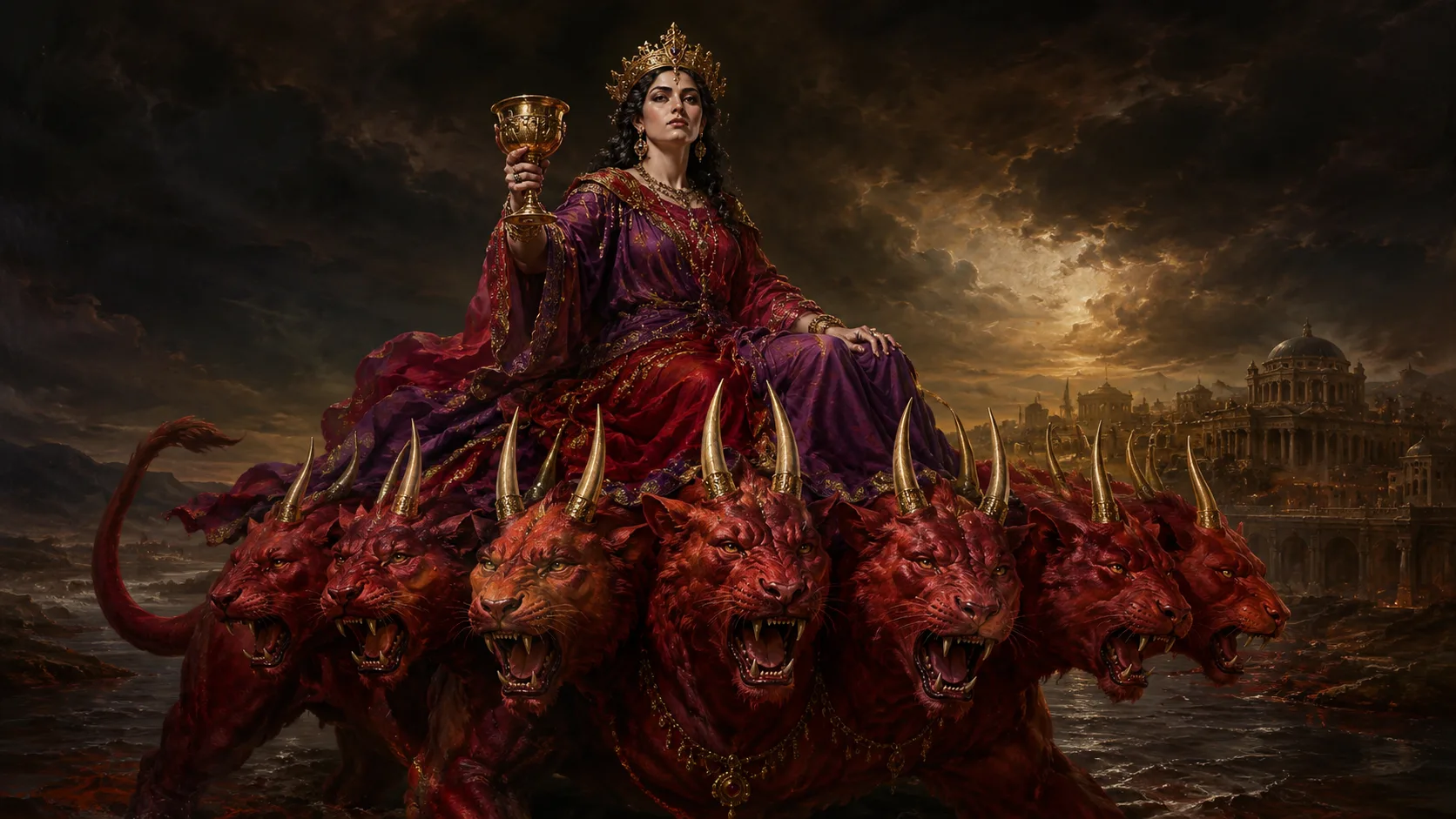
And there came one of the seven angels which had the seven vials, and talked with me, saying unto me, Come hither; I will shew unto thee the judgment of the great whore that sitteth upon many waters: with whom the kings of the earth have committed fornication, and the inhabitants of the earth have been made drunk with the wine of her fornication… And the woman was arrayed in purple and scarlet colour, and decked with gold and precious stones and pearls, having a golden cup in her hand full of abominations and filthiness of her fornication: and upon her forehead was a name written, MYSTERY, BABYLON THE GREAT, THE MOTHER OF HARLOTS AND ABOMINATIONS OF THE EARTH.
Set against the faithful woman of Revelation 12, the woman of Revelation 17 is the figure deliberately inverted — an apostate counterpart to the apostolic bride. Where the faithful woman brings forth Christ, the apostate woman brings forth fornication with the kings of the earth. Where the faithful woman is clothed with the sun of the gospel, the apostate woman is arrayed in the ecclesiastical purple and scarlet of human authority. Where the faithful woman holds the cup of the Lord’s Supper, the apostate woman holds a golden cup full of abominations and filthiness. Where the faithful woman’s name is the name of the Father in her forehead (Rev 14:1), the apostate woman’s name in her forehead is the name BABYLON.
Question 02
What are the seven identifying marks of Babylon in Revelation 17?
Answer
Revelation 17 supplies seven distinct identifying marks of Babylon. The willing reader is invited to read them off the text and ask what fits:
- Sitteth upon many waters (Rev 17:1, 15). The angel decodes the symbol in the chapter itself: the waters which thou sawest, where the whore sitteth, are peoples, and multitudes, and nations, and tongues. Babylon exerts universal jurisdiction over peoples, not over a single ethnic or national constituency. The Papacy holds the only such universal religious jurisdiction in the historical record.
- Arrayed in purple and scarlet (Rev 17:4). The two colours of the official ecclesiastical vestment of the Roman Catholic hierarchy — purple for the bishops, scarlet for the cardinals. Not metaphorical correspondence but visible, photographable correspondence on the public record of any consistory.
- Decked with gold, precious stones, and pearls (Rev 17:4). The material wealth of the system, accumulated across centuries of indulgences, papal-state revenues, the world’s largest single accumulation of religious artefact in the Vatican galleries, the global property and investment portfolio currently estimated in the hundreds of billions.
- Holding a golden cup full of abominations (Rev 17:4). Babylon mediates a mixed cup of doctrine to the nations: portions of the apostolic gospel intermingled with the abominations of unbiblical tradition. Revelation 18:23 names the mediation: by thy sorceries were all nations deceived — Greek pharmakeia, the inducement of belief by the seduction of mixed content rather than the clarity of apostolic truth.
- Name on her forehead, MYSTERY, BABYLON THE GREAT (Rev 17:5). Not a hidden identity, but an openly-displayed one: the name in the place of conviction, the public self-identification of the system. Mystery in the prophetic vocabulary (Greek mysterion) is the technical term for the secret doctrines of the post-apostolic mystery religions: the cults of Isis, Mithras, Cybele, Eleusis — the systems whose initiatory rites, celibate priesthoods, mediatorial intercessors, and sun-worship structures were absorbed into the apostate Christianity of the post-Constantinian centuries.
- Drunken with the blood of the saints, and with the blood of the martyrs of Jesus (Rev 17:6). Babylon is identified by the persecution of the people of God across centuries: the medieval inquisitions, the suppression of the Waldenses, the burning of Wyclif’s bones, the martyrdoms of Hus, Tyndale, Cranmer, Latimer, Ridley, the dragonnades, the Saint Bartholomew’s Day massacre, the Thirty Years’ War. The witness of the documentary historical record is unequivocal.
- The great city, which reigneth over the kings of the earth (Rev 17:18). The climactic identifier the prophecy supplies. The woman is identified explicitly as a specific city holding political ascendancy over the kings of the earth at the moment of the prophecy. Q3 walks the first-century identification.
Question 03
What did John’s first-century readers understand by “the great city, which reigneth over the kings of the earth”?
Answer
In the year John wrote the Apocalypse — tradition and internal evidence place it under Domitian, c. AD 95, John exiled to Patmos — only one city in the inhabited earth reigned over the kings of the earth. The Parthian empire to the east was a regional rival, but not a power before whom client kings appeared as Roman client kings did in the Senate. The remaining great kingdoms had long since fallen. There was one Rome, one Senate, one Caesar, and one city to which the kings of the earth came for confirmation. John’s readers, in the seven churches of Asia, lived under that city’s administration. The identification was immediate.
That apostolic Christians used the cipher Babylon for Rome is independently attested in the New Testament. Peter closes his first epistle with the greeting the church that is at Babylon, elected together with you, saluteth you; and so doth Marcus my son (1 Pet 5:13). Peter was not writing from Babylon on the Euphrates — a city by the AD 60s already largely depopulated and of no ecclesiastical significance. The patristic and Reformation consensus is that Peter is writing from Rome under the same apostolic cipher John would later use in Revelation: Babylon as the symbolic name for the imperial capital whose treatment of the apostles and the early church carried forward the spirit of Nebuchadnezzar.
Babylon, in our own John, is a figure of the city of Rome, as being equally great and proud of her sway, and triumphant over the saints.
Indeed, the holy church which is at this day in Rome, which Peter calls Babylon, by reason of its size and eminence.
The patristic Roman identification continues through the Reformation. Wyclif, Hus, Luther, Calvin, Zwingli, Tyndale, Knox, Bullinger, Cranmer, Latimer, Ridley, the Westminster framers, the Puritans, Newton, Wesley, and Edwards all read Babylon as the Papacy — the institution that inherited the Roman imperial structure and continued the persecution of the saints under ecclesiastical sanction. The Reformation Babylon is not the TAHBRI Babylon; the TAHBRI Babylon is the Reformation Babylon, retained where the modern church has surrendered it.
Question 04
What do the seven mountains of Revelation 17:9 identify?
Answer
And here is the mind which hath wisdom. The seven heads are seven mountains, on which the woman sitteth.
The angel supplies a second, parallel identifier alongside the city-that-reigneth-over-the-kings clue. The seven heads of the beast on which the woman sits are seven mountains. The Greek word is hora — mountains, hills, elevations. The phrasing invites the reader to locate a city seated on seven such elevations. Rome called itself by exactly this designation across centuries of its own literature, before John was born and after he wrote:
- Virgil, Aeneid 6.782–783 (29 BC): Rome, that famous queen, which on the seven hills (septem montibus) shall lift up her head among the nations of the earth.
- Horace, Carmen Saeculare 7 (17 BC): The gods who delight in the seven hills (septem colles).
- Propertius, Elegies 3.11.57 (c. 20 BC): The city set on its seven hills (septem urbs alta iugis) which presides over the whole world.
- Ovid, Tristia 1.5.69 (c. AD 8): Septem totidem iuga — the seven ridges of Rome.
- Martial, Epigrams 4.64 (c. AD 88): The seven sovereign hills (septem dominos montes).
- Cicero, Pliny, Juvenal, and Statius all use the same designation. Rome was known in its own contemporary literature as urbs septicollis — the seven-hilled city.
The seven hills of Rome were and are: the Aventine, the Caelian, the Capitoline, the Esquiline, the Palatine, the Quirinal, and the Viminal. The geographical identification is not a Protestant invention or an Adventist polemic; it is Rome’s own contemporary self-description, attested in Latin literature available in every standard university library. John wrote in the language of his readers, in the symbolic codes his readers would have understood immediately. The seven mountains decoded the woman’s seat in one phrase.
And there are seven kings: five are fallen, and one is, and the other is not yet come; and when he cometh, he must continue a short space. And the beast that was, and is not, even he is the eighth, and is of the seven, and goeth into perdition.
The seven heads have a second prophetic layer alongside the geographical seven mountains: seven kings, of which five had fallen, one was, and one was yet to come at the moment of writing. Read in the prophetic-history framework of Daniel 2 and 7, the five fallen kings are the major oppressing powers prior to Rome — Egypt, Assyria, Babylon, Medo-Persia, Greece; the one that is at John’s moment is pagan Rome; the seventh is the divided-Rome / papal phase that succeeds it; and the eighth that is of the seven is Babylon’s final confederate manifestation at the closing crisis, going into perdition at the second coming. Two layers, one identification — geographically Rome, historically the whole sequence of empires of confused worship of which Rome is the climactic seat.
Question 05
How does Babylon trace through the whole Bible from Genesis to Revelation?
Answer
And the whole earth was of one language, and of one speech… And they said one to another, Go to, let us build us a city and a tower, whose top may reach unto heaven; and let us make us a name, lest we be scattered abroad upon the face of the whole earth… Therefore is the name of it called Babel; because the Lord did there confound the language of all the earth.
Babylon’s origin is at Babel under Nimrod, in the post-flood generations of Genesis 11. The Babel project had three identifiable features that the later Babylon — and the later spiritual Babylon — would carry forward. First, defiance of God’s explicit command: God had told Noah’s sons to be fruitful and multiply and replenish the earth (Gen 9:1), and Babel was the program to gather and centralise lest we be scattered abroad. Second, false worship by human invention: a tower whose top would reach unto heaven, a human-engineered access to the divine independent of God’s appointed mediation. Third, the making of a name: let us make us a name, the project of human self-glorification under a religious banner.
Sit thou silent, and get thee into darkness, O daughter of the Chaldeans: for thou shalt no more be called, The lady of kingdoms… And thou saidst, I shall be a lady for ever… Therefore hear now this, thou that art given to pleasures, that dwellest carelessly, that sayest in thine heart, I am, and none else beside me; I shall not sit as a widow, neither shall I know the loss of children.
Isaiah’s rebuke of the historical Babylon of Nebuchadnezzar’s day employs the same language Revelation 18 will employ of the spiritual Babylon of the closing crisis. The lady of kingdoms; I sit a queen, and am no widow, and shall see no sorrow (cf. Rev 18:7); I am, and none else beside me (a Babylonian claim to deity that mirrors the beast’s blasphemies of Rev 13:5–6). The continuity is deliberate. The historical Babylon was the OT type; the spiritual Babylon of Revelation is the NT antitype.
The connecting tissue between the two is the mystery religion of ancient Babylon — sun-worship under various names (Bel, Marduk, Shamash); a mother-and-child cult around the goddess Ishtar (Semiramis in the later Hellenistic tradition) and her son Tammuz; a dying-and- rising fertility god; a celibate priesthood mediating between the people and the deities; an elaborate sacramental system of confessionals, indulgences, purifying rites, and intercessory prayers to the dead. Every one of those elements migrated, through the Hellenistic mystery religions of the post-Alexandrian Mediterranean, into the apostate Christianity of the post-Constantinian centuries. The Roman pontifex maximus, the chief priest of the Babylonian pagan-Roman synthesis, retained the title after the emperor surrendered it to the Bishop of Rome in the late fourth century. Babylon did not die at Cyrus’s conquest; Babylon migrated. The institution Revelation 17 identifies is the inheritor of the institutional and ritual structure the Bible has been tracing since Genesis 11.
Question 06
What is the threefold confederacy of the closing crisis?
Answer
And I saw three unclean spirits like frogs come out of the mouth of the dragon, and out of the mouth of the beast, and out of the mouth of the false prophet. For they are the spirits of devils, working miracles, which go forth unto the kings of the earth and of the whole world, to gather them to the battle of that great day of God Almighty.
Revelation names three distinct entities working in confederacy at the closing crisis, and each one has been introduced separately in earlier chapters. Read the three together with what Revelation has already supplied:
- The dragon — Satan working through paganism and modern spiritualism. Revelation 12 named the dragon directly: the great dragon was cast out, that old serpent, called the Devil, and Satan (Rev 12:9). Satan’s historical instrument prior to the apostolic age was pagan Rome; his closing-hour instrument is the spiritualist deception of Lesson 9 — mediums, channelled spirits, near-death-experience apparitions, deceased-loved-one appearances, the alien-contact phenomenon — all built on the immortal-soul doctrine the apostate church inherited from the Hellenistic mystery religions.
- The beast — the recovered Papacy. The first beast of Revelation 13 (Lessons 12 and 13). Wounded in 1798, healing across the nineteenth, twentieth, and twenty-first centuries, restored to global diplomatic and ecclesiastical reach, reasserting its claim to universal religious jurisdiction and named in Revelation 17 as the woman riding the beast.
- The false prophet — apostate Protestantism. The third entity of the closing confederacy is identified in Revelation 19:20 as the same entity that wrought miracles before the beast — the function of the second beast of Revelation 13:13–14, whose modern manifestation is apostate Protestantism: the evangelical, charismatic, and mainline traditions that have surrendered the recovered apostolic gospel of the Reformation, joined hands with Rome on Sunday observance, the immortal-soul doctrine, the orthodox- creedal formulas, and the ecumenical post-Vatican-II project, and that will, at the closing test, enforce religious legislation under civil-power sanction on behalf of the recovered first beast.
The threefold confederacy is the architecture of Revelation’s Babylon. Spiritualism, the Papacy, and apostate Protestantism set together: the dragon’s ancient enmity against Christ, channelled through the beast’s ecclesiastical apparatus, executed through the false prophet’s political reach. The closing- crisis Babylon is not one institution but a confederacy of three. Revelation 18 will address the call to come out of the whole architecture.
Question 07
What is the closing call of Revelation 18?
Answer
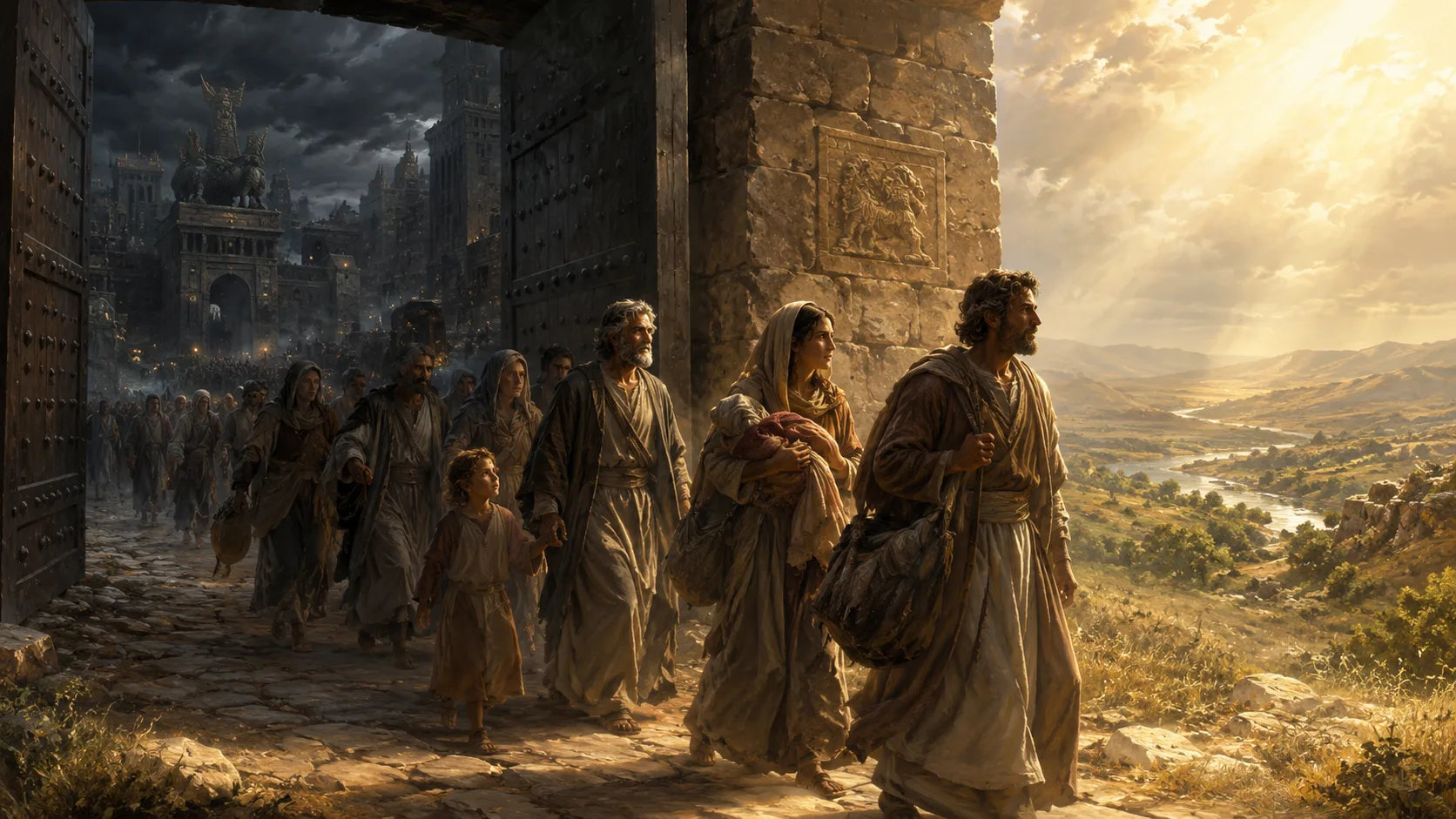
And after these things I saw another angel come down from heaven, having great power; and the earth was lightened with his glory. And he cried mightily with a strong voice, saying, Babylon the great is fallen, is fallen, and is become the habitation of devils, and the hold of every foul spirit, and a cage of every unclean and hateful bird. For all nations have drunk of the wine of the wrath of her fornication… And I heard another voice from heaven, saying, Come out of her, my people, that ye be not partakers of her sins, and that ye receive not of her plagues.
Three observations on the call. First, the angel of Revelation 18:1 lightens the earth with his glory. The closing message is not a sectarian whisper; it is a global proclamation, given to the entire inhabited earth, for every honest reader to hear and weigh. Second, the call presupposes God has people inside Babylon. My people, He calls them. The institute’s posture toward Christ’s sheep scattered across the systems is therefore not a posture of accusation but of recognition: they are His; the call is for their sake. Third, the timing of the call is the moment of Babylon’s fall — the moment her plagues are about to arrive. Come out of her, my people, that ye be not partakers of her sins, and that ye receive not of her plagues. The call is the protection of the willing heart from the consequences Babylon herself will bear.
And the merchants of the earth shall weep and mourn over her; for no man buyeth their merchandise any more: the merchandise of gold, and silver, and precious stones, and of pearls, and fine linen, and purple, and silk, and scarlet, and all thyine wood, and all manner vessels of ivory, and all manner vessels of most precious wood, and of brass, and iron, and marble, and cinnamon, and odours, and ointments, and frankincense, and wine, and oil, and fine flour, and wheat, and beasts, and sheep, and horses, and chariots, and slaves, and souls of men… for thy merchants were the great men of the earth; for by thy sorceries were all nations deceived.
Babylon is not only an ecclesiastical institution; she is a commercial network. The closing chapter records her trade with the merchants of the earth in twenty-eight categories of goods, ending with slaves, and souls of men. The combination of religious mediation with commercial penetration is one of Babylon’s signature characteristics, and the global economic structure of the contemporary Roman Catholic and Protestant ecumenical apparatus — the property holdings, the investment portfolios, the influence over commercial regulation in many jurisdictions, the global philanthropic networks — fulfil the prophecy at the institutional level visible on the public record.
Therefore shall her plagues come in one day, death, and mourning, and famine; and she shall be utterly burned with fire: for strong is the Lord God who judgeth her… Thus with violence shall that great city Babylon be thrown down, and shall be found no more at all.
The end of Babylon is total and sudden: in one day… in one hour… she shall be found no more at all. The fall is the executive judgement at the second coming, walked in Lesson 10 and to be detailed further in Lesson 15. The willing reader is invited to be outside Babylon when the day arrives — not because the date is imminent on a personal calendar, but because the call is given precisely so the answer can be made now, in the calm of understanding rather than the pressure of enforcement.
Question 08
What does Christ Himself say about the alternative to Babylon?
Answer
Revelation places Babylon and the heavenly city in explicit contrast across the closing chapters. Babylon is the city that gave the kings of the earth her wine of fornication; the New Jerusalem is the bride descending from heaven for the marriage of the Lamb. Babylon holds a golden cup full of abominations; Christ holds the fountain of the water of life. Babylon falls in an hour; the heavenly city stands for ever. The one is the counterfeit; the other is the original. And Christ Himself, in His own voice on the throne, names the alternative and the offer to the willing reader.
And he that sat upon the throne said, Behold, I make all things new… And he said unto me, It is done. I am Alpha and Omega, the beginning and the end. I will give unto him that is athirst of the fountain of the water of life freely.
Christ Himself, identified by the divine self-designation that belongs to Jehovah in the Hebrew prophets (Isa 41:4; 44:6; 48:12) and that Christ in His own voice applied to Himself across Revelation (1:8, 17; 22:13), names the offer. The thirsty reader is given the water of life, freely — without price, without sacramental mediation, without the golden cup of Babylon. The contrast is structural. Babylon’s wine is mixed with abominations and given in exchange for allegiance; Christ’s water of life is pure and given freely. The willing reader is invited to drink at the original fountain and to let Babylon’s cup pass.
And the Spirit and the bride say, Come. And let him that heareth say, Come. And let him that is athirst come. And whosoever will, let him take the water of life freely.
The closing invitation of the Bible echoes the offer. Come. Four times in one verse, in different voices — the Spirit’s, the bride’s, the hearing reader’s, and the universal invitation to the thirsty — one word stands at the centre of the call. Come — come out of Babylon, come to the Lamb, come to the water of life, come to the marriage supper, come to the inheritance the Father has prepared for them that love Him.
Question 09
What about the alternative readings of Babylon?
Answer
Five alternative readings of Revelation 17–18 circulate in the modern church and the modern academy. Each is addressed in its own terms below:
| Alternative reading | Why the text resists it |
|---|---|
| Babylon is first-century Rome only; the prophecy was fulfilled at AD 70 / Nero | Revelation 17:14 places Babylon at the moment "these shall make war with the Lamb, and the Lamb shall overcome them: for he is Lord of lords, and King of kings: and they that are with him are called, and chosen, and faithful." That moment is the second coming, not AD 70. Revelation 18:21 names Babylon’s destruction as final: "Thus with violence shall that great city Babylon be thrown down, and shall be found no more at all." The Rome of AD 70 was not thrown down at all, much less for ever; it continued for centuries as the seat of empire and then as the seat of the medieval Papacy. A first-century-Rome-only Babylon fails the explicit textual markers of the prophecy. |
| Babylon is unbelieving Jerusalem, destroyed in AD 70 (some Reformed preterism) | The identification rests on the parallels between Revelation 17’s harlot imagery and the Old Testament prophets’ rebuke of apostate Israel as adulterous (Hos 2; Ezek 16, 23). The parallel is real but the identification breaks on Revelation 17:18: "the woman which thou sawest is that great city, which reigneth over the kings of the earth." Jerusalem in the first century did not reign over the kings of the earth — Jerusalem was a tribute-paying province under Rome. Furthermore, the prophecy assigns Babylon’s destruction to "one hour" at the second coming (Rev 18:8, 10, 17, 19), not the protracted Roman siege of AD 67–70. The Jerusalem identification cannot bear the geopolitical and chronological markers the text supplies. |
| Babylon is a literal future rebuilt city of Babylon in Iraq (dispensational) | The reading requires a literal physical rebuilding of ancient Babylon to provide a stage for the prophecy — a rebuilding that contradicts Isaiah 13:19–22 and Jeremiah 51:62–64, where God Himself swears that Babylon shall be desolate "for ever" and shall not be inhabited "from generation to generation." The literal Babylon site near modern Hillah, Iraq, has stood ruined and unoccupied as a city for over two millennia, fulfilling the OT prophecy. A literal rebuilding to fulfil a New Testament prophecy would require God to reverse a sworn Old Testament prophecy. The dispensational reading also requires the seven mountains of Rev 17:9 to be in modern Iraq, where there are no seven mountains, rather than in Rome, where there famously are. |
| Babylon is a generic symbol of all human empire / consumerist civilisation | The reading is the modern non-confessional flight from any specific identification, treating Revelation as edifying generality rather than predictive prophecy. Revelation 17:18, however, says of the woman’s identity not "she symbolises all great cities" but "the woman which thou sawest IS that great city, which reigneth over the kings of the earth." Singular noun, specific referent, and a categorical "is." Generic readings are imported, not derived, and have to suppress the text’s own specificity to function. |
| Babylon is Jerusalem or pagan Rome, but emphatically not the Catholic Church (Catholic apologetic) | The Reformation read Babylon as the Papacy on the prophetic marks Daniel 7 and Revelation 13 supply (Lessons 12 and 13); the historicist Adventist reading continues the same identification on the same evidence. The Catholic apologetic alternative typically reroutes the prophecy either to first-century Jerusalem (preterism) or to pagan-Roman emperor-worship (a sub-preterism that severs Revelation 17 from its 1260-year arc and its second-coming terminus). Both reroutings require the text’s explicit time-markers to be ignored. The 1260 years run from AD 538 to AD 1798 (Dan 7:25; Rev 12:6, 14; 13:5; cross-referenced in Lessons 12 and 13); the seven-mountains marker fits Rome and only Rome; and the institutional features the prophecy assigns to Babylon — universal jurisdiction, purple-and-scarlet, the blood of the martyrs of Jesus, the global commerce in souls — fit the medieval-and-modern Papacy on the documentary record. |
Five alternatives, five failures. The historicist reading is the reading the text supports, the reading the Reformation recovered, and the reading the TAHBRI commends on the prophetic marks Revelation 17 itself supplies. Babylon is identifiable from the text, identifiable from the geography, identifiable from the history, and identifiable from the institutional self-presentation of the system on the documentary record. The willing reader is invited to weigh the evidence and answer the call.
A note on what is being recovered
The call of Revelation 18 is addressed to my people — Christ’s sheep scattered across every fold in confused Christianity. The institute reads the call as Christ Himself reads it: a tender summons to the willing heart in every Catholic parish, every evangelical congregation, every charismatic assembly, every mainline pew, every Eastern Orthodox sanctuary, every house church and prayer group, every secular reader of the New Testament who has ever loved Christ in the imperfect light their tradition gave them. The doctrine corrected is the structure, not the believer within it. The recovered apostolic gospel — the seventh-day Sabbath of the Creator, the state of the dead, the destruction of the wicked, the Father and the begotten Son of the apostolic confession, biblical authority over post-apostolic tradition, historicist prophetic understanding, the second-coming hope — is the substance to which the willing reader is being called. Come out is positive, not negative. The call is to the Lamb, not against the flock.
Question 10
What does the call to come out actually mean in practice?
Answer
The call to come out is, first, an allegiance shift before it is anything visible. The reader who has received the substance of the previous lessons in this course has already begun coming out of Babylon in the sense Scripture names. The visible expressions of the shift may follow at the pace of conviction and providence, and the institute commits no formula here. The substance is the substance:
- Allegiance to Scripture above tradition. The Reformation’s sola scriptura recovered; the post-apostolic tradition received only as it is consistent with the apostolic writings (Lesson 1).
- The Father as the only true God, and Christ as the begotten Son. The apostolic confession of 1 Cor 8:6 and 1 Tim 2:5 recovered; the imperial-orthodox creedal overlays of the post-Constantinian centuries received only as they consist with the apostolic confession (Lessons 2 and 3).
- The seventh-day Sabbath of creation recovered. The change of the day named by Rome herself as the mark of her authority refused in favour of the day God Himself sanctified at the close of creation week (Lessons 7, 8, and 13).
- The biblical state of the dead recovered. The doorway through which the spiritualist deception of the closing hour walks closed by the apostolic doctrine of the sleep of the dead and the resurrection at the personal return of Christ (Lesson 9).
- The destruction of the wicked recovered. The doctrine of eternal conscious torment refused in favour of the apostolic doctrine of the second death and the final cleansing of the universe of sin (Lesson 10).
- The historicist reading of prophecy recovered. The Reformation’s handling of Daniel and Revelation continued in preference to the dispensational, preterist, and liberal alternatives (Lessons 11, 12, 13).
- The closing-hour expectation and readiness. Watching, keeping the garments of Christ’s righteousness, holding the commandments of God and the faith of Jesus, awaiting the personal return of the Son of man with the clouds of heaven (Lessons 11, 13, 15–16 to come).
That substance is the substance of coming out of Babylon. The willing reader is not asked to convert to a label or sign a membership form; the willing reader is asked to receive the recovered apostolic faith, on Scripture’s own evidence, and to walk by the light given. The visible expressions of the allegiance shift — the day of worship kept, the Lord’s table approached, the fellowship sought, the call followed wherever providence sets the next door — will unfold for each reader at the pace the Spirit and Scripture set together. The institute commits one formula here only: the call is Christ’s, the substance is apostolic, and the invitation is open.
Summary of Lesson 14
- Revelation’s symbolic vocabulary is consistent with the Hebrew prophets: woman = church (faithful or apostate), waters = peoples, wine = doctrine, beasts = political powers.
- Babylon’s seven identifying marks (Rev 17): seated on many waters, arrayed in purple and scarlet, decked with gold/jewels/pearls, golden cup of abominations, MYSTERY BABYLON name in her forehead, drunken with the blood of the saints, and the great city that reigneth over the kings of the earth.
- The first-century city that reigned over the kings of the earth was Rome — uniquely and unambiguously. The apostolic cipher Babylon for Rome is attested in 1 Pet 5:13 and in Tertullian (c. AD 207) and Jerome (late 4th c).
- The seven mountains (Rev 17:9) are the seven hills of Rome — named as such across Rome’s own contemporary literature by Virgil, Horace, Propertius, Ovid, Martial, and others. Urbs septicollis.
- The seven kings (Rev 17:10–11) are the major oppressing powers in the prophetic sequence — Egypt, Assyria, Babylon, Medo-Persia, Greece, pagan Rome, papal Rome — with the eighth being Babylon’s final confederate manifestation.
- Babylon traces from Babel (Gen 11, Nimrod’s project) through historical Babylon (Isa 47) to spiritual Babylon (Rev 17–18) by the continuity of the mystery-religion structure — sun-worship, mother-and-child cult, dying-and-rising god, celibate priesthood, sacramental mediation, intercession with the dead.
- The threefold confederacy of Revelation 16:13–14 is the dragon (spiritualism, working through the immortal-soul deception of Lesson 9), the beast (the recovered Papacy of Lessons 12–13), and the false prophet (apostate Protestantism, allied with Rome at the closing test).
- The call of Revelation 18:4 is heaven’s closing invitation to Christ’s sheep within the confederacy: come out of her, my people. The call presupposes God’s people are inside Babylon at the moment of the call.
- Babylon’s fall is total, sudden, and final — in one hour, in one day, found no more at all (Rev 18:8, 17, 21). The destruction is the executive judgement at the second coming.
- Christ Himself in His own voice on the throne names the alternative: I am Alpha and Omega, the beginning and the end. I will give unto him that is athirst of the fountain of the water of life freely (Rev 21:5–6). Babylon’s golden cup of fornication set against the free water of life Christ offers from the throne.
- Coming out is, first, an allegiance shift to the recovered apostolic gospel: Scripture above tradition, the Father and the begotten Son, the seventh-day Sabbath, the state of the dead, the destruction of the wicked, historicist prophecy, the closing-hour expectation. The visible expressions follow at the pace of conviction and providence.
Personal response
The biblical identification of Babylon is, on first hearing, sobering. The institution is named, the system is described, the architecture of the closing-hour confederacy is laid bare. The institute’s pastoral priority is not to leave the willing reader in dread of the system but to lead the willing reader out of the system into the recovered apostolic gospel of the Father and His Son. Come out of her, my people is the call, and the call is to Christ; coming out of Babylon is at root coming into Christ on the terms the apostles set, with the recovered light of the Reformation and the doctrines of historic Adventism walked across thirteen previous lessons. The reader who hears the call is invited to answer.
Father in heaven, the only true God, the One who has called Your people out of Babylon in every generation, thank You for the plainness of Your word on the closing hour. I have seen the seven marks of Babylon. I have seen the seven mountains. I have heard Your Son’s call in His own voice: I am Alpha and Omega, the beginning and the end. I will give unto him that is athirst of the fountain of the water of life freely. Bring me out of every system of confused worship by the grace of Your Son, and into the recovered apostolic gospel. Let the water of life be my drink, the Sabbath of Your creation be my rest, the begotten Son of Your love be my Saviour, and the patience of the saints be my walk. In the name of Him who comes to make all things new, Jesus Christ. Amen.
From the call to come out, the next lesson asks the next question: how will Jesus return? Of every event on the prophetic calendar, none is described in Scripture with more precision than the manner of Christ’s return — personal, visible, audible, unmistakable, and refusing every counterfeit by which the spiritualist confederacy of the closing hour will attempt to imitate it. Lesson 15 walks the second coming on Scripture’s own terms.
Foundational text
“And I heard another voice from heaven, saying, Come out of her, my people, that ye be not partakers of her sins, and that ye receive not of her plagues.”
— Revelation 18:4