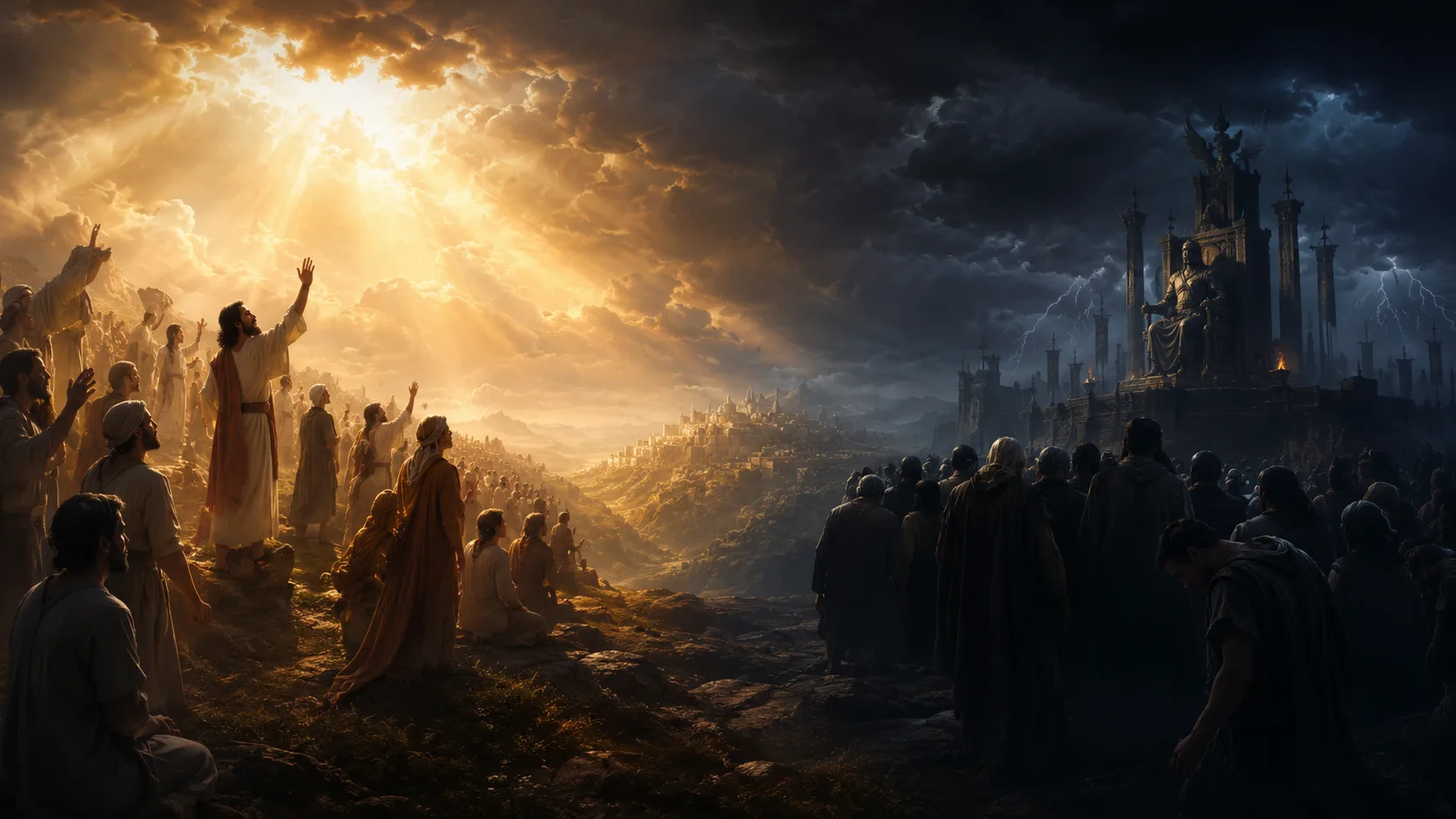
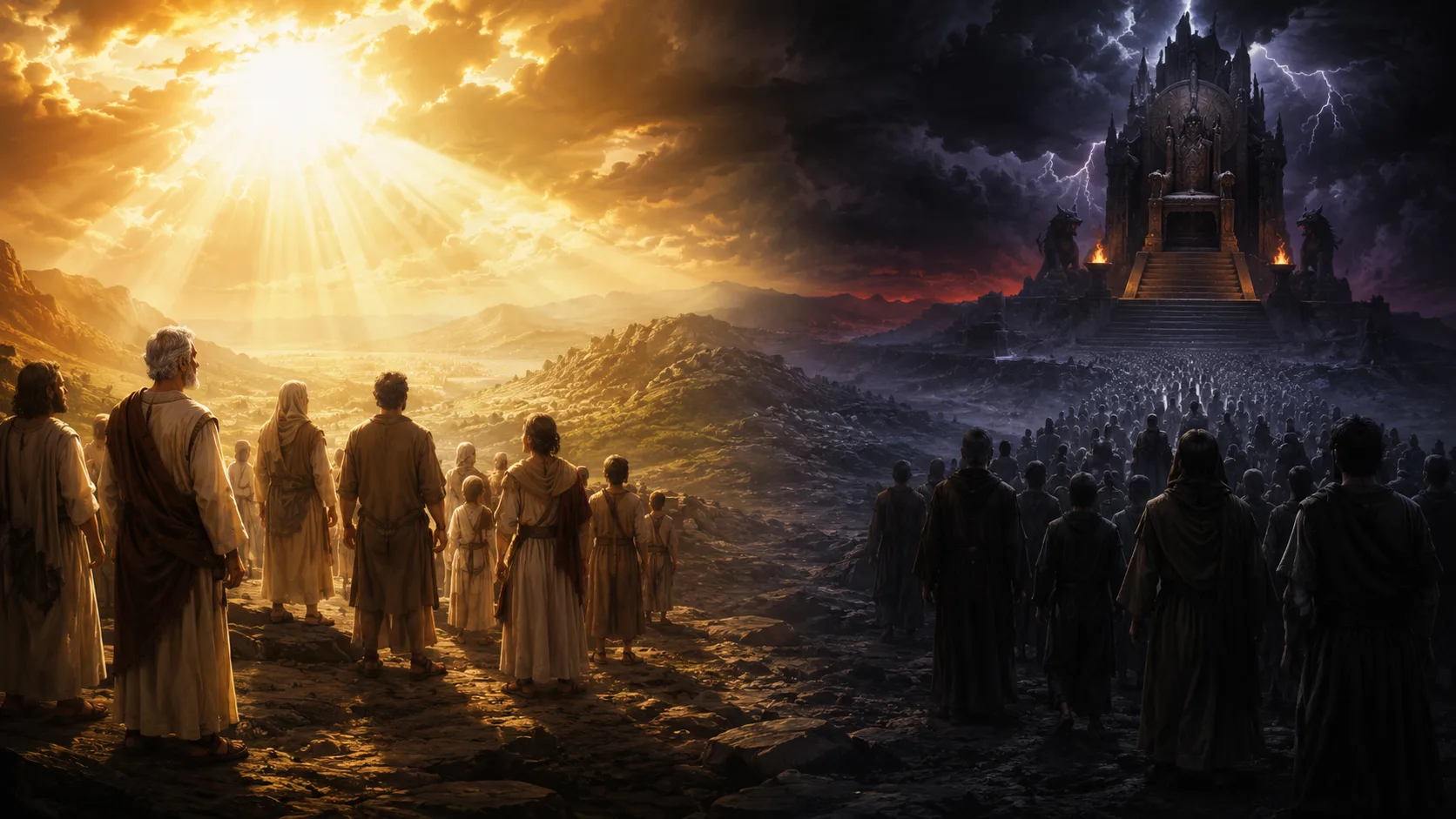
The mark of the beast is not a microchip, not a tattoo, not a barcode, and not a vaccine. It is the enforced sign of the beast’s claimed authority to alter the law of God — and Rome has, in her own published documents, named the sign and named the authority by which she has set it. This lesson walks Revelation 13, the image of the beast, and the closing test on which the final crisis turns.
Lesson 13 takes up the second great prophetic chapter of Revelation. Where Revelation 12 traced the persecution of the church across the Christian centuries by the dragon — Satan working first through pagan Rome and then through papal Rome — Revelation 13 sets out the specific structures of beast, image, and mark by which the controversy will be brought to its closing test. The first beast of the chapter is the same power Daniel 7 named as the little horn; the second beast is a later power that rises at the close of the first beast’s 1,260-year arc; and the mark of the beast is the test at the centre of the closing crisis. This lesson is the natural sequel to Lesson 12 and presupposes the historicist reading of Daniel established there.
Three preliminary observations frame the chapter. First, Revelation 13’s prophecy is not a new prophecy. It takes the symbols of Daniel 7 and re-presents them under John’s vision, with the close-up shifted from the rise of the little horn (Daniel) to its final operation and the system it pulls into existence with it (Revelation). Second, the prophecy is symbolic throughout: beasts are kingdoms (Dan 7:17, 23), waters are peoples (Rev 17:15), winds are conflict (Jer 49:36), and the mark in the hand or forehead is the biblical idiom for the seat of action and the seat of conviction (Deut 6:6–8; Ex 13:9, 16), not a literal anatomical placement. Third, the prophecy is solvable. Revelation 13:18 invites the willing reader explicitly: here is wisdom. Let him that hath understanding count the number of the beast: for it is the number of a man. Scripture would not have issued the invitation to count if the count were beyond the reach of the reader.
Question 01
How does Revelation itself frame the mark and the warning against it?
Answer
And he causeth all, both small and great, rich and poor, free and bond, to receive a mark in their right hand, or in their foreheads: and that no man might buy or sell, save he that had the mark, or the name of the beast, or the number of his name.
If any man worship the beast and his image, and receive his mark in his forehead, or in his hand, the same shall drink of the wine of the wrath of God, which is poured out without mixture into the cup of his indignation.
The closing crisis test has three components. First, worship of the beast and his image — a religious- allegiance act. Second, reception of his mark in forehead or hand — the sign of that allegiance. Third, economic compulsion under which no man may buy or sell who has refused the mark. The warning of the third angel (Rev 14:9–11) is the most solemn warning Scripture issues against any single sin: those who receive the mark drink the unmixed wrath of God. Whatever the mark is, it is something the willing reader needs to know in advance and refuse decisively. Revelation does not leave the reader to guess.
And these words, which I command thee this day, shall be in thine heart: and thou shalt teach them diligently unto thy children, and shalt talk of them when thou sittest in thine house, and when thou walkest by the way, and when thou liest down, and when thou risest up. And thou shalt bind them for a sign upon thine hand, and they shall be as frontlets between thine eyes.
The hand-and-forehead idiom is borrowed directly from Moses, where it described the law of God being kept as the guide of action (the hand) and the centre of conviction (the forehead). Revelation 13’s mark is the counterfeit of the same: the law of the beast received as the rule of action or the seat of conviction, in place of the law of God Moses commanded. The whole controversy Revelation 13 sets out is therefore between two authorities, two laws, and two signs of allegiance — and the willing reader is being asked whose side the heart is on, and which authority the hand and forehead are carrying.
Question 02
Who is the first beast of Revelation 13?
Answer
And I stood upon the sand of the sea, and saw a beast rise up out of the sea, having seven heads and ten horns, and upon his horns ten crowns, and upon his heads the name of blasphemy. And the beast which I saw was like unto a leopard, and his feet were as the feet of a bear, and his mouth as the mouth of a lion: and the dragon gave him his power, and his seat, and great authority. And I saw one of his heads as it were wounded to death; and his deadly wound was healed… And there was given unto him a mouth speaking great things and blasphemies; and power was given unto him to continue forty and two months. And he opened his mouth in blasphemy against God… And it was given unto him to make war with the saints, and to overcome them.
Seven prophetic marks identify the beast, and each one cross-references the prophetic architecture already established in Lessons 11 and 12. The willing reader is invited to read the marks off the text and ask what fits.
- Rises out of the sea. The sea in biblical prophecy is peopled territory (Rev 17:15 — the waters which thou sawest … are peoples, and multitudes, and nations, and tongues). The first beast rises in the densely populated centre of the ancient civilised world — the Mediterranean basin.
- Inherits the dragon’s seat, throne, and great authority. The dragon of Revelation 12 is pagan Rome under Satan’s direction (Rev 12:4 — the persecution of Christ at His birth). The first beast inherits the dragon’s seat: pagan Rome’s capital and political machinery pass intact to the beast that succeeds it. The geographical anchor is Rome itself.
- Composite of leopard, bear, and lion. The fourth beast of Daniel 7 was described as diverse from all the beasts that were before it; here in Revelation, John sees the same fourth-stage power, and explicitly notes that the new beast carries forward elements of the three preceding kingdoms (leopard / Greece; bear / Medo-Persia; lion / Babylon). The Papacy as the religious-political fourth-stage power absorbed pagan religious elements from each of the preceding empires — the philosophical inheritance of Greece, the imperial-administrative inheritance of Medo-Persia and Rome, and the mystery-religion inheritance of Babylon (which Lesson 14 will walk in detail).
- Speaks great things and blasphemies. Daniel 7:25 said the little horn would speak great words against the Most High. Revelation 13:6 reads in parallel: he opened his mouth in blasphemy against God, to blaspheme his name, and his tabernacle, and them that dwell in heaven. By Scripture’s own definition, blasphemy includes a human being claiming to forgive sins as God forgives them (Mk 2:7) and a human being claiming to be God (Jn 10:33). The Papacy claims both.
- Power for forty and two months — the same 1,260 prophetic days / years as Daniel 7:25. Forty-two months × thirty days = 1,260 days. On the day-for-a-year principle (Num 14:34; Ezek 4:6), that is 1,260 years. The two historical anchors of AD 538 to AD 1798 (Lesson 12) apply unchanged.
- Makes war with the saints and overcomes them. Daniel 7:21 had said the same of the little horn. Revelation 13:7 confirms the identification: the persecuting religious-political power across the centuries of medieval inquisition, the suppression of the Waldenses, the burning of Wyclif, Hus, Tyndale, Latimer, Ridley, the murder of the Albigenses, the dragonnades of Louis XIV, the massacres of Saint Bartholomew’s Day and the Thirty Years’ War.
- Deadly wound, and the wound healed. One of the beast’s heads is wounded as it were unto death, and the wound is healed (Rev 13:3, 12, 14). The historical anchor for the wounding is February 1798, when the French general Berthier captured Pope Pius VI and the temporal power of the Papacy was broken — the terminus of the 1,260 years. The prophecy of the wound’s healing is the rebuilding of the power’s influence across the nineteenth, twentieth, and twenty-first centuries: the Lateran Treaty of 1929 restoring sovereignty, the recovery of global diplomatic presence, the post-Vatican-II ecumenical reach. The wound is healing in real time on the public record.
Seven marks, one power. The first beast of Revelation 13 is the same little horn of Daniel 7 the Reformation identified four centuries ago and the TAHBRI continues to identify on the same prophetic and historical evidence: the medieval and post-medieval Papacy, as a religious- political system, not as the millions of sincere Catholic believers within the system whose love for Christ is unimpeachable and whose final call the same Revelation will issue in chapter 18.
Question 03
What is the mark of the beast specifically?
Answer
Daniel 7:25 named the action by which the little horn would assert his authority: he shall… think to change times and laws. The one law of God that names a time — the one commandment that begins remember and the one commandment that identifies the Lord by what He did in time — is the fourth commandment, the seventh-day Sabbath of Exodus 20:8–11. Rome’s most distinctive ecclesiastical claim, in her own published documents and across her own theological history, is that she has changed the day of worship from the seventh day to the first, on her own authority, as a mark of that authority.
Lesson 8 (Who Changed the Sabbath?) walked Rome’s own published admissions of the change across six primary sources — the Convert’s Catechism of Catholic Doctrine, the Doctrinal Catechism, Cardinal Gibbons’ Faith of Our Fathers, the Catholic Mirror, the Catholic Record, and Our Sunday Visitor — in which the Church of Rome explicitly names the change of the Sabbath to Sunday as her own act and as the mark of her authority. That documentary case is not rehearsed here, but referred to. Read in the light of Daniel 7:25 and Revelation 13, the change Rome herself names as the mark of her authority is the prophesied change of times and laws by which the little horn was to be identified.
The Catholic Church … by virtue of her divine mission, changed the day from Saturday to Sunday. The Protestant world at its birth found the Christian Sabbath too strongly entrenched to run counter to its existence; it was therefore placed under the necessity of acquiescing in the arrangement, thus implying the Church’s right to change the day, for over three hundred years. The Christian Sabbath is therefore to this day, the acknowledged offspring of the Catholic Church as spouse of the Holy Ghost, without a word of remonstrance from the Protestant world.
The mark of the beast is therefore the enforced observance of the day Rome has set in place of the day God Himself sanctified, received as a sign of allegiance to the authority that made the change. The mark is not the day taken in ignorance by a sincere believer who has never heard the question raised; the third angel’s warning is against those who, having heard the question set, choose the beast’s authority over God’s. The crisis is therefore future, but the structure is already in place; and the institute’s pastoral priority is to put the question before the willing reader plainly, so the decision can be made in the calm of understanding rather than the pressure of enforcement.
Question 04
What is the number of the beast?
Answer
And that no man might buy or sell, save he that had the mark, or the name of the beast, or the number of his name. Here is wisdom. Let him that hath understanding count the number of the beast: for it is the number of a man; and his number is Six hundred threescore and six.
John tells the reader the number is countable: it is the number of a man, the number of a name, and the reader with understanding is invited to do the count. The Latin title borne by the Pope across centuries of official usage — VICARIVS FILII DEI, the Vicar of the Son of God — resolves to exactly that count when the Roman numeral values are summed.
The count
VICARIVS
V = 5
I = 1
C = 100
A = 0
R = 0
I = 1
V = 5
S = 0
= 112
FILII
F = 0
I = 1
L = 50
I = 1
I = 1
= 53
DEI
D = 500
E = 0
I = 1
= 501
112 + 53 + 501 = 666
The title VICARIVS FILII DEI is attested in Roman Catholic canonical and conciliar literature across centuries — in the apocryphal Donation of Constantine, in the gloss on the Decretum Gratiani, and in subsequent canon law usage; the TAHBRI position is that the title is the Latin formal designation of the papal office under one of its standard self-descriptions, and that its count exactly matches the prophecy Revelation invited the reader to make. The objection that the title was never used in any single particular place misses what John actually said: the count is the number of his name, and that count returns 666 on the title’s Latin spelling. Latin was the ecclesiastical language of the very institution Daniel 7 and Revelation 13 identify; the count in Latin is the count Revelation invited.
A secondary supporting pattern is visible in the iconographic geometry of the identifying power. Six hundred threescore and six as a triple of sixes maps onto the equilateral triangle — an emblem the orthodox-formula tradition has long employed for the deity-construct that distinguishes itself from the biblical Father-and-Son framework TAHBRI recovers — whose three equal interior angles measure 60 degrees each (60° + 60° + 60° = three sixties). The iconographic resonance with the prophetic number is not the load-bearing demonstration; the load-bearing demonstration is the Latin gematria of the title. But the resonance is there, on the same emblem the same institution carries on the public record.
Question 05
What is the difference between the mark in the forehead and the mark in the hand?
Answer
And he causeth all, both small and great, rich and poor, free and bond, to receive a mark in their right hand, or in their foreheads.
The biblical idiom is consistent. The forehead is the seat of conviction — the place of thought, belief, deliberate choice. The hand is the seat of action — the place of work, compliance, performance. The mark in either place is an allegiance-mark, and Revelation distinguishes two profiles of those who receive it:
- The mark in the forehead. Received by deliberate conviction. Those who have heard the question of the Sabbath set, have understood the issue of authority involved, and have nevertheless chosen the beast’s authority over God’s. They believe what they observe; they affirm the change as a matter of principle. The forehead-mark is the mark of intentional allegiance.
- The mark in the hand. Received by economic compulsion. Those who have not settled the question by conviction, who may even disagree with the practice in principle, but who comply outwardly because no man might buy or sell, save he that had the mark (Rev 13:17). The hand-mark is the mark of pressured compliance — and Revelation 14:9 names this profile under the same warning as the conviction profile. Compliance does not exempt the complier from the test.
The set against which the mark is contrasted is the seal of God in the foreheads of His servants (Rev 7:2–3; 14:1) — the same allegiance idiom turned in the opposite direction. The seal of God is His name in the forehead of the willing; the mark of the beast is the counterfeit authority received in the forehead of the convinced or in the hand of the compelled. The closing crisis is therefore the moment at which every conscious adult in the inhabited earth is identifiable, by their forehead or by their hand, as standing under one authority or the other. There is no neutral position because the test itself is a test of the right of God to be obeyed in His own commandment.
Question 06
Who is the second beast of Revelation 13?
Answer
And I beheld another beast coming up out of the earth; and he had two horns like a lamb, and he spake as a dragon. And he exerciseth all the power of the first beast before him, and causeth the earth and them which dwell therein to worship the first beast, whose deadly wound was healed. And he doeth great wonders, so that he maketh fire come down from heaven on the earth in the sight of men, and deceiveth them that dwell on the earth by the means of those miracles which he had power to do in the sight of the beast.
Six identifying marks describe the second beast, and on the historicist reading they fit only one power in the modern record:
- Comes up out of the earth, not the sea. Where the first beast rose out of the densely peopled Mediterranean basin (waters = peoples, Rev 17:15), the second rises from the earth — the symbolic opposite, a sparsely-populated territory. The North American continent at the close of the eighteenth century fits the geographical marker precisely.
- Rises at the time the first beast is going into captivity. The first beast receives his deadly wound in 1798 (Rev 13:3, the terminus of the 1,260 years). The second beast is rising at that same hour. The United States declared independence in 1776, ratified its constitution in 1788, and was a recognised power on the world stage by 1798. The timing fits.
- Two horns like a lamb. Two powers, gentle in original form. The two constitutional principles distinctive of the American republic at its founding were civil liberty (no king) and religious liberty (no established church) — structural negations of the two distinctives of the first beast (the union of imperial authority and ecclesiastical claim). The two horns answer to the two foundational guarantees.
- Speaks as a dragon. Behaves at the close opposite to its original principles — legislating religious practice under civil-power compulsion, the very thing its founding documents were written to prevent. The prophecy is one of trajectory: the lamb-like beginning and the dragon-like end of the same power.
- Exercises all the power of the first beast before him, and makes an image to the beast. The second beast becomes the enforcer of the first beast’s structure on a global stage, and constructs an image — a copy — of the first beast’s essential pattern. The image is unpacked in Q7.
- Causes the earth and them which dwell therein to worship the first beast. Religious compulsion across the whole inhabited earth, conducted by the second beast on behalf of the first. The first beast does not need to recover its own dominance directly; the second beast pulls the world into alignment with the first.
The historicist Adventist identification of the second beast is the United States of America. The identification is not a national-political prejudice; it is a reading off the prophetic marks. A power rising at the close of the first beast’s 1,260 years, out of a sparsely- populated continent, founded on principles of civil and religious liberty, eventually exercising global influence and becoming the enforcer of a religious legislation that contradicts its founding principles, in alliance with the recovered first beast: the United States fits each mark on the published evidence. The TAHBRI position commends the identification to the willing reader on the text’s own grounds, and acknowledges that the closing chapters of this prophecy are still being written in the headlines of the present hour.
Question 07
What is the image of the beast?
Answer
Saying to them that dwell on the earth, that they should make an image to the beast, which had the wound by a sword, and did live. And he had power to give life unto the image of the beast, that the image of the beast should both speak, and cause that as many as would not worship the image of the beast should be killed.
An image is a likeness, a copy of the original. The image of the first beast is therefore a structural copy of the first beast’s essential pattern. The first beast’s essential pattern was the union of religious authority and civil power, with the civil arm enforcing the religious authority’s claims under penalty of law. The image is the reproduction of that pattern in another nation, at another time. On the prophetic structure of Revelation 13, the second beast (the United States) constructs the image at the close of probation by legislating the religious practice of the first beast under civil-power compulsion.
The decisive feature of the image is its enforcement mechanism. The text says as many as would not worship the image of the beast should be killed. The original first-beast structure persecuted dissent across centuries of medieval inquisition. The image-of-the-beast structure is prophesied to persecute the same dissent in the closing hours of earth’s history, under the civil arm of the second beast and the religious sanction of the recovered first beast. The economic phase — the prohibition of buying and selling for those who refuse the mark — is the first stage of enforcement; the death-penalty phase is the second. Both are predicted; both are still future to the present hour, but the structural groundwork is in place on the public record. The closing crisis is not speculative; it is positioned.
The believer who receives the doctrine of this lesson is not invited to map every present headline onto the prophecy. The lesson is positioned in the institute’s teaching at this point in the course precisely so the reader has the framework before the closing crisis arrives, not in the middle of it. The framework is the framework. The application to the headlines belongs to the Spirit and the conscience of the believer who has received the framework.
Question 08
How does Christ Himself frame the closing test?
Answer
Here is the patience of the saints: here are they that keep the commandments of God, and the faith of Jesus.
At the close of the third angel’s warning against the mark, Revelation identifies the company on the opposite side of the test in one verse. They are characterised by two things, set together: the commandments of God — including the fourth, the very commandment the beast power presumed to change — and the faith of Jesus — the apostolic gospel of the Father’s only-begotten Son, Who bore the sins of the believer at the cross. Commandment-keeping without the faith of Jesus is legalism. The faith of Jesus without commandment-keeping is antinomianism. The closing- crisis remnant holds both, set together, against the worship of the beast.
Behold, I come as a thief. Blessed is he that watcheth, and keepeth his garments, lest he walk naked, and they see his shame.
Christ Himself speaks the words. The placement is striking. The verse falls in the middle of the seven last plagues sequence (Rev 16:12–16), between the sixth and the seventh plague, just as the kings of the earth are being gathered to Armageddon. Christ interrupts the plague narrative with His own voice, addressing the willing reader of the closing hours of earth’s history directly. Behold, I come as a thief — the same self-disclosure He gave to the disciples on the Mount of Olives (Matt 24:42–44; Lk 12:39–40), now repeated under the seventh-plague urgency. The Lord Who comes is the same Lord Who warns; and the warning is the Lord’s own.
Blessed is he that watcheth — the closing- hour believer is to be awake to the prophetic structures, not asleep in the cultural Christianity that has surrendered both Daniel and Revelation to the futurists and the preterists. And keepeth his garments — the symbol of the imputed righteousness of Christ, received by faith (Isa 61:10; Rev 19:8). The closing-hour believer is to be clothed in Christ’s righteousness, watching, and ready. The warning is in the Lord’s own voice; the reader who has heard the chapter is invited to take the Lord at His word.
Question 09
What about the alternative readings of the mark and the beast?
Answer
Five alternative readings of Revelation 13 circulate in the modern church and the modern marketplace. Each one is addressed in its own terms below:
| Alternative reading | Why the text resists it |
|---|---|
| The mark is a microchip, tattoo, barcode, or vaccine | The text names the mark as the sign of the beast’s authority received in worship: "If any man worship the beast and his image, and receive his mark in his forehead, or in his hand" (Rev 14:9). Receiving the mark is a religious-allegiance act, not a medical procedure or a piece of consumer technology. The hand-and-forehead language is the standard biblical idiom for action and conviction (Deut 6:6–8; Ex 13:9, 16) — metaphorical, not anatomical. The mark is identifiable by what it commemorates and whose authority it acknowledges, not by its physical substance. A microchip cannot fulfil Daniel 7:25’s "think to change times and laws"; a Sabbath / Sunday transfer can and has. |
| The mark is Sharia or an Islamic identification | The beast of Revelation 13 inherits the dragon’s seat, throne, and authority (Rev 13:2), and the dragon in the immediately preceding chapter pursues the woman who brought forth the man-child (Rev 12) — pagan Rome persecuting Christ at His birth and the early Christian church after. The seat of the dragon is Rome; the beast that inherits it is therefore Roman-territory and post-pagan-Rome, not a power arising out of the Arabian peninsula in the seventh century. The four prophetic marks of Daniel 7 that Lesson 12 set out fit the Papacy, not Islam: out of the fourth kingdom, plucks up three of ten, post-AD 476 Roman territory, thinks to change times and laws. |
| The whole prophecy is yet future under a personal antichrist | The dispensational reading treats Revelation 13 as a description of a single future individual who will arise during a seven-year tribulation after a pre-tribulation rapture — an interpretive framework John Nelson Darby invented in the 1830s, with no antecedent in eighteen centuries of Christian commentary on Revelation. The text gives the first beast 42 months (Rev 13:5) — the same 1260-year period Daniel 7:25 assigns to the little horn — and the historical anchors of AD 538 and AD 1798 (Lesson 12) fall exactly. A future seven-year antichrist requires moving the historical fulfilment out of history and into speculation. |
| The number 666 identifies Nero (preterist gematria) | The Nero reading requires the Greek letters of Nero’s name to be transliterated back into Hebrew, a defective spelling (NRWN QSR) to be adopted, and the calculation made in Hebrew gematria — three artificial moves that no first-century reader of Revelation would have made spontaneously. Revelation was written in Greek for a Greek-reading audience. John says the number is "the number of a man" and the name of the beast (Rev 13:17–18) — a name available to count, not a back-transliteration available only to a scholar willing to switch languages and orthographies. Furthermore, Nero died in AD 68; the prophecy’s 42 months / 1260 years extend far past the first century. |
| The mark is symbolic only; no specific identification is possible | The mark is symbolic, but it is the symbol of a definite identification, not of a generic principle. Revelation 13:18 invites the reader explicitly to count the number: <em>here is wisdom. Let him that hath understanding count the number of the beast</em>. A symbol whose referent is in principle undeterminable is not a symbol Scripture would invite the reader to <em>count</em>. The historicist identification — on the prophetic marks of Daniel 7, the seat-of-the-dragon clue of Revelation 13:2, the 1260-year anchor, and the VICARIVS FILII DEI gematria of Revelation 13:18 — supplies a specific referent the text itself supports. |
Five alternatives, five failures. The historicist reading is the reading the text supports, the reading the Reformation recovered, and the reading the TAHBRI continues to commend on the prophetic marks Daniel 7 and Revelation 13 supply. The willing reader is invited to settle the question on Scripture’s own evidence, before the closing test arrives in its enforced form.
A note on what is being corrected
This lesson is not addressed against the millions of sincere Sunday-keeping Christians who have inherited the first-day practice as the only Sabbath their tradition ever taught them. The mark of the beast is not the day taken in ignorance; it is the day taken in conscious allegiance to the authority that made the change, against the authority of God Himself. Most of present-hour Christianity has never heard the question of the Sabbath set, has never seen Rome’s own published admissions on the change, has never compared the third angel’s warning of Revelation 14 with the four prophetic marks of the little horn in Daniel 7. The institute’s posture toward such believers is one of fellow love and patient instruction, not condemnation. What is being corrected is the doctrine, not the love of the sincere believer who has been taught a shorter version of the story. The crisis is future, but the framework is best received now, in the calm of understanding, rather than later in the pressure of enforcement.
Question 10
What does the warning call the willing reader to do?
Answer
And I heard another voice from heaven, saying, Come out of her, my people, that ye be not partakers of her sins, and that ye receive not of her plagues.
Heaven’s closing-hour call to Christ’s sheep in the systems of confused worship is not a call to rebellion or to bitterness; it is a call to come out — to the recovered apostolic gospel, the seventh-day Sabbath of the Creator, the begotten Son of the only true God, the resurrection hope, and the patience of the saints. Lesson 14 (Who Is Babylon?) will walk the call in full detail.
And I saw another angel ascending from the east, having the seal of the living God: and he cried with a loud voice to the four angels, to whom it was given to hurt the earth and the sea, saying, Hurt not the earth, neither the sea, nor the trees, till we have sealed the servants of our God in their foreheads.
The closing crisis is bracketed by two sealing acts. On the side of Christ, the angel from the east places the seal of the living God in the foreheads of His servants — the recovered Sabbath received in faith, the character of God reflected in the believer, the name of the Father and the Son owned openly. On the side of the beast, the mark is placed in the foreheads of the convinced or in the hands of the compelled. Every conscious adult is moving toward one or the other. The willing reader who has received this lesson is invited to settle the matter now, by the apostolic Sabbath of Hebrews 4:9, by the apostolic faith of Galatians 2:20, by the apostolic obedience of 1 John 5:3, and by the apostolic hope of 1 Thessalonians 4:16–17.
Summary of Lesson 13
- The mark of the beast is not a microchip, tattoo, barcode, or vaccine. It is the enforced sign of the beast’s claimed authority (Rev 13:16–17; 14:9–11). Hand-and-forehead are biblical idioms for action and conviction (Deut 6:6–8).
- The first beast of Revelation 13 is the same little horn of Daniel 7: out of the dragon’s seat (Rome), composite of the prior empires, speaks blasphemies, 42 months / 1,260 years (AD 538–1798), wars on the saints, deadly wound healed.
- The mark itself is identified with the change of the Sabbath to Sunday on the authority of Rome — the change of times and laws Daniel 7:25 predicted. Lesson 8 supplied the documentary case from Rome’s own publications.
- The number 666 resolves to the Latin title VICARIVS FILII DEI — Vicar of the Son of God — on the standard Roman-numeral summation: VICARIVS 112 + FILII 53 + DEI 501 = 666. A secondary iconographic resonance is visible in the equilateral triangle’s three sixties (60° × 3).
- Mark in the forehead = received by deliberate conviction; mark in the hand = received under economic compulsion. Both fall under the third angel’s warning (Rev 14:9).
- The second beast (Rev 13:11–17) fits the United States on six prophetic marks: out of the earth, rises at the wounding of the first beast, two lamb-like horns (civil and religious liberty), speaks as a dragon at the close, makes an image to the first beast, causes the earth to worship the first beast.
- The image of the beast is a structural copy of the first beast’s pattern: union of religious authority and civil power, with the civil arm enforcing religious legislation by economic compulsion and ultimately death penalty.
- Christ’s own self-disclosure of Rev 16:15 interrupts the seven-plagues narrative with the closing-hour warning: Behold, I come as a thief. Blessed is he that watcheth, and keepeth his garments.
- The five alternative readings — microchip / Sharia / dispensational futurism / preterist Nero / symbolic-only — fail on the text’s own internal markers and the historical record.
- The closing test set the company of the saints on the opposite side of the mark: they that keep the commandments of God, and the faith of Jesus (Rev 14:12). Commandment-keeping and the apostolic gospel set together. The seal of God (Rev 7:2–3) is placed in the foreheads of His servants against the mark of the beast.
- Heaven’s call is Revelation 18:4 — Come out of her, my people. Lesson 14 walks the call in detail.
Personal response
The doctrine of Revelation 13 is heavier than the doctrine of any preceding lesson, because it sets the willing reader in the actual landscape of the closing crisis. The first beast is identified, the mark is identified, the number is identified, the second beast is identified, the image is identified, the enforcement mechanism is identified, the company of the saints is identified, and the Lord’s own warning is heard. The willing reader is invited to do in the calm of understanding what would otherwise have to be done in the pressure of enforcement: settle the question of authority now, by faith in the Son of the only true God, in commandment-keeping that follows from that faith, and in expectation of the second coming that ends the controversy.
Father in heaven, the only true God, the Creator of the seventh-day Sabbath, the Author of the law and the giver of Your Son, thank You for the plainness of Your word on the closing crisis. I have seen the first beast and the marks that identify it. I have seen the mark and the number. I have seen the second beast and the image. I have heard Your Son’s own warning: Behold, I come as a thief. Blessed is he that watcheth, and keepeth his garments. Place me, by Your grace, in the company of the saints who keep Your commandments and hold the faith of Jesus. Seal me with Your seal in my forehead against the mark of the beast. Bring me out of every system of confused worship into the apostolic gospel of Your Son, the recovered Sabbath of Your creation week, and the patience that waits for the second coming. In the name of Him who comes as a thief, Jesus Christ. Amen.
From the identification of the beast, the next lesson asks the larger question: who is Babylon? Revelation 17 and 18 sets out the religio-political- economic confederacy of which the beast of Revelation 13 is the central religious figure, and issues the closing call: come out of her, my people. Lesson 14 walks the identification, the architecture, and the call.
Foundational text
“If any man worship the beast and his image, and receive his mark in his forehead, or in his hand, the same shall drink of the wine of the wrath of God… Here is the patience of the saints: here are they that keep the commandments of God, and the faith of Jesus.”
— Revelation 14:9–10, 12