Daniel’s visions traced the rise and fall of the great world powers from Babylon to the second coming — with an accuracy modern skeptics have been forced to dismiss as written after the fact. This lesson walks Daniel 2 and Daniel 7 in the historicist tradition the Protestant Reformation recovered, and lets the documents settle the question.
Two visions stand at the centre of the prophetic architecture of Daniel. Both run from the prophet’s own day to the second coming of Christ; both name the same four world-kingdoms in the same order; both end with the everlasting kingdom of God. The first — Nebuchadnezzar’s dream of the great image in Daniel 2 — is the prophecy in its simplest, most public form, given to a pagan king and explained by Daniel in the king’s court. The second — Daniel’s own vision of the four beasts in Daniel 7 — is the same prophecy in its richer, ecclesial form, with detail added at the close on the rise of the little horn and the throne-room judgement Lesson 11 already treated. The willing reader who has followed the seventy-weeks arithmetic of Lesson 11 already has the framework for this lesson: the same God Who appointed the calendar of Daniel 9 also appointed the succession of Daniel 2 and 7, and history has fulfilled it on the page.
The thesis of historicism is simple: Daniel’s prophecies are a continuous narrative of the major political-religious history of the earth from the sixth century BC to the second coming of Christ, fulfilled progressively in the rise and fall of named kingdoms, with the current hour located near the close of the sequence. Historicism was the consensus reading of the Protestant Reformation — of Wyclif, Hus, Luther, Calvin, Zwingli, Tyndale, Knox, the framers of the Westminster Confession, the Puritans, and the great evangelical commentators of the seventeenth and eighteenth centuries. It has been largely surrendered by the modern evangelical church to either dispensationalism (the futurist replacement) or critical preterism (the rationalist replacement). This lesson walks the reading the Bible itself supports.
Question 01
What did Nebuchadnezzar see in his dream — and what was its sweep?
Answer
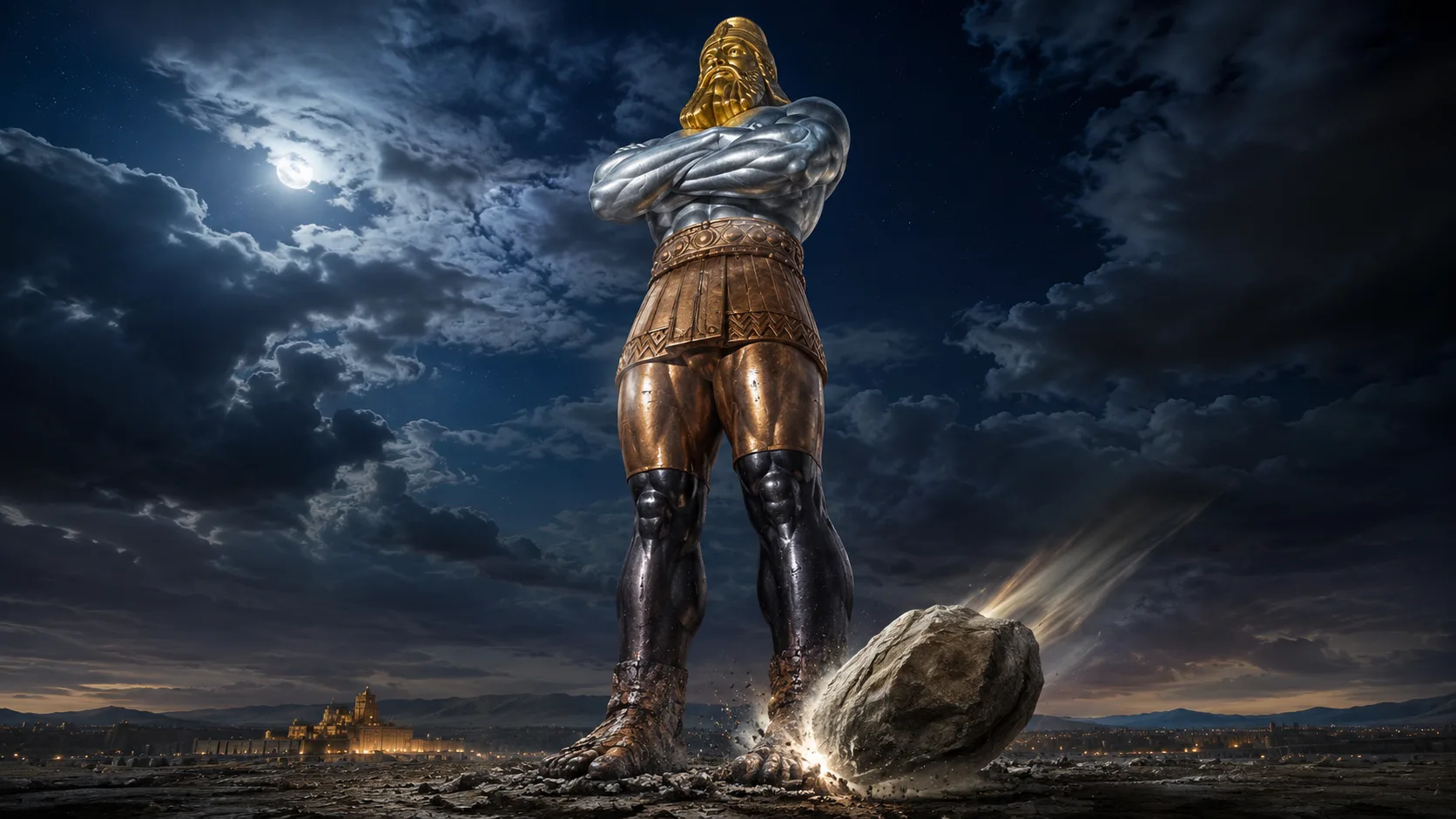
Thou, O king, sawest, and behold a great image. This great image, whose brightness was excellent, stood before thee; and the form thereof was terrible. This image’s head was of fine gold, his breast and his arms of silver, his belly and his thighs of brass, his legs of iron, his feet part of iron and part of clay. Thou sawest till that a stone was cut out without hands, which smote the image upon his feet that were of iron and clay, and brake them to pieces. Then was the iron, the clay, the brass, the silver, and the gold, broken to pieces together, and became like the chaff of the summer threshingfloors; and the wind carried them away, that no place was found for them: and the stone that smote the image became a great mountain, and filled the whole earth.
The dream is a single image of compound material, and four metals descend in decreasing value and increasing strength from head to feet: gold, silver, brass, iron. The feet are iron mixed with clay, the weakest cohesion in the figure. A stone, cut out without hands, strikes the image on those feet, shatters the whole figure, and grows into a mountain that fills the whole earth. The dream therefore has two layers. First, a sequence of four kingdoms followed by a divided phase. Second, the destruction of the entire sequence by a kingdom not of human origin — cut out without hands— that supersedes them all and lasts for ever.
Question 02
What did Daniel say the image represented?
Answer
Thou, O king, art a king of kings: for the God of heaven hath given thee a kingdom, power, and strength, and glory… Thou art this head of gold. And after thee shall arise another kingdom inferior to thee, and another third kingdom of brass, which shall bear rule over all the earth. And the fourth kingdom shall be strong as iron: forasmuch as iron breaketh in pieces and subdueth all things… And whereas thou sawest iron mixed with miry clay, they shall mingle themselves with the seed of men: but they shall not cleave one to another, even as iron is not mixed with clay. And in the days of these kings shall the God of heaven set up a kingdom, which shall never be destroyed: and the kingdom shall not be left to other people, but it shall break in pieces and consume all these kingdoms, and it shall stand for ever. Forasmuch as thou sawest that the stone was cut out of the mountain without hands, and that it brake in pieces the iron, the brass, the clay, the silver, and the gold; the great God hath made known to the king what shall come to pass hereafter.
Daniel reads the image as God’s preview of the political history of the earth from Nebuchadnezzar’s day forward. Thou art this head of gold identifies the first kingdom as the Babylonian empire of Nebuchadnezzar himself. After thee shall arise another kingdom begins the succession. Four world-kingdoms in sequence. A divided phase, where iron is mixed with clay and the resulting alloy does not cohere. And then, in the days of these kings, the God of heaven sets up the everlasting kingdom that ends all human kingdoms.
Question 03
How does history confirm the four kingdoms of Daniel 2?
Answer
Set against the historical record, the sequence is so precise as to have been the principal reason critical scholars in the nineteenth century moved the composition-date of Daniel to 165 BC: the prophecy is too accurate to be prophecy on the rationalist premise. On the text’s own face, the four-kingdom sequence unfolds as follows:
- Babylon — head of gold — 605–539 BC. Daniel names the kingdom directly (Dan 2:38). Babylon fell in 539 BC on the night of Belshazzar’s feast (Dan 5) to the combined Medo-Persian army under Cyrus, exactly as Isaiah had named Cyrus by name a century and a half in advance (Isa 44:28; 45:1).
- Medo-Persia — breast and arms of silver — 539–331 BC. The two arms answer to the two component peoples (the Medes and the Persians). Daniel 5:28 confirms the identification on the very night of Babylon’s fall: thy kingdom is divided, and given to the Medes and Persians. Daniel 8:20 names the empire directly in his second vision: The ram which thou sawest having two horns are the kings of Media and Persia.
- Greece — belly and thighs of brass — 331–168 BC. Alexander the Great defeated Darius III at Granicus (334 BC), Issus (333), and Gaugamela (331), bringing the Persian empire to an end. Daniel 8:21 names the empire directly: the rough goat is the king of Grecia. After Alexander’s death in 323 BC the empire fractured into four divisions under his generals (Cassander in Macedonia, Lysimachus in Thrace, Ptolemy in Egypt, Seleucus in Syria) — the four heads of the leopard of Daniel 7:6 and the four notable horns of Daniel 8:8, 22.
- Rome — legs of iron — from 168 BC. The kingdom of iron that breaketh in pieces and subdueth all things (Dan 2:40) is the Roman power that decisively defeated Macedonia at Pydna in 168 BC and absorbed the Greek successor states across the next century. Christ Himself was born and crucified under Rome (Lk 2:1; Lk 3:1), and the New Testament writes in Rome’s shadow.
- Divided Rome — feet and toes of iron mixed with clay — from c. AD 476. The western Roman empire fragmented under the barbarian migrations between AD 376 and 476, dividing into the kingdoms of Europe (Visigoths, Vandals, Ostrogoths, Heruli, Franks, Alamanni, Suevi, Burgundians, Anglo-Saxons, Lombards). Daniel’s text predicts the precise behaviour of the divided phase: they shall mingle themselves with the seed of men: but they shall not cleave one to another (Dan 2:43). Every subsequent attempt to reunify Europe by force — Charlemagne, Charles V, Napoleon, Hitler, and the modern political unions in their various forms — has fractured along the same fault line. Iron does not bond with clay.
- The stone kingdom — the second coming. In the days of these kings — not before, not after, but during the divided phase — the God of heaven shall set up a kingdom, which shall never be destroyed (Dan 2:44). The stone is cut without hands: its origin is not human politics, not a Christianised empire, not a restored caliphate, not a global governance body. It is the kingdom of God, set up at the second coming, that ends the entire sequence.
Four named, sequential, dated empires. One divided phase that has lasted from AD 476 to the present, behaving exactly as Daniel said it would behave. One terminus, future. The sequence is a list of major political units, with their dominance-dates verifiable in any general history of the ancient world. The prophecy is on the page; the history is on the page; the willing reader is invited to check.
Question 04
What is the stone cut without hands?
Answer
And in the days of these kings shall the God of heaven set up a kingdom, which shall never be destroyed: and the kingdom shall not be left to other people, but it shall break in pieces and consume all these kingdoms, and it shall stand for ever. Forasmuch as thou sawest that the stone was cut out of the mountain without hands, and that it brake in pieces the iron, the brass, the clay, the silver, and the gold; the great God hath made known to the king what shall come to pass hereafter.
Three things deserve emphasis about the stone. First, its origin is not human. The stone is cut without hands; the kingdom it represents is not a political union, not a Christianised civilisation, not a postmillennial consummation of human cooperation. It is the kingdom set up by the God of heaven Himself, intervening from outside the human sequence. Second, its timing is during the divided phase: in the days of these kings. The kingdom of God does not arrive in the days of Babylon or Greece or undivided Rome. It arrives during the iron-and- clay phase of post-AD 476 European division, and that phase is the present. Third, its effect is total. The stone does not coexist with the previous kingdoms; it breaks them in pieces and they become like the chaff of the summer threshingfloors, blown away until no place was found for them. The kingdoms of this world become the kingdoms of our Lord (Rev 11:15); nothing of the old order survives the transition.
The New Testament identifies the stone explicitly. Christ applies the figure to Himself in Matthew 21:44 (whosoever shall fall on this stone shall be broken: but on whomsoever it shall fall, it will grind him to powder), Peter identifies Christ as the stone in 1 Peter 2:6–8, and Paul calls Christ the rock in 1 Corinthians 10:4. The everlasting kingdom of Daniel 2 is the kingdom of Christ established at His second coming — the same kingdom of which Daniel’s second vision (chapter 7) will say more.
Question 05
What did Daniel see in his own vision of the four beasts?
Answer
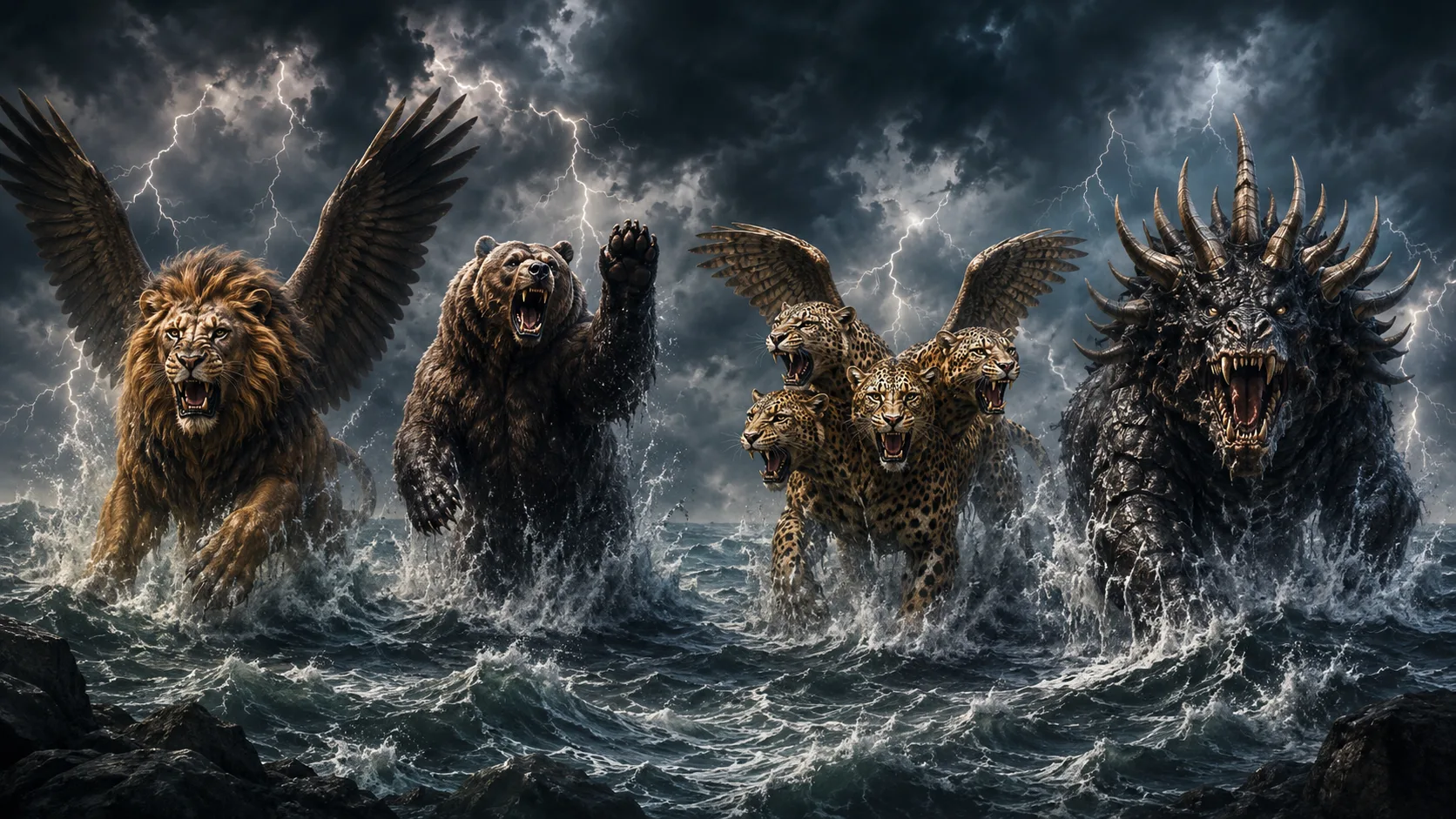
Daniel spake and said, I saw in my vision by night, and, behold, the four winds of the heaven strove upon the great sea. And four great beasts came up from the sea, diverse one from another. The first was like a lion, and had eagle’s wings… And behold another beast, a second, like to a bear, and it raised up itself on one side, and it had three ribs in the mouth of it between the teeth of it… After this I beheld, and lo another, like a leopard, which had upon the back of it four wings of a fowl; the beast had also four heads… After this I saw in the night visions, and behold a fourth beast, dreadful and terrible, and strong exceedingly; and it had great iron teeth: it devoured and brake in pieces, and stamped the residue with the feet of it: and it was diverse from all the beasts that were before it; and it had ten horns. I considered the horns, and, behold, there came up among them another little horn, before whom there were three of the first horns plucked up by the roots: and, behold, in this horn were eyes like the eyes of a man, and a mouth speaking great things.
Daniel’s vision repeats Nebuchadnezzar’s with the resolution turned up. The same four kingdoms in the same sequence are presented in animal-symbol rather than metal-symbol. The fourth beast, where Daniel 2 named only iron, here is described in detail: dreadful, terrible, strong exceedingly, with iron teeth, devouring and breaking in pieces, diverse from all the beasts before it, with ten horns. And then, in the close-up where Daniel 2 had only briefly named iron mixed with clay, Daniel 7 introduces a new element: another little horn, coming up among the ten, before whom three of the ten are plucked up by the roots, with eyes like the eyes of a man and a mouth speaking great things.
Question 06
How are the four beasts identified — and what are the ten horns?
Answer
These great beasts, which are four, are four kings, which shall arise out of the earth… Thus he said, The fourth beast shall be the fourth kingdom upon earth, which shall be diverse from all kingdoms, and shall devour the whole earth, and shall tread it down, and break it in pieces.
The angel-interpreter in the vision itself names the four as four kingdoms in succession on the earth, with the fourth being the fourth in the sequence. Reading Daniel 7 as a re-presentation of Daniel 2, the identifications carry across unchanged: the lion is Babylon, the bear is Medo-Persia, the leopard is Greece, the fourth beast is Rome. Three internal markers confirm the carryover. The leopard’s four heads answer to the four Greek successor-kingdoms after Alexander, matching the four notable horns of Daniel 8:22 which the same vision explicitly identifies as the post-Alexandrian quartet (Dan 8:21–22). The bear’s three ribs in its mouth answer to the three principal Medo-Persian conquests (Lydia 547 BC, Babylon 539 BC, Egypt 525 BC). The bear raised up on one side answers to the rise of the Persians as the dominant partner over the Medes in the joint empire.
And the ten horns out of this kingdom are ten kings that shall arise: and another shall rise after them; and he shall be diverse from the first, and shall subdue three kings.
Out of the fourth kingdom shall arise ten kings. The western Roman empire’s fragmentation between AD 376 and 476 produced approximately ten major Germanic kingdoms on the territory formerly under Roman rule — the Visigoths, Vandals, Ostrogoths, Heruli, Franks, Alamanni, Suevi, Burgundians, Anglo-Saxons, and Lombards. These ten correspond to the ten toes of Daniel 2 and the ten horns of Daniel 7. The vision proceeds to say something further about three of them.
Question 07
Who is the little horn — and what are the four marks?
Answer
I considered the horns, and, behold, there came up among them another little horn, before whom there were three of the first horns plucked up by the roots: and, behold, in this horn were eyes like the eyes of a man, and a mouth speaking great things… even of that horn that had eyes, and a mouth that spake very great things, whose look was more stout than his fellows. I beheld, and the same horn made war with the saints, and prevailed against them… And he shall speak great words against the most High, and shall wear out the saints of the most High, and think to change times and laws: and they shall be given into his hand until a time and times and the dividing of time.
Daniel 7 gives four specific identifying marks for the little horn, and a fifth for the duration of his dominance. Anyone seeking the identification reads the marks off the text and asks what fits:
- Rises out of the fourth kingdom, after the ten horns are in place. The little horn is a Roman-territory power that emerges into prominence after AD 476, not earlier.
- Plucks up three of the first horns by the roots. Three of the original ten Germanic kingdoms must be removed for the little horn’s ascent. History identifies the three as the Heruli (deposed AD 493 by Theodoric), the Vandals (destroyed AD 534 by Justinian’s general Belisarius in the African campaign), and the Ostrogoths (broken AD 538 by Belisarius in the siege of Rome). All three shared a non-Nicene theology that resisted the imperial-orthodox Trinity settlement of the Council of Nicaea — a detail the TAHBRI plans to walk in detail in a dedicated future article. For this lesson, the historical removal of the three is sufficient evidence for the second prophetic mark.
- Diverse from the other ten. The little horn is not just another barbarian successor-kingdom; it is a different kind of power entirely — a fusion of political authority and ecclesiastical claim, ruling from Rome itself, with jurisdiction over kings rather than over a single kingdom.
- Speaks great words against the Most High, wars on the saints, and thinks to change times and laws. A blasphemous religious claim against God (a power that arrogates to itself titles and prerogatives of deity); a persecuting power against the people of God (across centuries of inquisitions, suppressions, and martyrdoms); and a legislative claim to alter the law of God itself — specifically times and laws, the language of which most naturally implicates the fourth commandment that names the time God Himself sanctified.
- Time, times, and the dividing of time — 1260 prophetic days = 1260 years. On the day-for-a-year principle Scripture itself establishes (Num 14:34; Ezek 4:6), three and a half prophetic years equal 1,260 years. The dominance of the little horn over the saints of the Most High runs for that period.
The four prophetic marks — a Roman-territory power, post-AD 476, plucking up three of the ten, religiously distinctive, making blasphemous claims, persecuting the saints, legislating against the law of God — have in the consensus reading of the Protestant Reformation been identified with the medieval and post-medieval Papacy. Wyclif, Hus, Luther, Calvin, Zwingli, Tyndale, Knox, Bullinger, Beza, Cranmer, Latimer, Ridley, the framers of the Westminster Confession, the Puritans, Newton, Wesley, and Edwards all read the prophecy this way. The identification was not invented by Adventism; Adventism has held to the Reformation reading after most of the post-Reformation church surrendered it in the nineteenth and twentieth centuries to dispensationalism and critical preterism. The TAHBRI position is the Reformation position.
Question 08
How does the 1260-year prophecy fit the historical record?
Answer
The 1260-year period of Daniel 7:25 is repeated several times across Daniel and Revelation, by various equivalents: a time, times, and the dividing of time (Dan 7:25; 12:7; Rev 12:14); forty and two months (Rev 11:2; 13:5); a thousand two hundred and threescore days (Rev 11:3; 12:6). On the day-for-a-year principle, the period is 1,260 years. Two endpoints emerge on the evidence of the historical record:
- AD 538 — the beginning. In that year, the Roman general Belisarius broke the Ostrogothic siege of Rome — the third of the three plucked-up horns. The Emperor Justinian had already, by decree of AD 533 (the “Letter to John,” preserved in the Code of Justinian I.i.4), constituted the Bishop of Rome as head of all the holy churches. With the Ostrogothic check removed in 538, the decree could take effective force. The ecclesiastical supremacy of the Bishop of Rome, backed by the civil arm of the imperial Roman state, is established. The little horn enters its 1,260-year dominance.
- AD 1798 — the deadly wound. On 10 February 1798 the French general Berthier, acting under the Directory, entered Rome, deposed Pope Pius VI, and carried him into captivity in France, where he died at Valence the following year. The temporal sovereignty of the Papacy was broken. The 1,260-year period ended precisely at the year prophesied. Revelation 13:3 reads the event as the wound as it were unto death — though the same passage predicts the wound’s healing and the power’s recovery to global influence in the closing hours of earth’s history, which Lesson 13 will walk in detail.
538 + 1260 = 1798. The arithmetic is plain, the dates are public history, and the prophecy is fulfilled. The identification of the little horn is not a matter of polemical preference; it is a matter of which power in the historical record fits the prophetic marks Daniel 7 itself supplies. The Reformation read off the marks and named the power. The TAHBRI continues the reading on the same evidence.
Question 09
What does Daniel 7 add about the everlasting kingdom?
Answer
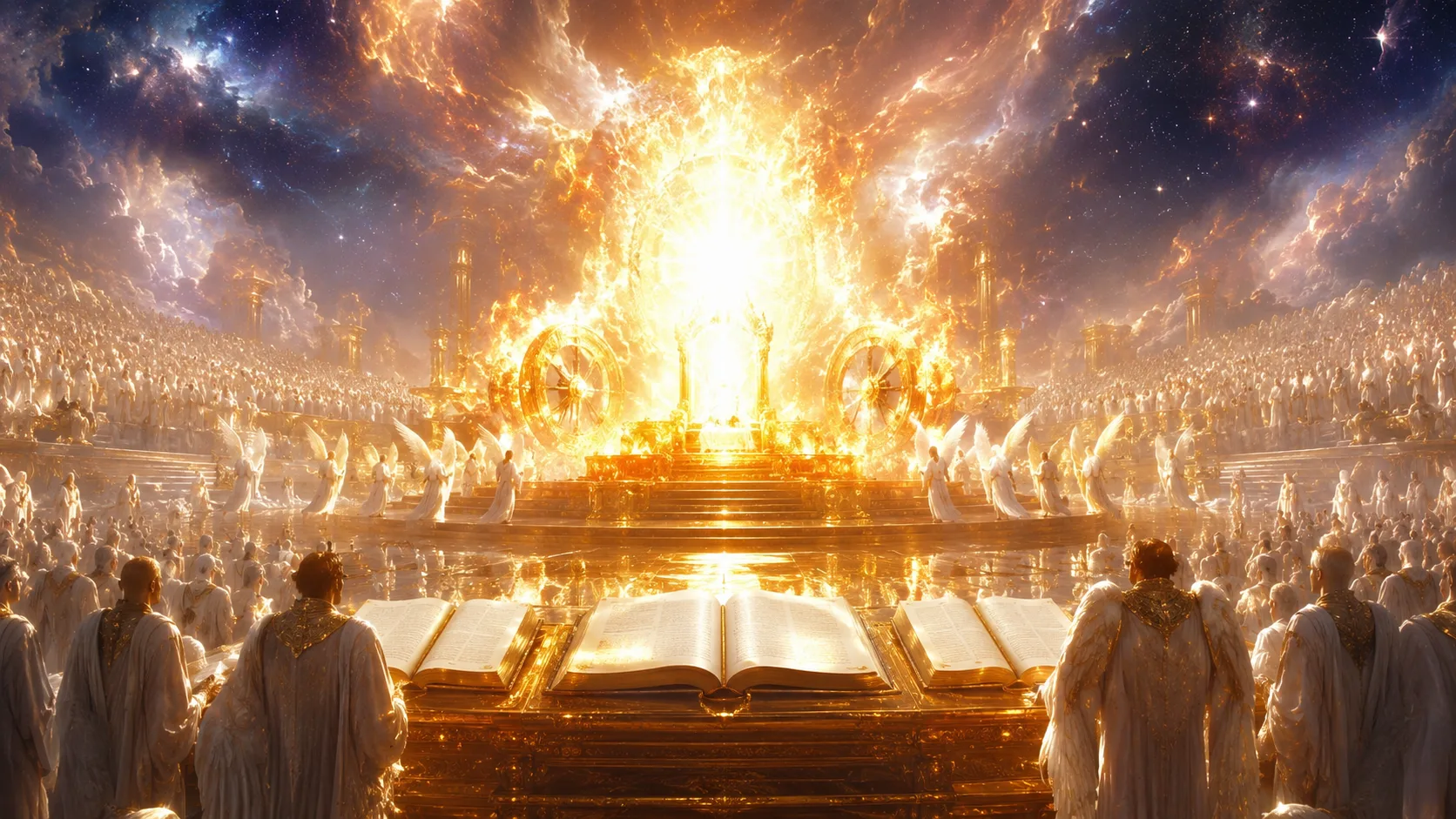
I saw in the night visions, and, behold, one like the Son of man came with the clouds of heaven, and came to the Ancient of days, and they brought him near before him. And there was given him dominion, and glory, and a kingdom, that all people, nations, and languages, should serve him: his dominion is an everlasting dominion, which shall not pass away, and his kingdom that which shall not be destroyed.
Daniel 7 closes with the same end Daniel 2 named, but with named persons in the place of an unnamed stone. The Ancient of days sits in the heavenly courtroom of the scene Lesson 11 already walked. One like the Son of man — the most-used self-designation of Christ in the four Gospels — comes with the clouds of heaven and is brought near before the Father. Dominion is given Him. All peoples serve Him. His dominion does not pass away. His kingdom is not destroyed. This is the same kingdom Daniel 2 named — the everlasting kingdom set up by the God of heaven that supersedes all the earthly successors — described from the heavenly side, with Christ Himself receiving it from the Father.
But Jesus held his peace. And the high priest answered and said unto him, I adjure thee by the living God, that thou tell us whether thou be the Christ, the Son of God. Jesus saith unto him, Thou hast said: nevertheless I say unto you, Hereafter shall ye see the Son of man sitting on the right hand of power, and coming in the clouds of heaven.
Christ at His trial, before the Sanhedrin, on solemn oath, identifies Himself as the Son of man of Daniel 7:13–14 — in His own voice, by direct citation of the Daniel passage. The high priest’s reaction in the next verse is to rend his clothes and accuse Him of blasphemy (Matt 26:65). Caiaphas understands precisely what the citation means: Christ is claiming to be the One Who comes with the clouds of heaven before the Ancient of days, the One to Whom is given dominion and an everlasting kingdom, the One Whom all peoples will serve. The ecclesiastical court of the day saw a divine claim in the citation and condemned it as blasphemy. The willing reader, two thousand years later, sees the same claim and is invited to receive it. The Son of man of Daniel 7 is Jesus Christ, in His own voice, on the most solemn occasion of His ministry, the night before His crucifixion.
But the judgment shall sit, and they shall take away his dominion, to consume and to destroy it unto the end. And the kingdom and dominion, and the greatness of the kingdom under the whole heaven, shall be given to the people of the saints of the most High, whose kingdom is an everlasting kingdom, and all dominions shall serve and obey him.
The close of the vision is the close of the controversy. The judgement Lesson 11 walked is set; the little horn’s dominion is taken away to be consumed and destroyed; and the kingdom under the whole heaven is given to the saints of the Most High. The everlasting kingdom is also the kingdom of God’s redeemed people. Daniel 2 ends with a stone filling the earth; Daniel 7 ends with the saints receiving the dominion. Same kingdom, two angles.
Question 10
How do the alternative readings of Daniel hold up?
Answer
Four non-historicist readings of Daniel are influential in the modern church and the modern academy. Each one is addressed in its own terms below:
| Reading | Why the text resists it |
|---|---|
| Preterist — the whole vision was fulfilled by Antiochus IV / AD 70 | Daniel 2 and Daniel 7 both end with a kingdom that supersedes all four preceding kingdoms and stands "for ever and ever" (Dan 2:44; 7:14, 27). Neither Antiochus’s death in 164 BC nor the Roman destruction of Jerusalem in AD 70 produced a final, universal, never-destroyed kingdom of God on earth. The fourth kingdom is named in Dan 7:23 as a fourth that follows three preceding ones; identifying that fourth as anything earlier than Rome leaves Greece without a place in the sequence. Christ Himself, after Antiochus and before AD 70, refers to "the abomination of desolation, spoken of by Daniel the prophet" as yet future (Matt 24:15) — a verdict no preterist reading can absorb. |
| Futurist — the prophecy is suspended until a future seven-year tribulation | The dispensational reading treats the church age as a "parenthesis" between Daniel 9’s sixty-ninth and seventieth weeks — an interval of almost two thousand years inserted into a single seven-year period with no textual warrant. The seventieth week is then transferred wholesale to a future antichrist who confirms a covenant for seven years. Daniel 9:27, however, names the One Who "shall confirm the covenant with many for one week" and "in the midst of the week" cause sacrifice to cease — language the New Testament unanimously applies to Christ Himself (Heb 9:15–17; Matt 27:51), not to a future antichrist. The "parenthesis" theory is a nineteenth-century innovation by John Nelson Darby; no commentator before Darby read the prophecy that way. |
| Late-date / Maccabean — Daniel was written after Antiochus IV, around 165 BC | The Dead Sea Scrolls preserve eight Daniel manuscripts (1QDan-a, 1QDan-b, 4QDan-a through 4QDan-e, 6QDan, pap6QDan), the earliest palaeographically dated to the late second century BC — copies already in circulation among the Qumran community within a generation of the supposed composition date. The Greek Septuagint translation of Daniel was made in the same general period. For a forgery alleged to have been written around 165 BC, the text was disseminated, translated, and venerated as Scripture across geographically dispersed communities in an implausibly short window. The simpler hypothesis is the one Christ Himself endorsed when He cited "Daniel the prophet" by name (Matt 24:15): the book is what it claims to be. Daniel’s prophecies also extend well past Antiochus — the iron-and-clay phase of Daniel 2, the little horn’s 1260-year arc of Daniel 7, the 2,300 days of Daniel 8 — none of which can be back-dated history. |
| Liberal — Daniel is generic apocalyptic literature, not specific prediction | The text resists the categorisation. Daniel 2 names a specific king (Nebuchadnezzar, "thou art this head of gold"), a specific sequence of four named-by-implication kingdoms, a specific division of the fourth (iron mixed with clay), and a specific event terminating the sequence (the stone cut without hands). The 70-weeks prophecy of Daniel 9 names a specific decree, a specific Messiah, a specific cessation of sacrifice "in the midst of the week," and produces verifiable AD 27 / 31 / 34 fulfilments in the historical record. Generic apocalyptic literature does not yield testable date arithmetic. Daniel does. |
Four readings, four failures. The historicist reading is the reading the text supports, the reading the historical record fulfils, and the reading the Protestant Reformation recovered from a medieval church that had largely abandoned it. The willing reader is invited to take the prophecy at face value: Daniel saw what is, and the present hour of earth’s history is the divided-Rome phase, near the terminus of the little horn’s arc, awaiting the stone that breaks the image and the kingdom given to the Son of man.
A note on what is being recovered
The identification this lesson defends is not a confessional polemic against the millions of sincere Catholic believers across the centuries who have loved Christ within the structures available to them. The institute reads Daniel 7 as the Reformation read it — as a divine identification of the historical system that overlaid the apostolic gospel with tradition, persecuted the saints who refused the overlay, and altered the times and laws of God. The identification stands on the prophetic marks the text supplies. The pastoral call is the one Revelation 18 itself issues to the people of God within the system: Come out of her, my people, that ye be not partakers of her sins (Rev 18:4). The doctrine corrected is the structure, not the love of the believer within it. Christ’s sheep are scattered across many folds and He calls them all to the recovered apostolic gospel.
Summary of Lesson 12
- Daniel 2 and Daniel 7 are parallel sweeps of the same prophetic history, from the sixth century BC to the second coming, told first in metals (the image) and then in animal-symbols (the four beasts).
- Four world-kingdoms in succession: Babylon (605–539 BC), Medo-Persia (539–331 BC), Greece (331–168 BC), and Rome (168 BC onward). Each named in the text or in the parallel chapters (Dan 2:38; 5:28; 8:20–21).
- Rome divides into ten kingdoms (the ten toes of Dan 2; the ten horns of Dan 7) under the Germanic migrations of AD 376–476. Iron mixed with clay does not cohere: every subsequent reunification attempt has failed (Dan 2:43).
- Out of the ten arises a little horn (Dan 7:8, 24) with four prophetic marks: rises after the ten, plucks up three (Heruli AD 493, Vandals AD 534, Ostrogoths AD 538), diverse from the others, speaks great words against the Most High and thinks to change times and laws.
- The little horn’s dominance lasts 1,260 years on the day-for-a-year principle (Dan 7:25 — a time, times, and the dividing of time = 1,260 prophetic days = 1,260 years).
- Endpoints in history: AD 538 (Justinian’s constitution of the Bishop of Rome and the breaking of the Ostrogothic siege) to AD 1798 (Berthier’s capture of Pius VI and the deadly wound of Rev 13:3). 538 + 1260 = 1798 exactly.
- The Reformation consensus on the identification of the little horn — Wyclif, Hus, Luther, Calvin, Zwingli, Tyndale, Knox, Newton, Wesley, Edwards — is the TAHBRI position, recovered from a modern church that has largely surrendered it to dispensationalism and critical preterism.
- Christ Himself, on solemn oath at His trial, identifies Himself as the Son of man of Daniel 7:13–14 (Matt 26:64). The everlasting kingdom of Daniel is the kingdom of Christ.
- The four standard alternatives to historicism — preterist, futurist, late-date Maccabean, and liberal generic-apocalyptic — fail on the text’s own internal markers and on the external evidence (the Dead Sea Scrolls, the Septuagint, Christ’s own citation of Daniel as prophet).
- The present hour of earth’s history is the iron-and-clay phase, after the 1,260-year arc, awaiting the stone cut without hands. The kingdom of God is the next event on Daniel’s prophetic calendar.
Personal response
The prophetic architecture of Daniel 2 and 7 is the scaffolding on which the rest of biblical prophecy hangs. The four kingdoms locate the reader in history. The little horn identifies the persecuting power. The 1,260 years bring the reader to the close of the eighteenth century and the wound of Revelation 13. The everlasting kingdom of the Son of man is the next event of magnitude on the calendar. The willing reader who has received this lesson knows where in the prophecy the present hour stands — and the institute commends, in light of that location, the prayer Daniel himself prayed when he understood the magnitude of the hour:
Father in heaven, the only true God, the Ancient of days, thank You for the plainness of Your word on the history of the nations. I have seen the four kingdoms in their sequence and their fulfilments. I have seen the little horn and its 1,260 years brought to their terminus on the date Your word named. I have heard Your Son identify Himself as the Son of man of Daniel’s vision, coming with the clouds of heaven to receive the kingdom. Place me, by Your grace, among the saints of the Most High who receive the kingdom from Your hand. Let me hear Your call out of every system that has overlaid Your gospel, and walk in the apostolic light Your Spirit and Your word together set before me. In the name of the Son of man, the everlasting King, Jesus Christ. Amen.
From the prophetic architecture of the kingdoms, the next lesson asks the next question: what is the mark of the beast? Revelation 13 takes up the little horn of Daniel 7 under another set of symbols, names its image, its mark, and its number, and brings the prophetic timeline to the closing test on which the final crisis turns. Lesson 13 walks the case.
Foundational text
“And in the days of these kings shall the God of heaven set up a kingdom, which shall never be destroyed: and the kingdom shall not be left to other people, but it shall break in pieces and consume all these kingdoms, and it shall stand for ever.”
— Daniel 2:44