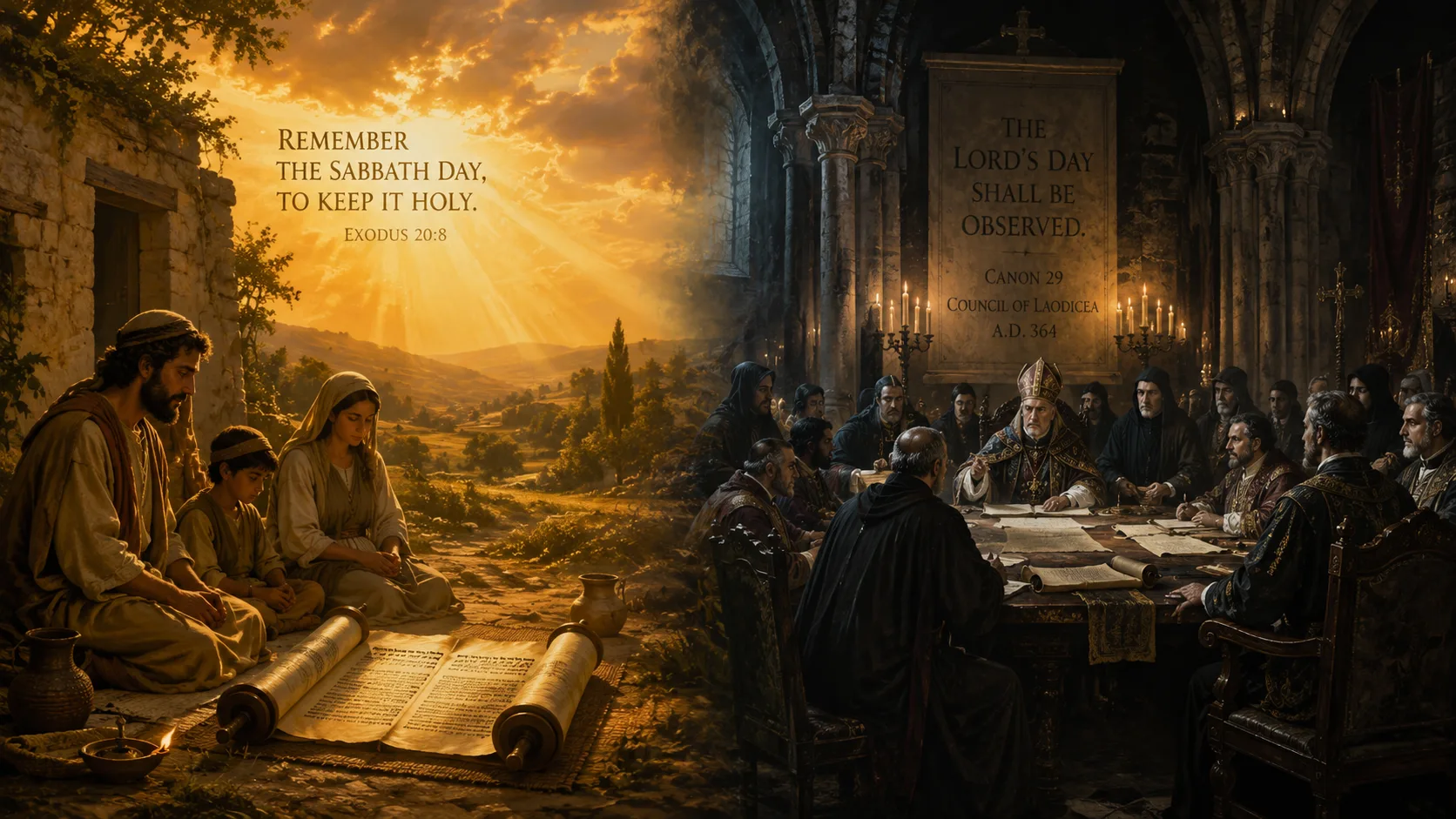
Lesson 7 established that the biblical Sabbath is the seventh day of the week — Saturday — kept unbroken from Eden through the apostolic age. Yet most of the Christian world today observes a different day. The honest question is the historical one: who changed the day, when, and on what authority? The answer is not in dispute. It is on the documentary record — including, with full transparency, on the record of the institution that made the change.
This lesson lets the historical witnesses speak. The principal witnesses are Roman Catholic primary sources — catechisms, episcopal newspapers, apologetic literature — in which the Catholic Church repeatedly and openly confesses that the change of the Sabbath was her own act and constitutes her own mark of authority over the Bible. A secondary set of witnesses are historic Protestant theologians and confessions who acknowledged, against the interest of their own Sunday-keeping tradition, that the change has no biblical warrant. The two sets of witnesses converge on the same conclusion. The case is open, and the documents are quoted below in the witnesses’ own words.
For the deeper-dive treatment of the closing-crisis significance of the Sunday-Sabbath issue, see the library article The Final Events. This lesson stays compact and historical.
Question 01
Does the New Testament command Sunday observance?
Answer
No. The New Testament contains exactly eight passages that mention the first day of the week. Each one names the day in passing, as a calendar date, without any instruction to keep it holy. None contains a command of the form thou shalt rest on the first day of the week, or Sunday is the new Sabbath. The eight references are:
- Matt 28:1; Mk 16:2, 9; Lk 24:1; Jn 20:1, 19 — six references to the morning and evening of the resurrection day. Each is a chronological notation, not a commandment.
- Acts 20:7 — a single meeting at Troas in which Paul preached late into the night. By Hebrew reckoning (the reckoning Luke uses throughout Acts), this was Saturday evening after sundown — the beginning of the first day of the week — and the very next verse records Paul departing on foot for a day-long journey, which would have been impossible on a Sabbath. It was a single farewell meeting, not a weekly Sunday service.
- 1 Cor 16:1–2 — Paul’s instruction that each believer set aside funds for the poor saints at Jerusalem on the first day of the week. The text describes a private, personal accounting at home (Greek par’ heautō, by himself), not a public worship gathering, and contains no Sunday observance instruction.
Eight passing references, no commandment. The reader who examines each passage in its own context will find no New Testament authority for Sunday observance as a substitute for the seventh-day Sabbath.
Question 02
Historically, when did the change to Sunday observance happen?
Answer
The change was gradual, spanning the second through fourth Christian centuries, and was driven by a combination of doctrinal drift, anti-Jewish sentiment in the post-apostolic empire, accommodation to pagan sun- worship, and political consolidation under Constantine. The principal historical milestones:
- c. AD 150–250. Some Gentile Christian congregations in the western Roman Empire begin to assemble also on Sunday in commemoration of the resurrection, in addition to their continuing Sabbath worship. Justin Martyr’s First Apology (c. AD 155) is the earliest extant Christian witness to a Sunday assembly — and notably he frames it as a Sun-day, not as a replacement Sabbath.
- AD 321, March 7. Emperor Constantine issues the first civil Sunday law, decreeing in part: “On the venerable day of the Sun, let the magistrates and people residing in cities rest, and let all workshops be closed.” The edict uses the explicitly pagan language of dies Solis — the day of the Sun — honoured by Constantine’s favoured deity Sol Invictus, the unconquered Sun. The rationale is sun-worship; Christian theological justification will be retrofitted to it over the following decade.
- c. AD 336. The Council of Laodicea, in canon 29, formally anathematises continuing Sabbath observance among Christians: “Christians shall not Judaise and be idle on Saturday, but shall work on that day; but the Lord’s day they shall especially honour, and, as being Christians, shall, if possible, do no work on that day. If, however, they are found Judaising, they shall be shut out from Christ.” The penalty for Sabbath observance among Christians is now formal excommunication.
- AD 538. The completion of the Justinian decree of 533 transfers civil authority over the former Roman territories to the bishop of Rome — the prophetic moment Daniel 7:25 had named, beginning the 1,260-year period of papal political supremacy in Europe. With civil authority backing the ecclesiastical decree, the Sunday observance is enforceable across Christendom.
The change is therefore not the work of the apostles, who died decades before any of these events. It is the work of the post-apostolic Christianised empire and the episcopal authority of Rome operating under its civil backing.
Question 03
Why did the change happen?
Answer
Several factors converged. The Bar Kochba revolt of AD 132–135 generated significant anti-Jewish sentiment across the Roman world, and many Gentile Christian congregations sought to distinguish themselves visibly from Judaism by shifting their public worship to a day other than the Jewish Sabbath. The popular sun-cults of the empire — Mithraism, the imperial cult of Sol Invictus instituted by Aurelian in 274 — provided a culturally familiar day already regarded as sacred. Constantine’s personal attachment to the Sun-cult before his Christianisation provided the political mechanism. The bishops of Rome, gaining authority across the empire as Constantine’s favoured see, consolidated the change as their own prerogative. And the doctrinal innovation that Christ had risen on Sunday and therefore that day should be the new sacred day was developed retrospectively to justify what had been done for other reasons.
Bible-faithful Christian groups continued to observe the seventh-day Sabbath throughout this entire period, often at the cost of persecution. The Celtic Christians of the British Isles, the Waldenses of the Italian Alps, certain Eastern church traditions, and various small surviving groups across the medieval period maintained Sabbath observance until the Reformation began the recovery of what had been set aside.
Question 04
What does the Roman Catholic Church herself say about the change?
Answer
The Roman Catholic Church has been consistent and forthright on this question for centuries. She does not claim that Scripture authorises Sunday observance; she claims that her own ecclesiastical authority does. The change is repeatedly named in her own published documents as her act and her mark of authority over Protestants who accept it from her without realising what they are accepting.
| Source | Statement |
|---|---|
| A Convert's Catechism of Catholic Doctrine — Peter Geiermann (1957 ed., p. 50) | "Q. Which is the Sabbath day? A. Saturday is the Sabbath day. Q. Why do we observe Sunday instead of Saturday? A. We observe Sunday instead of Saturday because the Catholic Church transferred the solemnity from Saturday to Sunday." |
| Doctrinal Catechism — Stephen Keenan (1851, p. 174) | "Q. Have you any other way of proving that the Church has power to institute festivals of precept? A. Had she not such power, she could not have done that in which all modern religionists agree with her — she could not have substituted the observance of Sunday the first day of the week, for the observance of Saturday the seventh day, a change for which there is no Scriptural authority." |
| Faith of Our Fathers — Cardinal James Gibbons (1876, p. 89) | "You may read the Bible from Genesis to Revelation, and you will not find a single line authorizing the sanctification of Sunday. The Scriptures enforce the religious observance of Saturday, a day which we [Catholics] never sanctify." |
| The Christian Sabbath — Catholic Mirror booklet (1893) | "The Catholic Church, for over one thousand years before the existence of a Protestant, by virtue of her divine mission, changed the day from Saturday to Sunday… The Christian Sabbath [Sunday] is therefore to this day the acknowledged offspring of the Catholic Church, as Spouse of the Holy Ghost, without a word of remonstrance from the Protestant world." |
| The Catholic Record (Sept 1, 1923) | "Sunday is our mark of authority… the Church is above the Bible, and this transference of Sabbath observance is proof of that fact." |
| Our Sunday Visitor (1950) | "The Protestant mind does not seem to realise that in accepting the Bible, in observing the Sunday, in keeping of Christmas and Easter, they are accepting the authority of the spokesman for the Church, the Pope." |
Six representative voices, spanning more than a century and a half of Catholic publication. The argument they make is consistent and self-aware. The Catholic Church knows the seventh-day Sabbath is the Bible Sabbath. She knows Sunday is her substitution. She defends the substitution not by appealing to the Bible — she knows the Bible doesn’t support it — but by appealing to her own claimed divine authority to alter the law of God. The Sunday observance is, on her own published testimony, the mark of her authority over the Christian conscience.
A note on what is being critiqued
The doctrinal architecture this lesson is correcting — the claim that any human ecclesiastical authority can alter the moral law of God — is the institutional teaching of the Roman Catholic Church and, by inheritance and silent consent, the practice of the great majority of Protestant traditions that followed. The institute’s argument is with the architecture, not with the more than a billion Catholic and the hundreds of millions of Protestant Christians who have inherited the Sunday observance without ever being shown what their own institutions have written about its origin. The vast majority have never read Stephen Keenan, Cardinal Gibbons, the Catholic Mirror, or Our Sunday Visitor. The vast majority have never been told that the Roman Catholic Church openly claims the change as her own. The vast majority love Christ genuinely and would respond to Scripture’s witness if they were ever shown it. The institute’s call — in the words of the closing book of Scripture itself — is to those who love Christ to come into the light their inherited tradition has obscured. The quarrel is with the teaching. It is never with neighbours.
Question 05
Did Scripture predict a power that would attempt to change God’s law?
Answer
And he shall speak great words against the most High, and shall wear out the saints of the most High, and think to change times and laws: and they shall be given into his hand until a time and times and the dividing of time.
Yes. The prophet Daniel, writing in the sixth century BC, foretold the rise of a religio-political power that would arise in the prophetic time after the breakup of the Roman Empire, would speak great words against the Most High, would persecute the saints, and would think to change times and laws. The Hebrew zeman v’dath — times and law — specifically denotes the appointed times within the divine law. The time and times and dividing of time — 1,260 prophetic years — runs from AD 538 (when the civil arm was given to the papacy under Justinian) to AD 1798 (when Napoleon’s general Berthier carried the pope into French captivity), an exact fulfilment.
The institute does not bring Daniel 7:25 in to prejudge the historical case made above. It brings the prophecy in after the historical case, so that the reader can see that the change of the Sabbath was precisely what Daniel’s prophecy had foretold twelve centuries before it happened. Scripture predicted the event. The event occurred. The historical evidence is on the record. The Roman Catholic Church openly confesses her role. The prophecy and the documentary record converge on the same conclusion.
Question 06
Have Protestant scholars also admitted the change has no biblical basis?
Answer
Yes — openly and at length. The most candid Protestant theologians of the past four centuries have acknowledged what their own traditions have not always been willing to act on. The witness of these Protestant scholars is doubly weighted because it runs against the tradition they personally belong to:
| Source | Statement |
|---|---|
| The Baptist Manual — Edward T. Hiscox (1893) | "There was and is a commandment to keep holy the Sabbath day, but that Sabbath day was not Sunday… It will however be readily said, and with some show of triumph, that the Sabbath was transferred from the seventh to the first day of the week… Where can the record of such a transaction be found? Not in the New Testament — absolutely not." |
| Theological Compend — Amos Binney (Methodist Episcopal, 1902 ed., p. 170) | "It is true, there is no positive command for infant baptism… Nor is there any for keeping holy the first day of the week. Many believe that Christ changed the Sabbath. But, from his own words, we see that he came for no such purpose." |
| The Augsburg Confession — Article 28 (1530) | The foundational Lutheran confessional document concedes openly that the change of the Sabbath to Sunday is "an example of the power of the Church, that she has changed the Sabbath of the Decalogue to the Lord's Day, contrary to the Decalogue, as it seems." |
The Baptist Manual, the Methodist Theological Compend, and the Augsburg Confession together represent three of the largest Protestant traditions. Each acknowledges, in its own published apologetic literature, that Sunday observance is not a New Testament institution and that the change from Sabbath to Sunday cannot be sustained from Scripture. The hostile Catholic witness and the reluctant Protestant witness converge: the historical fact of the change is settled, and its lack of biblical warrant is admitted on both sides.
Question 07
What is the spiritual significance of the change?
Answer
Moreover also I gave them my sabbaths, to be a sign between me and them, that they might know that I am the Lord that sanctify them… And hallow my sabbaths; and they shall be a sign between me and you, that ye may know that I am the Lord your God.
Verily my sabbaths ye shall keep: for it is a sign between me and you throughout your generations; that ye may know that I am the Lord that doth sanctify you… It is a sign between me and the children of Israel for ever.
Scripture identifies the Sabbath three times as the sign of God’s sanctifying authority over His people. A sign is the visible token by which an authority is recognised. The Sabbath is God’s sign. By Rome’s own published confession, Sunday is her sign — her mark of authority, in her own phrase. Two signs, two authorities. The day the believer keeps is, on both witnesses’ own terms, the sign of which authority the believer acknowledges over conscience and worship.
The change of the Sabbath is the sign or mark of the authority of the Roman Church. Those who, understanding the claims of the fourth commandment, choose to observe the false instead of the true Sabbath are thereby paying homage to that power by which alone it is commanded.
The spiritual significance is therefore not abstract. Both institutions — the institution of God in Scripture, and the institution of Rome in her own documents — treat the day as the sign of the authority claimed. When the closing crisis of earth’s history reaches its decisive moment (the subject of the library article on the final events), the question of which sign the believer wears will be the public visible mark of which God the believer serves.
Question 08
What did Christ Himself say about traditions that override the commandments?
Answer
Howbeit in vain do they worship me, teaching for doctrines the commandments of men. For laying aside the commandment of God, ye hold the tradition of men… Full well ye reject the commandment of God, that ye may keep your own tradition… Making the word of God of none effect through your tradition, which ye have delivered: and many such like things do ye.
Christ’s answer to the Pharisees, who had substituted human tradition for the commandments of God, is also His answer to every later generation that does the same thing in different particulars. He did not treat such substitutions as harmless or as adiaphora. He treated them as vain worship — worship that does not reach the One worshipped, because the worshipper has set aside the One’s actual commandments in favour of the tradition’s substitutes. The application to the question of this lesson is direct.
Question 09
What is the prophetic call to honest seekers in the closing hour?
Answer
And after these things I saw another angel come down from heaven, having great power; and the earth was lightened with his glory. And he cried mightily with a strong voice, saying, Babylon the great is fallen, is fallen… And I heard another voice from heaven, saying, Come out of her, my people, that ye be not partakers of her sins, and that ye receive not of her plagues.
These were more noble than those in Thessalonica, in that they received the word with all readiness of mind, and searched the scriptures daily, whether those things were so.
The closing chapter of the prophetic book of Scripture contains the closing call of the Christ to the honest in heart who, through no fault of their own, find themselves inside religious systems that have departed from His Word. The call is not addressed to enemies. It is addressed to my people — sincere believers Christ recognises as His own — who are still resident inside the inherited system, and who are invited, gently and earnestly, to come out. The first step is the Berean step: to search the Scriptures for oneself, to read the Catholic and Protestant primary sources cited in this lesson, to read the eight New Testament references to the first day of the week, and to settle the question on the documents themselves.
Question 10
How should the reader respond?
Answer
The reader who has worked through Lesson 6 (the moral law stands), Lesson 7 (the seventh day is the Sabbath), and Lesson 8 (the change to Sunday was a post-apostolic institutional act with no scriptural warrant) now has the framework to receive the gospel call that opens before them. The institution of the seventh-day Sabbath is the standing love-appointment between the Creator and the creature He has redeemed. The reader is invited to recover what tradition has set aside — not for legalism, not for denominationalism, not for any human cause, but simply because the Father Christ revealed has called His people to honour the day He sanctified, and because keeping it is one of the ways the reconciled heart says to Him: I love you. I trust you. I will walk where you walk.
For the deeper-dive treatment of how the Sabbath functions as a love appointment at the centre of the week, see the library article A Day to Be Remembered.
Summary of Lesson 8
- The New Testament contains eight passing references to the first day of the week and no commandment to observe it as a sabbath replacement.
- The historical change was gradual, occurring across the second through fourth centuries, and was driven by anti-Jewish sentiment, pagan sun-worship, the Bar Kochba revolt, and political consolidation under Constantine.
- Constantine’s civil Sunday law of AD 321 invoked the pagan dies Solis — the day of the Sun. The Council of Laodicea (c. AD 336) formally anathematised Sabbath observance among Christians.
- The Roman Catholic Church confesses the change as her own act and her own mark of authority in multiple published primary sources spanning more than 170 years (Convert’s Catechism, Doctrinal Catechism, Faith of Our Fathers, Catholic Mirror, The Catholic Record, Our Sunday Visitor).
- Daniel 7:25 predicted a religio-political power that would think to change times and laws during the 1,260 prophetic years from AD 538 to AD 1798 — an exact fulfilment.
- Historic Protestant confessions and theologians (Augsburg Confession 1530; Baptist Manual 1893; Methodist Theological Compend 1902) have admitted that Sunday observance has no biblical warrant.
- The Sabbath is named three times in Scripture as the sign of God’s sanctifying authority over His people (Ex 31:13, 17; Ezek 20:12, 20). Sunday is named by Rome as her mark of authority. Two signs, two authorities.
- Christ Himself condemned the substitution of human tradition for the commandments of God as vain worship (Mk 7:7–9, 13).
- The closing book of Scripture issues a gentle and earnest call to honest believers still inside the inherited systems: Come out of her, my people (Rev 18:4). The first step is the Berean step — to search the Scriptures and the documentary record for oneself (Acts 17:11).
- The reader who has worked through Lessons 6, 7, and 8 now has the framework necessary to recover what tradition has set aside — the standing love appointment between the Creator and His redeemed.
Personal response
The historical witnesses have spoken. Scripture has spoken. Rome herself has spoken. The honest reader is now in a position to settle the question in the presence of the Father, and the institute commends a simple prayer for the response that follows:
Father in heaven, the only true God, I have heard the witnesses You have set before me — Your own commandment, the unbroken biblical record, the open confession of the institution that made the change, and the admissions of Protestant scholars on both sides. Where my tradition has obscured Your law, give me the grace to honour Your Sabbath as You have honoured it. Make Your Sabbath a delight in my life (Isa 58:13–14). Bring me into the light Christ has shed on this question, in the closing call of Revelation 18:4. In the name of Your Son, the Lord of the Sabbath, Jesus Christ. Amen.
From the foundation of the law and the Sabbath, the next lesson asks the next question: what happens to the human being at death? The answer Scripture gives is very different from the answer most modern Christianity teaches — and the difference is the doorway through which the spiritualist deception of the closing hour will walk. Lesson 9 walks the state of the dead and closes the doorway.
Foundational text
“Howbeit in vain do they worship me, teaching for doctrines the commandments of men. For laying aside the commandment of God, ye hold the tradition of men.”
— Mark 7:7–8