

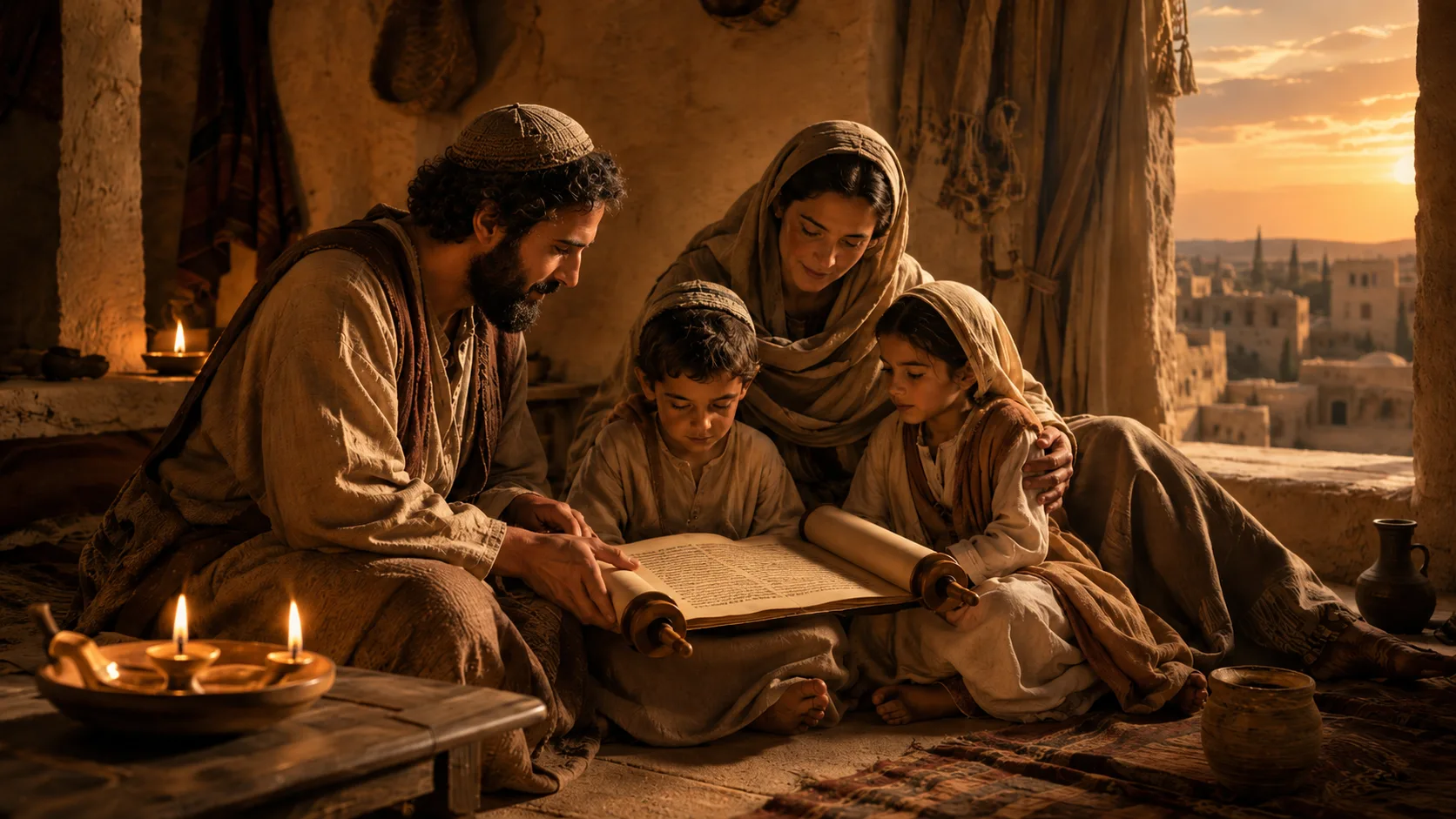
Lesson 6 established that the moral law of God stands unaltered after the cross. The fourth of the Ten Commandments — Remember the sabbath day, to keep it holy — therefore stands with the rest. But which day is it? Saturday? Sunday? Some other day? The Bible identifies the day with extraordinary clarity, and identifies it by the Bible’s own internal markers. This lesson walks the unbroken record from Eden to the new earth.
The Sabbath is one of the most controversial commandments in modern Christianity. The other nine the great majority of professed Christians still keep. The fourth they have widely set aside, generally on the strength of an argument the previous lesson showed will not hold. The question is not whether the Sabbath is binding — Lesson 6 answered that — but which day, of the seven the Creator made, He sanctified and on which He instructed His people to rest.
Scripture answers the question, and the answer has not changed across the four thousand years from Eden to the apostolic age. The institute’s deeper-dive article A Day to Be Remembered walks the Sabbath as the love appointment at the centre of the week. This lesson walks the more compact question the title names: which day is it? Lesson 8 takes up the next question: who changed the observance, when, and on what authority?
Question 01
Where did the Sabbath come from?
Answer
Thus the heavens and the earth were finished, and all the host of them. And on the seventh day God ended his work which he had made; and he rested on the seventh day from all his work which he had made. And God blessed the seventh day, and sanctified it: because that in it he had rested from all his work which God created and made.
From the Creator’s own hand, at the close of the first week of human history, in the original sinless creation. Three things are recorded in Genesis 2:1–3: God rested on the seventh day, He blessed it, and He sanctified it — set it apart as holy. The Sabbath is not a later Jewish invention; it predates Israel by approximately two and a half millennia. It was instituted in Eden, before sin entered the world, before there was such a thing as a Jew or a Gentile, in the universal opening chapter of the human story.
The Sabbath, as a memorial of creative power, points to God as the Maker of the heavens and the earth, and so distinguishes the true God from all false gods. All who keep the seventh day signify by this act that they are worshipers of Jehovah.
The Sabbath is, on the Bible’s own framing, a weekly memorial of Who God is. To keep it is to confess that this earth and everything in it was made by Him in six days, and that He is the true God in distinction from every claimant who is not.
Question 02
Was the Sabbath kept before Sinai?
Answer
And it came to pass, that on the sixth day they gathered twice as much bread, two omers for one man… And he said unto them, This is that which the Lord hath said, To morrow is the rest of the holy sabbath unto the Lord: bake that which ye will bake to day, and seethe that ye will seethe; and that which remaineth over lay up for you to be kept until the morning… Six days ye shall gather it; but on the seventh day, which is the sabbath, in it there shall be none.
See, for that the Lord hath given you the sabbath, therefore he giveth you on the sixth day the bread of two days; abide ye every man in his place, let no man go out of his place on the seventh day. So the people rested on the seventh day.
Yes. The manna in Exodus 16 was given to Israel several weeks before they arrived at Sinai, where the Ten Commandments were spoken. Yet the manna pattern itself assumes Sabbath observance. A double portion was given on the sixth day; no manna fell on the seventh; the people were instructed not to leave their tents on the seventh day. When some did so and went out to gather, God Himself rebuked them by name: How long refuse ye to keep my commandments and my laws? (Ex 16:28). The commandment was already in force. Sinai codified what Eden had instituted.
Question 03
What does the fourth commandment itself say?
Answer
Remember the sabbath day, to keep it holy. Six days shalt thou labour, and do all thy work: But the seventh day is the sabbath of the Lord thy God: in it thou shalt not do any work, thou, nor thy son, nor thy daughter, thy manservant, nor thy maidservant, nor thy cattle, nor thy stranger that is within thy gates: For in six days the Lord made heaven and earth, the sea, and all that in them is, and rested the seventh day: wherefore the Lord blessed the sabbath day, and hallowed it.
Several features of the fourth commandment deserve attention. The command begins with Remember — a verb no other commandment uses. The Lord asks His people to recall what He had instituted at creation, not to receive a new institution at Sinai. The command names the day specifically: the seventh day. The command gives its own ground: because in six days the Lord made the heavens and the earth, and rested the seventh. The command extends its scope to thy stranger that is within thy gates — including non-Israelites under Israelite jurisdiction. And the command is one of only ten spoken aloud by God Himself from Sinai, written by His own finger on stone, deposited inside the ark beneath the mercy seat. It is not an item of ceremonial detail. It is a moral commandment of the order of the prohibition of murder, theft, and adultery.
Question 04
Is the Sabbath only for Jewish people?
Answer
And he said unto them, The sabbath was made for man, and not man for the sabbath: Therefore the Son of man is Lord also of the sabbath.
Also the sons of the stranger, that join themselves to the Lord, to serve him, and to love the name of the Lord, to be his servants, every one that keepeth the sabbath from polluting it, and taketh hold of my covenant; Even them will I bring to my holy mountain, and make them joyful in my house of prayer… for mine house shall be called an house of prayer for all people.
No. Christ Himself said the Sabbath was made for man — the Greek anthrōpos, the whole human family, not for Israel only. And Isaiah, in a passage Christ Himself quoted (Mk 11:17), promised the same blessing to the Gentiles — the sons of the stranger — who would join themselves to the Lord and keep His Sabbath. The Sabbath belongs to the human race, because the creation it commemorates is the human race’s common origin under the one Creator Who made it.
The Sabbath does not bear the marks of a national legislation. It was not given as part of the Mosaic civil code. It was instituted in Eden, kept before Sinai, codified at Sinai, kept by the prophets, kept by Christ, kept by the apostles, and is sustained — as Question 10 will show — into the new earth itself. It is a creation ordinance for all humanity, not a ceremonial regulation for one nation in one historical period.
Question 05
Which day of the modern week is the biblical seventh day?
Answer
And that day was the preparation, and the sabbath drew on. And the women also, which came with him from Galilee, followed after, and beheld the sepulchre, and how his body was laid. And they returned, and prepared spices and ointments; and rested the sabbath day according to the commandment.
Now upon the first day of the week, very early in the morning, they came unto the sepulchre, bringing the spices which they had prepared.
The Bible identifies the seventh day by its own internal marker: the crucifixion narrative. Christ died on the preparation day, which is universally identified across Christian tradition as Friday — the day before the Sabbath. The women rested the sabbath day according to the commandment, the next day — which is universally identified as Saturday. The resurrection occurred upon the first day of the week, very early in the morning — universally identified as Sunday.
Friday, Saturday, Sunday. Preparation, Sabbath, Resurrection. The three-day sequence is preserved in every major Christian tradition’s observance of Good Friday and Easter Sunday. The day between — the day the women rested on according to the commandment — is the seventh-day Sabbath. Saturday is the biblical Sabbath. The identification is not in dispute; it is embedded in the very calendar Christians use to observe the death and resurrection of their Lord.
The same identification is preserved in the languages of the historic Christian world. In Spanish, the word for Saturday is sábado. In Italian, sabato. In Portuguese, sábado. In Russian, subbota. In Greek, Sávvato. The Latin and Greek words from which these descend are direct transliterations of the Hebrew shabbat. Across more than a dozen Christian languages, the name of Saturday literally is Sabbath.
Question 06
Did Christ Himself keep the Sabbath?
Answer
And he came to Nazareth, where he had been brought up: and, as his custom was, he went into the synagogue on the sabbath day, and stood up for to read.
And they went into Capernaum; and straightway on the sabbath day he entered into the synagogue, and taught.
And when the sabbath day was come, he began to teach in the synagogue.
Christ kept the Sabbath as His settled, repeated, weekly practice. Luke calls it his custom — the Greek kata to eiōthos auto, the standing pattern of His life. He attended the synagogue on the Sabbath. He taught on the Sabbath. He healed on the Sabbath (deliberately, to restore the proper observance from the Pharisees’ over-burdening additions, not to dismiss the day). He never once said anything that could be construed as an abrogation of the day. His Sabbath disputes were always with the human traditions that had buried the commandment, never with the commandment itself.
In Mark 2:28 He named Himself Lord of the sabbath. The point of that title is sometimes misread as suggesting Christ would later transfer the day to another. The point of the title is the opposite. Christ is the Lord of the Sabbath — the Sabbath belongs to Him, He instituted it at creation as the only-begotten through Whom the world was made (Jn 1:3; Lesson 3), and He kept it Himself throughout His earthly life. The Lord of the Sabbath has not been recorded anywhere as abolishing what He established and kept.
Question 07
Did Christ ever predict the Sabbath would be abolished?
Answer
But pray ye that your flight be not in the winter, neither on the sabbath day.
No. The opposite. Matthew 24 records Christ’s discourse on the coming destruction of Jerusalem — an event He places forty years in the future, in AD 70, long after His own crucifixion. In giving His disciples practical instructions for what they would face in that future day, He explicitly told them to pray that their flight would not occur on the Sabbath. The instruction is unintelligible if the Sabbath were to have been abolished at the cross. Christ assumed, decades into the future, that His disciples would still be observing the seventh-day Sabbath. He neither predicted nor authorised a change.
Question 08
Did the apostles keep the Sabbath after Pentecost?
Answer
But when they departed from Perga, they came to Antioch in Pisidia, and went into the synagogue on the sabbath day, and sat down… And when the Jews were gone out of the synagogue, the Gentiles besought that these words might be preached to them the next sabbath. Now when the congregation was broken up, many of the Jews and religious proselytes followed Paul and Barnabas… And the next sabbath day came almost the whole city together to hear the word of God.
And on the sabbath we went out of the city by a river side, where prayer was wont to be made; and we sat down, and spake unto the women which resorted thither.
And Paul, as his manner was, went in unto them, and three sabbath days reasoned with them out of the scriptures.
And he reasoned in the synagogue every sabbath, and persuaded the Jews and the Greeks.
The book of Acts records the apostles — including Paul, the apostle to the Gentiles — keeping the Sabbath as their settled weekly practice for the entire span Luke documents. In Antioch of Pisidia, Paul preached on the Sabbath; the Gentiles requested he preach the next Sabbath; he did so. In Philippi, he met with the women at the riverside on the Sabbath. In Thessalonica, he reasoned with them in the synagogue for three successive Sabbaths. In Corinth, he reasoned every Sabbath for what Luke records as a year and a half (Acts 18:11) — approximately seventy-eight consecutive Sabbaths. The verb Luke uses for Paul’s synagogue practice in Acts 17:2 is kata to eiōthos — the same construction Luke uses of Christ’s own Sabbath custom in Luke 4:16.
The apostles did not regard themselves as a generation freed from the Sabbath. They kept it as Christ had kept it. The single most-debated example of Paul holding a meeting on what some readers take to be Sunday — Acts 20:7 — is, by Hebrew reckoning, what would today be called Saturday evening (after sundown on the Sabbath), and the very next verse describes Paul immediately departing on foot for an all-day journey, which would have been impossible on a Sabbath. The book of Acts does not contain a single instruction to keep any day other than the seventh.
Question 09
What about “the Lord’s day” in Revelation 1:10?
Answer
I was in the Spirit on the Lord’s day, and heard behind me a great voice, as of a trumpet.
If thou turn away thy foot from the sabbath, from doing thy pleasure on my holy day; and call the sabbath a delight, the holy of the Lord, honourable; and shalt honour him, not doing thine own ways, nor finding thine own pleasure, nor speaking thine own words: Then shalt thou delight thyself in the Lord.
Therefore the Son of man is Lord also of the sabbath.
Revelation 1:10 is sometimes cited as evidence of an apostolic practice of keeping Sunday as the Lord’s day. The text itself does not identify which day John means by the phrase. The only day the Old and New Testaments together explicitly call the Lord’s day is the Sabbath. Isaiah called it my holy day and the holy of the Lord. Christ called Himself the Lord of the sabbath. The day to which Scripture itself attaches the title of the Lord’s day is the seventh-day Sabbath.
The shift in Christian usage by which the Lord’s day came to mean Sunday occurred well after the apostles, in the post-apostolic period documented in Lesson 8. John, writing in the AD 90s, would have been using the title for the day Scripture had attached it to. Other proposals require importing a meaning the New Testament nowhere supplies.
Question 10
Does the Sabbath continue into the new earth?
Answer
For as the new heavens and the new earth, which I will make, shall remain before me, saith the Lord, so shall your seed and your name remain. And it shall come to pass, that from one new moon to another, and from one sabbath to another, shall all flesh come to worship before me, saith the Lord.
There remaineth therefore a rest [Greek: sabbatismos] to the people of God.
Yes. Isaiah, writing of the new heavens and new earth which God will make, names the Sabbath as a continuing institution there — all flesh coming to worship before the Lord from one Sabbath to another. The Sabbath of Eden, the Sabbath of Sinai, the Sabbath of Christ, the Sabbath of the apostles, and the Sabbath of the redeemed in the new earth is one institution. The Greek word in Hebrews 4:9 is sabbatismos — literally a sabbath-keeping. The Greek vocabulary itself names the abiding rest of the people of God by the same root as the weekly Sabbath of the Hebrew Scriptures.
The institution Eden opened, eternity continues. Between Eden and eternity, the Sabbath has never been suspended in Scripture’s witness.
Question 11
What does this leave the reader to conclude?
Answer
The Bible names the seventh-day Sabbath as the day God sanctified at creation, codified at Sinai, kept by every generation of God’s people through the apostolic era, and preserved into the new earth. The seventh day of the week as we now keep it — Saturday, the day the women rested on between Christ’s death and resurrection — is the biblical Sabbath. No part of Scripture suspends the commandment; no apostle authorises a change; no prophecy of the new earth omits the day.
Yet most of the contemporary Christian world keeps a different day. How that came to be, when the shift occurred, by whose authority it was made, and what the institution that made it has said about its own act — this is the question the next lesson takes up. The reader who has worked through Lesson 7 now has the framework necessary to receive Lesson 8 honestly.
Summary of Lesson 7
- The Sabbath was instituted by God Himself at the end of creation week — rested on, blessed, sanctified (Gen 2:1–3). It predates Israel by approximately 2,500 years.
- It was kept by Israel before Sinai (Ex 16:22–30). Sinai codified what Eden had instituted.
- The fourth commandment specifies the seventh day, grounds the command in the creation week, and extends its scope to non-Israelites under Israelite jurisdiction (Ex 20:8–11).
- Christ said the Sabbath was made for man — the whole human family (Mk 2:27). Isaiah promised the same blessing to Gentile believers (Isa 56:6–7).
- The biblical seventh day is identified by the crucifixion narrative — Friday (preparation), Saturday (Sabbath, on which the women rested according to the commandment), Sunday (the resurrection on the first day of the week) (Lk 23:54–56; Lk 24:1). The same identification is preserved in more than a dozen historic Christian languages in which Saturday literally means Sabbath.
- Christ Himself kept the Sabbath as His settled custom (Lk 4:16; Mk 1:21; 6:2). His Sabbath disputes were with the Pharisees’ human traditions, never with the commandment itself.
- Christ never predicted the Sabbath would be abolished. In Matt 24:20 He assumed His disciples would still be observing it forty years after His crucifixion.
- The apostles kept the Sabbath as their settled practice (Acts 13:14, 42–44; 16:13; 17:2; 18:4). Paul reasoned in the synagogue every Sabbath for a year and a half in Corinth alone.
- The Lord’s day in Rev 1:10 is the biblical seventh-day Sabbath, since Scripture elsewhere attaches the title to that day specifically (Isa 58:13; Mk 2:28).
- The Sabbath continues into the new earth (Isa 66:22–23). The Greek sabbatismos of Heb 4:9 names the abiding rest of the people of God by the same root as the weekly Sabbath.
- No part of Scripture suspends the commandment, no apostle authorises a change, no prophecy of the new earth omits the day. The seventh-day Sabbath is the biblical Sabbath from Eden to eternity.
Personal response
The reader who has worked through Lessons 6 and 7 together now sees a question Scripture has been making plainly for forty centuries: the day the Lord set apart as a memorial of creation is the seventh day of the week, kept by His people across every age in which they have honoured His commandments. The question for the individual reader is whether to receive that witness as it stands, or to set it aside in favour of a tradition whose origin Lesson 8 will document.
The institute commends a simple prayer for the willing reader:
Father in heaven, the only true God, You sanctified the seventh day at the close of creation week and have kept it sanctified across every generation of Your people. Show me how to honour the day You have honoured. Free me from the inherited traditions that have set aside what You have not set aside. Make Your Sabbath a delight in my life, as Your prophet Isaiah described it (Isa 58:13–14). In the name of Your Son, Jesus Christ, the Lord of the Sabbath. Amen.
From which day, the next lesson asks the historical question: how, when, and by whose authority did most of the Christian world come to observe a different day, when Scripture nowhere authorises the change? Lesson 8 walks the post-apostolic transfer, in the words of those who made it.
Foundational text
“The sabbath was made for man, and not man for the sabbath: therefore the Son of man is Lord also of the sabbath.”
— Mark 2:27–28