
Lesson 5 established that the believer is justified by faith, not by works of the law. A natural question follows: if the believer is not justified by the law, has the law itself been abolished? Many modern teachers answer yes. The apostles, and the historic Christian tradition before the modern shift, answered no. This lesson lets Scripture settle the question.
The popular evangelical answer that the moral law of God was nailed to the cross is, on the apostles’ own testimony, one of the most consequential misreadings in modern Christianity. It empties the gospel of its moral content. It cuts the believer loose from the Father’s own standard of righteousness. And, downstream, it is the doctrinal mechanism by which the seventh-day Sabbath — the fourth of the Ten Commandments — has been quietly set aside by churches that still profess to keep the other nine. This lesson recovers the apostolic teaching on the law in its own terms.
Question 01
What does the Bible mean by “the law”?
Answer
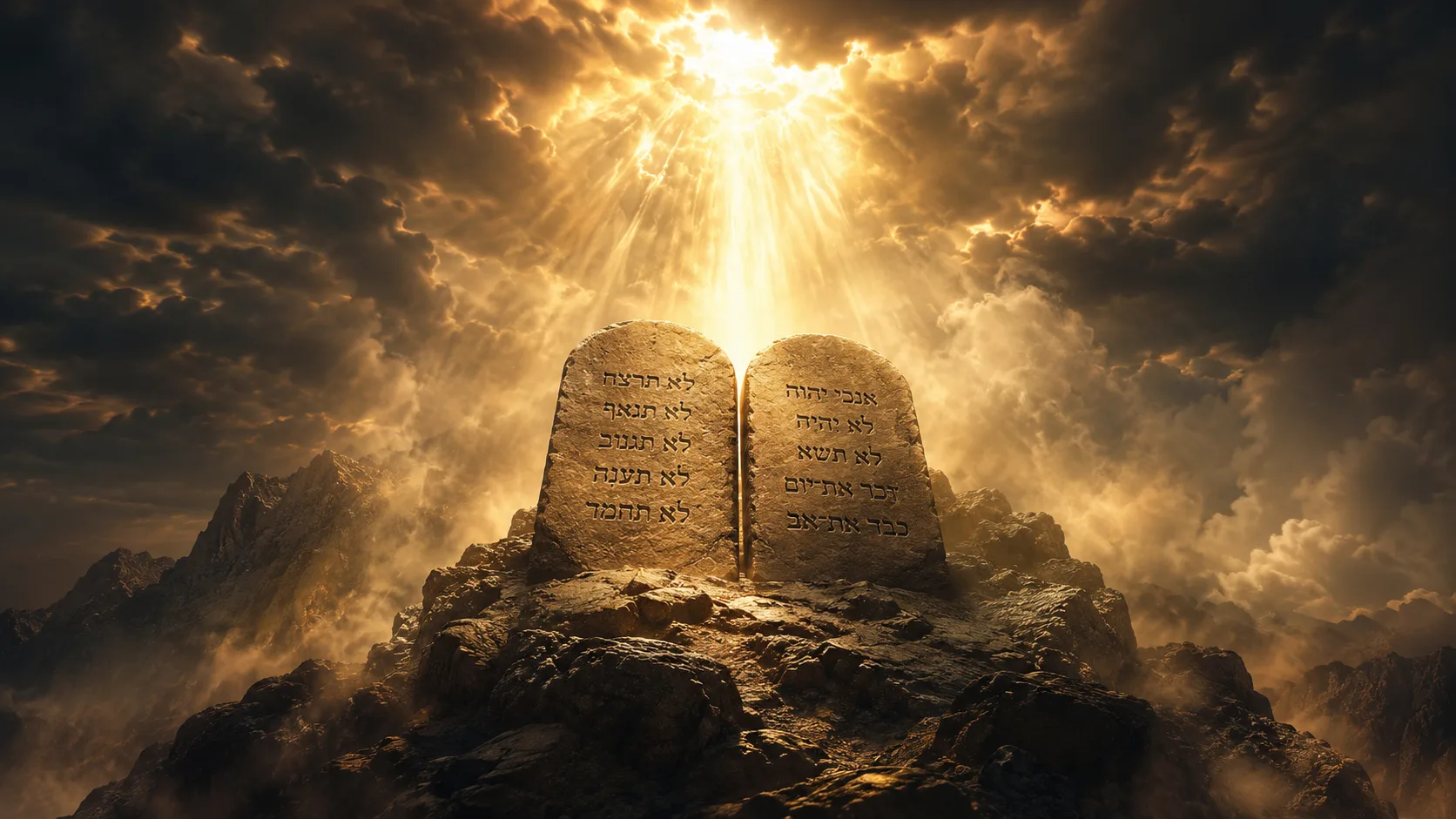
And he declared unto you his covenant, which he commanded you to perform, even ten commandments; and he wrote them upon two tables of stone.
And he gave unto Moses, when he had made an end of communing with him upon mount Sinai, two tables of testimony, tables of stone, written with the finger of God.
Scripture uses the word law in more than one sense, and confusion over the distinction has produced much of the modern misunderstanding. There are, on the historic Christian and pioneer Adventist reading, three biblical bodies of law that must not be conflated:
- The moral law — the Ten Commandments. Spoken by God Himself from Sinai, written by His own finger on two tables of stone, deposited inside the ark of the covenant (Ex 20; Ex 31:18; Deut 10:1–5). The eternal expression of God’s character. Binding in every age.
- The ceremonial law — the sacrificial and festival system. Given through Moses, written by him in a book, placed beside the ark (Deut 31:24–26). The typological shadows that pointed forward to Christ — the sacrifices, the feast days, the cleansing rites, the earthly sanctuary services. Fulfilled and ended at the cross.
- The civil and judicial law. Israel’s national legislation, given for the governance of one particular people in one particular era. Binding on national Israel; expired with the polity it governed.
The principal subject of this lesson is the first — the moral law, the Ten Commandments. When the New Testament says the believer is not under the law, or is free from the law, the immediate context will determine which of the three bodies is in view. The lesson will keep the distinction in front of the reader as it goes.
Question 02
Where did the moral law come from?
Answer
And God spake all these words, saying, I am the Lord thy God, which have brought thee out of the land of Egypt, out of the house of bondage. Thou shalt have no other gods before me… Thou shalt not make unto thee any graven image… Thou shalt not take the name of the Lord thy God in vain… Remember the sabbath day, to keep it holy… Honour thy father and thy mother… Thou shalt not kill. Thou shalt not commit adultery. Thou shalt not steal. Thou shalt not bear false witness against thy neighbour. Thou shalt not covet.
At that time the Lord said unto me, Hew thee two tables of stone like unto the first… And he wrote on the tables, according to the first writing, the ten commandments, which the Lord spake unto you in the mount out of the midst of the fire in the day of the assembly: and the Lord gave them unto me.
The moral law has a unique origin. No other body of biblical commandment was spoken aloud by God Himself in the hearing of an entire nation. No other body was written by God’s own finger on tables of stone. No other body was deposited inside the ark of the covenant beneath the mercy-seat where the divine presence rested. The Ten Commandments stand alone in the manner of their giving, which Scripture itself emphasises, and that manner is one of the indicators that they were intended as a different order of legislation from the ceremonial codes that followed.
Question 03
Is the moral law arbitrary, or does it express God’s character?
Answer
Wherefore the law is holy, and the commandment holy, and just, and good… For we know that the law is spiritual.
He that loveth not knoweth not God; for God is love… and he that dwelleth in love dwelleth in God, and God in him.
Owe no man any thing, but to love one another: for he that loveth another hath fulfilled the law… Love worketh no ill to his neighbour: therefore love is the fulfilling of the law.
The law is not arbitrary. Paul calls it holy, just, good, spiritual — four adjectives drawn directly from the character of God Himself. The sum of the law, Paul writes, is love — and John writes that God is love. The moral law is the expression, in operational commandments, of who God is. To love what the law forbids is to love what God hates; to love what the law requires is to love what God Himself loves. The commandments are not rules imposed from outside God’s nature; they are the contours of God’s nature given in the form a creature can hear and obey.
The law of God is as sacred as God Himself. It is a revelation of His will, a transcript of His character, the expression of divine love and wisdom. The harmony of creation depends upon the perfect conformity of all beings, of everything, animate and inanimate, to the law of the Creator.
The frame given here — the law as the transcript of His character — is the most helpful single phrase in clarifying the question. Modifying the moral law would require modifying God’s character. Since God’s character is unchanging (Mal 3:6; Heb 13:8; Jas 1:17), the moral law which expresses it is unchanging as well.
Question 04
Did Christ abolish the moral law at the cross?
Answer
Think not that I am come to destroy the law, or the prophets: I am not come to destroy, but to fulfil. For verily I say unto you, Till heaven and earth pass, one jot or one tittle shall in no wise pass from the law, till all be fulfilled.
Do we then make void the law through faith? God forbid: yea, we establish the law.
Christ’s own answer is unambiguous. He said explicitly, in advance, that He had not come to destroy the law; He had come to fulfil it. He swore the law would outlast heaven and earth themselves; that not one jot (the smallest Hebrew consonant) and not one tittle (the smallest pen-stroke distinguishing similar Hebrew letters) would pass from it. Paul, the apostle most associated with the doctrine of justification by faith, asked the antinomian question in advance and answered it himself: do we void the law through faith? God forbid: yea, we establish the law.
The Bible does, however, teach that one body of law ended at the cross — the ceremonial sacrificial system that had been the typological pointer to Christ. When the substance arrived, the shadow was no longer needed.
Blotting out the handwriting of ordinances that was against us, which was contrary to us, and took it out of the way, nailing it to his cross… Let no man therefore judge you in meat, or in drink, or in respect of an holyday, or of the new moon, or of the sabbath days: Which are a shadow of things to come; but the body is of Christ.
Which was a figure for the time then present, in which were offered both gifts and sacrifices… Which stood only in meats and drinks, and divers washings, and carnal ordinances, imposed on them until the time of reformation.
Colossians 2 is sometimes cited as evidence that the moral law was nailed to the cross. The passage itself rules that reading out. The handwriting of ordinances blotted out is identified in the next sentences: meats, drinks, holydays, new moons, sabbath days — the four categories of ceremonial regulation under the Mosaic typological system. The plural sabbath days in verse 16 is the regular Septuagint plural for the annual ceremonial sabbaths attached to the seven yearly feasts (Passover, Pentecost, Trumpets, Atonement, Tabernacles), not the weekly seventh-day Sabbath of the Decalogue. The ceremonial sabbaths were shadows of things to come; the substance is Christ. The moral law, the Ten Commandments deposited in the ark, was not the handwriting against us. The moral law was the permanent standard the typological sacrifices pointed the violator back to.
Question 05
What does Paul mean by “ye are not under the law, but under grace”?
Answer
For sin shall not have dominion over you: for ye are not under the law, but under grace. What then? shall we sin, because we are not under the law, but under grace? God forbid.
Now we know that what things soever the law saith, it saith to them who are under the law: that every mouth may be stopped, and all the world may become guilty before God. Therefore by the deeds of the law there shall no flesh be justified in his sight: for by the law is the knowledge of sin.
Paul’s phrase not under the law is the single most-quoted text in the antinomian argument. Paul himself, in the very next sentence, ruled out the antinomian reading: shall we sin, because we are not under the law? God forbid. If not under the law meant the moral law was abolished, the question Paul asks in verse 15 would be meaningless — because sin, as 1 John 3:4 defines it, is the transgression of the law. With no law, there could be no sin, and Paul’s anxious God forbid would be inexplicable.
Paul means something specific by under the law in Romans 6 and 7. He means under the law as a system of justification — under the law as the basis on which one stands or falls in God’s court. The believer is not under the law in that sense, because the law has condemned the believer (Rom 3:19–20) and Christ has paid the law’s claim against the believer at the cross (Lesson 5). The believer now stands under grace: under the favour purchased by Christ’s blood, in the gift relationship the gospel establishes. But standing under grace does not abolish the law; it places the believer in the only position from which the law can finally be kept — the position of one who is forgiven, indwelt by the Spirit, and empowered to walk in the righteousness the law requires.
A note on what is being critiqued
The doctrinal architecture this lesson is correcting — the position that the moral law of God was abolished at the cross — is widely held in modern evangelical and Pentecostal circles, in popular dispensationalism, and in a stream of contemporary grace-only teaching. The institute’s argument is with the teaching, not with the millions of sincere Christians who have received it without ever being shown the apostolic counterweight. Most of them love Christ genuinely, walk uprightly in nine of the ten commandments by the inheritance of Western Christian culture, and have never been given a careful walk through Romans 6 in its own context. The lesson is written for their benefit. The quarrel is with the doctrine; the call is to recover the apostolic framework — which is the same framework Christ Himself, Paul, John, and James all held in plain words.
Question 06
Did the apostles keep the moral law after Pentecost?
Answer
For I delight in the law of God after the inward man.
If ye fulfil the royal law according to the scripture, Thou shalt love thy neighbour as thyself, ye do well: But if ye have respect to persons, ye commit sin, and are convinced of the law as transgressors. For whosoever shall keep the whole law, and yet offend in one point, he is guilty of all. For he that said, Do not commit adultery, said also, Do not kill. Now if thou commit no adultery, yet if thou kill, thou art a transgressor of the law. So speak ye, and so do, as they that shall be judged by the law of liberty.
For this is the love of God, that we keep his commandments: and his commandments are not grievous.
Whosoever committeth sin transgresseth also the law: for sin is the transgression of the law.
Yes — uniformly. Paul, decades after the cross, called himself a delighted keeper of the law of God in the inward man. James, writing to the dispersed Christian congregations, named the Decalogue specifically — Do not commit adultery, Do not kill — and named violation of even one point as the transgression of the whole. John, the last living apostle at the end of the first century, defined the love of God itself as keeping his commandments, and defined sin as the transgression of the law. The apostles did not regard themselves as a generation freed from the moral standard their Lord had upheld throughout His earthly ministry. They regarded themselves as the first generation able, in the Spirit, finally to keep it.
Question 07
How can the believer keep the law that the unconverted cannot keep?
Answer
For what the law could not do, in that it was weak through the flesh, God sending his own Son in the likeness of sinful flesh, and for sin, condemned sin in the flesh: That the righteousness of the law might be fulfilled in us, who walk not after the flesh, but after the Spirit.
For this is the covenant that I will make with the house of Israel after those days, saith the Lord; I will put my laws into their mind, and write them in their hearts: and I will be to them a God, and they shall be to me a people.
But this shall be the covenant that I will make with the house of Israel; After those days, saith the Lord, I will put my law in their inward parts, and write it in their hearts; and will be their God, and they shall be my people.
Not by self-effort, not by trying harder. By a new covenant in which the law is no longer only an external standard against the unconverted heart, but an internal principle within the converted one. The new covenant, as Jeremiah foretold and Hebrews confirms, is the writing of the same law — not a new law — into the mind and heart of the believer by the Spirit of God. The believer keeps the law not under threat of penalty but out of the love the Father has shed abroad in the heart through the Spirit (Rom 5:5). What the unconverted cannot do, the converted can — precisely because the gospel has changed the heart and the Spirit has supplied the power.
This is the law-and-grace order in apostolic shape. The gospel does not abolish the law; the gospel supplies the power by which the law is finally kept. The righteousness of the law fulfilled in us, who walk not after the flesh, but after the Spirit.
Question 08
What about Paul’s teaching that “the law was our schoolmaster” (Gal 3:24)?
Answer
Wherefore then serveth the law? It was added because of transgressions, till the seed should come to whom the promise was made… Wherefore the law was our schoolmaster to bring us unto Christ, that we might be justified by faith. But after that faith is come, we are no longer under a schoolmaster.
Galatians is the New Testament book most heavily deployed in the antinomian argument, and a careful reading repays the question. The whole letter is addressed to a particular crisis: the Judaising teachers in Galatia who were telling Gentile believers they had to be circumcised and keep the Mosaic ceremonial system in order to be saved. Paul writes Galatians to reject that teaching at the level of the gospel itself. The law in view through much of Galatians is therefore primarily the ceremonial Mosaic system that pointed forward to Christ — the system that was added because of transgressions at Sinai (v. 19) and was designed to function till the seed should come (Christ). When the seed had come, the schoolmaster’s work was done.
Paul is not saying the moral law has been abrogated. He is saying the ceremonial system, with its sacrifices and its earthly priesthood and its annual feast cycle, has finished the work it was given to do, because Christ — to Whom every shadow pointed — has come. The reader who concludes from Galatians that the Ten Commandments have been abolished has imported a conclusion the text does not support, and has imported it in spite of Galatians 5:14, which Paul writes in the same letter: all the law is fulfilled in one word, even in this; Thou shalt love thy neighbour as thyself — itself a direct citation of the Decalogue’s second table.
Question 09
Does the law condemn the believer, or empower the believer?
Answer
There is therefore now no condemnation to them which are in Christ Jesus, who walk not after the flesh, but after the Spirit. For the law of the Spirit of life in Christ Jesus hath made me free from the law of sin and death. For what the law could not do, in that it was weak through the flesh, God sending his own Son in the likeness of sinful flesh, and for sin, condemned sin in the flesh: That the righteousness of the law might be fulfilled in us, who walk not after the flesh, but after the Spirit.
Both, and in that order. To the unconverted, the law condemns — it shows the sinner his sin (Rom 3:20), drives him to Christ for forgiveness (Gal 3:24), and pronounces him guilty under his own conscience and under heaven (Rom 3:19). To the converted, the same law is no longer the source of condemnation, because the condemnation has been borne by Christ. The believer in Christ stands under no condemnation, and the law that once accused him is now the standard by which the Spirit is forming Christ in him. The law’s function changes when the relationship changes. To one outside Christ, the law threatens. To one inside Christ, the law instructs and delights.
Question 10
How does the Book of Revelation describe God’s end-time people?
Answer
And the dragon was wroth with the woman, and went to make war with the remnant of her seed, which keep the commandments of God, and have the testimony of Jesus Christ.
Here is the patience of the saints: here are they that keep the commandments of God, and the faith of Jesus.
Blessed are they that do his commandments, that they may have right to the tree of life, and may enter in through the gates into the city.
The final book of the Bible, written decades after the cross, identifies the closing-hour people of God in a single recurrent phrase: they that keep the commandments of God. The phrase is not the language of a movement that has held the moral law abolished. It is the language of a movement that has held the moral law as the standing standard of righteousness all along, and that is found, at the close of the age, still in possession of it. The remnant of Revelation are commandment-keepers because they belong to the One Who kept the commandments perfectly Himself, and Who, by His Spirit, has formed the commandments in them.
Question 11
Why does this matter for the lessons to come?
Answer
For whosoever shall keep the whole law, and yet offend in one point, he is guilty of all. For he that said, Do not commit adultery, said also, Do not kill. Now if thou commit no adultery, yet if thou kill, thou art a transgressor of the law.
If the moral law of God stands — if not one jot or one tittle has passed from it — then every commandment in it stands. The reader who has followed this lesson is now in possession of the framework necessary to ask the question Lessons 7 and 8 take up. Most professed Christians keep nine of the Ten Commandments. The fourth — the commandment to remember the seventh day of the week and keep it holy — is the one widely set aside, generally with the explanation that we are not under the law, but under grace. This lesson has shown that the explanation will not hold. If the moral law stands, the fourth commandment stands. If the fourth commandment stands, the question becomes a practical one: which day of the week did God sanctify, and on what basis has the Christian church moved its observance to a different day? Lesson 7 walks the first half of that question; Lesson 8 walks the second.
Summary of Lesson 6
- Scripture distinguishes between the moral law (the Ten Commandments, written by God on stone), the ceremonial law (the sacrificial and festival system, written by Moses, ended at the cross), and the civil law (Israel’s national legislation, expired with the polity).
- The moral law was spoken by God Himself, written by His finger, placed inside the ark of the covenant — unique in its giving (Ex 20; Ex 31:18; Deut 4:13; 10:1–5).
- The moral law is the transcript of God’s character (Rom 7:12; Ps 119:172). Because God does not change, the law that expresses Him does not change either (Mal 3:6; Heb 13:8).
- Christ Himself denied that He had come to abolish the law and swore that not one jot or tittle would pass from it (Matt 5:17–18). Paul confirmed: faith does not void the law, faith establishes it (Rom 3:31).
- What ended at the cross was the ceremonial sacrificial law — the handwriting of ordinances of meats, drinks, holydays, new moons, and ceremonial sabbaths, the shadows whose substance was Christ (Col 2:14–17; Heb 9–10). The moral law was not the handwriting against the sinner; it was the standard the ceremonial system pointed him back to.
- Not under the law, but under grace (Rom 6:14) means not under the law as a system of justification. Paul rules out the antinomian reading in the very next verse: shall we sin? God forbid (Rom 6:15).
- The apostles all kept the moral law after Pentecost and named the Decalogue specifically as the standard (Rom 7:22; Jas 2:8–12; 1 Jn 3:4; 1 Jn 5:3).
- Galatians teaches that the ceremonial law was a schoolmaster to bring Israel to Christ and finished its work when Christ came (Gal 3:19, 24–25); it does not teach that the moral law has been abolished (Gal 5:14 cites the Decalogue directly).
- The new covenant writes the same law on the heart (Heb 8:10; Jer 31:33). The Spirit empowers the believer to keep what the unconverted cannot (Rom 8:3–4).
- Revelation identifies the closing-hour people of God as they that keep the commandments of God (Rev 12:17; 14:12; 22:14).
- If the moral law stands, every commandment in it stands — including the fourth. The question of which day, and on what authority the change to a different day was made, is the subject of Lessons 7 and 8.
Personal response
The believer who has received Christ at the cross is now invited into a new relationship to the law — not as a slave laboring under it for justification, but as a son delighting in it from a heart the Father has changed. The institute commends the simple prayer that opens that relationship:
Father in heaven, the only true God, I receive Your moral law as the transcript of Your character and the rule of the life I now live in Christ. I refuse the teaching that Your law was abolished at the cross. I receive it as the path of love You have ordained for Your children. By Your Spirit, write Your law in my heart, and conform me to the image of Your only-begotten Son, who kept it perfectly for me and is forming it in me. In His name. Amen.
From the standing of the moral law, the next two lessons ask the most contested practical question that follows from it: which day, of the seven the Creator made, did He sanctify as the Sabbath; and on what authority has the Christian church moved its observance to another day? Lesson 7 walks the seventh-day Sabbath through the unbroken biblical record. Lesson 8 walks the post-apostolic transfer, in the words of those who made it.
Foundational text
“Think not that I am come to destroy the law, or the prophets: I am not come to destroy, but to fulfil. For verily I say unto you, Till heaven and earth pass, one jot or one tittle shall in no wise pass from the law, till all be fulfilled.”
— Matthew 5:17–18