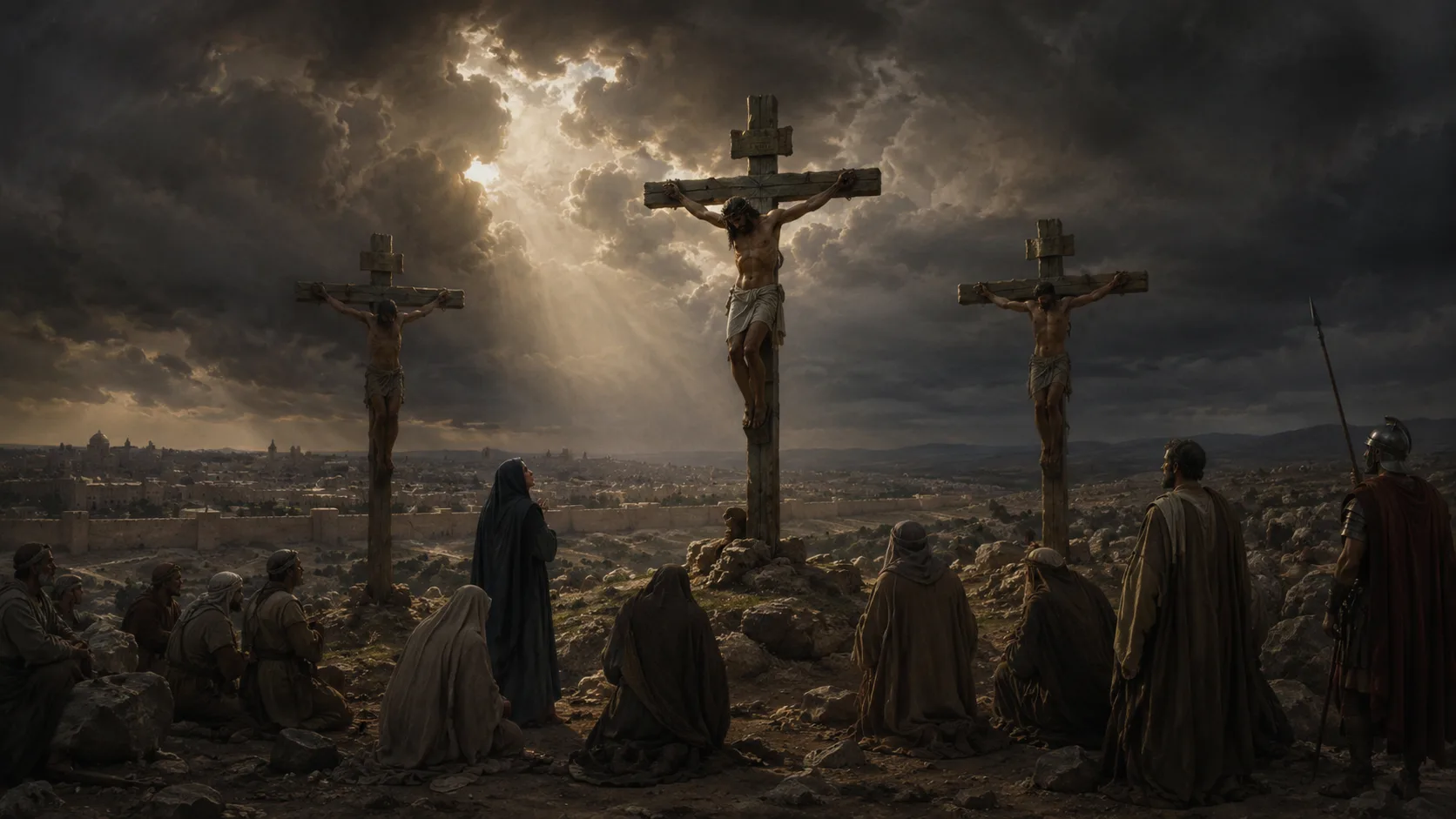

The cross is the most depicted, most discussed, and most contested event in human history. What actually happened there? What did Christ accomplish that He could not have accomplished any other way? And what does His death mean for the reader of this lesson, two thousand years on? This lesson lets the apostles — the men who walked with Him, watched Him die, watched Him rise, and gave their own lives explaining what it had meant — answer the question in their own words.
Lesson 4 set the controversy frame: the cross stood at the centre of a cosmic argument that had been unfolding since Lucifer’s rebellion in heaven. At Calvary, Satan was publicly unmasked; God’s character was publicly vindicated. But that was not all the cross accomplished. For the human race, the cross accomplished a specific transaction the apostles describe in legal, sacrificial, and relational terms together. A penalty was paid. A sacrifice was offered. A reconciliation was effected. A redemption was purchased. A people was bought. This lesson walks each of those elements in the apostles’ own language.
The institute holds the historic Protestant and pioneer- Adventist position that the atonement is substitutionary: Christ bore in His own person the penalty for sin that otherwise would have fallen on the sinner. The lesson will, where helpful, support Scripture’s own statements with brief citations from Ellen White’s exposition. Scripture leads; her witness follows.
Question 01
What is the gospel, in the apostles’ own words?
Answer
For I delivered unto you first of all that which I also received, how that Christ died for our sins according to the scriptures; and that he was buried, and that he rose again the third day according to the scriptures.
Paul, writing to the Corinthians some twenty-five years after the resurrection, gives the church the apostolic gospel in three clauses. Christ died for our sins — the substitutionary clause; was buried — the historical clause; and rose again the third day — the vindicating clause. He prefaces all three with first of all: this is the foundation of the gospel, the part Paul received, the part he delivered to every church he planted. Whatever else the New Testament teaches, the gospel begins here.
Question 02
Why did Christ have to die?
Answer
For all have sinned, and come short of the glory of God.
For the wages of sin is death; but the gift of God is eternal life through Jesus Christ our Lord.
And almost all things are by the law purged with blood; and without shedding of blood is no remission.
Because the wages of sin is death, and the human race had earned those wages. The Law of God is not arbitrary; it expresses the moral structure of the universe and the character of its Maker. A holy God cannot pronounce evil good without ceasing to be holy. The penalty for sin had to be paid — either by the sinner, in eternal loss, or by a Substitute willing and able to pay it on the sinner’s behalf. Christ came to be that Substitute.
Hebrews adds the sacrificial clause that runs through the entire Old Testament typology: without shedding of blood is no remission. From Abel’s lamb to Abraham’s ram on Mount Moriah, from the Passover lamb to the daily sanctuary offerings, the Hebrew Scriptures shaped the human conscience to expect a sacrificial death by which sin would be remitted. The New Testament identifies the substance of which all those sacrifices were shadows: Christ Himself.
Question 03
Whose death was it? Whose initiative? Whose offering?
Answer
For God so loved the world, that he gave his only begotten Son, that whosoever believeth in him should not perish, but have everlasting life.
Therefore doth my Father love me, because I lay down my life, that I might take it again. No man taketh it from me, but I lay it down of myself. I have power to lay it down, and I have power to take it again.
Herein is love, not that we loved God, but that he loved us, and sent his Son to be the propitiation for our sins.
How much more shall the blood of Christ, who through the eternal Spirit offered himself without spot to God, purge your conscience from dead works to serve the living God?
The Father’s initiative, the Son’s willing offering, both in perfect unity. The cross was not the Father lashing out at the Son. It was not a violent appeasement of an angry God by an outside party. It was the Father giving the Son He loved infinitely, and the Son willingly offering Himself, together — both moved by the same love for the rebel race, both cooperating in the single act of redemption.
John’s first epistle is precise on the order: the propitiation does not produce the Father’s love; the Father’s love produces the propitiation. The Father did not need to be persuaded by Calvary to love sinners. He was already the God Who loved sinners, and Calvary was the form His love took to redeem them consistent with His own justice. As John writes it: herein is love — not that we loved God, but that he loved us, and sent his Son to be the propitiation for our sins.
The institute’s editorial line guards this carefully against two common distortions. The first is the popular misreading on which the Father appears as wrath and the Son as love — as though the Father had to be appeased and the Son volunteered to absorb His anger. The Bible says the opposite: the Father is the One Who loved us first, and sent the Son. The second is the liberal misreading on which the cross is only a moral demonstration with no actual penalty borne. The Bible affirms a real propitiation, a real substitution, a real bearing of sin in our place. Both halves hold. Ellen White (1827–1915), the prophetic gift to the Advent movement — introduced more fully in Lesson 4 — expounded the same point at length:
The love of the Father for a fallen race is unfathomable, indescribable, without a parallel. This love led Him to consent that His only-begotten Son should die for the salvation of man. The atonement of Christ was not made in order to induce God to love those whom He otherwise hated; it was not made to produce a love that was not in existence; but it was made as a manifestation of the love that was already in God’s heart, an exponent of the divine favour in the sight of heavenly intelligences.
That is the apostolic doctrine of the atonement: the Father’s love provided the propitiation; the propitiation did not provide the Father’s love. The Father and the Son stand together in the cross.
Question 04
Did Christ die in our place? (The doctrine of substitution.)
Answer
But he was wounded for our transgressions, he was bruised for our iniquities: the chastisement of our peace was upon him; and with his stripes we are healed. All we like sheep have gone astray; we have turned every one to his own way; and the Lord hath laid on him the iniquity of us all.
Who his own self bare our sins in his own body on the tree, that we, being dead to sins, should live unto righteousness: by whose stripes ye were healed.
For Christ also hath once suffered for sins, the just for the unjust, that he might bring us to God.
For he hath made him to be sin for us, who knew no sin; that we might be made the righteousness of God in him.
Yes. Substitution is not a theory imposed on the New Testament by a later theological tradition. It is the apostles’ own language. Christ was wounded for our transgressions; He bare our sins; He suffered for sins, the just for the unjust; He was made to be sin for us, that we might be made the righteousness of God in him. The prepositions are precise. Christ stood in the sinner’s legal place. The penalty fell on Him rather than on us. The righteousness His life had earned was credited to us in exchange.
This is the apostolic doctrine the pioneer Adventist movement received and the institute holds without reservation. Modern attempts to recast the cross as only a moral demonstration, or only a Christus Victor over the powers, or only an ethical example, all sever the cross from the legal reality the apostles’ own grammar names. The fuller exposition of the same point in Steps to Christ:
Jesus was treated as we deserve, that we might be treated as He deserves. He was condemned for our sins, in which He had no share, that we might be justified by His righteousness, in which we had no share. He suffered the death which was ours, that we might receive the life which was His.
Question 05
What does Scripture mean by “propitiation”?
Answer
Being justified freely by his grace through the redemption that is in Christ Jesus: Whom God hath set forth to be a propitiation through faith in his blood, to declare his righteousness for the remission of sins that are past, through the forbearance of God; To declare, I say, at this time his righteousness: that he might be just, and the justifier of him which believeth in Jesus.
My little children, these things write I unto you, that ye sin not. And if any man sin, we have an advocate with the Father, Jesus Christ the righteous: And he is the propitiation for our sins: and not for ours only, but also for the sins of the whole world.
Propitiation is the New Testament word for the means by which the just claims of God’s broken law against sin are satisfied. The Greek hilastērion in Romans 3:25 is the same word the Septuagint used for the mercy seat — the lid of the ark of the covenant, where on the Day of Atonement the blood of the sacrifice was sprinkled to cover the violations of the law contained within. Paul names Christ as the propitiation: the place where the law’s claim against sin meets the blood that covers it, and meets it in such a way that God can be at once just — not pretending the violation did not occur — and the justifier of him which believeth in Jesus.
Both halves are necessary. A god who simply ignored the violation would not be just. A god who collected the penalty without supplying the means of redemption would not be the merciful Father Scripture names. The cross accomplishes both at once: the penalty is paid, the law is upheld, the violator is forgiven, and the Father’s justice and mercy meet in a single act.
Question 06
What specifically did Christ accomplish for us at the cross?
Answer
And you, being dead in your sins and the uncircumcision of your flesh, hath he quickened together with him, having forgiven you all trespasses; Blotting out the handwriting of ordinances that was against us, which was contrary to us, and took it out of the way, nailing it to his cross.
In whom we have redemption through his blood, the forgiveness of sins, according to the riches of his grace.
Therefore being justified by faith, we have peace with God through our Lord Jesus Christ… For if, when we were enemies, we were reconciled to God by the death of his Son, much more, being reconciled, we shall be saved by his life.
Thou art worthy to take the book, and to open the seals thereof: for thou wast slain, and hast redeemed us to God by thy blood out of every kindred, and tongue, and people, and nation.
The apostles name what the cross secured for the believing sinner in several converging images. Redemption: we are bought out of bondage by His blood, as a slave is bought out of the auction block. Forgiveness: the handwriting of the law’s charge against us is blotted out, nailed to the cross, no longer in evidence. Justification: we are declared righteous in God’s court — not because we are righteous in ourselves, but because Christ’s righteousness has been credited to our account. Reconciliation: the broken relationship between God and man is repaired, not by our negotiating, but by God’s own act in Christ. Peace with God: the war we had been waging against our Maker, often without realising it, is ended.
Every one of these is a separate gift, secured for the believer at the cross. The atonement does not accomplish only one thing; it accomplishes many things, and the New Testament insists on each of them.
Question 07
Did Christ also defeat the powers of evil at the cross?
Answer
Forasmuch then as the children are partakers of flesh and blood, he also himself likewise took part of the same; that through death he might destroy him that had the power of death, that is, the devil.
And having spoiled principalities and powers, he made a shew of them openly, triumphing over them in it.
For this purpose the Son of God was manifested, that he might destroy the works of the devil.
Yes. Lesson 4 walked the great-controversy dimension of the cross at length; this lesson confirms it. The cross was not only the place where the penalty for human sin was paid. It was also the place where Satan was finally and publicly unmasked, where the legal claim of the powers of darkness on the human race was undone, where death itself was defeated by the One Who came through it and out the other side. Christus Victor and substitutionary atonement are not competing accounts of the cross; both are scriptural, and both are accomplished in the single event.
Question 08
How is what Christ accomplished received — by works, or by faith?
Answer
For by grace are ye saved through faith; and that not of yourselves: it is the gift of God: Not of works, lest any man should boast.
Therefore we conclude that a man is justified by faith without the deeds of the law.
But to him that worketh not, but believeth on him that justifieth the ungodly, his faith is counted for righteousness.
Not by works of righteousness which we have done, but according to his mercy he saved us, by the washing of regeneration, and renewing of the Holy Ghost.
By faith, not by works. This is the apostolic doctrine the Protestant Reformation recovered after centuries of works-based teaching had obscured it. The merit by which the sinner is saved is not the sinner’s own merit. It is Christ’s merit, received as a gift, on trust. Faith is not a meritorious work; it is the empty hand that receives the gift another has provided. To attempt to add the sinner’s own efforts to Christ’s finished work, as the condition of being accepted, is to insult the cross by treating its accomplishment as insufficient.
Question 09
Does that mean works don’t matter at all?
Answer
For we are his workmanship, created in Christ Jesus unto good works, which God hath before ordained that we should walk in them.
Even so faith, if it hath not works, is dead, being alone… For as the body without the spirit is dead, so faith without works is dead also.
For in Jesus Christ neither circumcision availeth any thing, nor uncircumcision; but faith which worketh by love.
Works follow faith as the fruit follows the tree. They are not the root of salvation, but they are its necessary fruit. A faith that produces no good works is, on James’s testimony, a dead faith — the kind the devils themselves can possess and tremble (Jas 2:19). Paul and James do not contradict one another; they describe two ends of the same line. Paul tells the reader how the believer is first justified: by faith alone, without works. James tells the reader how the believer’s faith is finally vindicated as real: by the works it produces. Both halves hold.
The gospel order is therefore: Christ’s work for us at the cross, received by faith, produces His work in us by the Spirit, manifested in the good works the Father has prepared for us to walk in. Salvation is not earned. Salvation also is not abstract. It is a living union with the One Who saves, and the union shows.
Question 10
Did Christ finish the atonement at the cross, or is His work continuing?
Answer
By the which will we are sanctified through the offering of the body of Jesus Christ once for all… But this man, after he had offered one sacrifice for sins for ever, sat down on the right hand of God… For by one offering he hath perfected for ever them that are sanctified.
Wherefore he is able also to save them to the uttermost that come unto God by him, seeing he ever liveth to make intercession for them.
Now of the things which we have spoken this is the sum: We have such an high priest, who is set on the right hand of the throne of the Majesty in the heavens; A minister of the sanctuary, and of the true tabernacle, which the Lord pitched, and not man.
Both. The sacrifice of the cross was once-for- all and is not repeated. The shedding of His blood, the bearing of our sin, the satisfaction of the law, the defeat of the powers — all of it was accomplished in full at Calvary. Christ’s last word from the cross was It is finished (Jn 19:30), and the Greek tetelestai is the commercial term for a debt fully paid.
But the application of that finished sacrifice to the believing sinner is an ongoing work, carried on not by repeating the sacrifice but by Christ’s high-priestly ministry in the heavenly sanctuary. He ever liveth to make intercession for those who come to God through Him. The same blood that was shed once at Calvary is the basis on which He pleads our cause continually before the Father’s throne. The sacrifice does not need repeating; the intercession does not need ceasing.
The detailed treatment of Christ’s heavenly sanctuary ministry — what the daily and yearly services of the earthly sanctuary foreshadowed, the 2,300-day prophecy of Daniel 8:14, the cleansing of the sanctuary, and the judgment-hour ministry now in session — is the subject of Lesson 11 and of the library article The Hour of God’s Judgment. This lesson notes the bridge.
Question 11
How does the reader personally receive what Christ accomplished?
Answer
But as many as received him, to them gave he power to become the sons of God, even to them that believe on his name.
That if thou shalt confess with thy mouth the Lord Jesus, and shalt believe in thine heart that God hath raised him from the dead, thou shalt be saved. For with the heart man believeth unto righteousness; and with the mouth confession is made unto salvation.
Believe on the Lord Jesus Christ, and thou shalt be saved, and thy house.
By faith. By personal trust. By the simple, willing reception of Christ as the Saviour the Father has sent and the Lord to Whom the receiver now belongs. There is no ceremony required, no merit to be accumulated, no clerical mediator to be approached. The cross has been finished. The Father has been satisfied. The Saviour is ready. What remains is the response of the reader: to confess Him, to believe Him, to receive Him, and to walk with Him from this day forward.
Summary of Lesson 5
- The gospel proper, on the apostles’ own testimony, is that Christ died for our sins, was buried, and rose again the third day according to the scriptures (1 Cor 15:3–4).
- Christ had to die because the wages of sin is death (Rom 6:23); without shedding of blood there is no remission (Heb 9:22). The penalty had to be paid by the sinner or by a willing Substitute.
- The cross was the Father’s initiative (Jn 3:16; 1 Jn 4:10) and the Son’s willing offering (Jn 10:17–18; Heb 9:14), together. The Father did not need to be appeased by the Son from an outside party. The Father’s love provided the propitiation; the propitiation did not create the Father’s love.
- Christ died in our place — substitutionary atonement is the plain language of the apostles (Isa 53:5–6; 1 Pet 2:24; 3:18; 2 Cor 5:21).
- Christ is the propitiation: the place where the just claims of God’s broken law against sin are satisfied, so that God can be at once just, and the justifier of him which believeth in Jesus (Rom 3:24–26; 1 Jn 2:1–2).
- The cross secured many gifts for the believing sinner at once — redemption, forgiveness, justification, reconciliation, peace with God (Col 2:13–14; Eph 1:7; Rom 5:1, 10; Rev 5:9).
- The cross also publicly defeated Satan and the powers of darkness (Heb 2:14; Col 2:15; 1 Jn 3:8). Substitution and Christus Victor are not competing; both are accomplished in the single event.
- What Christ accomplished is received by faith, not by works (Eph 2:8–9; Rom 3:28; 4:5; Tit 3:5).
- Works follow faith as the fruit follows the tree (Eph 2:10; Jas 2:17, 26; Gal 5:6). A living faith produces good works; works do not produce justification.
- The sacrifice of the cross was once-for-all (Heb 10:10–14); the application of that finished sacrifice continues through Christ’s high-priestly ministry in the heavenly sanctuary (Heb 7:25; 8:1–2). The bridge to Lesson 11.
- The reader receives what Christ accomplished by personal trust (Jn 1:12; Rom 10:9–10; Acts 16:31). There is no ceremony, no clergy, no accumulated merit required.
Personal response
The cross of Christ is not a religious symbol to be admired from a distance. It is a transaction that asks for a response. Either Christ died in the reader’s place or He did not; either His blood is sufficient payment for the reader’s sin or it is not; either the propitiation is received by faith or it is set aside. There is no neutral ground between gratitude and refusal.
The institute commends a simple prayer for the reader ready to receive what Christ accomplished:
Father in heaven, the only true God, I receive what Your only-begotten Son has accomplished for me at the cross. I believe He died in my place for my sin. I believe You raised Him from the dead for my justification. I confess Him as my Saviour and my Lord. Forgive my sins for His sake. Adopt me into Your family by Your Spirit, and teach me to walk in the good works You have prepared for me to walk in. In the name of Jesus Christ. Amen.
From the gospel proper, the next lesson asks the next question. If salvation is by faith and not by works, what becomes of the law? Has the moral law been abolished? Or does it still stand, fulfilled by Christ in the believer rather than abolished by Him? Lesson 6 walks the question.
Foundational text
“For he hath made him to be sin for us, who knew no sin; that we might be made the righteousness of God in him.”
— 2 Corinthians 5:21