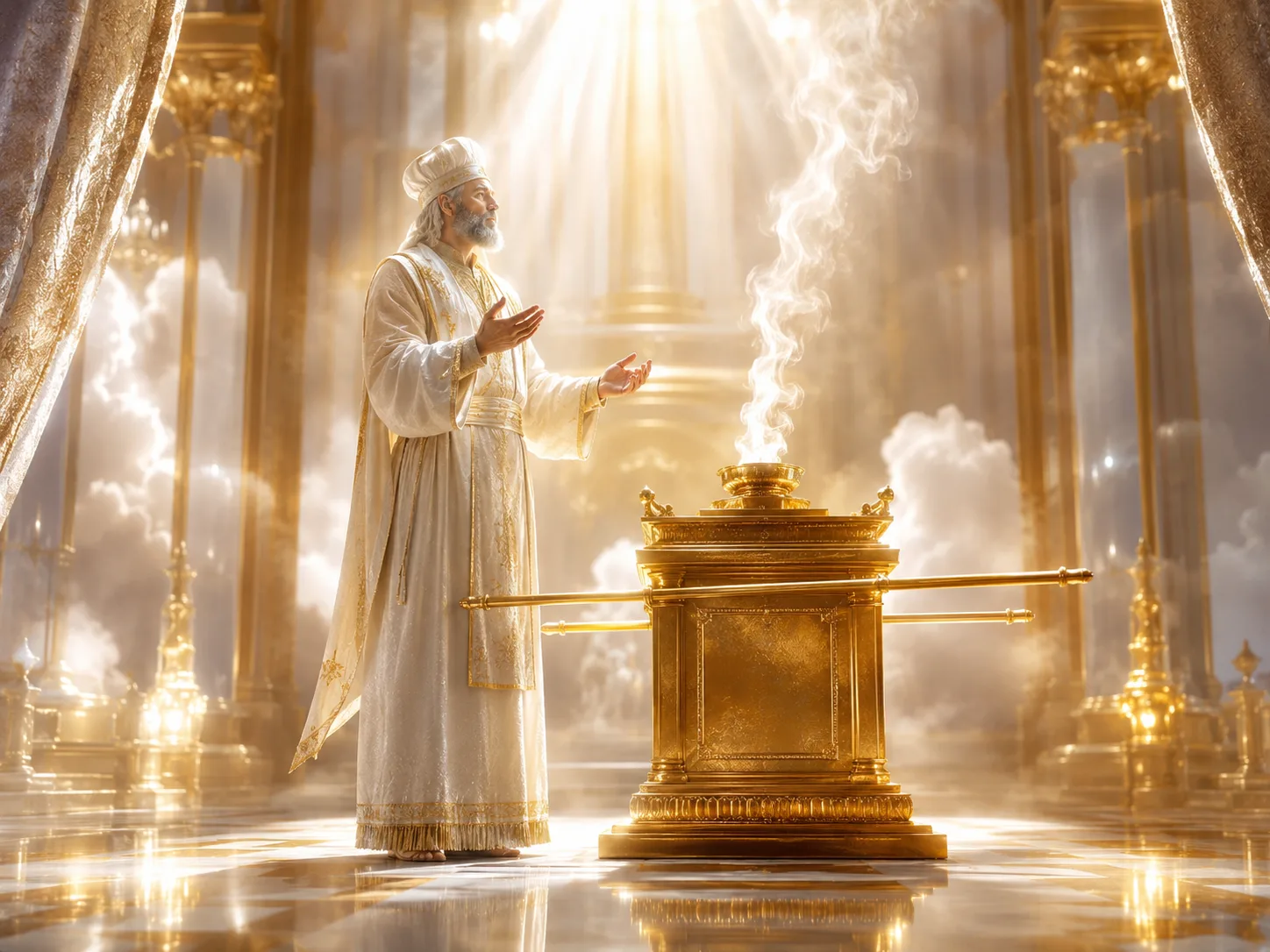

A clear Bible prophecy should lead the reader to Christ, not merely to dates. Daniel 8:14 points to the heavenly ministry of Jesus, the judgment-hour message, and the last-day call to worship the Creator in truth.
In Genesis, a fugitive named Jacob, fleeing his brother’s anger, lay down in the open country and took a stone for his pillow. That night he saw a ladder set up on the earth whose top reached to heaven, and the angels of God ascending and descending on it, and the LORD standing above it. He woke and said, “Surely the LORD is in this place; and I knew it not… this is none other but the house of God, and this is the gate of heaven” (Genesis 28:16–17). The stone Jacob rested his head upon was made a memorial; the ladder he saw, the Lord Himself later identified as the Son of Man (John 1:51). The stone, the ladder, the gate of heaven, and the Son of God are one image: there is a Rock on which the weary mind may safely rest, and that Rock is Christ.
Bible prophecy is given to lead the troubled human heart to that same Rock. The Daniel prophecies in particular are not given to feed speculation about dates and empires for their own sake. They are given so that the reader, watching predicted history unfold with precision over twenty-five centuries, may come to rest his head on the Stone the builders rejected — the Stone which is become the head of the corner (Psalm 118:22; Matthew 21:42).
This article traces one such prophecy: the 2300 days of Daniel 8:14. The verse is short: “Unto two thousand and three hundred days; then shall the sanctuary be cleansed.” Behind that one line stands the longest time prophecy in the Bible, a prophecy that reaches from the decree of a Persian king in the fifth century BC, through the precise year of Christ’s anointing and the precise year of His crucifixion, to a date in the nineteenth century from which the closing message of the gospel was to be carried to every nation on earth.
The Stone Cut Out Without Hands
Before the 2300 days are unfolded in Daniel 8, the book of Daniel opens with a different vision involving the same theme of a Stone. In Daniel 2, the Babylonian king Nebuchadnezzar dreams of a great image: a head of gold, breast of silver, belly of brass, legs of iron, feet of iron mixed with clay. The image represents the succession of world empires — Babylon, Medo-Persia, Greece, Rome, and the divided kingdoms that have stood on the territory of the old Roman empire ever since.
Then in the vision a stone is cut out of the mountain without hands. It strikes the image on its feet, grinds the whole structure to powder, and becomes a great mountain that fills the whole earth (Daniel 2:34–35). Daniel tells the king: “And in the days of these kings shall the God of heaven set up a kingdom, which shall never be destroyed… and it shall stand for ever” (Daniel 2:44).
The Stone is Christ. He is not cut out by human hands — that is, He is not the product of any human institution, dynasty, or political movement. He is set up by the God of heaven. He will not share His throne with the kingdoms of this world; He will replace them. Every Bible prophecy of judgment opens onto the same horizon: the kingdoms of men give way to the everlasting kingdom of the Son of God.
Daniel 8:14 belongs to the same line. It does not stand on its own. It is one verse in a much larger architecture that begins in the Persian period and ends with the same eternal kingdom set up by the same uncreated Stone.
The Longest Time Prophecy in the Bible
Then I heard one saint speaking, and another saint said unto that certain saint which spake, How long shall be the vision concerning the daily sacrifice, and the transgression of desolation, to give both the sanctuary and the host to be trodden under foot? And he said unto me, Unto two thousand and three hundred days; then shall the sanctuary be cleansed.
Two thousand and three hundred prophetic days. In Bible prophecy a prophetic day represents a literal year. The principle is given in Numbers 14:34 (“each day for a year, each day for a year”) and again in Ezekiel 4:6 (“I have appointed thee each day for a year”). On that scale, the prophecy of Daniel 8:14 covers two thousand three hundred actual years.
The starting point is given in the next chapter. In Daniel 9, the angel Gabriel returns to Daniel — explicitly to finish explaining the vision of chapter 8 — and tells him that seventy weeks have been “determined” (literally cut off) upon his people and the holy city (Daniel 9:24). Seventy prophetic weeks are 490 prophetic days, which on the day-for-a-year principle are 490 actual years. These 490 years are cut off from the 2300 and belong specifically to the Jewish nation. The clock for the whole 2300 years begins, Gabriel says, with “the going forth of the commandment to restore and to build Jerusalem” (Daniel 9:25).
The book of Ezra records the decrees that authorised the restoration. Three were issued: Cyrus in 538 BC, Darius in 519 BC, and Artaxerxes in 457 BC. Only the third — Artaxerxes — included full authority to restore the civil government, the magistrates, and the judicial system of Jerusalem (Ezra 7:11–26). That decree is the one Gabriel pointed to. From 457 BC, the prophetic clock begins to tick.
The companion article The Foretold Messiah walks the first 490 years of the prophecy step by step, showing how they reach the year of Christ’s anointing (AD 27), the year of His crucifixion (AD 31), and the year the gospel turned outward from Israel (AD 34). The summary table below sets out the structure without repeating that exposition. What concerns this article is what happens at the close of the remaining 1810 years.
| Prophetic Point | Historical Fulfilment |
|---|---|
| 457 BC | Decree of Artaxerxes (Ezra 7) — the prophetic clock starts. |
| AD 27 | 69 weeks (483 years) end. Jesus is anointed at His baptism — "Messiah the Prince." |
| AD 31 | Midweek crucifixion — "cause the sacrifice and the oblation to cease." |
| AD 34 | 70th week ends — Stephen martyred, gospel turns to the Gentiles. |
| AD 1844 | End of the 2300 prophetic years — "then shall the sanctuary be cleansed." |
Subtract the 490 years given to the Jewish nation from the full 2300 years given by Gabriel. 2300 minus 490 leaves 1810 years. Add those 1810 years to the AD 34 close of the 70 weeks (with no year zero in the Gregorian reckoning) and the prophecy reaches 1844. In that year, says the prophecy, “the sanctuary” — not the earthly one, which had been destroyed in AD 70, but the sanctuary in heaven of which the earthly was only a shadow — “shall be cleansed.”
The Cleansing of the Sanctuary
The angel’s answer in Daniel 8:14 makes sense only against the background of the Levitical sanctuary. There were two distinct ministries in the earthly sanctuary: the daily ministry, which dealt with individual confessed sins as worshippers brought their offerings throughout the year; and the yearly ministry, which took place on the Day of Atonement, the tenth day of the seventh month, and which dealt with the accumulated record of those confessed sins. The yearly day was called in Hebrew Yom Kippur — the Day of Atonement, or the Day of the Cleansing of the Sanctuary.
Leviticus 16 sets out the ritual in detail. Two goats were brought. Lots were cast over them. One was “for the LORD” and was slain as a sin offering; the other was “for Azazel” — the scapegoat — and was led away into the wilderness to bear the cumulative iniquities of Israel. Throughout the year the sins of the people had been symbolically transferred, through confession and sacrifice, into the sanctuary itself. On the Day of Atonement, the sanctuary was cleansed of that accumulated record: the sins were finally settled, either forgiven and removed from the camp, or unconfessed and resting on the head of the impenitent worshipper.
The Day of Atonement was therefore Israel’s annual day of judgment. It was a solemn day. It was not a day for ordinary labour. Every Israelite was commanded to “afflict his soul” (Leviticus 23:29) — that is, to engage in serious self-examination, confession, and turning of the heart toward God. The Hebrew root behind this language is the same root from which the title Yom Kippur is built.
The book of Hebrews then explains that the entire earthly system was “the figure for the time then present” (Hebrews 9:9), a shadow of the heavenly reality. Christ, the true High Priest, has not entered into a sanctuary made with hands. He has entered into heaven itself, “to appear in the presence of God for us” (Hebrews 9:24). The earthly sanctuary was cleansed yearly by the blood of bulls and goats; the heavenly sanctuary is cleansed by the better blood of Christ, in a single antitypical Day of Atonement that the prophecy of Daniel dated to the year 1844.
This is what the message of the judgment hour means. It is not that the second coming of Christ began in 1844 — that is the mistake the early Advent believers made, and the mistake they were led to correct after the disappointment. The visible return of Christ is still future. What began in 1844 is the closing phase of Christ’s heavenly ministry, the antitypical Day of Atonement, in which the cases of those who have professed His name are examined in the presence of the Father, and the final blotting out of sin is set in motion before His visible return to take His people home.
The Time of the End
Daniel was told something striking about his own prophecy. At the very end of the book, the angel said: “But thou, O Daniel, shut up the words, and seal the book, even to the time of the end” (Daniel 12:4). When Daniel asked for more clarity, the angel answered: “Go thy way, Daniel: for the words are closed up and sealed till the time of the end” (Daniel 12:9).
The book of Daniel itself, then, told its readers that its prophecies would not be fully understood until a specific later period called “the time of the end.” The natural question is: when does the time of the end begin?
The same chapter gives the marker. Daniel is told that “a time, times, and an half” (Daniel 12:7) would be accomplished, “and when he shall have accomplished to scatter the power of the holy people, all these things shall be finished.” The prophetic period “time, times, and half a time” appears repeatedly in Daniel and Revelation — also expressed as forty-two months, or 1260 days. On the day-for-a-year principle, this period covers 1260 actual years.
Historic Protestant interpreters, from the Reformation onward, identified this 1260-year period with the long era of papal ascendancy over Western Christendom — dated, on the standard Adventist reckoning, from AD 538, when the last of the three Arian Germanic kingdoms (the Ostrogoths) was driven from Rome and the Bishop of Rome received political consolidation under Justinian, to AD 1798, when the French general Berthier marched into Rome and took Pope Pius VI prisoner. Pius VI died in French captivity at Valence the following year, a death contemporaries described as the deadly wound of the beast (cf. Revelation 13:3).
From 1798 onward, the prophecies of Daniel began to be opened with a force and clarity unknown for centuries. Across Europe, Britain, and the new American republic, students of Scripture started publishing the 2300-day calculation and pointing forward to its terminus. The sealing of the book ended at the time of the end — and the time of the end began in 1798.
The Signs in the Heavens
Christ Himself, in Matthew 24 and Luke 21, told His disciples that signs in the heavens would precede His coming. Revelation 6 sets the same signs in sequence: a great earthquake; the sun darkened; the moon as blood; the stars falling from heaven. The signs follow the close of the long period of persecution and precede the opening of the sixth seal at the end of the age. In historicist Adventist reading, they are not vague symbols of religious feeling — they are specific historical events that struck a generation of Bible readers with the conviction that the time of the end had arrived.
| Sign | Scripture | Historical Event |
|---|---|---|
| Great earthquake | Revelation 6:12 | Lisbon earthquake — 1 November 1755. Felt across Europe and North Africa; conventionally rated as one of the most destructive earthquakes in recorded history. |
| Sun became black as sackcloth | Revelation 6:12 | The Dark Day — 19 May 1780. From New England through eastern Canada, the sun was obscured at noon; chickens roosted, candles were lit, the Connecticut legislature adjourned. |
| Moon became as blood | Revelation 6:12 | Night following the Dark Day — the moon, when it rose, appeared blood-red. Documented in colonial almanacs and personal journals on both sides of the Atlantic. |
| Stars fell unto the earth | Revelation 6:13 | The Leonid meteor storm — night of 12–13 November 1833. Observers across North America estimated tens of thousands of meteors per hour. The event so impressed the public consciousness that it is still referenced as "the night the stars fell." |
The Lisbon earthquake of 1755 shook Europe so violently that it produced a religious crisis across the continent. Voltaire wrote a poem about it; Wesley preached on it; entire cities re-examined their assumptions about divine providence. Twenty-five years later, the Dark Day of 19 May 1780 fell over New England with no recorded natural cause sufficient to account for it: the sun was obscured at noon, the moon by night rose blood-red, and the Connecticut General Assembly debated adjournment under candle light. Fifty-three years later, in November 1833, the Leonid meteor storm filled the night sky across North America with such intensity that observers genuinely believed the stars were falling out of heaven.
These were not isolated curiosities. They became part of the public consciousness of a generation, and they coincided with the opening of the Daniel prophecies and the rising preaching of the soon coming of Christ. A New England farmer named William Miller had begun, in 1818, to publish his calculation that the 2300 prophetic days of Daniel 8:14 would terminate around 1843–1844. The Falling Stars of 1833 fell within his preaching window and confirmed in the minds of thousands of readers that the prophetic clock was indeed running out.
The Sweet and the Bitter
And I went unto the angel, and said unto him, Give me the little book. And he said unto me, Take it, and eat it up; and it shall make thy belly bitter, but it shall be in thy mouth sweet as honey… And he said unto me, Thou must prophesy again before many peoples, and nations, and tongues, and kings.
The book of Revelation foretold the Advent experience in advance. John is shown a mighty angel with a little book open in his hand, and is commanded to eat it. The book of Daniel had been shut up and sealed; here it stands open. The eating of the book is the absorbing of its message; the sweetness in the mouth is the joy of the soon-coming Saviour; the bitterness in the belly is what follows when the time expected for Christ’s return passes and He does not visibly come.
That bitterness fell on the Advent movement in October 1844. Believers had sold their farms, settled their accounts, forgiven their debtors, and gathered to meet the Lord. Christ did not appear. The disappointment was severe. Some abandoned the faith; others mocked; a small remnant returned to the Scriptures with their hearts broken and their Bibles open.
What they found was that the time calculation had been correct but the event had been misunderstood. The sanctuary to be cleansed was not the earth, to be cleansed by fire at the second advent. The sanctuary to be cleansed was the heavenly sanctuary, of which the earthly was only a shadow, and the cleansing was the antitypical Day of Atonement, the closing work of Christ’s priesthood, the judgment-hour ministry that must take place before He returns. The believers had stood at the right moment but had looked in the wrong direction.
Revelation 10 ends with the commission: “Thou must prophesy again before many peoples, and nations, and tongues, and kings.” The Advent movement, having tasted the sweet and the bitter, was not finished. A worldwide work remained. The judgment-hour message had only just begun to sound.
The High Priest in the Heavenly Sanctuary
The cleansing of the sanctuary makes sense only in the light of the heavenly sanctuary itself. The book of Hebrews is the New Testament’s extended commentary on this theme. Christ, the risen Lord, is not absent. He is not silent. He is not waiting idly in heaven until His return. He is actively ministering as our High Priest:
Now of the things which we have spoken this is the sum: We have such an high priest, who is set on the right hand of the throne of the Majesty in the heavens; a minister of the sanctuary, and of the true tabernacle, which the Lord pitched, and not man.
Notice the careful order. There is one God and Father, on Whose throne the Majesty resides. At His right hand sits Christ, our High Priest, Who ministers before Him. The sanctuary is a real place in heaven; the priesthood is a real ministry; the work is the work of mediation for sinners. Christ pleads His own blood, His own perfect life and atoning death, in behalf of all who come to God by Him (Hebrews 7:25).
From 1844 onward, that ministry entered its final phase. The antitypical Day of Atonement began in heaven. The cases of those who have professed the name of Christ are being reviewed before the Father’s throne — not because God needs the investigation, but because all the universe is to see at the end that every judgment of God is righteous and that no name is blotted out arbitrarily. This is the work the prophecy calls “the hour of his judgment” (Revelation 14:7).
The Three Angels’ Messages
Out of the disappointment of 1844 arose a clear understanding of what message the world was now to hear. Revelation 14 places three angels in sequence, each carrying a portion of the closing gospel commission. These three messages, together, define the work of the people God has raised up at the close of the 2300 years.
The First Angel — Fear God, the hour of His judgment is come
And I saw another angel fly in the midst of heaven, having the everlasting gospel to preach unto them that dwell on the earth, and to every nation, and kindred, and tongue, and people, saying with a loud voice, Fear God, and give glory to him; for the hour of his judgment is come: and worship him that made heaven, and earth, and the sea, and the fountains of waters.
The first message is the everlasting gospel — the same gospel preached from the beginning, the gospel of salvation in the death and priestly intercession of the Son of God — but now with a specific announcement attached: “the hour of his judgment is come.” This is the announcement that the antitypical Day of Atonement has begun. The call to worship is framed in the very language of the fourth commandment (Exodus 20:11): worship the One Who made heaven, and earth, and the sea, and the fountains of waters. The Creator-Redeemer is to be honoured by the creation He made and the people He saves.
The Second Angel — Babylon is fallen
And there followed another angel, saying, Babylon is fallen, is fallen, that great city, because she made all nations drink of the wine of the wrath of her fornication.
The second message identifies a worldwide religious-political system as Babylon — the same name used for the ancient empire whose hallmarks were confusion of worship, idolatry, and compulsion of conscience. The Revelation Babylon is the spiritual recapitulation of the historic Babylon: religious confusion built on the mingling of truth with tradition, sustained by union with the kings of the earth, and resisting the plain commandments of God. The full case for this identification is laid out in the companion article Come Out of Babylon.
The Third Angel — the warning against the mark of the beast
And the third angel followed them, saying with a loud voice, If any man worship the beast and his image, and receive his mark in his forehead, or in his hand, the same shall drink of the wine of the wrath of God, which is poured out without mixture into the cup of his indignation.
The third angel is the most solemn warning in the entire Bible. It is given not in cruelty, but in mercy: God warns the world before His indignation is poured out, so that every person may have the opportunity to choose, with their eyes open, whom they will worship. The message closes with the identifying mark of the people who hear the warning and obey:
Here is the patience of the saints: here are they that keep the commandments of God, and the faith of Jesus.
The Remnant
Two chapters earlier, Revelation 12 had already given the same identifying marks of the people God raises up at the close of the age. The dragon, having failed to destroy the woman (the church), “went to make war with the remnant of her seed” — and the remnant is described in exactly two phrases:
And the dragon was wroth with the woman, and went to make war with the remnant of her seed, which keep the commandments of God, and have the testimony of Jesus Christ.
Two marks, no more. They keep all the commandments of God — not a selection — and they have the testimony of Jesus Christ. Revelation 19:10 defines the second phrase explicitly: “the testimony of Jesus is the spirit of prophecy.” The remnant church, by John’s own definition, is the church which holds fast to the whole law of God and to the prophetic gift through which the Lord still speaks to His people.
These marks are deliberately simple. They are not measured by size, popularity, political influence, denominational age, or cultural prestige. They are measured by faithfulness to the plain Bible. The question to ask of any movement claiming to be the people of God at the close of the age is therefore not “How large?” but “Do they keep all the commandments of God, and do they bear the testimony of Jesus, in the simple way the Scriptures describe?”
The Sabbath and the Seal of God
At the centre of the commandments of God stands the only one of the ten that is itself a sign of the relationship between the Creator and the creation He made:
Remember the sabbath day, to keep it holy. Six days shalt thou labour, and do all thy work: but the seventh day is the sabbath of the LORD thy God… For in six days the LORD made heaven and earth, the sea, and all that in them is, and rested the seventh day: wherefore the LORD blessed the sabbath day, and hallowed it.
The fourth commandment contains, uniquely among the ten, the three classical elements of a legal seal: the name of the Lawgiver (the LORD), His title (the One Who made), and His territory (heaven, earth, the sea, and the fountains of waters). The Sabbath is the only commandment in the Decalogue that identifies which God is meant. It is therefore called the sign and the seal of the covenant:
Moreover also I gave them my sabbaths, to be a sign between me and them, that they might know that I am the LORD that sanctify them … And hallow my sabbaths; and they shall be a sign between me and you, that ye may know that I am the LORD your God.
The first angel’s message of Revelation 14, calling the world to “worship him that made heaven, and earth, and the sea, and the fountains of waters”, is itself a deliberate echo of the wording of the fourth commandment. The last-day worship issue is therefore not merely doctrinal. It is the question of whether the inhabitants of earth will worship the Creator on the day He sanctified, or whether they will worship Him on a day appointed by a rival authority.
Catholic Admissions on the Sabbath
The honest researcher is occasionally startled to find that the clearest acknowledgements of where the change from the seventh day to the first came from are made by the very system that made the change. The Roman Catholic communion has, in its own catechetical and apologetic literature, openly described the shift from the biblical Sabbath to Sunday as a matter of ecclesiastical authority and has frequently used the change as a test case against Protestantism.
| Source | Statement |
|---|---|
| Cardinal James Gibbons | "You may read the Bible from Genesis to Revelation, and you will not find a single line authorizing the sanctification of Sunday. The Scriptures enforce the religious observance of Saturday." — The Faith of Our Fathers (1876), p. 111. |
| Catholic Mirror (1893) | "The Catholic Church for over one thousand years before the existence of a Protestant, by virtue of her divine mission, changed the day from Saturday to Sunday… The Christian Sabbath is therefore to this day the acknowledged offspring of the Catholic Church as Spouse of the Holy Ghost, without a word of remonstrance from the Protestant world." |
| Catholic Universe Bulletin (1942) | "The Church changed the observance of the Sabbath to Sunday by right of the divine, infallible authority given to her by her Founder, Jesus Christ. The Protestant, claiming the Bible to be the only guide of faith, has no warrant for observing Sunday." |
| Stephen Keenan — A Doctrinal Catechism | "Q. Have you any other way of proving that the Church has power to institute festivals of precept? A. Had she not such power, she could not have done that in which all modern religionists agree with her; she could not have substituted the observance of Sunday the first day of the week, for the observance of Saturday the seventh day, a change for which there is no Scriptural authority." (p. 174.) |
The reasoning of these passages is consistent across the centuries. The Roman communion does not claim that Sunday is the biblical Sabbath; it claims the authority to set aside the commandment of God in favour of an ecclesiastical institution and argues that the willingness of Protestants to follow the change is itself an acknowledgement of papal authority. The argument is textually plain in their own sources. Whatever else may be said about the Sabbath question, the historical origin of Sunday sacredness is not in dispute on the Catholic side.
The third angel’s warning against the mark of the beast therefore cannot be properly understood without reckoning with these admissions. The mark of the beast is, by its own framers’ confession, a mark of ecclesiastical authority deliberately set against the fourth commandment. The seal of God is, by Scripture, the Sabbath set within that commandment. The final controversy will turn on which authority the conscience submits to.
The Counter-Movements
It is a striking feature of nineteenth-century religious history that the years immediately surrounding 1844 produced not only the Advent movement, but a long line of counter-movements — religious systems each of which addresses the same themes of judgment, prophecy, restoration, and contact with the unseen world, but each of which redirects the seeker away from the biblical answer that the Advent message was rising to give.
| Movement | Counter-message |
|---|---|
| Spiritualism (modern revival 1848) | Communication with departed spirits. Began publicly with the Fox sisters at Hydesville, NY, within four years of 1844. Spreads the original Edenic lie — "ye shall not surely die" (Genesis 3:4) — and prepares the world to accept end-time spirit deceptions (Revelation 16:13–14). |
| Mormonism (1830) | Joseph Smith publishes the Book of Mormon and founds a parallel restorationist movement on the eve of the Advent awakening. Adds a second canon of scripture and a different gospel (Galatians 1:8). |
| Jehovah's Witnesses (Watch Tower, 1879) | Charles Taze Russell publishes Zion's Watch Tower, denying the personal visible return of Christ and reinterpreting 1914 in place of 1844. Diverts the judgment-hour message into a different chronology. |
| Christian Science (1879) | Mary Baker Eddy founds a healing system that denies the reality of sin, sickness, and death — emptying the gospel of its substance (1 John 1:8). |
| Theosophy (1875) | Helena Blavatsky founds the Theosophical Society, importing Eastern occultism into Western religion and reframing the serpent of Eden as the bringer of "wisdom." |
| Modern Freemasonry (1717→) | A long-running esoteric system that gathers Christian and pagan symbolism around a non-biblical "Great Architect." Its higher degrees confessedly reframe Lucifer and the morning star (Isaiah 14:12) in occult terms. Rose to particular prominence and influence in the same century the Advent message was preparing to sound. |
Read horizontally across the table, the pattern is unmistakable. Within roughly half a century on either side of 1844, the religious landscape produced parallel systems that occupy the same prophetic space: a restorationism that adds to the canon (Mormonism); a chronology that displaces the 2300-day prophecy (Russellism / Watch Tower); a denial of sin, sickness, and death (Christian Science); a re-introduction of pagan mysticism into Western religion (Theosophy); a public revival of spiritualism that opens the door to end-time spirit deceptions (Hydesville, 1848); and an esoteric brotherhood with a non-biblical “light” figure at its centre (the higher Masonic system).
None of these is offered here as a personal verdict on the sincerity of any individual within them. The point is structural. The biblical message of the judgment hour rises after 1798. The counter-systems rise in the same window. The reader is asked to weigh which of these messages corresponds to the marks of the remnant in Revelation 12:17 and Revelation 14:12: keeping all the commandments of God, and bearing the testimony of Jesus.
The Pioneer Witness and the Call to Return
The commission of Revelation 10:11 — “thou must prophesy again before many peoples, and nations, and tongues, and kings” — and the threefold message of Revelation 14 — “to every nation, and kindred, and tongue, and people” — together describe a worldwide work. The Advent movement that rose out of the disappointment of 1844 was not intended to remain a regional revival in New England. It was to carry its message to the ends of the earth.
Out of the small remnant who held to the Bible after October 1844, the Advent pioneers — James White, Ellen G. White, Joseph Bates, Hiram Edson, Uriah Smith, J. N. Andrews, J. N. Loughborough — organised, published, and sent forth. They held with clarity the message this article has traced: the heavenly sanctuary, the three angels’ messages, the seventh-day Sabbath as the seal of God, the soon coming of Christ, and — at the centre of their confession — the worship of the one true God the Father and His only begotten Son Jesus Christ, on the simple biblical pattern of 1 Corinthians 8:6: “to us there is but one God, the Father… and one Lord Jesus Christ.”
This is the heart of the pioneer Adventist position. The first SDA Statement of Belief, published in 1872, contains no Trinitarian formula. James White, J. H. Waggoner, J. N. Andrews, J. N. Loughborough, Joseph Bates, R. F. Cottrell, and S. N. Haskell all wrote against the post-Nicene Trinitarian creed and held to the biblical hierarchy: the Father is the one true God; Jesus Christ is His only begotten Son, divine, brought forth from the Father from the days of eternity (John 1:14, 18; John 8:42; Micah 5:2). The Holy Spirit, in the pioneer reading, is the Spirit of the Father and the Spirit of Christ — the divine presence and power proceeding from the Father through the Son — not a third co-equal Person of a triune Godhead. The Advent movement preached and printed this confession for the full generation of its founders.
A solemn historical fact must be recorded. In 1931, more than a generation after the death of the founding pioneers, the General Conference of Seventh-day Adventists published a new Statement of Fundamental Beliefs which for the first time in the denomination’s official literature incorporated Trinitarian language. The fuller doctrinal formalisation came with the General Conference’s adoption of the 27 Fundamental Beliefs in 1980, which set forth the modern Adventist communion’s official doctrine of God in the standard post-Nicene three-Persons-in-one-substance formula. Over the intervening decades the corporate institution has moved progressively further from the original Father–Son confession of its founders and deeper into the Trinitarian mainstream of historic Catholic theology — the very system the second and third angels’ messages were given to call God’s people out of.
This is not a small matter. The Bible places the worship of the true God at the centre of the closing controversy. The third angel’s warning is specifically against accepting the mark of a counterfeit worship-system. To carry the seventh-day Sabbath while embracing the central doctrine of the Sabbath-changing power is to bear the right sign over the wrong God. The seal of God is the Sabbath of the Father; the name of the beast — by Rome’s own catechism — is the mystery of the Trinity. The full case for this identification is treated in the companion article The Final Events.
The Bible never identifies the remnant by institutional structure alone. The remnant is identified by faithfulness to the commandments of God and the testimony of Jesus. The historical Advent movement was such a remnant in its earlier purity, and many faithful believers continue in that pioneer confession today both within and outside the modern denominational structure. The honest reader is invited to weigh whether the corporate institution that took the original pioneer name — having received and then progressively departed from the Father–Son message that distinguished its founders — still answers in its present official doctrine to the description in Revelation 12:17 and 14:12. The third angel, and the call of Revelation 18:4, are no respecter of institutions. They are a call to come out, to come back, to come home to the worship of the one true God of the Bible and His only begotten Son.
Come Out, My People
And after these things I saw another angel come down from heaven, having great power; and the earth was lightened with his glory. And he cried mightily with a strong voice, saying, Babylon the great is fallen, is fallen, and is become the habitation of devils, and the hold of every foul spirit, and a cage of every unclean and hateful bird… And I heard another voice from heaven, saying, Come out of her, my people, that ye be not partakers of her sins, and that ye receive not of her plagues.
The final appeal of Revelation is not a threat. It is the gentle call of the Father, through Jesus Christ, to His people who are still scattered throughout the confused religious systems of the world. He says, by name, “my people.” The honest in heart are everywhere — in every communion, in every congregation, in every tradition — and the call of the fourth angel of Revelation 18 is to them. He does not condemn the souls who have not yet seen the truth. He calls them out.
To come out of Babylon does not mean changing the name on the wall of a building. It means receiving Christ as He is in the Scriptures: His sacrifice, His present priestly ministry, His commandments, His Sabbath, His testimony of prophecy, His coming kingdom. It means resting the head — as Jacob did at Bethel — on the same Stone that Daniel saw cut out without hands, the same Stone that Peter confessed as the rejected cornerstone, the same Stone the prophecy of the 2300 days has carried us back to from beginning to end.
The Final Question
The Bible does not ask the reader to accept the prophecy of Daniel 8:14 on the strength of a tradition. It lays the prophecy out in plain language. It gives the starting decree. It gives the midpoint at the crucifixion of the Messiah. It gives the terminus. It declares the work that begins at the terminus. It names the marks of the people who carry the message of that work to the world. It states the appeal that is to be sounded to every nation before the visible return of Christ.
The honest question this prophecy puts to the reader is therefore not whether the dates can be made to fit. They have fitted, with precision, for centuries. The honest question is the question Christ Himself put to His disciples: “Whom say ye that I am?” (Matthew 16:15). If the prophecy is what it claims to be, and the Stone is who He claims to be, then the only intelligent response is the response of Peter: “Thou art the Christ, the Son of the living God.” And once that response is given, the rest of the prophecy follows of itself: the judgment is His; the sanctuary is His; the commandments are His; the Sabbath is His; the worldwide message is His; the coming kingdom is His; and the call to come out of Babylon is the voice of His mercy to those He still calls my people.
The Witness of Scripture
Unto two thousand and three hundred days; then shall the sanctuary be cleansed.
And I saw another angel fly in the midst of heaven, having the everlasting gospel to preach unto them that dwell on the earth, and to every nation, and kindred, and tongue, and people, saying with a loud voice, Fear God, and give glory to him; for the hour of his judgment is come: and worship him that made heaven, and earth, and the sea, and the fountains of waters.
And the dragon was wroth with the woman, and went to make war with the remnant of her seed, which keep the commandments of God, and have the testimony of Jesus Christ.
Here is the patience of the saints: here are they that keep the commandments of God, and the faith of Jesus.
And I heard another voice from heaven, saying, Come out of her, my people, that ye be not partakers of her sins, and that ye receive not of her plagues.
We have such an high priest, who is set on the right hand of the throne of the Majesty in the heavens; a minister of the sanctuary, and of the true tabernacle, which the Lord pitched, and not man.
Further Reading
- Uriah Smith. Daniel and the Revelation. Review & Herald. The nineteenth-century Adventist commentary that fixed the historicist reading of the 2300 days, the 1260 years, and the three angels’ messages in the form in which the Advent movement carried them to the world.
- William Miller. Evidence from Scripture and History of the Second Coming of Christ. The 1842 republished work that set out the 2300-day calculation in the form that produced the Advent awakening.
- Pioneer Adventist writings on the Godhead. The collected writings of James White, J. N. Andrews, J. H. Waggoner, J. N. Loughborough, Joseph Bates, R. F. Cottrell, and S. N. Haskell on the Father, the only begotten Son, and the personality of God — readily available in reprint and online — set forth the pre-1931 Adventist confession on the worship question that the present article reaffirms.
- Cardinal James Gibbons. The Faith of Our Fathers. 1876. The standard nineteenth-century Catholic apologetic containing the explicit acknowledgement that the Scriptures enforce the seventh day, not Sunday.
- Stephen Keenan. A Doctrinal Catechism. The standard Catholic catechism cited in nineteenth-century Sabbath-change debates, containing the argument that Protestants who keep Sunday have tacitly conceded the Roman communion’s authority to set aside the commandment.
- Companion article: The Foretold Messiah — the detailed exposition of the 70 weeks within the 2300 days, fixing the date of the Messiah’s anointing and the year of His crucifixion.
- Companion article: Come Out of Babylon — the detailed exposition of the second angel’s message and the call of Revelation 18.
Foundational text
“Unto two thousand and three hundred days; then shall the sanctuary be cleansed.”
— Daniel 8:14