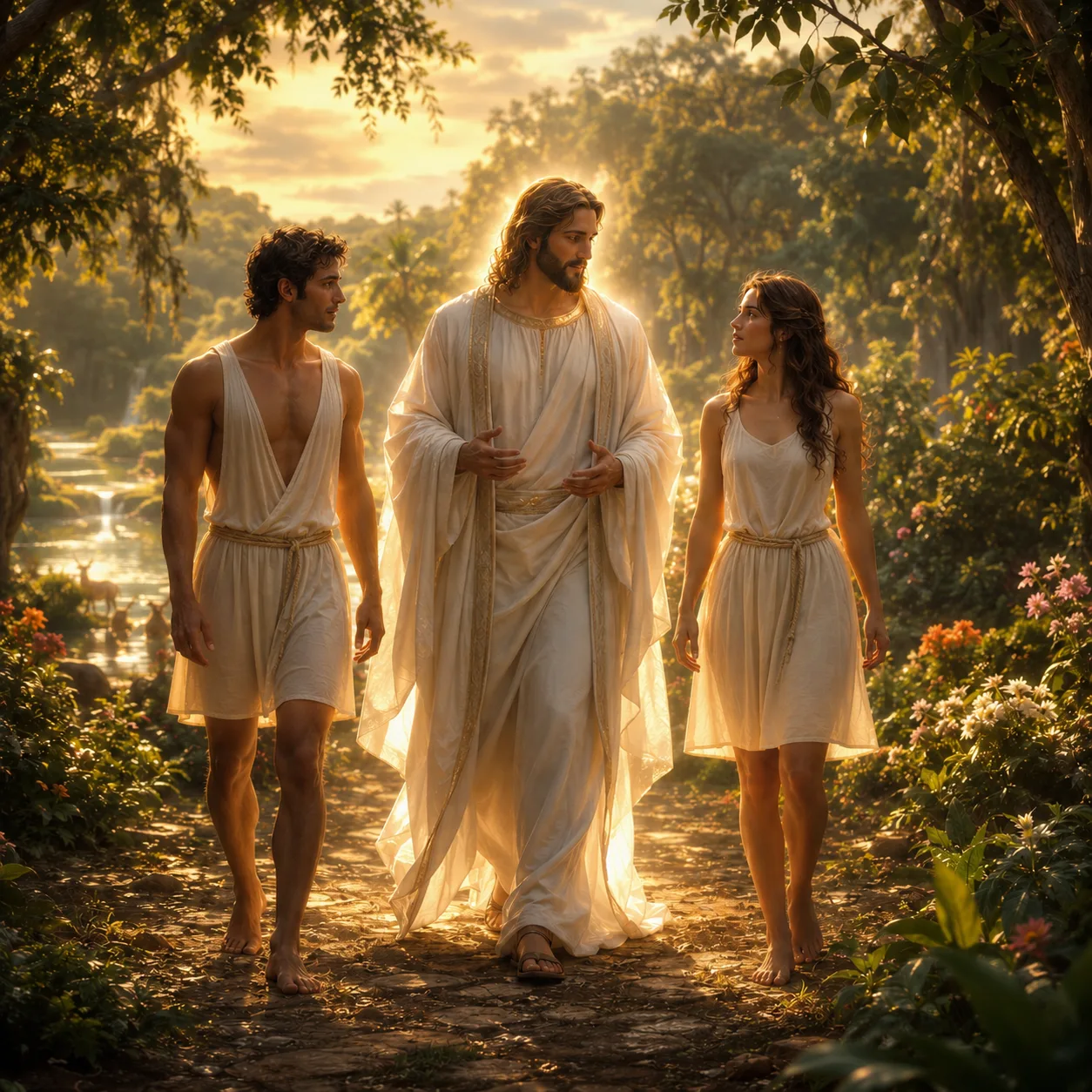


The Sabbath was not given to test whether man would obey. The tree of knowledge was given for that. The Sabbath was given as the meeting place — a day at the end of the creation week into which the Creator Himself stepped, looked at the creature He had just made, and said, in effect, it is worth it. Every Sabbath since has been an appointment to remember Him in that appointment.
Genesis opens with an architecture so simple that the eye almost misses it. In six days the Creator builds the world. In a seventh day He fills it with Himself. The first three days fashion the spaces; the next three days fill the spaces; and on the seventh day, when the spaces of matter and motion are complete, the Creator opens one more space — a space in time — and fills it not with another creature but with His own presence. That seventh-day space is what Scripture calls the Sabbath. Everything the Sabbath has ever meant from that day to this depends on what was put into it on the seventh day of creation week.
This article walks the Sabbath through five movements: the creation week itself, the great-controversy backdrop that explains why a new order of being needed a meeting place at all, the love appointment Eden never used as a test, the Sabbath’s passage into the closing controversy after the fall, and the Sabbath in the eternity of the new earth. It is the foundational creation-and-controversy frame on which the article The Final Events builds its closing-day argument, and on which The Hour of God’s Judgment builds its heavenly-sanctuary frame.
Part I — The architecture of creation week
Spaces and fillings
Read alongside one another, the six creative days reveal a deliberate symmetry. The first three days create the spaces; the next three fill those spaces with the inhabitants for which they were prepared.
| Day | What is made | Reference |
|---|---|---|
| Day 1 | Light separated from darkness | Genesis 1:3–5 |
| Day 2 | The firmament — waters above and below | Genesis 1:6–8 |
| Day 3 | Dry land, seas, vegetation | Genesis 1:9–13 |
| Day 4 | Sun, moon, and stars set in the firmament | Genesis 1:14–19 |
| Day 5 | Fish and fowl filling water and air | Genesis 1:20–23 |
| Day 6 | Land animals and man, made in God’s image | Genesis 1:24–31 |
| Day 7 | God rested, blessed and sanctified the day | Genesis 2:1–3 |
Day one fashions the space of light; day four fills it with the bodies that govern light. Day two fashions the firmament of sea and sky; day five fills it with the creatures that swim and the creatures that fly. Day three fashions the dry land and clothes it with vegetation; day six fills the dry land with animals and with man. Six days, six spaces filled. The material order is complete.
Then, on the seventh day, God opens a final space — a space not of matter but of time — and fills it not with another created order but with the immediate presence of Himself. There is no creature added on the seventh day. Heaven’s answer to the question what fills the seventh day? is simply: the Creator does.
Who was the Creator?
Scripture leaves no question. The Creator of all things was the Son of God.
God, who at sundry times and in divers manners spake in time past unto the fathers by the prophets, hath in these last days spoken unto us by his Son, whom he hath appointed heir of all things, by whom also he made the worlds.
In the beginning was the Word, and the Word was with God, and the Word was God. The same was in the beginning with God. All things were made by him; and without him was not any thing made that was made.
But to us there is but one God, the Father, of whom are all things, and we in him; and one Lord Jesus Christ, by whom are all things, and we by him.
For by him were all things created, that are in heaven, and that are in earth, visible and invisible, whether they be thrones, or dominions, or principalities, or powers: all things were created by him, and for him.
The Father is the source from Whom are all things; the Son is the One by Whom all things were made. The agency of creation is the Son, sent forth from the Father, bearing the Father’s name and the Father’s authority. The Sabbath, therefore, was not first instituted by some impersonal force at the close of creation week. It was instituted by the Son of God, acting in the Father’s will, stepping back from the work He had just finished and opening a seventh-day space in which He Himself would dwell with the creature He had just made.
When Christ would later say of Himself, “the Son of man is Lord also of the sabbath” (Mark 2:28), He was not making a denominational claim. He was identifying Himself as the One Who had made the day in the first place. The Lord of the Sabbath is the Maker of the Sabbath.
The seventh day — rest, and being refreshed
And on the seventh day God ended his work which he had made; and he rested on the seventh day from all his work which he had made. And God blessed the seventh day, and sanctified it: because that in it he had rested from all his work which God created and made.
Two questions immediately present themselves. The first is whether God rested because He was tired. The Bible answers plainly that He was not. “Hast thou not known? hast thou not heard, that the everlasting God, the LORD, the Creator of the ends of the earth, fainteth not, neither is weary?” (Isa 40:28). The Hebrew verb in Genesis 2:2 is shabat: not the rest of exhaustion, but the rest of cessation — the rest of a workman who steps back from a finished work because the work is finished. The Sabbath rest is the rest of completion.
The second question is whether Adam and Eve were tired on the first Sabbath. Adam had spent some hours naming the animals (Gen 2:19–20). Eve, created from his side late on the sixth day, had done nothing — she was, as a later commentator put it, created just before bedtime. Neither was worn out. Neither needed the Sabbath as a remedy for fatigue.
And yet a further word is added to the description of God’s seventh-day rest, only a few chapters later in the same book:
It is a sign between me and the children of Israel for ever: for in six days the LORD made heaven and earth, and on the seventh day he rested, and was refreshed.
The Hebrew word translated refreshed is nā́phash — literally to be breathed upon, to draw a deep breath, to be in fellowship. God was refreshed not from exhaustion but from the joy of seeing what He had made and meeting the creature He had made face to face. The seventh day was not a recovery from labour. It was the opening of a relationship.
Part II — The great-controversy backdrop
The angelic order, and the rebellion
To understand why the Father and the Son would set apart a seventh-day meeting place at the close of creation week, the reader has to look back further than the first chapter of Genesis. Before the earth was made, God’s creation already included an enormous host of created beings — the angels — with their orders, their captains, and a covering cherub at the head of them all.
Thou art the anointed cherub that covereth; and I have set thee so: thou wast upon the holy mountain of God; thou hast walked up and down in the midst of the stones of fire. Thou wast perfect in thy ways from the day that thou wast created, till iniquity was found in thee.
For thou hast said in thine heart, I will ascend into heaven, I will exalt my throne above the stars of God: I will sit also upon the mount of the congregation, in the sides of the north: I will ascend above the heights of the clouds; I will be like the most High.
The covering cherub — Lucifer — conceived the ambition to be worshipped as God. The substance of his grievance, as Scripture lets us see it, was directed at the Son. The Son was acknowledged in heaven as God by inheritance (Heb 1:4); the Son alone was admitted into the innermost counsel of the Father; the Son received worship which Lucifer thought was not properly distinguished from his own status as the leading creature. The complaint was at root a complaint about worship — about who would be adored, and on what ground.
The rebellion that followed swept a third of the angels into its current (Rev 12:4). War in heaven ended with the dragon and his angels cast out (Rev 12:7–9). The angelic order, once whole, was now diminished. A measure of heaven’s population had fallen.
A new order of being
It is into this prior history — not into a vacant universe — that Genesis 1 enters. And the creation of man is described in language which, read carefully against what God had previously said to and about the angels, marks man out as a deliberately new and different order of being.
And God said, Let us make man in our image, after our likeness: and let them have dominion over the fish of the sea, and over the fowl of the air, and over the cattle, and over all the earth, and over every creeping thing that creepeth upon the earth. So God created man in his own image, in the image of God created he him; male and female created he them. And God blessed them, and God said unto them, Be fruitful, and multiply, and replenish the earth, and subdue it: and have dominion.
Four things are said to man here that had never been said to the angels. They are worth pausing on.
First, man was created in the image of God as male and female. There is no record in Scripture of the angels having been created in two complementary sexes. Christ Himself confirms this distinction in Matt 22:30: “the angels of God in heaven” neither marry nor are given in marriage. The duality of male and female, with its capacity for union, is something introduced with man.
Second, man was told to be fruitful, and multiply. No angel was ever told that. Angels are not procreative beings. The capacity to bring forth life from one’s own being — to share, however far down the order, in the Creator’s own act of bringing creatures into existence — was a wholly new endowment granted to man.
Third, man was told to replenish the earth. The verb is māle’: to fill back up, to refill, to make full again. To replenish presupposes that something has been emptied. The most natural reading in the context of the preceding rebellion is that the new order being created was, in the long horizon of God’s purpose, intended to fill the place left vacant by the angels who had fallen.
Fourth, man was told to have dominion. No angel had ever received the charge to rule. Angels were ministering spirits, sent forth to minister (Heb 1:14). Man was made a ruler over the earth and all that moved upon it — given, in a small and local way, the very office of the Creator Himself: the office of one who rules over his creation.
Read together, these four marks describe a being unlike any previously made: in the image of God, sexed for union, procreative, a replenisher of the depleted creation, and a ruler under God of the world to which he had been given. Lucifer — watching from outside — could not have failed to recognise that something in the heavenly purpose was being decisively answered in this new creature. Man was being made, in a real if limited sense, to share what Lucifer had wanted and not received. And man was being made to bear what Lucifer was no longer fit to bear: the unbroken communion of a creature with his Creator.
Freedom of choice — the supreme gift
With this new creation came the most dangerous and the most generous gift the Creator could give a created being: the freedom to choose. God did not make man a puppet. He could have. He could have programmed Adam and Eve to love Him, and their love would have been impeccable and entirely empty. The love that God values is the love that could have chosen otherwise. He had seen what a created intelligence, given freedom, could refuse to give Him. He had seen Lucifer. Nevertheless He went forward and made another order of being with the same dreadful and beautiful gift. Genuine love requires the genuine possibility of refusal.
It is this freedom of choice that explains why a test had to exist in Eden at all, and why the test could not be the Sabbath. A test of freedom requires an option to refuse. The Sabbath was not, in Eden, an option to refuse. It was the promise of meeting — the appointment toward which the whole creation week was reaching. You could not have kept Adam and Eve away from that first Sabbath with ten wild horses. The test, if a test was needed, had to lie elsewhere.
Part III — The Sabbath as a love appointment
Made for man, not against him
And he said unto them, The sabbath was made for man, and not man for the sabbath.
The Sabbath, Christ said, was made for man. The order of the syllables matters. The Sabbath is a gift to man, not a burden laid on him. It was placed at the end of the creation week, after man had been made, to meet a need man would have as a creature in time. Angels, with their continuous, unbroken access to God’s presence, had no need of a weekly appointment. Man, set within time, needed a place inside time in which the Creator and the creature could meet without interruption from labour or distraction. The Sabbath is that place.
An appointment, not an inspection
It is worth holding the picture in the mind. Imagine a young man in love with a young woman who lives in another city. They cannot see each other every day, but they have agreed on a day to meet. He goes to the airport on the day she will come. The plane is on time; he is early. She steps off the plane and they look at each other, and in that look both of them know that the inconvenience and the cost of getting there was worth it.
Now imagine, against that picture, the following: she comes off the plane, and he opens a magazine and begins to read. She tries to speak; he says, “Please don’t interrupt me, the game is on the radio.” He picks her up on the following day instead of the day they had agreed.
It is, of course, an absurd picture. No man in love behaves that way. The day of meeting is the whole point of waiting, and once meeting is granted, every other claim falls silent. That is precisely the framework into which Scripture sets the Sabbath:
If thou turn away thy foot from the sabbath, from doing thy pleasure on my holy day; and call the sabbath a delight, the holy of the LORD, honourable; and shalt honour him, not doing thine own ways, nor finding thine own pleasure, nor speaking thine own words: Then shalt thou delight thyself in the LORD.
Two phrases give the substance. Call the sabbath a delight — not a duty, not a burden, but a delight. And then shalt thou delight thyself in the LORD — the destination of the delight in the day is the delight in the Person. The Sabbath, kept as Isaiah describes, is not a ceremony performed before God. It is a meeting kept with God.
The four worship commandments — who, what, how, when
Much Adventist conversation treats the fourth commandment as though it stood alone — as though the question of Sabbath-keeping could be settled without reference to the three commandments that precede it. Read together, the first four commandments form a complete worship statement, in which the Sabbath is the fourth movement, not the only one.
| Commandment | Worship dimension | Text |
|---|---|---|
| First commandment | WHO we worship | "Thou shalt have no other gods before me." (Ex 20:3) — and the preface names Him: "I am the LORD thy God, which have brought thee out of the land of Egypt." (Ex 20:2) |
| Second commandment | WHAT we worship | "Thou shalt not make unto thee any graven image… Thou shalt not bow down thyself to them, nor serve them." (Ex 20:4–5) — God is not an object; He cannot be represented by what He has made. |
| Third commandment | HOW we worship | "Thou shalt not take the name of the LORD thy God in vain." (Ex 20:7) — reverence for the Name, in spirit and in truth (Jn 4:23–24). |
| Fourth commandment | WHEN we worship | "Remember the sabbath day, to keep it holy." (Ex 20:8) — the appointed weekly meeting between the Creator and the creature He made. |
Read in this order, the structure is unmistakable. The fourth commandment specifies when God’s people gather in worship. The third specifies how the Name they worship is to be honoured. The second specifies what the worshipped One is not (an image, an object, a thing made). The first specifies who the worshipped One is — and the preface to the first commandment specifies Him by name: I am the LORD thy God (YHWH, the covenant name of the Father). The fourth commandment is the appointment; the first commandment is the Person with Whom the appointment is kept.
It follows that the day, kept faithfully on the calendar but kept toward the wrong Person, is not the same thing as the Sabbath of Scripture. The full controversy over the closing Sabbath, which the companion article The Final Events works out at length, begins here — in the recognition that the four worship commandments are integral, and that the Sabbath is only as faithful as the worship it carries.
Part IV — The test was the tree
What freedom of choice required
And out of the ground made the LORD God to grow every tree that is pleasant to the sight, and good for food; the tree of life also in the midst of the garden, and the tree of knowledge of good and evil… And the LORD God commanded the man, saying, Of every tree of the garden thou mayest freely eat: but of the tree of the knowledge of good and evil, thou shalt not eat of it: for in the day that thou eatest thereof thou shalt surely die.
Freedom of choice requires the genuine possibility of refusal. The possibility of refusal requires an object that can be refused. That object was the tree — one tree, in the centre of a garden full of trees, with one negative command attached to it. The whole of the test of obedience in Eden was concentrated there. The Sabbath played no role in the testing of Adam and Eve. The day was a delight; the tree was the boundary.
The serpent’s appeal to Eve in Gen 3:1–5 is precise. He does not attack the Sabbath. He does not ask her which day she keeps holy. He attacks the boundary, and behind the boundary, the character of God Who set it. “Yea, hath God said” is the introduction, and “ye shall be as gods” is the conclusion. The original temptation was a temptation to refuse God’s appointment for a creature and to grasp, in its place, the position of God Himself. It was a temptation to repeat in Eden the rebellion that had begun in heaven.
Eve fell at the tree. Adam, with eyes open, fell with her. The freedom that was given to them as the highest gift was used to refuse the boundary God had placed. Sin entered the world. Death entered with it. The face-to-face fellowship of the cool of the day was broken (Gen 3:8–10). The Sabbath, which had been a love appointment, would now have to function in a fallen world for a creature in rebellion.
Part V — The Sabbath after the fall
When the tree was withdrawn, the day became the test
After the fall, access to the tree of life was barred (Gen 3:22–24). The Edenic garden, and with it the tree of knowledge, was withdrawn from human reach. The test of obedience that had been concentrated at the tree had now to be relocated. It found its new locus in the day — in the Sabbath itself. From that point forward, the observance of the Sabbath became, among other things, a weekly act of allegiance: a confession that the worshipper served the God Who had made the world in six days and had rested on the seventh, against every counter-claim a fallen order might raise.
This is why, when Scripture turns to the period after Eden, the Sabbath is found at every decisive point in God’s dealings with His people — long before Mount Sinai, and continually thereafter.
| Moment | What is happening |
|---|---|
| Pharaoh, the first Sabbath law | "And Pharaoh said, Behold, the people of the land now are many, and ye make them rest (Hebrew shabat) from their burdens." (Ex 5:5) The same Hebrew word God used in Genesis 2:2. Pharaoh’s grievance against Moses was that he was making Israel keep the Sabbath. The first contest over the Sabbath was a contest between God’s appointment and a king’s law. |
| The manna in the wilderness | "Six days ye shall gather it; but on the seventh day, which is the sabbath, in it there shall be none." (Ex 16:26) Each Friday a double portion fell; each Sabbath none. The miracle ran for forty years (Ex 16:35). The Sabbath was being taught to a nation just out of slavery, by direct intervention of heaven, before the law was given at Sinai. |
| The Sabbath at Sinai — written by the finger of God | When the Decalogue was spoken from the mountain in the hearing of the nation, and engraved in stone by the finger of God Himself (Ex 31:18), the Sabbath stood as the central commandment — the fourth — with three commandments addressing the worship of God on either side. It alone of the ten begins with the word "Remember." |
| The Sabbath as covenant sign | "Wherefore the children of Israel shall keep the sabbath, to observe the sabbath throughout their generations, for a perpetual covenant. It is a sign between me and the children of Israel for ever." (Ex 31:16–17) Not a temporary national ordinance — a perpetual covenant, a sign whose reach is "for ever." |
Pharaoh’s complaint in Exodus 5:5 is one of the most overlooked verses in the Pentateuch. The Hebrew word the king of Egypt uses to describe what Moses is making the people do — shabat — is the same word God used in Genesis 2:2 of His own rest. Pharaoh is not complaining about laziness. He is complaining that Moses is making Israel keep the Sabbath. The first legislative attack on the Sabbath, then, is not Roman; it is Egyptian. And the deliverance of the Exodus is, among other things, a Sabbath deliverance: God intervenes against a king whose decree is preventing His people from keeping the day He had appointed.
The same pattern is repeated forty years later, in the manna. Before the law was given at Sinai, before the Decalogue was spoken from the mountain, God taught Israel the Sabbath by a miracle that ran every week of their forty-year journey: six days the bread fell, on the Sabbath it did not, and on the sixth day a double portion was provided. The Sabbath was being written into the habits of a slave-people who had forgotten it in centuries of Egyptian bondage, by the hand of God Himself, in advance of any codification of the law.
The codification of the moral law
At Sinai the Decalogue is spoken from the mountain in the hearing of the nation and engraved on stone by the finger of God Himself (Ex 31:18). The Sabbath stands at its centre, the fourth of ten, the only one to begin with the word “Remember.”
Remember the sabbath day, to keep it holy. Six days shalt thou labour, and do all thy work: but the seventh day is the sabbath of the LORD thy God: in it thou shalt not do any work, thou, nor thy son, nor thy daughter, thy manservant, nor thy maidservant, nor thy cattle, nor thy stranger that is within thy gates: For in six days the LORD made heaven and earth, the sea, and all that in them is, and rested the seventh day: wherefore the LORD blessed the sabbath day, and hallowed it.
Why was the law codified in this stern, prohibitive form? Why Thou shalt not at all, if the law is simply the character of God? A parable may help. Imagine a child who is given a puppy. There is no need to write down a law: thou shalt not chop off the puppy’s head. The instinct of love does the work. Now imagine that, in some terrible breakdown, the child has chopped the puppy’s head off, and after a long process of rehabilitation the parent considers giving him another pet. This time, the parent says, “You may have the puppy, but: Thou shalt not chop off its head; Thou shalt not strike it; Thou shalt not…” The prohibitions are not the character of love. They are the protective rails love builds around itself once love has been broken.
The Decalogue is the character of God, expressed in the form love takes after love has been broken. The Sabbath is in its centre, and the Sabbath is in the protective form the day has had to take after the fall. The form is Remember the sabbath day, to keep it holy. The substance, recovered when sin is recovered from, is what was given before sin entered: a love appointment with the Creator Who is also the Redeemer.
The Sabbath as sign of the One Who sanctifies
Moreover also I gave them my sabbaths, to be a sign between me and them, that they might know that I am the LORD that sanctify them… And hallow my sabbaths; and they shall be a sign between me and you, that ye may know that I am the LORD your God.
Beyond its function as a memorial of creation, the Sabbath is given a second function in the period after the fall: it becomes a sign of sanctification. The Sabbath signs the One Who sanctifies — the LORD, the Father, Who through His Son and by His Spirit makes His people holy. To keep the Sabbath as Ezekiel describes is to know — in the living, experiential sense of the verb — the Person Who sanctifies. The day signs the Person; the Person sanctifies the worshipper; the worshipper is identified, before heaven and earth, as belonging to that Person.
It is this signing function that the closing controversy of Rev 13–14 takes hold of and carries to its consummation. The full case is laid out in The Final Events. The brief form is this: in the last days the Sabbath becomes the visible sign of allegiance to the Father Whom Scripture names, against the rival worship of the beast-system whose name Revelation calls blasphemy. Two seals confront one another at the end. The Sabbath, kept toward the right Person, is one of the marks of the remnant (Rev 14:12).
Part VI — Christ and the Sabbath
The Maker of the day keeps the day
Christ in the days of His flesh kept the Sabbath as the custom of His people from the beginning had kept it (Luke 4:16). He did not abolish it. He did not transfer it. He did not relax it. He purified it, by clearing away the rabbinic accretions that had turned His own day of delight into a burden, and by teaching its true spirit: works of mercy, works of necessity, the healing of the sick, the freeing of those bound by infirmity (Mark 2:23–28; 3:1–5; Luke 13:10–17).
At His crucifixion, He breathed His last on the preparation day and rested in the tomb through the seventh day (Luke 23:54–56). The Sabbath of His tomb is the Sabbath of a finished work of redemption, exactly as the first Sabbath was the Sabbath of a finished work of creation. On the first day of the week He rose; on the seventh day He rested. The pattern of creation week is completed in the pattern of redemption week.
And He gave Himself the title that no transferer of days would ever have claimed:
And he said unto them, The sabbath was made for man, and not man for the sabbath: Therefore the Son of man is Lord also of the sabbath.
He is Lord of the Sabbath because He made the Sabbath. He keeps the Sabbath because He gave the Sabbath. The Christian who follows Christ keeps the day Christ kept, toward the Father Whom Christ worshipped, by the Spirit whom Christ has sent forth from the Father into the heart of the believer (Gal 4:6).
Part VII — The Sabbath in eternity
From one Sabbath to another, for ever
For as the new heavens and the new earth, which I will make, shall remain before me, saith the LORD, so shall your seed and your name remain. And it shall come to pass, that from one new moon to another, and from one sabbath to another, shall all flesh come to worship before me, saith the LORD.
The Sabbath is not a temporary ordinance for the period between Sinai and the cross. It is not a national badge attached to one people for one age. It precedes Sinai by twenty-five centuries. It follows the cross into the new earth without interruption. From one Sabbath to another, in the eternity of the new heavens and the new earth, all flesh will come to worship before the LORD. The day with which the creation week closed will be the day with which every week of the eternal kingdom is crowned.
This is not surprising once the Sabbath is rightly understood. If the day was given as a love appointment with the Creator, and if in the new earth the redeemed dwell with their Creator face to face (Rev 21:3), then the appointment continues. The form may change — there is no labour from which to cease, no sin from which to be sanctified — but the meeting itself does not. The Sabbath in eternity is the love appointment consummated, kept perpetually, with no fall to interrupt and no end to draw near.
What the seventh day was always meant to be
Run the thread back from the eternity in Isaiah 66 to the seventh day of Genesis 2. The line is unbroken. The Sabbath of the eternal kingdom is what the Sabbath in Eden was always intended to be: an undisturbed appointment between the Father and His children, made possible by the Son Who is the Lord of the day, kept in the Spirit poured out from the Father’s presence. Every Sabbath kept in faith between Eden and that consummation is a foretaste of the Sabbaths to come. Every Sabbath neglected is a foretaste refused.
It is for this reason that the closing controversy described in The Final Events carries the weight it does. The day is not a denominational token. It is the appointment with the Person Whose name will, in the end, be written in the foreheads of the sealed. The seventh-day Sabbath kept toward the wrong Person is not the Sabbath of Eden, of Sinai, of Calvary, or of the new earth. The seventh-day Sabbath kept toward the right Person is all four at once.
The closing word
The question the Sabbath puts to every reader is not the question of which day shows on a calendar. It is the question of which Person is on the other side of the appointment. The day is kept for the Person. The Person kept the day before any human being existed. The Person gave Himself, on the cross, to make sure that the appointment could be kept again in spite of everything sin had done to interrupt it. The Person waits, in the seventh-day appointment of every week, for the creature He has made.
If the appointment is kept — not in the spirit of an inspection but in the spirit of a delight — the Sabbath does what it was made to do. It refreshes the Creator (Ex 31:17); it sanctifies the creature (Ezek 20:12); it pre-figures, week by week, the unbroken Sabbath of the world to come. The day to be remembered is, in the deepest sense, the Person to be remembered — the Father, in His Son, by His Spirit poured into the heart that calls Him Abba.
The witness of Scripture
And on the seventh day God ended his work which he had made; and he rested on the seventh day from all his work which he had made. And God blessed the seventh day, and sanctified it: because that in it he had rested from all his work which God created and made.
Remember the sabbath day, to keep it holy. Six days shalt thou labour, and do all thy work: but the seventh day is the sabbath of the LORD thy God: in it thou shalt not do any work… For in six days the LORD made heaven and earth, the sea, and all that in them is, and rested the seventh day: wherefore the LORD blessed the sabbath day, and hallowed it.
And he said unto them, The sabbath was made for man, and not man for the sabbath: Therefore the Son of man is Lord also of the sabbath.
Moreover also I gave them my sabbaths, to be a sign between me and them, that they might know that I am the LORD that sanctify them.
If thou turn away thy foot from the sabbath, from doing thy pleasure on my holy day; and call the sabbath a delight, the holy of the LORD, honourable; and shalt honour him, not doing thine own ways, nor finding thine own pleasure, nor speaking thine own words: Then shalt thou delight thyself in the LORD.
For as the new heavens and the new earth, which I will make, shall remain before me, saith the LORD, so shall your seed and your name remain. And it shall come to pass, that from one new moon to another, and from one sabbath to another, shall all flesh come to worship before me, saith the LORD.
Further Reading
- Ellen G. White. Patriarchs and Prophets, chapters 1–3 (the rebellion of Lucifer, the creation week, and the fall); and chapter 8 (the Sabbath in Eden and after).
- J. N. Andrews. History of the Sabbath and First Day of the Week.The classic pioneer-era treatment of the Sabbath’s continuity from creation through Sinai, the apostolic period, and the change to Sunday in early post-apostolic centuries.
- Companion article: The Final Events — the closing-day argument that takes the Sabbath into the seal-of-God / mark-of-the-beast controversy and identifies the worship issue at the heart of the final crisis.
- Companion article: The Hour of God’s Judgment — the 2300 days, the heavenly sanctuary, and the judgment-hour ministry of Christ that the closing-day Sabbath message proclaims.
Foundational text
“And God blessed the seventh day, and sanctified it: because that in it he had rested from all his work which God created and made.”
— Genesis 2:3