
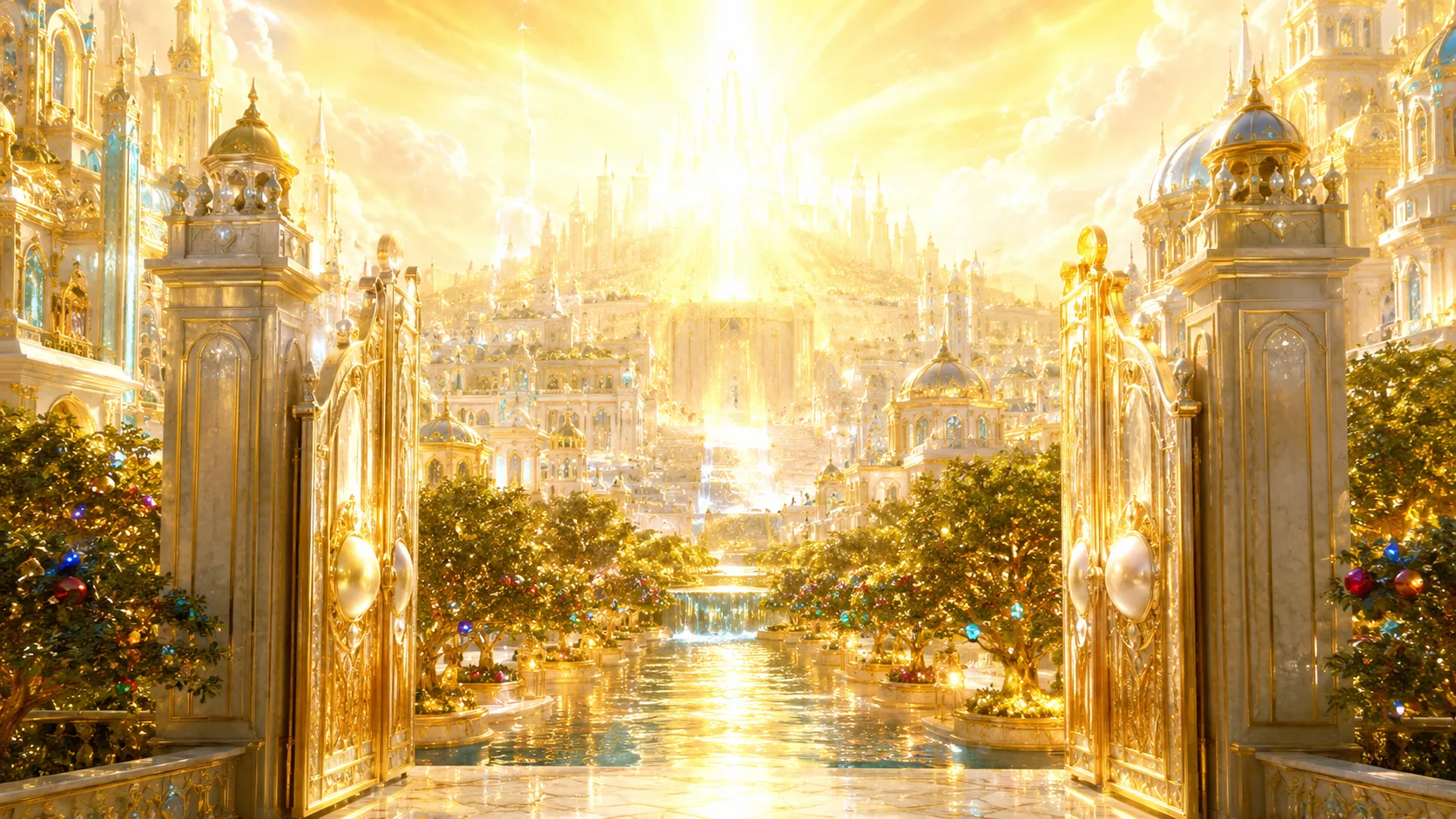
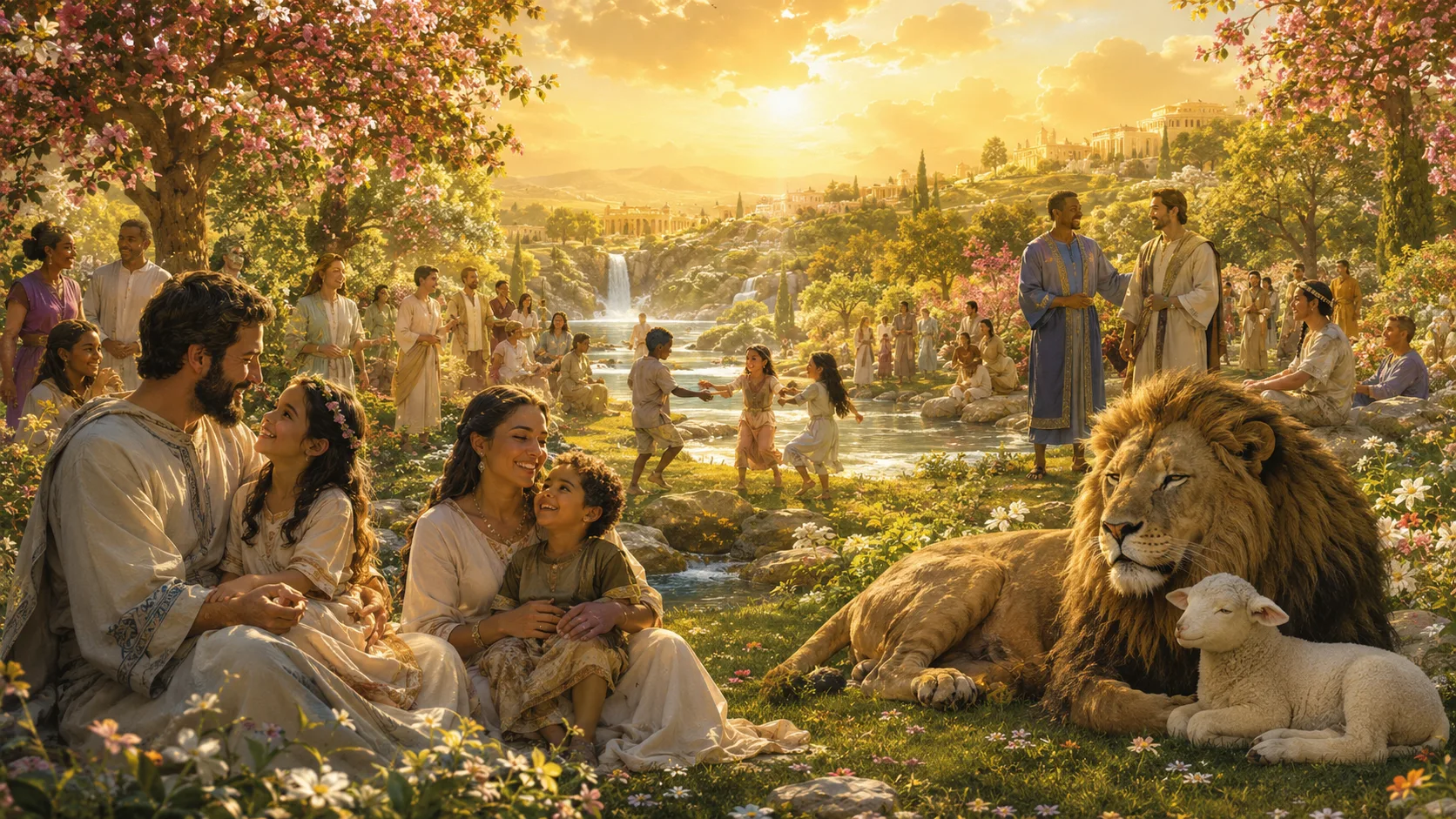
Scripture closes with the picture of a new heavens and a new earth wherein dwelleth righteousness — no more death, no more sorrow, no more pain, the tabernacle of God with men. This lesson walks the millennium, the executive judgement, the desolation of the earth in the interval, and the final restoration to which the whole biblical story has been moving.
Lesson 16 is the capstone of the course. Through fifteen previous lessons the institute has walked the willing reader from the authority of Scripture, through the identity of the Father and His begotten Son, the origin of evil, the cross, the law and the Sabbath, the state of the dead, the destruction of the wicked, the judgement-hour ministry, the historicist architecture of Daniel, the mark of the beast, the identification of Babylon, and the manner of Christ’s return. The story has been one story throughout. This closing lesson sets out its end: the millennium of Revelation 20, the great white throne judgement, the lake of fire that ends sin and death itself, and the new heavens and the new earth wherein dwelleth righteousness for ever.
The picture Scripture gives of the future is not the cessation of conscious life into an abstract eternal merger; it is the restoration of the entire created order to its pre-Fall condition and beyond. Revelation 21 names the destination: the tabernacle of God is with men, and he will dwell with them, and they shall be his people, and God himself shall be with them, and be their God (Rev 21:3). The willing reader who has received the substance of the previous lessons is invited to receive the final picture — not as a speculative addition to the gospel but as the apostolic gospel’s own proper completion.
Question 01
What is the millennium, and where does it stand in the prophetic timeline?
Answer
And I saw an angel come down from heaven, having the key of the bottomless pit and a great chain in his hand. And he laid hold on the dragon, that old serpent, which is the Devil, and Satan, and bound him a thousand years, and cast him into the bottomless pit, and shut him up, and set a seal upon him, that he should deceive the nations no more, till the thousand years should be fulfilled: and after that he must be loosed a little season. And I saw thrones, and they sat upon them, and judgment was given unto them: and I saw the souls of them that were beheaded for the witness of Jesus, and for the word of God… and they lived and reigned with Christ a thousand years. But the rest of the dead lived not again until the thousand years were finished. This is the first resurrection. Blessed and holy is he that hath part in the first resurrection: on such the second death hath no power, but they shall be priests of God and of Christ, and shall reign with him a thousand years.
The millennium is the thousand-year period bounded by two resurrections. The first resurrection at its opening is the resurrection of the righteous at the second coming, which Lesson 15 walked — the dead in Christ rising at the trump of God, the living believers changed, the whole company caught up together to meet the Lord in the air. The rest of the dead, in v. 5, are the wicked dead who do not live again until the thousand years are finished — the second resurrection that closes the period. The millennium is the interval between the two resurrections.
The framework is established not just by Revelation 20 but by Christ Himself in John 5:28–29 (cited several times across previous lessons) — they that have done good, unto the resurrection of life; and they that have done evil, unto the resurrection of damnation. Two resurrections. Revelation 20 supplies the chronological detail Christ’s statement implied: a literal thousand-year interval between them, with the saints reigning with Christ during it, the wicked dead unraised until its close, and Satan rendered inactive throughout because there is no one left on the inhabited earth for him to deceive.
Question 02
Where are the saints during the millennium?
Answer
Let not your heart be troubled: ye believe in God, believe also in me. In my Father’s house are many mansions: if it were not so, I would have told you. I go to prepare a place for you. And if I go and prepare a place for you, I will come again, and receive you unto myself; that where I am, there ye may be also.
Then we which are alive and remain shall be caught up together with them in the clouds, to meet the Lord in the air: and so shall we ever be with the Lord.
Christ’s own promise of John 14:3 (Lesson 15’s anchor) names the destination: that where I am, there ye may be also. At the second coming the resurrected and translated saints are caught up to meet the Lord in the air, and from there the gathering proceeds to the Father’s house in heaven, the place Christ has spent two thousand years preparing. The millennium is therefore the saints’ period of life with Christ in the heavenly Father’s house, prior to the descent of the New Jerusalem and the renewal of the earth.
And I saw thrones, and they sat upon them, and judgment was given unto them.
The thrones of Revelation 20:4 are heavenly thrones — the same throne-room scene Daniel 7:9–10 described and Lesson 11 walked. The saints sit on thrones in heaven during the millennium, and a specific work is given them:judgment was given unto them. The nature of the judgement is set out in Q5; the location is the heavenly Father’s house, not a rebuilt earthly Jerusalem.
Question 03
What is the condition of the earth during the millennium?
Answer
I beheld the earth, and, lo, it was without form, and void; and the heavens, and they had no light. I beheld the mountains, and, lo, they trembled, and all the hills moved lightly. I beheld, and, lo, there was no man, and all the birds of the heavens were fled. I beheld, and, lo, the fruitful place was a wilderness, and all the cities thereof were broken down at the presence of the Lord, and by his fierce anger. For thus hath the Lord said, The whole land shall be desolate; yet will I not make a full end.
Jeremiah’s vision uses the exact language of Genesis 1:2 — without form, and void, the pre- creation chaos — to describe the condition of the earth at the second coming. The wicked are slain by the brightness of His coming (2 Thess 2:8); the cities are broken down; there is no man; even the birds are fled. Jeremiah’s closing line is decisive: I will not make a full end. The desolation is not permanent. It is the interval condition, between the second coming and the renewal.
Behold, the Lord maketh the earth empty, and maketh it waste, and turneth it upside down, and scattereth abroad the inhabitants thereof… The land shall be utterly emptied, and utterly spoiled: for the Lord hath spoken this word… The earth also is defiled under the inhabitants thereof; because they have transgressed the laws, changed the ordinance, broken the everlasting covenant. Therefore hath the curse devoured the earth… And they shall be gathered together, as prisoners are gathered in the pit, and shall be shut up in the prison, and after many days shall they be visited.
Isaiah’s parallel oracle adds the prophetic note that those gathered in the pit shall be visited after many days — the millennial interval before the second resurrection. The condition of the earth during the thousand years is desolation, depopulation, and the chaos-condition of Genesis 1:2 returned upon the surface until the renewal. The willing reader is invited to read the prophets exactly as they wrote.
Question 04
What is Satan doing during the millennium — and what is the “bottomless pit”?
Answer
And I saw an angel come down from heaven, having the key of the bottomless pit and a great chain in his hand. And he laid hold on the dragon, that old serpent, which is the Devil, and Satan, and bound him a thousand years, and cast him into the bottomless pit, and shut him up, and set a seal upon him, that he should deceive the nations no more.
Two terms in the passage deserve careful reading. The bottomless pit is the Greek abyssos — the same word the Septuagint uses for the deep of Genesis 1:2, the chaos-condition of the pre-creation earth, the formless and void state to which Jeremiah 4:23 says the earth returns at the second coming. Satan’s prison during the millennium is the depopulated earth itself, returned to the formless and void condition under which it was originally created. The chain is the chain of circumstance: Satan, who has spent six thousand years deceiving the nations, has no nations to deceive because the righteous are in heaven and the wicked are dead in the graves awaiting the second resurrection. The deception that defined his existence has been suspended for a thousand years for want of subjects.
The picture is intentional. Satan, who began his rebellion by claiming he could administer the universe better than God (Lesson 4), is left for a thousand years on a desolate, depopulated earth, walking among the ruins of the civilisations his deception produced and the graves of the impenitent he led astray, with nothing to do and no one to corrupt. The interval is itself a vindication of God’s government: when Satan is unable to deceive, peace prevails by his absence. The same condition will prevail on the new earth permanently, by his destruction rather than his binding.
Question 05
What is the saints’ judgement-work during the millennium?
Answer
Do ye not know that the saints shall judge the world? and if the world shall be judged by you, are ye unworthy to judge the smallest matters? Know ye not that we shall judge angels? how much more things that pertain to this life?
And I saw thrones, and they sat upon them, and judgment was given unto them.
Paul says explicitly that the saints will judge the world and angels. Revelation 20:4 confirms: the saints are seated on thrones and given judgement during the millennium. The work is not the determination of the lost’s destiny — that was already settled in the investigative judgement Lesson 11 walked, before the second coming. The work is the saints’ review of the books, with full access to the documentation of every case, so that every question they have ever had about why a particular soul was finally lost can be answered from the records. The result is universal vindication: not one redeemed soul will leave the millennium with a question about the justice or the love of God in any case the books contain. When the executive judgement falls at the close of the period, every redeemed saint will hear themselves saying, with full understanding, what Revelation 16:7 records the saints saying in advance — even so, Lord God Almighty, true and righteous are thy judgments.
The judgement-work also covers the cases of the fallen angels. Two-thirds of the host of heaven remained loyal (Rev 12:4 implies the other third followed Lucifer); the loyal angels have never had the opportunity to review the case of their fallen brethren and, with the saints, see the entire sweep of the great controversy with full access to the records. The vindication is complete: heaven and earth, angels and redeemed humans, all on the same page about the justice and love of God.
Question 06
What happens at the close of the millennium?
Answer
But the rest of the dead lived not again until the thousand years were finished… And when the thousand years are expired, Satan shall be loosed out of his prison, and shall go out to deceive the nations which are in the four quarters of the earth, Gog and Magog, to gather them together to battle: the number of whom is as the sand of the sea. And they went up on the breadth of the earth, and compassed the camp of the saints about, and the beloved city: and fire came down from God out of heaven, and devoured them. And the devil that deceived them was cast into the lake of fire and brimstone, where the beast and the false prophet are, and shall be tormented day and night for ever and ever.
Four events occur in sequence at the close of the millennium. First, the second resurrection: the wicked dead of all ages are raised, restored to bodily existence, and stand on the earth once more. Satan is loosed by the simple fact of having human subjects again to deceive. Second, the descent of the New Jerusalem from heaven with Christ and the redeemed saints (Rev 21:2 — the city seen in Revelation 21:9–27, coming down from God out of heaven). Third, Satan gathers the second-resurrection wicked into an assault on the camp of the saints and the beloved city — the final assault of the great controversy, the last attempt of the rebel to seize the throne. Fourth, fire comes down from God out of heaven and devours the entire rebel host. The executive judgement at the great white throne is the legal moment within that descent.
And I John saw the holy city, new Jerusalem, coming down from God out of heaven, prepared as a bride adorned for her husband.
The New Jerusalem’s descent is the bridge between the heavenly millennium and the renewed earth. The city is the saints’ eternal home, brought down from heaven at the close of the thousand years and established on the renewed earth in Revelation 21–22. The willing reader is invited to picture the moment: the city of God, radiant with the glory of the Lord, descending to the earth Christ Himself made; the camp of the saints encompassing it; the wicked dead surrounding both; Satan among them; and the verdict of heaven falling on the assembled host in fire from above.
Question 07
What is the great white throne judgement?
Answer
And I saw a great white throne, and him that sat on it, from whose face the earth and the heaven fled away; and there was found no place for them. And I saw the dead, small and great, stand before God; and the books were opened: and another book was opened, which is the book of life: and the dead were judged out of those things which were written in the books, according to their works. And the sea gave up the dead which were in it; and death and hell delivered up the dead which were in them: and they were judged every man according to their works. And death and hell were cast into the lake of fire. This is the second death. And whosoever was not found written in the book of life was cast into the lake of fire.
The great white throne judgement is the executive sentencing-phase of the entire judgement-arc of Scripture — distinct from the investigative phase (Lesson 11), and distinct from the saints’ millennial review (Q5). The investigative judgement opened the books in heaven in 1844 and settled the cases of every name professing the gospel; the millennial review allowed the saints to see for themselves why each finally-lost name was finally lost; the great white throne is the moment of public sentence-execution. Every wicked soul stands before the throne in the second-resurrection body. The books are opened in full view of the assembled host. The verdicts already settled in heaven are made manifest. The sentence is the second death.
Wherefore God also hath highly exalted him, and given him a name which is above every name: that at the name of Jesus every knee should bow, of things in heaven, and things in earth, and things under the earth; and that every tongue should confess that Jesus Christ is Lord, to the glory of God the Father.
Paul’s prophecy of universal acknowledgement of Christ’s lordship reaches its terminus at this moment. Every knee bows. Every tongue confesses. The impenitent of all ages, raised at the second resurrection, standing before the great white throne, acknowledge with full understanding the Lord they had refused. The confession does not save them — the time of salvation closed at the second coming — but the confession is made, fully and finally, before sentence falls. The justice of God is vindicated in the universe: no soul leaves the great white throne with a complaint against God in their mouth.
Question 08
What does Christ Himself say at the close of the Bible?
Answer
I Jesus have sent mine angel to testify unto you these things in the churches. I am the root and the offspring of David, and the bright and morning star… He which testifieth these things saith, Surely I come quickly. Amen. Even so, come, Lord Jesus.
The closing words of the Bible are spoken in Christ’s own voice. Three claims arrive together. First, the personal identification: I Jesus. The same Jesus Who walked Galilee, Who died at Calvary, Who rose, Who ascended, Who has been ministering as High Priest in the heavenly sanctuary for nearly two thousand years, speaks the closing word of Scripture in His own name. Second, two divine self-designations together — the root and the offspring of David, divinely existent before David and humanly descended from David (Lesson 3), and the bright and morning star, the divine title Christ applies to Himself across the Apocalypse (Rev 2:28; cf. 2 Pet 1:19). Third, the closing promise: Surely I come quickly. The apostolic church’s response — even so, come, Lord Jesus — is the institute’s response and the believer’s response in every generation.
The closing word of the entire biblical revelation is not a doctrine or a command. It is a personal address from the risen Christ to the willing reader: I come quickly. The whole arc of Scripture — from Eden lost in Genesis 3 to Eden restored in Revelation 22 — closes on the promise of His personal return and the believer’s prayer for its hastening. The sixteen lessons of this course have led to this word.
Question 09
What about the alternative readings of the millennium?
Answer
Four alternative readings of Revelation 20 circulate in the modern church. Each is addressed in its own terms below:
| Alternative reading | Why the text resists it |
|---|---|
| Dispensational on-earth millennium with restored Israel, rebuilt temple, and reinstituted animal sacrifices | The reading requires a thousand-year period in which mortal Israel and immortal-resurrected saints coexist on a populated earth, with Christ reigning from a literally rebuilt temple in Jerusalem and animal sacrifices reinstituted under the old Levitical system. The framework is incompatible with Hebrews 7–10, which says the old sacrificial system has been once-for-all fulfilled and superseded in Christ — to reinstitute it would be to deny the sufficiency of the cross. The framework also requires the dead in Christ to be raised twice (once at the rapture, once at the start of the millennium proper) and the wicked to be raised, judged, and destroyed in two staged events separated by a thousand years — multiplications of resurrections the text never mentions. The dispensational on-earth millennium is an inheritance of nineteenth-century pre-millennial premillennialism, popularised in the Scofield Reference Bible (1909), with no antecedent in the previous eighteen centuries of commentary. |
| Postmillennial gradual transformation — the millennium is the historical age of the church's success leading up to Christ's return | The reading treats Revelation 20:1–6 as the age of the church's gradual Christianisation of the world, climaxing in Christ's return. The reading flourished in the nineteenth-century missions movement and largely collapsed in the twentieth. Two textual difficulties remain. First, Revelation 20:4 explicitly names "the souls of them that were beheaded for the witness of Jesus, and for the word of God" as the company reigning during the thousand years — martyrs, not the living church. Second, Revelation 20:5 says "the rest of the dead lived not again until the thousand years were finished" — language requiring a literal resurrection at the close of the period, which no postmillennial framework can absorb. |
| Amillennial — the millennium is the present church age, symbolic rather than literal | The reading collapses the thousand years into the present age between Christ's ascension and return, treating the numbers symbolically. The reading is more textually defensible than the dispensational and postmillennial alternatives, and shares with the historicist Adventist reading the rejection of an earthly millennial kingdom under reinstated Levitical sacrifice. The textual problem the amillennial reading does not fully address is Revelation 20:4–5's sequence: the first resurrection initiates the thousand years, and the second resurrection terminates them. If the first resurrection is the present believer's spiritual regeneration (the amillennial reading), the second resurrection cannot then be the bodily resurrection at the end — the two are not parallel. The historicist Adventist reading takes both resurrections as bodily, with the millennium as a literal interval between them. |
| Preterist — Revelation 20 was fulfilled at AD 70 | The reading treats Revelation 20's thousand-year period as a symbolic short interval between AD 30 and AD 70, with Satan's binding referring to the gospel's freedom from Jewish opposition after the cross, and his loosing referring to the Jewish revolt. The reading runs aground on Revelation 20:7–10, where Satan after his loosing gathers "the nations which are in the four quarters of the earth, Gog and Magog, to gather them together to battle: the number of whom is as the sand of the sea" — a global apocalyptic uprising no first-century Jewish revolt fulfils. The same passage describes "fire came down from God out of heaven, and devoured them" — a final destruction explicitly identified as the second death (v. 14), which AD 70 did not deliver. |
Four alternatives, four failures. The historicist Adventist reading — saints in heaven during a literal thousand years, earth desolate, Satan bound by chain of circumstance to the depopulated earth, the saints’ judgement-work on the books of the lost, the second resurrection terminating the period, the New Jerusalem descending, the final assault and the great white throne, the lake of fire ending sin and death itself — is the reading the text supports, the reading the apostolic eschatology of the previous lessons requires, and the reading the institute commends on Scripture’s own evidence.
Question 10
What will the new heavens and the new earth be like?
Answer
Nevertheless we, according to his promise, look for new heavens and a new earth, wherein dwelleth righteousness.
And I saw a new heaven and a new earth: for the first heaven and the first earth were passed away… And I heard a great voice out of heaven saying, Behold, the tabernacle of God is with men, and he will dwell with them, and they shall be his people, and God himself shall be with them, and be their God. And God shall wipe away all tears from their eyes; and there shall be no more death, neither sorrow, nor crying, neither shall there be any more pain: for the former things are passed away. And he that sat upon the throne said, Behold, I make all things new.
Five negatives and one positive fix the picture of the new earth. No more death: the curse of the Fall reversed at its root, mortality itself abolished. No more sorrow: grief, lament, weeping over loss ended. No more crying: the audible signs of affliction silenced for ever. No more pain: the body of the redeemed exempt from the suffering it bore across mortal life. And no more sea (Rev 21:1) — the symbolic vocabulary the Hebrew prophets used for the chaos of unruly peoples (Isa 57:20; Rev 17:15) permanently removed, with the inhabited surface restored to its pre-Fall form. The positive: the tabernacle of God is with men. The personal presence of the Father with His redeemed people, on the renewed earth, for ever.
For, behold, I create new heavens and a new earth: and the former shall not be remembered, nor come into mind… And they shall build houses, and inhabit them; and they shall plant vineyards, and eat the fruit of them… They shall not labour in vain, nor bring forth for trouble… The wolf and the lamb shall feed together, and the lion shall eat straw like the bullock… They shall not hurt nor destroy in all my holy mountain, saith the Lord.
Isaiah’s vision of the new earth supplies the domestic, agricultural, and ecological details Revelation names in summary. The redeemed build houses and inhabit them — embodied life in real homes. They plant vineyards and eat the fruit — productive, fulfilling work without the curse’s frustration. They do not labour in vain — the futility introduced at Genesis 3:17–19 reversed. The animal kingdom is restored to the herbivory of Eden (Gen 1:29–30); predator and prey eat together; nothing hurts or destroys.
For as the new heavens and the new earth, which I will make, shall remain before me, saith the Lord, so shall your seed and your name remain. And it shall come to pass, that from one new moon to another, and from one sabbath to another, shall all flesh come to worship before me, saith the Lord.
Three things deserve emphasis. First, the new earth is not temporary; it remains before me, saith the Lord — the eternal home of the redeemed. Second, the seventh-day Sabbath continues on the new earth (from one sabbath to another) — the same Sabbath of creation week (Lesson 7), the same Sabbath that Christ kept (Lk 4:16), the same Sabbath Babylon presumed to change (Lessons 8, 13) is the Sabbath the redeemed keep eternally. The fourth commandment was not a temporary cultural arrangement; it was the eternal appointment of the Creator with His creatures, and it endures into the new creation. Third, all flesh shall come to worship — the redeemed humanity gathered in regular worship of the Father through the Son, world without end.
And there shall be no more curse: but the throne of God and of the Lamb shall be in it; and his servants shall serve him: and they shall see his face; and his name shall be in their foreheads. And there shall be no night there; and they need no candle, neither light of the sun; for the Lord God giveth them light: and they shall reign for ever and ever.
Four final particulars. No more curse: the Genesis 3:14–19 curse that has shaped all of human history is gone. The throne of God and of the Lamb shall be in it: the Father and the begotten Son seated together at the centre of the renewed creation (Lessons 2, 3, the apostolic confession of 1 Cor 8:6 recovered in the new earth’s final form). They shall see his face: the personal seeing of the Father that Christ promised the pure in heart in the Sermon on the Mount (Matt 5:8). And they shall reign for ever and ever: the redeemed sharing in Christ’s own kingdom, in the new heavens and the new earth, world without end.
A note on the picture before the willing reader
The picture Scripture gives of the believer’s eternal future is not abstract, disembodied, or monotonous. It is embodied life on a renewed earth, in recognisable houses with recognisable family and friends, with productive work that bears fruit, with animal companions whose pre-Fall harmony has been restored, with the Father’s personal presence at the centre, with the seventh-day Sabbath of creation kept eternally, with the begotten Son of God enthroned at the Father’s right hand, and with no death, sorrow, crying, pain, or curse to mar any of it. The institute commends the picture to the willing reader as Scripture itself paints it — not as a metaphor for spiritual states, but as the literal restoration of the created order to its pre-Fall condition and beyond. The blessed hope is concrete, personal, and recognisable, and the willing reader is invited to set their affections on it.
Summary of Lesson 16
- The millennium of Revelation 20 is a literal thousand-year interval bounded by the two resurrections of John 5:28–29 — the first at the second coming, the second at the close of the thousand years.
- The saints are in heaven with Christ during the millennium, in the Father’s house Christ has prepared (Jn 14:1–3; 1 Thess 4:17), seated on thrones (Rev 20:4).
- The earth is desolate during the millennium — returned to the chaos-condition of Gen 1:2 (Jer 4:23–27; Isa 24). Cities broken down; no man; even the birds fled.
- Satan is bound to the depopulated earth by chain of circumstance: with no nations to deceive (the righteous in heaven, the wicked dead in the graves) his deception is suspended for the entire interval. The bottomless pit (Greek abyssos) is the earth itself in its Gen 1:2 chaos-state.
- The saints’ work during the millennium is judgement (1 Cor 6:2–3; Rev 20:4) — not the determination of final destinies (which was settled in the investigative judgement of Lesson 11) but the review of the books of the lost, so that every redeemed soul leaves the millennium with full understanding of the justice and the love of God in every case.
- At the close of the millennium: the second resurrection raises the wicked dead; the New Jerusalem descends (Rev 21:2); Satan, loosed by the recovery of subjects, gathers Gog and Magog (the wicked of all ages) for the final assault on the camp of the saints and the beloved city.
- The great white throne judgement (Rev 20:11–15) is the executive sentencing-phase: every wicked soul stands before the throne, the books are opened, every knee bows (Phil 2:10–11), every tongue confesses the lordship of Christ. The justice of God is vindicated before the assembled universe.
- Fire from heaven devours the rebel host (Rev 20:9); death and hell are themselves cast into the lake of fire (Rev 20:14, cross-referencing Lesson 10); the second death is the irreversible end of the lost. The universe is finally cleansed of sin, sinners, and death itself.
- Christ Himself in His own voice closes the Bible: I Jesus… I am the root and the offspring of David, and the bright and morning star… Surely I come quickly (Rev 22:16, 20).
- The new heavens and the new earth (2 Pet 3:13; Rev 21–22; Isa 65, 66): no more death, sorrow, crying, pain, or curse; the Father’s personal presence with His people; the seventh-day Sabbath kept eternally (Isa 66:22–23); embodied life in real homes with productive work, restored ecological harmony, and the throne of God and of the Lamb at the centre.
- The four alternative readings of the millennium (dispensational on-earth, postmillennial gradual transformation, amillennial spiritualised, and preterist AD 70) fail on the text’s own internal markers and on the apostolic eschatology established across the previous lessons of the course.
Personal response — and the close of the course
Sixteen lessons have brought the willing reader from the first question — is the Bible the Word of God? — to the last, the new heavens and the new earth toward which the whole biblical narrative has been moving. Between the two questions the institute has walked the identity of the Father, the begotten Son, the origin of evil, the cross, the law, the Sabbath, the state of the dead, the destruction of the wicked, the judgement-hour ministry, the prophetic architecture of Daniel, the mark of the beast, the call to come out of Babylon, the manner of Christ’s return, and the new earth. The reader who began at Lesson 1 and has reached Lesson 16 has the complete biblical framework in hand — not as a list of doctrines to assent to but as the substance of a life to be lived in expectation of the return of Christ.
The institute commends the course to the willing reader in the closing words of the apostolic writings: the apostolic gospel, the apostolic doctrine, the apostolic hope. The Father as the only true God. The begotten Son as the Saviour. The Holy Spirit as the agent of sanctification. The seventh-day Sabbath of creation as the day of rest and worship. The state of the dead as sleep until the resurrection. The lake of fire as the end of sin and death. The historicist understanding of Daniel and Revelation as the framework of the prophetic timeline. The investigative judgement in session as the present heavenly reality. The mark of the beast and the seal of God as the closing test. The personal, visible, audible, unmistakable return of Christ as the next event on the calendar. The millennium, the great white throne, and the new earth as the climactic conclusion.
The willing reader is invited to do what the Bereans did (Acts 17:11) — to receive the word with all readiness of mind and to search the Scriptures daily, whether these things be so. The institute’s commit is the substance: the apostolic gospel, the recovered pioneer doctrines, the historicist prophetic framework, the biblical cosmology, the closing-crisis expectation. The reader’s commit is the response: to walk by the light Scripture supplies, to keep the commandments of God and the faith of Jesus, to set the heart on the blessed hope, to look for Christ’s return, and to say with the apostolic church, even so, come, Lord Jesus.
Father in heaven, the only true God, the Author of the Scriptures, the Architect of the redemption, and the Goal of the believer’s hope, thank You for the sixteen-fold walk through Your word. Thank You for Your only begotten Son, the Lamb who bore the wages of my sin, the High Priest who pleads my case, the King who is coming back for me. Thank You for the seventh-day Sabbath of Your creation; thank You for the resurrection that awaits the sleeping believer; thank You for the lake of fire that ends sin and death; thank You for the new heavens and the new earth wherein dwelleth righteousness. Place me, by Your grace, among those who keep Your commandments and the faith of Your Son. Let me be found among those who hear, in the closing hours of earth’s history, the voice from heaven saying come out of her, my people, and answering. Let me see the lightning- flash visibility of the real return and not be deceived by any counterfeit. Let my name be written in the book of life. And when I see Your Son coming with the clouds of heaven, let me say with the apostolic church across two thousand years — even so, come, Lord Jesus. Amen.
The course closes here. The reader who has walked all sixteen lessons is invited to walk on — into the broader library of the institute, into the daily reading of Scripture, into the weekly keeping of the Sabbath of the Creator, into the apostolic life of the recovered gospel, and into the expectation of the personal return of the Lord. Until He come.
Foundational text
“And I saw a new heaven and a new earth… And God shall wipe away all tears from their eyes; and there shall be no more death, neither sorrow, nor crying, neither shall there be any more pain: for the former things are passed away.”
— Revelation 21:1, 4