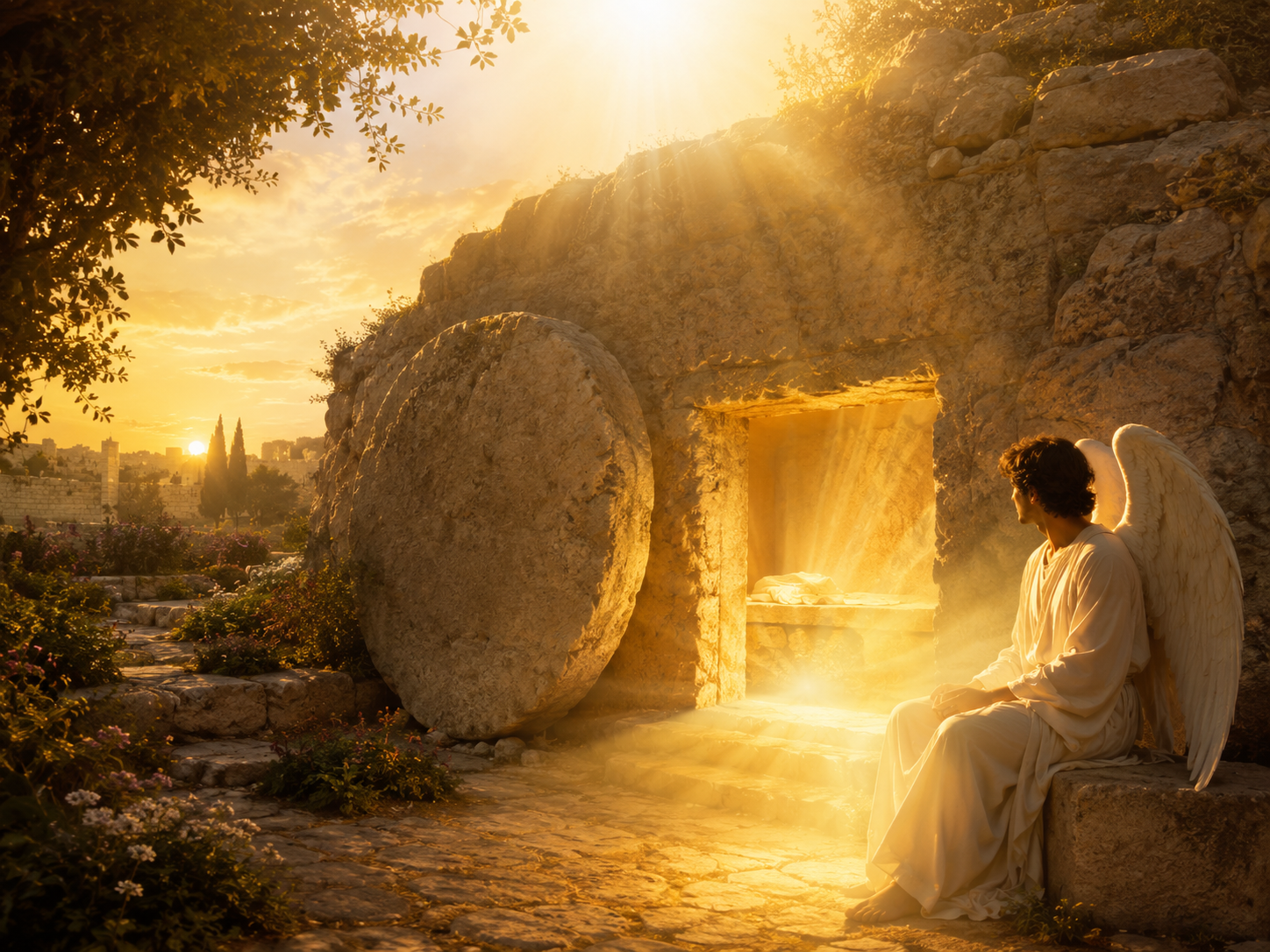
So far this question has looked academic — a matter of titles and definitions. It is not. The moment the Son becomes only a metaphor — a co-eternal God who was never truly begotten, who only plays the part of a Son — three pillars of the gospel begin to crack at once: Christ’s real temptation, His real death, and His real resurrection by the Father. Paul warned that a false Christ comes quietly, by a corruption of the mind — “another Jesus… another spirit… another gospel.” This lesson follows that warning to its root.
Question 01
Can a Son who is only a metaphor be really tempted?
Answer
No — and Scripture forces the point with two verses that cannot both be true of the same indivisible God. The first tells us plainly what is impossible for God:
Let no man say when he is tempted, I am tempted of God: for God cannot be tempted with evil, neither tempteth he any man.
God cannot be tempted with evil. Yet of Jesus the same Bible says the exact opposite — that He met temptation at every point we do:
For we have not an high priest which cannot be touched with the feeling of our infirmities; but was in all points tempted like as we are, yet without sin.
Hold the two together. If Christ is simply “God the Son,” the indivisible triune God who cannot be tempted, then His being “in all points tempted like as we are” is not a real ordeal — it is a performance, a temptation that was never genuinely felt because the One being tested could not, by definition, be reached. The metaphor-Son cannot bleed. A real Son — one who truly came forth from the Father and took our flesh — could be touched “with the feeling of our infirmities” in earnest. The gospel needs Him to have been.
Question 02
What does a real Sonship mean for Gethsemane?
Answer
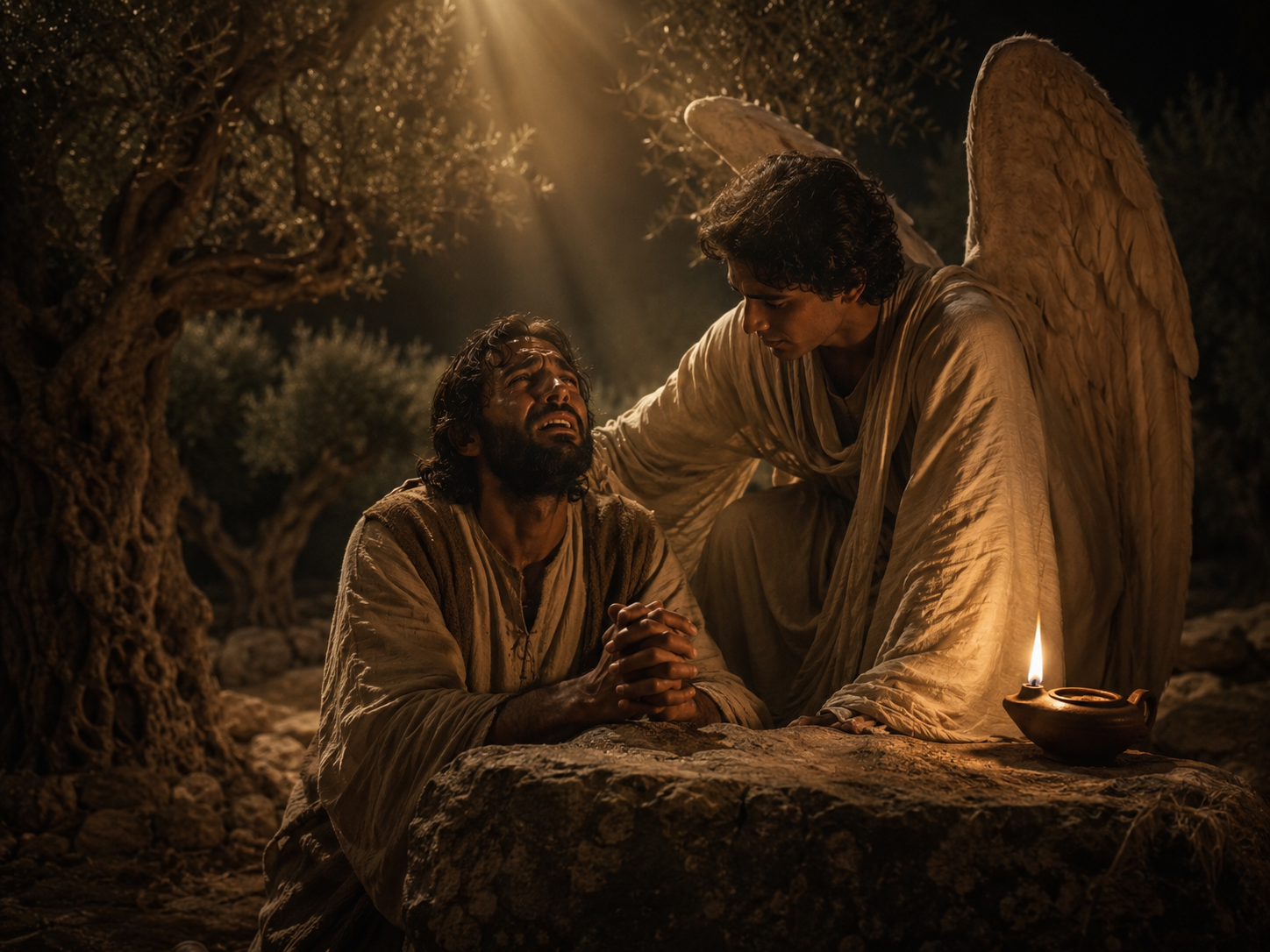
It means the garden was a true battle and not a rehearsal. When Christ knelt under the olive trees, He did not recite a settled script; He wrestled, in our own nature, to bring a human will into full surrender to His Father:
Saying, Father, if thou be willing, remove this cup from me: nevertheless not my will, but thine, be done.
“Not my will, but thine.” There is a real human will here, pressed to its limit, and there is a real choosing to lay it down. This is the weight Hebrews points to when it says He offered up “prayers and supplications with strong crying and tears” (Hebrews 5:7). Be careful to hold the line exactly where Scripture holds it: Christ took our fallen flesh and felt the full pressure of the assault, yet He carried no inner bent toward evil and remained, throughout, “without sin” (Hebrews 4:15). The reality of the conflict is not the reality of an even chance of inward failure — it is the reality of a genuine onslaught met by a Son who genuinely struggled and genuinely overcame. Erase His true Sonship and you erase the struggle: a God who cannot be tempted has nothing to overcome, and Gethsemane becomes theatre.
Question 03
If Christ is the indivisible God, could He really die?
Answer
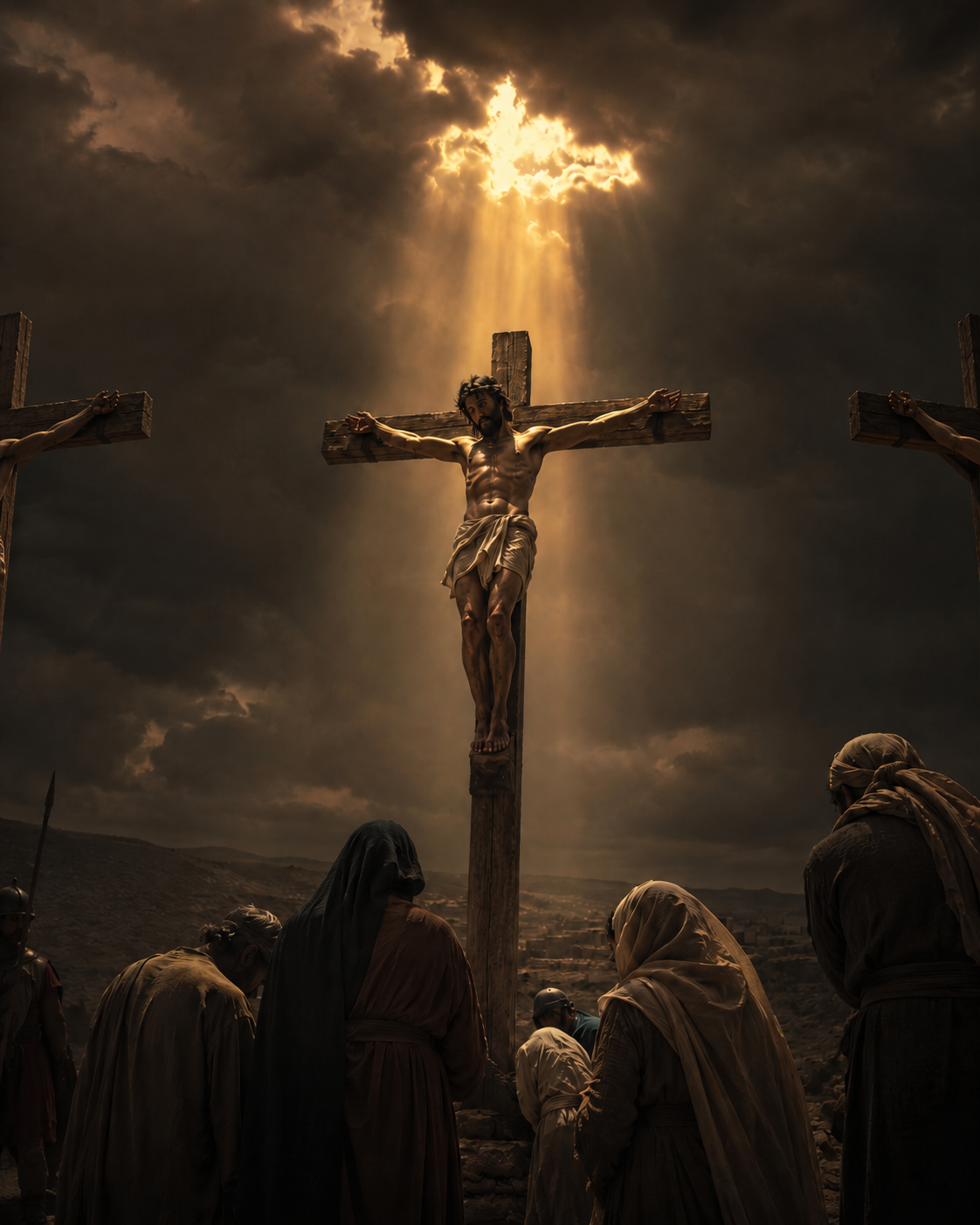
This is where the metaphor collapses most visibly. The classic Trinitarian definition makes the Son one indivisible substance with the Father and the Spirit — and that one God, all agree, cannot die. But if the divine Son cannot die, then whatever died on the cross was not the divine Son. Only His humanity perished, and a merely human death cannot atone for the world. Scripture, however, insists that the death reached far deeper than the body. The Father made His soul an offering:
Yet it pleased the LORD to bruise him; he hath put him to grief: when thou shalt make his soul an offering for sin… he hath poured out his soul unto death.
“He hath poured out his soul unto death.” The sacrifice was not skin deep; it touched His very life. To say the divine Son could not die is to say the cross was, at bottom, a human tragedy with a divine spectator — and that is not the gospel the apostles preached.
Question 04
How could the sacrifice be truly divine?
Answer
Because the One who offered Himself was Himself divine, and He offered Himself through what Scripture calls His eternal Spirit — His own divine life laid down:
How much more shall the blood of Christ, who through the eternal Spirit offered himself without spot to God, purge your conscience from dead works to serve the living God?
“Through the eternal Spirit offered himself.” This is the hinge of the atonement: a divine Person gave up a divine life. A real Father gave a real Son, and that Son surrendered not merely a body but His very self. The value of Calvary rests entirely on this — that the Sufferer was who Scripture says He is. Reduce Him to a metaphor and the offering is reduced with Him; the infinite price shrinks to a finite one, and the ransom can no longer cover the world.
Question 05
Who raised Jesus from the dead?
Answer
Scripture answers with a remarkable consistency: the Father raised the Son. This is not a stray verse but a drumbeat running through the book of Acts and the epistles — more than twenty times the resurrection is laid to the Father’s hand, and not once is the Son said to have summoned Himself back from the grave by His own independent power:
Whom God hath raised up, having loosed the pains of death: because it was not possible that he should be holden of it.
“Whom God hath raised up.” The witness is repeated again and again — “the God of our fathers raised up Jesus” (Acts 3:15); “if thou shalt… believe in thine heart that God hath raised him from the dead, thou shalt be saved” (Romans 10:9); the gospel is by “God the Father, who raised him from the dead” (Galatians 1:1). This matters because a dead man does not raise himself, and the consistency of the testimony shows that the Son truly lay in death, dependent on His Father to call Him forth. The one passage often set against this — where Christ says, “I lay down my life, that I might take it again… I have power to lay it down, and I have power to take it again” (John 10:17–18) — speaks of His willing self-surrender and of the authority He received from His Father (“This commandment have I received of my Father”), not of a divine Son who never really died. The Son freely laid His life down; the Father raised it up.
Question 06
Why does this make it “another Jesus, another spirit”?
Answer
Because change the Son and you have changed everything that hangs on Him. If His Sonship is a metaphor, then the Father who “sent” Him sent no real Son, the temptation that He overcame was no real battle, and the death that He died was no real divine sacrifice. What remains wearing the name of Jesus is not the Jesus of Scripture at all. Paul saw this danger with great precision:
But I fear, lest by any means, as the serpent beguiled Eve through his subtilty, so your minds should be corrupted from the simplicity that is in Christ. For if he that cometh preacheth another Jesus, whom we have not preached… or another gospel, which ye have not accepted, ye might well bear with him.
“Another Jesus… another spirit… another gospel.” It comes, Paul says, the way the serpent came to Eve — not by open denial but by a subtle corrupting of the mind away from “the simplicity that is in Christ.” And of any such gospel his verdict is absolute:
But though we, or an angel from heaven, preach any other gospel unto you than that which we have preached unto you, let him be accursed.
The stakes could hardly be higher. A real Father, a real Son, a real sacrifice freely offered and raised again — this is the simplicity that is in Christ. Replace the begotten Son with a metaphor and the whole structure quietly hollows out: the temptation, the cross, and the empty tomb all become figures of speech. The gospel is not a doctrine about a Son who only seemed to be one. It is the good news that the only true God truly gave His only begotten Son.
Personal response
Sit for a moment with what the cross cost if it is real. A true Father did not send an actor or surrender a part of Himself by a figure of speech; He gave His own Son, who truly struggled, truly died, and was truly raised. Ask yourself honestly which Jesus you have been worshipping — the begotten Son whose battle and whose death were real, or a metaphor that quietly empties Gethsemane and Calvary of their meaning. Bring that question to the Father in His Son’s name, and let the answer deepen, not flatten, your wonder at the love that gave Him.
Foundational text
For if he that cometh preacheth another Jesus, whom we have not preached, or if ye receive another spirit, which ye have not received, or another gospel, which ye have not accepted, ye might well bear with him.