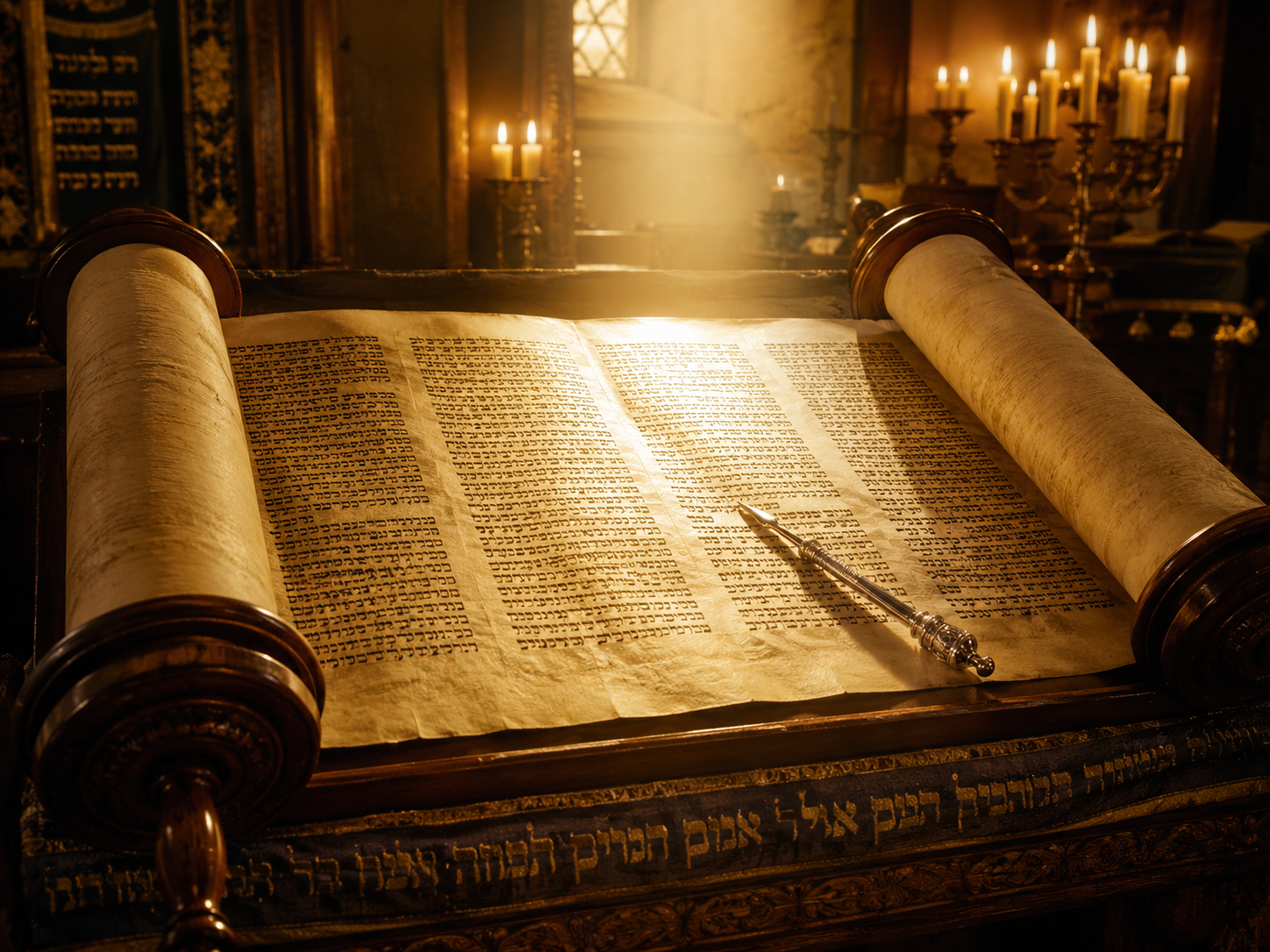
Shalom. We write to you as those in debt to you. It was through your people that the oracles of God came into the world (Romans 3:2); the Scriptures we love, we received from your hands. We are not strangers to the Shema, nor enemies of the Torah, nor despisers of the covenant God made with Abraham, Isaac, and Jacob. We come the way Ruth came to Naomi — not to take your heritage from you, but to ask you to look again at its own deepest promise.
Companion study: How the Trinity Crept Into Christianity
And we come knowing why many of you have turned away. You were handed a "Jesus" wrapped in a doctrine that no reader of Moses could accept — a God said to be three, a riddle the rabbis rightly refused. We will tell you plainly: we refuse it too. We do not believe God is three. We believe what you confess every day — that the LORD our God is one LORD. The question this letter asks is not whether God is one. It is whether the one God of Israel has a Son — and whether the prophets you already trust told you His story long before He came.
The Son hidden in your own Scriptures
Most have been taught that the very idea of a "Son of God" is foreign to the Hebrew Bible — a later, Gentile importation. But it is in your Scriptures, in plain Hebrew, long before the New Testament was written. The second Psalm — a coronation psalm of the LORD's Anointed, His Mashiach — has the LORD Himself say:
… the LORD hath said unto me, Thou art my Son; this day have I begotten thee … Kiss the Son, lest he be angry, and ye perish from the way … Blessed are all they that put their trust in him.
The LORD has a Son; the kings of the earth are commanded to do homage to that Son; and the psalm ends by pronouncing blessed all who take refuge in Him — language the Tanakh reserves for God. (Some dispute the Aramaic word for "Son" in verse 12; they need not — verse 7 has already said it in Hebrew, plainly.) And the wisest of your kings asks a question that has waited millennia for an answer:
Who hath ascended up into heaven, or descended? … what is his name, and what is his son's name, if thou canst tell?
The One who holds the wind in His fists and bound the waters has aSon, and we are dared to name Him. This is not a Messiah who is merely a gifted man, a son of David and nothing more. The Scriptures sketch Someone higher — a Son brought forth from God Himself, of the Father's own nature, and yet not the Father. To confess Him is not to add a second God beside the first. It is to know the one God more truly: the Father, and the Son He loves.
The One who appeared to the fathers
There is a figure who walks through the whole Torah and the Prophets and has puzzled every careful reader: the Angel [Messenger] of the LORD, the Malak YHWH. He is not one of the created host. He speaks as God in the first person, accepts worship that angels refuse, forgives or refuses to pardon sin — and yet He is sent by the LORD, distinct from the One who sends Him.
He meets Hagar, and she calls Him "the LORD that spake unto her" (Genesis 16:13). He stays Abraham's hand on Moriah and swears by Himself as God (Genesis 22). He wrestles with Jacob, who names the place "for I have seen God face to face" (Genesis 32:30). He speaks from the burning bush as the I AM (Exodus 3). And of this Messenger the LORD gives a warning unlike any given about a creature:
Behold, I send an Angel before thee … Beware of him, and obey his voice, provoke him not; for he will not pardon your transgressions: for my name is in him.
The divine Name does not merely rest upon this Messenger; itindwells Him. Here is One who is the LORD and is yet sent by the LORD — a distinction within the one God that your own Torah records without embarrassment. And the prophet Micah tells us this One is no newcomer:
… out of thee shall he come forth unto me that is to be ruler in Israel; whose goings forth have been from of old, from everlasting.
The Ruler to be born in Bethlehem has "goings forth" — a coming out, a being brought forth — that reach back into the days of eternity. He is born in time, yet He proceeds from the Father before all worlds. The Messiah of the prophets is the Messenger of the fathers: the Son, eternally from the Father, who stepped into history at Bethlehem.
The Spirit and the oneness of God
Let us guard the Shema together, because this is where you have been told Christianity collapses into three gods — and where, if you have met only the doctrine of the Trinity, you were right to object. But the Scriptures do not give you three. They give you the Father, His Son, and His Spirit — and the Spirit is not a third deity. It is God's own breath and presence and power, as your own prophets say:
… and now the Lord GOD, and his Spirit, hath sent me.
There is the Sender (the Lord GOD), there is His Spirit, and there is the Sent One who speaks — and it is all the working of the one God. The Spirit of God is to God what your spirit is to you: not another person beside you, but your very self reaching out. So when we say the Father saves by His Son and through His Spirit, we have not left the Shema. We have only watched the one God act — as Father, as the Son He sends, as the Spirit He pours out. One God, undivided, exactly as Moses said.
The Servant who bore our sins
Now we come to the passage that, more than any other, has been quietly set aside. In the yearly cycle of synagogue readings, the haftarah moves from Isaiah 52 to Isaiah 54 — stepping around the chapter between. Read that chapter slowly, as if for the first time, and ask honestly: of whom does the prophet speak?
Surely he hath borne our griefs, and carried our sorrows … But he was wounded for our transgressions, he was bruised for our iniquities … and with his stripes we are healed … and the LORD hath laid on him the iniquity of us all.
This is not the nation Israel suffering for its own sins — the Servant suffers for the sins of others, and "my people" (Isaiah 53:8) are the ones for whom He is stricken. He is innocent ("he had done no violence, neither was any deceit in his mouth," 53:9), He is silent before His accusers, He is "cut off out of the land of the living." And the prophet says His death is no tragedy but an offering:
… thou shalt make his soul an offering for sin [asham] … he shall prolong his days … he shall see of the travail of his soul, and shall be satisfied … for he shall bear their iniquities.
The Servant is made a guilt-offering, He bears the iniquity of many — and then He prolongs His days and is satisfied: He lives again after the offering of His soul. Death, then life; a sin-bearing death and a resurrection. Daniel, numbering the weeks until the end, says the same in one line:
And after threescore and two weeks shall Messiah be cut off, but not for himself …
The Mashiach, named outright, is "cut off" — killed — and "not for himself." This is the heart of the matter: the Scriptures foretold a Messiah who would die bearing the sins of His people and rise again. That is not the church's invention. It is Isaiah's and Daniel's. We believe it was fulfilled in Yeshua — Jesus — and that He is the Servant Isaiah saw.
Written in the feasts and the sacrifices
You keep the feasts; you honor the sacrifices your fathers were given. We do not mock that — we believe those very feasts were a living prophecy, a calendar of the Messiah drawn in advance. Begin with the first and greatest, the night your nation was born:
… and when I see the blood, I will pass over you, and the plague shall not be upon you to destroy you …
A spotless lamb, its blood marking the door, death passing over all who shelter beneath it — this is the gospel in a single night, kept every year for fifteen centuries before it came true. The whole sacrificial system rests on one principle your Torah states exactly:
… it is the blood that maketh an atonement for the soul.
But the blood of bulls and goats was never the thing itself — it was the shadow of the thing. Year after year, Yom Kippur came again, because no animal could truly carry away a man's guilt; the repetition was the proof of its insufficiency. The prophets knew a better covenant was coming:
Behold, the days come, saith the LORD, that I will make a new covenant with the house of Israel … I will put my law in their inward parts, and write it in their hearts …
A covenant not engraved on stone but on the heart; a circumcision not of the flesh but of the inner man, which Moses himself promised — "the LORD thy God will circumcise thine heart" (Deuteronomy 30:6). This is where we must speak tenderly but truly. The spring feasts have already met their Substance: Passover in the Messiah's death, Firstfruits in His rising, Pentecost (Shavuot) in the pouring out of the Spirit. To keep the shadow after the Body has come (the sacrifices, the festal atonements that all pointed forward) is to turn back toward the picture once the Person has arrived.
Hear us carefully, because this is often confused: we are notspeaking of the weekly seventh-day Sabbath. That Sabbath is older than Sinai and older than Israel — God rested on it and hallowed it at the creation of the world (Genesis 2:2–3), before there was a Jew or a Gentile. It is a sign of the Creator for all mankind, and we keep it gladly. It is the annual sabbaths, the festal and sacrificial system foreshadowing the Messiah, whose purpose was completed when He came. The Creator's rest abides; the shadows have found their Substance.
The day the prophecy named
If a Messiah was to come and be "cut off," when? Your Scriptures do not leave it vague. Gabriel gave Daniel a clock:
Seventy weeks are determined upon thy people … to make reconciliation for iniquity, and to bring in everlasting righteousness … from the going forth of the commandment to restore and to build Jerusalem unto the Messiah the Prince shall be seven weeks, and threescore and two weeks … And after threescore and two weeks shall Messiah be cut off …
From the decree to rebuild Jerusalem, the prophecy counts the weeks of years to the coming of Mashiach the Prince, and declares He would be "cut off" — and then the city and the sanctuary destroyed (Daniel 9:26). The Second Temple fell in the year 70. Whatever else one concludes, Daniel requires the Messiah to have come and to have been cut off before that destruction — He cannot still be future. The timetable your own prophet was given runs out in the first century, in the days of Yeshua of Nazareth.
And the manner of His rising was sketched too. Hosea cried, "after two days will he revive us: in the third day he will raise us up" (Hosea 6:2); David sang that God's Holy One would not be abandoned to the grave: "neither wilt thou suffer thine Holy One to see corruption" (Psalm 16:10) — words that cannot fit David himself, whose tomb and bones remained. Even the prophet Jonah, three days in the deep and brought up alive, became a sign the Messiah would claim as His own.
The Branch and the sign
Two more threads the prophets wove. Isaiah gave the house of David a sign — and here we will be careful and honest, because the word matters. The Hebrew almah means a young woman of marriageable age; in its world that meant an unmarried girl, a maiden. Isaiah says her conceiving and bearing will be asign — and a sign, by definition, is something arresting, not ordinary:
… Behold, a virgin [almah] shall conceive, and bear a son, and shall call his name Immanuel.
We do not rest the case on the lexicon alone. But it is worth knowing that the Jewish scholars who translated the Scriptures into Greek two centuries before Yeshua — the Septuagint — rendered almah here with parthenos, virgin. The name they record, Immanuel, "God with us," tells the rest: the child of the sign is God's own presence come near. Jeremiah names the same Branch of David in a way that startles:
… I will raise unto David a righteous Branch … and this is his name whereby he shall be called, THE LORD OUR RIGHTEOUSNESS.
The Branch bears the divine Name — YHWH Tsidkenu. (The prophet later gives Jerusalem a like name, so we will not press this as a bare equation; rather, as with the Messenger in whom the Name dwells, the Branch carries the Father's Name because He comes from the Father and bears His character.) And He is a King who is also a Priest — though no son of David was ever of the tribe of Levi:
The LORD said unto my Lord, Sit thou at my right hand, until I make thine enemies thy footstool … Thou art a priest for ever after the order of Melchizedek.
David calls this coming One my Lord — David's own superior — seated at the right hand of the LORD, a King-Priest in the order of Melchizedek, who was priest before Levi was born. A mere son of David could not be David's Lord. The Messiah of the Psalms is greater than the throne He inherits.
Why He was not received
Then why, you ask, did our teachers not receive Him? But the Scriptures foretold that too. Isaiah's Servant is "despised and rejected of men" (Isaiah 53:3); it was always the pattern that the prophets were stoned by the very people they were sent to save. Israel looked for a conquering king to break Rome — the Messiah ben David of glory — and overlooked the suffering Messiah, the One your later sages would call Messiah ben Joseph, who is wounded and dies. Your own tradition felt the tension between the suffering texts and the reigning texts so sharply that it imaginedtwo Messiahs. The truth is gentler and greater: one Messiah, who comes twice.
Even the long silence after Malachi — four centuries with no prophet — was not abandonment but preparation: the stage being set, the Scriptures gathered and translated, the world made ready for the One to come "in the fulness of the time." And consider your own survival. Scattered to every nation, hated, hunted, and yet never consumed — no other people has done this. The God who promised Abraham an everlasting seed has kept you in being through three thousand years, which is itself a standing testimony that He has not finished His covenant with you.
Believing is not idolatry
We know the deepest fear: that to bow to a Son is to break the first commandment, to give to another the glory due to God alone. Hold the fear up to the light. We do not ask you to worship a second God, or a man made into a god, or a mother and child beside the Almighty — all of which we reject as firmly as you do. We ask you to receive the Son the Father Himself sent, in whom is His Name, who seeks not His own glory but the glory of the One who sent Him. To honor that Son is not to rival the Father; it is to obey Him — "Kiss the Son," your own psalm said. The Father is not jealous of the Son He gave; He is glorified in Him.
And remember who first believed this. The first thousands who confessed Yeshua as Messiah were not Gentiles leaving Judaism — they were Jews, in Jerusalem, who still went up to the temple, still kept the Sabbath, still loved the Torah, and saw in Yeshua not its abolition but its goal. The faith we are commending to you was born in a Jewish cradle. We are, in a sense, only asking you to come home to what your own first-century brothers found.
The hope of the fathers
The hope that carried your fathers was never merely a long life and a quiet grave. It was resurrection — the dead raised, the body restored, God Himself seen with waking eyes:
And many of them that sleep in the dust of the earth shall awake, some to everlasting life …
Job, in his anguish, reached the same certainty: "I know that my redeemer liveth … and though after my skin worms destroy this body, yet in my flesh shall I see God" (Job 19:25–26). This is our hope too — and we hold it because the Messiah has already walked through death ahead of us and come out alive, the firstfruits of that harvest. The kingdom He brings is not first a change of governments but a change of hearts (the new covenant written within); and it ends not in a flag over Jerusalem but in something far greater:
For, behold, I create new heavens and a new earth: and the former shall not be remembered …
A remade world, death undone, and the LORD dwelling with His people — the ancient promise of every prophet. We believe the Father will keep it through the Son He has appointed, and that the same pierced One Israel did not recognize at His first coming will be recognized at His second:
… and they shall look upon me whom they have pierced, and they shall mourn for him …
Come and see
We have not written to take your Scriptures from you; we have written to hand them back open. Do this one thing, by yourself, with no one watching: read Isaiah 53 aloud, slowly, and ask the God of Abraham, Isaac, and Jacob to show you of whom the prophet speaks. Read the second Psalm and the seventy weeks of Daniel and the Branch of Jeremiah, and ask Him whether His Son has already come.
You were right to refuse a God who is three; we refuse Him with you. But do not let a doctrine men invented rob you of the Messiah your prophets promised. There is one God — the Father — and He so loved the world that He gave His only Son, that whoever trusts in Him should not perish but have everlasting life. That Son is the Servant of Isaiah, the Branch of Jeremiah, the Prince of Daniel, the Lord of David's psalm — Yeshua, the Messiah of Israel, who came to His own. May the God of your fathers open the Scriptures to you as He opened them to two travelers on a road to Emmaus long ago, until your heart burns within you and you know Him. Shalom.
For the documentary history behind this letter, see How the Trinity Crept Into Christianity — how the creed of three was formulated in the fourth century, three hundred years after the apostles, and the apostolic confession it displaced.