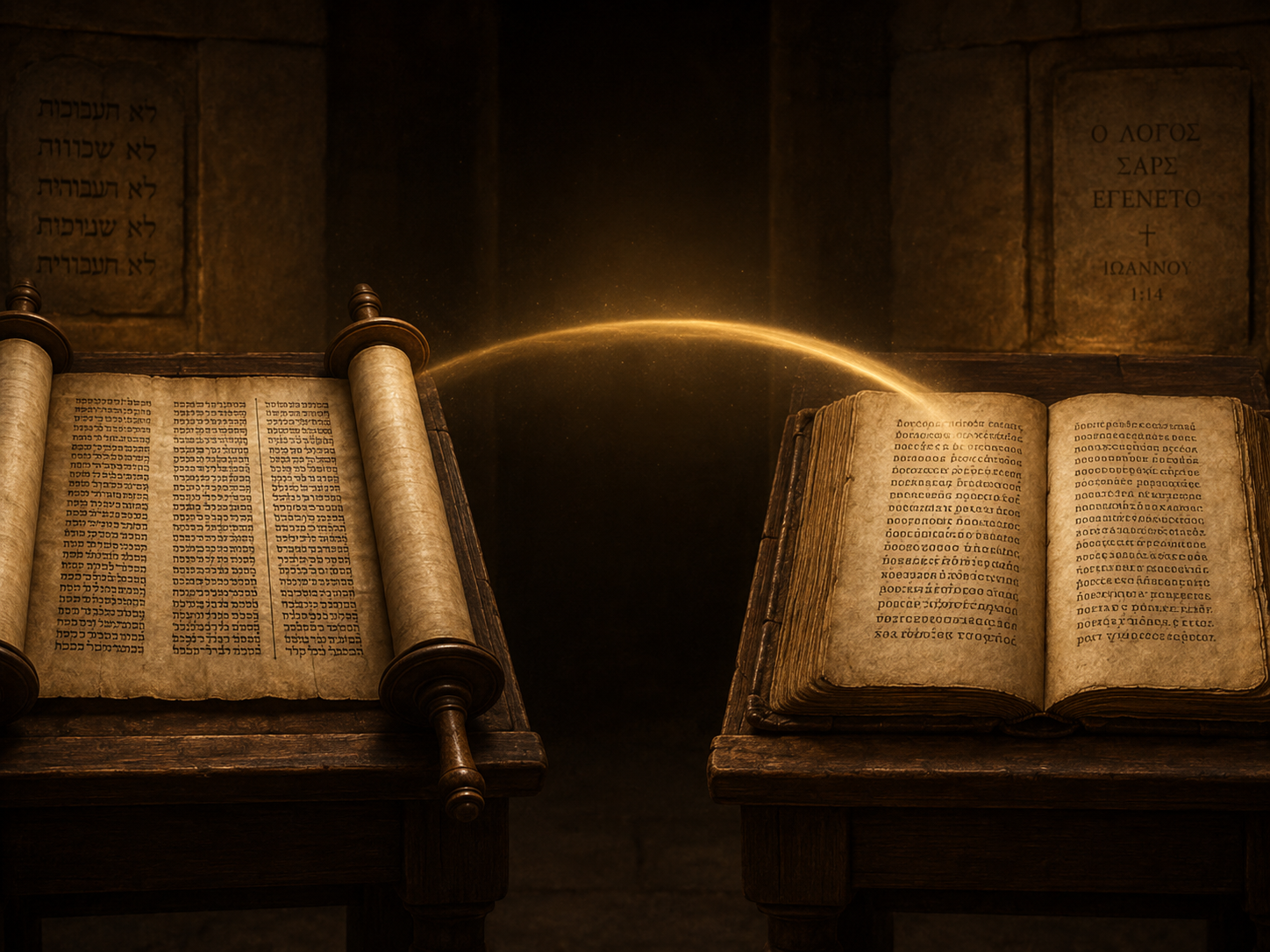
There is a challenge that circulates in counter-missionary circles, handed to Christians as a kind of dare: every New Testament claim about the Messiah must come from a clear Old Testament text that leaves the reader with the very same conclusion. No vague verses. Do it yourself. The list of claims is short — the Messiah must die for our sins, rise the third day, be believed unto salvation, and leave and return — and the blanks beside them are left empty, as if no honest reader could fill them.
We take the challenge gladly, because it is, in the end, a gift. The blanks can be filled — and filled from the Hebrew Scriptures, contextually, the reader's own Bible doing the work. But first we should be honest about the rules, because one of them is quietly bent.
The rules — and the quiet catch
Two rules govern the challenge. The first is fair: a New Testament claim about the Messiah should be answerable from the Old. We agree — that is exactly how the apostles argued, and how the Messiah Himself argued on the road to Emmaus, "beginning at Moses and all the prophets" (Luke 24:27). The second rule is where the catch hides: it demands the Old Testament state a thing as explicitly as the New, and rules out anything "vague" — by which is meant typology, pattern, and progressive revelation, the very way the Bible unfolds.
But revelation is a seed that becomes a tree. The Old Testament is the promise; the New is the performance. To demand that the blueprint already look like the finished house is to forbid the one thing prophecy does — open slowly, "here a little, and there a little" (Isaiah 28:10). And notice the double standard: Rabbinic Judaism's own central practices — the details of how to keep the Sabbath, the laws of kosher slaughter, the fixed liturgy of prayer, the very decision to suspend the sacrifices after the Temple fell — are nowhere stated "clearly and contextually" in the Tanakh. They are inferred, developed, carried by tradition. The standard that is supposed to demolish the New Testament would demolish the synagogue first.
So we will not hide behind typology — but we will not apologize for it either. And to be fair, we will meet the four claims even on the stricter ground, with texts about the Messiah that are plain.
1 · The Messiah dies for our sins
The claim to be grounded
1 Corinthians 15:3 — "Christ died for our sins according to the scriptures." Where do the Scriptures say the Messiah must die for the sins of others?
This is the easiest blank of the four, because an entire chapter of Isaiah is devoted to it — the chapter the synagogue lectionary steps around, reading Isaiah 52 and then 54:
But he was wounded for our transgressions, he was bruised for our iniquities … the LORD hath laid on him the iniquity of us all … thou shalt make his soul an offering for sin [asham].
The Servant suffers not for His own sin — "he had done no violence, neither was any deceit in his mouth" (53:9) — but for "the transgression of my people" (53:8). He is made an asham, a guilt-offering; He "bare the sin of many" (53:12). That is substitutionary atonement stated outright. Daniel names the sufferer with the word Mashiach:
And after threescore and two weeks shall Messiah be cut off, but not for himself …
And the principle beneath it all is written into the Torah: "it is the blood that maketh an atonement for the soul" (Leviticus 17:11). Psalm 22 even sketches the manner — the mocking, the pierced hands and feet, the casting of lots for the garments — centuries before crucifixion existed. The claim is not vague. It is Isaiah 53.
2 · The Messiah rises the third day
The claim to be grounded
1 Corinthians 15:4 — "he rose again the third day according to the scriptures." Where do the Scriptures foretell the resurrection — and the third day?
That the Messiah must live again after His sin-bearing death is plain: Isaiah's Servant, having been made an offering for sin, "shall prolong his days" and "shall see of the travail of his soul, and shall be satisfied" (Isaiah 53:10–11) — life after the offering. David adds that God's Holy One would not decay in the grave:
For thou wilt not leave my soul in hell; neither wilt thou suffer thine Holy One to see corruption.
David died and his body decayed — his tomb was a landmark in Jerusalem for a thousand years — so the psalm reaches past David to One who would rise before corruption set in. Now the harder part, and we will be candid: the third day exactly is carried not by a single flat sentence but by pattern and prophecy together. Hosea writes:
After two days will he revive us: in the third day he will raise us up, and we shall live in his sight.
Jonah, three days in the deep and brought up alive, became the sign the Messiah claimed as His own (Matthew 12:40). And the wave-sheaf of firstfruits was offered "on the morrow after the sabbath" (Leviticus 23:11) — the very day the Messiah rose, "the firstfruits of them that slept." This is exactly how Paul argues: "according to the scriptures" — plural, the whole witness, not one proof-text. The challenge's own demand for a single clear verse is itself the artificial rule; the prophets answer in chorus.
3 · Believe, and be saved
The claim to be grounded
Romans 10:9 — "if thou shalt … believe in thine heart that God hath raised him from the dead, thou shalt be saved." Where does the Old Testament make faith the way of salvation?
Here the challenge hands us the answer, because the very passage it cites — Romans 10 — is built out of the Tanakh. Read two verses past the one quoted, and Paul is quoting Isaiah and Joel:
For the scripture saith, Whosoever believeth on him shall not be ashamed … For whosoever shall call upon the name of the Lord shall be saved.
Those are not new sayings — they are the prophets, word for word:
… he that believeth shall not make haste … And it shall come to pass, that whosoever shall call on the name of the LORD shall be delivered.
And the root runs to the very beginning of the nation: Abraham "believed in the LORD; and he counted it to him for righteousness" (Genesis 15:6), and Habakkuk gives the line that became the heartbeat of the gospel — "the just shall live by his faith" (Habakkuk 2:4). Salvation by trusting God, not by earning Him, is not a Christian novelty. It is Abraham's, and Habakkuk's, and Joel's.
4 · The Messiah leaves and returns
The claim to be grounded
Acts 1:11; Hebrews 9:28 — the Messiah ascends and will "appear the second time." Where do the Scriptures speak of a Messiah who departs and comes again?
Daniel sees the ascension — the Son of man brought up to God and enthroned:
… behold, one like the Son of man came with the clouds of heaven, and came to the Ancient of days … And there was given him dominion, and glory, and a kingdom …
David sees Him seated at God's right hand, waiting for a future day of return and reckoning:
The LORD said unto my Lord, Sit thou at my right hand, until I make thine enemies thy footstool.
"Until" is the whole argument: He is seated away, and then He acts again. And Zechariah names what happens when He comes back — Israel recognizes the One it once pierced:
… and they shall look upon me whom they have pierced … And his feet shall stand in that day upon the mount of Olives …
A pierced Messiah who is looked upon and mourned at His coming — He must have come once to be pierced, and come again to be seen. This two-stage shape so pressed on the rabbis that they proposed two Messiahs: Messiah ben Joseph, who suffers and dies, and Messiah ben David, who reigns. The simpler answer the prophets give is one Messiah, who comes twice — first the offering, then the crown.
The challenge, met
Four blanks, four answers — Isaiah 53 and Daniel 9, Psalm 16 and Hosea 6, Isaiah 28 and Joel 2, Daniel 7 and Psalm 110 and Zechariah 12. Not one of them is borrowed from the New Testament; every one is from the Hebrew Scriptures the challenge says it honors. The dare assumes the Tanakh is silent about a dying, rising, returning Messiah. It is not silent. It is the source.
One last and gentler word, for anyone who set this challenge after walking away from Jesus. Very often the thing that drove the leaving was not Isaiah — it was the doctrine of the Trinity, a God said to be three, which no reader of the Shema can accept. If that was the stumbling-block, take heart: we reject that doctrine too. There is one God, the Father. But He has a Son — the Servant Isaiah saw, the Prince Daniel numbered, the One David called Lord — and rejecting a creed men invented was never a reason to let go of Him. The fuller invitation is in our companion letter, written to the same heart, in love.