"Thy way, O God, is in the sanctuary: who is so great a God as our God?"
Psalm 77:13, KJV
When God delivered Israel from Egypt, He did more than free a captive nation. He began teaching them the gospel through visible lessons they could see, touch, and remember. At Sinai He gave Moses the Ten Commandments, written by His own finger on tables of stone. At the same mountain He gave the pattern of the sanctuary. The two gifts belong together: the law that defines what sin is, and the sanctuary that shows how God saves the sinner who has transgressed it. This article walks the pattern in order — what the law is, what the sanctuary is, what Christ does as the antitype of both, and what the closing work of the sanctuary means for the reader living in the era of judgment that began in 1844.
God Wrote the Law With His Own Finger
Scripture says of Sinai: "And he gave unto Moses, when he had made an end of communing with him upon mount Sinai, two tables of testimony, tables of stone, written with the finger of God" (Exodus 31:18). And again: "The tables were the work of God, and the writing was the writing of God, graven upon the tables" (Exodus 32:16). The Ten Commandments are the only document in Scripture inscribed by God Himself rather than transcribed through a human writer.
There are in fact only three recorded instances of God writing with His own finger in the entire Bible. At Sinai He wrote the Decalogue (Exodus 31:18). In the temple court He stooped and wrote in the sand before the accusers of the woman taken in adultery (John 8:6, 8). At the close of Babylon's last feast, a hand wrote her judgment on the palace wall (Daniel 5:5). The pattern is consistent: when God writes with His own finger, He writes about His law, His mercy, and His judgment. The Sinai tablets carry all three.
Scripture defines sin precisely against this law: "Whosoever committeth sin transgresseth also the law: for sin is the transgression of the law" (1 John 3:4). If sin is the transgression of the law, then there must be a law for there to be a transgression. Paul makes the principle explicit: "where no law is, there is no transgression" (Romans 4:15). And the consequence is fixed: "the wages of sin is death" (Romans 6:23). Sin separates the sinner from God — "your iniquities have separated between you and your God" (Isaiah 59:2) — and a sentence of death stands over every transgressor.
The Justice Problem — Why the Cross Did Not Set the Law Aside
Two solutions to the death sentence were theoretically available. Either God could set aside the law (so that there would be no transgression, and therefore no penalty), or the penalty had to be paid. Modern teaching often presents the cross as if it accomplished the first — as if Christ's death abolished the law and freed the believer from any continuing obligation to it. The biblical reading is the second, and the difference is fundamental.
Consider an ordinary example. Suppose a violent crime is committed against someone we love, and the judge calls the matter in and dismisses it with a verbal warning: "Please do not do this again." Most observers would say that justice has not been done. The law has been treated as if it did not really matter. The victim has not been vindicated, and the offender has not been answered. A judge who acts this way is a corrupt judge, not a merciful one. Real mercy does not pretend that real wrongs are nothing.
God is one hundred per cent just. He is also one hundred per cent merciful. The cross is the place where those two attributes meet without compromise. The law's death sentence is paid in full — not by relaxing the demand, but by the Son of God Himself taking the demand upon Himself in the place of the sinner. "Christ hath redeemed us from the curse of the law, being made a curse for us" (Galatians 3:13). The cross therefore does not abolish the law. It is the strongest possible vindication of the law. If the law could have been set aside, Christ need not have died. The fact that He died means the law still stands.
Grace Saves, and Grace Establishes the Law
Salvation is not earned by law-keeping. Paul is explicit: "For by grace are ye saved through faith; and that not of yourselves: it is the gift of God: not of works, lest any man should boast" (Ephesians 2:8-9). The sinner cannot work his way back to a holy God. He receives forgiveness as a free gift, paid for by the blood of Christ alone.
But the same Paul, in the same body of writing, refuses the conclusion that grace cancels obedience. "What then? shall we sin, because we are not under the law, but under grace? God forbid" (Romans 6:15). And again: "Do we then make void the law through faith? God forbid: yea, we establish the law" (Romans 3:31). The believer obeys not in order to be saved, but because he has been saved and now loves the One Who saved him. Jesus said, "If ye love me, keep my commandments" (John 14:15). Saving grace and the law of God are not at war. They are two facets of the same gospel.
The structure of the new covenant confirms this. God says through Jeremiah, in the passage Hebrews quotes as the new-covenant promise: "I will put my laws into their mind, and write them in their hearts" (Hebrews 8:10). The law that was once written by His finger on stone is, in the new covenant, written by His Spirit on the heart. The substance is the same; only the location changes. The believer who has been forgiven by grace is then transformed by grace into the kind of person whose love for the Father expresses itself in obedience to His commandments.
Two Laws — Moral and Ceremonial
A great deal of confusion about "the law" in Scripture is resolved when the reader recognises that the Old Testament contains two distinct legal categories. They differed in author, in writing material, in location, in purpose, and in duration.
The moral law is the Ten Commandments. It was written by God with His own finger on tables of stone (Exodus 31:18). The stone tablets were placed inside the ark of the covenant (Deuteronomy 10:2, 5). The law defines what sin is (Romans 7:7). It is described in Scripture as holy, just, and good (Romans 7:12), as the law of liberty (James 2:12), as the royal law (James 2:8), and as eternal — "all his commandments are sure. They stand fast for ever and ever" (Psalm 111:7-8). It existed before Sinai: Genesis 26:5 records that Abraham "obeyed my voice, and kept my charge, my commandments, my statutes, and my laws" centuries before the giving at Sinai. Jesus said of it, "Till heaven and earth pass, one jot or one tittle shall in no wise pass from the law, till all be fulfilled" (Matthew 5:18).
The ceremonial law is a separate body of regulation — sacrificial procedures, festival calendars, dietary rules tied to ceremonial cleanness, priestly garments and rites. It was written by Moses in a book (Deuteronomy 31:24). That book was placed beside the ark, not inside it (Deuteronomy 31:26). It was given "because of transgressions, till the seed should come to whom the promise was made" (Galatians 3:19). It pointed forward to Christ and met its fulfilment in Him. When He died, the veil of the temple was rent in two from top to bottom (Matthew 27:51), and the entire sacrificial system was answered in the one perfect Sacrifice. The ceremonial law was therefore temporary by design. The moral law remains.
These categories must be kept separate when reading Paul. When Paul says the believer is "not under the law but under grace" (Romans 6:14) in the context of justification, he is denying that the law can be the basis of salvation — not denying its abiding moral authority. When he speaks of the ordinances "blotted out" at the cross (Colossians 2:14), he is speaking of the ceremonial regulations that Christ fulfilled, not of the Decalogue God wrote in stone. The reader who collapses the two categories will inevitably find Paul contradicting himself. The reader who keeps them distinct will find Paul perfectly consistent.
The Commandments Did Not Begin at Sinai
A common assertion in modern Christianity is that the Ten Commandments belong specifically to the Jews and were given for the first time at Sinai. Scripture itself does not support this claim. Genesis 26:5 records the LORD saying of Abraham, four centuries before Sinai, that "Abraham obeyed my voice, and kept my charge, my commandments, my statutes, and my laws." Whatever the Sinai event accomplished, it did not invent the commandments. It republished them in a permanent and authoritative form for a forgetful people.
Every one of the Ten Commandments is reaffirmed in the New Testament. The first: "Thou shalt worship the Lord thy God, and him only shalt thou serve" (Matthew 4:10). The second: "Little children, keep yourselves from idols" (1 John 5:21). The third: "that the name of God and his doctrine be not blasphemed" (1 Timothy 6:1). The fourth: "The sabbath was made for man, and not man for the sabbath: therefore the Son of man is Lord also of the sabbath" (Mark 2:27-28). The fifth: "Honour thy father and thy mother" (Matthew 19:19). The sixth, seventh, and eighth: "Thou shalt not commit adultery, Thou shalt not kill, Thou shalt not steal" (Matthew 19:18). The ninth: "Thou shalt not bear false witness" (Romans 13:9). The tenth: "Thou shalt not covet" (Romans 7:7). The New Testament does not abolish the Ten Commandments. It reaffirms each one of them.
The Pattern of the Sanctuary
When God gave Israel the Ten Commandments at Sinai, He also gave Moses the pattern of the sanctuary. The instruction was explicit: "And let them make me a sanctuary; that I may dwell among them. According to all that I shew thee, after the pattern of the tabernacle, and the pattern of all the instruments thereof, even so shall ye make it" (Exodus 25:8-9). And again: "See, saith he, that thou make all things according to the pattern shewed to thee in the mount" (Hebrews 8:5).
The sanctuary was not invented by human imagination. Every dimension, every material, every colour, every article of furniture, every ceremony was specified by God Himself. Hebrews tells the reader why: the earthly sanctuary was a "figure of the true" (Hebrews 9:24), a working scale-model of the heavenly reality in which Christ now ministers. To study the sanctuary therefore is to study the gospel itself, set out in physical form so that the believer could see with his eyes what his Saviour would one day accomplish for him.
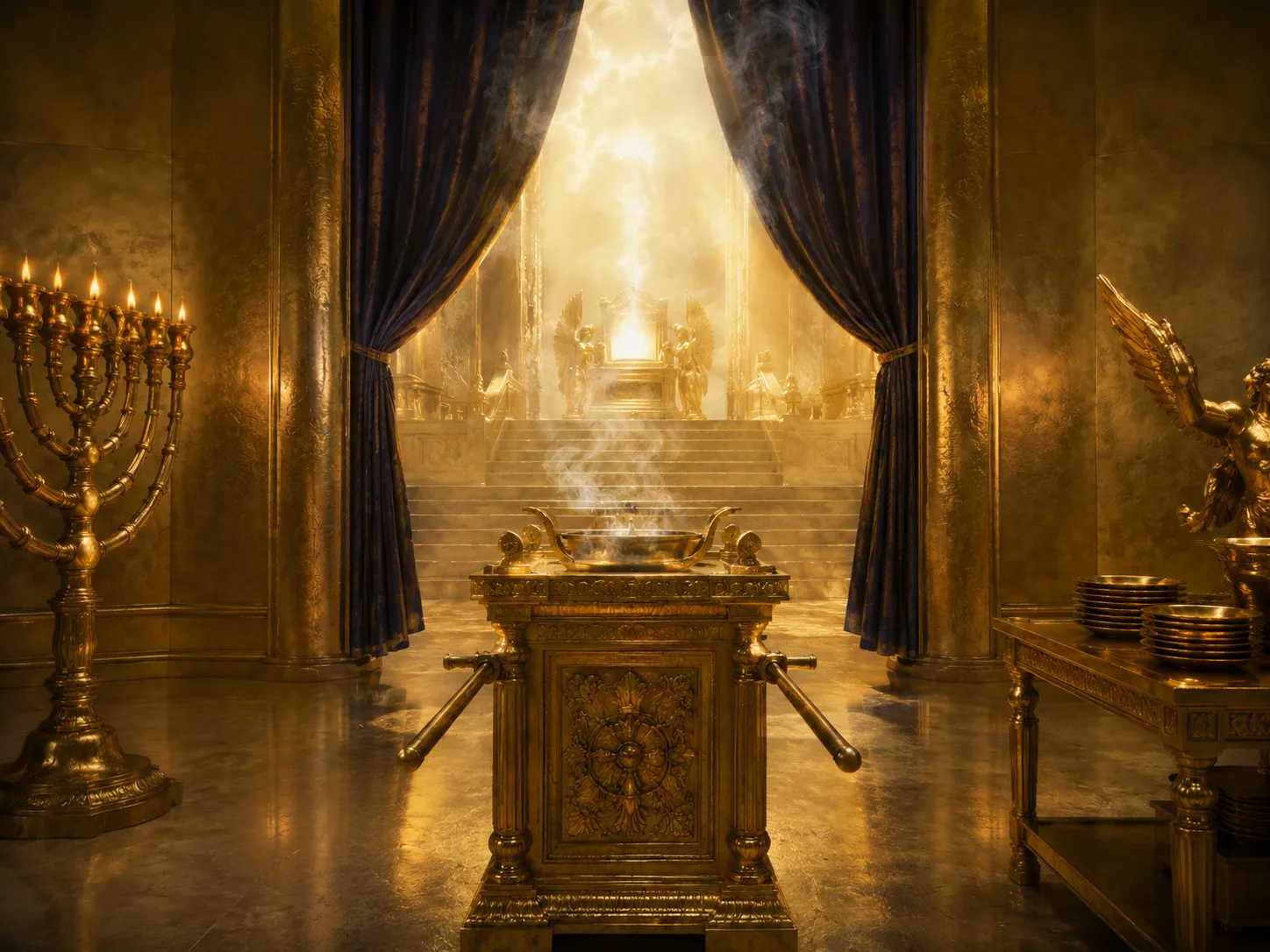
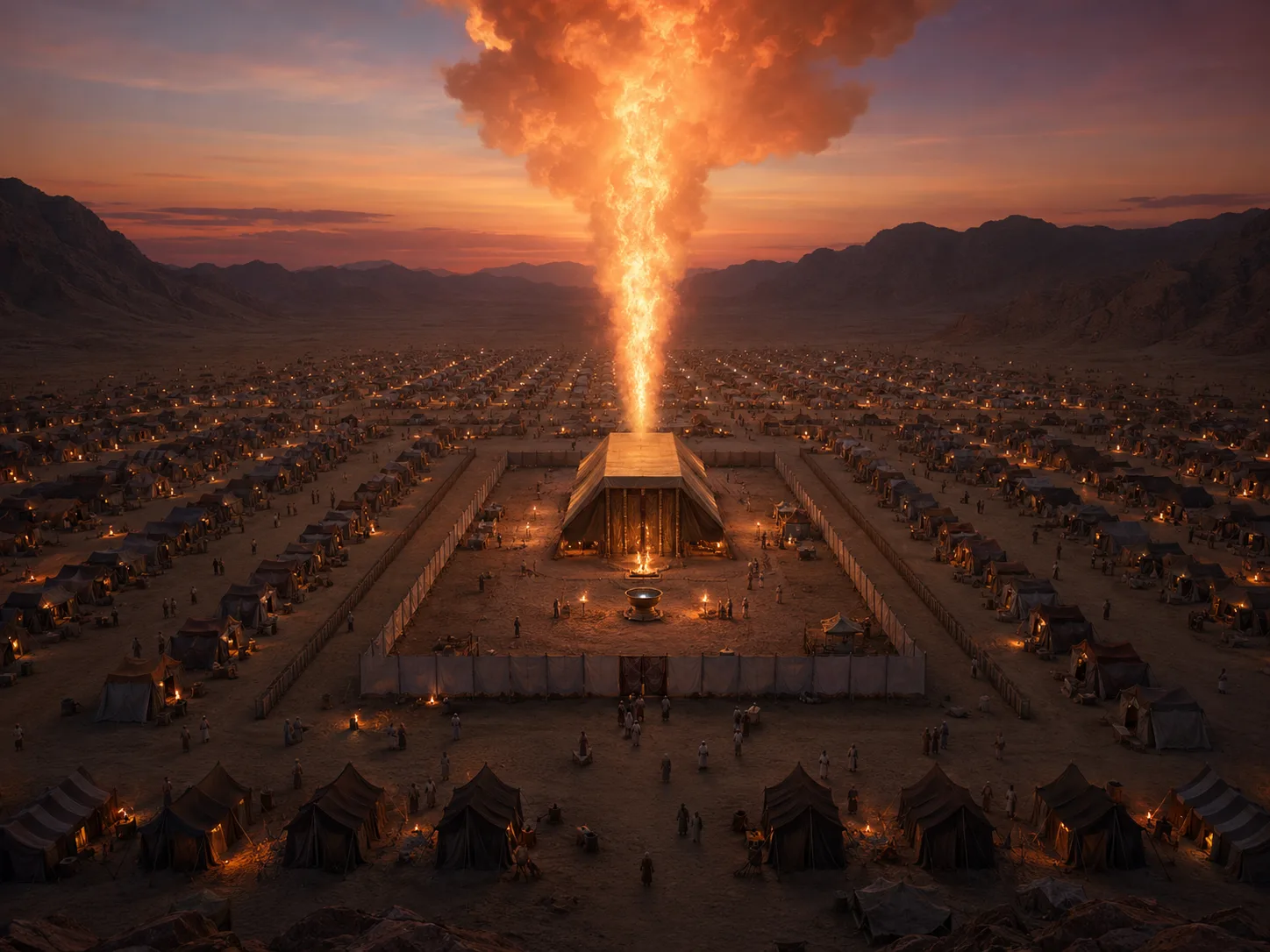
The earthly sanctuary had three areas. Around it ran a court of white linen, entered by a single gate at the east. Inside the court stood the altar of burnt offering and the laver. Within the sanctuary tent itself were two chambers separated by a veil: the Holy Place, containing the table of shewbread, the seven-branched lampstand, and the altar of incense; and the Most Holy Place, containing the ark of the covenant beneath the wings of two cherubim. Each piece of furniture, and the order in which the worshipper encountered them, taught a specific aspect of Christ's saving work.
The Courtyard — Sacrifice and Cleansing
The court was surrounded by a wall of white linen, the colour of righteousness. There was only one entrance — one gate, on the eastern side. The exclusivity of the gate is the same lesson Jesus would later put plainly: "I am the door: by me if any man enter in, he shall be saved" (John 10:9), and "I am the way, the truth, and the life: no man cometh unto the Father, but by me" (John 14:6). One sanctuary, one entrance, one Saviour.
The gate, the inner door, and the veil between the Holy and Most Holy Places were all woven from the same four colours: blue, purple, scarlet, and white, with threads of fine gold. The colours were not decorative. Blue is the colour of obedience — Numbers 15:38-40 specifies the blue ribband on the borders of garments as a reminder to obey the commandments. Scarlet is the colour of sacrifice and atoning blood. White is the colour of righteousness (Revelation 19:8). Purple — obtained anciently by mixing scarlet and blue — is the colour of royalty: sacrifice and obedience joined together produce the King. The gold thread running through every panel is the divine nature, the deity of the Christ Who would unite all four colours in His own person.
Just inside the gate stood the altar of burnt offering. Here a sacrificial animal was slain. The procedure was specified in detail (Leviticus 1-7; 16). The sinner brought an animal, laid his hands on its head, and confessed his sin over it — symbolically transferring the guilt of his transgression onto the substitute. The animal was then killed by the worshipper himself. The blood was caught by the officiating priest. The fat was burned on the altar; the carcass, in many of the offerings, was taken outside the camp and burned (Hebrews 13:11-12). Every detail prefigured Christ. Jesus would be "led as a lamb to the slaughter" (Isaiah 53:7); His blood would be applied not in a basin but at the heavenly throne; and He would suffer outside the gate of Jerusalem (Hebrews 13:12), where the Roman crosses stood.
Beyond the altar stood the laver — a great bronze basin of water in which the priests washed before entering the sanctuary tent. The laver represents cleansing — the new birth of the repentant sinner, the washing of regeneration (Titus 3:5), and the daily cleansing of the believer's walk by the word of God: "Sanctify them through thy truth: thy word is truth" (John 17:17). Forgiveness at the altar is not the end of the gospel; cleansing at the laver follows it. Christ does not merely cover the past. He cleanses the life.
The Holy Place — Daily Fellowship With Christ
Beyond the laver, the priest entered the first chamber of the sanctuary tent — the Holy Place. Three pieces of furniture stood there. On the north side, the table of shewbread, with its twelve loaves of unleavened bread always before the LORD. On the south side, the seven-branched golden lampstand. Before the inner veil, the altar of incense. The three together depicted the daily life of the believer in fellowship with God.
The table of shewbread bore twelve loaves — one for each tribe of Israel; one, by extension, for each apostle of the Lamb. Jesus said, "I am the living bread which came down from heaven: if any man eat of this bread, he shall live for ever" (John 6:51). The bread is the word of God internalised by faith. The believer eats this bread daily — not as a religious obligation but as the actual nourishment of his soul. Bethlehem, the place of Christ's birth, means literally "house of bread."
The lampstand burned continually with pure olive oil. Christ said of Himself, "I am the light of the world: he that followeth me shall not walk in darkness, but shall have the light of life" (John 8:12). The oil that fed the lamp is the Spirit of God — the divine power and presence of the Father proceeding through the Son — by which the Light of the world shines through the believer into a dark age. Without the oil, the lamp goes dark. Without the Spirit of Christ working in the heart, the believer's witness fails.
The altar of incense stood directly before the veil. On it the priest burned a special mixture of fragrant gum-resins (Exodus 30:34-38) so that a continual cloud of perfumed smoke rose before the holiest place. The incense represents the prayers of God's people, made acceptable through the merits of Christ (Revelation 8:3-4). The believer's prayer does not stand on its own merit; it ascends to the Father only because it is offered through the name and ministry of the Son. "No man cometh unto the Father, but by me" applies as much to prayer as to salvation.
The Most Holy Place — Law Under Mercy
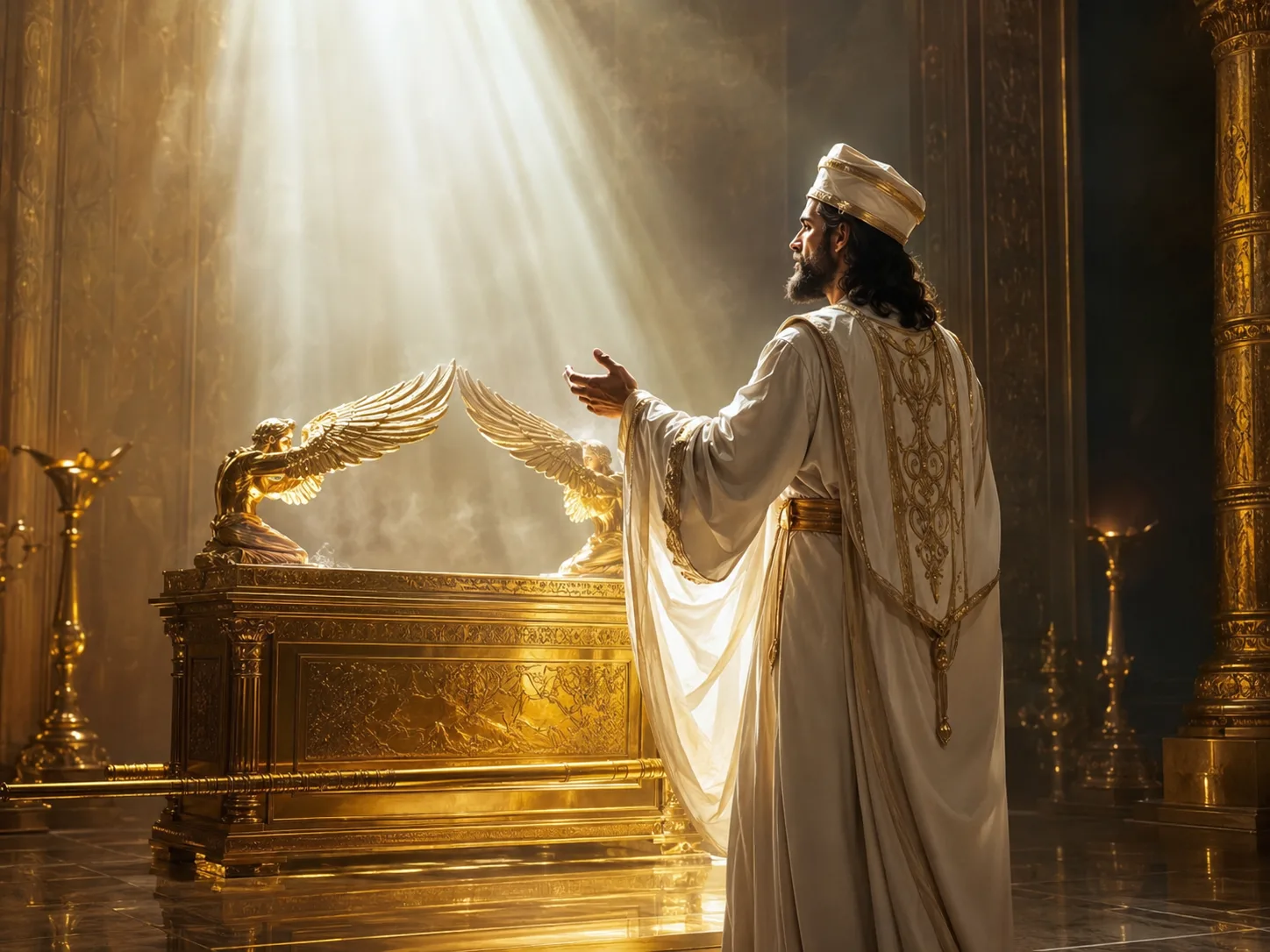
Through the second veil lay the Most Holy Place. Only one article of furniture stood there: the ark of the covenant, a gold-covered acacia chest containing the two tables of stone. Above the ark, of solid gold, lay the mercy seat. From between the two cherubim that overshadowed the mercy seat, the visible glory of the LORD — the Shekinah — appeared as a luminous cloud.
The arrangement is itself an entire theology. The law of God lies inside the ark; the mercy of God lies upon the ark. The law cannot be reached except through the mercy. The mercy does not deny the law; it covers it. The penitent sinner is not saved by the law being pushed aside, but by mercy being interposed between him and the law's righteous demand. Proverbs 28:13 states the rule: "He that covereth his sins shall not prosper: but whoso confesseth and forsaketh them shall have mercy." Mercy is real, and mercy is plentiful, but mercy reaches the sinner only at the place where the sinner is honest about the law.
One small detail in the dimensions makes the point unforgettable. The altar of burnt offering in the court stood one and a half cubits high (Exodus 27:1). The mercy seat over the ark stood one and a half cubits long (Exodus 25:17). God's justice and God's mercy stand at exactly the same height. He is not more just than merciful, nor more merciful than just. He is both, fully, at the same moment, in the same Christ.
Christ as Sacrifice and as High Priest
The sanctuary service depicted two distinct movements in the work of Christ. First, He was the Sacrifice. He died once for all, offering His perfect life in the place of guilty humanity. "Behold the Lamb of God, which taketh away the sin of the world" (John 1:29). The earthly altar of burnt offering pointed to Calvary.
Second, after His resurrection and ascension, Christ became the High Priest, ministering on behalf of His people in the heavenly sanctuary itself. "We have such an high priest, who is set on the right hand of the throne of the Majesty in the heavens; a minister of the sanctuary, and of the true tabernacle, which the Lord pitched, and not man" (Hebrews 8:1-2). The earthly Holy Place pointed to Christ's daily intercessory work since His ascension. The cross was not the end of Christ's work for the sinner; it was the foundation that made the heavenly ministry possible.
John writes in this exact key: "My little children, these things write I unto you, that ye sin not. And if any man sin, we have an advocate with the Father, Jesus Christ the righteous: and he is the propitiation for our sins" (1 John 2:1-2). Christ is the Advocate now. He has not retired from the work; He is actively pleading His own blood before the Father on behalf of every soul who confesses sin to Him and trusts in Him. The believer's daily walk depends on this continuing ministry as much as on the finished sacrifice that established it.
There is a striking geographical detail worth pausing on. Mount Moriah, on which the temple was eventually built (2 Chronicles 3:1), is the same mountain on which Abraham was called to offer Isaac (Genesis 22:2). When Solomon quarried Moriah for temple stone, the digging left a small adjacent hill standing alone — the hill later called Golgotha. The place of Abraham's typological sacrifice, the place of the temple sacrifices, and the place of the Lamb of God's death stand on the same ridge of stone. The location preached the gospel long before the gospel had been preached in words.
The Day of Atonement — Cleansing of the Sanctuary
The daily ministry of the sanctuary dealt with individual sins as worshippers brought them. Once a year, on the tenth day of the seventh month — the Day of Atonement, in Hebrew Yom Kippur — a different and more solemn service was conducted. On that day, the accumulated record of sin that had been symbolically transferred into the sanctuary throughout the year was finally cleansed from it. Leviticus 16 sets out the procedure.
Two goats were brought before the LORD at the door of the tabernacle. Lots were cast over them. One lot read "For the LORD"; the other lot read "For Azazel" — the scapegoat. The Lord's goat was killed as a sin offering. The high priest carried its blood through the inner veil into the Most Holy Place and sprinkled it before the mercy seat, making atonement for the holy place itself "because of the uncleanness of the children of Israel, and because of their transgressions in all their sins" (Leviticus 16:16). When the cleansing of the sanctuary was complete, the high priest came out, laid both his hands on the head of the second goat — Azazel — confessed over it all the iniquities of the people, and the goat was led away by a fit man into the wilderness, never to return.
It is essential to read this ritual correctly. The atonement for sin is made by the Lord's goat — the type of Christ — whose blood is shed and carried into the sanctuary. The scapegoat is not a second saviour. The scapegoat does not shed any blood; "without shedding of blood is no remission" (Hebrews 9:22). The scapegoat receives, after the atonement is complete, the responsibility for the sins it provoked. The Hebrew name Azazel is the proper name of a fallen being, and the New Testament identification is unambiguous: the originator of sin, Satan himself, will at the end of the great controversy receive the responsibility for the rebellion he instigated. Christ pays for sin redemptively; Satan answers for it as instigator. The two roles must never be merged.
The Seven Feasts as Prophetic Outline
Israel kept seven annual feasts, each of which functioned as a prophetic appointment within the unfolding plan of salvation. The first four cluster in the spring and the fifth in early summer; the last three fall in the autumn. The arrangement is itself a calendar of redemption.
- Passover (Nisan 14) — the death of the Lamb. Fulfilled at Calvary, on the very day the Passover lambs were slain (1 Corinthians 5:7).
- Unleavened Bread (Nisan 15) — Christ's sinless body in the tomb. Leaven represents sin (1 Corinthians 5:8); Christ's body saw no corruption.
- Firstfruits (Nisan 16) — the resurrection. Christ became "the firstfruits of them that slept" (1 Corinthians 15:20) on the exact day of the wave offering.
- Pentecost (Sivan 6, fifty days after Firstfruits) — the giving of the law at Sinai, and in antitype the giving of the Spirit at the founding of the apostolic church (Acts 2:1-4).
- Trumpets (Tishri 1) — the heralding of the judgment-hour message. In antitype, the Advent awakening that sounded the warning of approaching judgment in the early nineteenth century.
- Day of Atonement (Tishri 10) — the cleansing of the sanctuary and the final cases of judgment. In antitype, the heavenly work that began in 1844 and continues until probation closes.
- Tabernacles (Tishri 15-22) — the gathering home of the harvest. In antitype, the gathering of the redeemed to the kingdom at the return of Christ (Revelation 21:3).
The spring feasts have all been fulfilled in the historical work of Christ. The autumn feasts are unfolding in the present and yet-to-come work of Christ in the heavenly sanctuary. The middle feast, Pentecost, bridges the two. The reader who understands the calendar of the feasts understands the whole shape of the gospel.
The Antitypical Day of Atonement — 1844
The earthly Day of Atonement was a one-day annual cleansing of an earthly sanctuary. Daniel saw in vision a far longer and far weightier cleansing of a far greater sanctuary. "And he said unto me, Unto two thousand and three hundred days; then shall the sanctuary be cleansed" (Daniel 8:14). The two thousand three hundred days, read on the day-for-a-year principle of Numbers 14:34 and Ezekiel 4:6, are two thousand three hundred actual years. The angel Gabriel told Daniel the starting point in the next chapter: "from the going forth of the commandment to restore and to build Jerusalem" (Daniel 9:25). That decree, issued by Artaxerxes of Persia, is dated to 457 BC and confirmed by Babylonian astronomical tablets.
Counting forward two thousand three hundred years from 457 BC — and accounting for the absence of a year zero in the Christian calendar — the prophecy reaches the autumn of 1844. The sanctuary to be cleansed at that date is not the earthly one, which had been destroyed by the Romans in AD 70 and never rebuilt. The sanctuary to be cleansed is the heavenly one of which the earthly was a shadow. The cleansing is the antitypical Day of Atonement — Christ's closing high-priestly ministry in the Most Holy Place of the true tabernacle.
This is the great prophetic discovery of the Advent pioneers in the years following the Great Disappointment of 22 October 1844. The believers had calculated the date correctly but had misunderstood the event. They had expected Christ to come visibly to cleanse the earth. What He had in fact done was move, in the heavenly sanctuary, from the daily ministry of the Holy Place into the closing ministry of the Most Holy Place. The pre-advent investigative judgment had begun. The companion article The Hour of God's Judgment walks the full prophecy step by step.
We have lived since 1844 in the era the prophecy calls "the hour of his judgment" (Revelation 14:7). Christ is still our Advocate; probation has not yet closed; mercy still pleads. But the closing work has begun, and the closing work has a definite end.
The Judgment Is Good News
A reader unfamiliar with the sanctuary message often hears the word judgment and assumes the worst. The actual structure of the doctrine teaches the opposite. The sins that are recorded in the heavenly sanctuary are precisely the sins that have been confessed and forgiven. The transfer of guilt that happened in type at the earthly altar happens in reality at the heavenly throne: the confessed sin of the repentant believer is borne by Christ, applied to His record, and held there under His own blood.
When the antitypical Day of Atonement closes those records, it is good news that there are many of them in your name. Every entry in the heavenly record is an entry that reads "pardoned." The accuser of the brethren (Revelation 12:10) will rise to charge each believer with every remembered offence, and the answer of the heavenly court will be the same in every case: confessed, applied to the blood, forgiven. "If we confess our sins, he is faithful and just to forgive us our sins, and to cleanse us from all unrighteousness" (1 John 1:9).
When the cleansing is complete, the redeemed will stand before God not as forgiven sinners but as persons whose sins have been entirely removed from the records of heaven — "as far as the east is from the west" (Psalm 103:12). The promise is total. "Though your sins be as scarlet, they shall be as white as snow; though they be red like crimson, they shall be as wool" (Isaiah 1:18). The investigative judgment is therefore not the dark side of the gospel. It is the gospel proceeding to its conclusion.
No New Temple Is Coming
A current of modern Christian thought, much of it tied to specific dispensational eschatology, anticipates the rebuilding of the Jewish temple in Jerusalem and the reinstitution of the Levitical sacrificial system. The biblical reading of the sanctuary makes that expectation impossible.
When Christ died, the veil of the temple was rent in two from top to bottom (Matthew 27:51) — torn by God Himself, from the height no human hand could reach, in the direction no human force could produce. The sign was unmistakable. The earthly sanctuary system had reached its appointed end. Every sacrifice of every Old Testament priesthood had pointed forward to the death of the true Lamb. With the Lamb of God offered, the shadow had no further role. Hebrews puts the matter beyond reach of compromise: "by one offering he hath perfected for ever them that are sanctified" (Hebrews 10:14), and "now where remission of these is, there is no more offering for sin" (Hebrews 10:18).
To rebuild the temple and re-institute animal sacrifice today would be, in effect, to deny that Christ's one sacrifice was sufficient. The sanctuary now in operation is not on Mount Moriah but in heaven (Hebrews 8:1-2), and the priest now in office is not of Aaron's lineage but of the order of Melchizedek (Hebrews 7:24-25). The reader interested in the prophetic future is directed not to an expected rebuilt temple in the Middle East but to the closing work of the High Priest currently ministering in the true tabernacle above.
A Call to Faith, Confession, and Surrender
The sanctuary message ends as the Day of Atonement ended in Israel — with a personal call to every worshipper. Leviticus 23:29 was severe: "whatsoever soul it be that shall not be afflicted in that same day, he shall be cut off from among his people." The afflicting of the soul meant honest self-examination, the confession of unacknowledged sin, the giving up of cherished offences, the renewed surrender of the whole life to the LORD.
The same call comes now, in the antitypical day in which the reader lives. Bring the sins. Confess them and forsake them. The Advocate is willing to receive them. The mercy is willing to cover them. The record is willing to register them as pardoned. And one day, when the closing decree of probation has been spoken (Revelation 22:11), the cleansing will be complete, the record will be sealed, the Saviour will lay aside His priestly garments, and He will return to take His people home (Hebrews 9:28).
Until that day, the sanctuary remains the framework within which the gospel makes complete sense. Justification at the altar. Cleansing at the laver. Daily fellowship in the Holy Place. Mercy above the law in the Most Holy. Christ as the Lamb. Christ as the High Priest. Christ as the soon-coming King. "Thy way, O God, is in the sanctuary: who is so great a God as our God?" (Psalm 77:13).
Key Takeaways
- The Ten Commandments — written by God's own finger on stone, placed inside the ark — define what sin is. They have not been abolished by the cross; they have been confirmed by it.
- The ceremonial law — written by Moses in a book, placed beside the ark — was added because of transgression and was fulfilled in Christ at Calvary.
- Salvation is by grace through faith alone, but grace establishes the law rather than abolishing it. The new covenant writes the law on the heart.
- The sanctuary was built according to a divinely-revealed pattern of the heavenly. Its colours, dimensions, and ceremonies preached the gospel in physical form.
- The court depicts justification and cleansing; the Holy Place, the daily walk of fellowship; the Most Holy Place, the meeting of law and mercy at the throne of God.
- Christ is both the Lamb (sacrificed once at Calvary) and the High Priest (ministering still in the heavenly sanctuary above).
- The Day of Atonement cleansed the earthly sanctuary annually; its antitype cleanses the heavenly sanctuary in a single closing work that began in 1844 and continues until probation closes.
- The scapegoat (Azazel) is Satan — receiver of responsibility for sin, never a second atonement. Christ alone bears sin redemptively.
- The investigative judgment is good news: the sins recorded in the heavenly sanctuary are forgiven sins, and the closing work will blot them out entirely.
- No earthly temple will be rebuilt. The veil was rent by God Himself; the priestly ministry now in operation is in heaven.