
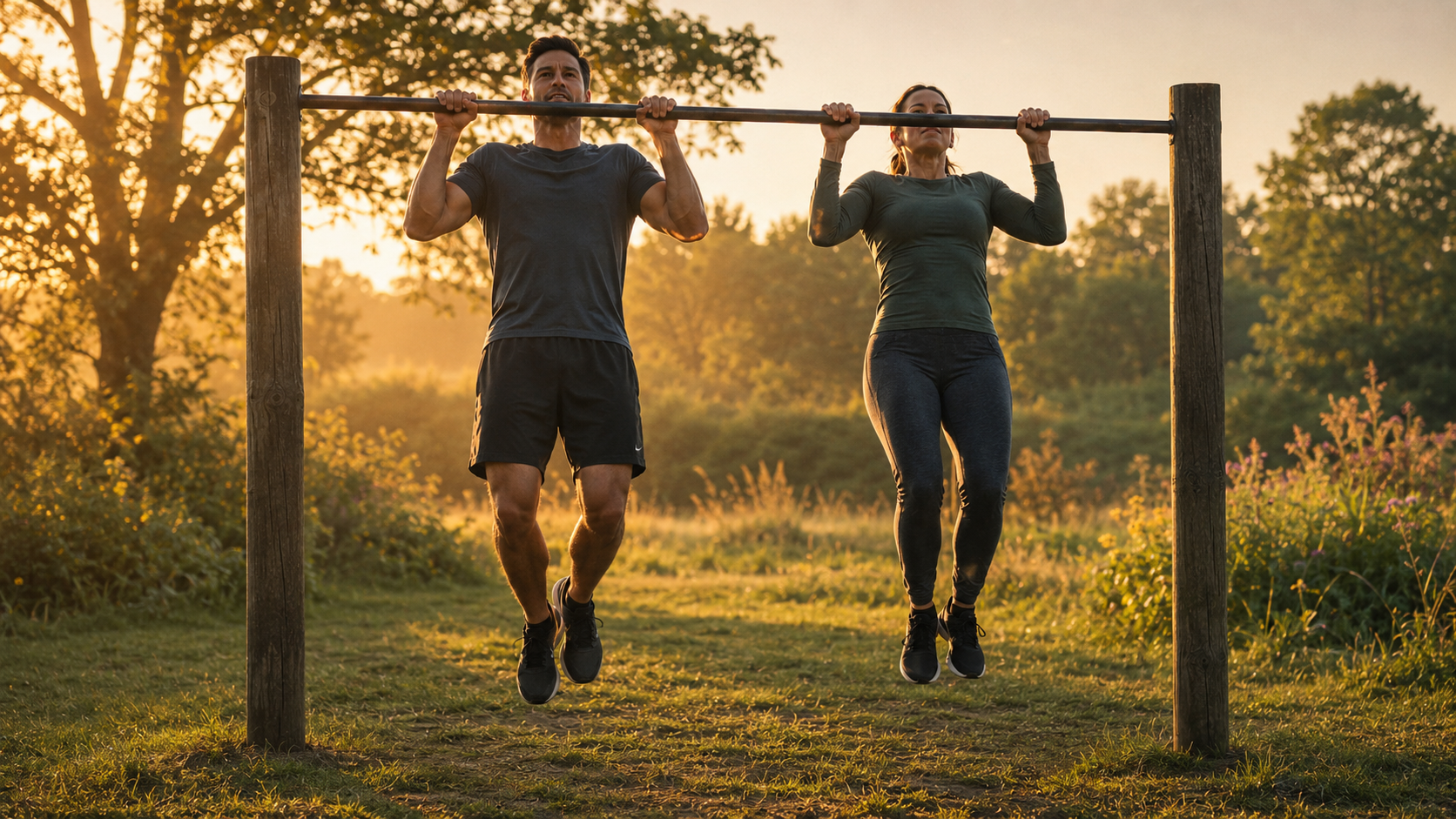
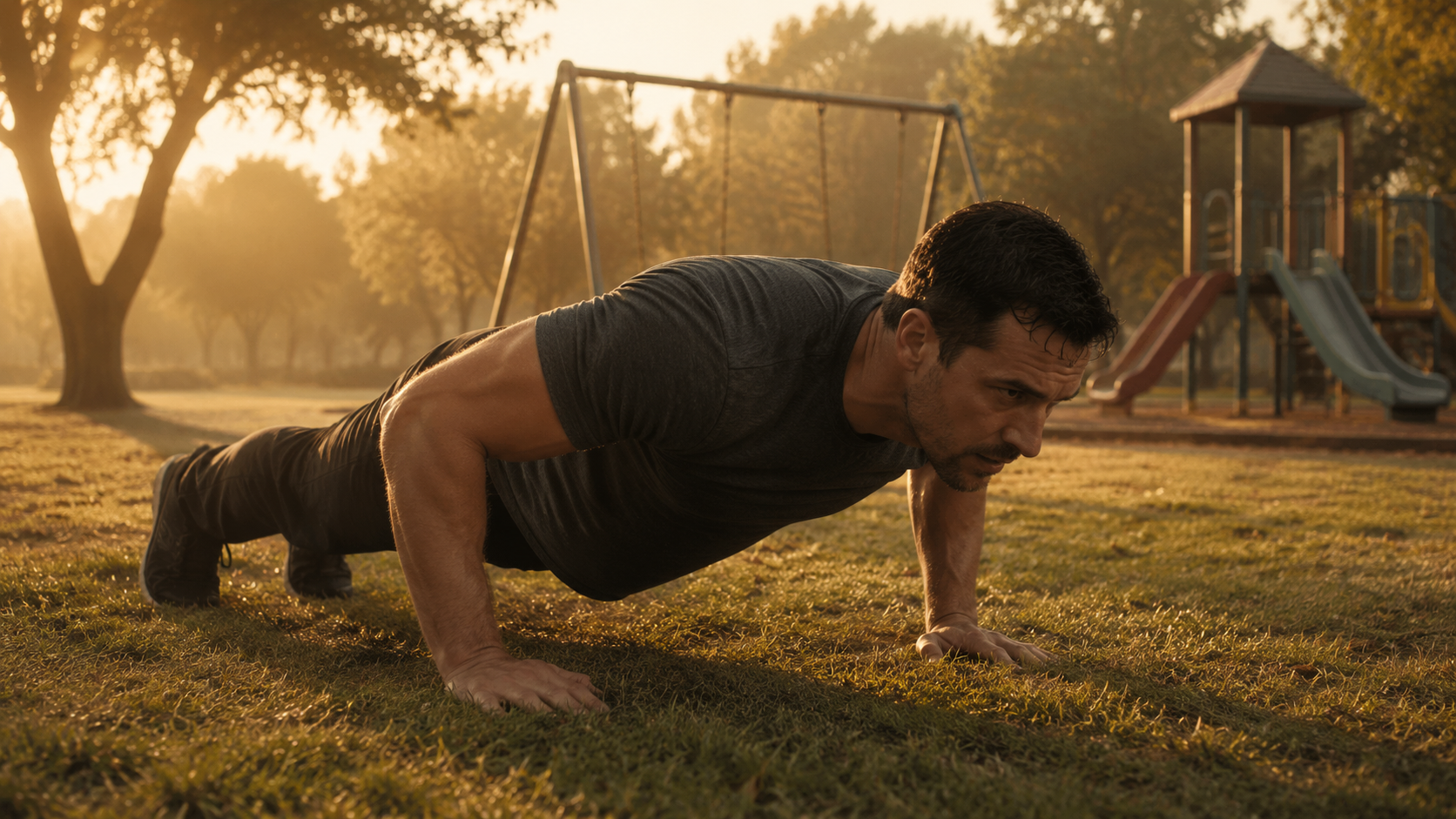
And every man that striveth for the mastery is temperate in all things… I therefore so run, not as uncertainly; so fight I, not as one that beateth the air: But I keep under my body, and bring it into subjection.
Of all the disciplines a person can take up, physical training is not the most important. Scripture says so plainly, and I will not pretend otherwise: bodily exercise profiteth little. But it is the most teachable — the one arena where you cannot lie to yourself. The bar either goes up or it doesn’t. The walk either happened or it didn’t. The body keeps an honest ledger no story can talk it out of, and that honesty is exactly why it is the best place a soft will has to learn what discipline actually feels like before it is asked to obey where no one is watching.
The body is an honest teacher
Most of the disciplines that matter are invisible while you build them. Prayer, study, holding your tongue, setting money aside — you can do them faithfully for months and see nothing on the outside, and you can neglect them for months and, for a while, look exactly the same. That invisibility is what makes them easy to drop. There is no scoreboard in the room, so the part of you that wants to quit gets to argue the point.
The body removes the argument. It gives you an answer the same day. You either showed up or you did not, and within a few weeks the mirror and the numbers report the verdict whether you asked them to or not. This is not a small thing. It means the body is the one place where a person who has never once followed through on anything can prove to himself, in plain sight, that following through works — that the small thing done daily actually compounds into a result he can see and touch. And once a will has felt that proof in the flesh, it stops being a theory everywhere else.
That is the whole reason to start here. Not because a strong body is the point of a life — it is not — but because the body is the teachable arena where the mechanism of discipline is learned first and fastest, and then carried, quietly, into the rooms where the stakes are eternal. Paul reasoned the very same way: he trained like an athlete so that he would not be a castaway in the greater race. The temperance he learned in the body was the temperance he needed in the spirit.
Is caring for the body unspiritual?
A certain kind of piety hears all this and flinches. Isn’t fussing over the body carnal? Aren’t we supposed to be minding our souls? That instinct feels spiritual, but it is not from the Bible. It is from the Greeks — the old dualism that split the world in two and called the spirit good and the body a prison the real self is waiting to escape. Scripture never talks that way. God formed the body first, with His own hands, and pronounced the whole man very good. He did not make a soul and reluctantly house it in meat.
On our ground this matters even more than usual, because we do not believe a person is a soul that merely wears a body for a while. Scripture makes the man a unity — dust and breath together becoming a living soul — and the hope it holds out is not a ghost floating free of the flesh but the resurrection of the body. You are not a spirit slumming in a carcass. You are, body and all, the thing God made and intends to raise. So the body is not beneath your spiritual attention; it is part of what your spiritual attention is for. To wave it off as “just the flesh” is not humility. It is a pagan idea wearing a halo.
What? know ye not that your body is the temple of the Holy Ghost which is in you, which ye have of God, and ye are not your own? For ye are bought with a price: therefore glorify God in your body, and in your spirit, which are God’s.
The body is called a temple — the dwelling of God’s own Spirit, His presence and power resident in you — and a person does not let the temple fall into ruin and call the neglect devotion. Paul goes further and asks for the body itself to be brought to the altar: present your bodies a living sacrifice, holy, acceptable unto God, which is your reasonable service (Romans 12:1). Not the soul only — the body, offered up and kept fit for use. Stewardship of the flesh is not vanity. It is worship in work clothes.
Which brings us back to the one verse that seems to argue the other way. Bodily exercise profiteth little: but godliness is profitable unto all things, having promise of the life that now is, and of that which is to come (1 Timothy 4:8). Read it carefully: it is a ranking, not a dismissal. Bodily exercise profits little — a real profit, only a small one, and only for this life. Godliness profits all things, in this life and the next. So the body is the servant and godliness is the master, and any fitness that forgets that order has become an idol. But a servant is not an enemy. Kept in its place — under godliness, never over it — bodily discipline is the schoolmaster that trains the will the soul will need.
Exercise belongs to the health message
There is a further reason this is not a hobby but a duty. The health message the pioneers recovered was never only a diet. It named eight plain, God-given remedies — pure air, sunlight, abstemiousness, rest, exercise, proper diet, the use of water, and trust in divine power — and set them out as the ordinary means of keeping the body God gave. Exercise is one of the eight. It sits in the same list as temperance and rest and clean water, which is to say it is not optional enthusiasm layered on top of the Christian life; it is part of the plainest stewardship of the body that life asks.
That reframes the whole thing. Movement is not a vanity project for people who care how they look in a mirror. It is one of the settled duties of a person who understands that the strength and clarity he brings to his work, his family, and his walk with God all run through a body that has to be kept. The fuller case for the health message — why the body’s laws are God’s laws, and why keeping them is part of the message and not beneath it — I lay out in The Health Message. Here I only want the practical corner of it: how a person with no athletic history actually begins, and keeps going for the rest of his life.
Start with walking
Start with the one thing nobody has an excuse to skip: walk. Before a single weight is touched, before any program is chosen, walking is the baseline every human body should have and almost none of us do anymore. It costs nothing, needs no equipment, injures no one, and it is the exact movement the body was built to do all day long. The wellness industry quietly buried it because you cannot sell it, but on the actual evidence it is closer to a complete physical and mental protocol than almost anything else a person can do.
A few of the plain benefits, since they matter. Walking burns fat as its primary fuel and keeps stress hormones low, which is why for steady fat loss it quietly beats the running most people punish themselves with and give up on. A short walk after a meal — even ten or fifteen minutes — pulls sugar out of the blood through the working muscles and blunts the spike, one of the simplest guards there is against the slow slide into insulin trouble and type-2 diabetes. It conditions the heart, oils the joints instead of pounding them, lifts the mood, clears the head, and puts you under real daylight, which the body needs and the indoor life starves it of.
And walking does something the harder training never will: it leaves the mind free. A hard set demands all of you; a walk demands almost none, which is why it has been the thinking man’s and the praying man’s exercise for as long as there have been roads. It is the original meditation — the place a person can pray without hurry, think a problem all the way through, or simply be quiet under the sky. Isaac went out to meditate in the field at the eventide (Genesis 24:63). You can stack the walk with a Scripture track, a good book read aloud, or the morning’s prayer, and get the body and the soul fed in the same thirty minutes. Aim for a brisk but conversational pace, most days, ideally in the morning light. That alone, kept for a year, will change more than most gym memberships ever do.
When it becomes automatic
Here is what almost no one stays in the game long enough to discover: after enough repetition, training stops being a thing you make yourself do and becomes a thing your body starts asking for. Somewhere past the first year of genuine consistency the whole polarity flips. The rest day starts to feel wrong. The body gets restless without the walk, sleeps worse without the work, and the appetite and the mood begin to lobby for the session instead of against it. What was a daily act of will quietly becomes the new normal you would have to exert will to break.
That is not mysticism; it is the same paradigm shift that governs every deep habit — the pattern repeated often enough to sink below the waterline of conscious effort and run on its own. I lay out how that reprogramming actually works, and why the long flat stretch before it takes is where nearly everyone quits, in Changing Your Paradigm and The Slight Edge. For our purposes the only thing you need to believe is that the flip is real and it is coming, so that you do not mistake the hard early months for the whole experience. They are the toll, not the road.
Then add resistance
Once the walk is a fixed part of your day, add the second half: resistance. Muscle is not vanity — it is the tissue that keeps you upright, guards the joints, holds off the frailty that ends most people’s independence long before their years do, and, not incidentally, is where the body clears its sugar. You do not need a barbell or a membership to begin. Push-ups, pull-ups, dips, and squats — pushing, pulling, and standing up under a load — cover the whole body with four movements and a floor.
Two principles keep resistance training productive and keep you out of the injuries and burnout that end most attempts:
- Four sets per exercise, at most. More than that is mostly fatigue, not growth. A few hard sets, done with real effort, deliver nearly all the result of a long punishing session, without the wreckage that makes you dread the next one.
- Stop one rep before failure. Leaving a rep or two in reserve builds muscle nearly as well as grinding to total failure, while sparing the joints and the nervous system so you can come back tomorrow and the day after. The goal is not to be destroyed in one session; it is to be able to keep the appointment for the next twenty years.
For men: a real physique without a gym
A word specifically for the men who want to build a genuinely good physique and have no interest in a gym: you do not need one. A short list of movements, done hard and progressed patiently, will take you further than most of what happens on a crowded gym floor. Focus on these and let the rest go:
- Pull-ups and chin-ups — back and biceps, the single best upper-body builder there is.
- Push-ups and chest dips — chest, shoulders, and triceps; dips especially are a machine’s worth of chest and arm work off nothing but a bar or two edges.
- Shoulder press — the shoulders that actually make a frame look built.
- Squats, Bulgarian split squats, and jumping squats — legs and hips, the half of the body most home-trainers skip and shouldn’t.
Two of those carry more than their weight: push-ups and pull-ups are not single exercises but whole families. Master a few of the variations of each — for push-ups, incline and decline, diamond, wide, and archer; for pull-ups, wide and close grip and the slow lowering — and you can strike the chest, back, shoulders, and arms from every angle and reach very nearly any upper-body goal you have on those two movements alone.
That is the whole physique, covered. The one thing bodyweight work needs is a way to keep getting harder — because once a movement drifts up into the 35–40+ rep range you are training endurance, not building. The fix is to add load: a weight vest works for everything, and for the upper-body pulls and dips a weight belt you can hang plates from — also sold as a dip belt or pull-up belt — does the same job. Add a little weight, drop back into the hard 8–25 rep range, and grow again.
And there is no shame in resistance bands. The good brands now are genuinely good, and bands do two things bodyweight alone does poorly: they let you train the isolation movements — curls, triceps extensions — that round out an arm, and they let a man who cannot yet do a single pull-up assist the movement and build toward his first one. Anyone starting from zero can begin with a band.
One practical note on the bands. Get a cheap set of work gloves — Walmart or Amazon, a few dollars — and wear them whenever you use the loop-style bands, the kind where the rubber loop rests directly against your skin. Two reasons: the rubber dragging on bare skin can chafe and irritate, and most loop bands leave a rubber smell on your hands that the gloves keep off. The bands that come with handles need no gloves; grip those bare if you choose.
For women
For women the core is much the same, with a few adjustments. Get the resistance bands — for you especially they are worth it — and do not skip the push-ups and pull-ups; the upper body matters just as much, and we will come back to why. For the lower body, lean on squats and, above all, Bulgarian split squats.
If you are training for glutes specifically — as many women are — the Bulgarian split squat is one of the best glute movements there is, and a small change makes it better still: lean the torso forward a little more while performing the movement, and the work shifts squarely onto the glute.
For hip thrusts you do not need a loaded barbell. If you cannot get to a gym, a simple flat bench — around a hundred dollars — is all the equipment required. Rather than piling on the enormous loads the barbell hip thrust usually calls for, switch to the one-legged hip thrust: bracing on a single leg lets you use far, far less weight — often just a single dumbbell — and get the same result, without ever wrestling a hundred-pound bar into your lap. A small cushioned pad for the lower back — sold as a hip-thrust pad, sometimes a “baddie pad” — lets you rest comfortably against the edge of the bench while you do them.
And even while the focus is on legs and glutes, keep the pull-ups and push-ups in — do not neglect the upper body just because the goal is lower.
One last word, because it stops a lot of women before they start: do not be afraid of becoming “too muscular.” It is far harder than the fear suggests — genuinely difficult for almost anyone, and especially for a woman. A woman with a normal female hormone profile essentially cannot build that kind of extreme muscle without taking additional hormones or drugs; short of that, it takes a rare, born-in hormonal makeup even to approach it. For the ninety-five percent of women and more who have neither, getting “too muscular” is not a real risk — it is very difficult, close to impossible. What the training will actually give you is strength, shape, and a body that works. Train without the fear.
The minimalist case
Everything the fitness world sells runs the opposite direction: complexity, novelty, the perfect program, the next supplement, the split that changes every eight weeks. Almost all of it is noise, and the noise is the product. The truth is dull and it is this: simplicity wins, because simplicity is what you can keep. Ten years of a mediocre routine done faithfully will build a body that ten furious weeks followed by quitting never touches. Consistency is not one variable among many; it is the whole game, and every bit of complexity you add is a new excuse to stop.
So the honest program is almost embarrassingly plain. Walk daily. Lift a few hard sets a few times a week, mostly the four basic movements. Eat enough protein to build with, sleep enough to recover on, and then — this is the part no one wants to hear — do it for a decade. The people with the bodies you envy did not find a secret. They found something simple and refused to stop, which is the only secret there has ever been. It is the compound math again: too small to feel on any given day, undeniable across years.
The practical protocol
Stripped to the essentials, the entire thing fits on one card:
- Walk 30–60 minutes daily — the non-negotiable base. Brisk, conversational, morning light when you can, plus a short walk after meals whenever possible.
- Lift 3–5 times a week. Push, pull, squat, and a core movement. Bodyweight to start; add load over time. Home is fine; a gym is a convenience, not a requirement.
- Four sets per exercise, maximum. Roughly ten to sixteen hard sets per muscle across the week is plenty to grow on.
- Stop about one rep short of failure. Hard, not annihilating. Recover-able is the whole point.
- Protein: roughly 0.7–1 gram per pound of bodyweight. The one nutrition number worth tracking; the rest is fussing.
- Sleep 7–9 hours. You do not grow in the gym; you grow in the bed. Cheap the sleep and you cheat the whole enterprise.
- Track a few key lifts. If the numbers or the reps are slowly climbing over months, it is working. If not, adjust. Everything else is opinion.
- Ignore the supplement aisle. Food, water, and sleep do the work; nearly everything on the shelf is marketing charging rent on your hope. For the handful of supplements and supplement brands that do earn a place — the ones I actually use — see the health section of adamhinestrosa.com.
- Then keep it for years. Not weeks. Years. The protocol is not the secret; the not-quitting is.
How I do this
My own version is deliberately unimpressive, and that is the point. I walk every day — a real walk, most often in the morning with a Scripture track or a book going, and short ones after meals when I can. That is the base I never skip, the one piece I would keep if I had to give up everything else.
For resistance I keep it simple enough that no travel, gym closure, or bad week can break it: push-ups and pull-ups at home for the upper body, twenty minutes, a few times a week — pushing and pulling, hard sets stopped a rep short. Legs I keep just as plain: I aim for a hundred bodyweight squats — air squats — or more across a day, a couple of hard sets of them, and I add a set of leg press when I have it and a set of jumping squats; some days I trade the jumping squats for a pair of light dumbbells and squat holding those — even eight or ten pounds makes a real difference to a plain bodyweight squat. When I have a gym in reach I use the added equipment for variety, but I never let the routine depend on it, because a routine that depends on ideal conditions is a routine that quietly ends the first month conditions are not ideal. Protein and sleep I treat as non-negotiable — the two levers that actually decide whether the training turns into anything — and supplements I mostly ignore. None of it is heroic. It is the plainest possible thing, repeated past the point where it became who I am.
Godliness first
Let me end where the one hard verse put us, because the order is everything. Godliness is first. Bodily exercise profiteth little — and if a man builds the body and starves the soul, he has spent his years polishing a house he is about to move out of. The body you are training will age, weaken, and be laid down; it is not the immortal thing, and it is not god. It will be raised, which is reason enough to honor it — but it will be raised by Another, not saved by its own strength. Keep the servant a servant.
Held in that order, though, this is one of the most useful things a person can take up — not because a strong body saves anyone, but because the discipline learned in the honest arena of the flesh is the same discipline the soul is starving for. The man who has taught his body to keep an appointment it did not feel like keeping has learned, in the one place he could not fool himself, the exact muscle that prayer and study and self-command require. Start with the walk. Add the work. Keep it for years. And remember the whole time that you are training the servant so the master can be served — bringing the body into subjection, as Paul did, so that having called others, you are not yourself a castaway.
Sources
On the exercise and health claims (the science, cited; the doctrine is Scripture’s):
- The health message’s eight natural remedies — pure air, sunlight, abstemiousness, rest, exercise, proper diet, water, and trust in divine power (Ellen G. White, The Ministry of Healing, p. 127).
- Resistance training: the established finding that stopping one to three reps short of failure produces muscle growth comparable to training to failure, with better recovery (proximity-to-failure and training-volume literature).
- Walking: fat oxidation as the primary fuel at an easy pace; post-meal walking and glucose clearance through muscle (GLUT4) without added insulin load; walking’s association with reduced type-2 diabetes risk in the metabolic-health literature.
Scripture (KJV): 1 Corinthians 9:24-27; 1 Corinthians 6:19-20; Romans 12:1; 1 Timothy 4:8; Genesis 24:63.