
Open the Bible anywhere and you walk into the middle of a war. Not a war between nations — a war behind the nations. A conflict older than the human race, fought over a question every thinking creature eventually asks: is God good? The Bible has one sweeping name for this conflict and tells one continuous story about it, from the third chapter of Genesis to the last chapter of Revelation. Christians have come to call it the great controversy — the cosmic struggle between Christ and Satan over the character and government of God. Understand it, and the whole Bible snaps into focus.
The one story behind all stories
Most people read the Bible as a collection of separate accounts — a creation here, a flood there, a Saviour in the Gospels, strange symbols at the end. But Scripture is not a scrapbook. It is a single story with a single plot, and the plot is a controversy. There are two persons at its center, two claims about God on trial, and a watching creation waiting for the verdict. Everything else — every patriarch, every prophet, every prophecy — is a scene in that one drama.
And the drama opens not on earth, but in heaven.
The rebellion that started it
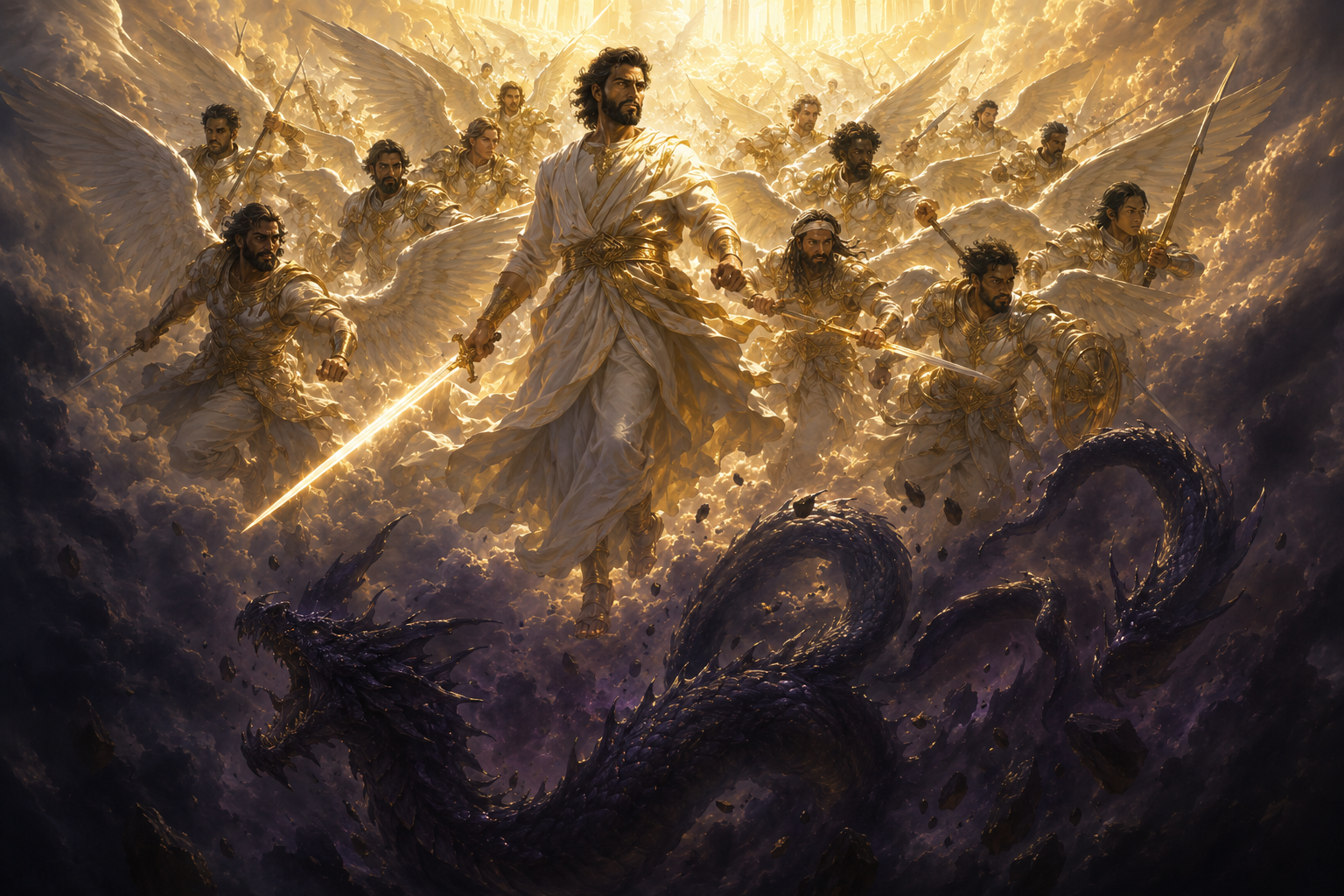
And there was war in heaven: Michael and his angels fought against the dragon; and the dragon fought and his angels, and prevailed not… And the great dragon was cast out, that old serpent, called the Devil, and Satan, which deceiveth the whole world: he was cast out into the earth, and his angels were cast out with him.
War in heaven. The words are startling, because we imagine heaven as the one place where conflict could never begin. Yet that is exactly where it began — and Scripture tells us with whom. Two prophets, sent to rebuke the proud kings of Babylon and Tyre, reach past the human rulers to describe the spirit working behind them, in language no earthly king could ever fit.
How art thou fallen from heaven, O Lucifer, son of the morning!… For thou hast said in thine heart, I will ascend into heaven, I will exalt my throne above the stars of God… I will be like the most High.
Thou wast perfect in thy ways from the day that thou wast created, till iniquity was found in thee… Thine heart was lifted up because of thy beauty.
Here is the origin of evil, and it is sobering: it did not come from a monster. It came from the most exalted and beautiful of God’s created beings — “the anointed cherub that covereth” (Ezekiel 28:14), a being Scripture calls Lucifer, “son of the morning.” He was perfect — until iniquity wasfound in him. Note what Scripture does and does not say. It does not say God made him evil. It says perfection turned, by his own choice, into self-exaltation. Five times he says I will, and the last is the heart of it: I will be like the most High. Not content to serve the throne, he coveted it. The covering cherub wanted worship.
And he was not alone. The dragon’s tail “drew the third part of the stars of heaven” (Revelation 12:4) — a symbol of the angels he swept into his rebellion. The leader of that resistance is named: Michael, “and his angels” — a title Scripture gives to the Son of God Himself (see the study linked below). So the two figures of the whole controversy stand revealed at the outset: the Son of God on one side, and a fallen cherub on the other.
What the war is really about
Here most people misread the story. They picture a contest of raw power — as if Satan thought he could out-muscle the Almighty. But a created being cannot out-muscle his Creator, and Lucifer knew it. The war was never about power. It was about God’s character and government — and that is a battle power cannot win.
The charge Lucifer raised was a slander. He insinuated that God’s law was arbitrary and His rule self-serving; that the Creator demanded an obedience He would not render Himself; that the creatures could be happier — freer — out from under His authority. In short, that God is not love but a tyrant, and His law a cage. It was the first lie, and it was aimed at the one thing that holds all loyal creation together:trust in the goodness of God.
You cannot answer a slander like that with a thunderbolt. If God had simply struck Lucifer down, the watching creation would have served Him afterward — but out of fear, not love, and the whispered charge would have seemed confirmed: so He is a tyrant after all.A government of love can only be vindicated by a demonstration of love. The accusation had to be allowed to unfold, in full view, until every creature could see for itself what rebellion really produces — and what God’s character really is.
Why God did not simply destroy him
This is the question that unlocks the rest. If God is all-powerful, and sin is so terrible, why has He let it run for so long? Why not end it the moment it began?
Because God is not the only one watching. Scripture lets us glimpse a creation full of loyal, intelligent beings — “the morning stars sang together, and all the sons of God shouted for joy” (Job 38:7) — onlooking worlds and unfallen hosts who had never seen evil and could not yet understand what Lucifer’s claims would actually come to. For their sake, and for the security of the whole created order forever after, the experiment of rebellion had to be allowed to bear its fruit in the open. Sin had to be seen for what it is. Only then could it be put away forever and never rise again — not because it was crushed, but because it was understood and freely rejected by all.
So God, in patience, gave the lie room to prove itself. The theater He chose for the demonstration was a newly created world.
The war comes to earth
When God made the earth and placed our first parents in it, He gave them everything and withheld only one thing — a single tree — as the one simple expression of their trust. Into that garden the same fallen cherub came, now “that old serpent” (Revelation 12:9), and he brought the very same charge he had raised in heaven, only now aimed at a man and a woman.
And the serpent said unto the woman, Ye shall not surely die: For God doth know that in the day ye eat thereof, then your eyes shall be opened, and ye shall be as gods, knowing good and evil.
Read it closely — it is the rebellion in miniature. God is holding out on you. His word is not trustworthy. You can be your own god.It is the identical slander against God’s character and the identical bid for self-exaltation, now offered to humanity. And our first parents believed it. They transferred their trust from the Creator to His accuser — and in that moment the human race enlisted on the wrong side of the war. Sin entered, and death with it (Romans 5:12). The earth became occupied territory; Satan could even call himself “the prince of this world” (John 12:31).
It was the darkest hour of the controversy. But God had already prepared His answer — and He gave it on the spot, in the hearing of the serpent himself.
The promise of a Deliverer
And I will put enmity between thee and the woman, and between thy seed and her seed; it shall bruise thy head, and thou shalt bruise his heel.
This single verse is the gospel in seed form — the first promise of a Saviour, spoken before the first family ever left Eden. God Himself would put enmity between the two sides, so that fallen humanity would not simply be swallowed by the enemy. And out of the human family would come a Seed— one particular Descendant — who would take a wound to the heel but deliver a death-blow to the head of the serpent. The whole rest of the Bible is the unfolding of that promise: the long line of the woman’s seed, the sacrificial lambs that pointed forward to a coming substitute, the prophets who described Him centuries in advance, and at last His arrival.
From Eden onward the human family runs in two streams — those who keep faith with God and those who side with His accuser. Cain and Abel, Seth’s line and the world before the flood, Babel and Abraham, Israel and the nations. The controversy is no longer only in heaven; it now runs through every generation, every family, and at last every heart. And occasionally Scripture pulls back the curtain to let us see the unseen side of it directly.
A window into the war: Job
Now there was a day when the sons of God came to present themselves before the LORD, and Satan came also among them. And the LORD said unto Satan, Whence comest thou? Then Satan answered the LORD, and said, From going to and fro in the earth.
The book of Job is one of the clearest windows in all Scripture into the great controversy. It opens not on earth but in a heavenly assembly, where Satan appears as the accuser — exactly the role Revelation gives him: “the accuser of our brethren… which accused them before our God day and night” (Revelation 12:10). He charges that Job serves God only because it pays — that no one truly loves God for God’s own sake. It is the old slander again: God cannot command love, only purchase compliance. The suffering of one faithful man becomes the arena in which the lie is publicly answered, before the watching worlds, by a human being who trusts God even when everything is stripped away.
Job shows us that our trials are rarely only about us. Behind the visible struggle stands an unseen one, and the faith of an ordinary believer can speak to the whole controversy. As Paul put it plainly:
For we wrestle not against flesh and blood, but against principalities, against powers, against the rulers of the darkness of this world, against spiritual wickedness in high places.
The decisive battle: the cross
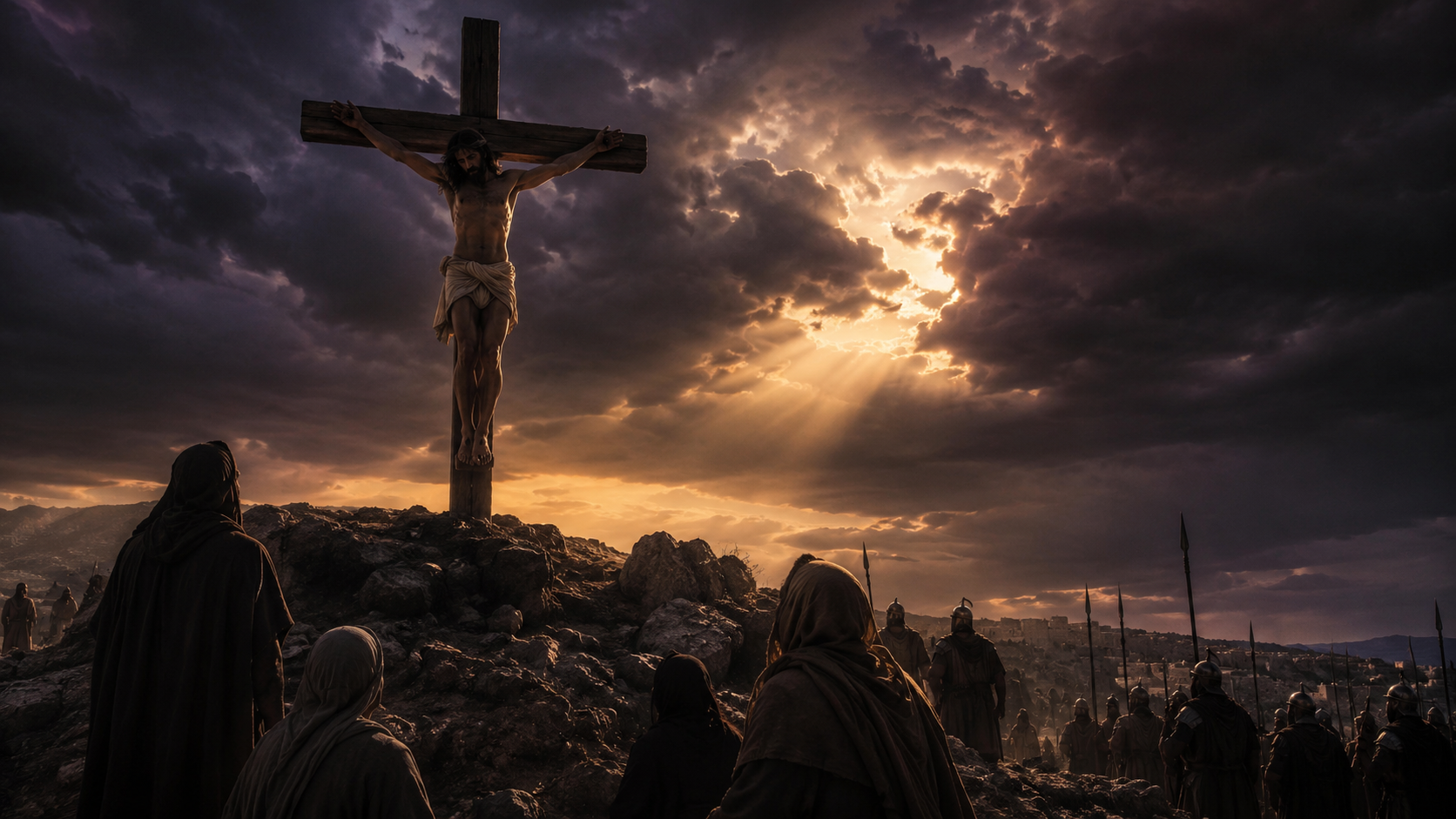
When the fullness of time had come, the promised Seed arrived. The Son of God laid aside His glory, was born into the human family, and lived the one life the controversy had been waiting for — a man who, under every assault the enemy could bring, never once distrusted or disobeyed His Father. Where Adam fell, the second Adam stood. And then He went to a cross.
The cross is the turning point of the entire war, and it won the controversy on the very ground the controversy was fought: not power, but character. There, two characters were unveiled at once for all creation to see. Satan’s was exposed in full: the accuser who claimed to love the worlds murdered the sinless Son of God — his true nature, hatred dressed as righteousness, stood naked at last. And God’s was revealed in full: a love that would rather die than lose His creatures, a Ruler who gives His own life for rebels. The lie that God is a self-serving tyrant could never survive the sight of Calvary.
Now is the judgment of this world: now shall the prince of this world be cast out. And I, if I be lifted up from the earth, will draw all men unto me.
At the cross the verdict of the whole controversy was effectively rendered. Scripture says the Son of God came “that through death he might destroy him that had the power of death, that is, the devil” (Hebrews 2:14), and that He “spoiled principalities and powers… triumphing over them in it” (Colossians 2:15). Satan was a defeated foe from the moment Christ cried, “It is finished.” This is how the redeemed in every age have overcome him:
And they overcame him by the blood of the Lamb, and by the word of their testimony; and they loved not their lives unto the death.
The conflict now
If the war is already won, why does it still rage? Because a defeated enemy is not yet a destroyed one. Satan knows his verdict is fixed and his time is short, and so his fury has turned on everyone who belongs to the winning side. John saw it precisely:
And the dragon was wroth with the woman, and went to make war with the remnant of her seed, which keep the commandments of God, and have the testimony of Jesus Christ.
That is the age we live in. The same accuser who slandered God in heaven, deceived Eve in Eden, and accused Job before the throne now “as a roaring lion, walketh about, seeking whom he may devour” (1 Peter 5:8). His weapons are the ones he has always used: deception, accusation, and the offer of self-exaltation in the place of trust in God. Every human being lives inside this conflict and is, knowingly or not, taking a side. There is no neutral ground in a war over the loyalty of the heart.
How it ends
The Bible does not leave the outcome in doubt. The Saviour who won the decisive battle will return to execute the verdict. The dead in Christ will rise, the redeemed of all ages will be gathered, and the long rebellion will at last be brought to a full and final end. Sin, and the one who began it, will be no more (Revelation 20). And when it is over, the controversy will close the way it had to close — not with a tyrant crushing his critics, but with a vindicated God whose entire creation freely confesses that He was right all along:
Great and marvellous are thy works, Lord God Almighty; just and true are thy ways, thou King of saints.
Every question raised in heaven will have been answered in full view of all. The watching worlds will have seen what rebellion produces and what God’s love endured to save them. And on that settled foundation, evil will never rise again — “affliction shall not rise up the second time” (Nahum 1:9). The curse is lifted, the earth is made new, and the long ache of the controversy is wiped from every face:
And God shall wipe away all tears from their eyes; and there shall be no more death, neither sorrow, nor crying, neither shall there be any more pain: for the former things are passed away.
Why this is the key to everything
Once you see the great controversy, you cannot un-see it. It is the thread that ties the whole Bible together — why a good God allows evil, why the law matters, why the cross was necessary, what the prophecies of Daniel and Revelation are tracking, and why history is moving toward a climax rather than in circles. It explains your own life, too: the pull toward distrust and self-rule you feel is not random, and neither is the call to trust and follow God.
For this is the heart of the whole matter — you are not a spectator. You live inside this story, and the one decision it asks of every person is the same one Eve faced and Job faced and all creation is watching still: will you believe the accuser’s old whisper that God cannot be trusted — or will you take your stand with the Lamb who already won? The outcome of the war is certain. The only thing still open is which side you are on. And the invitation, to anyone who will hear it, is to come over to the side that wins.
Go deeper
This study has stayed deliberately within the Bible, because the great controversy is the Bible’s own story and is best learned first from the text itself. For readers who want a full, book-length tracing of the same theme across the whole sweep of history — from the fall of Lucifer to the new earth — Ellen G. White’s The Great Controversy (and its companion volume Patriarchs and Prophets) remains the classic extended treatment. Read it the way it was meant to be read: with the open Bible beside it.