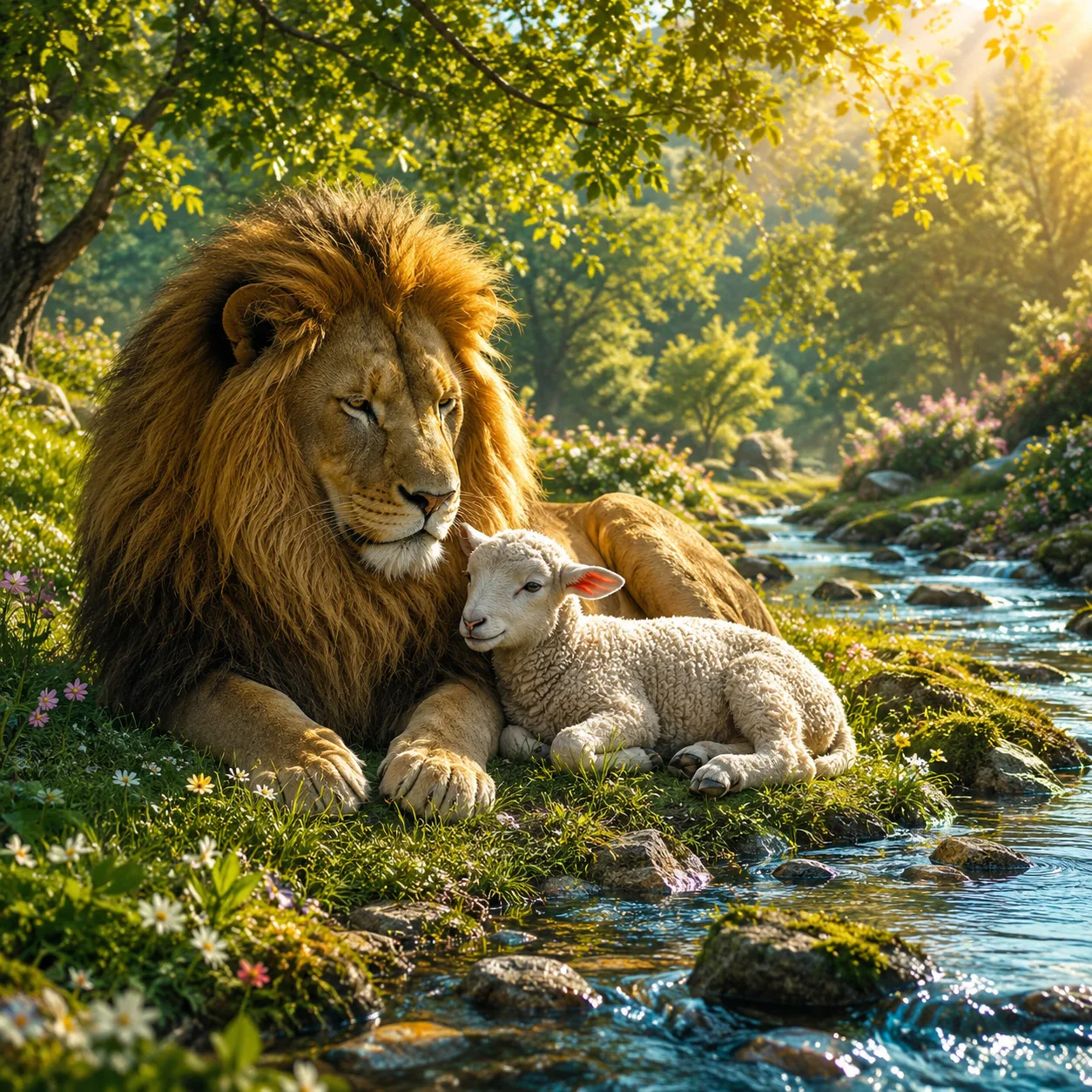
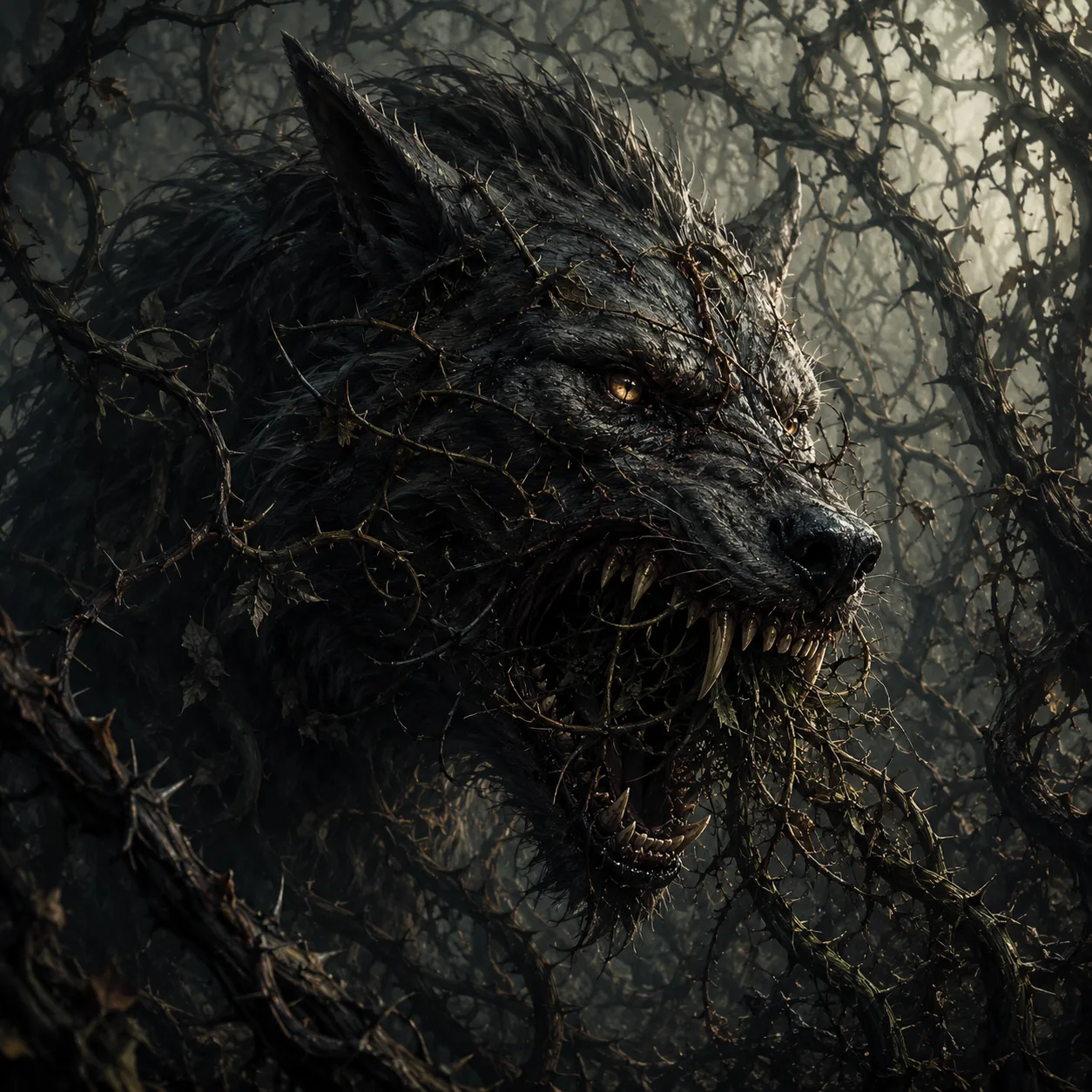
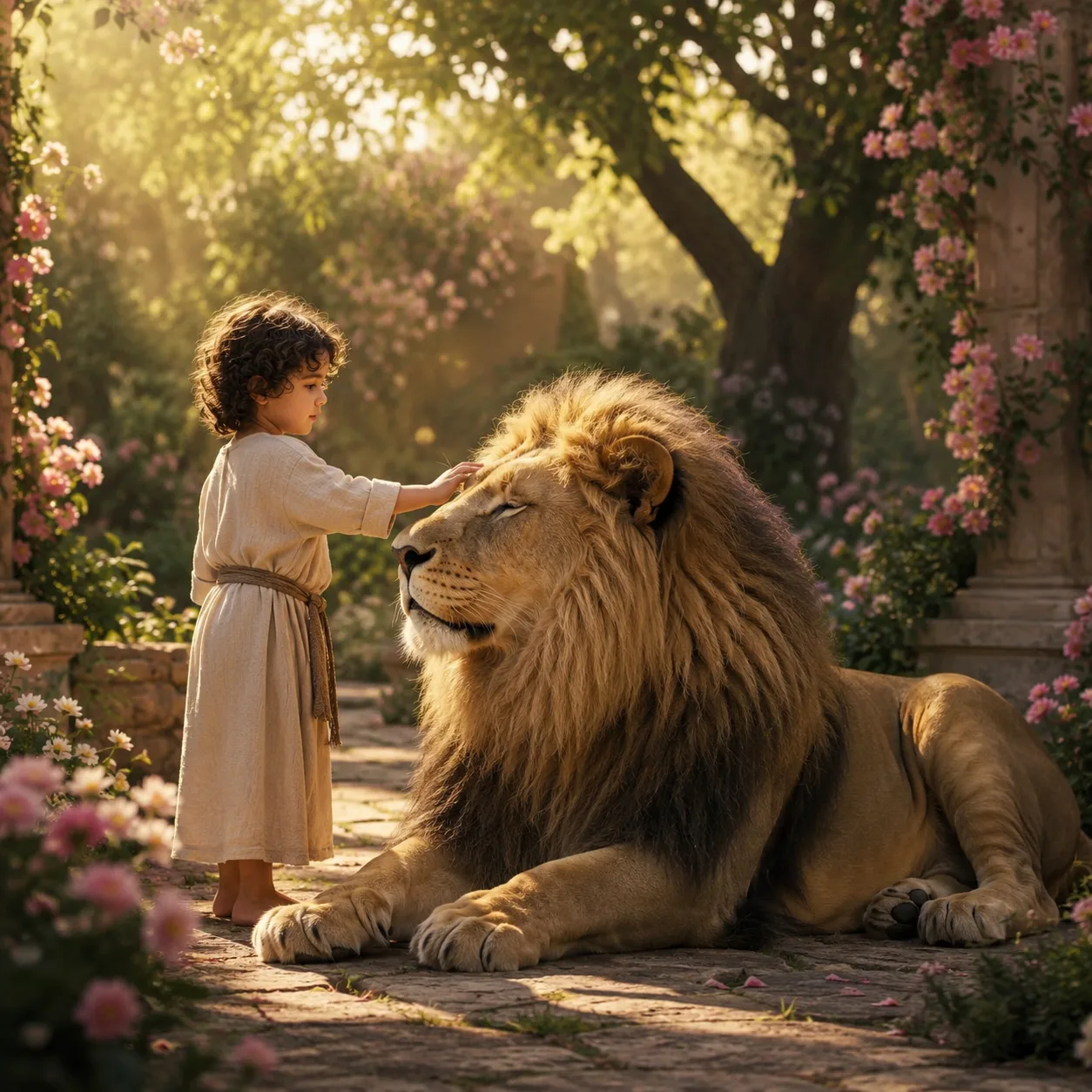
The strongest objection an honest atheist makes against the Christian God is the objection from the cruelty of nature. Charles Darwin himself wrote that he could not reconcile the universe of parasitic wasps and cat-and-mouse torment with a loving Creator. The objection is serious. It also depends on the assumption that the world we see is the world God made. The Bible says it is not. The world we see is the world after the fall — a creation subjected to vanity, groaning and travailing in pain until its appointed deliverance. The cruelty in it was added with sin and will be removed with sin. The wolf will yet dwell with the lamb.
The natural world as we observe it is, in many of its features, beautiful beyond description. The colours of a coral reef, the singing of dawn birds, the architecture of a snowflake, the intricacy of a leaf, the affection between a parent animal and its young — all of these are evidence enough for a reasonable observer that whatever mind designed nature loved beauty, loved order, and loved life. But the same natural world contains the cheetah at the throat of the gazelle, the ichneumon wasp laying its eggs in a living caterpillar, the cancer cell in the marrow of a child. The Christian apologist who pretends the second list is not there is no apologist. The atheist who cites it has identified a real difficulty. The article that follows is the institute’s answer to that real difficulty.
The argument runs in ten movements. Part I lets Darwin state his objection in his own words. Part II shows that the Bible itself anticipates the difficulty and gives the structural answer: the world we see is not the world God made. Part III walks the principal evidence that the carnivory observed in the modern animal kingdom is adaptation, not original design. Part IV looks at the vestigial features — snakes with leg bones, lizards with rudimentary limbs — that hint at the unfallen original. Part V treats the curse on the ground and the plant kingdom: thorns and thistles as modifications of pre-existing structures. Part VI catalogues the way the predatory toolkit of the modern animal kingdom — stings, fangs, venoms — turns out, on inspection, to consist of modifications of structures with originally non-predatory functions. Part VII does the same for parasites. Part VIII traces the broader pattern of devolution rather than evolution — a creation winding down, not winding up. Part IX brings in Romans 8: the whole creation groans, waiting for its appointed deliverance. Part X sets out the Bible’s own answer in its eschatological form: Isaiah’s wolf with the lamb, the new earth wherein dwelleth righteousness.
Part I — Darwin’s objection
The letter to Asa Gray
Charles Darwin was not a militant atheist. He had trained for the Anglican ministry at Cambridge. He understood the structure of the design argument and felt its force. What turned him away from theism, by his own repeated testimony, was not the geological evidence or the variation of finches but the apparent cruelty of nature.
In a letter dated 22 May 1860 to his friend the American botanist Asa Gray — a sincere Christian whom Darwin respected — Darwin wrote:
I had no intention to write atheistically. But I own that I cannot see, as plainly as others do, and as I should wish to do, evidence of design and beneficence on all sides of us. There seems to me too much misery in the world. I cannot persuade myself that a beneficent and omnipotent God would have designedly created the Ichneumonidae with the express intention of their feeding within the living bodies of Caterpillars, or that a cat should play with mice.
The ichneumon wasps Darwin names are real and the picture is accurate. The wasps lay their eggs inside living caterpillars; the larvae hatch and consume the caterpillar from within, eating non-essential organs first so that the host stays alive (and the meat stays fresh) until the very end. There is no obvious way to describe this arrangement as the design of a kind Creator. The cat playing with the half-dying mouse before killing it is the same difficulty in domestic miniature.
The objection in its serious form
The objection is not a sentimentalism. It is the precise form the problem of evil takes when the evil in question is not the doings of free moral agents but the apparent structure of biological design itself. If the wasp was designed by a good God to do what it does, then either the God did not understand what He was doing, or He intended the suffering for some end that is not merely tolerated but built in. Neither alternative sits comfortably with the goodness Christianity ascribes to God.
The Christian apologist owes a serious answer, not a dismissal. The bulk of this article is that answer.
Part II — “Very good” — what the original creation actually was
The verdict on the sixth day
The Bible itself anticipates the objection by being extraordinarily explicit about what the original creation was like before sin entered the world. The key verses come at the end of the creation week:
And God saw every thing that he had made, and, behold, it was very good. And the evening and the morning were the sixth day.
The Hebrew adjective rendered good here (tov) appears in Genesis 1 seven times. The first six instances describe individual components of the creation as “good” (tov). The seventh, capping the sequence, intensifies the description: tov me’od — very good, exceedingly good, the best God Himself can call a finished work. There is no ichneumon wasp consuming a caterpillar in tov me’od. There is no cancer in tov me’od. There is no predator at the throat of any prey in tov me’od. Whatever the world looked like on the seventh-day evening of creation week, it was not the world Darwin found irreconcilable with a good Creator.
The original diet, by direct command
The Bible is unusually specific about the original diet of both man and beast:
And God said, Behold, I have given you every herb bearing seed, which is upon the face of all the earth, and every tree, in the which is the fruit of a tree yielding seed; to you it shall be for meat. And to every beast of the earth, and to every fowl of the air, and to every thing that creepeth upon the earth, wherein there is life, I have given every green herb for meat: and it was so.
The diet given to man at creation was plant matter — seeds, grains, fruits, nuts. The diet given to every other animal — every beast of the earth, every bird, every creeping thing — was also plant matter: the green herb. The verse does not allow exceptions. Carnivory does not appear in the original arrangement. The lion in Genesis 1 ate green herb, not gazelle. The wolf ate green herb, not lamb. The shark, the eagle, the wasp, and the cat all ate green herb. The arrangement Darwin found impossible to reconcile with a good God is not the arrangement Genesis describes.
Death entered later, and by a known mechanism
The Bible is equally specific about when and how the present arrangement came in. Death is not a feature of the original creation. It is the wage of sin:
Wherefore, as by one man sin entered into the world, and death by sin; and so death passed upon all men, for that all have sinned.
And unto Adam he said, Because thou hast hearkened unto the voice of thy wife, and hast eaten of the tree, of which I commanded thee, saying, Thou shalt not eat of it: cursed is the ground for thy sake; in sorrow shalt thou eat of it all the days of thy life; Thorns also and thistles shall it bring forth to thee; and thou shalt eat the herb of the field.
The fall introduces three things into the creation that were not in it before: death, the curse on the ground, and thorns and thistles. The whole subsequent biological history of the earth — predation, parasitism, carnivory, disease, the wasp-and-caterpillar arrangement Darwin objected to — runs after this point in the narrative, not before it. Whatever explains the carnivory and cruelty observable today, the Bible’s answer is structural: that is not how it was when God finished His work.
Part III — Carnivory: adapted, not designed
The textbook argument from dentition
The standard counter to the biblical reading is the argument from dentition. Look at a lion’s teeth, the counter runs — the long canines, the bone-shearing carnassials, the powerful jaw musculature. This animal could not possibly have been designed for any diet other than meat. Carnivory must be original.
The argument has a single decisive weakness: dentition tells you very little about what an animal actually eats. Across the modern animal kingdom, a substantial body of species classified as carnivores by their teeth turn out, on dietary observation, to eat overwhelmingly plant matter. And the reverse: animals with "herbivore" dentition can, under environmental pressure, become functional carnivores. The same teeth in different environments produce different diets. The diet is not fixed by the equipment.
| Animal | Equipment / classification | Actual diet |
|---|---|---|
| Brown bear | Classified as a carnivore. Equipped with formidable canines and claws. | Actual diet, in the wild, is approximately 80% plant matter — berries, roots, nuts, grasses, salmon during the brief annual run. The classification by dentition over-reports the meat content of the bear's actual diet by a factor of about five. |
| Giant panda | Classified as a member of the order Carnivora. Possesses carnivore dentition. | Diet is essentially 100% bamboo. The carnivore "equipment" is used to crush dense plant material. The panda demonstrates conclusively that carnivore dentition does not require carnivory in practice. |
| Red panda | Classified as a carnivore. Dentition consistent with the classification. | Diet is approximately 95% bamboo. The remaining 5% is fruit, eggs, occasional small animals. Like the giant panda, a "carnivore" whose actual diet is overwhelmingly plant matter. |
| Galápagos marine iguana | Reptile with formidable claws and what looks like aggressive equipment. | Diet is exclusively marine algae. The lizard spends much of its day grazing on underwater seaweed beds. Equipment that would look in the fossil record like the toolkit of a predator is in fact a toolkit for clinging to wave-washed rocks while feeding on plants. |
| Kea parrot (New Zealand) | Possesses a powerful curved beak capable of crushing nuts and tearing flesh. Native diet historically consisted of roots, fruits, and insects from native forest. | When European settlers cleared the kea's native forest in the 19th century, the parrots lost their root food source. Some individuals learned to use the same beak to attack live sheep on the cleared pastures, tearing through the back to feed on the kidney fat. When trees were replanted in the 20th century, the keas largely returned to their original plant diet. A single bird, equipped with a single beak, did either depending on what its environment supplied. |
| Pacu (Amazon) | Closely related to the piranha. Possesses formidable jaws and teeth visually similar to the piranha's. | Diet consists almost entirely of fruits and nuts that fall from trees overhanging the river. The same dentition that in the piranha is used to attack flesh is used in the pacu to crack seeds. The dentition is dual-use; the diet is determined by what the environment supplies. |
The kea parrot — a single bird, two diets
The case of the New Zealand kea deserves a second look. For most of its history, the kea was an alpine parrot that ate roots, fruits, and insects extracted from the native forest. Its powerful curved beak was the tool it used to dig roots, crack hard fruits, and break up rotting wood looking for grubs.
When European settlers arrived in the nineteenth century, they cleared large tracts of native forest for sheep grazing. The kea’s traditional food disappeared. Some keas began landing on the backs of live sheep and using the same beak to tear through the wool and skin to reach the kidney fat beneath. The behaviour spread. Farmers organised culls. The kea population collapsed.
In the twentieth century, conservation efforts replanted native forest in significant areas of the South Island. As the forest returned, so did the kea’s traditional food, and the predatory behaviour largely subsided. The same beak, the same bird, in the same body, did fundamentally different things depending on what the environment supplied. The dentition (or beak structure) determined what the bird could do; the environment determined what the bird in fact did.
The example generalises. A modern lion has the equipment for predation. In the conditions that obtained after the fall, with vegetation no longer supplying the abundant nutrition the original creation supplied, the lion uses its equipment for predation. There is no contradiction in supposing that the same equipment, on the unfallen earth, performed the function it still performs in the modern panda and the kea before the forest was cut: the processing of tough plant material. The teeth do not determine the diet. The environment does.
Part IV — Vestigial witnesses to the unfallen original
“Upon thy belly shalt thou go”
The Bible gives one specific anatomical change associated with the fall, in the curse on the serpent:
And the LORD God said unto the serpent, Because thou hast done this, thou art cursed above all cattle, and above every beast of the field; upon thy belly shalt thou go, and dust shalt thou eat all the days of thy life.
The curse implies a prior state in which the serpent did not go upon its belly. The grammar requires it — an imposed punishment can only impose a condition that was not already present. Whatever the serpent had been before the fall — whether legged, winged, or otherwise locomoting in a manner that did not require dragging the ventral surface across the ground — the curse changed that. The serpent we know today is the cursed form.
The vestigial limbs of modern snakes
The modern anatomical record is consistent with this biblical account in a specific and pointed way. Several extant snake species retain vestigial limbs: remnants of a pelvic girdle and rudimentary hind-limb bones embedded in the body wall, having no current locomotor function and serving no obvious modern purpose, but plainly present on dissection.
The boa constrictors and pythons are the textbook examples. Both retain a recognisable pelvic girdle and a pair of small bony spurs adjacent to the cloaca on either side — the remnants of what would, in a four-legged ancestor, have been the hind legs. The spurs are visible on the surface in some individuals. In males they are used in courtship; otherwise they perform no locomotor function. The pelvic girdle is too small to attach to a working hip joint and is too far from the spine to articulate with anything.
The mainstream evolutionary reading is that snakes descended from four-legged ancestors and lost the legs progressively over evolutionary time. The biblical reading is structurally simpler. The serpent originally had legs (or analogous locomotor structures). At the curse, the genetic program for the legs was switched off or progressively suppressed. The vestigial pelvis and spurs are exactly what we would expect to find if the biblical account is correct: the genetic memory of the original anatomical equipment, visible in the modern form but no longer expressed.
The same pattern in lizards
The same pattern recurs across other modern reptiles. The slow worm of Europe is a legless lizard that retains, on dissection, vestigial pelvic and pectoral girdles. Several burrowing skink species in Africa and Australia have so-called “rudimentary” legs — tiny limbs of one or two non-functional toes — which are not used for locomotion. The Cape dwarf burrowing lizard is a frequently cited case. In each case, the anatomical record shows what the curse on the serpent gives us as theological foreshadowing: the biological capacity for one anatomical configuration present in the genome, but suppressed in the modern form.
The deeper point is that the suppression of an existing genetic capacity is structurally different from evolutionary innovation. Switching off a gene that already exists is not the building of a new function; it is the silencing of an old one. The biblical account predicts exactly this kind of post-fall genetic record. The companion article on Mutation and the Limits of Chance treats the loss-of-function pattern in detail.
Part V — Thorns and thistles: the curse on the plant kingdom
The curse specified
And unto Adam he said, Because thou hast hearkened unto the voice of thy wife, and hast eaten of the tree, of which I commanded thee, saying, Thou shalt not eat of it: cursed is the ground for thy sake… Thorns also and thistles shall it bring forth to thee.
The text is precise. Two specific botanical features are named as appearing after the curse and as not having been present before: thorns and thistles. The garden Adam tended in Eden contained neither. The cursed ground he would now till would contain both.
What thorns and thistles actually are, structurally
A thorn, on close botanical inspection, is not a new organ. It is a modified stem — a branch whose development was diverted from producing leaves and flowers and instead produced a hardened, pointed, woody spike. The stem-derived thorn is what you find on roses, on the thorn-tree acacia, and on many of the wild legumes. Spines — the related but distinct structures on cacti, holly leaves, and gorse — are modified leaves. Their developmental origin is the leaf-producing meristem, redirected toward defence and water conservation rather than photosynthesis. Thistles, strictly so called, are the spiny modification of flower bracts — the protective leaves that surround the flower head are extended into rigid pointed structures.
The deeper observation is that none of these defensive structures involves a new gene or a new biochemical capacity. They are redirections of existing developmental programs — stem becomes thorn, leaf becomes spine, bract becomes thistle — in a direction that protects the plant in a hostile environment. The genetic capacity was always there; the redirection of the capacity is what the curse on the ground biologically consists of.
This is what one would expect if the Genesis account is accurate. The original plant kingdom contained the full genetic capacity for what would, after the curse, be expressed in defensive form. In the unfallen environment the capacity was not needed and was not expressed. In the fallen environment, where plants must compete for limited resources against herbivory and against each other, the existing capacity is redirected.
Part VI — Stings, fangs, and the modification of existing structures
The same pattern across the predatory toolkit
The exact pattern observed in the plant kingdom — old structures redirected to new defensive or offensive functions, with no new genetic capacity introduced — recurs across the animal kingdom. The predatory toolkit of the modern animal world consists, on inspection, almost entirely of repurposed structures whose original functions are recognisable.
| Modern structure | Original function | Post-fall function |
|---|---|---|
| Snake fangs | Originally simple teeth used for grasping prey or vegetation. | After the fall: hollow injection devices delivering venom (which is itself modified saliva — see next row). The fang is a tooth redirected, not a new organ. |
| Snake venom | Originally salivary enzymes for predigestion of food. | After the fall: salivary enzymes concentrated and modified into proteins that disrupt the prey's nervous system or blood clotting. The biochemistry is recognisably digestive in origin. |
| Bee and wasp stings | Originally ovipositors — egg-laying tubes used by female insects to deposit eggs in plant matter or soft substrates. | After the fall: ovipositors of bees and many wasps converted into defensive injection devices. Only female bees can sting because only females have the original ovipositor. |
| Spider fangs | Originally chelicerae for handling prey or vegetation. | After the fall: hollow fangs injecting digestive enzymes — the spider liquefies its prey externally and then drinks. The enzymes are again recognisably digestive. |
| Mosquito proboscis | Originally a piercing tube for accessing plant nectar and other plant fluids — the function it still performs in male mosquitoes today. | After the fall: in females specifically, the proboscis is used to access vertebrate blood as a protein source for egg production. The structure is identical; only the female targets blood, and only at certain stages of her reproductive cycle. |
| Thorns and thistles | Modified stems (thorns), modified leaves (spines), or modified petals (thistles). All built from existing plant structures. | After the curse: redirected toward defence and survival in a degraded environment. No new genetic capacity was introduced — existing developmental programmes were redirected. |
The point is structural and important. None of these features is a new invention of the post-fall environment. Each is the redirection of an existing capacity. The snake’s fangs are teeth. The wasp’s sting is an ovipositor. The mosquito’s blood-feeding proboscis is a nectar-feeding proboscis used for a different liquid source. The thorn is a stem. The thistle is a bract.
What this tells us is that the genetic capacity for the predatory toolkit was present in the original creation, in benign form, doing the work of a peaceful and abundant biological order. The fall did not introduce the underlying capacity. The fall redirected the underlying capacity toward functions that the new, competitive, scarce, fallen environment required. The capacity is the same. The environment is what changed.
Part VII — Parasites are former free-living organisms
The diagnostic feature of a parasite
A parasite, biologically defined, is an organism that lives in or on another organism (the host), draws its nutrition from the host, and in the process generally causes the host some degree of harm. The standard textbook examples — tapeworms, blood flukes, parasitic wasps, parasitic barnacles — are all organisms whose entire life history is structured around this dependence on a host.
The diagnostic feature of a parasite, however, when examined under the microscope, is almost always that it has lost structures or capacities that its free-living relatives still possess. The tapeworm has no digestive system — the head, body, and reproductive segments are all present, but the gut is absent. Why? Because the tapeworm lives inside the digestive system of its host. The host’s already-digested food bathes the tapeworm continuously. The tapeworm needs no gut of its own, and over generations of redundancy the gut has been lost. The free-living flatworms to which tapeworms are most closely related have functional digestive systems. The tapeworm has lost what its relatives still have.
The Sacculina parasite barnacle
The most striking example of this loss-of-function pattern in parasitism is the genus Sacculina— a parasitic barnacle that infects crabs. The larva of Sacculina resembles an ordinary barnacle larva and behaves identically. On finding a crab host, however, the larva injects itself into the crab’s tissue, sheds essentially every recognisable barnacle feature — the shell, the body segmentation, the jointed appendages, the filtering apparatus — and becomes, in effect, a soft mass of branching tissue permeating the crab’s body cavity. The adult Sacculina has no shell, no limbs, no gut, no recognisable barnacle features whatever. What it has is a single sac that emerges through the crab’s abdomen and produces eggs.
Sacculina is not a barnacle that evolved into a new parasite phylum. It is a barnacle that lost almost all its barnacle features because, inside the crab, none of them were needed. The parasitism is, biologically, a loss-of-function pattern superimposed on an originally free-living organism.
The general principle
The general principle, then, is that parasites are almost universally former free-living organisms that, in the post-fall environment of scarcity and competition, found themselves able to survive better inside or on another organism than independently. Over generations the capacities they no longer needed for independent life were lost. The result is the modern parasite: a stripped-down former free-liver. The original creation did not include parasites as designed structures. The fall introduced the conditions of scarcity and competition under which parasitism became a viable strategy. The biological adaptation followed.
The pattern is consistent across the parasite kingdom. Lice are degenerate forms of free-living booklice. Fleas are wingless modifications of free-living winged insects. Internal parasites of every phylum show comparable loss-of-function patterns. The Darwinian assumption that God designed the ichneumon wasp specifically to consume living caterpillars is not the Bible’s assumption. The Bible’s assumption is that the ichneumon wasp’s ancestors lived on plant matter and had no occasion to parasitise anyone, and that the modern arrangement is one more piece of biological evidence for what the fall did to creation.
Part VIII — The broader pattern: devolution, not evolution
The age of giants is in the past, not the future
The companion article on the Fossil Record documents in detail the mammalian record from the Pleistocene to the present: the giant mammoths, the giant sloths, the giant beavers, the giant kangaroos, the dire wolves, the sabre-toothed cats, the Irish elk with its nearly-four-metre antler span. Every order of mammals had its giants in the geologically recent past. Every order has lost them. The modern mammalian fauna is the diminished remnant of an earlier and more impressive one.
The same pattern recurs across the rest of biology. The dinosaurs of the Mesozoic are larger than any modern reptile by orders of magnitude. The dragonflies of the Carboniferous had wingspans of seventy centimetres — ten times the size of the largest modern dragonfly. The early mammalian crocodiles — the so-called “super-crocs” of the Cretaceous — reached fifteen metres in length. The trees of the Carboniferous coal forests were forty metres tall in species that today survive only as ground-level lycopodiums. The pattern is consistent: the past was bigger.
What this looks like under the biblical reading
Under the standard evolutionary reading, the giants of the past are an embarrassment that has to be accommodated rather than predicted. Why should the early stages of an upward evolutionary process produce organisms of greater size and impressiveness than the modern descendants? Why should the trajectory be consistently downward?
Under the biblical reading, the pattern is exactly what one would expect. The original creation was unfallen and unconstrained, with an atmosphere thicker and oxygen content higher than today, an environment uniformly warm and abundant, and a genome at full creative capacity. The post-flood world is a degraded environment in which the original genetic capacity for giantism, while still present in residual form, is no longer adequately supported. Populations have bottlenecked, lost diversity, gone extinct. The modern fauna is the surviving fragment of a much larger original. The pattern, in a word, is devolution.
The fossil graveyards as a single event
The companion article on the Flood treats the geological evidence for the single catastrophic flood event that buried the Pleistocene fauna in the sedimentary deposits we now mine. The Karoo Supergroup of southern Africa alone, by standard estimates, preserves the remains of approximately eight hundred billion vertebrate animals. The cumulative evidence is overwhelming for a single global extinction-level event, not a slow accumulation of unrelated local catastrophes. The biblical account names the event and gives the year-and-seventeen-days timing (Gen 7–8). The post-flood world is the world the surviving organisms had to adapt to.
Part IX — The whole creation groaneth
For I reckon that the sufferings of this present time are not worthy to be compared with the glory which shall be revealed in us. For the earnest expectation of the creature waiteth for the manifestation of the sons of God. For the creature was made subject to vanity, not willingly, but by reason of him who hath subjected the same in hope, Because the creature itself also shall be delivered from the bondage of corruption into the glorious liberty of the children of God. For we know that the whole creation groaneth and travaileth in pain together until now. And not only they, but ourselves also, which have the firstfruits of the Spirit, even we ourselves groan within ourselves, waiting for the adoption, to wit, the redemption of our body.
Paul puts the situation in three precise terms. The creation was made subject to vanity — that is, to futility, frustration, and the corruption that flows from the fall. It was subjected not willingly — it did not earn the condition or consent to it. It was subjected in hope — the subjection is not permanent. The deliverance is coming.
Three substantial implications follow from this single passage, each of which goes directly to Darwin’s objection.
First: the cruelty observable in nature today is not the state in which God made the world. The creation is described as having been made subject to its present condition — a condition imposed, not original. The verbs in the Greek are clear about this. The world we see is not the world God made.
Second: the cruelty is experienced by the creation itself as suffering — a groaning, a travailing in pain. Paul does not pretend the suffering is illusory or that the design is benign in its present form. He acknowledges it is bad. He acknowledges that the creation itself groans under it. The Christian account does not minimise the difficulty Darwin named. It names the same difficulty in stronger language.
Third: the subjection is not permanent. The creation will be delivered. The glory which shall be revealed in the children of God will include the deliverance of the creature itself from the bondage of corruption. The wasp will not always do what it does to the caterpillar. The lion will not always do what it does to the gazelle. The deliverance is the eschatological promise.
Part X — The restoration: Isaiah’s wolf and the lamb
The prophetic picture, set out in seven verses
Isaiah, writing in the eighth century BC, gives the fullest Old Testament picture of what the deliverance of the creature will look like:
| Reference | What is promised |
|---|---|
| Isaiah 11:6 | "The wolf also shall dwell with the lamb, and the leopard shall lie down with the kid; and the calf and the young lion and the fatling together; and a little child shall lead them." |
| Isaiah 11:7 | "And the cow and the bear shall feed; their young ones shall lie down together: and the lion shall eat straw like the ox." |
| Isaiah 11:8 | "And the sucking child shall play on the hole of the asp, and the weaned child shall put his hand on the cockatrice' den." |
| Isaiah 11:9 | "They shall not hurt nor destroy in all my holy mountain: for the earth shall be full of the knowledge of the LORD, as the waters cover the sea." |
| Isaiah 65:25 | "The wolf and the lamb shall feed together, and the lion shall eat straw like the bullock: and dust shall be the serpent's meat. They shall not hurt nor destroy in all my holy mountain, saith the LORD." |
| Revelation 21:4 | "And God shall wipe away all tears from their eyes; and there shall be no more death, neither sorrow, nor crying, neither shall there be any more pain: for the former things are passed away." |
| Revelation 22:3 | "And there shall be no more curse: but the throne of God and of the Lamb shall be in it; and his servants shall serve him." |
The prophetic picture is unmistakable. Carnivory ends. The wolf eats with the lamb, not the lamb. The lion eats straw — the same green herb Adam was assigned at creation — like the ox. The cobra and the cockatrice are safe for a small child to handle. The serpent, against whom the curse of Genesis 3:14 was pronounced, has its diet specified: dust shall be the serpent’s meat. The poison is gone. The curse, which began with thorns and thistles, is lifted: there shall be no more curse (Rev 22:3).
The restoration is exactly the original
Compare the original creation diet of Genesis 1:29-30 with the new-earth diet of Isaiah 65:25. Both are vegetarian. Both apply to all creatures uniformly. Both take their place in a creation where there is no predation, no parasitism, no death, no curse.
The match is not accidental. The story Scripture tells is one continuous arc: a perfect creation made “very good,” subjected to vanity by the fall, groaning through the millennia of post-fall biological adaptation (in which predation, parasitism, and carnivory emerged as survival strategies in a degraded environment), and at length delivered into a new earth in which the original conditions are not merely restored but eternally confirmed. The intermediate biology — the world we observe and that Darwin objected to — is the middle of the story, not its beginning or its end.
The final tableau
And I heard a great voice out of heaven saying, Behold, the tabernacle of God is with men, and he will dwell with them, and they shall be his people, and God himself shall be with them, and be their God. And God shall wipe away all tears from their eyes; and there shall be no more death, neither sorrow, nor crying, neither shall there be any more pain: for the former things are passed away.
And there shall be no more curse: but the throne of God and of the Lamb shall be in it; and his servants shall serve him.
The final tableau of Scripture is exactly the Genesis tableau, expanded and made eternal. The Lord dwells with His people. The curse is gone. Death is gone. The wasp and the caterpillar are reconciled. The lion lies down with the lamb. The character of God Darwin found impossible to deduce from the creation as he observed it is the character of God the redeemed will see when the creation has been restored.
Closing — the answer to Darwin’s objection
Darwin’s objection was honest and serious. The cruelty observable in nature is real, and the Christian apologist who pretends it is not is no apologist. The Bible’s answer to the objection is not a denial of the data. It is a different account of how the data came to be.
The world we see is not the world God made. The world we see is the world after the fall — a world in which the original genetic capacity has been redirected toward predation, parasitism, defence, and survival in a degraded environment; a world in which death entered with sin and remains until the deliverance; a world that groans and travails in pain until now, awaiting the manifestation of the sons of God. The wasp consuming the caterpillar is not God’s original design. It is a marker of the fall, and Scripture acknowledges it as such.
The world to come is the world God will make again. The biological details of that restoration are given in Isaiah and confirmed in Revelation. The wolf with the lamb. The lion eating straw. The child with the asp. The curse gone. Death gone. The tabernacle of God with men. The cruelty of the present age is not the final word. It is the middle of the story.
What is being asked of the reader, then, is to hold the present biological observation honestly and to read it against the longer biblical arc within which it sits. Darwin saw the present arrangement and concluded against the Creator. The Bible sees the same arrangement and gives the explanation, the cause, and the cure. The Creator Darwin could not find in the wasp is found in the promise that the wasp will not always do what it does. The deliverance is coming. The Lamb Who was slain will reign with His Father in a creation made new, and the former things will be passed away.
The witness of Scripture
And God said, Behold, I have given you every herb bearing seed, which is upon the face of all the earth, and every tree, in the which is the fruit of a tree yielding seed; to you it shall be for meat. And to every beast of the earth, and to every fowl of the air, and to every thing that creepeth upon the earth, wherein there is life, I have given every green herb for meat: and it was so.
And God saw every thing that he had made, and, behold, it was very good. And the evening and the morning were the sixth day.
Wherefore, as by one man sin entered into the world, and death by sin; and so death passed upon all men, for that all have sinned.
For the creature was made subject to vanity, not willingly, but by reason of him who hath subjected the same in hope, Because the creature itself also shall be delivered from the bondage of corruption into the glorious liberty of the children of God. For we know that the whole creation groaneth and travaileth in pain together until now.
The wolf also shall dwell with the lamb, and the leopard shall lie down with the kid… They shall not hurt nor destroy in all my holy mountain: for the earth shall be full of the knowledge of the LORD, as the waters cover the sea.
And there shall be no more curse: but the throne of God and of the Lamb shall be in it; and his servants shall serve him.
Further Reading
- Walter J. Veith. Genesis Conflict, Lecture 106: “Creation to Restoration.” Amazing Discoveries. The principal source on which this article rests — the vegetarian original, the adapted carnivory, the redirected biological structures, the restoration to come.
- Charles Darwin to Asa Gray. Letter of 22 May 1860, in The Correspondence of Charles Darwin, vol. 8 (Cambridge University Press, 1993), and online via the Darwin Correspondence Project. The ichneumon-wasp objection in Darwin’s own words.
- Ellen G. White. Patriarchs and Prophets, ch. 3 (“The Temptation and Fall”) and ch. 4 (“The Plan of Redemption”). The classical Adventist exposition of the fall and the resulting biological condition of creation.
- Ellen G. White. The Great Controversy, ch. 42 (“The Controversy Ended”). The restoration of all things in the new earth.
- Companion article: The Fossil Record — the geological evidence for the giants of the past, devolution, and the catastrophist account of the fossil-bearing strata.
- Companion article: Mutation and the Limits of Chance — the genetic case for loss-of-function rather than evolutionary innovation.
- Companion article: The Flood — the single global catastrophic event that buried the Pleistocene fauna.
- Companion article: The Final Events — the eschatological framework within which the new-earth promise of Isaiah and Revelation sits.
Foundational text
“The wolf also shall dwell with the lamb, and the leopard shall lie down with the kid; and the calf and the young lion and the fatling together; and a little child shall lead them.”
— Isaiah 11:6