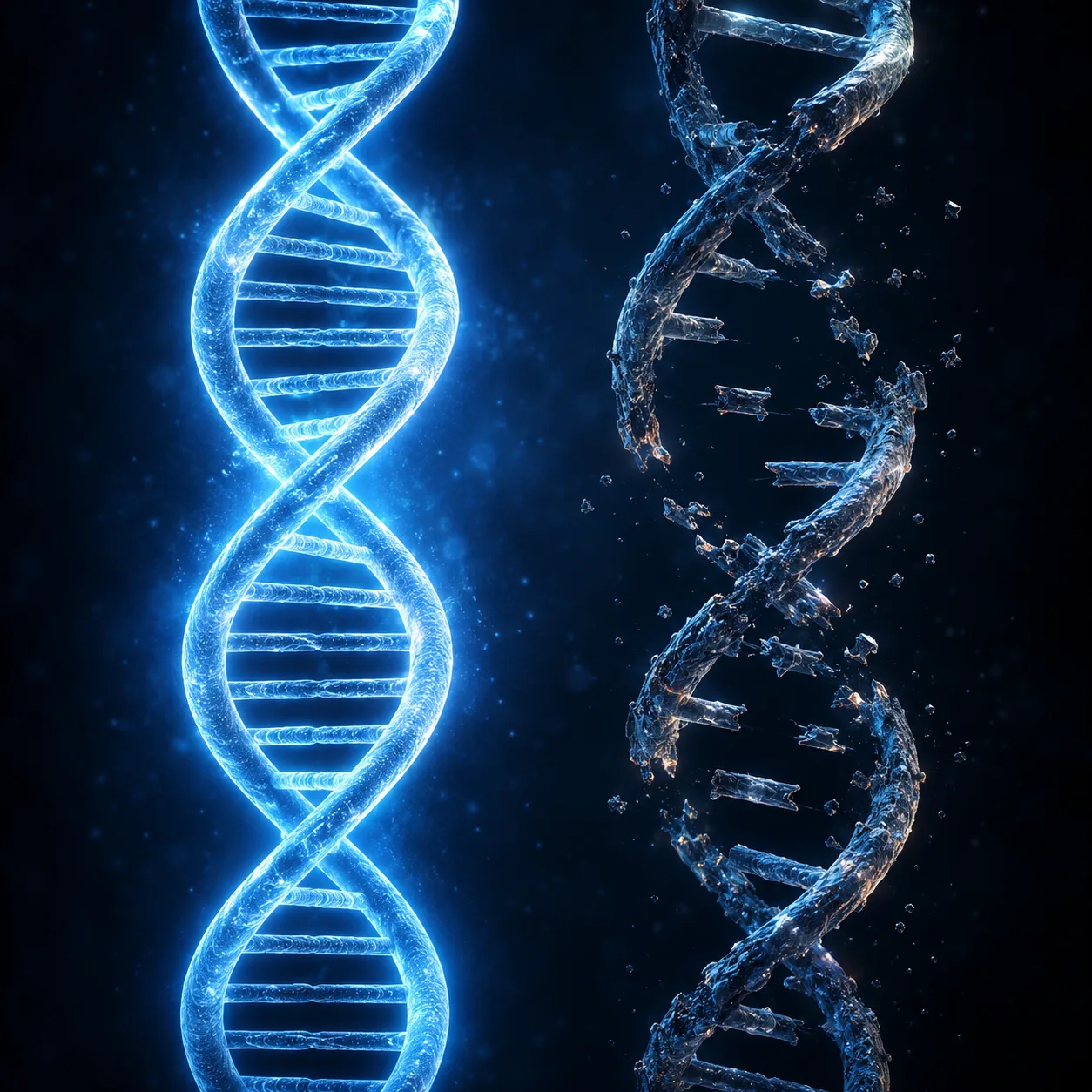

The modern evolutionary story rests on a two-part mechanism: random mutation supplies the variation, and natural selection sorts the variation into the appearance of design. The second half of the mechanism is real but limited. The first half is where the entire weight of the theory rests — and it is far weaker than the confident textbook presentation suggests. Natural selection cannot act on a gene that does not yet exist. The gene has to arise first, by chance, and so does every molecular machine that reads it. The probability resources of the entire history of the universe fall many orders of magnitude short of what the calculation requires.
The most powerful objection to the Darwinian mechanism is not, in the end, a fossil-record objection or a probabilistic objection in the abstract. It is the precise observation that natural selection — the part of the mechanism for which the empirical evidence is undisputed — can only operate on traits that are already expressed in living organisms. It cannot reach down into the DNA and tell mutation which way to go. The DNA changes by chance. The expressed organism is then tested by selection. If, and only if, the chance change happens to be functional, will selection retain it. Every genuinely new feature in the entire evolutionary history of life on earth therefore has to have arisen, in the first instance, by an unguided molecular accident in a length of DNA. The article that follows asks whether that mechanism is, on the arithmetic, equal to the job assigned to it.
The case is set out in ten movements. Part I clarifies what natural selection actually does and what it cannot do. Part II applies the resulting framework to the origin-of-life problem. Part III shows that the information stored in DNA is useless without a translation machinery that is itself DNA-encoded — a chicken-and-egg the standard story does not solve. Part IV walks the cell as the molecular factory it is. Part V examines the mutational record and finds overwhelmingly destructive change. Part VI takes up the cell-type problem: a single human body contains over two hundred specialised cell types, each requiring its own regulatory machinery. Part VII reframes the spectrum of observed biological variation as variation within kinds. Part VIII distinguishes loss-of-function from evolution. Part IX addresses sexual reproduction and the genetic implications of the Genesis account of Adam and Eve. Part X states the architect-required conclusion.
The article assumes familiarity with the deep-time question; see Genesis vs Deep Time for the cross-examination of the deep-time framework on which the time-budget for evolution depends, and the Fossil Record for the parallel case against the macroevolutionary story from the geological evidence.
Part I — What natural selection actually does
The Lamarck/Darwin distinction, sharpened
In the early nineteenth century, two competing accounts of biological change were on offer. Lamarck proposed that organisms acquire features through use — a giraffe stretches its neck reaching for high leaves, and the slightly-longer neck is somehow transmitted to its offspring. The implicit assumption was that the organism’s experience could rewrite its heritable biology. The assumption was wrong. Acquired characters are not, in fact, transmitted to the next generation. Lamarckism failed.
Darwin proposed something different. The variation already exists in the population. Some giraffes are born with slightly longer necks; some with slightly shorter. In an environment where leaves are higher, long-necked giraffes feed better, survive better, and reproduce more. Their long-neck trait, being heritable, becomes more common in the next generation. No organism stretches; the variation is already there. Selection sorts.
The distinction can be put into a single sentence which is load-bearing for the entire argument that follows:
Birds fly because they have wings; they do not have wings because they fly.
The wing must exist, fully formed, before selection has anything to test the flying advantage on. A partial wing — a feathered forelimb that cannot yet generate lift — offers no flying advantage and therefore receives no selective premium for becoming more wing-like. The intermediate stages between a forelimb and a functional wing are not selectively favoured. The mechanism by which the wing arose, then, cannot have been gradual selection of flying advantage. The selection acts only once the wing is there.
Genotype vs phenotype — the load-bearing distinction
The clearest way to see what natural selection can and cannot do is to set out the distinction biologists make between two levels of analysis:
Genotype: the DNA. The full set of genes the organism inherited from its parents and will pass to its offspring. The level at which the information lives. The level at which heritable change can occur.
Phenotype: the expressed organism. The body, the behaviour, the physiology. What you actually see when you look at the creature. The level at which the organism interacts with its environment.
Natural selection acts only at the level of the phenotype. It cannot reach down into the DNA. It tests whether the organism, as expressed, survives and reproduces. If it does, the underlying DNA is (statistically) carried to the next generation. If it does not, the DNA dies with the organism.
This is uncontroversial. It is also the foundation of the argument that follows. Because if selection can only test what is already expressed, then every genuinely new piece of biological information — every novel gene, every new molecular machine, every new body plan — has to arise at the genotype level before selection has anything to act on. And the only mechanism the standard theory allows at the genotype level is random mutation — the chemical accident in the copying of DNA. Selection sorts existing variation; mutation must supply the new variation; and mutation is, by definition, blind.
Darwin’s Galapagos finches — a real but bounded observation
The observation Darwin made on the Galapagos — finches on different islands with beak shapes adapted to local food sources — is real, well documented, and entirely consistent with the genotype/phenotype framework just set out. The finches arrived with genetic variation for beak size and shape. The islands selected, locally, for the beak shapes best suited to the food available. Generations of selection produced visible local adaptation.
What the observation does not support is the inference Darwin drew from it — that the same mechanism, given enough time, will turn a finch into a non-finch. Variation within the existing genetic capacity of the finch kind is uncontroversial. Generation of new genetic capacity, of the sort required to produce a hawk from a finch, requires an entirely different process: the chance arrival, at the genotype level, of new DNA sequences encoding new functional proteins. That is the process the rest of this article cross-examines.
Part II — The origin-of-life problem
Miller’s amino-acid experiment
The standard origin-of-life narrative begins with the 1953 experiment of Stanley Miller, who simulated a hypothesised early-earth atmosphere — methane, ammonia, hydrogen, water vapour — in a sealed glass apparatus, ran electrical discharges through it for a week, and recovered, at the bottom of the apparatus, a small quantity of organic compounds including several amino acids. The experiment is presented in introductory biology textbooks as evidence that the building blocks of life will arise spontaneously under early-earth conditions.
On honest inspection, the experiment proves far less than this. Three difficulties cripple its extrapolation to a serious origin-of-life scenario.
The reducing-atmosphere requirement
Miller’s apparatus required a reducing atmosphere — one with hydrogen and ammonia but no free oxygen. Free oxygen would have destroyed the organic compounds as fast as they formed. The atmospheric chemistry the experiment requires is not, by current geological consensus, the atmosphere the early earth actually had. Iron-oxide deposits in the oldest sedimentary rocks indicate substantial free oxygen in the atmosphere from the earliest periods. The Miller experiment’s atmosphere is the atmosphere the theory requires, not the atmosphere the geology indicates.
The contradictory chemistries
Even granting the reducing atmosphere, the chemistry of the early-earth scenario contradicts itself across the different building blocks life requires. Amino acids require the presence of ammonia as the source of their nitrogen-bearing amino group. Sugars (essential for DNA and RNA) require an acidic, ammonia-free environment to form and remain stable; in the presence of ammonia, sugars decompose. The two classes of essential biomolecules cannot form in the same chemical environment. The standard response — that they formed separately in different environments and were then somehow concentrated together — multiplies the improbability by introducing further unsolved transport problems.
The handedness problem
Amino acids exist in two mirror-image forms (enantiomers): left-handed and right-handed. Miller’s experiment produces both forms in equal proportions, as do all non-biological synthesis routes. All the proteins of all living organisms are built exclusively from the left-handed form. A protein containing even one right-handed amino acid at any position folds incorrectly and is non-functional. There is no non-biological mechanism to separate the two enantiomers selectively at scale, and no mechanism to keep them separated against the natural tendency to racemise (mix) over time.
The probability problem, made specific
Even if all three of the above difficulties were waved aside — the right atmosphere, the right chemistry, the right handedness — the assembly of a functional protein from the resulting amino acid pool is combinatorially staggering.
| Quantity | Magnitude |
|---|---|
| Atoms in the observable universe | Approximately 10⁸⁰. Particle physics estimate. Counts atoms only, not sub-atomic particles, dark matter, or radiation. |
| Probability of one functional protein arising by chance | A typical functional protein requires a specific sequence of roughly 150 amino acids selected from 20 possibilities at each position, all in the left-handed enantiomer. Conservative probability calculations (Stephen Meyer, Douglas Axe) place the chance of a single functional protein at approximately 1 in 10¹⁶⁴. |
| Probability of the minimal genome of even the simplest known free-living organism | Mycoplasma genitalium, the smallest known free-living organism, has about 525 genes and a genome of approximately 580,000 base pairs. The probability of this genome arising by chance is so vanishingly small that the number has no comparator in physical reality. |
| Time available, on the standard model, for these probabilities to be realised | Approximately 10¹⁷ seconds since the Big Bang (~13.8 billion years). |
| Verdict, on the mainstream's own arithmetic | The probability resources of the entire history of the universe fall short of what the calculation requires by tens of orders of magnitude. The result is, for all practical purposes, zero. |
The first protein had to assemble itself, by chance, from a soup of randomly oriented amino acids. A typical functional protein, on conservative calculations by Douglas Axe (Cambridge, Journal of Molecular Biology, 2004), has a probability of arising at random of approximately 1 in 1074. This is the calculation for one protein. A minimum-viable cell requires several hundred. The probability of all of them arising jointly is the product of the individual probabilities — a number so small that the entire history of the universe, even at the standard 13.8-billion-year timescale, supplies nowhere near the probability resources required.
For a fuller treatment of the time-budget question, see the companion article Genesis vs Deep Time. The point here is that even on the standard timescale, the probability arithmetic does not work.
Part III — Information without machinery is useless
The book and the factory
Suppose, for the sake of argument, that the first cell’s DNA had somehow arisen by chance. The probability is essentially zero, but suppose it. What follows is a strand of nucleotides, sitting in a primeval pool, encoding (in its base sequence) the information required to make functional proteins. The information is real. It is also entirely inert.
DNA, by itself, does nothing. It is an instruction set, like a book. A book left on a shelf does not build the thing described in its pages. For the instructions in the book to produce the airplane, three further things are required: a reader who can read the instructions, a factory equipped with tools, and workers who can execute the steps. Without the reader, the factory, and the workers, the book is inert — however perfectly written.
The same holds for DNA. For the information encoded in the DNA to produce a working organism, the cell needs:
- A transcription machinery that can read a DNA template and produce a complementary messenger RNA (the “reader”).
- A translation machinery— the ribosome — that can read the messenger RNA and assemble proteins from amino acids (the “factory”).
- A supply chain of transfer RNAs, charged with the correct amino acids by specific enzymes, delivering raw materials to the assembly site (the “workers”).
- An energy source (ATP) powering every step.
The chicken-and-egg
Every one of these machines is itself a complex assembly of proteins. Every one of these proteins is encoded by DNA. Every one of these proteins is built by the very machinery whose construction it is required to assist.
The ribosome — the protein factory — cannot be built without the ribosome, because building any protein, including the proteins that make up the ribosome, requires a ribosome. The transcription enzyme RNA polymerase cannot transcribe its own gene because the transcription requires RNA polymerase. Every step in the DNA-to-protein pipeline presupposes, for its own existence, the prior existence of the steps that come after it.
The point applies above the level of natural selection entirely. Selection cannot act on a half-built ribosome because a half-built ribosome makes no proteins. Selection cannot act on a transcription enzyme with no DNA to transcribe. The whole system has to be present and working simultaneously, or none of it works. The system is irreducible. It cannot be assembled stepwise by selection because no step short of the whole has any selectable value.
Part IV — The cell as molecular factory
What actually happens inside a cell
The textbook diagram of the cell — nucleus, ribosomes, mitochondria, endoplasmic reticulum, Golgi apparatus — undersells the complexity by orders of magnitude. The cell is not a balloon containing organelles. It is a highly-coordinated industrial complex in which billions of molecular events per second are carried out by tens of thousands of distinct molecular machines, each itself composed of hundreds or thousands of precisely-folded atoms in precisely the right positions.
A short walk through the protein-synthesis pipeline alone will give the scale:
| Stage | What happens |
|---|---|
| DNA | The instruction set. A double-helix polymer of nucleotides that encodes, in a four-letter alphabet (A, T, G, C), the sequences of every protein the cell will ever make. The information density is on the order of two bits per base, with the human genome storing about three gigabases — roughly 750 megabytes of information. |
| Transcription | A molecular machine called RNA polymerase reads a DNA template and produces a complementary messenger RNA. The machine binds, unwinds, reads, transcribes, and releases — all with proof-reading to maintain copy fidelity. It is itself a protein, encoded by DNA, requiring transcription to exist. |
| mRNA processing | The pre-mRNA is then edited: introns are removed and exons are spliced together by a multi-protein complex called the spliceosome. Errors at this stage produce non-functional or pathological proteins. |
| Translation | The mRNA is fed into a ribosome — a two-subunit molecular machine of roughly fifty proteins and several RNA molecules — which reads it three bases at a time and assembles the corresponding protein from amino acids supplied by transfer-RNA molecules. The ribosome is itself a protein-and-RNA assembly that must already exist for any protein to be made. |
| Protein folding | The completed amino-acid chain must fold into the precise three-dimensional shape its function requires. Many proteins are folded by chaperone proteins — themselves needing to be already present. |
| Transport | The folded protein is then routed to its destination by yet another network of molecular machines (the signal-recognition particle, the endoplasmic-reticulum translocon, the Golgi apparatus, vesicle-trafficking systems). |
| Energy supply | Every step above consumes ATP. ATP is supplied by mitochondria, themselves complex organelles dependent on hundreds of proteins which must already be in place. |
And this is one pipeline. The cell also contains: the replication machinery that copies the genome before cell division (with multiple proof-reading mechanisms catching and correcting copying errors at rates approaching one in ten billion); the cell-cycle control system that decides when to divide and when to wait; the DNA-damage repair system that recognises and fixes broken strands; the immune-system molecular machinery in vertebrates; the nerve-impulse transmission machinery in neurons; the contractile machinery in muscle cells; and dozens of other fully-formed, irreducibly-complex systems.
Irreducible complexity in three specific systems
Three textbook examples make the irreducibility argument concrete:
The bacterial flagellum— the molecular outboard motor that propels many single-celled organisms through liquid — consists of approximately forty distinct protein parts, including a rotor, a stator, a drive shaft, a universal joint, and a propeller. Remove any one of the forty parts and the motor does not work. There is no half-built configuration that confers any selective advantage; the partial assembly has no function. The whole thing must be present or none of it is.
The blood-clotting cascade— the sequence of events by which a small cut stops bleeding without the entire bloodstream gelling — involves a chain of about a dozen enzymes that activate each other in sequence. Each enzyme exists in an inactive form (a zymogen) and must be activated by the enzyme one step upstream in the cascade. Remove any step in the chain and either the blood does not clot (hemophilia) or it clots uncontrollably (thrombosis throughout the vasculature). The cascade has no functional intermediate form.
The vertebrate eye — which Darwin himself called “in the highest possible degree” an organ that to suppose could have been formed by natural selection seemed “absurd in the highest possible degree” — is a system of lens, iris, retina, optic nerve, and visual cortex working in coordinated balance. The intermediate stage between no eye and a functioning eye is not a half-eye that gives a small selective advantage; it is a non-functional protrusion. The insect compound eye, which uses an entirely different architecture of thousands of independently-aimed ommatidia, presents the same problem in its own way: it requires the coordinated existence of the lenses, the photoreceptors, and the neural integration system simultaneously. The design is, in fact, so well-engineered that NASA studied the insect compound eye as a model for the mirror array in some of its space-based telescope concepts.
Part V — Mutations don’t build; they break
The fragility of the code
The genetic code reads in three-letter words (codons). A string of bases like AGT-GCT-CAT-AGC encodes four specific amino acids in a specific order. Delete a single base anywhere upstream, and every codon downstream of the deletion is read in a different frame. The original AGT-GCT-CAT-AGC becomes GTG-CTC-ATA-GC…— an entirely different protein, almost certainly non-functional. A single-base point mutation can change one amino acid; a single-base deletion can corrupt every amino acid in the protein downstream of the deletion. The code is not robust to errors. The code is exquisitely fragile.
This is what mutation looks like at the molecular level. The bulk of mutations are either neutral (changing a base in a way that does not change the resulting amino acid, owing to the redundancy of the codon table) or harmful (changing the protein in a way that makes it function worse or not at all). The fraction of mutations that are genuinely beneficial — that introduce a new, useful biochemical function not present before — is vanishingly small, and the standard examples cited as “beneficial” turn out, on inspection, to be loss-of-function changes that confer survival advantage in narrow specific environments.
Sickle-cell anemia, the textbook example
The most-cited example of a “beneficial mutation” is the sickle-cell hemoglobin mutation, which confers partial resistance to malaria. The bargain is not as good as the textbook presentation suggests. A person homozygous for the sickle-cell allele has sickle-cell anemia — a chronic, painful, life-shortening disease in which the red blood cells deform under oxygen-stress and clog small blood vessels. A person heterozygous for the allele has milder anemia and some malaria resistance. In a malaria-endemic environment, the heterozygous arrangement confers a net survival advantage. The “beneficial” mutation, viewed honestly, is a damaging mutation whose damage happens to fall short of what malaria does. It is not a new functional protein. It is a broken protein whose breakage is, in one specific environment, less bad than the alternative.
The same structural pattern holds for the other commonly cited “beneficial” mutations: bacterial antibiotic resistance (usually loss of function in the target receptor), lactase persistence in adult humans (loss of the developmental switch that normally turns off lactase production after weaning), the Italian apoA-1 Milano cholesterol variant (a structural protein change with mixed effects). Each is a real example of a mutation producing a survival advantage in a particular context. None of them is an example of mutation building a new functional protein with a new functional capacity.
The cumulative record
The cumulative experimental record of mutation in the laboratory is extensive. Decades of mutagenesis experiments on fruit flies, bacteria, and other model organisms have produced millions of mutations of every type. They have produced flies with extra eyes in odd places, flies with legs growing where antennae should be, bacteria resistant to one antibiotic at the cost of resistance to another, plants with sterile flowers, and countless other phenotypes — all of them modifications, suppressions, or deformations of pre-existing genetic structures. They have not produced a single genuinely new molecular machine. They have not produced a single new functional protein with a new functional capacity. The mechanism of mutation, as experimentally observed, is overwhelmingly a mechanism of breakage. It is asked to be the engine of construction by a theory whose alternative explanation is unwelcome.
Part VI — The cell-type problem
One genome, many cell types
A single human body contains over two hundred morphologically distinct cell types — neurons, muscle cells, liver cells, skin cells, immune cells, bone cells, blood cells, retinal photoreceptors, intestinal goblet cells, and many more. Every one of these cells, in a given individual, carries the same DNA — the identical full human genome inherited from the fertilised egg. The difference between a neuron and a liver cell is not a difference of genetic content. It is a difference of which genes are switched on, in what proportions, in what context.
For an evolutionary mechanism to produce a body with this variety of cell types, several distinct genetic systems have to coexist:
- Identity genes — specifying what makes each cell type the cell type it is (the proteins, channels, receptors, and structural elements characteristic of each type).
- Switching systems— signalling networks that turn the identity genes on in some cells and off in others, in the right tissues at the right time.
- Coordination systems— gradients and signalling cascades that tell each cell where in the body it is and what its neighbours are doing.
- Developmental programs— the orchestrated sequence by which a single fertilised egg becomes, in nine months, a fully formed human being with all these cell types in their correct anatomical positions.
Each of these layers is encoded in DNA. Each of these layers is itself complex enough that it has its own regulatory architecture. The whole thing has to be present and coordinated for any of it to function. A single fertilised egg that does not know how to develop becomes a tumor, not an organism. The system is irreducibly complex at a scale much greater than the single molecular machines treated in Part IV.
Part VII — Variety within kinds, built in from the beginning
What the genome of the dog kind contains
The modern dog breeds range from the Chihuahua (~3 lb) to the Saint Bernard (~200 lb), from the dachshund’s elongated body to the bulldog’s compressed jaw, from the Afghan’s coat to the basenji’s shorthair. The morphological variation is enormous. The genetic distance, measured by whole-genome sequencing, is tiny — every dog breed shares essentially the same gene complement, with the visible differences attributable mostly to which alleles are dominant at particular loci and to differences in regulatory regions that affect when and how much certain genes are expressed.
The variation we observe today is not the result of mutation building new functional capacity. It is the result of selective breeders pulling forward different combinations of the variation already present in the ancestral dog (or wolf) kind. The Chihuahua and the Great Dane carry the same gene set in the same order; the difference is which alleles, in what regulatory context, are doing the work. The selective breeder accelerates the same process Darwin observed on the Galapagos: he sorts existing variation. He does not generate new functional information.
The Genesis answer
The Genesis account places this exactly. The Lord made the animals “after their kind” (Gen 1:21, 24, 25). The Hebrew word translated kind (min) is broader than the modern taxonomic category of species. A single biblical “kind” corresponds, roughly, to the modern category of family. The dog kind includes all the modern canids — wolves, coyotes, jackals, foxes, and domestic dogs — which can interbreed and produce fertile offspring. The cat kind includes the domestic cat and the large cats. The horse kind includes horses, zebras, and donkeys.
The Genesis frame predicts what we in fact observe: large genetic capacity within each kind, with the kind’s full variation expressible in many breeds, hybrids, and local adaptations; and clean boundaries between kinds, with no observed cases of one kind crossing into another. The dog kind never produced a non-dog. The horse kind never produced a non-horse. Variation within is enormous; variation across is not observed.
The case from the fossil record for the same conclusion is set out in detail in the companion article on the Fossil Record.
Part VIII — Loss-of-function is not evolution
Cave fish without eyes
A favourite textbook example of “evolution in action” is the cave fish — populations of fish living in lightless caves which, over generations, have lost the functional eyes their surface-dwelling relatives still possess. The textbook story presents this as confirmation of the evolutionary mechanism. On inspection, it confirms something rather different.
The cave fish has not gained anything. It has lost something. The genes that previously produced functional eyes have either been deleted, deactivated, or neutralised by mutation; in the dark environment, the loss is not selected against, so the population accumulates the loss. This is a perfectly real microevolutionary change, and it is consistent with the mutation-and-selection mechanism in its negative form — breaking what was already there. It is not evidence of the positive form of the mechanism — building something new. The cave fish did not gain a new sense to compensate for the loss of sight. It just lost sight.
Flightless birds
The same pattern recurs across biology. Flightless birds — ostriches, emus, the kiwi, several island species — are descended from flying ancestors whose wings have been progressively reduced. The loss of flight, in an environment where flight conferred no selective advantage (large flightless predators on the African plains, islands with no terrestrial predators), is consistent with neutral genetic drift. Wing-development genes have been deactivated or downregulated. No new functional capacity was added. Something was subtracted.
The asymmetry the textbook obscures
What is asked in the major transitions of the evolutionary story — fish to amphibian, reptile to mammal, ape to man — is overwhelmingly addition: new organs, new physiological systems, new molecular machinery, new behavioural repertoires. The observable changes the textbook examples document are overwhelmingly subtraction: loss of eyes, loss of flight, loss of metabolic pathways, loss of regulatory switches. The mechanism, as actually observed at work, runs in the opposite direction from the one the major transitions require.
Part IX — Sexual reproduction and the genetic implications of Adam and Eve
Why sexual reproduction is a problem for the standard theory
The standard theory has, in fact, never given a fully satisfying account of why sexual reproduction exists at all. Sexual reproduction is, in pure cost-benefit terms, enormously expensive. It halves the genetic contribution of each parent to the next generation. It requires the extraordinarily elaborate machinery of meiosis — the cell division process by which sex cells (sperm and egg) are produced with exactly half the chromosome number, with carefully orchestrated crossover events to generate genetic diversity in the resulting gametes. It requires the coordinated existence of two anatomically and physiologically distinct sexes, each with reproductive organs serving complementary functions. It requires that members of the two sexes find each other, recognise each other, and successfully copulate. It requires the timing of receptivity to align between the sexes. And all of this had to arise — on the standard theory — incrementally, by mutation acted on by selection, with every intermediate stage being viable and competitive.
The intermediate stages are not, on inspection, viable. A single mutant individual with the beginnings of a sex organ but no partner of the complementary sex with whom to mate has no reproductive output and dies childless. The selective premium on becoming sexual is zero until there is at least a pair of complementary partners simultaneously. The whole system has to be present at once or it does not function. Selection cannot supply it stepwise.
What the Bible says, and what the biology confirms
The Genesis account is precise on the origin of the two sexes:
And the LORD God caused a deep sleep to fall upon Adam, and he slept: and he took one of his ribs, and closed up the flesh instead thereof; And the rib, which the LORD God had taken from man, made he a woman, and brought her unto the man. And Adam said, This is now bone of my bones, and flesh of my flesh: she shall be called Woman, because she was taken out of Man.
The narrative says: Adam first; Eve from Adam. The biology turns out to be exactly consistent with this ordering. The two human sexes are distinguished chromosomally: a woman has two X chromosomes; a man has one X and one Y. The Y chromosome carries genes (most notably SRY, the sex-determining region) that the X chromosome does not. A man therefore carries every gene that a woman carries, plus the Y-specific genes a woman does not. A man can in principle be the genetic source for both sexes; a woman cannot. If the original pair was made one from the other, the order has to be man first, woman from man.
The Genesis account predates the discovery of the chromosomal basis of sex determination by approximately three thousand five hundred years. It happens to get the arrangement exactly right.
Part X — The architect-required conclusion
What the evidence supplies
The cell is a molecular factory of staggering complexity. The genetic code is a precise instruction set. The information in the DNA is useless without the machinery to read and execute it; the machinery is itself encoded by the DNA. The whole pipeline is irreducibly complex at every level — from the individual molecular machine, to the cellular factory, to the developmental program, to the body plan, to the coordinated body itself. The probability of the system arising spontaneously, on any honest calculation, is essentially zero. The mutational record, as actually observed, runs in the wrong direction — toward loss of function rather than toward the gain of new function the major transitions require.
What the evidence supplies, taken as a whole, is a system that bears every hallmark of having been designed by an intelligence vastly greater than any human engineer has ever brought to bear on any human design. The intelligence is not optional. The complexity is too high, the irreducibility is too tight, the integration is too precise. The system cannot have built itself, by any mechanism the standard theory has on offer.
The Bible’s witness, and the architect named
Romans 1:20 puts the situation in two lines that the serious biologist eventually has to come to terms with:
For the invisible things of him from the creation of the world are clearly seen, being understood by the things that are made, even his eternal power and Godhead; so that they are without excuse.
The architect is not anonymous. He is named in the opening verse of Scripture and in the prologue of John’s Gospel:
In the beginning was the Word, and the Word was with God, and the Word was God. The same was in the beginning with God. All things were made by him; and without him was not any thing made that was made.
The Word is the Son. The Father is the source from Whom are all things; the Son is the One by Whom all things are made (1 Cor 8:6; Col 1:16; Heb 1:2). The molecular factory of the cell, the genome that orchestrates it, the body plan it builds, and the consciousness that contemplates the whole are the work of the Son of God, acting in the Father’s will. The biological evidence does not, on its own, deliver the name of the architect. It demands an architect. The Scriptures supply the name.
Closing
The Darwinian mechanism has two parts: random mutation and natural selection. The second is real and limited. The first is the load-bearing element on which the entire theory depends — and it is the part the evidence does not support. Selection sorts; mutation has to supply. The probability arithmetic of supplying, by chance, a single functional protein vastly exceeds the probability resources of the entire history of the universe. The cellular machinery that would have to read the protein once produced is itself irreducibly complex and itself encoded by the same DNA. The mutational record runs predominantly toward loss. The pattern of variation we actually observe is variation within kinds, exactly as the Genesis account predicts.
The reader is asked to weigh the genetic and biochemical evidence honestly. The conclusion the evidence demands is not philosophically congenial to a culture committed to the exclusion of the Creator. It is, however, the conclusion the evidence demands. The intelligence the cell bears every mark of having been designed by is named in the opening verse of Scripture. The molecular factory honours its Maker.
The witness of Scripture
And God said, Let the earth bring forth grass, the herb yielding seed, and the fruit tree yielding fruit after his kind, whose seed is in itself, upon the earth: and it was so. And the earth brought forth grass, and herb yielding seed after his kind, and the tree yielding fruit, whose seed was in itself, after his kind: and God saw that it was good.
And God said, Let the earth bring forth the living creature after his kind, cattle, and creeping thing, and beast of the earth after his kind: and it was so. And God made the beast of the earth after his kind, and cattle after their kind, and every thing that creepeth upon the earth after his kind: and God saw that it was good.
I will praise thee; for I am fearfully and wonderfully made: marvellous are thy works; and that my soul knoweth right well.
For the invisible things of him from the creation of the world are clearly seen, being understood by the things that are made, even his eternal power and Godhead; so that they are without excuse.
Through faith we understand that the worlds were framed by the word of God, so that things which are seen were not made of things which do appear.
All things were made by him; and without him was not any thing made that was made.
Further Reading
- Walter J. Veith. Genesis Conflict, Lecture 105: “The Genes of Genesis.” Amazing Discoveries. The principal exposition on which this article’s framework rests — the genotype/phenotype distinction, the book-and-factory analogy, the variation-within-kinds case.
- Stephen C. Meyer. Signature in the Cell: DNA and the Evidence for Intelligent Design. HarperOne, 2009. The comprehensive case for the information-content argument in DNA, with the calculations underlying the probability figures cited in Part II.
- Douglas D. Axe. “Estimating the Prevalence of Protein Sequences Adopting Functional Enzyme Folds.” Journal of Molecular Biology 341: 1295–1315 (2004). The peer-reviewed protein-probability calculation cited in Part II.
- Michael J. Behe. Darwin’s Black Box: The Biochemical Challenge to Evolution. Free Press, 1996. The original book-length presentation of the irreducible-complexity case, with the bacterial flagellum and blood-clotting cascade as principal examples.
- John C. Sanford. Genetic Entropy & the Mystery of the Genome.FMS Publications, 2005. The argument that the mutational record, properly tabulated, is overwhelmingly degenerative and is in fact running the human genome (and others) downhill, not uphill.
- Companion article: Genesis vs Deep Time — the time-budget question on which the probability calculations in Part II depend.
- Companion article: The Fossil Record — the parallel case against macroevolution from the geological evidence (Cambrian explosion, living fossils, soft tissue, dinosaur-bird claim).
- Companion article: A Day to Be Remembered — the six literal days of creation week.
Foundational text
“I will praise thee; for I am fearfully and wonderfully made: marvellous are thy works; and that my soul knoweth right well.”
— Psalm 139:14