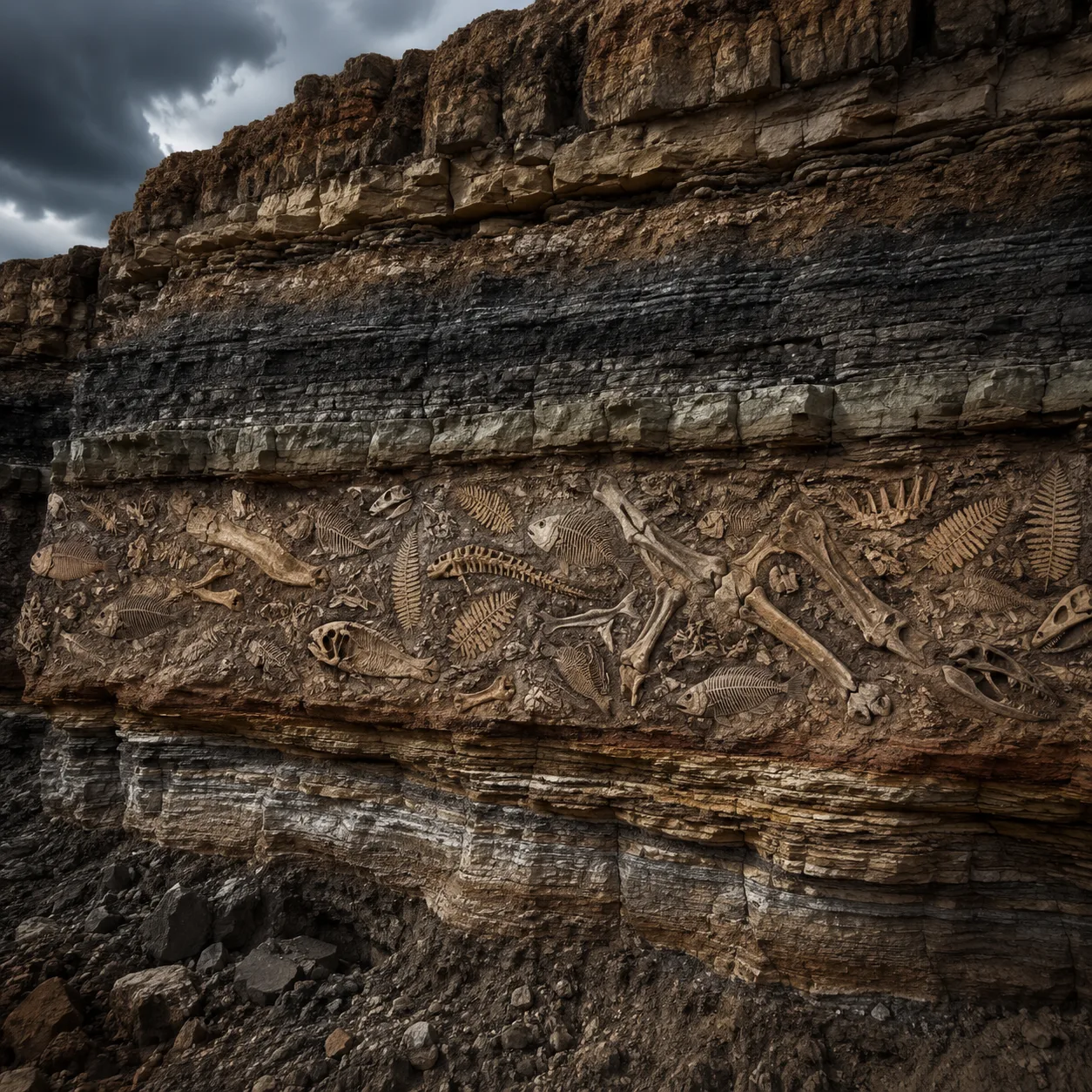


Genesis names a young earth: six days of creation, a few thousand years ago. Modern science names an old one: 13.8 billion years to the Big Bang, 4.5 billion years to the formation of the earth. The two timescales differ not by orders of magnitude but by a factor of a million. They cannot both be right. The mainstream case for deep time is presented as settled science. The closer reading shows it is far weaker than its confident presentation suggests — weaker, in fact, on the mainstream’s own data.
This article cross-examines the modern deep-time framework on its own terms. It does not attempt the deeper biblical-cosmology critique of the heliocentric model itself — that work is done in the institute’s study on the shape of the earth, to which the reader is referred for the foundational question of cosmology. The brief here is narrower: granting, for the sake of cross-examination, the framework in which mainstream cosmologists and geologists work, the deep-time story does not survive its own admissions. The Big Bang contradicts the cosmological principle on which it rests. Radiometric dating fails on the only samples on which its assumptions can be checked. The geological column has never been observed in its supposed totality at any location on the surface of the earth. The story is sold with the confidence of fact and the substance of theory.
The case is set out in three movements. Part I cross-examines Big Bang cosmology. Part II cross-examines radiometric dating. Part III cross-examines the standard geological column. A closing section sets the alternative: the biblical chronology the Lord Himself confirms in the words of Christ.
Part I — The Big Bang as story
The standard account in brief
The standard cosmological account begins with a singularity — a point of effectively infinite density and zero volume — which, somewhere between 10 and 20 billion years ago (current consensus 13.8 billion), expanded outward in an event known as the Big Bang. Expansion is inferred from the observed red shift of distant galaxies: light from far objects is shifted toward the longer wavelengths, which is interpreted as evidence that the objects are receding. From present recession rates the history is run backward to a point of origin from which all space, time, matter, and energy emerged.
Two foundational assumptions hold the account together. The first is the principle of general relativity, supplied by Einstein, providing the mathematical framework for a curved, expanding spacetime. The second is the cosmological principle: the assumption that, viewed on a sufficiently large scale, the universe is homogeneous and isotropic — matter is evenly distributed in every direction. Without these two assumptions, the standard model loses its scaffolding.
Five problems the standard account cannot dissolve
The honest reader who works through the cosmological literature finds, alongside the confident textbook presentation, a series of admitted difficulties which the standard model has not solved. Five are particularly load-bearing.
| Problem | Substance |
|---|---|
| 1. Matter and antimatter | A primordial energy event would have produced matter and antimatter in equal quantities. The two annihilate on contact, leaving pure radiation. The mainstream cosmos consists of an overwhelming preponderance of matter and no detectable antimatter at scale. The standard model has no satisfying account of the asymmetry; it is conceded as an unsolved problem. |
| 2. Angular momentum | An explosion from a central point produces linear momentum — fragments fly outward in straight lines. The observed universe exhibits overwhelmingly angular motion — planets rotate, moons orbit, stars revolve, galaxies spin. The standard rescue hypothesis is that the primordial point was itself rotating — a stipulation introduced precisely to save the model from the observation that refutes it. |
| 3. Retrograde rotation | Even granting a rotating primordial point, the rule fails in detail. Venus, Uranus, and Pluto rotate retrograde — opposite to the system. Several moons of Jupiter, Saturn, Uranus, and Neptune orbit retrograde. Some galaxies (NGC 4622 is the textbook case) rotate opposite to their own spiral arms. Each anomaly requires an independent rescue. |
| 4. Matter not uniformly distributed | The cosmological principle — the foundational assumption of the standard model — requires matter to be uniformly distributed across the universe. Observation shows the opposite: matter is concentrated in clusters, superclusters, and filaments separated by enormous voids. The pattern is the inverse of what the model predicts. |
| 5. From nothing | Alan Guth and Paul Steinhardt, writing in Scientific American (May 1984), conceded: "It is tempting to go one step further and speculate that the entire universe evolved from literally nothing." The observation is honest. It is also a statement of faith. A universe arising "from literally nothing" is not a scientific conclusion. It is a metaphysical postulate. |
Each individual problem might be set aside as a working difficulty awaiting resolution. Taken together they describe a model whose foundations — the cosmological principle most directly — are contradicted by the very observations the model exists to explain. A theory whose founding postulate is falsified by the data is, on ordinary scientific grounds, a theory in serious trouble. The confidence with which the standard model is asserted at the textbook level is not matched by the candour with which these problems are discussed at the technical level.
The origin of the elements
A further difficulty rarely surfaced for the lay reader. Even if the singularity-and-expansion story is granted, the chemistry it produces is hydrogen, a little helium, and traces of the lightest elements. The periodic table from carbon onward — the elements out of which planets, oceans, and bodies are made — does not come out of the Big Bang. It is supplied, on the standard model, by successive generations of stars: gas clouds collapse under gravity, ignite, fuse heavier elements in their cores, and die in supernova explosions which scatter the new elements into the interstellar medium, where the cycle begins again.
The mechanism is elegant on paper. It is much less elegant in practice. To collapse a primordial gas cloud into a star requires that gravity overcome the natural tendency of gas to expand — a tendency we observe whenever gas is released into an evacuated chamber. The conditions under which a diffuse cloud of hydrogen will spontaneously collapse into a fusion-igniting star without external compression are not well demonstrated. The story assumes a process which the laboratory has not been able to reproduce, and which the visible universe gives no example of in progress today.
What the standard model is, and is not
The standard cosmological model is an attempt to give an account of the visible universe without reference to a Creator. It is the philosophical commitment to that exclusion, more than any feature of the evidence, which accounts for its dominance. As the model’s own proponents have conceded, the alternative which makes the evidence intelligible is the one the model is constructed to avoid. Allan Sandage, the late dean of observational cosmology, put it bluntly: “The world is too complicated in all of its parts and interconnections to be due to chance alone. I am convinced that the existence of life with all its order in each of its organisms is simply too well put together. Each part of a living thing depends on all its other parts to function. How does each part know? How is each part specified at conception? The more one learns of biochemistry the more unbelievable it becomes unless there is some kind of organising principle — an architect.”
The text of Scripture supplies the architect:
Through faith we understand that the worlds were framed by the word of God, so that things which are seen were not made of things which do appear.
Part II — Radiometric dating
How the method works
Radiometric dating, in principle, is not difficult to understand. Certain isotopes — uranium-238, potassium-40, rubidium-87, and others — decay spontaneously into known daughter products at measured rates. The proportion of parent isotope to daughter product in a rock sample, together with the measured half-life of the decay, is then taken to indicate how long the decay has been running — that is, how long ago the rock formed. Send a sample to an accelerator mass spectrometry laboratory and the technicians can determine the parent-to-daughter ratio with very high precision.
The laboratory science is real. The instruments work. What the laboratory cannot do is supply the assumptions on which the conversion of an isotope ratio into an age depends. Those assumptions are made before the sample is sent to the lab. They cannot be verified by the lab.
Three assumptions, three vulnerabilities
| Assumption | Vulnerability |
|---|---|
| Assumption 1 — Constant decay rates | The method assumes the half-life of every isotope has been the same throughout earth's history. There is no independent way to verify this for the deep past. The decay rates we measure today are extrapolated backwards across billions of putative years without check. |
| Assumption 2 — Clock set to zero at formation | The method assumes that when a rock formed, only the parent isotope was present and none of the daughter. This is testable on rocks of known formation date. Modern volcanic ejecta from Hawaii, New Zealand, and Mt St Helens — rocks observed forming within recent decades — routinely return radiometric ages of millions to hundreds of millions of years. The clock is not set to zero at formation. The assumption fails on the only samples we can check it against. |
| Assumption 3 — Closed system | The method assumes no parent or daughter isotope has entered or left the sample over its history. Rocks are porous. Water percolates through them; many of the relevant isotopes are water-soluble. The closed-system assumption is contradicted by the basic physical chemistry of the materials being dated. |
The second of these is the most damaging. The method’s principal claim is that it can date rocks of unknown antiquity. The only way to test that claim is to apply it to rocks of known antiquity and see whether it returns the right answer. Where this test has been performed, the method has failed.
The Mt St Helens test case
On 18 May 1980, Mt St Helens in Washington State erupted in the most dramatic volcanic event in modern American history. The volcanic dome that formed in the crater after the eruption is one of the most recent geological formations on earth — new rock, observed in formation, dated by ordinary calendar.
In 1996 the geologist Steven Austin sent samples from the Mt St Helens dome to a commercial radiometric dating laboratory (Geochron Laboratories, Cambridge, Massachusetts), without identifying the rock’s actual provenance. The samples were dated by the potassium-argon method. The lab returned ages ranging from approximately 0.34 to 2.8 million years for rock known to be a decade old at the time of testing.
Comparable results have been obtained from modern lava flows in Hawaii (some dating to up to 22 million years despite formation on observed dates within the last two centuries) and from New Zealand. The pattern is consistent enough that it is not a fluke. The method routinely attributes very large ages to recent rock.
The mainstream response is that the apparent ages reflect not the time of the rock’s formation but the time of the parent material from which the magma was sourced — that “inherited argon” from the deep mantle is producing a false signal. This is reasonable as an explanation of the anomaly in modern lavas. It is also a complete admission that the method does not, in fact, measure the formation date of the rock. If “inherited argon” can produce a two-million-year false age in a rock known to be ten years old, the same mechanism can in principle produce false ages in rocks of unknown provenance — and we have no way of telling, in the older cases, which dates reflect formation and which reflect inheritance. The method’s capacity to deliver reliable formation ages in the deep past depends precisely on the ability to rule out the mechanism it cannot rule out.
The honest conclusion
Radiometric dating is not a measurement. It is an interpretation. The precision of the isotope-ratio measurement is real; the conversion of that measurement into an age is governed by three assumptions, two of which cannot be tested independently, and the third of which fails when it is tested. The ages that emerge are not scientific facts in the sense in which the boiling point of water at sea level is a scientific fact. They are derivations from premises. Change the premises and the ages change with them.
For a fuller discussion of related dating anomalies — in particular, the presence of radiocarbon in coal and diamonds conventionally dated at hundreds of millions to billions of years — see the companion article on the Flood.
Part III — The geological column
It does not exist in its supposed totality
The geological column — the layered sequence of strata from the Precambrian at the base, through the Cambrian, Ordovician, Silurian, Devonian, Carboniferous, Permian, Triassic, Jurassic, Cretaceous, Paleogene, Neogene, and Quaternary at the top — is the textbook backbone of modern geology. Every introductory textbook prints it as a diagram. The arrangement is the visual basis on which deep time is taught.
It is worth noting plainly: the column as the textbooks display it does not exist anywhere on the surface of the earth in its supposed totality. There is no location at which a geologist can walk down from the Quaternary through every intervening period to the Precambrian basement. The column is a composite. It is assembled by correlating fragments of the sequence visible at different locations across the world — here a slice of the Cretaceous overlying a slice of the Jurassic, there a slice of the Carboniferous overlying a slice of the Devonian. The full sequence is a synthesis from partial samples.
That synthesis is held together by two assumptions: that the sequence has been the same everywhere, and that the fossils contained in each layer faithfully mark its position in the sequence. The second assumption introduces the well-known circularity of dating layers by their fossils and dating fossils by their layers. The first assumption faces problems of its own.
Unconformities — the missing-time problem
Across many locations where significant sections of the column are exposed — the Grand Canyon being the most famous — geologists identify boundaries called unconformities: places where one stratum sits directly on top of another that is supposed to be tens or hundreds of millions of years older, with no record of the intervening time. In the Grand Canyon alone, the Great Unconformity at the base of the Tapeats Sandstone is claimed to represent the loss of roughly one billion years of geological history. The intervening rock is gone. The contact between the rock above and the rock below is the missing time.
Two facts about these contacts are worth pausing on. First, the contact is flat. Where a billion years of erosion is said to have removed an unknown thickness of sediment, what remains underneath the next stratum is not a chaotic erosional surface but a clean, level plane. Second, the contact shows no evidence of the weathering, paleosol development, or root-system penetration which any modern land surface accumulates within human timescales, let alone over millions of years of exposure. The supposedly long-exposed surface looks, structurally, exactly like a freshly deposited surface immediately overlain by the next mud layer.
The erosion-rate problem
There is also a quantitative problem with the deep-time reading. Measured continental erosion rates — the rate at which water and weather strip sediment from the continents and deposit it in the oceans — average something on the order of 6 cm per 1,000 years for the United States as a whole, and as much as 2 metres per 1,000 years for the Himalayas. At those rates, the entire continental crust of North America would be reduced to sea level in roughly 10 to 14 million years.
The standard model holds that the continents are billions of years old and that the present geological column on the continents has accumulated over hundreds of millions of years. If the standard model is right and the erosion rates are right, the continents should have been worn down to sea level dozens or hundreds of times over. They have not. The continents are still there, with their full elevation, their full sedimentary cover, and their unweathered unconformities. The mainstream rescue is tectonic uplift — the suggestion that the continents are continually being raised by mantle processes at rates sufficient to offset erosion. The rescue is necessary, but it does not address why so much sediment is still on the continents (rather than already washed into the ocean basins) if the standard timescales are correct.
What the column actually looks like
The deeper problem with the standard column is that the evidence on the ground does not look like what the textbook diagram says it should look like. The layers are flat. The contacts between them are flat. There are no erosional surfaces, no soil profiles, no organic decomposition zones between successive strata. There are, however, structures throughout the column — polystrate trees passing vertically through multiple supposedly time-separated layers, soft-sediment deformation features that require all the layers to have been wet at the same time, graded bedding indicating rapid deposition, marine fossils on the summits of every major continental mountain range — that fit the model of a single catastrophic depositional event far better than they fit the model of slow accumulation over hundreds of millions of years. The case for that catastrophic alternative is worked out in detail in the companion article on the Flood.
Part IV — Time as a doctrinal question
The biblical chronology
Genesis 1 narrates the creation of the heavens and the earth and all that in them is in six literal days, evening and morning, capped by a seventh-day rest. Exodus 20:11 embeds the same six-day chronology in the moral law itself: “For in six days the LORD made heaven and earth, the sea, and all that in them is, and rested the seventh day…” The Sabbath commandment stands or falls with the six-day creation it commemorates.
The genealogies of Genesis 5 and 11, taken at their plain sense, give from Adam to Abraham something on the order of two thousand years. The remainder of biblical chronology from Abraham to Christ is fixed at approximately another two thousand years by the synchronisms of the Old Testament with surrounding Near Eastern history. From Christ to the present is another two thousand years. The biblical timeline from creation to today is, on the most straightforward reading, on the order of six thousand years — not billions.
The full chronological framework on which this timeline rests is laid out in the companion article A Day to Be Remembered, which treats the literal six days and their consequences for the doctrine of the Sabbath.
The testimony of Christ
The deep-time question is not, in the end, a question that can be deferred to the geologists. It is a question on which the Lord Himself has spoken — not by extended argument, but by the simple grammar of His own statements about the beginning.
But from the beginning of the creation God made them male and female.
And he answered and said unto them, Have ye not read, that he which made them at the beginning made them male and female.
Christ’s phrase is “from the beginning of the creation”. He places the creation of the first man and the first woman at the beginning of the creation itself — not billions of years after it. The mainstream chronology places mankind’s appearance some 13.8 billion years after the beginning of the universe and 4.5 billion years after the formation of the earth. Christ’s testimony cannot be reconciled with the mainstream chronology without doing violence to His plain words.
The reader who believes Christ to be the Son of God and the appointed teacher of His people is faced, in the end, with a choice on whose authority the question of the age of the earth will be settled. The institute’s editorial position rests on the testimony of Christ. The deep-time framework rests on the assumptions reviewed in Parts I, II, and III of this article, every one of which is, on examination, far weaker than its confident presentation suggests.
Why time matters — the deep-time framework as scaffolding
It might be asked why the time question matters at all. The reader who already believes in a Creator might wonder whether the difference between six thousand years and six billion is a difference worth contending for. The answer is that the entire modern account of the origin of life and of biological diversity — the macro-evolutionary story — depends on the deep-time framework as its load-bearing scaffold. Without billions of years of available time, the small accumulated mutations and statistically rare events on which the standard evolutionary mechanism depends have nowhere to occur. Remove deep time and the entire evolutionary architecture collapses for want of duration.
This is why deep time, however abstract it might seem at first, is the contested ground. The biblical account is not principally a story about how long ago things happened. It is a story about who made them and why. But the modern rival account requires a particular answer to the time question as the precondition of the rival story it wants to tell. To establish deep time is to clear the ground for the substitution of an unguided process in the place of the Creator. To collapse deep time is to remove the scaffolding on which the substitution rests. The substitution — not the time question by itself — is what is finally at stake.
The closing question
The Big Bang is a story that contradicts the principle on which it is built. Radiometric dating is an interpretation that fails on the only samples on which its assumptions can be checked. The geological column is a composite synthesis whose flat contacts and unweathered unconformities do not match the deep-time story it is cited to support. Each of these is a substantial scholarly claim, and each is in some sense the public face of modern science. But each, on closer reading, is far less secure than its confident presentation suggests.
The reader is asked to consider whether the testimony of Christ — clear, plain, and consistent with the Hebrew Scriptures from Genesis 1 forward — is the more reliable witness on the question of when the heavens and the earth and all that in them is were made. The institute holds that He is. The deep-time framework was constructed to do without Him; its weaknesses on its own terms are part of the reason it has not, in the end, succeeded.
The witness of Scripture
In the beginning God created the heaven and the earth.
For in six days the LORD made heaven and earth, the sea, and all that in them is, and rested the seventh day: wherefore the LORD blessed the sabbath day, and hallowed it.
But from the beginning of the creation God made them male and female.
Through faith we understand that the worlds were framed by the word of God, so that things which are seen were not made of things which do appear.
For this they willingly are ignorant of, that by the word of God the heavens were of old, and the earth standing out of the water and in the water: Whereby the world that then was, being overflowed with water, perished.
For by him were all things created, that are in heaven, and that are in earth, visible and invisible, whether they be thrones, or dominions, or principalities, or powers: all things were created by him, and for him: And he is before all things, and by him all things consist.
Further Reading
- Walter J. Veith. Genesis Conflict, Lecture 101: “The Earth in Time and Space.” Amazing Discoveries. The source on which the Big Bang and dating critiques in this article principally rest.
- Steven A. Austin. Excess Argon within Mineral Concentrates from the New Dacite Lava Dome at Mount St. Helens Volcano. Creation Ex Nihilo Technical Journal 10(3): 335–343 (1996). The Mt St Helens potassium-argon dating study summarised in Part II.
- D. Russell Humphreys et al. Radioisotopes and the Age of the Earth (RATE) Project. Institute for Creation Research, 1997–2005. The radiocarbon-in-coal-and-diamonds findings referred to in the closing of Part II.
- Alan H. Guth and Paul J. Steinhardt. “The Inflationary Universe.” Scientific American, May 1984. The source of the “literally nothing” admission cited in Part I.
- Companion article: The Flood — the catastrophist account of the geological column, marine fossils on every mountain range, polystrate trees, and the radiocarbon evidence against deep dates.
- Companion article: The Shape of the Earth — the deeper biblical-cosmology critique of the heliocentric and globe-earth model from which the entire Big Bang framework descends.
- Companion article: A Day to Be Remembered — the literal six days of creation week and the chronology built on them.
Foundational text
“For in six days the LORD made heaven and earth, the sea, and all that in them is, and rested the seventh day: wherefore the LORD blessed the sabbath day, and hallowed it.”
— Exodus 20:11