

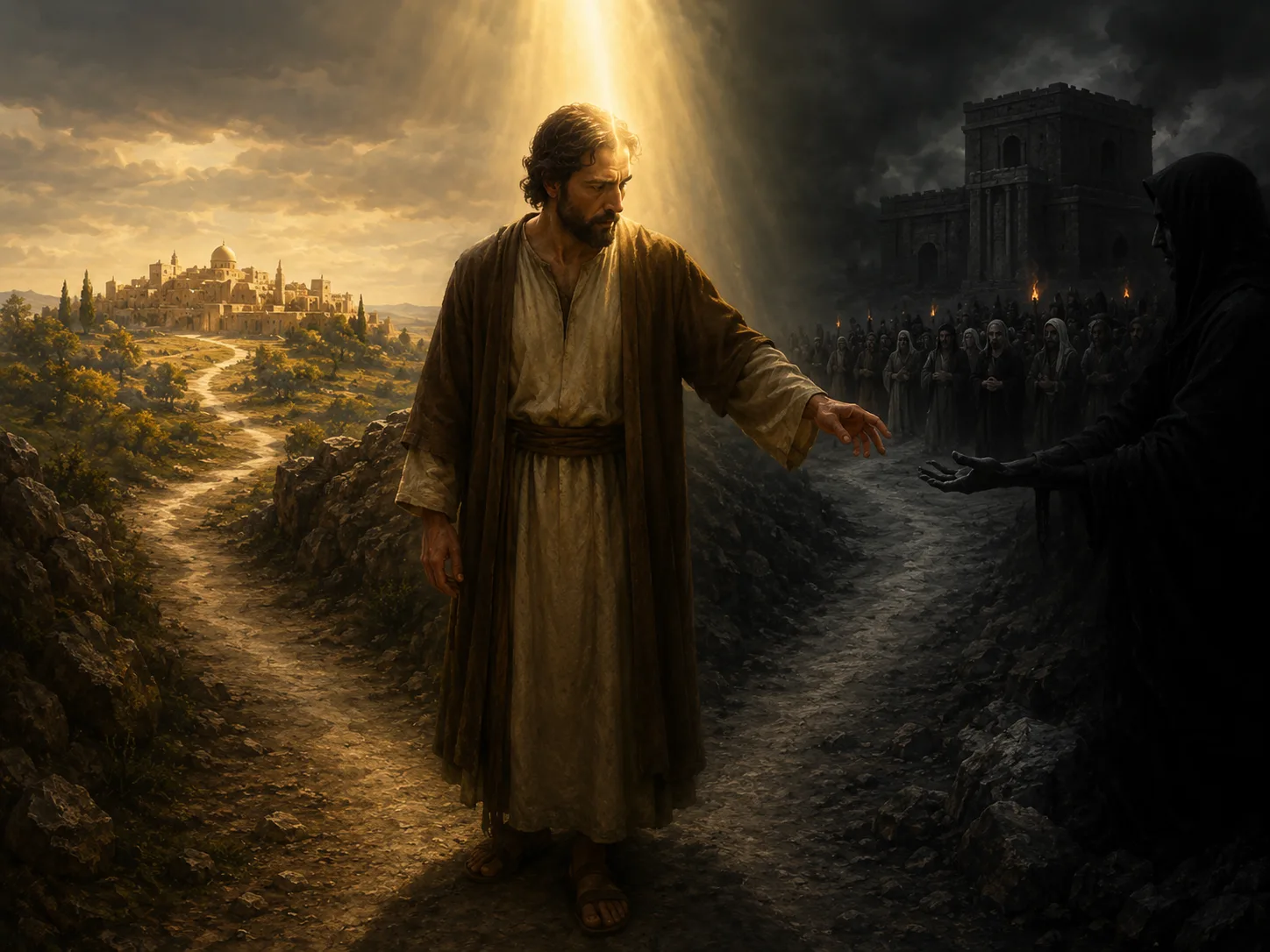
Revelation puts two opposites in the same place — the forehead, and the hand. The seal of God (Rev 7:2; 14:1) and the mark of the beast (Rev 13:16) face each other across the identical pair of locations, because they are not just two signs. They are two answers to the same question: whose servant are you, and where does your worship come to rest?
Symmetry by design
And I saw another angel ascending from the east, having the seal of the living God: and he cried with a loud voice to the four angels … saying, Hurt not the earth, neither the sea, nor the trees, till we have sealed the servants of our God in their foreheads.
And he causeth all, both small and great, rich and poor, free and bond, to receive a mark in their right hand, or in their foreheads.
The forehead is the seat of conscious belief. The hand is the place of practiced obedience. The seal claims the forehead first and the hand follows from it. The mark, by contrast, is receivable in either — a hand without a converted forehead, a forehead that has accepted the substitute even while the hand has not yet been forced to perform it. The asymmetry matters.
Not a visible mark
Before going further, one thing has to be cleared away. Neither the seal nor the mark is a literal thing the eye can see — no glowing symbol, no tattoo, no stamp on the skin. Scripture places both in the forehead, the seat of the mind, because both describe an inward allegiance, not an outward badge. The seal is a settling of the character into the truth of God, so fixed it cannot be moved; the mark is the answering settlement into the substitute. No human inspector could walk through a crowd and read who carries which.
Nevertheless the foundation of God standeth sure, having this seal, The Lord knoweth them that are his.
“The Lord knoweth them that are his” — the seal is legible to God, not to men. It is God who seals, and God who reads the sealing. The historic Adventist understanding put it plainly: the sealing is “not any seal or mark that can be seen, but a settling into the truth, both intellectually and spiritually, so they cannot be moved.” The Sabbath and Sunday become the visible outworking of an invisible allegiance only at the end, when the final crisis forces the inward settlement out into open practice. Until then, and even then, the seal itself is a matter of the heart that only God can see.
Two readings of the seal
Historicist exposition has produced two readings of what the seal actually is. Both are circulated today; they are not flatly contradictory, but they sit at different depths.
Reading 1 · Day
The Sabbath as the seal
The seal is the seventh-day Sabbath, the sign of God’s ratifying authority over the whole law (Ex 31:13–17; Ezek 20:12). To be sealed is to be settled, on the right day, on the right side of the Sabbath-versus-Sunday decision the end-time crisis will force.
Reading 2 · Identity
The Father’s name as the seal
The seal is, as Revelation 14:1 states explicitly, the Father’s name in the forehead — His identity, His character. The Sabbath is the sign of this seal, not its content. Sabbath-keeping while worshipping a substituted God produces obedience without sealing.
The deeper reading contains the surface
Three observations tilt the case toward the identity reading.
First, Revelation 14:1 is explicit. “Having his Father’s name written in their foreheads.” Whatever the seal is, its content has been named — not the Sabbath as a freestanding rule, but the Father’s name as the thing inscribed. The Sabbath comes into the picture as the sign of that name, the memorial of the Creator the first angel calls humanity to worship (Rev 14:7; Ex 20:11). The day and the name are linked — not interchangeable.
Second, Revelation 13:1 names the beast’s mark in the same register. The beast carries a name of blasphemy; he claims the worship of every nation; the mark he enforces is the visible sign of that worship. The Bible’s definition of blasphemy (John 10:33, Luke 5:21) makes the name an identity offense, not a day offense. The seal and the mark thus mirror each other at the identity level. The Sabbath/Sunday axis is the visible edge of that deeper contest.
Third, the symmetry of forehead and hand resolves only at this depth. If the contest is purely about a day, then the forehead-mark and the hand-mark collapse into the same thing. But the text keeps them distinct. The forehead can be marked without the hand; the hand can keep the right day while the forehead has already accepted the substitute. That distinction is only legible if the forehead is the seat of doctrine and the hand of practice. The day is the practice; the identity is the doctrine.
The pastoral implication
Of the two readings, the deeper one has a sharper pastoral edge. If the seal is the Sabbath, then keeping the Sabbath is the safe ground. If the seal is the Father’s name, then keeping the Sabbath while worshipping a different God produces a forehead-mark with a hand-seal — exactly the half-state the chapters describe. The danger is not first to those who keep Sunday; the danger is also to those who keep the right day with the wrong God in mind.
This is the gravest thing the chapters carry, and it is the reason the first angel’s message — worship him that made heaven, and earth, and the sea, and the fountains of waters — addresses identity before practice. Get the Father back and the Sabbath follows. Get the Sabbath without the Father and the seal does not arrive.
How the two beasts enforce both layers
Revelation 13’s sea beast carries the name (the substitute identity, Rev 13:1 and 13:5–6). Revelation 13’s earth beast enforces the mark (the visible day, Rev 13:15–17). Two beasts, two layers, one final allegiance. Chapter 14 mirrors them with the inverse: the Father’s name in the forehead (the identity, Rev 14:1) and the keeping of the commandments in the hand (the practice, Rev 14:12). The two-and-two structure is not incidental; it is how the chapter maps the contest.
Where this site lands
On this site, the seal of God is read as the Father’s name written in the forehead — the identity of the only true God (John 17:3; 1 Cor 8:6), settled in the mind, with the Sabbath as its appointed sign in the hand. The mark of the beast is read as the inverse on the same axis: a substituted identity in the forehead, with Sunday as its appointed sign when the controversy is forced into the open. Both layers matter. The text uses both.
Further reading
- Revelation 13 — the beast, the name, the mark, the number.
- Revelation 14 — the redeemed with the Father’s name, the three angels, the patience of the saints.