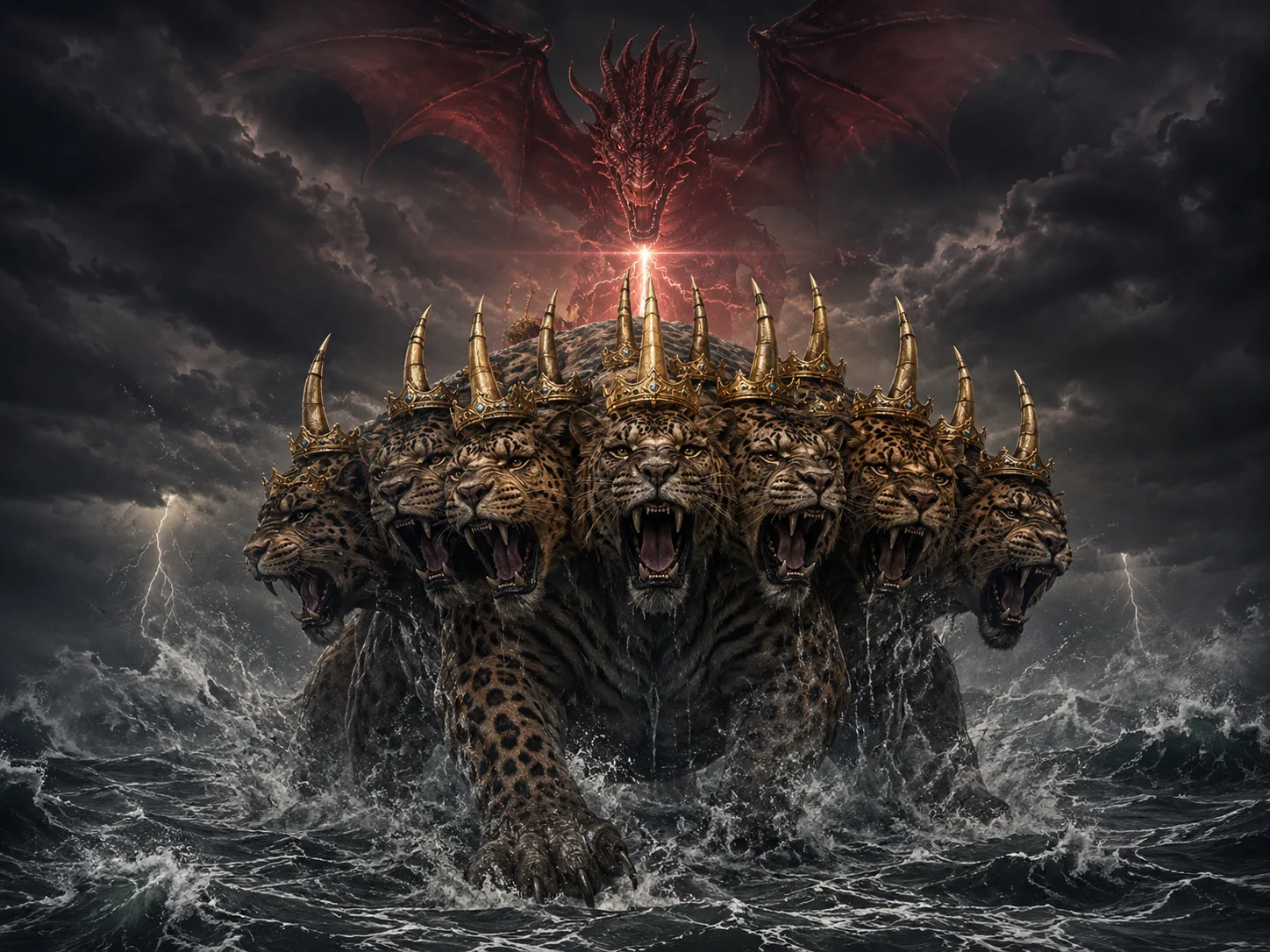

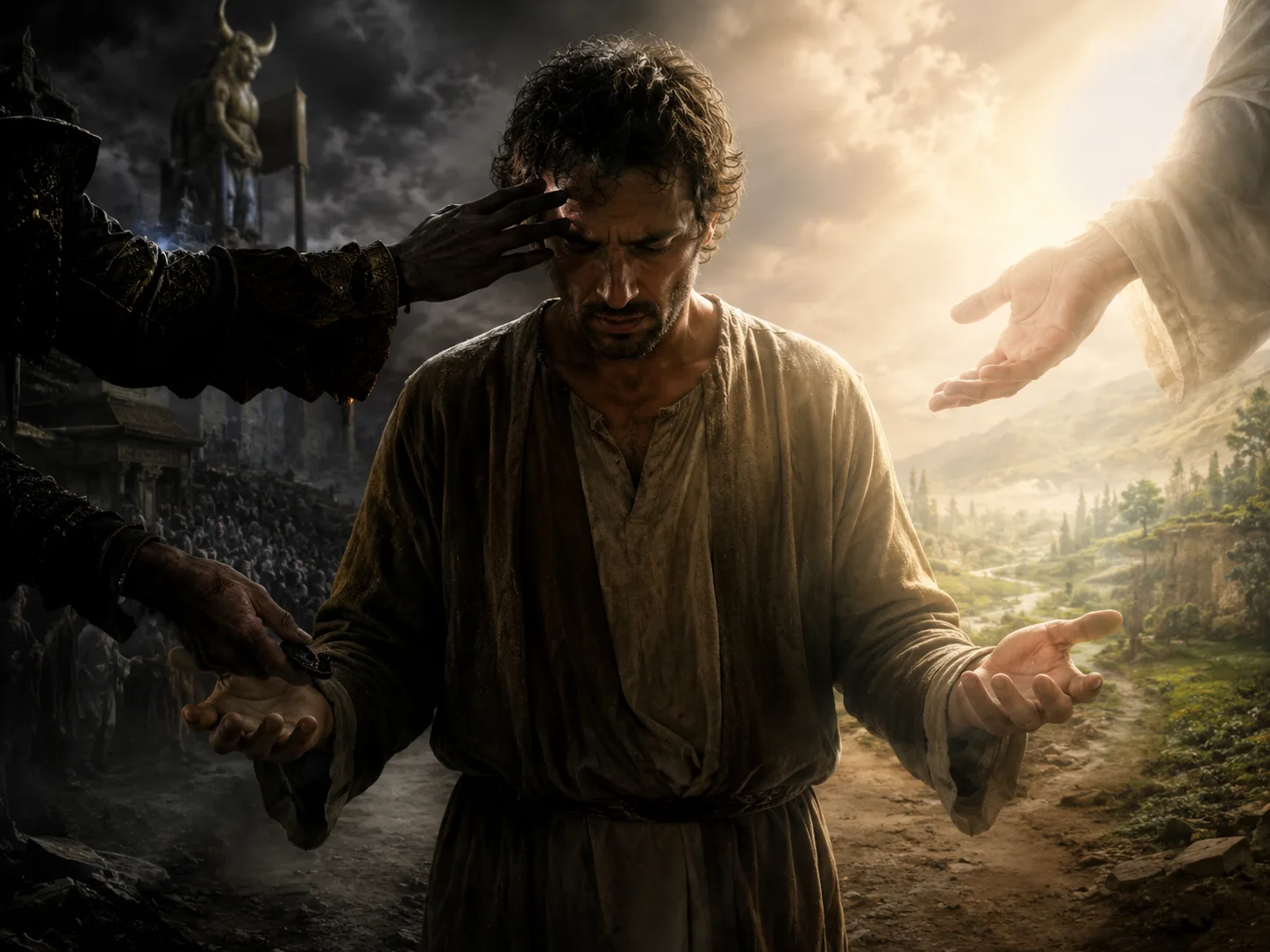
Daniel 7 ended with a little horn rising among the ten and speaking great things for a time, times, and the dividing of time. Revelation 13 picks up the same power at the end-time and gives it new symbolic flesh: a beast from the sea with seven heads and ten horns, joined by a second beast from the earth that speaks like a dragon. Together they enforce a mark, a name, and a number — three forms of one allegiance.
The sea beast — the same power, new vestments
And I stood upon the sand of the sea, and saw a beast rise up out of the sea, having seven heads and ten horns, and upon his horns ten crowns, and upon his heads the name of blasphemy. And the beast which I saw was like unto a leopard, and his feet were as the feet of a bear, and his mouth as the mouth of a lion: and the dragon gave him his power, and his seat, and his great authority.
The composite is deliberate. The leopard, bear, and lion of Daniel 7 are all here — Greek, Persian, Babylonian features absorbed into a single Roman successor. The ten horns return, wearing crowns now. The seven heads add a feature Daniel did not carry. And one detail makes the identification certain: it bears, on its heads, the name of blasphemy. This is the same power as Daniel’s little horn — the medieval papal system as it stands at history’s end.
Verse 5 reads: “There was given unto him a mouth speaking great things and blasphemies; and power was given unto him to continue forty and two months.” Forty-two months of thirty days is 1260 days — the same 1260-year span as Daniel 7, Daniel 12, and Revelation 11 and 12. The text is naming a power that has already existed, that received a deadly wound in 1798, and that the chapter says “his deadly wound was healed: and all the world wondered after the beast.”
What blasphemy means in this book
The chapter uses the word blasphemy three times (vv. 1, 5, 6). It is not a mood; it is a defined offense, and the Bible defines it twice through Christ’s own enemies. When the Jews sought to stone Him, they said:
For a good work we stone thee not; but for blasphemy; and because that thou, being a man, makest thyself God.
And when Jesus forgave the paralytic, the scribes said within themselves:
Who can forgive sins, but God alone?
Two definitions of blasphemy emerge from the lips of Christ’s own opponents: claiming the divine name and claiming the divine prerogative to forgive sins. Both fit the medieval papal claim with precision. The pope’s titles include Vicarius Filii Dei (Vicar of the Son of God) and Dominus Deus Noster Papa (Our Lord God the Pope, in certain canon-law glosses). The priesthood, by the Council of Trent, exercises a juridical authority to forgive sins. The signatures the Bible itself names appear on the system the chapter is describing.
The name of blasphemy
Then there is the puzzling phrase of verse 1: upon his heads the name of blasphemy. Not a name that causes blasphemy; not a name uttered in blasphemy; the name of blasphemy — a specific, identifying name. What does Rome herself name as her central doctrine, the source from which all her other teaching flows?
Rome on Rome
The mystery of the Most Holy Trinity is the central mystery of Christian faith and life. It is the mystery of God in himself. It is therefore the source of all the other mysteries of faith, the light that enlightens them. It is the most fundamental and essential teaching in the hierarchy of the truths of faith.This is Rome’s own self-witness. The doctrine she names as her foundation — the doctrine that, in the fourth century, was hammered into the church through the imperial Councils of Nicaea and Constantinople under the patronage of the same emperors who began the long compromise of Pergamos — is the doctrine of the Most Holy Trinity. The Bible names the Father alone as the only true God (John 17:3, 1 Corinthians 8:6), explicitly, and never once teaches that God is three persons. The substitution is the name of blasphemy the beast carries on its heads.
This site treats the doctrine of the Godhead at length on the relevant articles; here it is enough to say that Revelation 13’s wording is precise and that Rome supplies the identification.
The earth beast — a lamb-horned dragon
And I beheld another beast coming up out of the earth; and he had two horns like a lamb, and he spake as a dragon.
A second beast appears — coming up not out of the sea (peoples and nations, Rev 17:15), but out of the earth (a sparsely populated region). It has two horns like a lamb (an appearance of innocence and freedom — civil and religious liberty), but speaks like a dragon. The Reformation-era expositors who watched this chapter from the late eighteenth century identified the rising new-world republic: a power born in the same decade the sea beast received its deadly wound, established on constitutional protections that looked lamb-like, occupying a continent then sparsely peopled, but destined to speak with the old voice of compulsion when the controversy ripened.
The earth beast “causeth the earth and them which dwell therein to worship the first beast, whose deadly wound was healed” (v. 12) and “maketh an image to the beast which had the wound by a sword, and did live” (v. 14). An image of the first beast is a structural copy of it — a church-state apparatus, modelled on the medieval pattern, established in the new world to enforce the old. The text describes a future the chapter pictures as certain.
The mark, the name, the number
And he causeth all, both small and great, rich and poor, free and bond, to receive a mark in their right hand, or in their foreheads: and that no man might buy or sell, save he that had the mark, or the name of the beast, or the number of his name.
The text gives three categories. Not a single mark with three forms — three distinct things named alongside one another:
- The mark — the visible enforced sign of allegiance.
- The name — the identifying theological substance the beast carries.
- The number of his name — its numeric fingerprint, 666 (v. 18), the value of Vicarius Filii Dei taken as Roman numerals (V·I·C·I·V·I·L·I·I·D·I).
All three place the bearer in the same category. The visible mark — historically read by the Reformers and their successors as enforced Sunday observance in deliberate substitution for the seventh-day Sabbath — is one form. The name (the trinitarian theology the beast’s system teaches as its central mystery) is another. The number is a third. The forehead = the mind, where doctrine is believed. The hand = the works, where allegiance is performed.
Sunday as the visible sign
Rome’s self-witness names Sunday observance plainly as her mark of authority — not derived from Scripture, but from her own legislative power:
Rome on Rome
Sunday is our mark of authority. The Church is above the Bible; and this transference of Sabbath observance is proof of that fact.And, on the theological source from which it derives:
Rome on Rome
You may read the Bible from Genesis to Revelation, and you will not find a single line authorising the sanctification of Sunday. The Scriptures enforce the religious observance of Saturday.The visible mark and the doctrinal name interlock. The day is the sign of the doctrine. Receiving one without the other is possible: a Sabbath-keeper can carry the name (the trinitarian theology) in the forehead while keeping the right day in the hand. The text’s symmetry of forehead-and-hand is precise.
Enforcement, not present possession
The chapter is careful: the mark is caused to be received through economic compulsion — “no man might buy or sell” (v. 17). Today’s Sunday-keepers are not yet under that compulsion, and most are not consciously refusing the gospel; they are following the custom they were taught. The mark, in its enforced form, lies ahead. But the theological name in the forehead is already in circulation, and the substitute Sabbath is already kept by most of the Christian world. The infrastructure is in place; the text describes the moment when it is enforced.
A note on tone
Revelation 13 critiques a system and a doctrine, not the people inside them. Every era named in the seven churches has contained believers Christ called His own. The text’s quarrel is with institutional self-exaltation and theological substitution, not with Catholic neighbours. Salvation has never been a denominational membership and will not become one here.
The counterpoint
Revelation 13 is the dark image. The next chapter answers it. Against the beast’s name and number, Christ shows a redeemed company with the Father’s name written in their foreheads. Against the enforced mark, three angels carry an unstoppable message to every nation. The two chapters face each other across the same axis: who you worship, and how the worship is marked.
Further reading
- Revelation 14 — the redeemed with the Father’s name, the three angels, the patience of the saints.
- The seal and the mark — the two opposites laid alongside each other, with the surface reading and the deeper reading.
- Daniel 7 — the same power identified earlier, before its end-time configuration.