
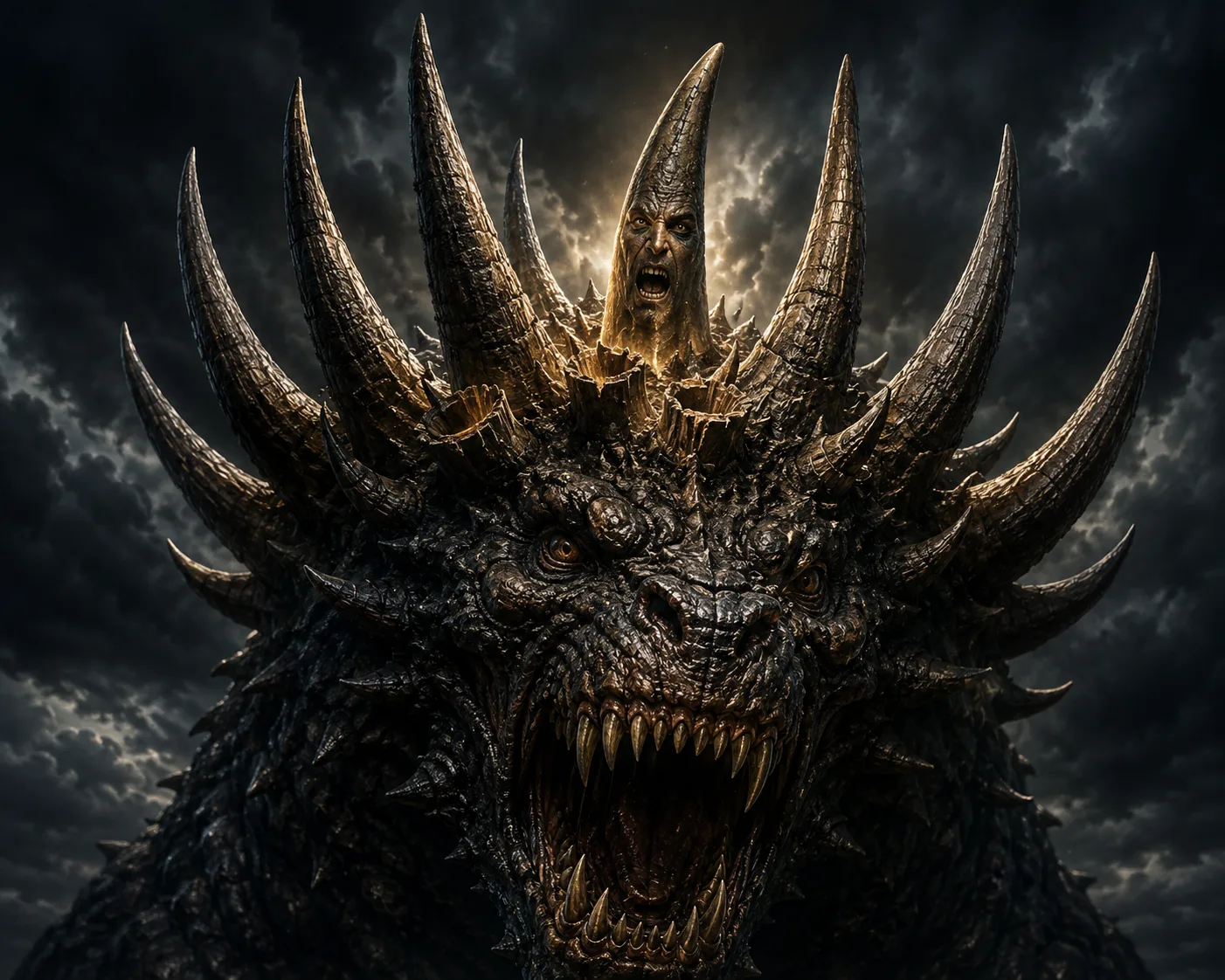
Years after he interpreted the king’s image, Daniel himself has a vision: four winds stir the sea, and four beasts rise. The same four empires of Daniel 2 reappear — but now in living form, with new detail. The fourth beast carries ten horns, and a small one rises among them, presuming to change times and laws and warring with the saints “until a time, times, and the dividing of time.”
From statue to beasts
Daniel 2 was the long view: a dream-statue showing the empires by outline. Daniel 7 is the close-up: the same empires now as predator animals, with personality, with attitudes toward God, with violence and pride that the metals could only hint at. The shift in genre is not coincidental — it is how prophecy works in this book. Subsequent visions in Daniel will sharpen further: in chapter 8 the ram and goat will name the empires explicitly; in 11 they will move in formation, kings of the north and south. Each pass is a tighter focus.
The four beasts
| Beast | Empire | Dates |
|---|---|---|
| Lion with eagle’s wings | Babylon | 605–539 BC |
| Bear, raised on one side, three ribs in its mouth | Medo-Persia | 539–331 BC |
| Leopard with four wings and four heads | Greece | 331–168 BC |
| Dreadful beast with iron teeth and ten horns | Rome | 168 BC – AD 476 |
Daniel himself names the rule: “These great beasts, which are four, are four kings, which shall arise out of the earth” (Dan 7:17). The Bible is its own dictionary; beasts in prophetic vision are kingdoms.
Ten horns out of the fourth beast
The dreadful beast has ten horns. When Rome falls in AD 476, ten Germanic kingdoms divide its western territory: Alamanni, Franks, Lombards, Anglo-Saxons, Suevi, Visigoths, Burgundians, Heruli, Vandals, and Ostrogoths. Their modern names are German, French, Italian, English, Portuguese, Spanish; three of them — Heruli, Vandals, and Ostrogoths — do not survive (see the note below).
Out of the ten, Daniel sees another, a little horn:
I considered the horns, and, behold, there came up among them another little horn, before whom there were three of the first horns plucked up by the roots: and, behold, in this horn were eyes like the eyes of man, and a mouth speaking great things.
The little horn’s marks
Verses 23–25 list the identifying signatures of this power. Read closely: each is specific, and together they admit only one candidate in history.
- It arises out of the fourth beast. European, not Asian, not African — a Roman daughter.
- It rises among the ten. After AD 476, not before.
- It is diverse from the others. Not a tribe or a kingdom in the ordinary political sense; a different kind of power.
- It plucks up three. Three of the ten kingdoms are removed in its rise.
- It speaks great words against the Most High. The Bible itself defines blasphemy two ways: claiming to be God (John 10:33) and assuming to forgive sins (Luke 5:21).
- It wears out the saints. Not a single persecution; a long, grinding attrition.
- It thinks to change times and laws. A power that takes upon itself the prerogative of the Lawgiver.
- It holds dominion for “a time, times, and the dividing of time.” A definite, calculable period.
The Reformers — Wycliffe, Hus, Luther, Calvin, Knox, Cranmer, Tyndale — read these marks together and reached the same conclusion: the little horn is the medieval papacy. Not the Catholic people, not even every Catholic doctrine — but the system that grew on Rome’s soil, claimed authority over Rome’s former emperors, and presumed to legislate God’s law and the Christian week.
A time, times, and the dividing of time
The duration is given in deliberately veiled language. “A time” is one year; “times” is two (a dual, in the Aramaic); “the dividing of time” is half a year. The total is three-and-a-half prophetic years — 1260 prophetic days (counting a year of 360). By the day-year principle of Numbers 14:34 and Ezekiel 4:6, that is 1260 literal years.
The same span is named five more times in Scripture, in different formulas, all reducing to 1260: Daniel 12:7; Revelation 11:2 (forty- two months); Revelation 11:3 (twelve hundred and threescore days); Revelation 12:6; Revelation 12:14; Revelation 13:5. Six independent attestations point at one period of medieval and modern church history.
Start: AD 538 — Justinian’s decree names the bishop of Rome “corrector of heretics and ruler of all the churches,” and the last of the three obstructing horns (the Ostrogoths) is removed from Italy by his general Belisarius.
End: AD 1798 — on 10 February, General Berthier enters Rome with French troops, proclaims a Roman Republic, and arrests Pope Pius VI, who dies in captivity the following year. The papacy’s temporal authority is interrupted exactly 1260 years from its consolidation. Revelation 13:3 calls this the “deadly wound.”
The judgment scene
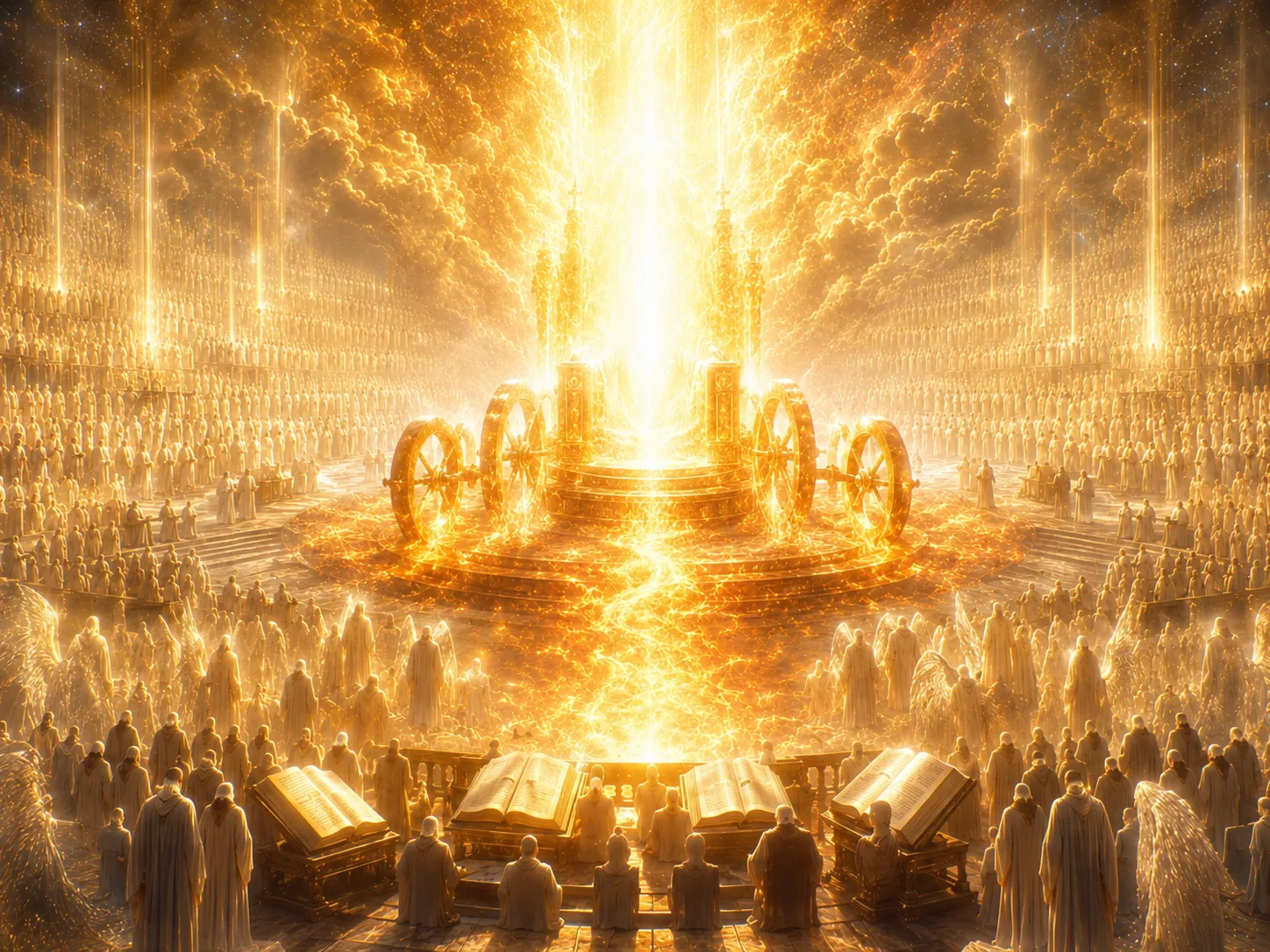
The vision does not end with the horn. Daniel sees “thrones cast down” — better rendered “thrones placed” — and the Ancient of Days sits, the books open, and judgment is rendered. Then the Son of Man comes with the clouds and receives a kingdom that shall not pass away.
I saw in the night visions, and, behold, one like the Son of man came with the clouds of heaven, and came to the Ancient of days, and they brought him near before him. And there was given him dominion, and glory, and a kingdom, that all people, nations, and languages, should serve him.
This is the heavenly counterpart of Daniel 2’s stone. The kingdom is given — not seized, not built, not won by political maneuver. The closing scene of the chapter is the same closing scene as the dream of the image: God’s kingdom takes the world.
A note on the three plucked horns
The Heruli (AD 493), Vandals (AD 534), and Ostrogoths (AD 538) are conventionally remembered as “Arian heretics” — but the only witnesses are the power that destroyed them, and there is reason to think they may have held a non-Nicene biblical Christianity closer to the apostolic original, including the seventh-day Sabbath. The three plucked horns treats the historical case in detail.
Further reading
- Daniel 2 — the master statue this vision retells.
- The historicist hermeneutic — the day-year principle and why prophecy reads continuously.